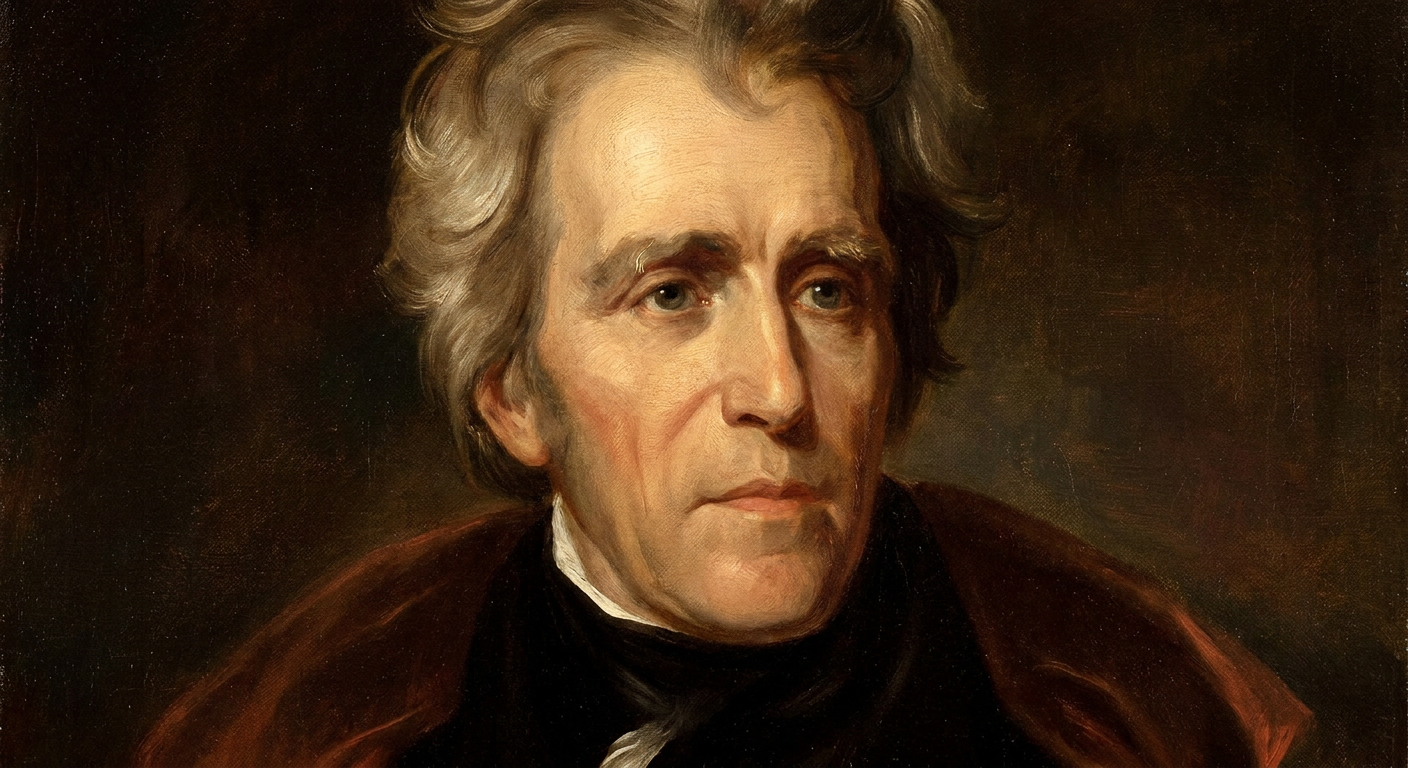
Quick Facts
- Years
- 1767 – 1845
- Category
- World Leaders & Revolutionaries
- Nationality
- American
- Occupation
- Military officer, lawyer, planter, politician, and seventh U.S. president
Andrew Jackson
1767 – 1845 · American · Military officer, lawyer, planter, politician, and seventh U.S. president
Recommended Audiobooks
Listen next from Marcus Alden

Life Lessons from Simon Bolivar
Marcus Alden · 55 min

Life Lessons from George Washington
Marcus Alden · 54 min
Andrew Jackson rose from a turbulent childhood on the Carolina frontier to become a celebrated general and the seventh president of the United States. To admirers, he embodied determination, popular government, national union, and resistance to entrenched privilege. To critics, he represented executive overreach, racial oppression, economic instability, and the violent expansion of a slaveholding republic.
Jackson first became a national hero by defeating a British army at New Orleans in 1815. As president from 1829 to 1837, he strengthened the office, confronted South Carolina during the nullification crisis, destroyed the Second Bank of the United States, and helped reshape American politics around mass participation by white male voters. His administration also implemented Indian Removal, forcing Native nations from their homelands at devastating human cost.
Few presidents have left a legacy so influential or so contested. Jackson helped create the modern Democratic Party and transformed how candidates appealed to voters. Yet his wealth depended on enslaved labor, and his policies accelerated Indigenous dispossession. Students continue to examine him because his life brings together central conflicts in American history: democracy and exclusion, union and states’ rights, popular leadership and concentrated power, national expansion and human suffering.
Quick Facts
| Field | Information |
|---|---|
| Full Name | Andrew Jackson |
| Common Name(s) | Andrew Jackson; “Old Hickory” |
| Born | March 15, 1767 |
| Died | June 8, 1845 |
| Age at Death | 78 |
| Birthplace | Waxhaws region along the North Carolina–South Carolina border; the exact side remains disputed |
| Nationality | American |
| Occupation | Lawyer, planter, military officer, politician, president |
| Historical Era | Early American republic and Jacksonian era |
| Famous For | Battle of New Orleans, Jacksonian democracy, Bank War, nullification crisis, Indian Removal |
| Political Affiliation | Democratic-Republican; later Democratic Party |
| Religion | Presbyterian |
| Education | Limited frontier schooling; read law through apprenticeship rather than attending college |
| Parents | Andrew Jackson Sr. and Elizabeth Hutchinson Jackson |
| Spouse(s) | Rachel Donelson Robards Jackson |
| Children | No biological children; adopted Andrew Jackson Jr. and helped raise or support several other young relatives and wards |
| Major Works | Presidential messages, Bank Veto Message, Nullification Proclamation, Farewell Address |
| Major Achievements | Victory at New Orleans; two presidential terms; preservation of federal authority during nullification; creation of a durable Democratic coalition |
Early Life
Jackson was born shortly after his father’s death to Scots-Irish Presbyterian immigrants in the Waxhaws, a frontier settlement divided by today’s North Carolina–South Carolina boundary. Both states later claimed him, although Jackson regarded himself as South Carolinian.
The American Revolution shaped his childhood brutally. At thirteen, he served as a courier for the patriot militia. British troops captured him and his brother Robert. When Jackson refused an officer’s order to clean his boots, the officer struck him with a sword, scarring his head and hand. Smallpox followed; Robert died soon after their release.
Jackson’s mother, Elizabeth, died while assisting American prisoners near Charleston. His other brother, Hugh, had already died after the Battle of Stono Ferry. By fourteen, Jackson had lost his immediate family. These experiences contributed to his lifelong hostility toward Britain, fierce sense of independence, and combative temperament.
His formal education was irregular. After briefly working as a teacher, he moved to Salisbury, North Carolina, and studied law in the customary apprenticeship system. Licensed in 1787, he traveled west to the Tennessee frontier, where courts, land disputes, violence, and rapid settlement created opportunities for an ambitious young lawyer.
Rise to Prominence
Jackson settled in Nashville and became a prosecutor, land speculator, planter, and public official. Tennessee’s admission to the Union opened a political path: he helped draft its constitution, served briefly in the U.S. House and Senate, and became a judge on the Tennessee Superior Court.
He also joined the state militia, eventually becoming major general. His nickname, “Old Hickory,” reflected soldiers’ belief that he was as tough as hickory wood. He demanded obedience and shared many hardships with his men, but he could be severe toward deserters and subordinates.
During the War of 1812, Jackson led forces against the Red Stick faction of the Muscogee people in the Creek War. His victory at Horseshoe Bend in 1814 broke Red Stick resistance. The resulting Treaty of Fort Jackson required the Muscogee to surrender about 23 million acres, including land belonging to groups that had supported the United States.
Jackson’s defining military triumph came at New Orleans on January 8, 1815. His mixed force of regulars, militia, free men of color, Choctaw fighters, and Jean Lafitte’s Baratarians inflicted a crushing defeat on British troops. Although the Treaty of Ghent had already been signed, news had not crossed the Atlantic. The victory strengthened American confidence and made Jackson a national hero.
He later invaded Spanish Florida during the First Seminole War. His occupation of Spanish posts and execution of two British subjects caused an international controversy. Secretary of State John Quincy Adams defended the campaign diplomatically, and Spain ceded Florida in the Adams–Onís Treaty.
Major Achievements
Military Victory at New Orleans
New Orleans secured Jackson’s reputation as the leading soldier of his generation. The battle did not cause the peace treaty, but it removed fears that Britain might challenge American control of the lower Mississippi and gave the postwar nation a powerful story of unity and resilience.
Creation of a Mass Political Coalition
After losing the disputed election of 1824, Jackson’s supporters organized voters through newspapers, rallies, local committees, and disciplined party networks. His victories in 1828 and 1832 helped establish the Democratic Party and an enduring two-party system.
This political participation was highly unequal. Voting rights expanded principally for white men while women remained disfranchised and most Black and Native Americans were excluded from citizenship or political power.
Defense of the Union
When South Carolina declared federal tariffs null within the state, Jackson rejected its claim that a state could unilaterally invalidate federal law. He issued a forceful proclamation and obtained congressional authority to enforce customs duties. A compromise tariff promoted by Henry Clay helped end the crisis without war.
Defeat of the Second Bank
Jackson vetoed renewal of the Second Bank of the United States in 1832, describing it as a privileged institution serving wealthy interests. The veto broadened presidential power by rejecting legislation partly on policy grounds, not merely constitutional objections. Supporters saw democratic reform; opponents warned that Jackson had weakened financial stability.
Reduction of the Federal Debt
In January 1835, the federal government briefly paid off its interest-bearing national debt—the only time this has occurred. Land sales and restrained federal spending helped produce the result. It was short-lived, however, and speculative growth soon contributed to financial turmoil.
Leadership or Work
Jackson led through personal authority, decisive action, loyalty, and confrontation. He distrusted institutions that appeared distant from ordinary white citizens and relied heavily on an informal circle of advisers that opponents called the “Kitchen Cabinet.”
His strengths included courage, persistence, political intuition, and the ability to present complicated disputes as moral contests. He survived an assassination attempt, censures, bitter elections, and chronic illness without retreating from his objectives.
Those qualities could become weaknesses. Jackson often treated disagreement as betrayal, personalized public disputes, and stretched presidential power. His strong sense of honor encouraged feuds, while his certainty left little room for the rights or perspectives of Native peoples, abolitionists, political opponents, and others outside his democratic constituency.
Personal Life
Jackson married Rachel Donelson Robards after both believed her first husband had completed their divorce. Because the divorce was not yet legally final, they had to marry again in 1794. Political enemies later portrayed Rachel as an adulteress. Jackson blamed the attacks for worsening the distress preceding her death in December 1828, shortly before his inauguration.
The couple had no biological children. They adopted a nephew, Andrew Jackson Jr., and cared for several relatives and wards. Jackson also brought an orphaned Muscogee boy, Lyncoya, into his household after a wartime campaign. Lyncoya died of tuberculosis as a teenager. The relationship appears personally affectionate, but it coexisted with Jackson’s support for policies devastating to Native communities.
At the Hermitage, his Tennessee plantation, Jackson enjoyed horse racing, entertaining guests, and managing agricultural business. Enslaved people produced the plantation’s wealth; approximately 150 were held there by the time of his death. Surviving evidence also records punishments and efforts to capture people who escaped.
Jackson suffered from chronic pain, digestive problems, respiratory illness, and bullets that remained in his body after violent encounters. He was thin, scarred, quick-tempered, sociable with friends, and intensely protective of his reputation.
Philosophy or Beliefs
Jackson presented government as a contest between ordinary citizens and privileged minorities. He favored majority rule, rotation in office, limited federal spending, territorial expansion, and a strong Union. His conception of “the people,” however, centered overwhelmingly on white men.
He opposed concentrated financial power and believed the national bank gave unfair advantages to wealthy investors. Yet his economic program did not reject private wealth: Jackson was a planter, landowner, speculator, and enslaver.
On federalism, he defended state authority in many matters but denied that a state could destroy the Union or nullify federal law. This combination explains why he could oppose federal investment projects while threatening force against South Carolina.
Jackson formally joined the Presbyterian Church after leaving office, although Christian language had long appeared in his public statements. His religious outlook emphasized providence and personal morality, but it did not lead him to reject slavery or reconsider Indian Removal.
Challenges and Controversies
Indian Removal
The most consequential moral indictment of Jackson’s presidency concerns Native nations. He supported the Indian Removal Act of 1830, which authorized negotiations intended to exchange Indigenous lands east of the Mississippi for western territory. Jackson described removal as protective and voluntary, but negotiations took place under intense coercion, with states seizing Native lands and the federal government refusing to secure Native sovereignty effectively.
The Cherokee Nation pursued legal resistance. In Worcester v. Georgia (1832), the Supreme Court rejected Georgia’s attempt to impose its laws within Cherokee territory. Jackson’s exact response is uncertain. The famous statement “John Marshall has made his decision; now let him enforce it” lacks reliable contemporary documentation.
Removal affected the Choctaw, Muscogee, Chickasaw, Cherokee, Seminole, and other peoples. Thousands died from disease, hunger, exposure, and violence. Most Cherokee removal occurred under Martin Van Buren after Jackson left office, but Jackson promoted the policy, signed the enabling law, supported the disputed Treaty of New Echota, and helped create the conditions for the Trail of Tears.
Slavery and Racial Order
Jackson accumulated wealth through enslaved labor and defended slavery as a social and economic institution. His administration attempted to suppress abolitionist publications sent through the mail, although Congress did not enact his requested prohibition. His democratic reputation must therefore be understood as racially restricted.
Some defenders emphasize that Jackson’s views resembled those of many southern leaders of his era. Historians generally respond that historical context explains beliefs but does not erase personal agency, material benefit, or the harm inflicted upon enslaved people.
The Bank War and the Economy
Jackson’s assault on the Second Bank addressed genuine concerns about concentrated power and limited accountability. Nevertheless, removing federal deposits and placing them in selected state banks encouraged unstable lending. His Specie Circular required payment for federal land in gold or silver, tightening credit.
Scholars debate how much responsibility Jackson bears for the Panic of 1837. International credit conditions, falling cotton prices, British financial policy, speculation, and state banking practices all mattered. His policies were important contributing factors, but the crisis cannot accurately be attributed to one person alone.
Patronage and Executive Power
Jackson defended rotation in office as a democratic safeguard against permanent bureaucracy. In practice, political loyalty influenced appointments, helping popularize what critics called the spoils system. Although he did not invent patronage and replaced a smaller proportion of officials than legend suggests, his administration made party service more central to federal appointments.
Opponents labeled him “King Andrew I,” arguing that he abused vetoes, removed deposits without proper authority, ignored Congress, and concentrated power in the presidency. Supporters answered that he used elected executive authority to challenge unelected elites.
Violence and Personal Feuds
Jackson participated in duels, brawls, and honor disputes. In 1806 he killed Charles Dickinson in a duel after insults involving a horse-racing disagreement and Rachel’s reputation. Jackson was also wounded in an 1813 Nashville fight with Thomas Hart Benton and others. Such violence reflected an elite honor culture, but it was controversial even in Jackson’s own lifetime.
Legacy
Jackson transformed the presidency into a more openly popular and partisan institution. Later leaders borrowed his image as a defender of ordinary citizens, his use of the veto as a policy weapon, and his claim to represent a national electorate directly.
His name defines the “Jacksonian era,” but historians increasingly question older narratives that treated it simply as democratic progress. Political opportunity grew for white men while Indigenous dispossession and slavery expanded. Jackson’s career therefore illustrates how democracy can broaden participation for one group while denying rights to others.
The Hermitage near Nashville operates as a museum and historic site. Numerous counties, cities, schools, monuments, and Jackson Square in New Orleans bear his name. His portrait remains on the U.S. twenty-dollar bill, though proposals have called for Harriet Tubman to replace him on its front. Statues and memorials continue to prompt debate over whom the nation honors and how public history should acknowledge harm.
Interesting Facts
- Jackson was the first president born in a log-cabin frontier environment.
- His exact birth state is disputed because the Waxhaws boundary was poorly surveyed.
- He was the only former prisoner of war to become president until the modern era’s presidential candidates who had been POWs; among presidents, Jackson remains unique.
- A British sword left permanent scars on his head and hand.
- He was orphaned by age fourteen.
- Jackson served Tennessee in both houses of Congress.
- He became a national hero before learning that New Orleans was fought after peace had been signed.
- A bullet from the Dickinson duel remained near his heart for life.
- He was the first president to ride on a railroad while in office.
- His 1829 inauguration drew an unusually large public crowd to Washington.
- He survived the first known assassination attempt against a sitting U.S. president when both of Richard Lawrence’s pistols misfired.
- Jackson then attacked Lawrence with his cane until others intervened.
- The U.S. national debt briefly reached zero during his administration.
- He kept an African grey parrot that reportedly learned profanity and had to be removed from his funeral.
- The Senate censured him in 1834; the censure was expunged in 1837.
- He remains the only president to have served as a justice on Tennessee’s highest court.
- He died at the Hermitage and was buried beside Rachel.
Famous Quotes
- “Our Federal Union—it must be preserved.” Jackson offered this toast at an 1830 dinner during a confrontation over states’ rights. It summarized his rejection of disunion.
- “The Constitution of the United States forms a government, not a league.” In his 1832 Nullification Proclamation, Jackson argued that no state could treat the Union as a voluntary compact it might simply abandon.
- “Disunion by armed force is treason.” Also from the proclamation, this blunt warning demonstrated his willingness to enforce federal law.
- “The rich and powerful too often bend the acts of government to their selfish purposes.” Jackson’s 1832 Bank Veto Message framed the bank dispute as a struggle against privilege.
- “If we cannot at once, in justice to interests vested under improvident legislation, make our Government what it ought to be, we can at least take a stand against all new grants of monopolies.” In the Bank Veto Message, he connected reform with opposition to exclusive privilege.
- “In a country where offices are created solely for the benefit of the people no one man has any more intrinsic right to official station than another.” Jackson’s first annual message defended rotation in office, though critics saw partisan patronage.
- “Without union our independence and liberty would never have been achieved.” His 1837 Farewell Address urged Americans to protect national unity.
- “I was born for a storm, and a calm does not suit me.” This line appears in Jackson’s correspondence and aptly reflects his combative temperament.
- “John Marshall has made his decision; now let him enforce it.” Frequently attributed to Jackson after Worcester v. Georgia, this quotation is not supported by reliable contemporary evidence and should be treated as apocryphal.
- “One man with courage makes a majority.” Widely attributed to Jackson, but no secure primary source establishes that he said it.
Timeline
- 1767 — Born in the Waxhaws on March 15.
- 1780–1781 — Serves as a patriot courier, is captured, and loses his mother and brother Robert.
- 1787 — Gains admission to the bar and moves west.
- 1791 — Marries Rachel; they marry again legally in 1794.
- 1796 — Helps frame Tennessee’s constitution and enters the U.S. House.
- 1797 — Becomes a U.S. senator.
- 1798–1804 — Serves as a Tennessee superior court judge.
- 1802 — Elected major general of the Tennessee militia.
- 1806 — Kills Charles Dickinson in a duel.
- 1813–1814 — Commands forces in the Creek War.
- 1814 — Wins at Horseshoe Bend and imposes the Treaty of Fort Jackson.
- 1815 — Defeats the British at New Orleans.
- 1818 — Invades Spanish Florida during the First Seminole War.
- 1821 — Briefly serves as governor of Florida Territory.
- 1824 — Wins a plurality of electoral and popular votes but loses the House-decided presidential election to John Quincy Adams.
- 1828 — Defeats Adams; Rachel dies before the inauguration.
- 1829 — Becomes seventh president.
- 1830 — Signs the Indian Removal Act.
- 1832 — Vetoes the Bank’s recharter, confronts nullification, and wins reelection.
- 1833 — Removes federal deposits from the Bank.
- 1834 — Receives a Senate censure.
- 1835 — Survives an assassination attempt; federal debt briefly reaches zero.
- 1836 — Supports the Specie Circular and Martin Van Buren’s election.
- 1837 — Leaves office; Senate expunges his censure.
- 1845 — Dies at the Hermitage on June 8.
Frequently Asked Questions
1. Why is Andrew Jackson important?
Jackson changed American politics, military history, and the presidency. His New Orleans victory made him a national hero, while his campaigns helped expand U.S. control across the Southeast. As president, he built the Democratic Party, appealed directly to a mass electorate, defended federal authority during nullification, and destroyed the national bank. His importance also arises from the destructive consequences of Indian Removal, his support for slavery, and his expansion of executive power.
2. Was Andrew Jackson born in North Carolina or South Carolina?
The evidence does not settle the question conclusively. Jackson was born in the Waxhaws, where the colonial boundary between the Carolinas was uncertain. He stated that he had been born in South Carolina, and that became the traditional identification. Some local evidence supports a North Carolina location. Responsible biographies acknowledge the dispute rather than presenting either state’s claim as certain.
3. Why was he called “Old Hickory”?
Soldiers reportedly compared Jackson to hickory because of his toughness during demanding military campaigns. He endured poor weather, shortages, illness, and long journeys while expecting similar endurance from his troops. The nickname supported his later political image as an unpolished but resilient frontier leader. That image was effective campaign symbolism, although Jackson was also a wealthy planter, lawyer, landowner, and experienced officeholder rather than simply a common backwoodsman.
4. Did Jackson win the Battle of New Orleans after the war ended?
The Treaty of Ghent was signed on December 24, 1814, before the main battle on January 8, 1815. However, news traveled slowly, and the treaty had not yet been fully ratified. Neither army at New Orleans knew peace had been agreed. The victory did not create the treaty, but it protected the city, strengthened the American negotiating outcome in practice, and produced an enormous psychological boost after a difficult war.
5. What happened in the election of 1824?
Jackson won more popular and electoral votes than any other candidate but lacked an Electoral College majority. Under the Constitution, the House of Representatives chose among the top three candidates and selected John Quincy Adams. When Adams appointed Henry Clay secretary of state, Jackson’s supporters alleged a “corrupt bargain.” No conclusive evidence proves an explicit deal, but the accusation energized Jackson’s movement and helped him win the 1828 rematch.
6. What was Jacksonian democracy?
Jacksonian democracy was a political movement emphasizing majority rule, party organization, distrust of concentrated economic privilege, and participation by ordinary white men. Property restrictions on voting were declining, and campaigns became more popular and organized. The term must be used carefully: the era widened democratic participation for many white men but did not offer equal democracy to women, Native Americans, or most Black Americans. It developed alongside slavery and territorial dispossession.
7. What was the spoils system?
The spoils system refers to awarding public positions to political supporters. Jackson called his approach “rotation in office,” arguing that government jobs should not become permanent possessions of an elite bureaucracy. Critics believed competence was being sacrificed for loyalty and party service. Jackson did not invent patronage, nor did he dismiss every federal employee, but his administration made partisan appointments a more visible and organized part of national politics.
8. Why did Jackson oppose the national bank?
Jackson believed the Second Bank of the United States possessed excessive economic and political influence. It was federally chartered but had private shareholders, including foreign investors. He argued that it favored wealthy interests and placed public power beyond sufficient democratic control. Opponents replied that the Bank provided financial discipline and a stable national currency. Jackson’s veto was politically popular, but the subsequent financial system proved vulnerable to speculation and instability.
9. Did Jackson cause the Panic of 1837?
Jacksonian policies contributed, but no single-cause explanation is adequate. The removal of federal deposits encouraged expansion by state banks, while the Specie Circular tightened requirements for purchasing federal land. At the same time, cotton prices fell, British lending contracted, international credit weakened, and speculative bubbles collapsed. Historians therefore debate the weight assigned to Jackson. The depression began shortly after Martin Van Buren took office, but many of its conditions developed earlier.
10. What was the nullification crisis?
South Carolina declared federal tariffs unconstitutional and supposedly void within the state. Jackson denied that one state could nullify federal law or leave the Union unilaterally. He prepared to enforce tariff collection and secured a Force Bill from Congress. Simultaneously, Henry Clay promoted a compromise that gradually lowered tariffs. South Carolina withdrew its nullification ordinance, avoiding military conflict. The crisis anticipated later arguments over secession but did not resolve them permanently.
11. What role did Jackson play in the Trail of Tears?
Jackson was no longer president during the principal Cherokee removal of 1838–1839, but his responsibility was substantial. He made removal a central federal policy, signed the Indian Removal Act, declined to protect Native sovereignty adequately against state intrusion, and backed a disputed treaty used to justify Cherokee expulsion. Martin Van Buren administered the forced march. Separating the implementation between two presidencies is chronologically accurate but does not remove Jackson’s central role in creating the policy.
12. Did Jackson ignore the Supreme Court?
The claim is often oversimplified. In Worcester v. Georgia, the Court rejected Georgia’s jurisdiction within Cherokee territory. The Court did not issue Jackson a simple direct command that he openly defied, and the famous enforcement quotation attributed to him is unverified. Nevertheless, his administration did not use federal power to make the ruling an effective shield for Cherokee sovereignty. The legal details are complex, but the political outcome favored Georgia and removal.
13. Did Andrew and Rachel Jackson have children?
They had no biological children. They adopted Andrew Jackson Jr., one of Rachel’s nephews, and provided homes, guardianship, education, or financial support to several other relatives and young people. Jackson also brought the orphaned Muscogee child Lyncoya into his household. The extensive family network reveals a private capacity for affection and obligation, but historians caution against using it to excuse his public support for removal or his participation in slavery.
14. How many enslaved people did Jackson own?
The number changed as Jackson bought, sold, inherited, and transferred enslaved people. By the time of his death, approximately 150 people were enslaved at the Hermitage. Their labor in cotton fields, domestic service, skilled trades, and plantation operations underpinned his wealth. Documents show family communities among the enslaved as well as resistance, escape attempts, punishment, and Jackson’s efforts to recover runaways. The Hermitage now interprets these lives alongside Jackson’s political career.
15. Was Jackson a good president?
The answer depends on the standards applied, but a balanced assessment must include both effectiveness and human consequences. Jackson defended the Union, built a durable party, connected the presidency to mass politics, and challenged a powerful bank. He also supported slavery, drove Indian Removal, encouraged patronage, destabilized finance, and expanded executive authority. Modern scholars generally rank him as highly consequential but deeply damaging in major areas rather than simply “good” or “bad.”
Lessons We Can Learn
- Popular mandates require limits. Jackson’s electoral strength made government more responsive to many white voters, but majority support did not protect minority rights.
- Decisiveness can prevent or deepen crises. His firmness helped contain nullification; similar inflexibility intensified removal and the Bank War.
- Economic systems have unintended consequences. Destroying the Bank answered concerns about privilege but left serious questions about financial regulation unresolved.
- Historical context explains without excusing. Slavery and dispossession were widespread, yet contemporaries challenged both, showing alternatives existed.
- Political images can conceal social position. Jackson’s “common man” identity coexisted with substantial land, influence, and enslaved wealth.
- Institutions matter most during conflict. His disputes with Congress, the Bank, states, and courts reveal why separated powers require restraint and negotiation.
- Victory stories need qualification. New Orleans was genuinely important, but the war’s peace agreement preceded it.
- Private kindness does not erase public harm. Jackson’s devotion to dependents cannot cancel the effects of removal and slavery.
- Coalitions can outlast individuals. The Democratic organization built around Jackson shaped politics for generations.
- Legacies should hold contradictions together. Modern interpretation need not choose between denying Jackson’s achievements and overlooking those harmed by them.
Related Historical Figures
- Rachel Donelson Jackson — His wife, whose marriage history became a bitter campaign controversy.
- John Quincy Adams — Jackson’s opponent in the elections of 1824 and 1828.
- Henry Clay — Congressional leader, Bank supporter, and architect of the nullification compromise.
- Martin Van Buren — Adviser, vice president, successor, and key organizer of the Democratic Party.
- John C. Calhoun — Jackson’s vice president who became the leading theorist of nullification.
- Nicholas Biddle — President of the Second Bank and Jackson’s principal opponent in the Bank War.
- John Marshall — Chief justice during major cases concerning federal authority and Native sovereignty.
- Osceola — Seminole leader associated with resistance to removal in Florida.
- Major Ridge — Cherokee leader who signed the disputed Treaty of New Echota and was later killed by opponents of the agreement.
- Davy Crockett — Tennessee politician, former Jackson ally, and congressional opponent of Indian Removal.
Watch and Learn
The Age of Jackson: Crash Course US History #14 — CrashCourse — approximately 15 minutes.
This widely viewed educational overview clearly explains Jacksonian democracy, the Bank War, patronage, nullification, and Indian Removal. Its lively presentation is useful as an introduction, though viewers should pair its compressed account with detailed primary sources and modern scholarship on Native nations and slavery.
Watch and Learn
The Age of Jackson: Crash Course US History #14 · CrashCourse
Related Historical Figures