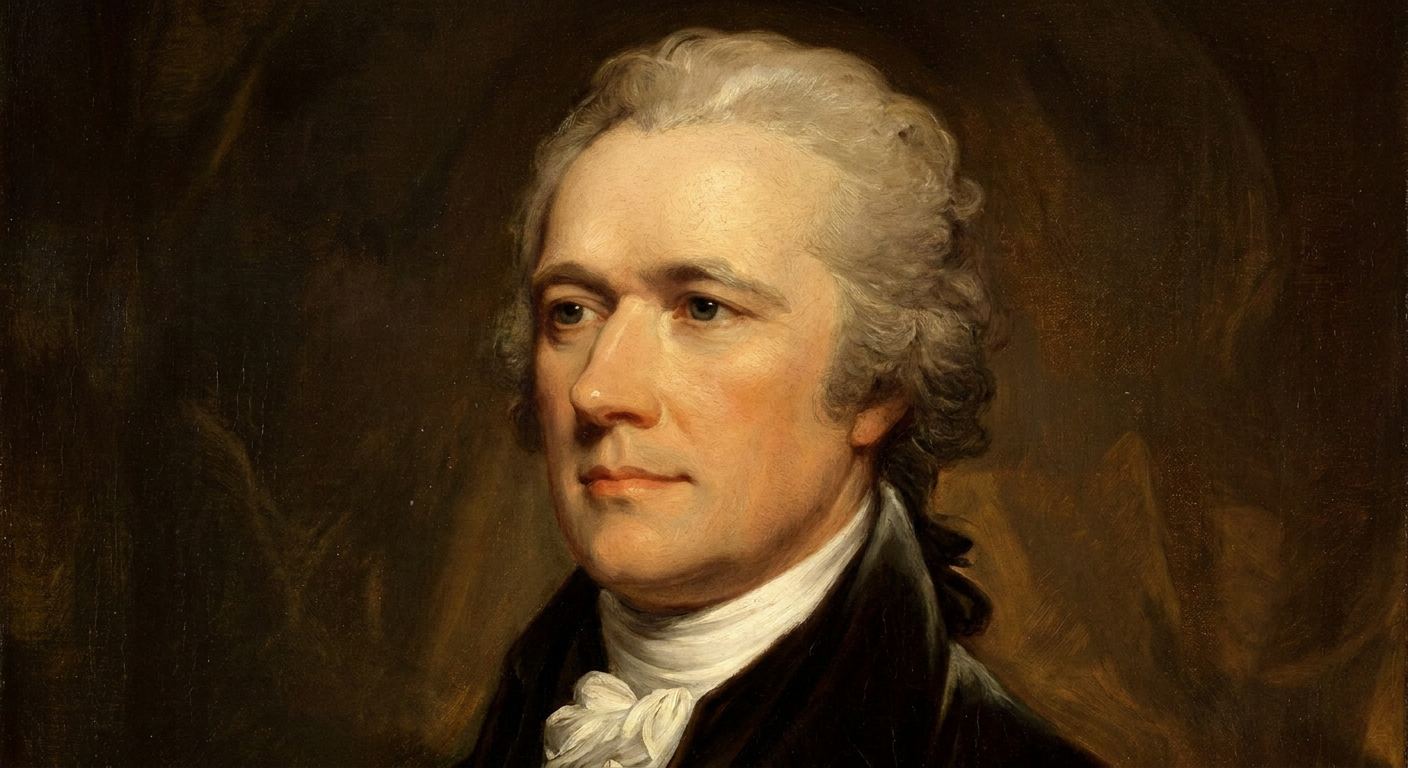
Quick Facts
- Years
- 1755 – 1804
- Category
- World Leaders & Revolutionaries
- Nationality
- American
- Occupation
- Statesman, military officer, lawyer, economist and writer
Alexander Hamilton
1755 – 1804 · American · Statesman, military officer, lawyer, economist and writer
Recommended Audiobooks
Listen next from Marcus Alden

Life Lessons from Simon Bolivar
Marcus Alden · 55 min

Life Lessons from George Washington
Marcus Alden · 54 min
Alexander Hamilton rose from an insecure childhood in the Caribbean to become one of the most influential—and controversial—architects of the United States. A gifted writer, Revolutionary War officer, constitutional advocate and the first secretary of the Treasury, he helped transform a financially fragile union into a functioning national government.
Hamilton believed that political independence could survive only if supported by public credit, reliable taxation, effective administration and a diversified economy. He designed a federal financial program that funded the national debt, assumed state war debts, created the Bank of the United States and encouraged manufacturing. He also wrote most of The Federalist Papers, served closely under George Washington and helped establish the Federalist Party.
Yet Hamilton's career was marked by fierce conflict. Critics feared that his preference for energetic government favored wealthy interests and threatened republican liberty. His attacks on political rivals divided his own party, while his public confession of an extramarital affair damaged his family and reputation. In 1804, at approximately 49 years old, he was mortally wounded in a duel with Vice President Aaron Burr.
Hamilton remains important because arguments surrounding federal authority, national debt, executive power, banking and political partisanship still echo through American public life. His accomplishments, contradictions and capacity for both disciplined institution-building and destructive personal combat make him an enduring subject of historical study.
Quick Facts
| Field | Details |
|---|---|
| Full Name | Alexander Hamilton |
| Common Name(s) | Alexander Hamilton; Hamilton |
| Born | January 11, probably 1755; Hamilton himself used 1757 |
| Died | July 12, 1804 |
| Age at Death | Probably 49; 47 if the 1757 date is used |
| Birthplace | Charlestown, Nevis, British Leeward Islands |
| Nationality | British subject by birth; American after independence |
| Occupation | Statesman, army officer, lawyer, economist and political writer |
| Historical Era | American Revolution and Early Republic |
| Famous For | First Treasury secretary, financial system, The Federalist Papers and duel with Aaron Burr |
| Political Affiliation | Federalist Party leader |
| Religion | Raised in the Christian tradition; associated with the Episcopal Church, with the intensity of his observance changing over time |
| Education | Informal Caribbean schooling; King's College, now Columbia University, without graduating |
| Parents | James Hamilton and Rachel Faucette Lavien |
| Spouse(s) | Elizabeth Schuyler Hamilton, married 1780 |
| Children | Philip, Angelica, Alexander Jr., James Alexander, John Church, William Stephen, Eliza and Philip, sometimes called “Little Phil” |
| Major Works | The Federalist Papers contributions; Report on Public Credit; Report on a National Bank; Report on Manufactures; Reynolds Pamphlet |
| Major Achievements | Revolutionary War service, constitutional advocacy, federal financial system, Coast Guard predecessor and establishment of the Federalist Party |
Early Life
Hamilton's beginnings remain unusually difficult to reconstruct. He was born on Nevis on January 11, but surviving records conflict over the year. Hamilton later identified 1757 as his birth year, while evidence from the Caribbean, including probate material, supports 1755. Many modern biographers favor 1755, although the question is not conclusively settled.
His parents, James Hamilton and Rachel Faucette Lavien, were not legally married. Rachel had left an earlier husband but could not obtain a divorce permitting remarriage. Alexander and his brother James were consequently considered illegitimate under contemporary law, a status that limited inheritance and social opportunity.
The family moved to St. Croix, where James Hamilton eventually left. Rachel operated a small shop before dying in 1768. The brothers received little from her estate, and their guardian later died by suicide. These losses exposed Alexander early to debt, unstable households and commercial risk.
He found employment with the trading firm Beekman and Cruger. The business handled commodities, ships, credit, insurance and international correspondence. Still in his teens, Hamilton sometimes managed operations while an owner was away. This practical education in commerce later informed his unusually detailed understanding of taxation, currency and public finance.
A vivid letter Hamilton wrote describing a devastating 1772 hurricane impressed local readers. Community supporters financed his journey to mainland North America for education. After preparatory study in New Jersey, he entered King's College in New York in 1774. The coming imperial crisis soon redirected his energy from formal education to revolution.
Rise to Prominence
Hamilton joined the colonial debate through pamphlets defending the Continental Congress against loyalist criticism. Though young, he argued with confidence about natural rights, representation and constitutional authority. When war began, he trained with a volunteer militia and became captain of a New York artillery company in 1776.
His unit performed effectively during the difficult campaigns around New York and New Jersey. Hamilton's intelligence and organizational ability attracted senior officers. In 1777, George Washington appointed him an aide-de-camp with the rank of lieutenant colonel.
For approximately four years, Hamilton drafted orders, negotiated with commanders, handled intelligence and wrote important correspondence. The position gave him a close view of the Continental Army's chronic shortages and Congress's inability to raise dependable revenue. He concluded that the loose confederation lacked the authority necessary to defend itself.
Hamilton wanted a battlefield command, however, and grew frustrated with staff duty. After a quarrel with Washington in 1781, he left the general's staff while remaining in the army. Washington later gave him command of an assault battalion at Yorktown. Hamilton led the nighttime capture of British Redoubt No. 10, an operation that helped complete the allied siege and preceded Lord Cornwallis's surrender.
After the war, Hamilton studied law, passed the New York bar and entered a successful legal practice. He represented some former loyalists against punitive measures, arguing that treaties and law should restrain retaliation. He also entered politics, campaigned for stronger continental authority and attended the 1787 Constitutional Convention.
Major Achievements
Revolutionary War service
Hamilton's artillery command, staff work and Yorktown assault established his national reputation. More importantly, wartime administrative failure shaped his political thought. The army often lacked pay and supplies because Congress depended heavily on voluntary state contributions. Hamilton's later financial reforms were, in part, answers to problems he had witnessed firsthand.
Advocacy for the Constitution
At the Constitutional Convention, Hamilton favored a stronger central government than most delegates would accept. His lengthy June 18 speech proposed unusually durable executive and senatorial terms and drew criticism from opponents who considered his ideas too monarchical. He nevertheless signed the final Constitution, judging it far better than the Articles of Confederation.
During New York's ratification struggle, Hamilton joined James Madison and John Jay in publishing essays under the name “Publius.” Collected as The Federalist Papers, the essays explained the proposed government's structure and defended ratification. Hamilton wrote 51 of the 85 essays under the generally accepted allocation, although historical disputes once surrounded the authorship of several papers.
Restoring public credit
President Washington appointed Hamilton the first secretary of the Treasury in 1789. The new government inherited large Revolutionary War debts and uncertain credit. Hamilton proposed paying federal obligations at their stated value and having the national government assume eligible state war debts.
Supporters argued that honoring obligations would establish trust, lower future borrowing costs and bind creditors to the Union. Opponents objected that speculators had purchased securities cheaply from struggling veterans and that states that had paid more of their debts would be treated unfairly. Congress adopted the core program in 1790 after political negotiations that also helped place the permanent national capital on the Potomac.
Creating the Bank of the United States
Hamilton proposed a partly private, federally chartered bank to hold government funds, facilitate tax payments, issue dependable banknotes and expand credit. Thomas Jefferson and James Madison argued that the Constitution did not expressly authorize such a corporation.
Hamilton answered with a broad interpretation of the Necessary and Proper Clause: if an objective was constitutional, Congress could choose appropriate means not prohibited by the Constitution. Washington signed the bank bill in 1791. This reasoning became an enduring foundation for implied federal powers.
Building financial administration
Hamilton did more than propose policy. He organized customs collection, accounting procedures and debt management for the new government. Revenue depended heavily on import duties, but Congress also enacted an excise tax on distilled spirits. Resistance in western Pennsylvania produced the Whiskey Rebellion of 1794. Hamilton supported enforcement and accompanied the militia mobilized by Washington, although no major battle followed.
Hamilton also helped establish the Revenue-Marine in 1790, a fleet of cutters used to enforce customs laws. It became a principal ancestor of the United States Coast Guard. His Report on Manufactures advocated economic diversification, infrastructure and selective government encouragement of industry, anticipating later debates over industrial policy.
Leadership or Work
Hamilton worked at extraordinary speed and produced long, closely reasoned reports. He combined abstract constitutional argument with practical administrative detail. Rather than treating government as a set of ideals alone, he designed offices, revenue streams, procedures and incentives.
His principal strengths included:
- Exceptional command of written argument
- Mastery of financial and administrative detail
- Willingness to make long-term plans
- Decisiveness during institutional uncertainty
- Ability to connect military security with economic capacity
His leadership also had serious weaknesses. Hamilton was sensitive to insults, impatient with compromise and prone to lengthy public attacks. He sometimes treated disagreement as evidence of ignorance or bad faith. His efforts to influence Washington's administration extended beyond the Treasury portfolio, irritating colleagues who considered him overbearing.
Washington valued Hamilton's ability and frequently requested his advice, even after Hamilton left office in 1795. Hamilton's relationships with Jefferson and Madison deteriorated as they developed rival understandings of the republic. Jefferson feared concentrated financial power; Hamilton feared weak government, popular volatility and revolutionary disorder.
Personal Life
Hamilton married Elizabeth Schuyler in December 1780. She belonged to a wealthy and politically connected New York family headed by General Philip Schuyler. Their marriage brought Hamilton affection, stability and valuable social connections. They had eight children.
The family endured severe trauma. Their eldest son, Philip, died in 1801 after a duel with George Eacker. Philip used pistols associated with the later Hamilton–Burr encounter, according to family tradition and historical accounts. Their daughter Angelica suffered a serious mental collapse after her brother's death and required care for the rest of her life.
Hamilton was energetic, sociable and intensely ambitious. He maintained an enormous correspondence and often worked late. Friends admired his charm and brilliance; opponents saw vanity and combativeness. He formed a particularly close intellectual and emotional friendship with his sister-in-law Angelica Schuyler Church. Claims that the relationship was sexual remain speculative and are not established by surviving evidence.
From 1791 to 1792, Hamilton had an affair with Maria Reynolds. Her husband, James Reynolds, demanded money after learning of it. When political adversaries later suspected financial corruption, Hamilton showed them evidence that the payments concealed adultery rather than misuse of Treasury funds. In 1797, after rumors spread, he publicly disclosed the affair in extraordinary detail.
Philosophy or Beliefs
Hamilton believed liberty required effective institutions. In his view, a government unable to collect revenue, enforce law or defend the nation would eventually collapse or invite disorder. He therefore supported energetic executive authority, federal supremacy within constitutional limits and a permanent capacity to manage public debt.
He distrusted direct mass decision-making but did not advocate returning America to British rule. His preference was representative government filtered through elections, offices and legal procedures. Critics reasonably identified elitist elements in his thought: he expected educated and property-owning leaders to exercise substantial influence. Yet claims that he secretly planned to establish a monarchy go beyond the available evidence.
Economically, Hamilton saw merchants, farmers, manufacturers and public creditors as parts of an interconnected national system. He did not celebrate debt without limits; he argued that manageable, properly funded debt could strengthen credit, while excessive debt would be dangerous.
Hamilton opposed slavery in principle, supported the New-York Manumission Society and assisted efforts connected with Black military service during the Revolution. Nevertheless, scholars debate the depth and consistency of his antislavery record. He did not make abolition central to his national program, worked within slaveholding networks and participated in transactions or arrangements involving enslaved people for relatives. Portraying him as either a committed modern abolitionist or an uncomplicated defender of slavery obscures a mixed record.
His religious life also resists a simple label. Hamilton expressed strong Christian feeling as a youth, appeared less observant during much of his political career and showed renewed religious concern near the end of his life. He sought communion after the duel and received it from Episcopal Bishop Benjamin Moore.
Challenges and Controversies
The financial system
Jeffersonian critics argued that Hamilton's program enriched securities speculators, favored commercial regions and copied British financial practices. Hamilton's supporters answered that national survival required dependable credit and that economic development benefited the whole union. Both views influenced the first organized party conflict in American politics.
The Whiskey Rebellion
The whiskey excise weighed heavily on small western producers who often converted grain into easily transported spirits. Hamilton regarded resistance to a lawful tax as a test of federal authority. Critics saw the military response as intimidating and unequal. Washington pardoned the principal convicted rebels, combining a display of authority with restraint.
Foreign policy and party conflict
Hamilton favored neutrality during the European wars and closer commercial ties with Britain. He defended the controversial Jay Treaty, which reduced the immediate risk of war but failed to resolve every grievance. Democratic-Republicans accused Federalists of sacrificing France and accommodating Britain.
The Reynolds Pamphlet
Hamilton's 1797 publication protected him against the specific allegation of official corruption, but it humiliated Elizabeth and exposed intimate details to the public. The decision demonstrated both his concern for public honor and his destructive lack of judgment. The scandal effectively ended any realistic prospect of his becoming president.
Conflict within the Federalist Party
Hamilton opposed President John Adams, although both were Federalists. In 1800 he wrote a harsh private critique of Adams that became public. It divided the party during a crucial election and damaged Hamilton's standing. When the election produced an Electoral College tie between Jefferson and Burr, Hamilton preferred Jefferson, whom he considered principled but mistaken, to Burr, whom he regarded as dangerously unprincipled.
Duel with Aaron Burr
Long political hostility culminated after Hamilton opposed Burr's 1804 campaign for governor of New York. Burr demanded an explanation for a reported “despicable opinion” Hamilton had expressed. Their correspondence failed to resolve the dispute.
They met at Weehawken, New Jersey, on July 11, 1804. Hamilton was shot and died the following day. Evidence indicates that he had written beforehand of his intention to withhold his first fire, and his shot struck above and behind Burr. Historians still debate whether he deliberately fired away, fired involuntarily after being hit or followed another plan. Burr's shot was fatal, but the exact sequence cannot be recovered with certainty.
Legacy
Hamilton's most durable monument is institutional. The United States still operates with public debt, central fiscal administration, customs enforcement and a broad understanding of implied federal powers. The modern Federal Reserve is not the same institution as Hamilton's bank, but debates over central banking continue to invoke him.
Chief Justice John Marshall's decision in McCulloch v. Maryland in 1819 echoed Hamilton's constitutional reasoning when it upheld Congress's authority to establish a national bank. Later advocates of industrialization, infrastructure and active federal economic policy also drew upon Hamiltonian ideas.
His reputation has repeatedly changed. Jeffersonian traditions long portrayed him as an aristocratic opponent of democracy. Later historians praised him as a farsighted builder of modern government, while other scholars emphasized the unequal consequences of his policies and limitations of his antislavery record.
Hamilton appears on the United States ten-dollar note. Major sites associated with him include Hamilton Grange National Memorial in New York, his grave at Trinity Church and the preserved Yorktown battlefield. Columbia University commemorates its former student, while the Coast Guard regards him as a founding figure.
The Broadway musical Hamilton, inspired by Ron Chernow's biography and created by Lin-Manuel Miranda, brought his life to a vast new audience. The production takes artistic liberties and should not be treated as a documentary, but it renewed public interest in founding-era politics, historical memory and who gets represented in national narratives.
Interesting Facts
- Hamilton's birth year is disputed between 1755 and 1757.
- He was born on Nevis and spent much of his youth on St. Croix.
- His mother could not legally marry his father.
- A hurricane letter helped secure financial support for his education abroad.
- He attended King's College but left during the Revolution without graduating.
- He commanded an artillery company before joining Washington's staff.
- He led an assault on Redoubt No. 10 at Yorktown.
- He defended some former loyalists after the war.
- He was the only New York delegate to sign the Constitution.
- He wrote the majority of The Federalist Papers.
- He became Treasury secretary at about 34 years old if born in 1755.
- The Revenue-Marine he helped create was an ancestor of the Coast Guard.
- He published his own adultery confession to rebut corruption allegations.
- His eldest son died in a duel three years before Hamilton did.
- Hamilton opposed both Aaron Burr's presidential ambitions and his campaign for New York governor.
- He never served as president or vice president.
- His New York home, the Grange, was moved twice and survives as a national memorial.
- Elizabeth Hamilton outlived him by half a century and helped preserve his papers.
Famous Quotes
- “The sacred rights of mankind are not to be rummaged for among old parchments or musty records.” — The Farmer Refuted (1775). Hamilton grounded rights in human nature rather than royal grants.
- “It has been frequently remarked that it seems to have been reserved to the people of this country…to decide…whether societies of men are really capable or not of establishing good government from reflection and choice.” — Federalist No. 1 (1787). He framed ratification as a global test of self-government.
- “A nation, without a national government, is, in my view, an awful spectacle.” — Federalist No. 85 (1788). The line summarizes his fear of political fragmentation.
- “Energy in the executive is a leading character in the definition of good government.” — Federalist No. 70 (1788). Hamilton defended a vigorous, accountable presidency.
- “No legislative act, therefore, contrary to the Constitution, can be valid.” — Federalist No. 78 (1788). He explained why courts should enforce constitutional limits.
- “Why declare that things shall not be done which there is no power to do?” — Federalist No. 84 (1788). Hamilton argued that a bill of rights might imply powers the federal government had never received.
- “Not only the wealth, but the independence and security of a country, appear to be materially connected with the prosperity of manufactures.” — Report on Manufactures (1791). He connected industry with national security.
- “My real crime is an amorous connection with his wife.” — Reynolds Pamphlet (1797). Hamilton admitted adultery while denying financial corruption.
- “I have resolved, if our interview is conducted in the usual manner, and it pleases God to give me the opportunity, to reserve and throw away my first fire.” — Statement written before the Burr duel (1804). It documents his stated intention, though the exact sequence during the duel remains disputed.
- “Fly to the bosom of your God and be comforted.” — Final letter to Elizabeth Hamilton (1804). The farewell reflects his renewed religious language before the duel.
The popular saying “Those who stand for nothing fall for anything” is often assigned to Hamilton, but reliable evidence that he coined it has not been found.
Timeline
- 1755 or 1757 — Born on Nevis on January 11.
- 1765 — Family relocates to St. Croix around this period.
- 1768 — His mother dies.
- 1772 — Writes a celebrated account of a Caribbean hurricane.
- 1773 — Reaches mainland North America to pursue education.
- 1774 — Enters King's College and joins colonial political debate.
- 1775 — Publishes revolutionary pamphlets and trains with a militia.
- 1776 — Becomes captain of a New York artillery company.
- 1777 — Joins Washington's staff as lieutenant colonel.
- 1780 — Marries Elizabeth Schuyler.
- 1781 — Leaves Washington's staff and leads troops at Yorktown.
- 1782 — Enters Congress under the Articles of Confederation.
- 1783 — Establishes a New York legal practice.
- 1786 — Attends the Annapolis Convention and calls for a broader convention.
- 1787 — Participates in the Constitutional Convention and begins The Federalist Papers.
- 1788 — Helps secure New York's ratification of the Constitution.
- 1789 — Becomes the first secretary of the Treasury.
- 1790 — Congress adopts the central elements of his public-credit plan; Revenue-Marine established.
- 1791 — First Bank of the United States chartered; Hamilton submits Report on Manufactures.
- 1791–1792 — Conducts affair with Maria Reynolds.
- 1794 — Supports suppression of the Whiskey Rebellion.
- 1795 — Resigns from the Treasury and resumes legal practice.
- 1797 — Publishes the Reynolds Pamphlet.
- 1798 — Becomes senior officer of the provisional army during the Quasi-War.
- 1800 — Attacks John Adams in a pamphlet and opposes Burr in the tied presidential election.
- 1801 — Son Philip dies following a duel.
- 1804 — Opposes Burr's gubernatorial campaign; mortally wounded July 11 and dies July 12.
Frequently Asked Questions
1. When was Alexander Hamilton born?
Hamilton was born on January 11, but his year of birth is disputed. He consistently presented himself as born in 1757. Caribbean documents, including probate evidence produced after his mother's death, indicate 1755. Many recent biographers regard 1755 as more probable, possibly because Hamilton had reason to appear younger when supporters financed his education. That explanation is plausible rather than proven. Responsible accounts therefore acknowledge both dates instead of presenting the issue as settled.
2. Where was Hamilton born?
He was born in Charlestown on Nevis, a small Caribbean island then governed as part of Britain's Leeward Islands. He later lived on St. Croix. These islands were deeply connected to Atlantic trade and plantation slavery. Hamilton's commercial employment introduced him to shipping, credit, currencies and commodity markets. His Caribbean upbringing distinguished him from founders rooted in mainland landholding families and contributed to his outward-looking economic perspective.
3. Was Hamilton an immigrant?
In modern discussions, Hamilton is often described as an immigrant because he moved from the Caribbean to mainland North America. Legally, however, both his birthplace and the mainland colonies were within the British Empire when he moved. “Migrant within the empire” is therefore more technically precise for that moment. After the Revolution created the United States, his Caribbean origin made him foreign-born under the new national framework. The immigrant label communicates an important truth, provided the changing legal context is understood.
4. How did Hamilton meet George Washington?
Hamilton attracted attention as a capable artillery officer during the 1776 campaigns. Several generals sought his services, and Washington appointed him an aide-de-camp in March 1777. Hamilton then became part of the commander in chief's central staff, drafting correspondence and orders and managing sensitive assignments. Their relationship survived a sharp quarrel in 1781. Washington continued to trust Hamilton's judgment, appointed him Treasury secretary and later consulted him on military and political matters.
5. What did Hamilton do at Yorktown?
In October 1781, Hamilton commanded American light infantry in a nighttime attack on British Redoubt No. 10. French troops simultaneously attacked a neighboring position. Capturing the redoubts allowed allied siege lines to move closer to the British defenses. Cornwallis surrendered soon afterward. Hamilton did not single-handedly win Yorktown, as simplified retellings sometimes imply, but his leadership in a dangerous and strategically important operation was genuine.
6. Why did Hamilton support the Constitution?
His Revolutionary War experience convinced him that the Articles of Confederation left Congress unable to tax effectively, regulate national commerce or supply an army reliably. He wanted a government capable of acting directly on individuals rather than merely requesting help from states. Hamilton preferred an even stronger system than the convention adopted, but supported the compromise Constitution because it established federal taxing, executive, judicial and commercial powers that the confederation lacked.
7. How many Federalist Papers did Hamilton write?
The generally accepted allocation credits Hamilton with 51 of the 85 essays, Madison with 29 and Jay with five. Hamilton and Madison both claimed several disputed essays after publication, creating an authorship controversy. Statistical analysis and manuscript research have helped produce the prevailing allocation, though readers may still encounter older totals. Whatever the exact division of disputed papers, Hamilton unquestionably organized the project and wrote its largest share.
8. What was Hamilton's financial plan?
The program combined several measures: funding federal debt on dependable terms, assuming state Revolutionary War debts, collecting customs duties and excises, establishing a national bank and improving financial administration. Hamilton believed these policies would establish public credit, connect influential economic actors to the federal government and support commerce. Critics argued that the system rewarded speculators and concentrated power. Its main features gave the government financial credibility, although arguments over beneficiaries remain historically important.
9. Did Hamilton create the national bank?
Hamilton designed and defended the First Bank of the United States, but Congress created it through legislation and Washington approved the charter in 1791. It was not a central bank identical to today's Federal Reserve. It was a federally chartered corporation with private shareholders that held government deposits, issued notes and facilitated payments. Hamilton's constitutional defense of the bank became nearly as influential as the institution itself.
10. Did Hamilton own enslaved people?
The evidence is debated. Hamilton publicly supported manumission efforts and criticized slavery, but records connect him to purchases or financial arrangements involving enslaved people for members of the Schuyler family, and some scholars argue that evidence indicates personal ownership. Others find the case inconclusive. What is clear is that he operated within slaveholding social and commercial networks and never made nationwide abolition a political priority. His record should not be idealized or reduced to a single uncertain claim.
11. Why did Hamilton publish the Reynolds Pamphlet?
Political enemies suspected that payments to James Reynolds showed Treasury corruption. Hamilton disclosed that Reynolds had extorted him over an affair with Maria Reynolds, providing documents to demonstrate that public money was not involved. When accusations resurfaced, he published the evidence in 1797. The pamphlet rebutted the corruption charge but exposed his adultery, injured his family and displayed remarkably poor political judgment.
12. Why did Hamilton oppose Aaron Burr?
Hamilton considered Burr talented but dangerously flexible in principle. He helped block Burr when the tied election of 1800 went to the House of Representatives, preferring Jefferson despite profound policy disagreements. Hamilton again worked against Burr during the 1804 New York governor's race. Burr regarded Hamilton's repeated interventions and reported insults as threats to his honor and career. Their dispute grew from years of political conflict rather than one isolated remark.
13. Did Hamilton intentionally miss Burr?
Before the duel, Hamilton wrote that he intended to “reserve and throw away” his first shot. His bullet hit a tree branch above and behind Burr, supporting the possibility that he deliberately fired away. Yet witnesses had limited views, pistols could be inaccurate and it is uncertain whether Hamilton fired before or after being struck. Historians cannot reconstruct the precise sequence conclusively. His written intention is established; its execution remains debated.
14. How did Hamilton die?
Aaron Burr's shot struck Hamilton in the lower abdomen at Weehawken on July 11, 1804. The ball caused devastating internal injuries and lodged near his spine. Hamilton was taken across the Hudson River to the Greenwich Village home of his friend William Bayard. Physicians could not repair the damage. After seeing family members and receiving religious rites, he died on July 12.
15. What happened to Burr after the duel?
Burr faced murder indictments in New York and New Jersey, although neither produced a conviction. He completed his term as vice president, but his national political prospects were largely destroyed. Later he became involved in an obscure western enterprise and was tried for treason in 1807. He was acquitted because the prosecution failed to meet the Constitution's demanding evidentiary standard. Burr lived until 1836.
16. Why is Hamilton on the ten-dollar bill?
Hamilton appears on the note because of his foundational role in American public finance and the Treasury Department. His portrait has appeared on various federal notes, with the modern ten-dollar association developing through later currency design. In 2015 the Treasury announced plans to change the note, but renewed public interest and debate altered those plans. Currency honors are commemorative choices, not fixed constitutional entitlements.
17. How accurate is the musical Hamilton?
The musical accurately captures many broad events: Hamilton's Caribbean origin, wartime rise, authorship, financial program, affair, party conflicts and death. It compresses chronology, simplifies policy, combines dramatic motives and omits many people and circumstances. Its casting and musical language deliberately reinterpret the founding for modern audiences. It is a powerful work of historical art, but biographies, primary sources and scholarship are necessary for factual study.
Lessons We Can Learn
- Institutions turn ideals into practice. Hamilton answered wartime financial chaos with administrative systems. Modern readers can infer that goals require workable procedures, not slogans alone.
- Early hardship need not determine achievement. His Caribbean childhood restricted opportunity, yet education and patronage opened paths forward. This is inspiration, not proof that barriers are easily overcome.
- Writing can create opportunity. The hurricane letter and political pamphlets displayed his ability before powerful audiences. Clear communication remains a practical professional skill.
- Credit depends on trust. Hamilton's debt program treated reliable promises as a national asset. The broader lesson applies to governments, organizations and individuals.
- Compromise may be necessary. He accepted a Constitution weaker than his ideal and participated in fiscal bargains. Durable progress often requires accepting partial gains.
- Expertise does not eliminate blind spots. Hamilton's financial brilliance coexisted with poor personal judgment. Competence in one area should not be mistaken for universal wisdom.
- Public power needs accountability. His case for executive “energy” also emphasized responsibility concentrated in identifiable officials. Effective action and oversight need not be opposites.
- Personal attacks can destroy alliances. Hamilton's criticism of Adams weakened their party. The modern lesson is interpretive, but the political cost is historically evident.
- Transparency cannot erase misconduct. The Reynolds Pamphlet answered one accusation while confirming another failure. Disclosure matters, but it does not undo harm.
- Cultures of honor can become lethal. Hamilton and Burr allowed reputation and convention to draw them into a duel. Their tragedy warns against systems in which violence becomes an accepted answer to insult.
Related Historical Figures
- George Washington — Hamilton served as his aide and Treasury secretary; Washington gave his programs crucial support.
- Elizabeth Schuyler Hamilton — His wife preserved his papers, defended his reputation and pursued charitable work after his death.
- Thomas Jefferson — Hamilton's cabinet rival offered a competing vision of federal power, agriculture and foreign policy.
- James Madison — His collaborator on The Federalist Papers later became a leading opponent of Hamilton's financial program.
- John Jay — Co-author of The Federalist Papers and fellow supporter of the Constitution.
- Aaron Burr — Political rival who mortally wounded Hamilton in their 1804 duel.
- John Adams — Federalist president whose leadership Hamilton attacked, deepening a damaging party split.
- Marquis de Lafayette — Revolutionary colleague connected to Hamilton through the war and Atlantic reform movements.
- Philip Schuyler — Hamilton's father-in-law, a general and New York political leader.
- John Marshall — Chief justice whose opinion in McCulloch v. Maryland reinforced Hamiltonian ideas about implied federal power.
Watch and Learn
Video: “Where US Politics Came From: Crash Course US History #9”
Channel: CrashCourse
Approximate duration: 14 minutes
URL: https://www.youtube.com/watch?v=r161cLYzuDI
This widely viewed educational overview explains how Hamilton's financial policies and conflict with Jefferson contributed to the emergence of America's first political parties. Its brisk presentation is especially useful for understanding the wider political setting, although viewers should use the documentary record and fuller biographies for nuance about Hamilton's personal life and disputed legacy.
Watch and Learn
Where US Politics Came From: Crash Course US History #9 · CrashCourse
Related Historical Figures