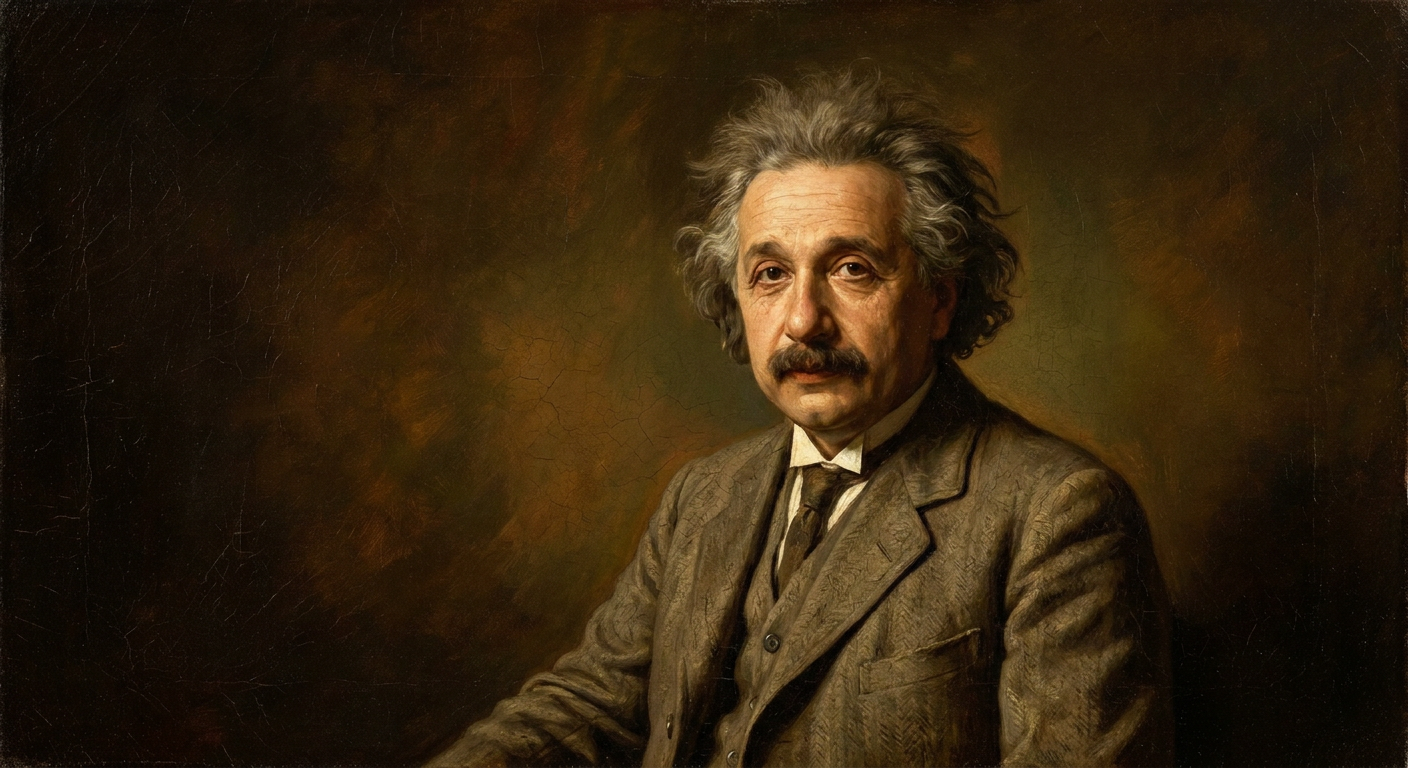
Quick Facts
- Years
- 1879 – 1955
- Category
- Scientists & Inventors
- Nationality
- German-born Swiss and American
- Occupation
- Theoretical physicist
Albert Einstein
1879 – 1955 · German-born Swiss and American · Theoretical physicist
Recommended Audiobooks
Listen next from Marcus Alden

Life Lessons from James Clerk Maxwell
Marcus Alden · 42 min

Life Lessons from Archimedes
Marcus Alden · 48 min
Albert Einstein transformed humanity’s understanding of space, time, gravity, light, matter, and energy. Born in the German Empire in 1879, he became the defining physicist of the modern age—not through a single discovery, but through a series of insights that changed the foundations of science.
In 1905, while employed at a Swiss patent office, Einstein published papers explaining Brownian motion, introducing light quanta, establishing special relativity, and revealing the relationship between mass and energy expressed by (E=mc^2). A decade later, his general theory of relativity described gravity as the curvature of spacetime. Its successful astronomical test in 1919 made him an international celebrity.
Einstein’s importance extended beyond relativity. His work helped establish quantum physics, even though he later challenged its dominant interpretation. He also became a prominent advocate of civil liberties, Jewish causes, international cooperation, and nuclear arms control. A committed pacifist for much of his life, he nevertheless supported warning the United States that Nazi Germany might seek an atomic bomb—a decision that complicated his public legacy.
Einstein remains compelling because his life joined imagination with discipline, moral conviction with contradiction, and extraordinary achievement with human fallibility. Scientists still test his theories, while historians continue to examine the private relationships, political choices, and philosophical disagreements behind the familiar image of the untidy-haired genius.
Quick Facts
| Field | Details |
|---|---|
| Full Name | Albert Einstein |
| Common Name(s) | Albert Einstein; Professor Einstein |
| Born | 14 March 1879 |
| Died | 18 April 1955 |
| Age at Death | 76 |
| Birthplace | Ulm, Kingdom of Württemberg, German Empire |
| Nationality | German by birth; Swiss from 1901; also American from 1940 |
| Occupation | Theoretical physicist, professor, author, public intellectual |
| Historical Era | Modern physics; late 19th and early 20th centuries |
| Famous For | Special and general relativity, (E=mc^2), light quanta, Brownian motion |
| Political Affiliation | Independent; democratic socialist sympathies, civil libertarian and internationalist |
| Religion | Born into a secular Jewish family; rejected a personal God but retained a strong Jewish identity |
| Education | Swiss Federal Polytechnic in Zürich; PhD, University of Zürich |
| Parents | Hermann Einstein and Pauline Koch Einstein |
| Spouse(s) | Mileva Marić, 1903–1919; Elsa Einstein, 1919–1936 |
| Children | Lieserl, Hans Albert and Eduard Einstein |
| Major Works | Four major papers of 1905; general relativity papers; The Meaning of Relativity; The World as I See It |
| Major Achievements | Relativity; foundational contributions to quantum theory and statistical physics; 1921 Nobel Prize in Physics |
Early Life
Albert Einstein was born in Ulm on 14 March 1879. His father, Hermann, and uncle Jakob operated electrical businesses, while his mother, Pauline, was an accomplished amateur pianist. The family was culturally Jewish but not strictly observant.
Soon after Albert’s birth, the Einsteins moved to Munich. As a child, he learned to speak somewhat later than expected, but popular claims that he had a serious learning disability are unsupported. He performed especially well in mathematics and physics, although he disliked rigid discipline and rote instruction.
Two experiences became central to his own account of childhood. At about five, he was fascinated by a compass whose needle moved through an unseen influence. Around twelve, he worked through a geometry book and encountered the power of logical proof. Family friend Max Talmud—later Max Talmey—brought him books on science and philosophy, encouraging his independent study.
Einstein also learned the violin. Music, especially Mozart and Bach, remained a source of pleasure and concentration throughout his life.
The family’s business difficulties took his parents to Italy in 1894, while Albert initially remained in Munich. Unhappy at school and wishing to avoid German military obligations, he left before graduating and joined them. He later relinquished his Württemberg citizenship, becoming stateless for several years.
After failing the general portion of the entrance examination for the Swiss Federal Polytechnic—while excelling in mathematics and physics—he studied at a progressive school in Aarau. Its comparatively open atmosphere suited him. He entered the Zürich Polytechnic in 1896 to train as a mathematics and physics teacher.
There he met Mileva Marić, a Serbian student and the only woman in their section. They shared intellectual interests and developed a romantic relationship. Scholars continue to study their correspondence when assessing Marić’s role in Einstein’s early thinking. The surviving evidence shows that they discussed physics closely, but it does not establish that she co-authored his published theories.
Einstein graduated in 1900. His tendency to skip lectures and challenge authority had strained relationships with professors, making an academic appointment difficult to obtain.
Rise to Prominence
Einstein became a Swiss citizen in 1901. After temporary teaching work, he secured a position in 1902 at the Swiss Patent Office in Bern. He evaluated inventions involving electrical and mechanical systems, work that sharpened his ability to identify essential principles in technical descriptions.
The job was not intellectually isolating. Einstein discussed science and philosophy with friends Maurice Solovine and Conrad Habicht in an informal group they jokingly called the Olympia Academy. In 1903 he married Mileva Marić.
Then came 1905, later called Einstein’s annus mirabilis, or miracle year. While still a patent examiner, he published four papers of exceptional importance:
- He proposed that light sometimes behaves as discrete packets of energy.
- He gave a quantitative explanation of Brownian motion.
- He established special relativity.
- He derived mass–energy equivalence.
He also completed his doctorate at the University of Zürich. Recognition came gradually. Einstein gained academic posts in Zürich and Prague, returned to Zürich, and in 1914 moved to Berlin, then one of the world’s leading scientific centers.
In Berlin he completed general relativity in 1915. British astronomer Arthur Eddington helped organize observations during a 1919 solar eclipse to test whether gravity bent starlight by the amount Einstein predicted. The results were presented as confirmation. Later historical analysis found the measurements less decisive than newspapers implied, but subsequent observations have confirmed gravitational light bending with great precision.
The press turned Einstein into a global celebrity. His fame reflected genuine scientific achievement, but it was magnified by public fascination with a theory that appeared mysterious, revolutionary, and understandable to only a few specialists.
Major Achievements
Light Quanta and the Photoelectric Effect
In 1905 Einstein argued that light energy could be emitted or absorbed in localized units later called photons. This explained the photoelectric effect, in which light ejects electrons from matter.
The proposal extended Max Planck’s quantum idea and challenged the purely wave-based description of light. It helped launch quantum physics and contributed to technologies including photodetectors, solar cells, lasers, and digital imaging. Einstein’s 1921 Nobel Prize specifically recognized this work, not relativity.
Brownian Motion and Atomic Reality
Einstein explained the irregular movement of tiny particles suspended in liquid as the cumulative effect of collisions with molecules. His equations allowed measurable quantities to reveal molecular dimensions.
At a time when some scientists still regarded atoms as convenient theoretical devices, experiments by Jean Perrin and others supported Einstein’s predictions. The work strengthened the evidence that atoms and molecules physically exist.
Special Relativity
Special relativity grew from two principles: the laws of physics are the same for observers moving at constant speeds, and the speed of light in a vacuum is constant for all such observers.
The consequences overturned ordinary intuition. Moving clocks run differently relative to one another, lengths depend on motion, and events simultaneous to one observer may not be simultaneous to another. The theory did not mean that “everything is relative”; it identified invariant laws and showed how measurements of space and time depend on motion.
Special relativity is essential to particle physics and must be considered in technologies such as satellite navigation.
Mass–Energy Equivalence
Einstein’s equation (E=mc^2) states that mass is a form of energy. Because the speed of light squared is enormous, a small change in mass corresponds to a large amount of energy.
The relationship helps explain nuclear reactions, stellar energy, and particle processes. Einstein did not invent the atomic bomb, nor did his equation alone provide instructions for building one. Nuclear weapons depended on later discoveries, engineering, and government programs.
General Relativity
Einstein’s greatest theoretical accomplishment was general relativity. Completed in 1915, it treats gravity not simply as a force acting across space but as the effect of mass and energy curving spacetime. Objects and light follow paths through that curved geometry.
The theory explained a discrepancy in Mercury’s orbit and predicted gravitational redshift, light bending, black holes in later solutions, and gravitational waves. It remains fundamental to cosmology and astrophysics. The 2015 direct detection of gravitational waves offered a dramatic modern confirmation of a prediction rooted in Einstein’s equations.
Stimulated Emission and Quantum Statistics
In 1917 Einstein described stimulated emission, a process later essential to lasers. In the 1920s, building on work by Satyendra Nath Bose, he developed Bose–Einstein statistics and predicted a new state of matter now called a Bose–Einstein condensate. It was produced experimentally in 1995.
These contributions demonstrate that Einstein was a founder of quantum theory even though he later opposed aspects of its prevailing interpretation.
Leadership or Work
Einstein led primarily through ideas rather than administration. He preferred solitary concentration, informal discussion, and thought experiments. He asked what an observer would measure while moving beside a beam of light or standing inside an accelerating elevator, reducing difficult problems to vivid conceptual situations.
His strengths included:
- Identifying contradictions hidden within accepted assumptions.
- Combining physical intuition with demanding mathematics.
- Pursuing questions for years despite resistance.
- Communicating broad scientific ideas to the public.
He also had weaknesses. Einstein could be dismissive of institutional routines and resistant when new theories conflicted with his philosophical expectations. He depended on mathematical help at important moments, notably from Marcel Grossmann during the development of general relativity. His correspondence shows warmth toward colleagues but also competitiveness and occasional harshness.
Einstein valued intellectual independence above conformity. Yet his achievements were not created in isolation: Planck, Lorentz, Minkowski, Grossmann, Bose, Eddington and many others contributed concepts, mathematics, tests, or extensions essential to modern physics.
Personal Life
Einstein and Mileva Marić had a daughter, Lieserl, before their marriage. Surviving records do not establish her ultimate fate; she may have died young or been adopted. Their sons were Hans Albert, who became a respected hydraulic engineer, and Eduard, who showed intellectual and musical promise but developed severe mental illness and spent long periods in psychiatric institutions.
The marriage deteriorated as Einstein’s career advanced. During their separation he sent Marić a set of severe conditions for continuing domestic life, a document often cited as evidence of emotional coldness. They divorced in 1919. As part of the settlement, Einstein promised her the money from a future Nobel Prize, which he later received.
That year he married Elsa Löwenthal, his cousin on both sides of the family. Elsa managed their household and helped shield him from growing public demands. She died in 1936 after they had emigrated to the United States.
Einstein had romantic relationships outside both marriages, documented in letters. These relationships complicate idealized portrayals of him. Although affectionate toward his sons at times, he was frequently absent, and his relationship with Eduard became particularly painful.
He enjoyed sailing despite reportedly being an indifferent sailor, disliked socks, played the violin, favored simple clothing, and cultivated an informal manner. He suffered from digestive illness and later developed an abdominal aortic aneurysm.
Philosophy or Beliefs
Einstein believed nature was governed by rational, intelligible order. He often used religious language metaphorically, referring to “God” as the harmony of natural law rather than a personal being who intervened in human affairs. He admired the philosopher Baruch Spinoza and rejected both conventional theism and the label of simple atheism.
His Jewish identity grew more important as antisemitism intensified. He supported the Hebrew University of Jerusalem and Zionist cultural development, while favoring cooperation between Jews and Arabs. In 1952 Israeli leaders offered him the largely ceremonial presidency of Israel. He declined, explaining that he lacked the experience and aptitude for dealing with people and official functions.
Politically, Einstein defended democracy, civil liberties, racial equality, and forms of democratic socialism. He criticized nationalism, militarism, economic inequality, and McCarthy-era political intimidation. In the United States he supported the NAACP, corresponded with W. E. B. Du Bois, and formed a friendship with singer and activist Paul Robeson.
His pacifism was strong but not absolute. Hitler’s rise convinced him that resistance to Nazi aggression might require military force. After the war, he advocated international control of nuclear technology and stronger global institutions.
Challenges and Controversies
Quantum Mechanics
Einstein objected to the idea that quantum mechanics offered only probabilistic outcomes as a complete account of reality. His debates with Niels Bohr became legendary. Einstein did not deny quantum theory’s experimental success; he questioned whether it was complete.
The 1935 Einstein–Podolsky–Rosen paper argued that quantum mechanics implied troubling nonlocal correlations or omitted elements of reality. Later experiments testing Bell’s theorem favored quantum predictions over broad classes of local hidden-variable theories. Even where Einstein’s preferred conclusion failed, his objections helped expose quantum entanglement as a profound physical feature.
Family Relationships
Einstein’s treatment of Marić and his emotional distance from his children have drawn justified criticism. Some popular accounts compensate by portraying Marić as an uncredited co-creator of relativity. Historians differ over the degree of her intellectual influence, but the documentary record does not support equal authorship of Einstein’s 1905 papers.
The Atomic Bomb Letter
In 1939, prompted by physicists Leo Szilard and Eugene Wigner, Einstein signed a letter to President Franklin D. Roosevelt warning that uranium chain reactions might permit powerful bombs and that Germany could pursue them. Szilard drafted the letter; Einstein used his fame to give it influence.
Einstein did not work on the Manhattan Project and was denied security clearance. He later regretted the nuclear arms race, though his decision must be understood against the genuine danger posed by Nazi Germany.
Politics and Federal Surveillance
The FBI maintained an extensive file on Einstein because of his associations with peace, civil-rights and left-wing organizations. Critics considered some groups communist fronts; defenders viewed the surveillance as political overreach. No credible evidence established that Einstein was a Soviet agent.
Cosmology and the “Biggest Blunder” Story
Einstein introduced a cosmological constant to permit a static universe. After evidence for cosmic expansion emerged, he abandoned that model. Physicist George Gamow later reported that Einstein called the constant his “biggest blunder,” but historians cannot independently verify the exact remark. Modern cosmology again uses a cosmological constant-like term to describe accelerated expansion.
Legacy
Einstein’s equations continue to guide research into black holes, gravitational waves, cosmic expansion, nuclear processes, and the structure of the universe. Atomic clocks and satellite navigation require relativistic corrections, making his apparently abstract work part of everyday technology.
His cultural legacy is equally powerful. Photographs of his expressive face and unruly hair turned him into a symbol of genius and humane nonconformity. That image can obscure the collaborative scientific world around him and the complexity of his private life.
Institutions preserving his legacy include the Albert Einstein Archives at the Hebrew University of Jerusalem, the Einstein Papers Project at the California Institute of Technology, the Einstein House in Bern, and the Einstein Museum within Bern’s Historical Museum. Princeton, where he spent his final decades at the Institute for Advanced Study, remains closely associated with him.
Element 99 was named einsteinium. His name also appears on schools, streets, prizes, spacecraft experiments, astronomical objects, and research institutes. In 1999, Time named him its Person of the Century.
Einstein’s continuing relevance lies not in celebrity but in a rare combination: he changed fundamental science, confronted the political disasters of his era, and left questions that remain alive in laboratories and philosophy seminars.
Interesting Facts
- Einstein was born on 14 March, now celebrated by many as Pi Day.
- He held no citizenship from 1896 until becoming Swiss in 1901.
- His first permanent professional position was at a patent office, not a university.
- Three of his revolutionary 1905 papers were written before he held a doctorate.
- The Nobel Prize honored his photoelectric-effect work rather than relativity.
- He promised his future Nobel money to Mileva Marić in their divorce settlement.
- He never received a Nobel Prize for relativity.
- He played the violin and sometimes performed chamber music with friends.
- A total solar eclipse helped make him internationally famous in 1919.
- He became an American citizen in 1940 while retaining Swiss citizenship.
- He was not a member of the Manhattan Project.
- He publicly opposed racial segregation in the United States.
- He helped establish the Hebrew University of Jerusalem.
- He declined the presidency of Israel in 1952.
- The refrigerator patented by Einstein and Leo Szilard had no moving mechanical parts in its basic design.
- His final scientific goal was a unified field theory, which he did not complete successfully.
- After his death, pathologist Thomas Harvey removed his brain; the handling and later distribution of tissue raised serious ethical questions.
- Einstein refused major surgery for his aneurysm, saying he wished to die without artificially prolonging life.
Famous Quotes
- “Imagination is more important than knowledge.” In a 1929 interview with George Sylvester Viereck, Einstein emphasized that discovery requires envisioning possibilities beyond established information.
- “I have no special talent. I am only passionately curious.” Written in a 1952 letter, this reflected his preference for explaining achievement through sustained curiosity rather than mystique.
- “Life is like riding a bicycle. To keep your balance you must keep moving.” Einstein used this image in a 1930 letter to his son Eduard during a difficult period.
- “The most incomprehensible thing about the universe is that it is comprehensible.” Appearing in his 1936 essay “Physics and Reality,” the line expresses wonder that human reasoning can uncover natural laws.
- “Subtle is the Lord, but malicious He is not.” Einstein made this remark in 1921 while discussing experimental tests. “God” referred to nature’s order, not necessarily a personal deity.
- “The unleashed power of the atom has changed everything save our modes of thinking.” Used in a 1946 appeal, it warned that nuclear weapons required new forms of political responsibility.
- “Science without religion is lame, religion without science is blind.” In his 1941 essay “Science and Religion,” Einstein used “religion” broadly for moral purpose and reverence, not religious dogma.
- “God does not play dice” is a famous paraphrase of Einstein’s objections to quantum indeterminacy. In a 1926 letter to Max Born, he more precisely wrote that “He is convinced that He does not play dice.”
- “If I were to remain silent, I’d be guilty of complicity.” Einstein wrote words to this effect about speaking against injustice; exact versions circulating online vary, so the wording should not be treated as securely fixed.
- “Insanity is doing the same thing over and over and expecting different results.” This is widely attributed to Einstein but lacks reliable evidence. It should not be presented as an authentic quotation.
Timeline
- 1879 — Born in Ulm in the German Empire.
- 1880 — Family moves to Munich.
- 1894 — Leaves school in Munich and joins his family in Italy.
- 1896 — Enters the Swiss Federal Polytechnic and relinquishes Württemberg citizenship.
- 1900 — Graduates with a teaching diploma.
- 1901 — Becomes a Swiss citizen.
- 1902 — Joins the Swiss Patent Office; daughter Lieserl is born.
- 1903 — Marries Mileva Marić.
- 1904 — Son Hans Albert is born.
- 1905 — Publishes landmark papers on light quanta, Brownian motion, special relativity and mass–energy equivalence; completes doctorate.
- 1910 — Son Eduard is born.
- 1911 — Becomes a professor in Prague.
- 1912 — Returns to Zürich.
- 1914 — Moves to Berlin; separates from Marić.
- 1915 — Completes general relativity.
- 1917 — Applies relativity to cosmology and publishes work on stimulated emission.
- 1919 — Divorces Marić, marries Elsa, and becomes internationally famous after eclipse observations.
- 1921 — Travels to the United States; receives the Nobel Prize for Physics awarded for 1921.
- 1924–1925 — Develops Bose–Einstein statistics and predicts condensation.
- 1933 — Leaves Germany after the Nazi takeover and settles in Princeton.
- 1935 — Publishes the Einstein–Podolsky–Rosen paper.
- 1936 — Elsa Einstein dies.
- 1939 — Signs the letter warning Roosevelt about possible German atomic research.
- 1940 — Becomes an American citizen.
- 1946 — Campaigns for nuclear arms control through the Emergency Committee of Atomic Scientists.
- 1952 — Declines the presidency of Israel.
- 1955 — Signs the Russell–Einstein Manifesto and dies in Princeton on 18 April.
Frequently Asked Questions
1. What is Albert Einstein best known for?
Einstein is best known for special and general relativity. Special relativity changed how physicists understand space, time and motion, while general relativity explained gravity through curved spacetime. He is also associated with (E=mc^2), but his contributions to quantum theory, atomic evidence, statistical physics and cosmology were equally important to the development of modern science.
2. Did Einstein fail mathematics at school?
No. This enduring story is false. Einstein was highly capable in mathematics from childhood and had mastered advanced topics before entering the Zürich Polytechnic. He did fail his first polytechnic entrance examination, but his strongest scores were in mathematics and physics; weaker performance in language, literature and other general subjects caused the overall failure.
3. What does (E=mc^2) mean?
The equation states that mass and energy are equivalent. In an object’s rest frame, its energy is its mass multiplied by the speed of light squared. Because that multiplier is extremely large, small changes in mass can correspond to great amounts of energy. The principle helps explain stars, nuclear reactions and particle transformations.
4. Did Einstein invent the atomic bomb?
No. Einstein neither designed the bomb nor worked on the Manhattan Project. His mass–energy relationship formed part of nuclear physics, and he signed a 1939 warning to President Roosevelt about a possible German bomb program. The weapon itself resulted from nuclear-fission research and an enormous engineering program involving many other scientists.
5. Why did Einstein receive the Nobel Prize?
The Nobel Committee awarded Einstein the 1921 Physics Prize for his services to theoretical physics, especially his law of the photoelectric effect. His light-quantum explanation had strong experimental support and became foundational to quantum physics. Relativity was famous by then, but committee members remained cautious about rewarding a theory still undergoing observational scrutiny.
6. Was Mileva Marić a co-author of relativity?
Marić was Einstein’s fellow physics student, first wife and an important intellectual companion during his early years. Their letters show shared discussion of scientific ideas. However, surviving manuscripts, publications and correspondence do not establish that she formulated or co-authored special relativity. Historians debate her influence, but claims of concealed equal authorship go beyond the available evidence.
7. Was Einstein religious?
Einstein rejected belief in a personal God who answers prayers or intervenes in events. He nevertheless used religious language to express awe at the rational structure of nature and identified with Spinoza’s idea of divinity manifested in natural order. He also valued Jewish culture and solidarity, particularly in response to European antisemitism.
8. Why did Einstein leave Germany?
Einstein was abroad when Adolf Hitler became chancellor in 1933. As a Jewish scientist, democrat and outspoken critic of militarism, he faced direct danger. Nazis attacked his work as “Jewish physics,” seized property and targeted political opponents. Einstein renounced German citizenship and accepted a position at the Institute for Advanced Study in Princeton.
9. Did Einstein prove that everything is relative?
No. Relativity does not say that truth, morality or every physical quantity is relative. It explains how measurements of time and space differ between observers in different states of motion while preserving universal physical laws. The speed of light and spacetime intervals, for example, have invariant roles within the theory.
10. What was Einstein’s role in quantum mechanics?
Einstein helped create quantum theory by introducing light quanta, explaining the photoelectric effect, developing stimulated emission and extending Bose’s statistical work. He later argued that standard quantum mechanics was incomplete because it treated probabilities as fundamental. His criticism did not destroy quantum theory, but it inspired research into entanglement and the nature of physical reality.
11. What was Einstein’s relationship with Niels Bohr?
Einstein and Bohr respected one another but disagreed deeply about quantum mechanics. Their debates centered on whether the theory gave a complete description of reality. Bohr defended the standard interpretation, while Einstein devised thought experiments intended to reveal its limitations. Their exchange became one of the most influential philosophical debates in twentieth-century science.
12. Why did Einstein become famous in 1919?
Eclipse expeditions measured starlight passing close to the Sun, where general relativity predicted that gravity would bend it. The announced results favored Einstein over the simpler Newtonian estimate, and newspapers portrayed the event as a revolution in science. The original data had considerable uncertainty, but later observations confirmed the predicted effect accurately.
13. Was Einstein a pacifist?
Einstein was a prominent pacifist after the First World War, but Nazi expansion changed his position. He concluded that refusing all military resistance could enable a violent dictatorship. His support for warning Roosevelt reflected that exception. After 1945, he again emphasized disarmament, international government and prevention of nuclear war.
14. Why did Einstein decline Israel’s presidency?
After President Chaim Weizmann died in 1952, Israeli Prime Minister David Ben-Gurion’s government offered Einstein the presidency. Einstein was honored but declined, saying he lacked practical experience and the natural ability to deal properly with people. The office was largely ceremonial, but accepting it would still have required substantial public and diplomatic responsibilities.
15. How did Einstein die?
Einstein died in Princeton Hospital on 18 April 1955 after an abdominal aortic aneurysm ruptured. He had previously undergone treatment but refused another operation, preferring not to prolong life artificially. He was cremated, and his ashes were scattered privately. His brain was removed during autopsy without clear prior permission, creating an enduring ethical controversy.
Lessons We Can Learn
- Question assumptions. Einstein reconsidered ideas about absolute time that most physicists took for granted. Modern application: established frameworks deserve scrutiny when evidence exposes contradictions.
- Use imagination with discipline. His thought experiments were creative but had to produce precise, testable mathematics. Creativity matters most when joined to verification.
- A modest job need not limit serious work. The patent office gave Einstein financial stability while he pursued physics independently. Achievement is not confined to prestigious institutions.
- Build on other people’s work. Relativity drew on Maxwell, Lorentz, Mach, Minkowski, Grossmann and others. The evidence challenges the modern myth of the completely isolated genius.
- Accept correction by observation. Eclipse tests and later experiments determined whether Einstein’s predictions survived. Reputation cannot substitute for evidence.
- Productive disagreement can advance knowledge. Einstein’s objections to quantum theory inspired sharper questions and new experiments, even when later results favored views he resisted.
- Expertise does not guarantee moral perfection. His scientific brilliance coexisted with painful family failures. Admiring achievement should not require ignoring documented harm.
- Political choices depend on context. His shift from strict pacifism under the Nazi threat shows the difficulty of applying principles during emergencies. Whether his choice was correct remains open to ethical analysis.
- Use public influence responsibly. Einstein spoke about racism, refugees and nuclear danger. A modern interpretation is that specialists can contribute to public debate while acknowledging the limits of their expertise.
- Leave room for uncertainty. Einstein pursued unanswered questions to the end of his life. His unfinished unified theory reminds us that even exceptional thinkers rarely complete the intellectual projects they begin.
Related Historical Figures
- Isaac Newton — Established the earlier theory of gravity that general relativity extended and revised.
- Max Planck — Founded quantum theory and became an early supporter of Einstein’s work.
- Hendrik Lorentz — Developed transformations and electrodynamic ideas essential to the background of special relativity.
- Mileva Marić — Einstein’s fellow student, first wife and early intellectual companion.
- Marcel Grossmann — Friend and mathematician who helped Einstein master geometry needed for general relativity.
- Arthur Eddington — Helped organize the 1919 eclipse observations that brought Einstein global fame.
- Niels Bohr — His debates with Einstein shaped the interpretation of quantum mechanics.
- Satyendra Nath Bose — His work with Einstein produced Bose–Einstein statistics and the prediction of condensates.
- Leo Szilard — Collaborated with Einstein on refrigeration patents and drafted the 1939 Roosevelt letter.
- J. Robert Oppenheimer — Led the wartime laboratory at Los Alamos and later worked in Princeton’s scientific community; unlike Einstein, he directly participated in atomic-bomb development.
Watch and Learn
“The Real Meaning of E=mc²” — PBS Space Time — approximately 14 minutes
This widely viewed educational video explains Einstein’s most famous equation without reducing it to a slogan. PBS Space Time connects mass–energy equivalence to special relativity and modern physics, making it a useful companion to the biographical story while carefully distinguishing the equation from simplistic claims about nuclear weapons.
Watch and Learn
The Real Meaning of E=mc² · PBS Space Time
Related Historical Figures