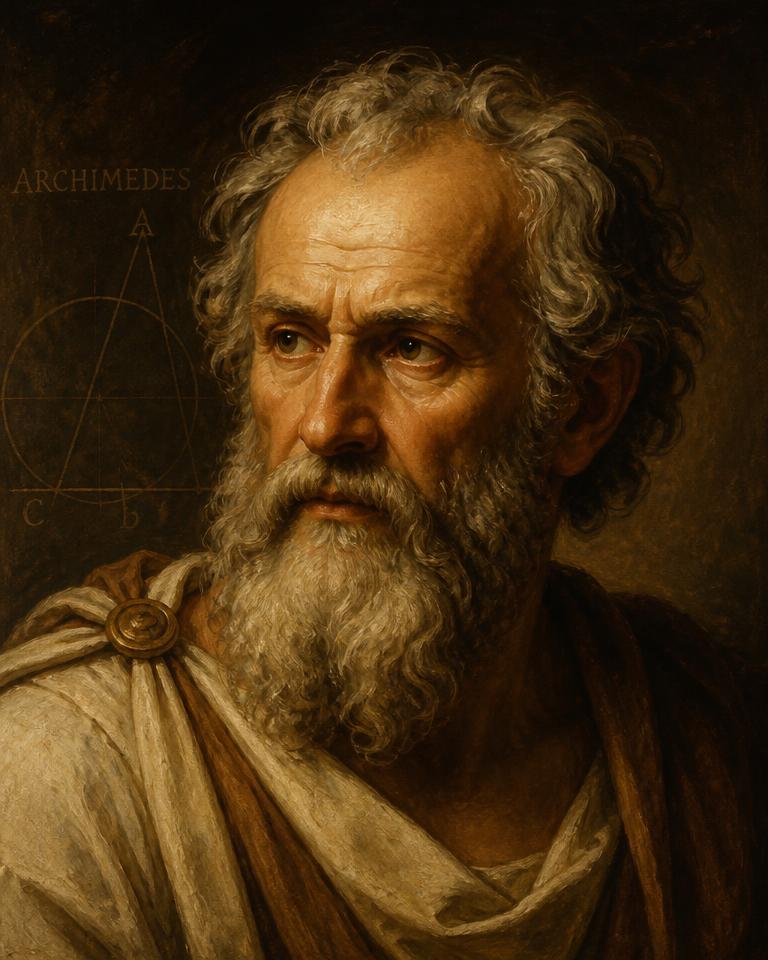
Quick Facts
- Years
- 287 BC – 212 BC
- Category
- Scientists & Inventors
- Subcategory
- Ancient Mathematics
- Nationality
- Greek
- Occupation
- Mathematician & Engineer
Archimedes
287 BC – 212 BC · Greek · Mathematician & Engineer
Audiobook

Life Lessons from Archimedes
Marcus Alden · 48 min
Archimedes of Syracuse was one of antiquity’s greatest mathematicians, physicists, and engineers. Born around 287 BCE in the Greek city of Syracuse on Sicily, he made foundational discoveries in geometry, hydrostatics, mechanics, and numerical calculation. His surviving writings show a thinker who combined rigorous proof with extraordinary physical insight.
Archimedes determined relationships among the sphere, cylinder, cone, and parabola; approximated pi with unprecedented precision; explained the law of the lever; and formulated the principle of buoyancy now bearing his name. He also designed or analyzed practical machines, including water-raising screws, compound pulleys, and defensive devices reportedly used during Rome’s siege of Syracuse.
Much of his life is known only through later writers, so famous stories—the bath, the cry of “Eureka,” and the burning mirrors—must be treated cautiously. His own works provide firmer evidence: they reveal disciplined reasoning, ingenious methods, and results that anticipated integral calculus without constituting calculus in its modern form.
Archimedes died during Rome’s capture of Syracuse in 212 BCE. Yet his books survived in Greek, Arabic, and Latin traditions, profoundly influencing Renaissance science and early modern mathematics. He remains studied because his methods unite abstraction, experimentation, and engineering with unusual power.
Quick Facts
| Field | Information |
|---|---|
| Full Name | Archimedes of Syracuse |
| Common Name(s) | Archimedes |
| Born | c. 287 BCE |
| Died | 212 BCE |
| Age at Death | About 75 |
| Birthplace | Syracuse, Sicily, Magna Graecia |
| Nationality | Greek; citizen or resident of Syracuse |
| Occupation | Mathematician, physicist, engineer, inventor, astronomer |
| Historical Era | Hellenistic period |
| Famous For | Archimedes’ principle, law of the lever, geometry, approximation of pi, mechanical inventions |
| Political Affiliation if applicable | Closely associated by later tradition with Syracuse and King Hiero II; formal office not recorded |
| Religion if significant | Presumably participated in Greek civic culture; specific beliefs not recorded |
| Education | Details unknown; possible study or scholarly contacts in Alexandria |
| Parents | Father reportedly Phidias, an astronomer; mother not recorded |
| Spouse(s) | Not recorded |
| Children | Not recorded |
| Major Works | On the Sphere and Cylinder, Measurement of a Circle, On Floating Bodies, On the Equilibrium of Planes, Quadrature of the Parabola, On Spirals, The Sand-Reckoner, The Method, The Cattle Problem |
| Major Achievements | Foundations of hydrostatics and statics; major geometric theorems; bounds for pi; analysis of centers of gravity; influential machines |
Early Life
Archimedes was born about 287 BCE in Syracuse, a powerful Greek-speaking city-state on Sicily’s eastern coast. The date is inferred from the Byzantine scholar John Tzetzes, who wrote many centuries later that Archimedes was 75 when he died. It is therefore conventional rather than independently certain.
In The Sand-Reckoner, Archimedes identifies Phidias as his father; the wording describes Phidias as an astronomer. Nothing reliable is known about his mother, siblings, marriage, or children. Plutarch later claimed that Archimedes was related to King Hiero II, but historians cannot verify the relationship.
Syracuse stood at the meeting point of Greek, Carthaginian, and Roman power. Archimedes grew up during the Hellenistic age, when the conquests of Alexander the Great had encouraged intellectual exchange across the eastern Mediterranean. Alexandria’s Museum and Library became especially important centers for mathematics.
Ancient evidence does not explicitly document Archimedes’ schooling. Later tradition places him in Alexandria, and his correspondence makes strong Alexandrian connections likely. He addressed works to Conon of Samos, an astronomer and mathematician active there, and later exchanged problems with Conon’s associate Dositheus of Pelusium. He also knew the work of Euclid and earlier geometers such as Eudoxus.
Whether Archimedes formally studied at the Museum is unknown. What is certain is that he belonged to an international mathematical community whose members circulated propositions, proofs, and challenges by letter.
Rise to Prominence
No dependable chronology survives for Archimedes’ early career. His reputation probably grew through mathematical treatises sent to other scholars and through service to Syracuse’s rulers. In his prefaces, he refers to sending theorems to Alexandrian colleagues, sometimes first distributing results without proofs and later supplying demonstrations.
His work advanced several inherited traditions. From Eudoxus he developed the method of exhaustion, which enclosed curved figures within successively tighter geometric bounds. From Greek mechanics he transformed practical rules about balances and levers into demonstrative science. He crossed boundaries between theoretical geometry and physical problems while preserving the Greek ideal of rigorous proof.
Later authors emphasize his work for Hiero II. Vitruvius tells the famous story that Hiero asked him to determine whether a votive crown contained adulterated metal without damaging it. A realization involving displaced water supposedly sent Archimedes running from a bath crying “Eureka!”—“I have found it!” The story was recorded roughly two centuries after his death and its proposed procedure would have been difficult to execute accurately. It nevertheless reflects his authentic interest in hydrostatics.
Plutarch also credits Archimedes with demonstrating mechanical advantage by moving a heavily loaded vessel through a pulley arrangement. Even if embellished, the account captures a central feature of his fame: he could show that mathematical principles produced dramatic physical effects.
Major Achievements
The Principle of Buoyancy
In On Floating Bodies, Archimedes established that a body immersed in fluid experiences an upward effect related to the weight of displaced fluid. In modern language, the buoyant force equals the weight of the displaced fluid.
He used the principle to analyze floating bodies and conditions of equilibrium. This work effectively founded mathematical hydrostatics. Its lasting applications include ship design, hydrometers, submarines, fluid measurement, and explanations of why objects sink or float.
The theorem is secure; its discovery in a bathtub is not. Separating the mathematics from the anecdote preserves rather than diminishes Archimedes’ achievement.
The Law of the Lever and Centers of Gravity
On the Equilibrium of Planes presents postulates governing balances and proves propositions about levers and centers of gravity. The basic relation is that weights balance when their magnitudes are inversely proportional to their distances from the fulcrum.
This mattered because it converted a familiar machine into an object of mathematical analysis. Archimedes calculated centers of gravity for triangles, parallelograms, and parabolic segments, helping establish statics as a quantitative discipline.
Pappus later associated him with the statement, “Give me a place to stand, and I shall move the Earth.” The saying expresses mechanical advantage, although it should not be read as a literal engineering proposal.
Geometry of the Sphere and Cylinder
Archimedes regarded his results on the sphere and circumscribed cylinder with special pride. In On the Sphere and Cylinder, he proved that a sphere’s surface area equals four times the area of its greatest circle. He also showed that the volume of a sphere is two-thirds the volume of the cylinder enclosing it; its surface area likewise bears a two-thirds relationship to the cylinder’s total surface, including its bases.
These results required sophisticated limiting arguments. According to Cicero, Archimedes requested a sphere and cylinder on his tomb. Cicero claimed to have found the neglected monument near Syracuse in 75 BCE by recognizing that design.
Approximation of Pi
In Measurement of a Circle, Archimedes bounded the ratio of a circle’s circumference to its diameter between 3 10/71 and 3 1/7. He obtained these limits by comparing inscribed and circumscribed regular polygons, ultimately using 96 sides.
He did not claim that pi equaled 22/7; rather, 22/7 was an upper bound. His procedure supplied both a numerical approximation and a rigorous error interval. Polygonal approximation remained a standard strategy for centuries and illustrates how exact reasoning can govern numerical computation.
Quadrature of the Parabola
Archimedes proved that the area of a parabolic segment is four-thirds the area of a certain inscribed triangle. He offered a mechanical argument and a geometric proof using an infinite sequence of triangles whose total areas form a geometric progression.
The work is an outstanding ancient example of finding the area of a curved region. It anticipates ideas later formalized in integral calculus, but Archimedes did not possess modern algebraic notation, limits, or the general differential-integral framework.
Spirals, Conoids, and Spheroids
In On Spirals, Archimedes studied the curve now called the Archimedean spiral, generated by a point moving uniformly along a ray while that ray rotates uniformly. He determined tangents and areas associated with the curve.
In On Conoids and Spheroids, he calculated volumes of solids formed from conic sections. These works extended exact geometry beyond the elementary figures treated in Euclid and demonstrated that apparently irregular curves and solids could be analyzed systematically.
The Sand-Reckoner
Greek number notation was poorly suited to expressing extremely large quantities. In The Sand-Reckoner, Archimedes constructed a system capable of naming numbers vastly larger than the estimated number of grains of sand needed to fill the cosmos.
The essay also preserves important astronomical information. It mentions Aristarchus of Samos’s heliocentric model and reports an estimate for the Sun’s apparent diameter. Archimedes did not endorse heliocentrism there; he used cosmological models to demonstrate the power of his numerical system.
The Method of Mechanical Theorems
In The Method, addressed to Eratosthenes, Archimedes explained how balancing imagined slices or indivisibles could reveal geometric results before formal proof. He clearly distinguished discovery from demonstration: mechanical reasoning suggested the answer, while geometry established it rigorously.
The text survived in the Archimedes Palimpsest, a medieval prayer book made from erased mathematical manuscripts. Rediscovered and studied in modern times, it transformed understanding of Archimedes’ creative process.
Engineering and Defensive Machines
Ancient writers credit Archimedes with improving the water-raising screw and devising compound pulleys and siege defenses. During the Roman siege of Syracuse, machines reportedly hurled projectiles, dropped heavy objects, and used crane-like devices to seize or destabilize ships.
The broad claim that he designed effective defenses is supported by Polybius, Livy, and Plutarch, although their descriptions contain dramatic literary elements. The “Claw of Archimedes” is plausible in principle but not archaeologically confirmed.
Burning mirrors said to have ignited Roman ships appear only in much later accounts and remain controversial. Modern experiments have produced mixed outcomes under carefully arranged conditions, not proof of ancient battlefield use.
Leadership and Work
Archimedes was not a political leader in the usual sense. His influence arose through intellectual authority, problem-solving, and possibly advisory work for Syracuse’s court. Later accounts portray Hiero as trusting his technical judgment.
His working method combined several strengths:
- reducing complicated questions to simpler mathematical relationships;
- using physical models to discover patterns;
- demanding deductive proof before accepting a theorem;
- checking quantities through upper and lower bounds;
- communicating results through specialized treatises and letters.
He could also be competitive. In some prefaces, he noted that previously circulated claims had been announced without proof, and he exposed scholars who claimed false results. This suggests a research culture in which priority and rigor mattered.
His principal limitation was not intellectual but contextual: Greek mathematical style made works difficult for nonspecialists, and his surviving texts rarely explain practical construction details. Consequently, later stories often overshadowed his actual demonstrations.
Personal Life
Reliable information about Archimedes’ private life is exceptionally scarce. No ancient source securely names a spouse or child. Claims about his household should therefore be treated as unknown rather than filled with speculation.
His clearest documented relationships were scholarly. He admired Conon of Samos and corresponded with Dositheus after Conon’s death. He addressed The Method to Eratosthenes, the Alexandrian scholar famous for measuring Earth’s circumference.
Plutarch portrays Archimedes as so absorbed in geometry that he neglected food, bathing, and bodily care and drew figures in ashes or on his skin. These images belong to the ancient literary stereotype of the distracted genius. They may preserve a reputation for intense concentration, but they are not neutral eyewitness reporting.
No dependable evidence describes his health. He remained intellectually or technically active into old age if the traditional dates and siege narratives are accepted.
Philosophy and Beliefs
Archimedes left no philosophical or theological treatise. His religious convictions are not recorded, although as a Syracusan Greek he lived amid the civic cults and customs of Hellenistic society.
His writings do reveal an intellectual ethic. He valued proof, acknowledged predecessors and correspondents, and distinguished heuristic discovery from final demonstration. He did not reject practical mechanics, but later authors say he considered pure geometry especially worthy of admiration.
Politically, he appears loyal to Syracuse. His defensive work during the Roman siege served his city, yet no surviving evidence identifies him with a faction or provides his views on monarchy, democracy, Carthage, or Rome.
His scientific worldview was mathematical: physical equilibrium, floating, magnitude, and motion could be represented through proportion and geometry. That commitment helped make mechanics a demonstrative science rather than merely a collection of craft rules.
Challenges and Controversies
The greatest challenge in writing Archimedes’ biography is the uneven evidence. His mathematical texts are primary sources for his ideas, but most biographical stories come from writers living generations later.
The crown and “Eureka”
Vitruvius is the source for the bath story. The episode may encode a real hydrostatic investigation, but measuring overflow accurately enough to detect small differences in alloy composition would have been difficult. Some researchers suggest a balance-based method would have worked better. The anecdote is famous, not firmly verified.
Burning mirrors
Polybius and Livy, major sources for the siege, do not mention solar weapons. The story emerges in later antiquity and medieval tradition. Experiments show that arrays of mirrors can ignite suitable stationary targets under favorable sunlight, but battlefield practicality is doubtful. Historians generally regard the claim as unproven.
Anticipating calculus
Archimedes used exhaustion, infinitesimal-style heuristics, and summations that resemble integral reasoning. Calling him the “inventor of calculus,” however, risks anachronism. Modern calculus required symbolic algebra, general algorithms, and concepts developed much later by figures including Newton and Leibniz.
The circumstances of his death
Ancient accounts agree that a Roman soldier killed Archimedes when Syracuse fell, despite commander Marcus Claudius Marcellus supposedly wishing to spare him. They disagree on details. One version says he refused to leave a geometric diagram; another says the soldier mistook mathematical instruments for valuables. His final words, often rendered “Do not disturb my circles,” are not securely documented.
Legacy
Archimedes’ writings circulated unevenly after antiquity. Byzantine scholars preserved Greek manuscripts, while Arabic translators and mathematicians transmitted and extended portions of his work. Latin translations, especially those associated with William of Moerbeke in the thirteenth century, helped return Archimedean mathematics to western European scholarship.
During the Renaissance and Scientific Revolution, his combination of mathematics and mechanics influenced figures such as Leonardo da Vinci, Galileo Galilei, Johannes Kepler, Bonaventura Cavalieri, and Isaac Newton. Galileo especially treated Archimedes as a model for mathematical physics.
The Archimedes Palimpsest became one of the most important manuscript discoveries connected with ancient science. A thirteenth-century scribe had overwritten erased copies of works including The Method and Stomachion. Modern multispectral imaging recovered text invisible to ordinary inspection.
Archimedes is commemorated in Syracuse through monuments, museums, exhibitions, and reconstructions of machines. The Museo Archimede e Leonardo in Syracuse explores his mechanics alongside later engineering traditions. Statues and plaques appear in Sicily and elsewhere, and mathematical institutions, prizes, craters, asteroids, ships, and scientific projects have carried his name.
His most important memorial remains conceptual. Every classroom demonstration of buoyancy, every calculation involving levers, and every historical discussion of rigorous approximation continues a tradition he helped create.
Interesting Facts
- Archimedes wrote in the Doric dialect of Greek associated with Syracuse.
- His estimate of pi used polygons with as many as 96 sides.
- He proved bounds for pi rather than declaring it exactly equal to 22/7.
- He considered the sphere-cylinder relationship especially important.
- His father Phidias is mentioned in The Sand-Reckoner.
- That work records Aristarchus’s heliocentric hypothesis.
- The Cattle Problem leads to extraordinarily large integer solutions.
- The Archimedean spiral is named for his systematic study of it.
- He used mechanical balancing as a tool for discovering geometric theorems.
- He nevertheless required geometric proof for formal demonstration.
- His works include studies of floating paraboloids.
- Cicero reported finding his tomb more than a century after his death.
- Polybius described his defenses as frustrating the Roman attack on Syracuse.
- The Archimedes screw remains used for moving water and other materials.
- The earliest detailed “Eureka” account comes from Vitruvius, not Archimedes.
- The burning-mirror story is absent from the earliest siege narratives.
- A lost work about a mechanical astronomical device may be reflected in later descriptions.
- The Stomachion concerns a geometric dissection puzzle, though the surviving text is incomplete.
Famous Quotes
Ancient quotations often survive only in later paraphrase. The following are documented in ancient or medieval sources, but none can be treated like a modern transcript.
- “Eureka! Eureka!”—“I have found it!” Vitruvius attributes this cry to Archimedes after the bath insight. It symbolizes sudden discovery, though the episode is unverified.
- “Give me a place to stand, and I shall move the Earth.” Reported in Greek by Pappus in connection with the lever. It expresses the principle of mechanical advantage.
- “Do not disturb my circles.” A traditional version of words allegedly spoken before his death. The exact phrase is disputed and varies among sources.
- “Stand away from my diagram.” Another traditional rendering of his supposed final protest. Disputed; it conveys absorption in mathematical work.
- “There are some, King Gelon, who think that the number of the sand is infinite in multitude.” Opening idea of The Sand-Reckoner. Archimedes introduces his system for expressing enormous numbers.
- “I thought fit to write out for you and make known the method.” From The Method, addressed to Eratosthenes. It explains his willingness to reveal a technique of discovery.
- “Certain things first became clear to me by a mechanical method.” From The Method in translation. It shows that physical reasoning guided his geometric insights.
- “It is easier, when we have previously acquired by the method some knowledge of the questions, to supply the proof.” From The Method. It distinguishes finding a result from proving it.
- “The surface of any sphere is four times its greatest circle.” The theorem stated in On the Sphere and Cylinder. It summarizes one of his proudest results.
- “Any floating body displaces its own weight of fluid.” Common modern summary of On Floating Bodies, not a secure verbatim quotation from Archimedes.
Timeline
- c. 287 BCE — Born in Syracuse, Sicily, according to the traditional chronology.
- Early third century BCE — Receives mathematical education; possible Alexandrian study remains unconfirmed.
- Before c. 220 BCE — Develops scholarly ties with Conon of Samos and Alexandrian mathematicians.
- Third century BCE — Produces major works on equilibrium, curves, areas, volumes, and floating bodies; exact order is debated.
- Third century BCE — Writes The Sand-Reckoner for King Gelon, preserving information about Hellenistic astronomy.
- Third century BCE — Corresponds with Dositheus and addresses The Method to Eratosthenes.
- c. 214 BCE — Roman forces under Marcellus begin operations against Syracuse during the Second Punic War.
- 214–212 BCE — Defensive machines attributed to Archimedes help oppose Roman assaults.
- 212 BCE — Syracuse falls; a Roman soldier kills Archimedes.
- 75 BCE — Cicero reports rediscovering Archimedes’ tomb near Syracuse.
- Sixth century CE — Eutocius writes influential commentaries preserving parts of the Archimedean tradition.
- Ninth–tenth centuries — Greek manuscript traditions continue in Byzantium; Arabic scholarship translates and studies Archimedean works.
- 1269 — William of Moerbeke completes important Latin translations of Archimedes.
- 1906 — Johan Ludvig Heiberg identifies major Archimedean texts in the palimpsest.
- Late twentieth–early twenty-first centuries — Conservation and multispectral imaging reveal further palimpsest material.
Frequently Asked Questions
Who was Archimedes?
Archimedes was a Greek mathematician, physicist, and engineer from Syracuse who lived during the third century BCE. His surviving books address geometry, statics, hydrostatics, spirals, large numbers, and methods of mathematical discovery. He is best known for Archimedes’ principle of buoyancy, the law of the lever, rigorous bounds for pi, and theorems about spheres and cylinders. Ancient historians also credited him with machines used to defend Syracuse. Because later legend surrounds his life, historians rely most confidently on his own writings for his intellectual biography.
When and where was Archimedes born?
He was probably born around 287 BCE in Syracuse, a Greek city on the island of Sicily. The year is reconstructed from a much later statement that he died at age 75 in 212 BCE, so it should be written as approximate. Syracuse was then a wealthy and strategically important city within the Greek cultural region often called Magna Graecia. Its location exposed Archimedes to a world shaped by competition among Greek states, Carthage, and the expanding Roman Republic.
What did Archimedes discover?
His best-known discoveries include the principle governing buoyancy, mathematical laws of levers and equilibrium, and exact relationships among the areas and volumes of spheres and cylinders. He also established rigorous bounds for pi, squared a parabolic segment, studied spirals, and devised a notation for enormous numbers. “Discovery” should be used carefully: he inherited methods and problems from earlier Greek mathematicians, especially Eudoxus and Euclid, but extended them with exceptional originality.
What is Archimedes’ principle?
Archimedes’ principle states that an object wholly or partly immersed in a fluid experiences an upward buoyant force equal to the weight of the fluid it displaces. If buoyancy balances an object’s weight, it can float; if its weight is greater, it sinks unless another force intervenes. Archimedes developed the underlying theory in On Floating Bodies. The principle remains essential in naval architecture, submarine operation, density measurement, and introductory physics.
Did Archimedes really shout “Eureka” in a bath?
Possibly, but the evidence is weak. The story comes from the Roman architect Vitruvius, writing about two centuries after Archimedes. He says Archimedes realized while bathing how to test whether King Hiero’s crown had been adulterated and ran home shouting “Eureka.” No surviving Archimedean work tells the story, and the proposed overflow measurement would have faced practical accuracy problems. Historians therefore present it as a famous ancient anecdote rather than established fact.
How did Archimedes approximate pi?
He compared the perimeters of regular polygons drawn inside and outside a circle. By repeatedly doubling the number of sides until reaching 96-sided polygons, he obtained increasingly tight lower and upper limits. He proved that pi lies between 3 10/71 and 3 1/7. This was not merely a rough decimal estimate: it was a logically justified interval, demonstrating a powerful method for controlling numerical error.
Did Archimedes invent calculus?
Not in the modern sense. He used the method of exhaustion, infinite geometric sequences, and heuristic arguments involving imagined slices, all of which resemble later integral methods. His work strongly foreshadowed calculus and influenced its prehistory. However, he lacked modern symbolic algebra, functions, derivatives, and a general fundamental theorem connecting differentiation and integration. Newton, Leibniz, and their seventeenth-century predecessors created a broader formal discipline under very different mathematical conditions.
What was the Archimedes screw?
The Archimedes screw is a rotating helical surface inside a cylinder or trough that lifts water from a lower level to a higher one. Ancient writers connected the device with Archimedes, perhaps following a visit to Egypt, but neither the journey nor sole invention is securely documented. Similar technology may have existed earlier. His name nevertheless became permanently associated with it. Modern versions move irrigation water, wastewater, grain, powders, and even generate low-head hydroelectric power.
Did Archimedes burn Roman ships with mirrors?
There is no reliable contemporary evidence that he did. Early accounts of the siege describe artillery and ship-grabbing mechanisms but not burning mirrors. The solar-mirror story appears in later sources. Experiments have shown that coordinated mirrors can heat or ignite targets under controlled conditions, yet difficulties involving clouds, moving ships, range, materials, and alignment make battlefield use questionable. The fairest conclusion is that such a weapon is physically conceivable in limited circumstances but historically unproven.
What was the Claw of Archimedes?
The “Claw” is a modern name for a defensive device described in ancient siege narratives. It may have been a crane-like beam, hook, or grappling mechanism capable of lifting a ship’s bow, tilting the vessel, or dropping it violently. Polybius and Plutarch describe frightening attacks on Roman ships, though neither provides engineering plans. Reconstructions suggest feasibility, but archaeology has not confirmed a particular machine. It represents the plausible intersection of Archimedes’ mechanical knowledge and Syracuse’s fortifications.
How did Archimedes die?
He was killed by a Roman soldier when Syracuse fell in 212 BCE. Ancient sources agree on this broad outline and report that Marcellus had wanted him spared. Details differ: one account portrays him concentrating on a diagram and refusing to follow the soldier; another says he was carrying mathematical instruments mistaken for valuables. The conflicting narratives prevent certainty. The celebrated command not to disturb his circles is a literary tradition, not a securely preserved final statement.
What books by Archimedes survive?
Substantially surviving works include On the Sphere and Cylinder, Measurement of a Circle, On Spirals, On Conoids and Spheroids, On the Equilibrium of Planes, Quadrature of the Parabola, On Floating Bodies, The Sand-Reckoner, and The Method. The Stomachion and Cattle Problem also survive in special or incomplete forms. Other works known from references are lost. Surviving texts sometimes depend on medieval manuscripts, translations, and scholarly reconstruction.
What is the Archimedes Palimpsest?
It is a medieval manuscript made by erasing and overwriting parchment that had contained Greek mathematical texts. Beneath Christian prayers, scholars identified works by Archimedes, including the unique principal copy of The Method and important material from Stomachion and On Floating Bodies. Johan Ludvig Heiberg studied it in 1906. Later conservation and multispectral imaging recovered additional writing. The palimpsest is invaluable because it reveals both lost content and Archimedes’ heuristic reasoning.
Was Archimedes related to King Hiero II?
Plutarch says Archimedes was related to Hiero, but the claim comes centuries after their lives and lacks independent confirmation. Their association is nevertheless plausible. Ancient traditions connect Archimedes with court problems, public machines, and Syracuse’s defenses, and The Sand-Reckoner is addressed to King Gelon, Hiero’s son or co-ruler. It is safest to describe him as associated with the Syracusan royal circle while treating a blood relationship as uncertain.
Why was the sphere and cylinder theorem important to him?
Archimedes proved that a sphere has two-thirds the volume of its circumscribed cylinder and that its surface bears a corresponding relationship to the cylinder’s total surface. These results brought curved three-dimensional forms under exact mathematical control. Ancient testimony says he requested that a sphere and cylinder mark his grave. Whether every detail of that request is historical, Cicero’s report of recognizing the tomb by the figures shows how closely the theorem became linked with Archimedes’ identity.
What was Archimedes’ greatest contribution?
There is no single objective choice. Physicists often emphasize buoyancy and statics; mathematicians point to his geometry and limiting methods; historians of science stress his union of mechanical intuition with proof. His broadest contribution may have been methodological: he showed that physical and geometric problems could be attacked through models, proportional reasoning, approximation, and rigorous demonstration. That combination became central to later mathematical science.
Lessons We Can Learn
- Separate discovery from proof. In The Method, mechanical reasoning suggested results, but geometry verified them. Modern ideas likewise need testing and validation.
- Use bounds when exact answers are unavailable. His limits for pi gave guaranteed accuracy. Today, error ranges are vital in computing, engineering, and statistics.
- Connect theory with practice. Lever theory and hydrostatics addressed real machines and fluids. Abstract knowledge becomes more powerful when linked responsibly to applications.
- Build on predecessors. Archimedes advanced methods associated with Eudoxus and Euclid. Innovation often comes through mastering and extending earlier work.
- Communicate with peers. His exchanges with Conon, Dositheus, and Eratosthenes placed research within a community. Collaboration and criticism improve ideas.
- Reduce large problems to manageable parts. He analyzed areas and volumes through polygons, triangles, and imagined slices. Decomposition remains a universal problem-solving technique.
- Do not confuse memorable stories with evidence. The bath and mirrors are culturally powerful but uncertain. Critical source evaluation matters in history and public life.
- Design for constraints. Syracuse’s defenses reportedly adapted mechanics to walls, ships, and ranges. Good engineering begins with actual operating conditions.
- Preserve knowledge carefully. The palimpsest shows how easily works can disappear and how scholarship can recover them. Archives and open preservation serve future generations.
- Let curiosity cross disciplines. Archimedes moved among geometry, astronomy, fluids, machines, and number systems. Complex modern challenges similarly reward interdisciplinary thinking.
Related Historical Figures
- Hiero II of Syracuse — Ruler linked by tradition to Archimedes’ court work, crown problem, and engineering demonstrations.
- Gelon II — Hiero’s son or co-ruler and the addressee of The Sand-Reckoner.
- Conon of Samos — Alexandrian mathematician and astronomer whom Archimedes respected and treated as a scholarly correspondent.
- Dositheus of Pelusium — Recipient of several Archimedean works after Conon’s death.
- Eratosthenes of Cyrene — Alexandrian scholar to whom Archimedes addressed The Method.
- Euclid — Earlier mathematician whose axiomatic geometry formed part of Archimedes’ intellectual foundation.
- Eudoxus of Cnidus — Developed exhaustion techniques that Archimedes extended in advanced area and volume proofs.
- Aristarchus of Samos — Astronomer whose heliocentric hypothesis is summarized in The Sand-Reckoner.
- Marcus Claudius Marcellus — Roman commander who captured Syracuse and reportedly regretted Archimedes’ death.
- Cicero — Roman statesman who said he rediscovered Archimedes’ tomb in 75 BCE, preserving an influential memory of his sphere-cylinder theorem.
Watch and Learn
The real story behind Archimedes’ Eureka! - Armand D'Angour · TED-Ed
Related Historical Figures