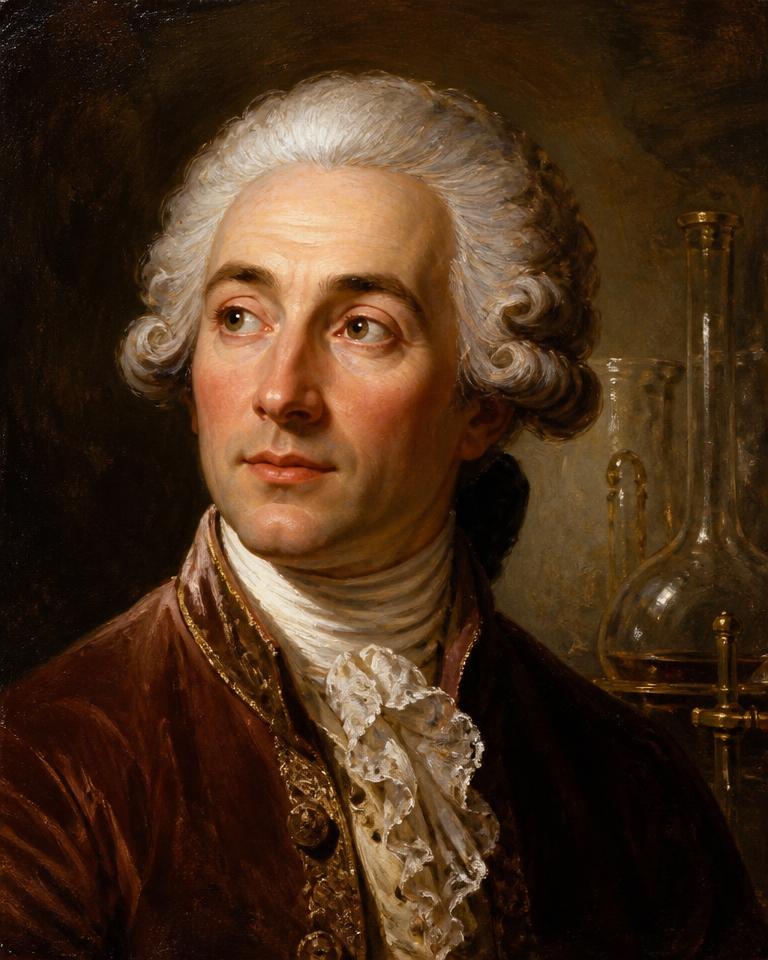
Quick Facts
- Years
- 1743 – 1794
- Category
- Scientists & Inventors
- Subcategory
- Chemistry
- Nationality
- French
- Occupation
- Chemist
Antoine Lavoisier
1743 – 1794 · French · Chemist
Audiobook

Life Lessons from Antoine Lavoisier
Marcus Alden · 48 min
Antoine-Laurent de Lavoisier was a French chemist, public administrator, and reformer whose quantitative methods helped transform chemistry into a modern experimental science. Born in Paris in 1743, he combined careful measurement, precisely designed apparatus, and systematic terminology to reinterpret combustion, respiration, and chemical change. His experiments established that matter is conserved in ordinary chemical reactions and showed that combustion involves combination with a component of air—later named oxygen—rather than the release of an imagined substance called phlogiston.
Lavoisier also helped clarify the nature of elements, demonstrated that water is a compound rather than an element, contributed to a rational system of chemical nomenclature, and wrote the influential Elementary Treatise of Chemistry in 1789. Beyond the laboratory, he worked on taxation, agriculture, gunpowder production, public health, education, and the metric system.
His achievements were inseparable from collaboration, especially with his wife, Marie-Anne Paulze Lavoisier, who translated scientific texts, prepared illustrations, maintained records, and participated in laboratory life. His career was also entangled with the inequitable tax-farming system of the ancien régime. During the French Revolution, that association helped lead to his conviction and execution in 1794. Lavoisier remains important because his life illustrates both the power of exact measurement and the moral complexity of science conducted within political institutions.
Quick Facts
| Field | Information |
|---|---|
| Full Name | Antoine-Laurent de Lavoisier |
| Common Name(s) | Antoine Lavoisier; Antoine-Laurent Lavoisier |
| Born | 26 August 1743 |
| Died | 8 May 1794 |
| Age at Death | 50 |
| Birthplace | Paris, Kingdom of France |
| Nationality | French |
| Occupation | Chemist, public administrator, tax farmer, economic and agricultural reformer |
| Historical Era | Enlightenment; French Revolution |
| Famous For | Oxygen theory of combustion, conservation of matter, chemical nomenclature, quantitative chemistry |
| Political Affiliation if applicable | No modern party affiliation; served ancien-régime institutions and later participated in reform projects during the Revolution |
| Religion if significant | Raised Roman Catholic; precise private beliefs are not clearly documented |
| Education | Collège des Quatre-Nations (Collège Mazarin); law degree from the University of Paris |
| Parents | Jean-Antoine Lavoisier and Émilie Punctis |
| Spouse(s) | Marie-Anne Pierrette Paulze, married 1771 |
| Children | None |
| Major Works | Opuscules physiques et chimiques (1774); Méthode de nomenclature chimique (coauthor, 1787); Traité élémentaire de chimie (1789) |
| Major Achievements | Reformed combustion theory; identified oxygen’s role in combustion and respiration; formulated mass balance in reactions; helped create modern chemical nomenclature; advanced calorimetry and the metric system |
Early Life
Lavoisier was born into a prosperous Parisian legal family. His father, Jean-Antoine Lavoisier, was an attorney associated with the Parlement of Paris. His mother, Émilie Punctis, came from a wealthy family but died when Antoine was five. An inheritance from her later gave him substantial financial independence.
At the Collège des Quatre-Nations, commonly called the Collège Mazarin, he received a broad education in classics, mathematics, astronomy, botany, geology, and chemistry. The astronomer and mathematician Nicolas-Louis de Lacaille strengthened his interest in precise observation. The botanist Bernard de Jussieu and mineralogist Jean-Étienne Guettard also influenced him. With Guettard, Lavoisier participated in geological and mineralogical surveys of France.
He studied law in accordance with family expectations, earning a degree and qualifying for legal practice. Yet natural philosophy increasingly absorbed him. Eighteenth-century chemistry was rich in practical knowledge but divided by inconsistent names, uncertain definitions, and theories that were difficult to test quantitatively. The dominant explanation of burning was phlogiston theory, which proposed that combustible bodies released a fire-like principle.
Lavoisier entered science during the Enlightenment, when learned academies, royal patronage, state administration, and practical improvement were closely linked. He investigated urban lighting and submitted an award-winning study to the Académie des Sciences. In 1768, at only 25, he was elected an adjunct member of that institution.
Rise to Prominence
Lavoisier’s ascent rested on scientific talent, wealth, institutional access, and exceptional organizational discipline. In 1768 he also purchased a share in the Ferme générale, the private corporation that collected certain royal taxes. The position made him wealthy and helped finance an elaborate laboratory, but it later exposed him to revolutionary hostility.
His early research addressed geology, water, combustion, and the composition of air. One turning point came when he tested the old claim that water could be converted into earth. By weighing vessels and their contents before and after prolonged heating, he showed that the residue came from the glass vessel rather than from the creation of earth. The experiment demonstrated his characteristic reliance on balances and closed systems.
In the early 1770s he burned phosphorus and sulfur and found that the products gained weight. He inferred that something from the air had combined with them. His 1774 book, Opuscules physiques et chimiques, assembled experiments on gases and combustion and announced a research program that challenged phlogiston chemistry.
Joseph Priestley visited Paris in 1774 and described a gas he had produced by heating mercuric oxide. Priestley interpreted it as “dephlogisticated air.” Lavoisier repeated and extended the experiment, identifying the gas as the component of air that supports combustion and respiration. Carl Wilhelm Scheele had independently prepared the same gas earlier, although his publication appeared later. Priority for oxygen’s preparation is therefore shared and historically nuanced; Lavoisier’s distinctive contribution was incorporating it into a systematic theory.
By the 1780s, his laboratory had become a center for collaborative experimentation. Public demonstrations, carefully prepared memoirs, and debates at the Académie made him internationally prominent. Opposition remained strong, particularly among defenders of phlogiston, but Lavoisier’s framework gradually prevailed because it unified quantitative evidence, gas chemistry, and a new vocabulary.
Major Achievements
The Oxygen Theory of Combustion
Lavoisier demonstrated that burning and the calcination of metals involve combination with part of the air. He named that component “oxygen,” from Greek roots meaning “acid former,” because he mistakenly believed it was present in every acid.
The theory replaced phlogiston with an explanation based on measurable substances. It accounted for why metals gain mass when heated and why combustion ceases in a sealed vessel after part of the air has been consumed. Although his acid theory was wrong, his account of oxidation reorganized chemistry around reactions between substances rather than hypothetical principles.
Conservation of Matter and Quantitative Chemistry
Lavoisier did not originate the broad idea that matter persists, but he made rigorous mass accounting central to chemical practice. In closed-vessel experiments, he weighed reactants and products and showed that total mass remained constant through chemical change.
His Elementary Treatise of Chemistry expressed the principle memorably: nothing is lost and nothing created in an operation of art or nature; the quantity of matter is the same before and after. This mass-balance method became fundamental to chemical equations, stoichiometry, laboratory analysis, and industrial process control.
Demonstrating That Water Is a Compound
Working within an international community that included Henry Cavendish and others, Lavoisier helped establish that water is formed from two gases rather than being a classical element. He called them oxygen and hydrogen, the latter meaning “water former.”
Experiments synthesizing water and decomposing it undermined the ancient four-element scheme. The achievement showed how analysis and synthesis could identify composition, strengthening the emerging concept of chemical compounds.
Reforming Chemical Nomenclature
In 1787 Lavoisier, Louis-Bernard Guyton de Morveau, Claude-Louis Berthollet, and Antoine-François de Fourcroy published a systematic method of chemical nomenclature. Names were designed to communicate composition and chemical relationships rather than preserve a confusing collection of alchemical and craft terms.
Some names rested on theories later revised, but the guiding principle endured: scientific language should be consistent, informative, and open to correction. Modern chemical nomenclature descends from this reform.
Defining Elements Operationally
In Traité élémentaire de chimie (1789), often translated as Elementary Treatise of Chemistry, Lavoisier defined an element pragmatically as a substance that existing methods could not decompose. His list contained 33 “simple substances.” Some, such as oxygen and sulfur, remain elements; others, including light and caloric, do not.
The importance lay less in producing a perfect list than in rejecting metaphysical certainty. Elemental status depended on experimental analysis. This operational approach prepared the way for nineteenth-century atomic chemistry.
Connecting Respiration and Combustion
With Pierre-Simon Laplace, Lavoisier used an ice calorimeter to compare the heat produced by a guinea pig with that produced by burning carbon. He argued that respiration is a slow form of combustion involving oxygen and producing carbon dioxide and heat.
The details of metabolism proved more complicated, but this work linked chemistry, physiology, and energy measurement. It helped lay foundations for biochemistry and nutritional science.
Gunpowder, Agriculture, and Public Administration
As an administrator of the Régie des poudres, Lavoisier improved French gunpowder production through better refining, testing, and organization. He also conducted agricultural experiments on an estate at Fréchines, examining yields, livestock, and soil management.
He contributed reports on public health, taxation, education, and economic reform. During the Revolution he participated in the commission that developed a uniform system of weights and measures, an important step toward the metric system.
Leadership and Work
Lavoisier led through planning, measurement, documentation, and coordinated expertise. His laboratory was not a solitary workshop. It involved instrument makers, assistants, visiting savants, and Marie-Anne Lavoisier, whose records and drawings preserved experimental procedures.
His decision-making style emphasized balance sheets: define inputs, isolate the process, measure outputs, and identify discrepancies. He invested in costly instruments, including precision balances, gasometers, and calorimeters. Public experiments were often rehearsed and staged so that witnesses could observe critical results.
His strengths included persistence, mathematical discipline, administrative competence, and an ability to integrate scattered findings into a coherent system. He understood that theories gain power when paired with standardized language and reproducible methods.
His weaknesses were partly intellectual and partly social. He sometimes presented chemistry’s reform as more complete than it was, underestimated the resilience of alternative interpretations, and promoted the incorrect oxygen theory of acids. His wealth and official positions also distanced him from those harmed by ancien-régime taxation. The same administrative confidence that made him effective could appear technocratic and politically insensitive.
Personal Life
In 1771 Lavoisier married Marie-Anne Pierrette Paulze, the 13-year-old daughter of tax-farm official Jacques Paulze. Early marriage was legal in the period, though the age difference is striking by modern standards. The couple had no children.
Marie-Anne became an accomplished scientific collaborator. She learned English, translated works by Joseph Priestley and Richard Kirwan, added critical notes, drew laboratory apparatus, engraved plates, and hosted gatherings of scientists. Jacques-Louis David’s celebrated double portrait presents the couple amid instruments and manuscripts, emphasizing their intellectual partnership.
Their Paris home and Arsenal laboratory became meeting places for French and foreign researchers. Lavoisier maintained detailed notebooks and worked according to an exacting schedule divided among science, administration, and finance. Accounts often describe him as methodical, reserved, industrious, and ambitious, although retrospective personality judgments should be treated cautiously.
He was interested in agriculture, economics, education, and civic improvement as well as chemistry. His social circle included Laplace, Berthollet, Fourcroy, Benjamin Franklin, and other Enlightenment figures. No major chronic illness dominates the surviving record before his imprisonment.
Philosophy and Beliefs
Lavoisier embodied Enlightenment confidence in reason, measurement, and useful knowledge. He believed natural phenomena should be explained through experiment rather than inherited authority. His operational definition of elements showed caution: chemistry should claim only what analysis could demonstrate.
Politically, he was a reformer rather than an early revolutionary radical. He criticized inefficiency and supported rationalized taxation, education, public accounting, and uniform measurement. Yet he remained a beneficiary and officer of the Ferme générale. His career therefore combined genuine reform with participation in an unequal fiscal order.
He was raised Catholic, and conventional religious references appear in his environment, but historians lack sufficient evidence to reconstruct a detailed personal theology. Claims that he was either a militant atheist or an especially devout believer go beyond the record.
Ethically, he valued public utility and administrative order. He sought improvements in sanitation, food supply, agriculture, and state manufacture. Modern readers may admire this civic orientation while also asking whether technical reform can compensate for service within unjust institutions.
Challenges and Controversies
Credit for Oxygen
Priestley and Scheele produced oxygen independently before Lavoisier’s mature interpretation. Priestley communicated his experiment to Lavoisier in 1774, and some contemporaries accused Lavoisier of insufficiently acknowledging others. Most historians distinguish discovery of the gas from explanation of its role: Priestley and Scheele prepared it, while Lavoisier transformed its theoretical meaning. Credit belongs to several investigators.
The Rejection of Phlogiston
Lavoisier’s “chemical revolution” did not win immediate acceptance. Phlogiston theory had explained many observations within older assumptions, and chemists such as Priestley and Kirwan defended it. Lavoisier’s opponents were not simply irrational conservatives; they disagreed about evidence, terminology, and what counted as explanation. His system prevailed gradually through experimental success, pedagogy, and institutional influence.
Scientific Errors
Lavoisier believed oxygen was the universal acidifying principle. Hydrochloric acid and other oxygen-free acids eventually disproved that claim. He also listed light and caloric as simple substances. These errors demonstrate that his achievement was methodological and structural, not infallibility in every conclusion.
Tax Farming
The Ferme générale collected indirect taxes for the monarchy and profited from the difference between payments collected and sums owed to the crown. It was widely associated with privilege, coercion, and opaque finance. Lavoisier undertook some reforms and used his income to support research, but he materially benefited from the system.
Defenders emphasize his public service and attempts at improvement. Critics stress that expertise and philanthropy did not erase complicity in an inequitable institution. Both dimensions are necessary to understand his position.
Tobacco and Jean-Paul Marat
Lavoisier worked on detecting adulteration of tobacco, a taxed monopoly product. The enforcement regime was unpopular. A frequently repeated story says that he personally blocked Jean-Paul Marat’s election to the Académie des Sciences and thereby created a fatal enemy. Marat’s scientific claims were criticized by academicians, including in an evaluation involving Lavoisier, but simple revenge narratives exaggerate the evidence and obscure the broader political prosecution of tax farmers.
Trial and Execution
During the Reign of Terror, the former Farmers-General were arrested and accused of defrauding the state and adulterating tobacco, among other charges. Lavoisier was tried with 27 colleagues by the Revolutionary Tribunal on 8 May 1794. All were convicted and guillotined that day in Paris.
The proceeding offered little opportunity for an individualized defense. The famous statement that “the Republic has no need of scientists” is traditionally attributed to a judge rejecting a request for delay, but its exact wording and provenance are disputed. In 1795 the government posthumously reviewed the financial charges and formally cleared the Farmers-General’s reputations, describing them as wrongly condemned.
Legacy
Lavoisier’s enduring legacy is the conversion of chemistry into a discipline organized around measurement, composition, reproducibility, and systematic naming. He did not create modern chemistry alone; his work depended on European gas chemistry, skilled artisans, collaborators, and institutional networks. Nevertheless, he integrated those resources with unusual force.
The law of conservation of mass remains an essential approximation for ordinary chemical reactions, although nuclear physics shows that mass and energy must be considered together. His account of respiration anticipated biochemical approaches to metabolism. His nomenclature project established the principle that scientific names should express organized knowledge.
His instruments, manuscripts, and portraits survive in major collections, especially in France. The Musée des Arts et Métiers in Paris preserves apparatus associated with his laboratory. His name is inscribed on the Eiffel Tower among prominent French scientists and engineers. Statues, streets, schools, lecture halls, and scientific prizes commemorate him.
Lavoisier is still studied not only as a heroic founder but also as a case in collaboration, disputed credit, institutional power, and political responsibility. His execution symbolizes the vulnerability of scholarship during political violence, while his tax-farming career prevents his story from becoming a simple tale of innocent science opposed to ignorant politics.
Interesting Facts
- Lavoisier trained in law but devoted his career primarily to science and administration.
- He joined the Académie des Sciences at age 25.
- His mother’s inheritance helped finance his experimental work.
- He used some of the finest precision balances available in eighteenth-century Europe.
- Marie-Anne Lavoisier engraved illustrations for his chemical textbook.
- He coined the name “oxygen” but incorrectly linked it to all acids.
- He helped popularize the name “hydrogen,” meaning “water former.”
- His 1789 textbook presented 33 substances as then-undecomposed elements.
- The list included light and caloric, which are not chemical elements.
- He and Laplace measured heat with an ice calorimeter.
- He compared animal respiration with combustion.
- He helped improve the quality and consistency of French gunpowder.
- He experimented with agricultural productivity at Fréchines.
- He served on the commission associated with metric measurement reform.
- He had no children.
- Jacques-Louis David painted a famous double portrait of Antoine and Marie-Anne.
- Lavoisier was executed on the same day as 27 other former Farmers-General.
- He died less than three months before the fall of Robespierre.
- His name is one of the 72 names inscribed on the Eiffel Tower.
- Priority for oxygen cannot accurately be assigned to Lavoisier alone.
Famous Quotes
Translations vary because Lavoisier wrote in French.
- “Nothing is lost, nothing is created, everything is transformed.” This familiar summary expresses his mass-balance principle, but the compact wording is a later paraphrase rather than an exact sentence from his works.
- “We must trust to nothing but facts.” From the preface to the Elementary Treatise; it summarizes his ideal of experimental restraint.
- “They are presented to us by nature, and cannot deceive.” Continuing the same passage, he argued that observations should take priority over imagination.
- “It is upon facts that we must establish our reasoning.” From the Elementary Treatise preface; a statement of evidence-based method.
- “We ought never to suppose them but when they are necessary.” Referring to assumptions, he warned against multiplying hypotheses beyond the evidence.
- “Every thing which can be imagined to have happened, must be looked upon as an hypothesis.” From the same methodological discussion; it distinguishes possibility from proof.
- “The weight of the whole is equal to the sum of the weights of its parts.” From his discussion of chemical operations; it articulates quantitative conservation in laboratory terms.
- “In every operation, there is an equal quantity of matter before and after the operation.” From the Elementary Treatise; this is the historical basis of the conservation maxim.
- “The art of concluding from experience and observation consists in evaluating probabilities.” Attributed to Lavoisier in discussions of scientific method; translations differ, and readers should consult the French source before treating a particular English wording as definitive.
- “The Republic has no need of scientists.” Not Lavoisier’s quotation. Traditionally attributed to tribunal official Jean-Baptiste Coffinhal during Lavoisier’s trial, but the wording is disputed.
- “It took them only an instant to cut off that head, and a hundred years may not produce another like it.” Not Lavoisier’s quotation. Mathematician Joseph-Louis Lagrange reportedly said this after the execution; the exact wording survives through later recollection.
Timeline
- 1743 — Born in Paris on 26 August.
- 1748 — His mother dies while he is a child.
- 1754–1761 — Studies at the Collège Mazarin.
- 1763–1764 — Completes legal studies and qualifies as an advocate.
- 1764 — Begins major work with Jean-Étienne Guettard on France’s mineralogical survey.
- 1766 — Receives recognition from the Académie des Sciences for his study of urban street lighting.
- 1768 — Elected to the Académie des Sciences and enters the Ferme générale.
- 1771 — Marries Marie-Anne Pierrette Paulze.
- 1772 — Reports experiments showing that phosphorus and sulfur gain weight during burning.
- 1774 — Publishes Opuscules physiques et chimiques; meets Joseph Priestley in Paris.
- 1775 — Begins work in the royal gunpowder administration.
- 1777–1778 — Develops and publishes the oxygen-based interpretation of combustion and respiration.
- 1783 — With Laplace, investigates heat and respiration; participates in work establishing water’s composition.
- 1785 — Presents a major account of experiments on the formation and decomposition of water.
- 1787 — Coauthors the new system of chemical nomenclature.
- 1788 — Supports proposals for fiscal and administrative reform.
- 1789 — Publishes Traité élémentaire de chimie as the French Revolution begins.
- 1790–1791 — Works on commissions concerning weights, measures, and public finance.
- 1791 — The Ferme générale is abolished.
- 1793 — Removed from the weights-and-measures commission; arrested with other former tax farmers.
- 1794 — Tried, convicted, and guillotined on 8 May.
- 1795 — A posthumous governmental review clears the Farmers-General’s reputations and acknowledges wrongful condemnation.
Frequently Asked Questions
Who was Antoine Lavoisier?
Antoine Lavoisier was an eighteenth-century French chemist and administrator. He helped replace phlogiston theory with an oxygen-based explanation of combustion, made precise weighing central to chemical analysis, and participated in creating systematic chemical terminology. His career extended beyond research into taxation, gunpowder, agriculture, public health, and metric reform. He is often called a founder of modern chemistry, although that description should not obscure the contributions of Marie-Anne Lavoisier, Priestley, Scheele, Cavendish, and many other researchers and artisans.
Why is Lavoisier called the father of modern chemistry?
The title reflects his role in organizing chemistry around quantitative experiments, mass balance, defined substances, and systematic nomenclature. His Elementary Treatise of Chemistry offered a coherent framework that students could learn and researchers could test. Yet “father” is a simplifying honorific, not a literal account of disciplinary origins. Modern chemistry arose from many traditions and investigators. A more precise statement is that Lavoisier was a principal architect of the late-eighteenth-century chemical revolution.
Did Lavoisier discover oxygen?
Not by himself. Carl Wilhelm Scheele produced oxygen before 1774 but published later. Joseph Priestley produced it in 1774 and told Lavoisier about the experiment. Priestley called it dephlogisticated air. Lavoisier repeated the work, recognized the gas as a distinct component of atmospheric air, named it oxygen, and used it to explain combustion and respiration. Historians therefore distinguish the preparation of oxygen from the theoretical interpretation that made it central to a new chemistry.
What did Lavoisier prove about combustion?
He showed that combustion is not the escape of phlogiston. Instead, a burning substance combines with part of the air. This explained why metals often become heavier when converted into calxes, now called oxides: they acquire material from the atmosphere. By conducting reactions in sealed vessels and weighing the system, Lavoisier demonstrated that apparent gains or losses could be accounted for quantitatively. His theory connected burning, oxidation, and respiration within one framework.
Did Lavoisier discover the law of conservation of mass?
He gave conservation of matter its most influential experimental and pedagogical formulation in chemistry, but the underlying idea had precedents. Earlier natural philosophers, including Mikhail Lomonosov, had expressed related principles. Lavoisier’s importance lies in consistently applying mass balance to reactions and making it a foundation of chemical reasoning. In ordinary reactions, the total mass of a closed system remains effectively constant. Nuclear reactions require the broader conservation of mass-energy.
What was phlogiston theory?
Phlogiston theory proposed that combustible materials contained a principle released during burning. It offered a common explanation for fire, calcination, and related processes, but encountered difficulty with the increased mass of heated metals. Its supporters developed sophisticated responses rather than abandoning it immediately. Lavoisier replaced phlogiston with an account based on combination with oxygen. The transition illustrates how theories change through evidence, new instruments, revised concepts, and persuasive language—not through a single decisive experiment alone.
How did Marie-Anne Lavoisier contribute?
Marie-Anne translated English scientific works into French, including writings by Priestley and Kirwan, and supplied critical commentary that helped her husband engage with rival theories. She documented experiments, produced detailed drawings, engraved plates for the Elementary Treatise, and helped manage the laboratory’s intellectual gatherings. Historians increasingly treat her as a collaborator and scientific communicator, not merely a hostess or assistant, although surviving publications usually appeared under Antoine’s name.
Was water considered an element before Lavoisier?
In classical natural philosophy, water was one of four elements alongside earth, air, and fire. Eighteenth-century experiments challenged that classification. Work by Cavendish, Priestley, Lavoisier, and others showed that water could be formed from hydrogen and oxygen and could be decomposed under suitable conditions. Lavoisier incorporated these findings into his new chemical system. Water was consequently understood as a compound, although the later atomic explanation and the formula H₂O developed after his lifetime.
What was Lavoisier’s most important book?
His most influential work was Traité élémentaire de chimie, published in 1789 and translated as Elementary Treatise of Chemistry. It organized the new chemistry, described experimental methods and apparatus, presented a list of simple substances, and taught chemical reactions through quantitative accounting. Marie-Anne Lavoisier prepared its engraved illustrations. The book was innovative as both a scientific synthesis and a textbook, although some of its contents—especially caloric and the oxygen theory of acids—were later rejected.
Why did Lavoisier think oxygen caused acidity?
Many acids known to him contained oxygen, and combustion experiments connected oxygen with acidic products formed by substances such as sulfur and phosphorus. He therefore named the gas from Greek-derived words meaning “acid former.” The generalization was incorrect. Hydrochloric acid contains no oxygen, and later chemistry identified hydrogen-ion behavior rather than oxygen content as central to common acid definitions. The mistake shows how a powerful theory can overextend a pattern drawn from limited evidence.
What was the Ferme générale?
The Ferme générale was a private tax-collection corporation operating under contracts with the French monarchy. Its members advanced money to the state and collected indirect taxes and duties, retaining profits under the system’s terms. It was widely hated for privilege, enforcement practices, and lack of transparency. Lavoisier purchased a share in 1768. The income financed his laboratory, but his membership made him politically vulnerable and morally implicated in ancien-régime fiscal inequality.
Why was Lavoisier executed?
Revolutionary authorities prosecuted him as one of the former Farmers-General during the Reign of Terror. Charges included conspiracy against the state, financial misconduct, and tobacco adulteration. The collective trial moved quickly, and the defendants received little meaningful opportunity to distinguish their individual conduct. Lavoisier was convicted and guillotined on 8 May 1794. His science did not cause his death; his association with the tax-farming institution was the central factor amid revolutionary political violence.
Did a judge say France had no need of scientists?
A famous story claims that a request to delay Lavoisier’s execution so he could complete scientific work was answered, “The Republic has no need of scientists.” The remark is often attributed to tribunal official Jean-Baptiste Coffinhal. However, contemporary documentation does not securely establish the exact exchange, and versions differ. It should therefore be presented as a disputed attribution rather than a verbatim courtroom statement. The phrase remains symbolic of destructive hostility toward intellectual life.
Was Lavoisier cleared after his death?
Yes, in a posthumous administrative and political sense. In 1795, after the Terror, authorities reviewed the accounts and reputations of the executed Farmers-General and concluded that they had been wrongly condemned. Lavoisier’s property and papers became subjects of restitution efforts, and official acknowledgment was sent to the families. This could not undo the execution, and it did not resolve every modern ethical question about tax farming, but it repudiated the revolutionary tribunal’s treatment.
What role did Lavoisier play in the metric system?
Lavoisier served in revolutionary-era work on uniform weights and measures and helped support a rational, standardized system based on reproducible physical references. He was not the sole inventor of the metric system; mathematicians, astronomers, instrument makers, and officials shared responsibility. His involvement reflected his broader conviction that reliable measurement was essential to science, commerce, taxation, and public administration. The eventual metric system embodied an Enlightenment goal of replacing local variation with universal standards.
What was Lavoisier’s contribution to biology?
Lavoisier interpreted respiration as a slow combustion process. In experiments with Laplace, he compared oxygen use, carbon dioxide production, and heat released by animals with ordinary burning. This was an early attempt to quantify metabolism and relate physiological processes to chemical reactions. Modern biochemistry has revealed complex cellular pathways, so respiration is not simply fire within the body. Nevertheless, his work established that life processes could be investigated using chemical measurement and energy accounting.
What instruments did Lavoisier use?
His laboratory contained precision balances, furnaces, pneumatic apparatus for handling gases, thermometers, barometers, gasometers, and an ice calorimeter developed with Laplace. Apparatus was often specially commissioned from skilled makers. The balance was especially important because it allowed him to compare substances before and after reactions. His achievement depended not merely on owning instruments but on designing closed systems, controlling variables, recording procedures, and interpreting measurements within a coherent theory.
How accurate was Lavoisier’s list of elements?
His 1789 list included recognizable elements such as oxygen, hydrogen, sulfur, phosphorus, carbon, and several metals. It also included substances later shown to be compounds, as well as light and caloric, which are not matter. Its deeper significance was the criterion behind it: a simple substance was one that available chemical methods had not decomposed. Lavoisier openly allowed that future experiments might revise the list, making it an operational classification rather than an eternal catalog.
Lessons We Can Learn
- Measure before theorizing. Lavoisier’s closed-vessel weighings resolved problems that verbal speculation could not. Today, reliable data should constrain explanations.
- Account for the whole system. His mass balances included vessels, gases, reactants, and products. Modern problem-solving likewise improves when hidden inputs and outputs are identified.
- Use clear language. Chemical nomenclature made knowledge easier to communicate and test. Shared terminology remains crucial in science, medicine, and public policy.
- Revise inherited assumptions. Lavoisier challenged phlogiston and the classical status of water. Respect for tradition should not prevent evidence-based correction.
- Acknowledge collaboration. Oxygen research depended on Scheele, Priestley, artisans, colleagues, and Marie-Anne. Innovation is usually collective, even when history celebrates individuals.
- Separate discovery from interpretation. Producing oxygen and explaining its role were different achievements. Modern credit should distinguish observation, invention, analysis, and synthesis.
- Expect successful theories to contain errors. Lavoisier transformed chemistry yet misunderstood acids and caloric. Progress does not require perfect thinkers—only correctable methods.
- Consider the institutions funding knowledge. Tax-farming wealth supported his laboratory but carried social costs. Researchers today should examine how funding structures affect responsibility and trust.
- Standardization can serve the public. His work on measurement and manufacturing showed how common standards improve exchange, safety, and reproducibility.
- Protect due process and intellectual life. His rushed collective trial demonstrates the danger of political systems that replace individualized evidence with guilt by association.
Related Historical Figures
- Marie-Anne Pierrette Paulze Lavoisier — His wife and collaborator; translated texts, recorded experiments, and illustrated his publications.
- Joseph Priestley — English chemist who prepared oxygen and informed Lavoisier of the experiment while retaining phlogiston theory.
- Carl Wilhelm Scheele — Swedish Pomeranian chemist who independently prepared oxygen before Priestley, though publication was delayed.
- Henry Cavendish — British natural philosopher whose work on “inflammable air” contributed to understanding hydrogen and water.
- Pierre-Simon Laplace — Mathematician and physicist who collaborated with Lavoisier on calorimetry and respiration.
- Claude-Louis Berthollet — French chemist, colleague, and coauthor in the reform of chemical nomenclature.
- Louis-Bernard Guyton de Morveau — Major architect of systematic chemical naming and collaborator in the 1787 nomenclature project.
- Antoine-François de Fourcroy — Chemist, teacher, nomenclature collaborator, and influential promoter of the new chemistry.
- Joseph-Louis Lagrange — Mathematician traditionally credited with lamenting the irreplaceable loss caused by Lavoisier’s execution.
- Jean-Paul Marat — Revolutionary journalist and experimental claimant whose scientific work was criticized by academicians; later legends overstated a personal vendetta with Lavoisier.
Related Historical Figures