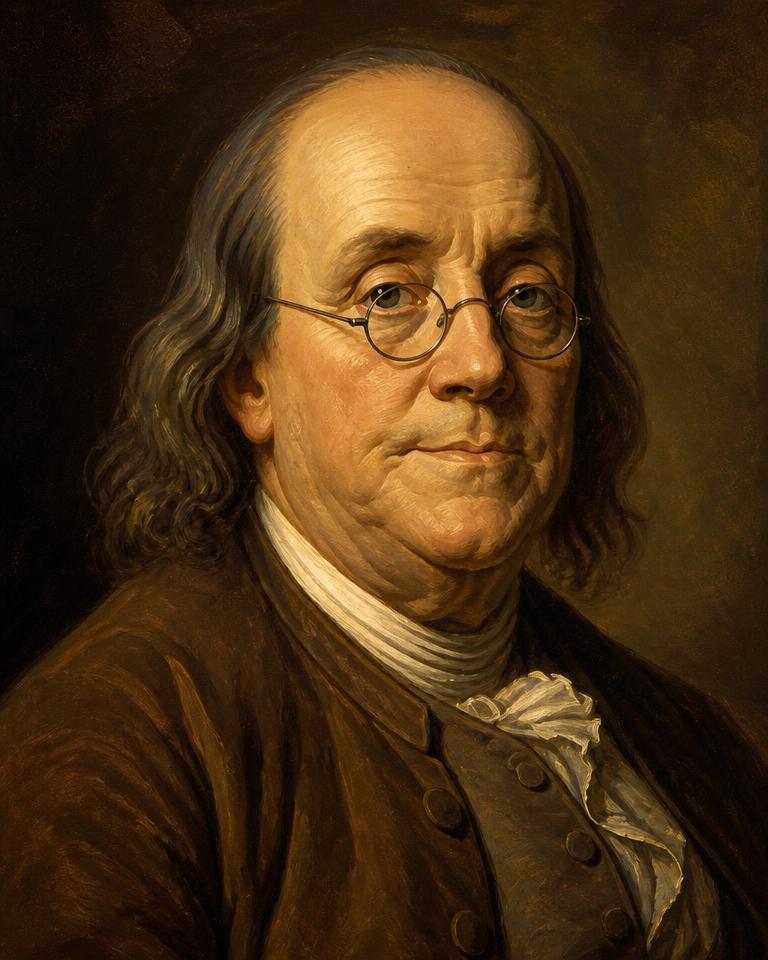
Quick Facts
- Years
- 1706 – 1790
- Category
- Scientists & Inventors
- Subcategory
- Electricity
- Nationality
- American
- Occupation
- Inventor & Statesman
Benjamin Franklin
1706 – 1790 · American · Inventor & Statesman
Audiobook

Life Lessons from Benjamin Franklin
Marcus Alden · 54 min
Benjamin Franklin was an American printer, writer, scientist, inventor, diplomat, and statesman whose long career connected the colonial world to the founding of the United States. Born in Boston in 1706 and largely self-educated, he built a successful printing business in Philadelphia before gaining international recognition for experiments showing that lightning was electrical.
Franklin helped create civic institutions—including a lending library, fire company, academy, hospital, and learned society—and improved colonial postal service. In politics, he promoted colonial cooperation, represented Pennsylvania in Britain, helped draft and sign the Declaration of Independence, secured the crucial French alliance during the Revolutionary War, negotiated peace with Britain, and participated in the Constitutional Convention.
His inventions and practical innovations included the lightning rod, Franklin stove, glass armonica, and bifocal-style spectacles. He refused to patent his inventions, arguing that useful discoveries should benefit others. Yet his life also contained serious contradictions: he was once an enslaver and profited indirectly from slavery through newspaper advertisements, then became an abolitionist late in life.
Franklin remains important because he embodied both the intellectual energy and the moral limitations of the Enlightenment-era Atlantic world. Scientists study his experimental reasoning, diplomats examine his work in France, civic leaders cite his institution-building, and historians continue to debate his ideas about empire, democracy, race, religion, and national identity.
Quick Facts
| Field | Details |
|---|---|
| Full Name | Benjamin Franklin |
| Common Name(s) | Benjamin Franklin; Ben Franklin |
| Born | January 17, 1706 (January 6, Old Style) |
| Died | April 17, 1790 |
| Age at Death | 84 |
| Birthplace | Boston, Province of Massachusetts Bay, British America |
| Nationality | British subject until American independence; American thereafter |
| Occupation | Printer, publisher, author, scientist, inventor, postmaster, diplomat, statesman |
| Historical Era | Enlightenment; colonial America; American Revolution; Early Republic |
| Famous For | Electricity experiments, lightning rod, civic institutions, Declaration of Independence, French alliance, Treaty of Paris, U.S. Constitution |
| Political Affiliation | No modern party affiliation; Pennsylvania Assembly politician, revolutionary, and Federalist-leaning supporter of the Constitution |
| Religion | Raised in Puritan Congregationalism; later expressed a rational, nonsectarian theism and supported religious toleration |
| Education | Boston Latin School and George Brownell's English school; largely self-educated; no college degree |
| Parents | Josiah Franklin and Abiah Folger Franklin |
| Spouse(s) | Deborah Read Franklin; common-law marriage beginning in 1730 |
| Children | William Franklin; Francis Folger Franklin; Sarah “Sally” Franklin Bache |
| Major Works | Poor Richard's Almanack; The Autobiography of Benjamin Franklin; “Experiments and Observations on Electricity”; “Information to Those Who Would Remove to America”; “Remarks Concerning the Savages of North America” |
| Major Achievements | Established major civic institutions; advanced electrical science; reorganized postal service; helped draft the Declaration; negotiated the French alliance and Treaty of Paris; signed the Constitution; became president of the Pennsylvania Society for Promoting the Abolition of Slavery |
Early Life
Benjamin Franklin was the fifteenth of Josiah Franklin's seventeen children and the youngest son. Josiah, an English-born candle and soap maker, had children by two wives; Benjamin's mother, Abiah Folger, came from Nantucket. The crowded artisan household taught thrift, labor, and cooperation, but possessed limited money for formal education.
Franklin briefly attended Boston Latin School and then a writing and arithmetic school run by George Brownell. His father initially considered preparing him for the ministry, but the expense made that impossible. At ten, Benjamin began working in the family business. He disliked candle making and read whenever he could.
At twelve he was apprenticed to his older brother James, who published the New-England Courant. Printing exposed him to books, public argument, and news from across the Atlantic. Because James would not readily publish his adolescent brother, Benjamin secretly submitted satirical essays under the name “Silence Dogood.” The fictional widow mocked vanity, educational shortcomings, and religious intolerance. Their popularity revealed Franklin's talent for adopting accessible voices.
The apprenticeship was contentious. James was jailed after offending Massachusetts authorities, while Benjamin temporarily managed the paper. Benjamin later recalled that his brother sometimes beat him. In 1723, at seventeen, he broke his indenture and left Boston—an act that opened his career but also violated prevailing legal and familial expectations.
He traveled through New York to Philadelphia, arriving with little money. Colonial America then consisted of separate British provinces with weak mechanisms for cooperation. Philadelphia's commercial growth, religious diversity, and Quaker traditions of toleration offered unusual opportunities to an ambitious printer.
Rise to Prominence
Franklin found work in Samuel Keimer's print shop and met Deborah Read, whose family lodged him. Pennsylvania governor William Keith promised support for a printing venture and sent Franklin to London in 1724. Keith failed to provide the expected letters and credit, leaving the young man stranded. Franklin worked in London printing houses, improved his technical skills, and returned to Philadelphia in 1726 with merchant Thomas Denham.
After Denham's death, Franklin returned to printing. In 1728 he entered business with Hugh Meredith; by 1730 he controlled the enterprise. He acquired the Pennsylvania Gazette in 1729 and transformed it into an influential, readable newspaper. He also printed government documents and circulated books and advertisements, including notices connected to slavery and the slave trade.
In 1727 Franklin organized the Junto, a discussion and mutual-improvement club of tradesmen and artisans. Its members debated morals, politics, and business while sponsoring practical improvements. The Junto helped generate the Library Company of Philadelphia in 1731, an early subscription library that gave members access to books they could not individually afford.
Franklin began publishing Poor Richard's Almanack in 1732 under the persona Richard Saunders. Its calendars, weather predictions, humor, and memorable maxims reached a broad audience. Many sayings were traditional rather than original, but Franklin's editing made them widely known.
His business expanded through printing partnerships in other colonies. By his early forties, Franklin had accumulated enough wealth to retire from daily management and concentrate on science and public service. His electrical experiments, communicated to scientific contacts in Britain, then transformed a respected colonial printer into an international celebrity.
Major Achievements
Building Civic Institutions
Franklin treated institutions as tools for solving shared problems. The Library Company broadened access to knowledge. He helped organize Philadelphia's Union Fire Company in 1736, supported a night watch and street improvements, and promoted the Pennsylvania Hospital, chartered in 1751. His proposal used conditional public matching funds to encourage private donations.
He also helped create the Academy and Charitable School of Philadelphia, opened in 1751 and ancestral to the University of Pennsylvania. The American Philosophical Society, founded in 1743 and reorganized in 1769, encouraged useful knowledge across the colonies. These organizations provided durable models of voluntary association and public-private cooperation.
Electrical Science and the Lightning Rod
During the 1740s and 1750s, Franklin conducted systematic experiments with static electricity. He introduced influential terminology such as “positive,” “negative,” “charge,” “conductor,” and “battery,” though not every term or concept was entirely his invention. His single-fluid theory was eventually superseded, but it helped organize electrical phenomena coherently.
Franklin proposed that lightning was an electrical discharge and designed experiments to test the idea. In 1752 a pointed-rod experiment at Marly-la-Ville in France confirmed his prediction. Franklin later described a kite experiment performed during a thunderstorm in Philadelphia. The kite did not need to be struck directly; such a strike would probably have been fatal. Charge collected through a wet string provided evidence of atmospheric electricity.
The lightning rod converted theory into protection for buildings. Franklin's electrical papers were published in London as Experiments and Observations on Electricity. The Royal Society awarded him the Copley Medal in 1753, and European universities granted honorary degrees. His work helped establish experimental science in British America.
Practical Inventions and Observation
Franklin devised an improved open stove intended to warm rooms efficiently while reducing smoke, though later stove makers refined the design. He created the glass armonica after hearing musical glasses in London. Its rotating glass bowls allowed performers to produce sustained, ethereal tones; composers including Mozart and Beethoven wrote for related instruments.
He used divided lenses for near and distant vision—the form associated with bifocals—and experimented with flexible urinary catheters for his brother John. He charted information about the Gulf Stream with assistance from mariners and his cousin Timothy Folger. Franklin generally did not patent inventions, explaining that society should receive useful innovations freely.
Colonial Cooperation and Postal Reform
Franklin became clerk of the Pennsylvania Assembly in 1736 and a member in 1751. As Philadelphia postmaster and later joint deputy postmaster general for British North America, he inspected routes, improved accounting, accelerated delivery, and expanded service. Under his administration the colonial postal system became more efficient and profitable.
At the Albany Congress of 1754 he proposed a Plan of Union for common defense and western affairs. Colonial assemblies and imperial officials rejected it, but it anticipated later arguments for intercolonial government. His “Join, or Die” cartoon, showing a segmented snake, became an enduring emblem of unity.
Independence and the Declaration
Franklin spent much of 1757–1775 in London as an agent for Pennsylvania and other colonies. He initially sought reform within the British Empire rather than independence. During the Stamp Act crisis, his testimony before Parliament in 1766 clearly explained colonial resistance and helped support repeal.
Relations deteriorated after Franklin transmitted private letters from Massachusetts governor Thomas Hutchinson and lieutenant governor Andrew Oliver to colonial contacts. Publication caused a scandal. In 1774 the Privy Council publicly humiliated Franklin, and he was dismissed from the postal service.
Returning to Philadelphia in 1775, Franklin joined the Second Continental Congress. He served on the five-member committee that prepared the Declaration of Independence and suggested edits to Thomas Jefferson's draft. He voted for independence and signed the Declaration in 1776.
French Alliance and Revolutionary Diplomacy
Congress sent Franklin to France in late 1776. His scientific fame, cultivated public image, sociability, and political judgment made him exceptionally effective. Working with Silas Deane and Arthur Lee amid rivalry and suspicion, he sought arms, loans, recognition, and military alliance.
The American victory at Saratoga strengthened his position. France signed treaties of amity and alliance with the United States in 1778. French money, troops, weapons, and naval power proved indispensable to American victory. Franklin did not achieve this alone, but his credibility was central to sustaining the relationship.
Treaty of Paris and Constitutional Convention
Franklin, John Adams, and John Jay negotiated the preliminary peace with Britain, signed in 1782; the definitive Treaty of Paris followed in 1783. Britain recognized American independence, and the United States obtained boundaries extending to the Mississippi River, subject to unresolved disputes and Indigenous claims ignored by the negotiators.
Back in Pennsylvania, Franklin served as president of the state's Supreme Executive Council from 1785 to 1788. At the Constitutional Convention of 1787, age and illness limited his speaking, but his prestige and conciliatory interventions encouraged compromise. He signed the Constitution despite reservations, judging unified support preferable to the uncertainties of continued disunion.
Leadership and Work
Franklin's leadership was pragmatic, collaborative, and institution-centered. He often began with a problem—scarce books, fires, poor streets, weak communications—and organized subscribers, committees, matching funds, or experiments to address it. He understood that durable organizations mattered more than individual generosity.
He made decisions through observation, correspondence, trial, and revision. In science he designed testable procedures; in diplomacy he watched public opinion and adapted his presentation. His plain clothing and fur cap in France were partly authentic habits and partly a politically useful image of republican simplicity.
Franklin built extensive networks among printers, merchants, scientists, politicians, and salon hosts. He could be charming, humorous, patient, and strategically ambiguous. These qualities strengthened negotiations, although colleagues such as John Adams sometimes considered him too accommodating or socially indulgent.
His strengths included curiosity, persuasive writing, financial practicality, tolerance, and an ability to translate ideas into institutions. Weaknesses included emotional distance from family, occasional evasiveness, vanity, and a willingness to navigate patronage systems while presenting himself as self-made. His flexibility could look like wisdom to allies and opportunism to critics.
Personal Life
Franklin formed a common-law marriage with Deborah Read in 1730. A formal ceremony was complicated by uncertainty over whether Deborah's absent first husband, John Rogers, was still alive. She managed the household and business during Franklin's long absences.
William Franklin, born around 1730, was Benjamin's acknowledged son, but William's mother's identity is not recorded. Benjamin and Deborah raised him. Their son Francis Folger died of smallpox in 1736 at age four, a loss Franklin deeply regretted; Franklin later wrote that the child had not been inoculated. Their daughter Sarah, called Sally, married Richard Bache and cared for her father late in life.
The Revolution divided Benjamin and William. William, royal governor of New Jersey, remained a Loyalist and was imprisoned by revolutionary authorities. Father and son never fully reconciled. Benjamin largely excluded William from his estate.
Deborah feared ocean travel and did not join Franklin abroad. She died in 1774 while he was in London, and he had not returned despite her declining health. Historians view this as one of the clearest personal costs of his public career.
Franklin enjoyed swimming, chess, music, conversation, and playful literary hoaxes. He cultivated friendships with women as well as men, especially in France. Evidence supports affectionate and flirtatious relationships, but many sensational claims about his sexual life go beyond what surviving records establish.
He became stout and suffered severely from gout, bladder stones, and related ailments. Pleurisy contributed to his death in Philadelphia on April 17, 1790.
Philosophy and Beliefs
Franklin's worldview reflected Enlightenment empiricism: claims should be tested against experience, and knowledge should improve human life. His famous plan for moral improvement listed thirteen virtues, including temperance, industry, sincerity, justice, and humility. He admitted that perfection eluded him and discovered that pride could attach itself even to apparent humility.
Religiously, he rejected some orthodox doctrines when young and described himself for a time as a deist. Later statements affirmed belief in one God, providence, moral responsibility, and an afterlife while avoiding strict denominational commitments. He donated to varied congregations and praised religion chiefly for encouraging virtue. At the Constitutional Convention he proposed prayer, though the convention did not adopt a regular practice.
Politically, Franklin evolved. He first imagined a strengthened British Empire in which colonists enjoyed equal rights. British policy and experience turned him toward republican independence. He favored representative government, civic participation, religious toleration, and social mobility, while distrusting hereditary privilege.
His economic language celebrated industry and frugality, but he was not merely an advocate of accumulating wealth. He argued that wealth created obligations and that public usefulness gave success its moral purpose. Late in life, his expanding understanding of universal liberty led him to active abolitionism.
Challenges and Controversies
Franklin's involvement with slavery is his most serious moral contradiction. He enslaved people in his household and printed advertisements for enslaved people and slave sales. His newspaper also published antislavery arguments, illustrating the contested environment without erasing his participation. Over time he freed those he held and changed his position. As president of the Pennsylvania abolition society, he petitioned Congress in 1790 to act against slavery and the slave trade. Some historians emphasize this genuine development; others stress that his reckoning came after years of benefit from the system.
His early essay “Observations Concerning the Increase of Mankind” used racialized language and expressed anxiety about non-English populations. Later writings showed greater respect for Native societies and condemned racial prejudice, but his record remains inconsistent. Like other imperial negotiators, he accepted territorial settlements that disregarded Indigenous sovereignty.
The Hutchinson letters affair remains disputed in ethical terms. Franklin believed the letters exposed officials who were misrepresenting Massachusetts and encouraging coercion. Critics accused him of violating private correspondence and inflaming conflict. His public interrogation before the Privy Council made reconciliation with British leadership less likely.
Family relationships also damaged his reputation. His prolonged absences burdened Deborah, and his bitter break with William mixed political principle with personal anger. In France, fellow commissioners accused one another of disloyalty, corruption, or incompetence. No persuasive evidence establishes that Franklin betrayed the American cause, but French and British intelligence operated around his household, and his openness created security risks.
Several popular Franklin stories are exaggerated. He did not “discover electricity,” and the exact execution and dating of his kite experiment depend largely on his own later account. His achievements remain substantial without the mythology.
Legacy
Franklin shaped American science, diplomacy, publishing, voluntary associations, and political culture. His career demonstrated that a colonial artisan could gain transatlantic authority through print, experiment, organization, and public service. The model was inspiring, though his favorable circumstances, networks, and business interests complicate the simple “self-made man” narrative.
His image appears on the United States $100 note despite his never having served as president. Philadelphia's Franklin Institute preserves and interprets his scientific legacy, while the Benjamin Franklin Museum and Franklin Court occupy the site of his former home. His grave at Christ Church Burial Ground remains a major historical site. Statues, schools, towns, counties, streets, awards, and institutions bear his name worldwide.
The University of Pennsylvania traces its origins to his academy, and the American Philosophical Society and Library Company of Philadelphia continue to operate. His papers support scholarship on the Revolution, the Enlightenment, print culture, slavery, and everyday life.
Modern assessments are necessarily mixed. Franklin's experimental habits, civic creativity, humor, and diplomacy remain exemplary. His involvement in slavery, racial assumptions, imperial ambitions, and family failures reveal the limits of his era and choices. Studying both sides produces a more useful Franklin: neither flawless sage nor empty symbol, but a gifted and changing human being whose actions materially affected world history.
Interesting Facts
- Franklin was the youngest son in a family of seventeen children.
- He used “Silence Dogood” as a teenage pseudonym.
- He arrived in Philadelphia at seventeen after fleeing his apprenticeship.
- He spent roughly eighteen months working as a printer in London during the 1720s.
- The Junto met for discussion and practical civic improvement.
- Poor Richard's Almanack appeared annually from 1732 to 1758.
- His “Join, or Die” design was among the earliest political cartoons printed in British America.
- The Royal Society awarded him the 1753 Copley Medal.
- He received honorary degrees from St Andrews and Oxford, contributing to the title “Dr. Franklin.”
- He was elected a Fellow of the Royal Society.
- He invented the glass armonica in 1761.
- Franklin wrote about using divided spectacles for different viewing distances.
- He was an enthusiastic swimmer and wrote about swimming instruction.
- He was inducted into the U.S. Chess Hall of Fame in recognition of his role in American chess history.
- He signed the Declaration of Independence, Treaty of Alliance with France, Treaty of Paris, and U.S. Constitution.
- He was the oldest delegate at the Constitutional Convention.
- Approximately 20,000 people reportedly joined his Philadelphia funeral procession.
- He left money to Boston and Philadelphia in trusts intended to grow and support apprentices and public projects.
Famous Quotes
- “There are three things extremely hard, Steel, a Diamond, and to know one's self.” — Poor Richard's Almanack (1750). The maxim presents self-knowledge as a demanding moral discipline.
- “Early to bed and early to rise, makes a man healthy, wealthy and wise.” — Poor Richard's Almanack (1735). Franklin popularized this older proverb as advice about disciplined habits.
- “He that can have Patience, can have what he will.” — Poor Richard's Almanack (1736). It reflects the almanac's emphasis on persistence rather than instant success.
- “Dost thou love Life? then do not squander Time; for that's the Stuff Life is made of.” — Poor Richard's Almanack (1746). The line connects time management with mortality.
- “They that can give up essential Liberty to obtain a little temporary Safety, deserve neither Liberty nor Safety.” — Pennsylvania Assembly reply to the governor (1755), associated with Franklin's drafting. Its original context was a dispute over taxation and defense, not every modern liberty-versus-security question.
- “We must, indeed, all hang together, or most assuredly we shall all hang separately.” — Traditionally attributed to Franklin at the signing of the Declaration. The wording appeared in later recollections and is not securely documented contemporaneously.
- “Our new Constitution is now established, everything seems to promise it will be durable; but, in this world, nothing is certain except death and taxes.” — Letter to Jean-Baptiste Le Roy (1789). Franklin used familiar proverbial ideas to comment on uncertainty.
- “I agree to this Constitution with all its faults, if they are such.” — Final speech to the Constitutional Convention (1787), delivered by James Wilson because Franklin was too weak to stand. It expressed practical support despite doubts.
- “For having lived long, I have experienced many instances of being obliged, by better information or fuller consideration, to change opinions even on important subjects.” — Constitutional Convention speech (1787). The passage makes intellectual humility a basis for compromise.
- “A Republic, if you can keep it.” — Attributed to Franklin in James McHenry's notes after the Constitutional Convention. The report is near-contemporary, though the precise conversational wording cannot be independently verified; it stresses citizens' responsibility for preserving republican government.
Timeline
- 1706 — Born in Boston on January 17 by the modern calendar.
- 1714–1716 — Receives brief formal schooling.
- 1718 — Apprenticed to his brother James as a printer.
- 1722 — Publishes the “Silence Dogood” essays anonymously.
- 1723 — Leaves Boston and settles in Philadelphia.
- 1724 — Travels to London after Governor Keith promises support.
- 1726 — Returns to Philadelphia.
- 1727 — Organizes the Junto.
- 1728 — Establishes a printing partnership with Hugh Meredith.
- 1729 — Acquires the Pennsylvania Gazette.
- 1730 — Begins common-law marriage with Deborah Read.
- 1731 — Helps found the Library Company of Philadelphia.
- 1732 — Begins Poor Richard's Almanack; daughter Sarah is born.
- 1736 — Son Francis dies; Franklin helps organize the Union Fire Company and becomes Assembly clerk.
- 1737 — Becomes postmaster of Philadelphia.
- 1743 — Proposes the American Philosophical Society.
- 1747–1748 — Conducts electrical research and withdraws from daily printing management.
- 1749–1751 — Promotes an academy that becomes the University of Pennsylvania.
- 1751 — Elected to Pennsylvania Assembly; helps establish Pennsylvania Hospital.
- 1752 — Reports the kite experiment; lightning rods spread.
- 1753 — Receives Copley Medal; becomes joint deputy postmaster general.
- 1754 — Publishes “Join, or Die” and presents the Albany Plan of Union.
- 1757 — Begins extended service in London as Pennsylvania's agent.
- 1761 — Develops the glass armonica.
- 1766 — Testifies before Parliament during the Stamp Act crisis.
- 1773–1774 — Hutchinson letters scandal; dismissed as deputy postmaster general.
- 1774 — Deborah Franklin dies.
- 1775 — Returns to Philadelphia and enters the Second Continental Congress.
- 1776 — Helps draft and signs the Declaration; sails to France.
- 1778 — Helps secure treaties with France.
- 1782 — Signs preliminary peace articles with Britain.
- 1783 — Signs the definitive Treaty of Paris.
- 1785 — Returns from France; becomes president of Pennsylvania's Supreme Executive Council.
- 1787 — Serves at and signs the Constitutional Convention; becomes president of Pennsylvania's abolition society.
- 1790 — Petitions Congress against slavery; dies April 17 in Philadelphia.
Frequently Asked Questions
What is Benjamin Franklin best known for?
Franklin is best known for combining scientific, civic, and political achievement. His electrical research established the relationship between lightning and electricity and led to the lightning rod. He founded or supported influential Philadelphia institutions and reorganized colonial postal service. During the Revolution, he helped draft the Declaration of Independence and, as the leading American diplomat in France, helped obtain an alliance essential to victory. He later negotiated peace with Britain and signed the Constitution.
Did Benjamin Franklin discover electricity?
No. Electricity had been observed and studied long before Franklin. His contribution was to develop influential concepts and experiments that clarified how electrical charge behaved. He argued that lightning was electrical, proposed tests, and devised the lightning rod. Calling him the “discoverer of electricity” erases earlier researchers such as William Gilbert and European experimenters who influenced him. Franklin's genuine achievement was advancing electrical theory and converting experimental knowledge into practical protection.
Did Franklin really fly a kite in a thunderstorm?
Franklin published an account describing a kite experiment that collected atmospheric charge through a wet string in 1752. Most historians accept that some version probably occurred, although documentation is less complete than for the French pointed-rod test performed after his proposal. The kite was not described as receiving a direct lightning strike. Modern reenactments are extremely dangerous because lightning can kill; the experiment should not be imitated.
What did the kite experiment prove?
The experiment supported Franklin's proposal that storm clouds contain electrical charge and that lightning belongs to the same class of phenomena as laboratory sparks. Charge traveled through the damp string and could produce a spark near a key. Its importance lay less in theatrical lightning than in linking atmospheric observation to testable electrical theory. That connection supported the practical use of grounded pointed rods to draw charge safely away from buildings.
What did Benjamin Franklin invent?
His best-known inventions and designs include the lightning rod, glass armonica, an improved room stove, and divided spectacles associated with bifocals. He also designed a flexible urinary catheter for his brother and investigated ship and postal improvements. Claims that he single-handedly invented every device later bearing his name should be treated cautiously: technology often develops through cumulative refinement. Franklin's distinctive method joined observation, experimentation, and practical utility.
Why did Franklin never become president?
The presidency began under the Constitution in 1789, when Franklin was eighty-three, seriously ill, and nearing death. He had already served as president of Pennsylvania's Supreme Executive Council, a position broadly comparable to governor under that state's system. There is no evidence that he mounted a campaign for the U.S. presidency. George Washington was the consensus choice. Franklin's fame on the $100 note sometimes causes people to assume he was president.
Was Benjamin Franklin self-educated?
Mostly. Franklin attended school for only about two years, but he had literacy training, a printing apprenticeship, access to books, and contact with skilled workers and intellectual networks. He taught himself through extensive reading, imitation of admired prose, debate, correspondence, and experiment. Calling him self-educated is accurate if it does not imply that he learned alone. Printers, family members, Junto colleagues, scientists, and patrons all contributed to his development.
What was Poor Richard's Almanack?
It was Franklin's annual publication, issued from 1732 through 1758 under the fictional author Richard Saunders. Like other almanacs, it offered calendars, astronomical and weather information, practical material, humor, and maxims. Franklin borrowed and adapted many sayings from earlier traditions, packaging them in a memorable voice. The publication generated income, enhanced his reputation, and helped associate him with thrift and industry. Later selections appeared as “The Way to Wealth.”
What was Franklin's role in the Declaration of Independence?
Congress appointed Franklin to the Committee of Five alongside Thomas Jefferson, John Adams, Roger Sherman, and Robert R. Livingston. Jefferson wrote the principal draft; Adams and Franklin reviewed it and suggested changes before Congress debated and revised the text. Franklin therefore did not write the Declaration by himself, but he contributed editorial judgment, voted for independence, and signed the final document. His prestige also strengthened the new nation's international credibility.
Why was Franklin important to the American Revolution?
His greatest wartime contribution was diplomatic. France supplied loans, weapons, troops, and naval force, all critical to American survival and victory. Franklin's international scientific reputation and skill in French society helped persuade officials and the public to support the United States. He also served in Congress, worked on national administration, and negotiated the peace settlement. His importance rested on coalition-building rather than battlefield command.
What was the Albany Plan of Union?
Franklin's 1754 plan proposed a president-general appointed by the Crown and a grand council selected through colonial assemblies. The body would coordinate defense, western affairs, and related finances. Neither colonial legislatures nor imperial authorities accepted it: some feared excessive royal power, while others feared excessive colonial autonomy. It was not a blueprint identical to the later Constitution, but it showed Franklin thinking early about continental cooperation.
What were Franklin's religious beliefs?
Franklin was raised in a Puritan environment but rejected parts of orthodox Christianity as a young man. He later affirmed belief in God, providence, moral accountability, and an afterlife while remaining skeptical about disputed doctrine. He supported religious toleration and donated to different denominations. Scholars often describe him as a deist or theistic rationalist, though his beliefs changed over time and do not fit perfectly into a single label.
Did Benjamin Franklin own enslaved people?
Yes. Franklin enslaved people in his household and benefited from a print economy that included advertisements for slave sales and fugitives. He later freed those he held and became an abolitionist. As president of the Pennsylvania Society for Promoting the Abolition of Slavery, he submitted a 1790 petition asking Congress to use its powers against slavery and the trade. His transformation was significant, but it does not cancel his earlier participation.
Why did Franklin quarrel with his son William?
William Franklin, Benjamin's acknowledged son, served as royal governor of New Jersey and remained loyal to Britain during the Revolution. Benjamin embraced independence, making their disagreement both political and personal. William was detained by revolutionary authorities and later left for Britain. Their efforts at reconciliation failed, and Benjamin left William only a small portion of his estate. Their rupture illustrates how the Revolution divided families as well as governments.
What was Franklin's role at the Constitutional Convention?
At eighty-one, Franklin was the convention's oldest delegate. Illness limited his mobility, and colleagues sometimes read his speeches. He supported compromise, proposed prayer during a difficult period, and urged delegates to sign the final Constitution even if they disliked parts of it. He did not design the entire system, but his prestige, moderation, and closing appeal for unanimity helped legitimize the convention's work.
How did Benjamin Franklin die?
Franklin died at his Philadelphia home on April 17, 1790, aged eighty-four. He had long suffered from gout and bladder stones, and accounts identify pleurisy and complications affecting his breathing near the end. He was buried beside Deborah at Christ Church Burial Ground. His funeral attracted an exceptionally large crowd, reflecting his standing as a civic leader, scientist, diplomat, and surviving founder.
Lessons We Can Learn
- Keep learning beyond formal education. Franklin's schooling ended early, but disciplined reading and writing built expertise. Lifelong learning remains valuable when credentials or opportunities are limited.
- Turn discussion into institutions. The Junto generated libraries and civic projects. Productive groups should connect conversation with measurable action.
- Test ideas. Franklin's electrical work relied on experiments rather than reputation alone. Evidence and revision improve decisions in science, business, and public policy.
- Make knowledge useful. The lightning rod transformed theory into protection. Innovation has greater public value when it solves real problems.
- Build coalitions. The French alliance resulted from shared interests, relationships, and timing. Major goals often require partners rather than individual brilliance.
- Communicate for the audience. Franklin shifted between scientific papers, satire, almanacs, and diplomacy. Clear communication begins with understanding readers and listeners.
- Accept correction. His constitutional speech admitted that better information had changed his views. Intellectual humility makes compromise and improvement possible.
- Examine moral contradictions. Franklin moved from enslaver to abolitionist. Change matters, but accountability requires acknowledging earlier harm rather than rewriting it.
- Do not neglect private duties. His public service came with painful family absences and estrangement. Achievement should not make relationships invisible.
- Design for the long term. Franklin founded organizations and trusts intended to outlive him. Durable structures can multiply an individual's contribution across generations.
Related Historical Figures
- George Washington — Revolutionary commander and Constitutional Convention president; Franklin supported the national project Washington came to lead.
- Thomas Jefferson — Principal drafter of the Declaration; Franklin reviewed and edited Jefferson's draft.
- John Adams — Fellow diplomat and peace commissioner; he respected Franklin's talents but often criticized his methods in France.
- William Franklin — Benjamin's son and New Jersey's Loyalist royal governor; their estrangement embodied the Revolution's family divisions.
- Deborah Read Franklin — Franklin's wife and business partner at home, whose labor sustained the household during his absences.
- David Hume — Scottish Enlightenment philosopher and Franklin acquaintance; their connection reflects Franklin's British intellectual networks.
- Joseph Priestley — Scientist and religious dissenter who knew Franklin and shared interests in experimental inquiry and reform.
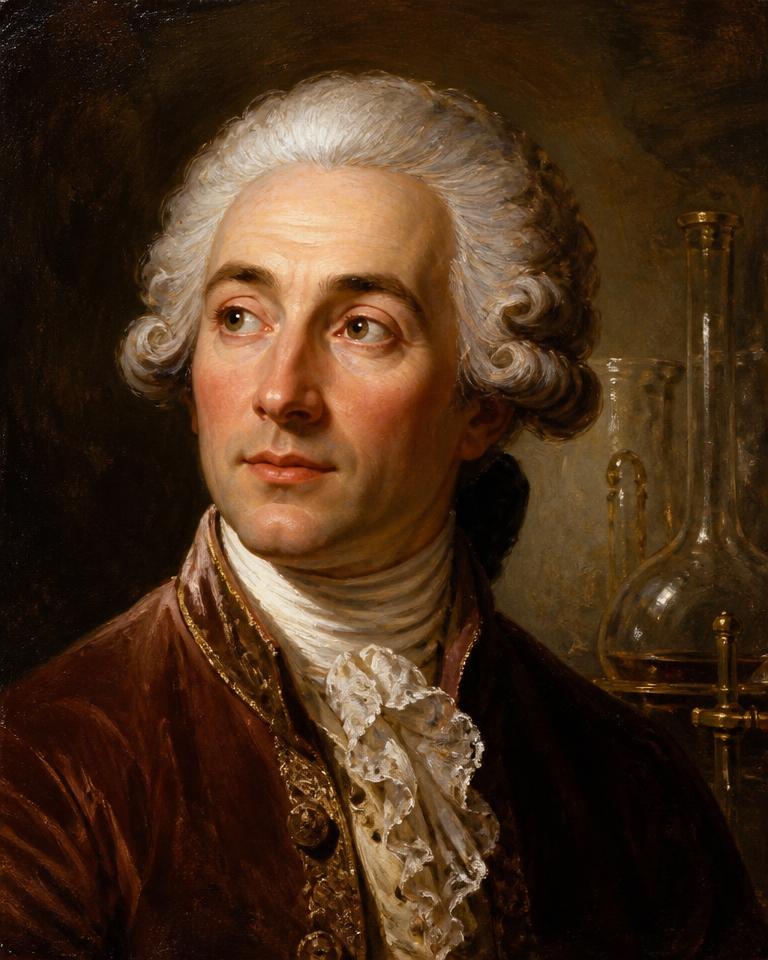
- Antoine Lavoisier — French scientist in Franklin's Paris circle; both represented the international culture of Enlightenment science.
- Marquis de Lafayette — French officer who supported the American cause; his service complemented the alliance Franklin helped secure.
- Thomas Paine — Political writer whom Franklin encouraged to emigrate to America; Paine later became a powerful advocate of independence.
Related Historical Figures