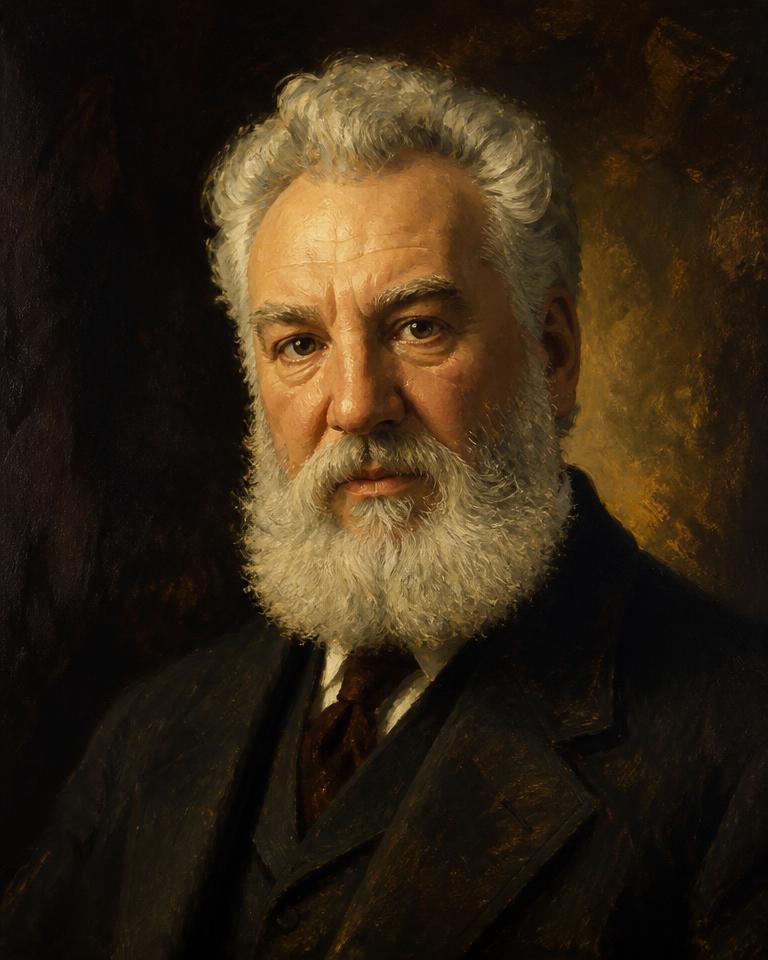
Quick Facts
- Years
- 1847 – 1922
- Category
- Scientists & Inventors
- Subcategory
- Telecommunications
- Nationality
- Scottish-American
- Occupation
- Inventor & Scientist
Alexander Graham Bell
1847 – 1922 · Scottish-American · Inventor & Scientist
Audiobook

Life Lessons from Alexander Graham Bell
Marcus Alden · 48 min
Alexander Graham Bell was a Scottish-born inventor, teacher, and experimental scientist whose work transformed human communication. Best known for securing the first U.S. patent for the telephone in 1876, Bell built upon years of research into speech, hearing, electricity, and the transmission of sound. His famous exchange with assistant Thomas Watson—“Mr. Watson—Come here—I want to see you”—demonstrated that intelligible speech could travel electrically through a wire.
Bell’s career extended far beyond one invention. He helped establish the Bell Telephone Company, pursued optical communication through the photophone, worked on sound recording and metal detection, and supported early aviation and hydrofoil research. He also taught deaf students and maintained lifelong ties to deaf education, although his advocacy of oralism and opposition to sign language and intermarriage among deaf people remain deeply controversial.
Bell worked across Britain, Canada, and the United States, combining scientific curiosity with practical experimentation. His notebooks reveal a restless investigator who moved between acoustics, engineering, medicine, heredity, and flight. He is still studied both for the enormous social consequences of telephony and for the ethical complexities of invention, disability education, patent ownership, and eugenic-era thought. Bell’s life illustrates how a celebrated innovator can leave a legacy that is technologically revolutionary yet historically mixed.
Quick Facts
| Field | Details |
|---|---|
| Full Name | Alexander Graham Bell |
| Common Name(s) | Alexander Graham Bell; A. Graham Bell |
| Born | March 3, 1847 |
| Died | August 2, 1922 |
| Age at Death | 75 |
| Birthplace | Edinburgh, Scotland |
| Nationality | British-born; later a naturalized U.S. citizen; closely associated with Canada |
| Occupation | Inventor, scientist, engineer, teacher of speech and deaf students |
| Historical Era | Industrial Revolution; Second Industrial Revolution |
| Famous For | Patenting and developing the telephone; work in acoustics, optical communication, aviation, and hydrofoils |
| Political Affiliation | No major party affiliation central to his career |
| Religion | Raised in a religious Protestant household; later associated with Unitarian thought |
| Education | Royal High School, Edinburgh; attended University of Edinburgh and University College London; no completed university degree |
| Parents | Alexander Melville Bell and Eliza Grace Symonds Bell |
| Spouse(s) | Mabel Gardiner Hubbard, married 1877 |
| Children | Elsie May Bell; Marian “Daisy” Hubbard Bell; two sons who died in infancy |
| Major Works | U.S. Patent No. 174,465; Visible Speech: The Science of Universal Alphabetics; papers on the photophone, deaf education, heredity, aviation, and hydrofoils |
| Major Achievements | Telephone patent and demonstrations; Bell Telephone Company co-founder; photophone; Volta Laboratory research; Volta Bureau; Aerial Experiment Association; HD-4 hydrofoil |
Early Life
Bell was born in Edinburgh on March 3, 1847, the second of three sons. His father, Alexander Melville Bell, was a prominent teacher of elocution who developed “Visible Speech,” a system of symbols representing the physical positions used to produce sounds. His grandfather, Alexander Bell, also taught speech. Bell therefore grew up in a household where voice, articulation, and communication were both family business and intellectual subjects.
His mother, Eliza Grace Symonds Bell, was severely hard of hearing. Bell communicated with her by speaking close to her forehead in a low, resonant voice and by using a manual finger alphabet. Her musical ability and hearing loss helped focus his attention on sound and deafness.
As a boy, Bell displayed mechanical curiosity. Around age 12, he and his friend Ben Herdman devised a machine that removed husks from wheat at the Herdman family mill. He also studied music and became an accomplished pianist. He formally added “Graham” to his name at age 11, reportedly because he wanted an additional name like his brothers.
Bell attended Edinburgh’s Royal High School but was not an outstanding conventional student. He later studied intermittently at the University of Edinburgh and University College London without earning a degree. Much of his education came through family instruction, reading, demonstrations, and laboratory experimentation.
He taught at Weston House Academy in Elgin, Scotland, and assisted his father’s work. In London, he investigated resonance and speech with encouragement from figures including philologist Alexander Ellis. Hermann von Helmholtz’s research on the physical basis of musical sound also influenced him, although Bell initially misunderstood aspects of Helmholtz’s apparatus. That misunderstanding helped prompt his own speculation that complex sounds might be transmitted electrically.
Tuberculosis shaped the family’s future. Bell’s brothers Melville James and Edward Charles died of the disease. Concerned for Alexander’s health, his parents emigrated with him in 1870 to Canada, settling at Tutelo Heights near Brantford, Ontario. Bell’s health improved there, and the family property became an important site for his sound experiments.
Rise to Prominence
Bell’s expertise in Visible Speech brought him to Boston in 1871. He demonstrated the system to teachers and instructed deaf students at institutions including the Boston School for Deaf Mutes, now the Horace Mann School. He also taught at the Clarke School in Northampton and the American Asylum for the Deaf in Hartford.
In 1872 he opened a Boston school for teachers of vocal physiology and speech. The following year, Boston University appointed him professor of vocal physiology and elocution. Among his private students was Mabel Hubbard, who had lost her hearing after scarlet fever in childhood. Her father, patent attorney and reformer Gardiner Greene Hubbard, became one of Bell’s principal financial supporters.
Bell was initially preoccupied with the “harmonic telegraph,” intended to carry multiple telegraph messages simultaneously over one wire by assigning each signal a different tone. Hubbard and leather merchant Thomas Sanders funded this research. Their expectations sometimes conflicted with Bell’s growing fascination with transmitting speech itself.
Bell relied on Thomas A. Watson, a skilled electrical designer and mechanic, to build experimental devices. In June 1875, while working on tuned reeds, Bell and Watson observed that a reed’s motion could produce a complex electrical current. The episode helped convince Bell that a single varying current might reproduce speech.
The patent race was intense. On February 14, 1876, Bell’s patent application was filed at the U.S. Patent Office; Elisha Gray submitted a caveat describing a liquid-transmitter concept that same day. Bell received U.S. Patent No. 174,465 on March 7. On March 10, he transmitted the celebrated request to Watson using a liquid transmitter: “Mr. Watson—Come here—I want to see you.”
Bell publicly demonstrated the telephone at the Centennial Exhibition in Philadelphia in June 1876. Attention from scientists and dignitaries, including Emperor Pedro II of Brazil and physicist William Thomson, later Lord Kelvin, helped turn the experimental instrument into an international sensation.
Major Achievements
The Telephone
Bell’s telephone converted sound vibrations into varying electrical signals and then reproduced them as audible sound. Earlier inventors had investigated electrical speech, and Antonio Meucci, Elisha Gray, Johann Philipp Reis, and others occupy important places in the telephone’s prehistory. Bell’s decisive achievement was obtaining a broad patent and helping produce a commercially workable system.
The Bell Telephone Company was established in 1877 by Bell, Hubbard, Sanders, and associates. Telephone exchanges, improved transmitters, switchboards, and long-distance networks soon expanded the technology beyond Bell’s early instruments. The telephone changed business, emergency communication, journalism, government, and domestic life while helping create the modern telecommunications industry.
The Photophone
In 1880, Bell and Charles Sumner Tainter developed the photophone, which transmitted speech on a beam of light. Sound caused a mirror to vibrate, modulating reflected sunlight; a selenium receiver converted those variations into an electrical signal and then sound.
Bell considered the photophone one of his greatest inventions. Its immediate usefulness was limited by clouds, atmospheric disturbance, and the difficulty of maintaining alignment. Nevertheless, it anticipated optical and wireless communication. Modern fiber-optic systems use different technology, but the photophone established the fundamental possibility of carrying voice through modulated light.
Volta Laboratory and Sound Recording
After receiving France’s Volta Prize for the telephone in 1880, Bell used the award money to support the Volta Laboratory in Washington, D.C. There, Bell, Tainter, and Chichester Bell improved sound-recording technology. Their graphophone used wax-coated cylinders and produced clearer, more practical recordings than some earlier systems.
The group’s patents contributed to the emerging recording industry. Bell also used part of his Volta resources to establish institutions supporting research and deaf education, demonstrating his tendency to reinvest recognition and income in experimental work.
The Induction Balance and Metal Detection
After President James A. Garfield was shot in 1881, Bell adapted an induction-balance device in an effort to locate the bullet. Tests showed that it could detect metal, but the attempt on Garfield was unsuccessful. Metal bed springs may have interfered, and physicians limited where Bell could search because they incorrectly believed the bullet was on one side of the body.
The episode did not save Garfield, who died after prolonged illness and medical complications. It nonetheless encouraged development of electromagnetic metal-detection techniques and illustrates both the possibilities and limits of technology under poor clinical assumptions.
Deaf Education and the Volta Bureau
Bell devoted substantial time and money to speech education. In 1887 he founded the Volta Bureau in Washington as a center for information about deafness. He also supported the American Association to Promote the Teaching of Speech to the Deaf, now the Alexander Graham Bell Association for the Deaf and Hard of Hearing.
His methods helped some deaf people develop spoken communication, but his opposition to sign language and preference for separate instruction from signing communities contributed to the marginalization of Deaf culture. This achievement must therefore be evaluated alongside its damaging institutional consequences.
Aviation and the Aerial Experiment Association
At Beinn Bhreagh, his estate near Baddeck, Nova Scotia, Bell experimented with tetrahedral kites. In 1907 he and Mabel Bell helped establish and finance the Aerial Experiment Association. Its members included Glenn Curtiss, Frederick “Casey” Baldwin, J. A. D. McCurdy, and U.S. Army observer Thomas Selfridge.
The association produced several aircraft. In 1909 McCurdy flew the Silver Dart from the ice at Baddeck Bay, making the first controlled powered flight in Canada and the British Empire. Bell’s role was primarily that of organizer, theorist, patron, and collaborator rather than pilot or sole designer.
Hydrofoils
Bell and Baldwin investigated hydrofoil boats, which lift their hulls partly clear of the water to reduce drag. Their HD-4, powered by aircraft engines, reached approximately 70.86 miles per hour in 1919, setting a world marine speed record.
The record stood for about a decade. Although Bell’s hydrofoil designs did not immediately become standard transportation, the work contributed to later high-speed marine engineering and reflected his lifelong interest in applying aerodynamic ideas to watercraft.
Scientific Institution Building
Bell was a founding member of the National Geographic Society in 1888 and served as its second president from 1898 to 1903. During this period, his son-in-law Gilbert Hovey Grosvenor developed National Geographic into a more visually compelling publication.
Bell also served the Smithsonian Institution as a regent and supported scientific communication. His influence came not only through devices but through networks connecting scientists, educators, patrons, and the public.
Leadership and Work
Bell led through enthusiasm, demonstration, and collaboration. He generated ideas rapidly, filled notebooks with sketches and questions, and depended on technically gifted partners to turn concepts into reliable apparatus. Watson, Tainter, Chichester Bell, Baldwin, McCurdy, and Curtiss were collaborators rather than incidental assistants.
His decision-making was exploratory. He often pursued several problems at once and accepted repeated failure as part of experimentation. This openness produced breakthroughs, but it could also scatter his attention. Bell was not always the best person to standardize or commercialize his inventions; Hubbard and other organizers played larger roles in creating the telephone business.
Bell valued communication, education, usefulness, and scientific exchange. He could be generous with resources, especially at Beinn Bhreagh and the Volta Laboratory. Mabel Bell also exercised major financial and organizational influence, notably by supporting the Aerial Experiment Association.
His principal weakness was a tendency to treat his own communication preferences as universally desirable. In deaf education, confidence in oral speech led him to undervalue sign language and Deaf community perspectives. His leadership was therefore creative and inspiring in laboratories but paternalistic in areas where he claimed authority over other people’s lives.
Personal Life
Bell married Mabel Gardiner Hubbard on July 11, 1877. She was 10 years younger than Bell and had been one of his students. Their marriage became a close intellectual and practical partnership. Mabel managed finances, encouraged his research, and pushed him to complete work when his attention wandered.
They had four children. Their daughters, Elsie May and Marian Hubbard, known as Daisy, survived to adulthood. Two sons, Edward and Robert, died in infancy. Bell was deeply attached to his family and maintained extensive correspondence when traveling.
In 1885 the Bells began acquiring land at Beinn Bhreagh near Baddeck on Cape Breton Island. It became their summer home, laboratory, farm, and eventually Bell’s final residence. He enjoyed sailing, sheep breeding, kite experiments, and the landscape around Bras d’Or Lake.
Bell was sociable but often became intensely absorbed in experiments. He kept unconventional working hours and sometimes worked late into the night. His friendships and professional relationships included Watson, Helen Keller, Anne Sullivan, Samuel Langley, and members of the scientific communities in Washington and Nova Scotia.
His health was fragile in youth because of fears of tuberculosis, but he lived to 75. Bell died from complications related to diabetes at Beinn Bhreagh on August 2, 1922. During his funeral, telephone service in parts of North America was briefly silenced in tribute.
Philosophy and Beliefs
Bell regarded science as a practical tool for overcoming barriers, especially barriers to communication. He believed observation and experiment should complement theory. His repeated movement among acoustics, medicine, flight, and engineering reflected confidence that principles discovered in one field could solve problems in another.
His religious outlook evolved. Raised in a Protestant environment, he later participated in Unitarian circles and expressed a broad, non-dogmatic spirituality. Religion was less central to his public identity than science, education, and family.
Politically, Bell was not known primarily as a partisan. He moved comfortably among business leaders, government officials, and scientific institutions. He embraced the era’s faith in progress but did not consistently examine who might be excluded by reforms presented as scientific.
That limitation is clearest in his ideas about deafness and heredity. Bell warned that residential schools and marriages between deaf people could contribute to a distinct “deaf variety of the human race.” Although he did not advocate compulsory sterilization and sometimes differed from more coercive eugenicists, his research and language participated in the eugenics movement. Modern scholars and Deaf historians emphasize that these views pathologized deaf identity and promoted social control.
Challenges and Controversies
Who Invented the Telephone?
Bell is conventionally credited with inventing the telephone because he secured the foundational U.S. patent and demonstrated intelligible electrical speech. Yet the invention emerged from international work by multiple experimenters. Antonio Meucci developed voice-communication devices earlier but did not obtain a full U.S. patent. Elisha Gray independently pursued a telephone and filed a caveat on the same day as Bell’s application.
Litigation repeatedly upheld Bell’s patents, but historians continue examining laboratory records and patent procedures. The strongest historical conclusion is not that Bell worked alone, nor that his contribution was fictitious, but that he made a crucial, legally decisive advance within a crowded field.
The Elisha Gray Patent Dispute
Gray’s caveat described a liquid transmitter, and Bell soon used a related arrangement in his successful March 10 experiment. Critics have alleged improper access to Gray’s filing. Defenders note that Bell had previously considered variable-resistance principles and that his patent claim was broader than one liquid-transmitter design.
Evidence has generated debate, but no consensus establishes that Bell simply stole the telephone. Patent examiner conduct, overlapping research, and later testimony remain subjects of scholarly scrutiny.
Oralism and Deaf Culture
Bell favored teaching deaf children to speak and lip-read and often opposed signing in schools. Supporters historically argued that speech could widen access to hearing society. Many Deaf scholars and activists counter that oralist policies suppressed natural sign languages, removed deaf teachers, isolated children, and treated deafness solely as a defect.
Bell’s personal devotion to individual students does not erase the institutional harm associated with his program. His legacy in deaf education is consequently contested more sharply than his work in telecommunications.
Eugenics and Heredity
Bell studied hereditary deafness and served as honorary president of the Second International Congress of Eugenics in 1921. He recommended measures intended to discourage the formation of a hereditary deaf population, including changing educational and social conditions that brought deaf people together.
Some biographers stress that he rejected compulsory laws and did not endorse the movement’s most violent policies. Critics respond that voluntary language and social reforms can still be coercive, especially when backed by powerful institutions. Both points matter, but they do not remove Bell from the history of eugenic thought.
Failed Experiments and Commercial Limits
Many Bell projects failed or had limited immediate application. The photophone was unreliable outdoors, giant tetrahedral kites proved structurally difficult, and the Garfield metal-detection effort failed clinically. Bell’s strength was not uninterrupted success but the willingness and financial capacity to test many ideas.
Legacy
Bell’s most visible legacy is the global telecommunications system. Modern smartphones differ radically from his apparatus, yet they inherit the central purpose of transmitting speech across distance. Telephone networks changed the pace and organization of modern life and laid infrastructure for later electronic communications.
His photophone is remembered as an early landmark in optical communication. Work at the Volta Laboratory influenced recorded sound, while projects at Beinn Bhreagh contributed to Canadian aviation and hydrofoil development. His institutional work helped expand public interest in geography and science.
Bell’s name survives in the Alexander Graham Bell National Historic Site in Baddeck, the Bell Homestead National Historic Site near Brantford, the Volta Laboratory and Bureau building in Washington, and numerous schools, streets, awards, and monuments. The scientific unit “bel,” and the decibel derived from it, honor Bell.
Commemoration has become more critical over time. Museums increasingly present Watson, Mabel Bell, Tainter, Baldwin, McCurdy, Gray, Meucci, and others as essential parts of the story. Deaf communities have also challenged celebratory narratives that ignore oralism and eugenics.
Bell remains important because his life joins technological innovation to difficult questions about patents, collaboration, disability, wealth, and authority. His record demonstrates that historical significance need not imply moral simplicity.
Interesting Facts
- Bell was born in Edinburgh but conducted much of his important work in Canada and the United States.
- He added “Graham” to his name when he was 11.
- His mother and wife were both deaf or severely hard of hearing.
- His first known invention was a wheat-husking device made during childhood.
- Bell became a Boston University professor without completing a university degree.
- His telephone patent was issued on March 7, 1876.
- The first clearly intelligible telephone sentence was transmitted three days later.
- Bell offered to sell telephone patent rights to Western Union, which declined.
- He initially answered the telephone with “Ahoy,” rather than “Hello.”
- The Volta Prize brought him 50,000 French francs.
- Bell’s photophone transmitted speech using light in 1880.
- He attempted to find the bullet in President Garfield with an electromagnetic device.
- He became a U.S. citizen in 1882.
- He was a founding member and later president of the National Geographic Society.
- He experimented with tetrahedral structures because their geometry combined lightness and strength.
- Mabel Bell financed the Aerial Experiment Association.
- The Silver Dart flew from frozen Baddeck Bay in 1909.
- Bell and Baldwin’s HD-4 set a marine speed record in 1919.
- Bell preferred to describe himself primarily as a teacher of the deaf rather than as a telephone inventor.
- Bell was buried at Beinn Bhreagh overlooking Bras d’Or Lake.
Famous Quotes
- “Mr. Watson—Come here—I want to see you.” Recorded in Bell’s notebook after the March 10, 1876 telephone experiment. It marks the first famous transmission of intelligible speech by his apparatus.
- “To tell the truth, I do not recognize the telephone as my invention.” Bell emphasized that electrical science drew on accumulated discoveries, illustrating his awareness of collective scientific development.
- “The day will come when the man at the telephone will be able to see the distant person to whom he is speaking.” Reported from Bell’s later reflections, this anticipated visual telecommunications, though not a detailed prediction of modern video calling.
- “The photophone is the greatest invention I have ever made, greater than the telephone.” Bell wrote enthusiastically about optical speech transmission in 1880, revealing that he valued scientific novelty above commercial success.
- “Leave the beaten track occasionally and dive into the woods.” Commonly documented from Bell’s advice to experimenters; it encourages exploration beyond established methods.
- “Observe, remember, compare.” Bell used this compact formulation for disciplined inquiry, emphasizing evidence and pattern recognition.
- “Before anything else, preparation is the key to success.” Widely attributed to Bell, but a reliable primary source is difficult to establish; treat the wording as disputed.
- “Concentrate all your thoughts upon the work at hand.” Frequently attributed to Bell, but its precise original source is uncertain; the attribution is not securely documented.
- “Great discoveries and improvements invariably involve the cooperation of many minds.” Often linked to Bell and consistent with his collaborative work, though versions vary and the exact wording should be treated cautiously.
- “God has strewn our paths with wonders and we certainly should not go through life with our eyes shut.” Attributed to Bell in biographical collections; it conveys his fusion of spiritual wonder and scientific curiosity, although quotation history is less secure than his laboratory record.
Timeline
- 1847 — Born in Edinburgh, Scotland, on March 3.
- 1858 — Adopts “Graham” as an additional name.
- c. 1859 — Builds a wheat-husking machine with Ben Herdman.
- 1863 — Begins teaching and studying speech at Weston House Academy.
- 1868 — Assists his father in London and studies anatomy and speech.
- 1870 — Emigrates with his parents to Brantford, Ontario.
- 1871 — Moves to Boston to teach Visible Speech.
- 1872 — Opens a school for vocal physiology and speech mechanics.
- 1873 — Becomes professor at Boston University.
- 1874 — Develops ideas linking the harmonic telegraph to speech transmission.
- 1875 — Works with Thomas Watson; observes a key tuned-reed effect.
- 1876 — Receives telephone patent; transmits intelligible speech; demonstrates at Philadelphia’s Centennial Exhibition.
- 1877 — Bell Telephone Company is formed; marries Mabel Hubbard.
- 1880 — Receives the Volta Prize and demonstrates the photophone.
- 1881 — Attempts to locate the bullet in President Garfield.
- 1882 — Becomes a naturalized U.S. citizen.
- 1885 — Begins establishing Beinn Bhreagh near Baddeck.
- 1887 — Establishes the Volta Bureau.
- 1888 — Helps found the National Geographic Society.
- 1890 — Helps found an association promoting speech teaching for deaf people.
- 1898 — Becomes president of the National Geographic Society.
- 1903 — Ends his National Geographic presidency.
- 1907 — Establishes the Aerial Experiment Association with collaborators.
- 1909 — The Silver Dart makes its historic Canadian flight.
- 1915 — Participates in the first ceremonial transcontinental telephone call.
- 1919 — HD-4 sets a world marine speed record.
- 1921 — Serves as honorary president of the Second International Congress of Eugenics.
- 1922 — Dies at Beinn Bhreagh on August 2.
Frequently Asked Questions
Who was Alexander Graham Bell?
Alexander Graham Bell was an inventor, scientist, speech teacher, and experimental engineer born in Scotland in 1847. He became famous for receiving the foundational U.S. telephone patent in 1876 and demonstrating intelligible electrical speech. He later worked on optical communication, sound recording, metal detection, airplanes, kites, and hydrofoils. Bell lived and worked in Britain, Canada, and the United States. His career also included extensive involvement in deaf education, an area now examined critically because he promoted oral speech while opposing sign language and some aspects of Deaf community life.
Did Alexander Graham Bell invent the telephone?
Bell made a decisive contribution and secured the patent that became the legal foundation of commercial telephony. However, the telephone did not spring from one person’s work alone. Antonio Meucci, Elisha Gray, Johann Philipp Reis, and others experimented with electrical voice transmission. Bell’s achievement combined sustained acoustic research, collaboration with Thomas Watson, a broad patent claim, successful demonstrations, and support from investors. It is accurate to call him a principal inventor of the practical telephone, provided that the phrase does not erase parallel work or the contributions of collaborators.
What did Bell say during the first telephone call?
Bell’s laboratory notebook records the words: “Mr. Watson—Come here—I want to see you.” He spoke them on March 10, 1876, in Boston, three days after his telephone patent was issued. Watson, working in another room, heard the sentence through the receiver and came to Bell. Accounts often call this the first telephone call. More precisely, it was Bell’s first famous successful transmission of clearly intelligible connected speech using his experimental apparatus.
Was Bell Canadian, Scottish, or American?
All three national settings formed part of his identity. Bell was born in Edinburgh and was British by birth. He moved to Canada with his family in 1870, performed important early experiments near Brantford, and later maintained a home and laboratory in Nova Scotia. He settled professionally in the United States and became a naturalized U.S. citizen in 1882. Calling him Scottish-born, Canadian-associated, and American-naturalized is more accurate than assigning his whole career to a single country.
Why did Bell study sound?
Bell came from a family of speech teachers. His father created Visible Speech, while his mother’s severe hearing loss made communication a personal concern. Bell taught articulation and vocal physiology and studied how the mouth, ear, and vibrating objects produce and receive sound. His harmonic-telegraph experiments led him toward the idea that electrical currents could reproduce the complex waves of speech. The telephone therefore developed from his work in acoustics and deaf education, not simply from an isolated attempt to improve the telegraph.
Who was Thomas Watson?
Thomas Augustus Watson was a machinist, electrical designer, and inventor who built much of Bell’s early experimental apparatus. Bell supplied acoustic knowledge and ideas, while Watson translated many concepts into functioning hardware and proposed improvements of his own. He received Bell’s first famous telephone sentence in 1876. Watson later helped demonstrate the technology and became associated with the Bell company before pursuing shipbuilding and other interests. Modern histories properly treat him as a vital collaborator rather than merely a laboratory assistant.
Who was Mabel Hubbard Bell?
Mabel Gardiner Hubbard Bell was Bell’s wife, former student, financial partner, and adviser. Deaf since childhood after scarlet fever, she married Bell in 1877. Her father, Gardiner Hubbard, financed Bell’s telephone research and helped organize the Bell Telephone Company. Mabel managed family resources, encouraged Bell’s experiments, and supplied substantial funding for the Aerial Experiment Association. She also developed community and agricultural projects around Baddeck. Her organizational contribution was essential to sustaining Bell’s later scientific career.
What was the Bell Telephone Company?
The Bell Telephone Company was formed in 1877 to manage and commercialize Bell’s telephone patents. Its early leadership and financing involved Gardiner Hubbard, Thomas Sanders, Bell, and associates. Bell himself was more interested in teaching and experimentation than in daily corporate management. Through reorganizations, licensing arrangements, exchanges, and network construction, the business became part of the corporate lineage leading to the American Bell Telephone Company and AT&T. Its growth helped turn the telephone from a scientific novelty into public infrastructure.
What was the photophone?
The photophone was a device Bell and Charles Sumner Tainter demonstrated in 1880. A speaker’s voice vibrated a mirror, varying a beam of reflected sunlight. A selenium receiver detected those variations and converted them back into sound. It sent speech without a wire, but clouds, atmospheric conditions, and alignment problems limited practical use. Bell regarded it as a major achievement because it showed that light could carry information. It is often described as a conceptual ancestor of optical communication, although modern fiber optics use much later technologies.
Did Bell invent the metal detector?
Bell developed an electromagnetic “induction balance” to locate the bullet lodged in President James Garfield after the 1881 assassination attempt. Related induction devices already existed, so saying that Bell single-handedly invented the metal detector oversimplifies the history. His apparatus detected metal in tests but failed to locate the bullet, probably because of interference from the bed’s metal springs and restrictions imposed by Garfield’s doctors. The experiment nonetheless became an important milestone in the development of practical metal-detection technology.
What was Bell’s role in aviation?
Bell studied lift, stability, and tetrahedral kite structures, then helped create the Aerial Experiment Association in 1907. He acted as organizer, theorist, and patron, with Mabel Bell providing crucial financing. Glenn Curtiss, Casey Baldwin, J. A. D. McCurdy, and Thomas Selfridge supplied engineering and piloting expertise. The association built several aircraft, including the Silver Dart, which McCurdy flew at Baddeck in 1909. Bell did not invent the airplane, but his team significantly advanced early aviation in North America.
What was the HD-4?
The HD-4 was an experimental hydrofoil developed principally by Bell and Casey Baldwin at Beinn Bhreagh. Hydrofoils use underwater lifting surfaces to raise the hull and reduce drag. Equipped with powerful aircraft engines, the craft reached about 70.86 miles per hour in 1919, establishing a world water-speed record. The achievement demonstrated the high-speed potential of hydrofoil design, although commercial adoption remained limited at the time. Bell’s marine research grew naturally from his studies of aerodynamic lift and lightweight structures.
What were Bell’s views on deaf education?
Bell supported teaching deaf children to speak and lip-read, believing this would help them participate in hearing society. He funded research and institutions devoted to oral education. However, he opposed the widespread use of sign language in schools and feared that separate Deaf institutions encouraged social isolation and intermarriage. Deaf historians argue that such policies suppressed sign languages, weakened Deaf culture, and denied children accessible communication. His intentions were often presented as benevolent, but the consequences and assumptions behind his approach remain strongly criticized.
Was Alexander Graham Bell a eugenicist?
Bell participated in eugenic-era research and organizations and was honorary president of the Second International Congress of Eugenics in 1921. His paper on the formation of a “deaf variety of the human race” examined hereditary deafness and discouraged conditions fostering marriage among deaf people. He did not promote compulsory sterilization and sometimes opposed coercive legislation. Nevertheless, his effort to shape reproduction and social association places him within eugenic thought. Historians distinguish degrees of coercion without minimizing the discriminatory assumptions involved.
Did Bell steal the telephone from Elisha Gray?
The claim remains controversial but is not established as simple theft. Gray filed a caveat on February 14, 1876, the same day Bell’s patent application was filed. Gray’s document included a liquid-transmitter method, and Bell soon tested a related device. Questions persist about whether Bell learned details through the Patent Office. Yet Bell had conducted extensive prior research and his patent covered broader principles. Courts upheld Bell’s claims, though legal victory does not settle every historical question. Scholars generally describe overlapping invention and disputed patent procedure rather than proven theft.
What connection did Bell have to Helen Keller?
Bell met Helen Keller as a child in 1886 after her parents sought advice about education. He recommended that the family contact institutions and specialists, helping set in motion the connection that brought Anne Sullivan to Keller. Keller remained Bell’s friend and dedicated The Story of My Life to him. She appreciated his personal kindness and support, even though later disability-rights perspectives criticize the oralist and eugenic assumptions present in parts of his broader work.
Where did Bell die and where is he buried?
Bell died on August 2, 1922, at Beinn Bhreagh, his estate near Baddeck, Nova Scotia. Diabetes contributed to his declining health. He was buried on the estate, on a hillside overlooking Bras d’Or Lake. Mabel Bell died several months later and was buried beside him. Beinn Bhreagh remains privately associated with the Bell family, while the nearby Alexander Graham Bell National Historic Site preserves artifacts and explains his experiments in communication, aviation, and marine engineering.
Why is Bell still important today?
Bell matters because the telephone accelerated the emergence of an interconnected world. His photophone anticipated communication by light, and his collaborative laboratories contributed to recording, aviation, and hydrofoil technology. Equally important, his life offers a case study in how inventions emerge through networks of researchers, funders, patents, and institutions. His involvement in oralism and eugenics also shows why technological brilliance does not guarantee ethical judgment. Studying both dimensions produces a more complete account of innovation and responsibility.
Lessons We Can Learn
- Study problems deeply. Bell’s command of acoustics grew from years of teaching speech. Expertise made his telephone experiments possible.
- Connect different fields. He linked physiology, music, electricity, and mechanics. Modern innovation likewise often occurs between disciplines.
- Collaborate with skilled partners. Watson and Tainter converted ideas into working machines. Credit and responsibility should be shared.
- Record experiments carefully. Bell’s notebooks preserve dates, designs, and results. Documentation supports discovery and historical accountability.
- Expect repeated failure. The photophone, kites, and early telephones required many trials. Useful research rarely follows a straight line.
- Demonstration matters. The Centennial Exhibition made the telephone understandable to influential audiences. A good invention must be communicated effectively.
- Institutions extend individual influence. Bell supported laboratories and scientific societies. Durable progress requires organizations, not only inspired individuals.
- Listen to people affected by reform. Bell’s oralism marginalized Deaf perspectives. Expertise should never replace meaningful participation by the community concerned.
- Separate scientific evidence from social prejudice. Bell’s heredity research absorbed eugenic assumptions. Data can be misused when human rights are ignored.
- Evaluate legacies honestly. Bell’s communication breakthroughs and discriminatory ideas coexist. Mature historical judgment can recognize achievement without suppressing harm.
Related Historical Figures
- Thomas A. Watson — Bell’s principal early technical collaborator and recipient of the first famous telephone message.
- Mabel Gardiner Hubbard Bell — Bell’s wife, adviser, financial manager, and supporter of his aviation work.
- Gardiner Greene Hubbard — Bell’s father-in-law, patent strategist, investor, and organizer of the telephone company.
- Elisha Gray — American inventor whose simultaneous patent filing became central to disputes over telephone priority.
- Antonio Meucci — Italian inventor whose earlier electrical voice devices form an important part of telephone history.
- Thomas Edison — Inventor of an improved carbon transmitter and a major participant in telephony and recorded sound.
- Charles Sumner Tainter — Bell’s Volta Laboratory collaborator on the photophone and graphophone.
- Glenn Curtiss — Engine designer, pilot, and member of Bell’s Aerial Experiment Association.
- J. A. D. McCurdy — Canadian aviation pioneer who piloted the Silver Dart at Baddeck.
- Helen Keller — Deafblind author and activist whom Bell advised and befriended, linking his personal generosity to his complicated disability legacy.
Watch and Learn
Alexander Graham Bell: The Telephone and More · Smithsonian Channel
Related Historical Figures