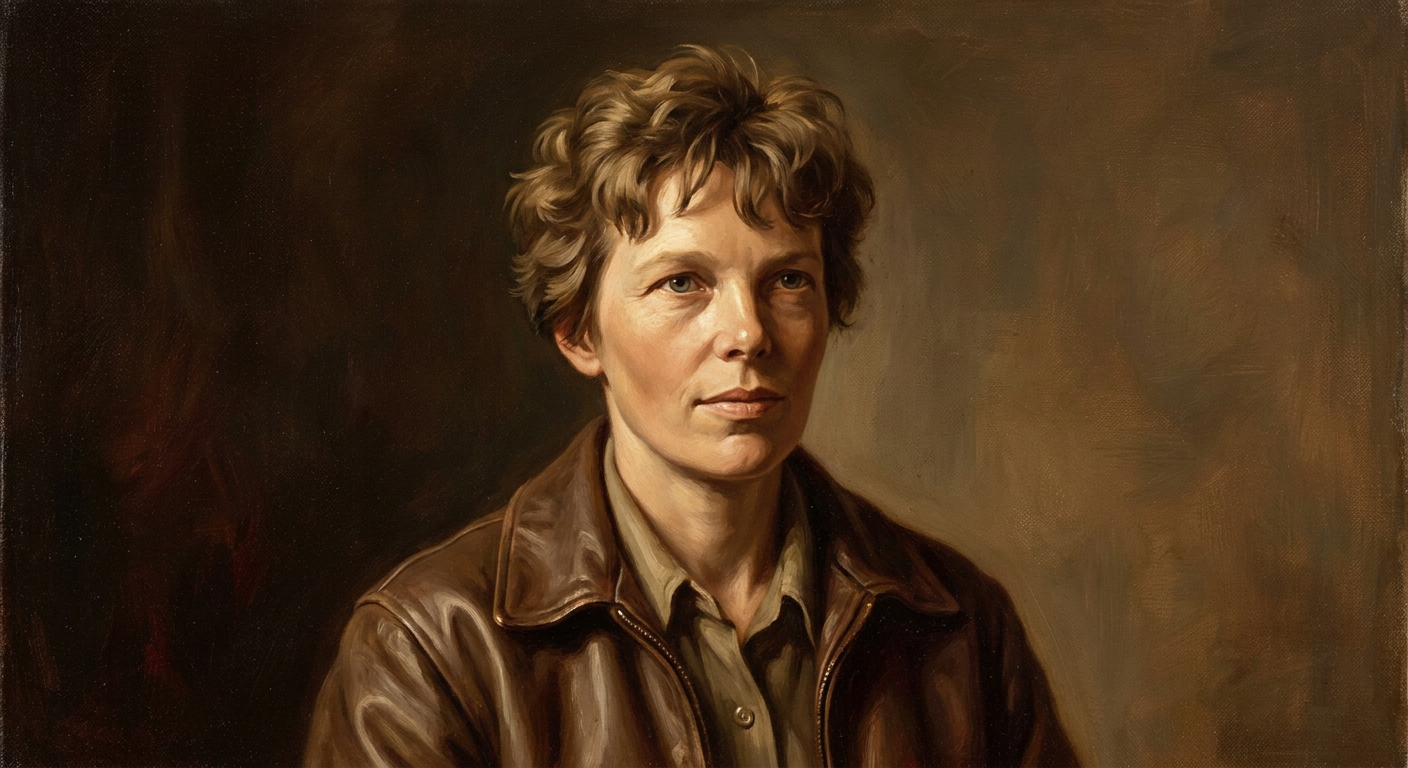
Quick Facts
- Years
- 1897 – 1937
- Category
- Explorers & Adventurers
- Nationality
- American
- Occupation
- Aviator, author, lecturer, editor, and women's rights advocate
Amelia Earhart
1897 – 1937 · American · Aviator, author, lecturer, editor, and women's rights advocate
Recommended Audiobooks
Listen next from Marcus Alden

Life Lessons from Christopher Columbus
Marcus Alden

Life Lessons from Sir Francis Drake
Marcus Alden
Amelia Earhart transformed aviation while the airplane was still a young and dangerous technology. A record-setting pilot, author, lecturer, editor, and advocate for women, she became one of the most recognizable public figures of the interwar era. Her fame began when she crossed the Atlantic as a passenger in 1928, but she refused to remain merely the celebrated woman aboard someone else’s aircraft. Four years later, she became the first woman to fly solo across the Atlantic Ocean, demonstrating exceptional endurance, technical competence, and courage.
Earhart continued breaking distance and speed records, including the first solo flight from Hawaii to the continental United States. Beyond these achievements, she used celebrity strategically. She promoted commercial aviation, encouraged women to enter male-dominated professions, supported the Equal Rights Amendment, and helped organize the Ninety-Nines, an international association of women pilots.
Her disappearance near Howland Island on July 2, 1937, during an attempted flight around the world, created an enduring historical mystery. No explanation has been conclusively proved, although most investigators believe her aircraft ran out of fuel and crashed into the central Pacific. Earhart remains important not simply because she vanished, but because of what she accomplished before she did: she widened the public imagination about who could fly, lead, explore, and take risks.
Quick Facts
| Field | Details |
|---|---|
| Full Name | Amelia Mary Earhart |
| Common Name(s) | Amelia Earhart; Lady Lindy, a press nickname she disliked |
| Born | July 24, 1897 |
| Died | Presumed July 2, 1937; legally declared dead January 5, 1939 |
| Age at Death | 39 |
| Birthplace | Atchison, Kansas, United States |
| Nationality | American |
| Occupation | Aviator, author, lecturer, editor, and advocate for women |
| Historical Era | Early aviation and the interwar period |
| Famous For | First woman to fly solo across the Atlantic; record-setting flights; unexplained disappearance |
| Political Affiliation | No major partisan identity; member of the National Woman’s Party and supporter of the Equal Rights Amendment |
| Religion | Raised in an Episcopal family; religion was not central to her public career |
| Education | Hyde Park High School; Ogontz School; premedical study at Columbia University; no degree |
| Parents | Samuel Edwin Stanton Earhart and Amelia Otis Earhart |
| Spouse(s) | George Palmer Putnam, married 1931 |
| Children | None |
| Major Works | 20 Hrs., 40 Min.; The Fun of It; Last Flight, published posthumously |
| Major Achievements | First woman to cross the Atlantic by air; first woman to fly solo across it; first person to fly solo from Hawaii to the continental United States; founding president of the Ninety-Nines |
Early Life
Amelia Mary Earhart was born in Atchison, Kansas, at the home of her maternal grandparents. Her father, Edwin Earhart, was a lawyer and railroad employee; her mother, Amy Otis Earhart, came from a prosperous local family. Amelia and her younger sister, Grace Muriel, enjoyed an unusually active childhood. They climbed trees, explored outdoors, collected insects, and engaged in pursuits conventionally reserved for boys.
Family life was less secure than it initially appeared. Edwin’s employment required repeated moves, and his struggles with alcohol contributed to financial and emotional instability. Amelia attended several schools before graduating from Hyde Park High School in Chicago in 1916. These disruptions helped make her independent, but they also left her wary of relying entirely on traditional family arrangements.
At the Ogontz School near Philadelphia, Earhart trained in subjects considered suitable for privileged young women. She left before graduating after visiting her sister in Toronto during the First World War. Disturbed by the injuries suffered by returning soldiers, she completed Red Cross training and worked as a nurse’s aide at Spadina Military Hospital. The experience exposed her to wartime aviation and strengthened her interest in medicine and public service.
After the war, Earhart briefly studied premedical subjects at Columbia University. She did not complete a degree, partly because family obligations repeatedly altered her plans. Her decisive encounter with flight came in California in December 1920, when pilot Frank Hawks took her on a short passenger ride. Earhart later recalled that she knew almost immediately that she wanted to fly.
She began lessons in 1921 with Neta Snook, one of the relatively few women working as professional pilots. Earhart paid for training through jobs that included photography, filing, and truck driving. She purchased a secondhand yellow Kinner Airster and named it the Canary. In 1922 she climbed to approximately 14,000 feet, establishing a women’s altitude record recognized by contemporary aviation authorities.
Rise to Prominence
Financial problems forced Earhart to sell the Canary, and for several years she pursued less glamorous work. After her parents separated, she moved east with her mother. She worked as a teacher and then as a social worker at Denison House, a settlement house serving immigrant families in Boston. Meanwhile, she remained involved in aviation, joined the Boston chapter of the National Aeronautic Association, and helped promote flying to the public.
Her turning point came in 1928. Publisher and promoter George Palmer Putnam helped organize a transatlantic flight financed by Amy Phipps Guest, who wanted a woman aboard. Earhart was selected partly because she was an experienced pilot, socially poised, and physically resembled Charles Lindbergh—a resemblance the press exaggerated through the nickname “Lady Lindy.”
On June 17–18, 1928, Earhart crossed the Atlantic in the Fokker F.VII Friendship with pilot Wilmer Stultz and mechanic Louis Gordon. The aircraft flew from Newfoundland to Wales in about 20 hours and 40 minutes. Earhart kept the flight log but did not pilot the plane. She candidly described herself as little more than baggage, ensuring that Stultz and Gordon received credit.
Nevertheless, she became the first woman to cross the Atlantic by airplane and an international celebrity. Putnam organized lectures, endorsements, and the book 20 Hrs., 40 Min. Earhart used these opportunities to finance further flying rather than treating the journey as a final achievement.
In 1929 she competed in the first Women’s Air Derby, later nicknamed the Powder Puff Derby. That year she also helped establish the Ninety-Nines, an organization formed by licensed women pilots. She became its first elected president in 1931. These activities shifted her image from symbolic passenger to working aviator and leader.
Major Achievements
The 1928 Transatlantic Crossing
Earhart’s flight aboard the Friendship gave women unprecedented visibility in international aviation. Although she was not the pilot, her role mattered in an era when many people considered long-distance flight unsuitable for women. She used the publicity to argue that women should receive training and opportunities rather than ceremonial recognition alone.
Solo Flight Across the Atlantic, 1932
On May 20, 1932, Earhart departed Harbour Grace, Newfoundland, in a red Lockheed Vega. She intended to reach Paris, following Lindbergh’s route, but ice, instrument trouble, strong winds, and a leaking fuel tank forced her to land near Londonderry in Northern Ireland after nearly 15 hours.
The imperfect landing did not diminish the achievement. Earhart became the first woman—and only the second person after Lindbergh—to fly solo nonstop across the Atlantic. She also became the first person to cross the Atlantic twice by air. The flight earned her the Distinguished Flying Cross, making her the first woman to receive it, as well as honors from France and the National Geographic Society.
Transcontinental Records
In August 1932, Earhart became the first woman to fly solo nonstop across the continental United States, traveling from Los Angeles to Newark. She later improved her own transcontinental time. These flights demonstrated that her Atlantic success was not an isolated event and encouraged confidence in long-distance aviation.
Hawaii-to-California Flight, 1935
On January 11–12, 1935, Earhart flew alone from Honolulu to Oakland. Previous attempts by other aviators had ended in death, making the Pacific route especially feared. She became the first person to complete the journey solo.
Later that year, she made notable solo flights from Los Angeles to Mexico City and from Mexico City to Newark. Her records helped present aviation as a practical network connecting distant cities rather than merely a field for stunts.
Work at Purdue University
In 1935 Purdue University appointed Earhart a visiting faculty member and career counselor for women. She advised students to prepare for independent careers and participated in aviation research. Purdue supporters helped finance the Lockheed Electra 10E that she used in her final expedition.
Advocacy and Institution Building
Earhart’s influence extended beyond cockpit records. Through the Ninety-Nines, lectures, articles, fashion ventures, and commercial endorsements, she created professional networks and public space for women in aviation. She did not erase discrimination, but she made exclusion harder to justify.
Leadership or Work
Earhart combined careful public communication with a willingness to accept physical risk. She studied weather information, consulted engineers, and relied on skilled navigators and mechanics. She also understood that record flights required sponsors, publicity, and dependable organizational support. Putnam managed much of the commercial machinery, while Earhart protected an image based on competence, modernity, and independence.
Her leadership style was encouraging rather than authoritarian. In the Ninety-Nines and at Purdue, she promoted cooperation among women who often competed for very limited aviation positions. She preferred practical opportunity over symbolic praise.
Her strengths included endurance, composure, persuasive speaking, mechanical familiarity, and an ability to recover from setbacks. Yet she was not infallible. The final world flight involved a highly demanding route, imperfect radio coordination, limited options for celestial navigation near Howland Island, and equipment that neither the crew nor supporting personnel always used consistently. Historians debate the relative weight of planning errors, communication failures, navigation difficulties, and bad luck.
Personal Life
Earhart married George Palmer Putnam on February 7, 1931. Putnam was a publisher, promoter, and organizer who had helped turn her 1928 crossing into a major public event. Before the wedding, Earhart wrote him a candid letter stating that she did not expect either partner to be bound by a rigid medieval code of faithfulness. She also asked to retain her own name and personal independence.
The marriage was both personal and professional. Putnam arranged lectures, publications, sponsorships, and publicity, while Earhart supplied the accomplishments and public voice at the center of their partnership. They had no children.
Friends described Earhart as warm, direct, energetic, and disciplined. She favored practical clothing, slept when travel allowed, and maintained a demanding lecture schedule to support expensive flights. She enjoyed poetry, photography, automobiles, and mechanical technology. Her slim build and short hair contributed to her modern public image, although press attention to her appearance sometimes overshadowed her professional ability.
Earhart experienced sinus problems and headaches, and an earlier illness had interrupted her education. Even so, she maintained a strenuous schedule involving flying, writing, teaching, product promotion, and frequent public appearances.
Philosophy or Beliefs
Earhart believed that ability should matter more than gender. She joined the National Woman’s Party and publicly supported the Equal Rights Amendment, a position that distinguished her from reformers who preferred labor laws offering women special protections. For Earhart, equal legal status and economic independence were central principles.
Her worldview emphasized action, preparation, and personal responsibility. She did not argue that danger should be ignored; she openly acknowledged it. Instead, she believed worthwhile goals could justify calculated risk when approached with training and discipline.
She also embraced technological modernity. Aviation, in her view, could shrink distances, encourage international understanding, and expand human possibility. Her religious upbringing was Episcopal, but she did not make theology a defining part of her public message. Her speeches and writings focused more often on courage, work, equality, and exploration.
Challenges and Controversies
Earhart worked in an industry that often treated women as novelties. Newspapers commented on clothing, appearance, and marital status while male pilots were more often assessed by technical achievement. She countered this by earning licenses, setting records, writing about aviation, and acknowledging the contributions of colleagues.
Commercialization drew criticism. She endorsed products, developed a clothing line, and participated in carefully managed publicity. Critics saw celebrity marketing; supporters argue that sponsorship was essential because aircraft, fuel, mechanics, and long-distance expeditions were extraordinarily expensive.
Her final expedition produced more serious debate. An initial westward attempt ended on March 20, 1937, when the Electra ground-looped during takeoff at Luke Field, Hawaii. The aircraft was badly damaged, but no one was killed. After repairs, Earhart and navigator Fred Noonan began an eastward attempt from Oakland and departed Miami publicly on June 1.
By July 2 they had reached Lae, New Guinea, with Howland Island as their next destination. The U.S. Coast Guard cutter Itasca waited near the tiny island. Earhart transmitted that fuel was running low and that the crew could not see the ship. Radio misunderstandings, incompatible procedures, uncertain bearings, and the difficulty of locating a low island in a vast ocean all contributed to the crisis. Contact ended that morning.
The official search found no aircraft. The dominant historical explanation is that the Electra exhausted its fuel and crashed into the ocean near Howland. The Nikumaroro hypothesis proposes that Earhart and Noonan landed on a reef and died as castaways. Artifacts and disputed interpretations of measurements taken from bones found in 1940 have kept that theory alive, but no item has been conclusively tied to the aviators. Claims of Japanese capture, espionage, or a secret return under another identity lack credible supporting evidence.
Legacy
Earhart’s disappearance became inseparable from her fame, but it should not obscure her achievements. She helped normalize the sight of women as pilots, technical professionals, lecturers, and institutional leaders. Later aviators—including military pilots, astronauts, and long-distance record setters—have cited her as an inspiration.
The Ninety-Nines continues to support women in aviation through education, scholarships, museums, and professional networking. The Amelia Earhart Birthplace Museum preserves her childhood home in Atchison, while the Amelia Earhart Hangar Museum displays a surviving Lockheed Electra 10-E of the same model as her final aircraft. Purdue University maintains extensive Earhart collections and commemorates her connection to the institution.
Airports, schools, scholarships, streets, bridges, monuments, and geographic features carry her name. Each July, Atchison hosts the Amelia Earhart Festival. Her story also remains central to discussions of search technology, historical evidence, media celebrity, and the barriers women face in technical fields.
Modern researchers continue searching for the Electra, but the mystery is only one part of her relevance. Earhart’s deeper legacy lies in her insistence that women should participate fully in shaping the technological future.
Interesting Facts
- Earhart saw an airplane at a state fair in 1908 but was not impressed by it.
- Her first influential flight did not occur until 1920, when she was 23.
- Her first instructor, Neta Snook, was a pioneering woman pilot and aviation business owner.
- Earhart slept in her leather flying clothes before her first solo flight to make them look worn.
- She named her yellow Kinner Airster the Canary.
- She worked as a social worker before becoming internationally famous.
- She was not the pilot of the 1928 transatlantic flight and publicly said so.
- She placed third in the heavy-aircraft division of the 1929 Women’s Air Derby.
- Earhart served as the first elected president of the Ninety-Nines.
- She married George Putnam only after declining several earlier proposals from him.
- She retained the name Amelia Earhart professionally after marriage.
- Her 1932 Atlantic flight ended in a Northern Irish pasture rather than Paris.
- Congress awarded her the Distinguished Flying Cross, the first given to a woman.
- She carried tomato juice during some long flights because it was practical to drink in turbulent conditions.
- Purdue University students and supporters helped fund her Lockheed Electra.
- Fred Noonan, not Earhart, was responsible for celestial navigation on the final expedition.
- Earhart and Noonan completed roughly 22,000 miles of their world route before disappearing.
- The United States conducted one of its most expensive air-and-sea searches to that date.
- A California court legally declared Earhart dead in 1939.
- No authenticated wreckage from her Electra has been publicly confirmed.
Famous Quotes
- “Please know I am quite aware of the hazards. I want to do it because I want to do it.” — From a letter to George Putnam before the final flight. It shows that Earhart recognized, rather than denied, the expedition’s danger.
- “Women must try to do things as men have tried.” — Published in Last Flight. The statement summarizes her belief that women deserved the opportunity to attempt difficult work even when failure was possible.
- “When they fail, their failure must be but a challenge to others.” — The continuation of the preceding passage, encouraging later women to learn from unsuccessful attempts rather than accept exclusion.
- “Courage is the price that life exacts for granting peace.” — From her poem “Courage.” Earhart presented bravery as the cost of living without being controlled by fear.
- “Flying may not be all plain sailing, but the fun of it is worth the price.” — Associated with her aviation writing and her realistic view that pleasure and difficulty could coexist.
- “I have often said that the lure of flying is the lure of beauty.” — Published in Last Flight. It conveys her aesthetic fascination with flight, not merely her interest in records.
- “Preparation, I have often said, is rightly two-thirds of any venture.” — From her published reflections on flying. It highlights the planning behind achievements often portrayed simply as daring.
- “The woman who can create her own job is the woman who will win fame and fortune.” — From Earhart’s public commentary on women’s careers, reflecting her emphasis on economic initiative.
- “Adventure is worthwhile in itself.” — Widely documented in Earhart’s writings and public image; it concisely expresses her view that exploration had value beyond prizes.
- “Never interrupt someone doing what you said couldn’t be done.” — Frequently attributed to Earhart, but no secure primary source has been established; the attribution should therefore be treated as disputed.
Timeline
- 1897 — Born in Atchison, Kansas, on July 24.
- 1908 — Saw her first airplane at the Iowa State Fair.
- 1916 — Graduated from Hyde Park High School in Chicago.
- 1917–1918 — Served as a nurse’s aide at Spadina Military Hospital in Toronto.
- 1919 — Began premedical study at Columbia University.
- 1920 — Took her first passenger flight with Frank Hawks.
- 1921 — Began flying lessons with Neta Snook and bought the Canary.
- 1922 — Set a women’s altitude record of approximately 14,000 feet.
- 1923 — Received an international pilot’s license from the Fédération Aéronautique Internationale.
- 1928 — Became the first woman to cross the Atlantic by airplane.
- 1929 — Competed in the Women’s Air Derby and helped establish the Ninety-Nines.
- 1931 — Married George Putnam and became president of the Ninety-Nines.
- 1932 — Became the first woman to fly solo nonstop across the Atlantic.
- 1932 — Completed the first solo nonstop transcontinental flight by a woman.
- 1935 — Became the first person to fly solo from Hawaii to the continental United States.
- 1935 — Joined Purdue University as a visiting faculty member and counselor.
- 1936 — Took delivery of the Lockheed Electra intended for a world flight.
- March 1937 — First world-flight attempt ended with a takeoff accident in Hawaii.
- June 1937 — Began a second, eastward world-flight attempt from Miami.
- July 2, 1937 — Disappeared with Fred Noonan near Howland Island.
- July 19, 1937 — The official naval search ended without finding the aircraft.
- 1938 — Last Flight, assembled from her writings, appeared posthumously.
- 1939 — Legally declared dead by a California court.
Frequently Asked Questions
1. What was Amelia Earhart most famous for?
Earhart was most famous for becoming the first woman to fly solo nonstop across the Atlantic Ocean. She completed the journey in May 1932, flying from Newfoundland to Northern Ireland. She also became the first person to fly solo from Hawaii to the continental United States. Her prominence came from both her records and her skillful use of publicity to promote aviation and women’s equality. Her 1937 disappearance intensified public interest, but her established achievements had already made her internationally important.
2. Was Amelia Earhart the first woman pilot?
No. Women had flown before Earhart, and several earned licenses before she did. French aviator Raymonde de Laroche became the first woman in the world to receive a pilot’s license in 1910, while Harriet Quimby became the first licensed American woman pilot in 1911. Earhart’s distinction came from particular long-distance records, especially her solo Atlantic crossing, and from her international visibility. She also strengthened professional networks for women pilots through the Ninety-Nines.
3. Did Earhart pilot the aircraft during her first Atlantic crossing?
No. During the 1928 flight of the Friendship, Wilmer Stultz served as pilot and Louis Gordon as mechanic and copilot. Earhart kept records and was the expedition’s female representative, but she did not control the aircraft. She openly acknowledged this, joking that she had been carried like a sack of potatoes. Her honesty increased her determination to make an Atlantic flight based on her own skill, which she accomplished alone four years later.
4. Why was her 1932 Atlantic flight so difficult?
Earhart faced darkness, fatigue, freezing conditions, strong winds, mechanical trouble, and ice on the aircraft. A damaged exhaust system sent flames near the fuselage, while a leaking fuel gauge made fuel management uncertain. She had planned to reach Paris but landed in a field near Londonderry, Northern Ireland. Despite missing her intended destination, she had crossed the Atlantic solo and nonstop in nearly 15 hours. The achievement demonstrated both endurance and the ability to respond sensibly to deteriorating conditions.
5. Who was Fred Noonan?
Frederick Joseph Noonan was an experienced navigator who had worked on Pan American Airways’ Pacific routes. He possessed valuable knowledge of celestial navigation, which determines position by observing the sun, stars, and horizon. Noonan accompanied Earhart on the final world-flight attempt and was responsible for long-range navigation. Locating Howland Island was exceptionally difficult because it was tiny, isolated, and surrounded by open ocean. Noonan disappeared with Earhart on July 2, 1937.
6. What was Earhart trying to achieve in 1937?
Earhart intended to circle the globe near the equator, producing one of the longest possible around-the-world routes. Other aviators had already flown around the world, so she was not attempting the first global flight of any kind. Her planned route was distinctive for its equatorial distance and demanding ocean crossings. She also expected the expedition to support research, publicity, writing, and aviation education. She and Noonan had completed most of the route when they vanished near Howland Island.
7. What happened on the flight to Howland Island?
Earhart and Noonan left Lae, New Guinea, in a heavily fueled Lockheed Electra on July 2, 1937. The Coast Guard cutter Itasca waited near Howland Island and attempted radio contact. Earhart reported that she could not see the ship and that fuel was running low. Although the Itasca heard several transmissions, reliable two-way communication was never established. Her final clearly accepted message described flying along a north-south position line. The Electra was not seen again.
8. What is the most likely explanation for her disappearance?
Most aviation historians and official investigators favor the “crash and sink” explanation: Earhart and Noonan failed to locate Howland Island, exhausted their fuel, and came down in the Pacific. This theory fits their radio reports and the known difficulty of the navigation problem. However, no confirmed wreckage has settled the matter. An alternative argues that they reached Nikumaroro and survived temporarily as castaways, but the archaeological and forensic evidence remains inconclusive. Certainty is impossible without authenticated physical evidence.
9. Was Earhart captured by Japan?
There is no reliable evidence that Japanese forces captured Earhart and Noonan. Versions of the claim place them in the Marshall Islands or Saipan and sometimes portray the flight as an espionage mission. Researchers have not found contemporary military records, authenticated photographs, aircraft remains, or consistent eyewitness evidence supporting these stories. Some memories were recorded decades later and conflict with the documented route. Historians generally classify Japanese-capture theories as unsupported rather than equally plausible alternatives.
10. Could Earhart have survived on Nikumaroro?
It is possible in principle, and researchers have identified circumstantial clues on Nikumaroro, formerly Gardner Island. These include signs of a historical castaway camp and objects dating from the general period. Bones discovered in 1940 were initially judged male and were later lost; modern reanalyses of their recorded measurements have produced conflicting conclusions. No object has been definitively connected to Earhart, Noonan, or the Electra. The hypothesis remains researched but unproved.
11. Why could the Itasca not guide her to Howland Island?
Several problems overlapped. Earhart and the ship did not establish sustained two-way voice communication, and some planned radio-direction-finding procedures were incompatible or misunderstood. Earhart apparently heard at least one signal but could not obtain a dependable bearing. The Electra’s radio setup, frequencies, antenna arrangements, atmospheric conditions, and crew procedures have all been examined. Historians disagree about which failure mattered most, but the result was that the ship could hear Earhart without successfully directing her to the island.
12. Was Earhart a skilled pilot?
The record supports describing Earhart as a capable and exceptionally experienced long-distance pilot. She completed multiple difficult solo flights and survived serious mechanical and weather problems through disciplined decision-making. She was not regarded by every contemporary as the finest technical pilot of her generation, and celebrity sometimes magnified her status. Nevertheless, dismissing her as merely a publicity creation ignores documented records, licenses, competitive flying, and years of practical experience. Skill and effective promotion both contributed to her career.
13. How did Earhart support women’s rights?
Earhart challenged gender restrictions through both public statements and practical institution building. She supported the Equal Rights Amendment, belonged to the National Woman’s Party, counseled women at Purdue University, and urged employers to judge women by competence. Through the Ninety-Nines, she helped women pilots exchange information and develop professional support. Her approach emphasized equal opportunity and economic independence. Some women reformers disagreed with her support for identical legal treatment because they feared losing workplace protections, reflecting a genuine debate within feminism.
14. What books did Earhart write?
Earhart wrote 20 Hrs., 40 Min., describing the 1928 Atlantic crossing and her early aviation experiences, and The Fun of It, a broader account of flying and women in aviation. She also wrote magazine articles, newspaper columns, speeches, and instructional commentary. Last Flight appeared after her disappearance and was assembled by George Putnam from dispatches, letters, notes, and other material. It therefore preserves her words but should not be treated as a manuscript she personally completed for publication.
15. Why was Earhart legally declared dead in 1939?
A declaration of death was necessary to settle her estate and related legal matters after an extensive search had failed. On January 5, 1939, a California court declared her legally dead, using July 2, 1937, as the presumed date. The ruling did not establish exactly how or where she died. It formally recognized the overwhelming likelihood that she had perished during the Howland Island flight. Putnam had initially resisted an immediate declaration while private search efforts continued.
16. Did Earhart have children?
Earhart had no biological children. George Putnam had two sons from his earlier marriage, David Binney Putnam and George Palmer Putnam Jr., making Earhart their stepmother. Her career involved extended travel, financial risk, lecturing, writing, and record flights. She resisted the assumption that marriage required surrendering professional independence. Her premarital letter to Putnam makes clear that she wanted their relationship to preserve space for separate work and identities, an unconventional position in the early 1930s.
Lessons We Can Learn
- Opportunity should follow ability. Earhart sought licenses and records rather than asking for praise alone. The modern lesson—an interpretation of her example—is to pair demands for inclusion with access to training and responsibility.
- Give collaborators proper credit. She emphasized that Stultz and Gordon flew the Friendship. Accurate acknowledgment builds trust and preserves historical fairness.
- Preparation does not eliminate risk. Her successful flights required planning, yet the 1937 expedition still failed. Modern projects should prepare carefully without assuming uncertainty can disappear.
- A setback need not end a career. Earhart sold her first aircraft and spent years outside professional flying before returning. Interrupted progress is not necessarily permanent defeat.
- Public visibility can serve a larger purpose. She converted celebrity into support for women’s careers and aviation. Influence is most durable when connected to institutions and opportunities.
- Honesty can strengthen credibility. Earhart admitted she had not piloted the 1928 crossing. Correctly describing one’s role is more valuable than claiming unearned achievement.
- Networks matter. The Ninety-Nines gave isolated women pilots a professional community. Talent develops more effectively when people can share knowledge and support.
- Technology requires communication systems. The Howland failure involved more than aircraft performance; radio procedures and coordination were crucial. Complex work depends on teams and compatible systems.
- Challenge conventions thoughtfully. Earhart questioned expectations surrounding work, marriage, and gender while building demonstrable competence. Social change is strengthened by practical alternatives.
- Separate evidence from an appealing story. The disappearance has generated dramatic theories, but none should outrank verified facts without proof. This is a modern historical lesson grounded in the uncertain evidence.
Related Historical Figures
- Charles Lindbergh — His 1927 solo Atlantic flight preceded Earhart’s and shaped press comparisons with her.
- Neta Snook — Earhart’s first flying instructor and an important early woman aviator.
- George Palmer Putnam — Earhart’s husband, publisher, expedition organizer, and publicity manager.
- Fred Noonan — Navigator on her final world-flight attempt and fellow missing crew member.
- Wilmer Stultz — Pilot of the 1928 Friendship transatlantic flight.
- Louis Gordon — Mechanic and copilot aboard the Friendship.
- Amy Phipps Guest — Wealthy sponsor whose proposed expedition led to Earhart’s first Atlantic crossing.
- Eleanor Roosevelt — Friend of Earhart who shared interests in women’s public leadership and aviation.
- Harriet Quimby — First licensed American woman pilot and an important predecessor.
- Jacqueline Cochran — Record-setting pilot and later leader of women military aviators, sometimes a competitor and sometimes an ally within aviation.
Watch and Learn
Recommended video: Amelia Earhart - First Woman to Fly Alone Across the Atlantic by Biography. Approximate duration: 3 minutes.
This concise educational profile offers a clear visual introduction to Earhart’s major records, public influence, and disappearance. It is especially useful as a starting point for students, although viewers should use detailed museum and archival sources for the continuing debate about her final flight.
Watch and Learn
Amelia Earhart - First Woman to Fly Alone Across the Atlantic · Biography
Related Historical Figures