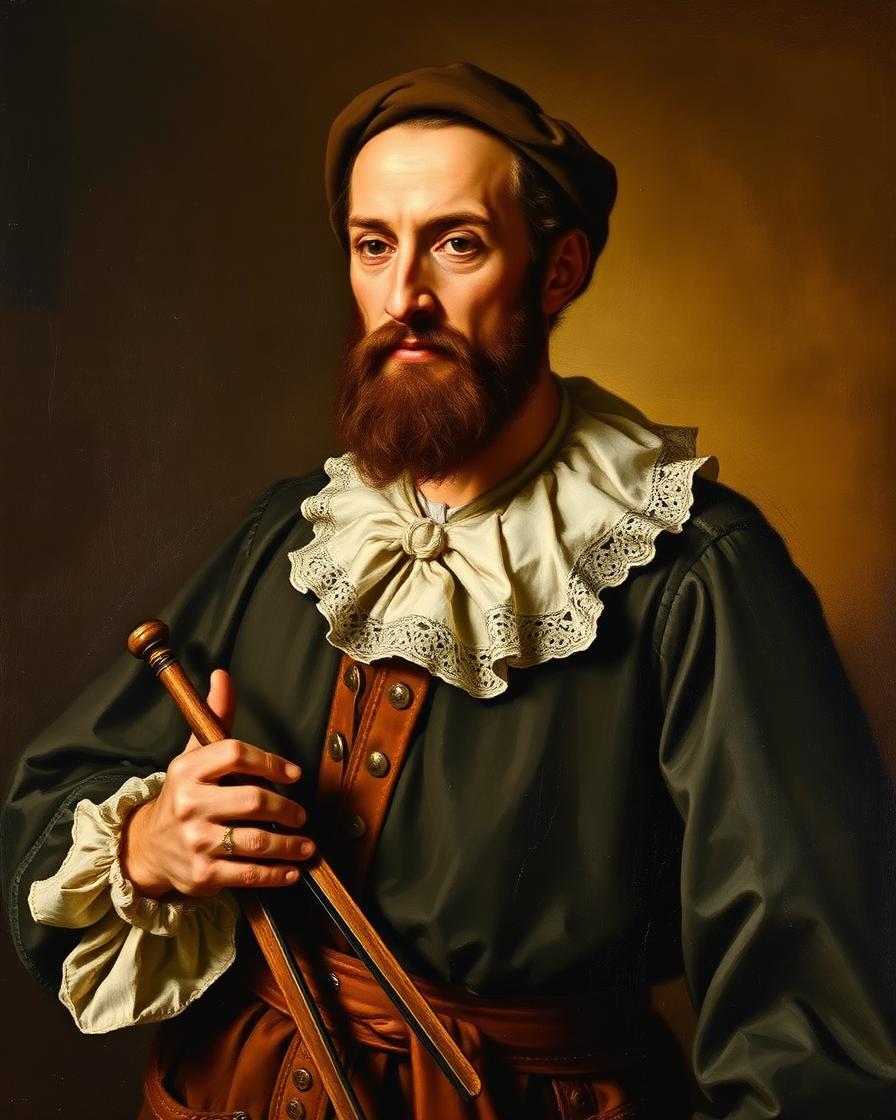
Quick Facts
- Years
- 1454 – 1512
- Category
- Explorers & Adventurers
- Nationality
- Florentine
- Occupation
- Navigator & Cartographer
Amerigo Vespucci
1454 – 1512 · Florentine · Navigator & Cartographer
Audiobook

Life Lessons from Amerigo Vespucci
Marcus Alden
Amerigo Vespucci was a Florentine merchant, navigator, geographical writer, and royal maritime official whose name became attached to the Americas. Born in Florence in 1454, he entered the commercial world of the Medici circle before moving to Seville, one of Europe’s principal centers of Atlantic enterprise. There he helped provision expeditions and later claimed to have participated in voyages along the coast of South America.
Vespucci’s enduring importance rests less on being the first European to reach the Western Hemisphere—he was not—than on the interpretation associated with his reports. The lands across the Atlantic, he argued, formed a “New World,” distinct from Asia as conventionally understood by Europeans. Printed accounts attributed to him circulated widely. In 1507, the cartographer Martin Waldseemüller used the feminine Latin form “America” on a world map, explaining that the new region could be named after Americus Vesputius.
The documentary record is complicated. Scholars broadly accept Vespucci’s participation in voyages of 1499–1500 and 1501–1502, but dispute other journeys and the authorship or accuracy of some published letters. He remains important not simply as an explorer but as a case study in navigation, printing, mapmaking, reputation, and the European transformation of global geography during an age also marked by conquest, enslavement, and colonial expansion.
Quick Facts
| Field | Information |
|---|---|
| Full Name | Amerigo Vespucci |
| Common Name(s) | Amerigo Vespucci; Americus Vespucius/Vesputius in Latinized forms |
| Born | March 9, 1454 |
| Died | February 22, 1512 |
| Age at Death | 57 |
| Birthplace | Florence, Republic of Florence |
| Nationality | Florentine by birth; naturalized subject of Castile in 1505 |
| Occupation | Merchant, navigator, geographical writer, royal maritime official, cartographer by traditional description |
| Historical Era | Renaissance; Age of Atlantic Exploration |
| Famous For | Recognizing or publicizing the Americas as a “New World”; giving his name indirectly to America |
| Political Affiliation | Served the Spanish Crown; earlier associated professionally with the Medici commercial network |
| Religion | Roman Catholic |
| Education | Privately educated, principally by his uncle Giorgio Antonio Vespucci; no university degree recorded |
| Parents | Nastagio (Anastasio) Vespucci and Lisa di Giovanni Mini |
| Spouse(s) | María Cerezo |
| Children | None securely recorded |
| Major Works | Letters attributed to him, especially Mundus Novus and the Lettera to Piero Soderini; authorship and details disputed |
| Major Achievements | Atlantic voyages; influential description of a separate continental landmass; pilot major of Castile from 1508 |
Early Life
Amerigo Vespucci was born into a respected Florentine family. His father, Nastagio Vespucci, worked as a notary for the money changers’ guild. The family belonged to Florence’s educated civic class and had connections with the powerful Medici. Florence in Vespucci’s youth was a center of banking, art, humanist scholarship, and long-distance commerce.
His uncle Giorgio Antonio Vespucci, a Dominican friar and humanist scholar, directed much of his education. Amerigo learned Latin and encountered classical literature, geography, astronomy, and mathematics. This training did not make him a modern scientist, but it equipped him to understand cosmographical arguments and navigational observations.
Another uncle, Guido Antonio Vespucci, undertook diplomatic service for Florence. Amerigo accompanied a Florentine mission to France in 1478–1479, probably in a junior role. The journey exposed him to court politics and international affairs during the conflict following the Pazzi conspiracy.
By the early 1480s, Vespucci was working within the Medici commercial world. He served Lorenzo di Pierfrancesco de’ Medici, a member of a junior Medici branch. Surviving correspondence shows Vespucci handling business matters rather than preparing from childhood to become an explorer. His path to oceanic travel grew from commerce, patronage, and practical opportunity.
The wider context was changing rapidly. Portuguese mariners were pushing down Africa’s Atlantic coast, while European scholars debated the size of the earth and the relationship between geographical theory and travelers’ reports. Maritime states sought direct access to Asian markets. These pressures brought merchants, navigators, royal officials, and mapmakers into increasingly close collaboration.
Rise to Prominence
In 1492, Vespucci was sent to Seville to assist Medici commercial interests. He became associated with the Florentine businessman Gianotto Berardi, who participated in financing and supplying Atlantic voyages, including enterprises connected with Christopher Columbus. After Berardi’s death in 1495, Vespucci continued commercial work involving ships and provisions.
This role placed him near the machinery of Spanish expansion: contracts, credit, equipment, crews, charts, and royal permissions. It also gave him practical knowledge of the risks that could ruin an expedition before it sailed.
Vespucci later claimed extensive voyaging experience. The most securely accepted expedition left Spain in 1499 under Alonso de Ojeda, with Juan de la Cosa also participating. Vespucci appears to have traveled along parts of the northern coast of South America before returning in 1500.
His second generally accepted voyage sailed from Lisbon in 1501 under Portuguese authority. Its command is often associated with Gonçalo Coelho, although the precise leadership and route remain imperfectly documented. The expedition explored a long stretch of Brazil’s Atlantic coast in 1501–1502. Observations of the coastline, southern sky, peoples, and immense distances helped support the conclusion that these lands could not easily be fitted into received descriptions of Asia.
Vespucci became internationally famous through printed letters rather than through command of a celebrated fleet. Mundus Novus, published in Latin in the early 1500s, announced that the lands visited deserved to be called a new world. The Lettera associated with Piero Soderini described four voyages, including disputed expeditions in 1497–1498 and 1503–1504. Cheap print, translation, and republication carried Vespucci’s name across Europe.
Major Achievements
Atlantic Exploration in 1499–1500
Vespucci participated in an expedition that examined the northern coast of South America. Accounts connect his travels with regions near present-day Guyana, Venezuela, and adjoining coasts, although reconstructing his exact route is difficult.
The voyage mattered because direct coastal observation challenged inherited geography. Shorelines, river mouths, currents, and celestial measurements generated information for pilots and mapmakers. The expedition formed part of Europe’s early effort to determine what Columbus’s landfalls represented.
Its long-term impact lay in the accumulation of evidence. No single voyage established the continental character of South America, but repeated reconnaissance weakened the idea that all western discoveries were merely islands near Asia.
Exploration of Brazil, 1501–1502
Sailing for Portugal, Vespucci joined an expedition that followed Brazil’s coast far south. The journey encountered a coastline so extensive that it appeared to belong to a very large landmass. Vespucci’s reports also described unfamiliar stars, environments, animals, and Indigenous societies.
This mattered strategically to Portugal, which needed to assess lands east of the demarcation line established after the Treaty of Tordesillas. Geographical information helped define commercial and imperial possibilities.
The voyage also strengthened the intellectual case for a fourth inhabited part of the world beyond Europe, Asia, and Africa. That concept proved more consequential than any one claimed latitude or place-name.
Publicizing the “New World”
The expression Mundus Novus—“New World”—became closely associated with Vespucci. The text bearing that title presented the western lands as a continental region unknown to classical authorities, rather than simply an Asian extension.
Its importance was conceptual. Europeans had discovered lands already inhabited by millions of people; “new” therefore described European knowledge, not human history. Nevertheless, within European geography, identifying a separate world region demanded major revisions to maps and cosmology.
The long-term result was a new global framework. Vespucci helped popularize an interpretation that other explorers, mapmakers, and scholars would refine.
The Naming of America
In 1507, scholars at Saint-Dié in Lorraine published the Cosmographiae Introductio with a large world map prepared by Martin Waldseemüller. Believing Vespucci had discovered the continental region, the authors proposed naming it “America,” using a feminine form of the Latinized “Americus,” analogous to Europa, Asia, and Africa.
Initially, “America” appeared on the southern landmass. Waldseemüller later showed doubts about assigning Vespucci priority, but the name spread through cartography and eventually covered both North and South America.
Vespucci did not name the continents after himself, and there is no evidence that he directed the decision. The episode demonstrates how printers and mapmakers could shape historical memory as powerfully as explorers.
Pilot Major of Castile
In 1508, the Spanish Crown appointed Vespucci piloto mayor, or pilot major, at the Casa de la Contratación in Seville. He examined and licensed pilots, helped organize instruction, and participated in maintaining an authoritative master chart known as the padrón real.
This office mattered because navigation required standardized expertise. Pilots needed knowledge of routes, latitudes, hazards, instruments, and changing charts. Vespucci’s appointment indicates that royal officials respected his practical and geographical competence.
His institutional impact continued through the system of regulated training and chart revision that supported Spain’s expanding oceanic empire.
Leadership and Work
Vespucci was not primarily a conquering admiral or colonial governor. His influence came through commercial coordination, observation, written communication, and technical administration. He worked within teams funded and controlled by merchants or monarchs.
His methods combined experience with learned geography. Accounts associated with him discuss latitude, celestial bodies, distances, winds, currents, and coastlines. Some claimed measurements are doubtful, but the overall approach reflects an effort to compare observation with inherited authority.
As pilot major, Vespucci’s leadership was bureaucratic and professional. He evaluated pilots and contributed to centralized geographical records. Such work demanded judgment, discretion, and an ability to translate individual experience into institutional knowledge.
His strengths included adaptability, literacy, numeracy, commercial experience, and communication. He moved successfully between Florence, Spain, and Portugal and between mercantile and royal environments.
His weaknesses are harder to separate from disputed texts. Letters associated with him sometimes exaggerate distances, dates, and personal importance. Whether those distortions came from Vespucci, editors, translators, printers, or later compilation remains debated. He also shared the Eurocentric assumptions of his era and participated in expeditions embedded in systems of appropriation and coercion.
Personal Life
Vespucci married María Cerezo in Spain. Little reliable information survives about her background, and no children are securely documented. His will left property and income provisions to his wife, offering a rare glimpse of the household.
He maintained links with Florentine patrons, particularly Lorenzo di Pierfrancesco de’ Medici, to whom an important manuscript letter was addressed. His professional network also included merchants, sailors, officials, printers, and cosmographers.
The letters portray him as curious about nature and human societies. They describe food, dwellings, customs, warfare, sexuality, animals, plants, and the night sky. These observations are valuable but must be read critically: they were written through a European lens and sometimes shaped unfamiliar peoples into sensational literary images.
Vespucci evidently tolerated the physical demands of long voyages, but detailed health records are lacking. Near the end of his life, he remained in royal service in Seville. He died there on February 22, 1512.
Philosophy and Beliefs
Vespucci was a Roman Catholic operating in societies where religion, monarchy, commerce, and exploration were closely connected. No systematic philosophical treatise by him survives. His worldview must therefore be reconstructed cautiously from letters and career choices.
His geographical thinking displayed a Renaissance humanist tension: respect for classical learning alongside willingness to revise it when experience contradicted authority. The claim that Europeans had encountered a new world implied that ancient writers did not possess complete knowledge of the globe.
Politically, Vespucci served patrons rather than articulating a theory of government. He worked first within Florentine mercantile networks and later for Iberian crowns. His naturalization in Castile and royal appointment show pragmatic loyalty to institutions that supported his career.
Ethically, he shared many assumptions of European expansion. Accounts linked to him objectify Indigenous people and report violence, captivity, and slave-taking without a modern critique of colonial domination. At the same time, some passages express admiration for Indigenous physical abilities, social practices, or closeness to nature. These mixed descriptions reveal curiosity without equality.
Challenges and Controversies
The largest controversy concerns how many voyages Vespucci made. The Lettera describes four. Most modern scholars accept two major voyages, in 1499–1500 and 1501–1502, while doubting or rejecting the 1497–1498 voyage because it conflicts with other evidence. A later Portuguese voyage in 1503–1504 is possible but less securely established.
Authorship is another problem. Mundus Novus and the Lettera survive through printed editions, not autograph manuscripts. Editors may have altered material, merged accounts, embellished claims, or introduced errors. A manuscript letter to Lorenzo di Pierfrancesco de’ Medici is generally treated as more reliable.
Vespucci was later accused of stealing Columbus’s glory. The accusation oversimplifies events. Columbus reached the Caribbean before Vespucci’s accepted voyages, and Vespucci did not personally choose the name America. Waldseemüller and his associates mistakenly or prematurely credited him with discovery of the continental landmass.
Defenders emphasize that Vespucci’s achievement was interpretive rather than one of priority. Critics respond that the published four-voyage narrative inflated his role. The fairest conclusion is that he was a genuine voyager and influential geographical communicator whose reputation was enlarged by uncertain texts and printing.
There are also moral controversies inherent in the expeditions. Europeans claimed inhabited lands, captured people, and opened routes later used for conquest, forced labor, slavery, and ecological disruption. Vespucci did not create these systems alone, but his work contributed to the geographical infrastructure of empire.
Legacy
Vespucci’s most visible legacy is the name “America.” What began as a cartographic label in 1507 became one of the world’s most consequential place-names. It outlived Waldseemüller’s own uncertainty and attached Vespucci permanently to two continents.
His career illustrates the collective nature of exploration. Merchants raised funds, sailors gathered experience, Indigenous guides supplied knowledge, scribes recorded reports, printers expanded audiences, and cartographers synthesized evidence. Vespucci’s fame emerged from this network.
Modern historians study him to understand how geographical knowledge was produced and contested. His letters also provide evidence—filtered and problematic—about early European encounters with South American environments and peoples.
Memorials include statues and street names in Italy and the Americas. Florence’s Ognissanti Church contains the Vespucci family associations and is traditionally identified as his burial place, although the precise disposition of his remains is uncertain. The Waldseemüller map of 1507, held by the Library of Congress, is sometimes called “America’s birth certificate.”
The Italian training ship Amerigo Vespucci, launched in 1931, remains one of the best-known vessels bearing his name. Institutions, schools, bridges, and geographic features also commemorate him. Modern interpretation increasingly places these honors alongside discussion of Indigenous histories and colonial consequences.
Interesting Facts
- Vespucci was born in Florence, not in Spain or Portugal.
- His first name became “Americus” in Latin.
- “America” was formed as a feminine Latinized name like Europa and Asia.
- He did not personally choose the name America.
- The name first appeared prominently on Waldseemüller’s 1507 map.
- It was initially applied to South America, not both continents.
- Vespucci began his career as a merchant and commercial agent.
- He helped supply maritime expeditions from Seville.
- Two of his claimed voyages are broadly accepted by scholars.
- The alleged voyage beginning in 1497 is widely disputed.
- He sailed under both Spanish and Portuguese authority.
- He became a naturalized Castilian subject in 1505.
- Ferdinand II appointed him pilot major in 1508.
- His office included examining and licensing pilots.
- No university attendance by Vespucci is documented.
- His uncle Giorgio Antonio gave him a humanist education.
- He married María Cerezo, but no children are securely known.
- The Italian navy operates a training ship named Amerigo Vespucci.
Famous Quotes
Because Vespucci’s best-known texts survive in edited Latin or Italian versions of uncertain authorship, wording differs among translations. The following quotations are documented in texts attributed to him; none should be treated as a verbatim modern-English transcript.
-
“I have found a continent in those southern regions that is inhabited by more numerous peoples and animals than our Europe, or Asia, or Africa.” — Mundus Novus. This summarizes the claim that the lands were continental and densely inhabited.
-
“It is proper to call it a new world.” — Mundus Novus. The phrase captures Vespucci’s importance in reframing European geography.
-
“Our ancestors had no knowledge of the things which I have seen.” — Mundus Novus. It expresses confidence that observation could exceed ancient authority.
-
“We knew that land to be a continent, and not an island.” — Mundus Novus, in common translation. It states the central geographical conclusion, although its evidentiary basis remains debated.
-
“The land of those countries is very fertile and delightful.” — From a letter attributed to Vespucci. The remark reflects European attention to environmental abundance and commercial potential.
-
“They live according to nature.” — From Mundus Novus. This is an influential but Eurocentric generalization about Indigenous societies.
-
“They have no private property.” — From Mundus Novus. It reports—or simplifies—forms of social organization unfamiliar to Europeans.
-
“They are very expert swimmers.” — From Vespucci’s ethnographic descriptions. It illustrates his close attention to physical skills, though the language generalizes diverse peoples.
-
“I resolved to abandon trade, and to fix my aim upon something more praiseworthy and stable.” — From the disputed Lettera to Soderini. It presents voyaging as a deliberate change of vocation, but the source’s reliability is contested.
-
“I determined to go and see a part of the world and its wonders.” — From the Lettera, in translation. It conveys curiosity; context and exact wording are disputed because of the text’s transmission.
Timeline
- 1454 — Born in Florence on March 9.
- 1478–1479 — Accompanies a Florentine diplomatic mission to France.
- Early 1480s — Enters Medici commercial service.
- 1492 — Moves to Seville to work in Florentine mercantile interests.
- 1495 — Continues expedition-related business after Gianotto Berardi’s death.
- 1497–1498 — Alleged first voyage; widely disputed by historians.
- 1499–1500 — Participates in a Spanish expedition associated with Alonso de Ojeda.
- 1501–1502 — Voyages under Portuguese authority along the Brazilian coast.
- 1503–1504 — Possible additional Portuguese voyage; documentation is uncertain.
- 1503–1504 — Mundus Novus circulates in print and translation.
- 1505 — Becomes a naturalized subject of Castile.
- 1507 — The Lettera and Cosmographiae Introductio appear; Waldseemüller maps “America.”
- 1508 — Appointed pilot major of Castile.
- 1512 — Dies in Seville on February 22.
Frequently Asked Questions
Who was Amerigo Vespucci?
Amerigo Vespucci was a Florentine merchant, navigator, geographical writer, and Spanish royal maritime official. He participated in at least two accepted Atlantic voyages and became associated with the argument that lands encountered across the Atlantic formed a distinct “New World.” Printed works attributed to him reached a wide European readership. In 1507, Martin Waldseemüller’s scholarly circle used Vespucci’s Latinized first name to coin “America.”
Why is America named after him?
Waldseemüller and collaborators believed Vespucci deserved credit for recognizing or discovering the newly mapped continental region. Their Cosmographiae Introductio proposed naming it “America,” after “Americus Vesputius,” and Waldseemüller placed that name on his 1507 map. Vespucci neither proposed nor authorized the name. Although Waldseemüller later reconsidered the attribution, the label had entered cartographic circulation and continued spreading.
Did Vespucci discover America?
Not in any simple sense. Indigenous peoples had inhabited the continents for thousands of years, and Norse voyagers reached part of North America centuries before him. Columbus reached the Caribbean in 1492, before Vespucci’s accepted voyages. Vespucci’s significance lies in exploring South American coasts and helping popularize the interpretation that these lands were not merely part of Asia but belonged to a distinct continental world.
How many voyages did he make?
A famous printed letter claims four voyages. Most scholars confidently accept two: a Spanish voyage in 1499–1500 and a Portuguese voyage in 1501–1502. The alleged 1497–1498 journey is generally considered doubtful because its chronology and claims conflict with stronger evidence. A 1503–1504 voyage may have occurred, but its details remain uncertain. Answers should therefore distinguish literary claims from documentary confidence.
Was Vespucci a ship’s captain?
The evidence does not establish him as supreme commander of the accepted expeditions. Alonso de Ojeda led the Spanish enterprise of 1499, while the Portuguese voyage is commonly connected with Gonçalo Coelho. Vespucci may have served as navigator, observer, commercial representative, or expedition member. Later descriptions sometimes overstate his command. His eventual appointment as pilot major confirms expertise but does not prove that he captained his earlier fleets.
What did Vespucci mean by “New World”?
He meant that the western lands described in accounts associated with him were a vast continental region unknown to classical European geography. “New” did not mean newly created or previously uninhabited. Indigenous societies had deep histories there. The phrase records a change in European understanding: inherited descriptions of Europe, Africa, and Asia could no longer explain all observed lands, peoples, skies, and coastlines.
What was Mundus Novus?
Mundus Novus was a short Latin printed text, based on a letter attributed to Vespucci, that circulated rapidly in the early sixteenth century. It described a Portuguese voyage and presented South America as a new continental region. Its vivid reports of nature and Indigenous customs made it popular. Scholars debate how faithfully the publication represented Vespucci’s original writing because no autograph copy survives and editors may have reshaped it.
Why are Vespucci’s letters controversial?
The major printed letters contain chronological problems, questionable distances, sensational descriptions, and voyage claims not securely supported elsewhere. They survive through editions and translations rather than originals in Vespucci’s hand. Some scholars have suspected fabrication; others argue that editors introduced distortions into authentic material. A manuscript letter to Lorenzo di Pierfrancesco de’ Medici provides stronger evidence and supports the conclusion that Vespucci genuinely voyaged and made geographical observations.
Did Vespucci steal credit from Columbus?
There is no solid evidence that Vespucci orchestrated a campaign to take Columbus’s credit or arranged for America to bear his name. Printers and mapmakers elevated Vespucci’s reputation, partly because the four-voyage narrative appeared to place him on the mainland early. Columbus unquestionably preceded Vespucci’s accepted voyages across the Atlantic. Their historical roles differ: Columbus initiated sustained European contact, while Vespucci became associated with identifying a distinct continental landmass.
What did Vespucci do before exploring?
He worked in commerce. After a humanist education in Florence, he entered the service of Lorenzo di Pierfrancesco de’ Medici and handled business affairs. He moved to Seville in 1492 and became involved in supplying oceanic expeditions through the enterprise of Gianotto Berardi. This background taught him finance, logistics, correspondence, and maritime organization—skills that connected commercial administration to exploration.
What was a pilot major?
The pilot major was a senior official at Spain’s Casa de la Contratación. Appointed in 1508, Vespucci examined prospective pilots, supervised aspects of navigational training, and helped maintain standardized geographical information. The office supported the padrón real, the official master chart from which working charts were derived. It gave the Crown greater control over technical knowledge essential to transatlantic travel and imperial administration.
Was Vespucci really a cartographer?
He is commonly called a cartographer, and his royal office involved charts and geographical information. However, no surviving map can be securely identified as personally drawn by him. “Navigator,” “cosmographical writer,” and “maritime official” are more precisely documented roles. Calling him a cartographer is reasonable in a broad institutional sense, provided it does not imply that he created the 1507 Waldseemüller map.
Where did Vespucci travel?
His accepted voyages took him to Atlantic South America. In 1499–1500 he traveled along portions of the northern coastline, associated with areas around present-day Guyana and Venezuela. In 1501–1502 he followed much of Brazil’s coast under Portuguese authority. Exact routes, landfalls, and southern limits remain debated because the narrative evidence is inconsistent and surviving records are incomplete.
Was Vespucci Spanish, Portuguese, or Italian?
He was born a subject of the Republic of Florence, so “Florentine” is historically most precise; he is commonly called Italian in modern terms. He later lived in Seville, sailed for both Spain and Portugal, and became a naturalized subject of Castile in 1505. His international career reflects a period when navigators, merchants, and technical experts frequently crossed political boundaries in search of patronage.
What did he write about Indigenous peoples?
Texts attributed to Vespucci describe Indigenous foodways, dwellings, warfare, marriage, sexuality, appearance, swimming, and property customs. Some passages express admiration, while others sensationalize or stereotype. They cannot be treated as neutral ethnography: translation, editorial intervention, misunderstanding, and European expectations shaped them. Historians use these accounts cautiously and compare them with archaeology, Indigenous scholarship, and other contemporary evidence.
How did Vespucci die?
Vespucci died in Seville on February 22, 1512, aged 57. No securely documented cause of death is generally accepted. He was still connected with royal maritime administration near the end of his life. His widow, María Cerezo, received provisions connected with his estate and service. Claims about a dramatic final illness should be avoided unless supported by stronger evidence.
Where is Amerigo Vespucci buried?
He died in Seville, but the precise history of his remains is uncertain. Florence’s Church of Ognissanti has strong Vespucci family connections and a memorial tradition associated with him, leading to frequent claims that he is buried there. Those claims should be stated cautiously. The uncertainty illustrates how later commemoration can become attached to places even when the documentary burial record is incomplete.
Why is Vespucci still studied?
He stands at the intersection of exploration, commerce, astronomy, navigation, printing, and cartography. His career helps explain how Europeans changed their image of the world and how a printed reputation could determine a continent’s name. He is also studied critically because the geographical revolution he represented accompanied invasion, enslavement, disease, and colonial rule affecting Indigenous societies.
Lessons We Can Learn
-
Revise inherited ideas when evidence changes. Vespucci’s “New World” interpretation challenged classical geography. Today, sound judgment likewise requires updating conclusions when credible observations conflict with tradition.
-
Communication can magnify discovery. His letters reached audiences that voyages alone could not. Research has lasting influence only when findings are communicated clearly and responsibly.
-
Verify dramatic claims. The disputed four-voyage narrative shows how repetition can turn uncertainty into accepted history. Modern readers should compare sources before sharing impressive stories.
-
Institutions turn experience into standards. As pilot major, Vespucci helped convert sailors’ knowledge into examinations and charts. Organizations benefit when individual expertise becomes reliable shared practice.
-
Credit is often collective. America’s naming involved travelers, Indigenous informants, printers, scholars, and mapmakers. Major achievements rarely belong to one person alone.
-
Labels shape perception. The word “America” influenced centuries of geographical thought. Names are not neutral; they carry assumptions about ownership, memory, and identity.
-
Adaptability creates opportunity. Vespucci shifted between commerce, voyaging, and administration across several states. Transferable skills remain valuable in periods of rapid technological change.
-
Curiosity needs ethical restraint. His close observation expanded knowledge, yet exploration also served imperial exploitation. Learning should be paired with respect for the people being studied.
-
Distinguish fame from priority. Vespucci became a continental namesake without being the first to cross the Atlantic. Public recognition does not always correspond neatly to chronology or contribution.
-
Acknowledge uncertainty openly. Historians continue debating his routes and texts. Stating what is known, probable, and disputed produces stronger understanding than false certainty.
Related Historical Figures
- Christopher Columbus — His 1492 voyage preceded Vespucci’s accepted journeys; comparisons between them shaped the controversy over discovery and naming.
- Martin Waldseemüller — The cartographer who placed “America” on his 1507 world map.
- Matthias Ringmann — Humanist associated with the Cosmographiae Introductio and the naming proposal.
- Alonso de Ojeda — Leader of the 1499 Spanish expedition in which Vespucci participated.
- Juan de la Cosa — Navigator and mapmaker on the Ojeda expedition who produced an important early world map.
- Gonçalo Coelho — Portuguese commander commonly linked to voyages along Brazil’s coast involving Vespucci.
- Lorenzo di Pierfrancesco de’ Medici — Vespucci’s Florentine patron and recipient of important correspondence.
- Gianotto Berardi — Florentine merchant in Seville whose business supplied Atlantic expeditions and employed Vespucci.
- Ferdinand II of Aragon — Monarch under whose authority Vespucci became pilot major of Castile.
- Pedro Álvares Cabral — Portuguese commander whose fleet reached Brazil in 1500, shortly before Vespucci’s major Portuguese voyage.
Related Historical Figures