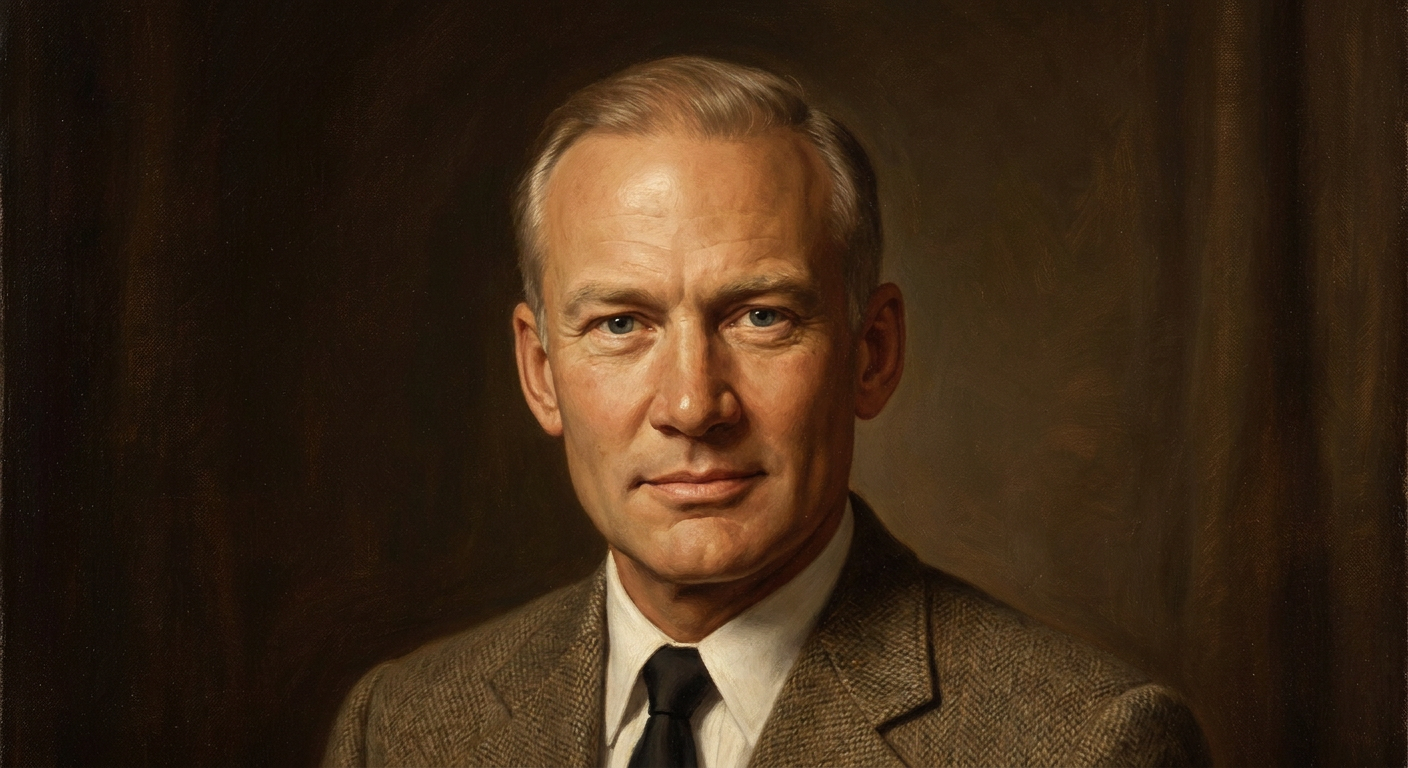
Quick Facts
- Years
- b. 1930
- Category
- Explorers & Adventurers
- Nationality
- American
- Occupation
- Astronaut, aerospace engineer, fighter pilot, author, and space advocate
Buzz Aldrin
b. 1930 · American · Astronaut, aerospace engineer, fighter pilot, author, and space advocate
Recommended Audiobooks
Listen next from Marcus Alden

Life Lessons from Christopher Columbus
Marcus Alden

Life Lessons from Sir Francis Drake
Marcus Alden
Buzz Aldrin helped turn one of humanity’s oldest dreams into a witnessed event. On July 20, 1969, he and Neil Armstrong landed the Apollo 11 lunar module Eagle on the Moon. Hours later, Aldrin became the second person to walk on another world. His description of the lunar landscape—“Magnificent desolation”—captured both its stark beauty and its profound loneliness.
Yet Aldrin’s importance extends beyond the order in which he stepped onto the surface. A decorated Korean War fighter pilot with a doctorate in astronautics, he developed expertise in orbital rendezvous at a time when joining two spacecraft in orbit remained dangerously difficult. During Gemini 12, his disciplined underwater training helped demonstrate that astronauts could work effectively outside a spacecraft. Those lessons were essential to Apollo’s success.
Aldrin’s life after the Moon was more complicated. He struggled with depression, alcohol misuse, uncertain purpose, family tensions, and the burden of permanent celebrity. By speaking publicly about mental illness and recovery, he challenged the heroic image that astronauts were expected to maintain. He later became an energetic advocate for human missions to Mars and proposed technical plans for sustained interplanetary travel.
Students still study Aldrin because his life joins scientific achievement, military service, personal vulnerability, and long-range imagination. His story shows that reaching a historic summit does not settle every human problem—and that exploration requires preparation as much as courage.
Quick Facts
| Field | Details |
|---|---|
| Full Name | Edwin Eugene Aldrin Jr. |
| Common Name(s) | Buzz Aldrin |
| Born | January 20, 1930 |
| Died | Living |
| Age at Death | Not applicable |
| Birthplace | Glen Ridge, New Jersey, United States |
| Nationality | American |
| Occupation | Astronaut, aerospace engineer, U.S. Air Force officer, fighter pilot, author, space advocate |
| Historical Era | Space Age; Cold War |
| Famous For | Apollo 11 lunar module pilot and second person to walk on the Moon |
| Political Affiliation | Publicly supported several Republican candidates; not central to his astronaut career |
| Religion | Raised Presbyterian; privately took Christian communion on the Moon |
| Education | U.S. Military Academy, BS; Massachusetts Institute of Technology, ScD in astronautics |
| Parents | Edwin Eugene Aldrin Sr. and Marion Gaddys Moon Aldrin |
| Spouse(s) | Joan Archer; Beverly Van Zile; Lois Driggs Cannon; Anca Faur |
| Children | James, Janice, and Andrew Aldrin |
| Major Works | Return to Earth; Men from Earth; Magnificent Desolation; Mission to Mars; No Dream Is Too High |
| Major Achievements | 66 combat missions in Korea; Gemini 12 spacewalks; Apollo 11 Moon landing; orbital-rendezvous research; advocacy for Mars exploration |
Early Life
Edwin Eugene Aldrin Jr. was born in Glen Ridge, New Jersey, during the early years of aviation’s rapid expansion. His father, Edwin Sr., had served as an Army aviator and later worked in aviation-related business. His mother, Marion, had the striking maiden name Moon, although claims that this somehow predicted her son’s future are family coincidence rather than historical explanation.
Aldrin grew up in nearby Montclair. His childhood nickname came from his older sister’s attempt to pronounce “brother” as “buzzer.” It was shortened to Buzz, the name by which he became universally known. He legally changed his first name to Buzz in 1988.
He attended Montclair High School and entered the United States Military Academy at West Point in 1947. West Point emphasized academic discipline, physical endurance, military duty, and leadership under pressure. Aldrin excelled, graduating third in the class of 1951 with a bachelor’s degree in mechanical engineering.
Although he could have pursued naval aviation, he chose the newly independent U.S. Air Force. He trained as a fighter pilot just as the Korean War was testing jet aircraft and Cold War military strategy. The combination of engineering ability and operational flying would define his later career.
Aldrin’s most important early influences were practical rather than philosophical: his father’s aviation background, West Point’s structured environment, combat experience, and the emerging science of spaceflight. He developed a reputation for intense preparation and for mastering technical details before acting.
Rise to Prominence
During the Korean War, Aldrin flew F-86 Sabre jets with the 51st Fighter-Interceptor Wing. He completed 66 combat missions and was officially credited with shooting down two Soviet-designed MiG-15 fighters. Photographs taken through his aircraft’s gun camera documented one engagement, including an opposing pilot ejecting.
After Korea, Aldrin served as a flight instructor and held assignments in the United States and Europe. Rather than attending test-pilot school—the usual path into the early astronaut corps—he pursued advanced academic work at the Massachusetts Institute of Technology.
At MIT he studied orbital rendezvous: the problem of guiding two spacecraft into the same orbit and bringing them safely together. His 1963 doctoral dissertation examined line-of-sight guidance techniques for crewed orbital rendezvous. Fellow astronauts later joked about his enthusiasm by calling him “Dr. Rendezvous,” but the subject was crucial. Apollo required a lunar module to leave the Moon and reconnect with a command module in lunar orbit.
NASA rejected Aldrin’s first astronaut application because he lacked test-pilot credentials. The agency subsequently broadened its requirements, and in October 1963 he joined Astronaut Group 3. His selection demonstrated that advanced scientific and engineering knowledge was becoming as valuable as traditional test-piloting experience.
Aldrin first served in backup and mission-planning roles. He helped refine rendezvous procedures and became deeply involved in extravehicular activity, or EVA. Earlier Gemini spacewalks had shown that moving and working in weightlessness could exhaust astronauts. Aldrin approached the difficulty like an engineering problem: break tasks into steps, provide stable handholds, and rehearse underwater, where neutral buoyancy could imitate some features of weightlessness.
His breakthrough came with Gemini 12 in November 1966. Command pilot James Lovell and Aldrin completed rendezvous objectives, while Aldrin performed three EVAs totaling about five and a half hours. His controlled performance showed that spacewalking could become productive rather than merely survivable. The mission made him a leading candidate for Apollo.
Major Achievements
Combat and Technical Expertise
Aldrin’s Korean War service established his ability to make decisions under extreme pressure. Combat flying was not equivalent to lunar exploration, but both demanded situational awareness, procedural discipline, and acceptance of risk. His later doctorate added an unusually strong theoretical foundation to that operational experience.
Solving the Spacewalking Problem
Gemini astronauts had previously encountered overheating, fatigue, and difficulty controlling their bodies during EVAs. Aldrin trained underwater, used restraints and handholds, and followed carefully sequenced tasks. Gemini 12 demonstrated that successful spacewalking depended less on improvised athletic effort than on tools, body positioning, and rehearsal.
This insight shaped later missions. Astronauts repairing satellites or assembling the International Space Station rely on the same broad principle: design the workplace and practice the job before entering orbit.
Apollo 11
Apollo 11 launched from Kennedy Space Center on July 16, 1969. The crew consisted of commander Neil Armstrong, command module pilot Michael Collins, and lunar module pilot Buzz Aldrin. Collins remained aboard Columbia in lunar orbit while Armstrong and Aldrin descended in Eagle.
The landing was tense. Computer alarms appeared during the descent, but flight controllers determined that the guidance computer was overloaded rather than failing. Armstrong maneuvered past a hazardous landing area as fuel ran low. Aldrin read critical altitude, velocity, and guidance information, allowing Armstrong to concentrate on piloting. Eagle landed in the Sea of Tranquility at 20:17 UTC on July 20.
Before leaving the module, Aldrin privately took communion using bread and wine provided by his Presbyterian church. He asked listeners on Earth to pause and reflect but did not describe the ritual during the live transmission. NASA was cautious about overt religious observances following controversy and litigation surrounding Apollo 8’s reading from Genesis. Aldrin later discussed the communion publicly, while also recognizing that Apollo belonged to people of many beliefs.
Armstrong stepped onto the Moon first, followed by Aldrin about nineteen minutes later. The astronauts deployed experiments, photographed the site, collected approximately 21.6 kilograms of material, and planted the U.S. flag. Aldrin tested movement techniques and described the view as “Magnificent desolation.” They spent about 21½ hours on the lunar surface, including roughly 2½ hours outside.
The landing mattered scientifically, technologically, and politically. It fulfilled President John F. Kennedy’s goal of landing a person on the Moon and returning safely before the decade ended. It also demonstrated American capability during the Cold War. At the same time, Apollo was an international human spectacle watched by hundreds of millions.
Return and Planetary Advocacy
After returning safely on July 24, the astronauts entered quarantine as a precaution against hypothetical lunar organisms. They then undertook an exhausting international tour.
In later decades Aldrin promoted permanent human expansion beyond Earth. His best-known technical concept is the “Aldrin cycler,” an orbit that repeatedly passes near Earth and Mars. Large interplanetary vehicles using such paths could, in principle, support repeated travel while smaller craft transferred passengers at each planet. Engineers continue to study cycler trajectories, although costs, radiation, life support, and political commitment remain major barriers.
Leadership or Work
Aldrin’s working style combined analytical rigor with competitive intensity. He preferred procedures grounded in geometry, simulation, and repeated practice. On Gemini 12, this approach converted dangerous spacewalking into manageable work. During Apollo 11, his concise instrument readings supported Armstrong’s manual landing decisions.
His strengths included:
- exceptional technical preparation;
- calm performance in combat and spaceflight;
- persistence after NASA initially rejected him;
- willingness to rethink ineffective methods;
- long-term commitment to space exploration.
His weaknesses were often related to the same forceful personality. Aldrin could be impatient, highly competitive, and uncomfortable when his role appeared secondary. The question of who would leave Eagle first reportedly mattered to him, though NASA’s decision also reflected command responsibility, spacecraft layout, and mission planning. Historians should avoid reducing this complex choice either to personal rivalry alone or to a purely mechanical necessity.
Aldrin worked within teams even when public memory focused on individual heroes. Apollo depended on hundreds of thousands of engineers, technicians, contractors, administrators, and military personnel. He consistently argued in later life that exploration required coordinated systems rather than isolated acts of bravery.
Personal Life
Aldrin married Joan Archer in 1954. They had three children: James, Janice, and Andrew. The marriage ended in divorce in 1974. He later married Beverly Van Zile in 1975; they divorced in 1978. His third marriage, to Lois Driggs Cannon, lasted from 1988 until their divorce in 2012. In 2023, on his ninety-third birthday, he married Anca Faur.
The period after Apollo was emotionally difficult. Aldrin retired from NASA in 1971 and from the Air Force in 1972, having reached the rank of colonel. He found that no ordinary assignment could easily follow the Moon landing. A brief appointment as commandant of the Aerospace Research Pilot School ended unhappily; he lacked test-pilot-school experience and felt poorly suited to the position.
Aldrin experienced depression and alcohol misuse, conditions also present in his family history. His mother died by suicide in 1968, shortly before Apollo 11, and his maternal grandfather had also died by suicide. Aldrin entered treatment, participated in recovery programs, and eventually became sober. His willingness to discuss these experiences was unusual for a military officer and astronaut of his generation.
He remained physically active and publicly visible into advanced age. His interests included aviation, engineering, science education, and proposals for Mars. His forceful humor and enthusiasm made him a frequent speaker and media guest, although celebrity sometimes intensified personal and family conflicts.
Philosophy or Beliefs
Aldrin’s worldview joined military service, scientific problem-solving, religious faith, and technological optimism. Raised in a Presbyterian setting, he viewed the Moon landing as an occasion for humility and gratitude. His lunar communion was personally meaningful, but he later suggested that a more universal observance might have better represented all humanity.
Politically, Aldrin has appeared with and endorsed Republican candidates, but his central public cause has usually been space policy rather than a detailed partisan program. He has worked with leaders of different parties when advancing exploration.
His writings present exploration as a long-term human responsibility. He argues that societies should not treat Mars merely as a destination for symbolic visits; they should develop sustained transportation and settlement plans. This is advocacy, not a settled scientific consensus. Supporters see human Mars missions as engines of discovery and innovation, while critics emphasize cost, danger, planetary protection, and the value of robotic exploration.
Ethically, Aldrin’s career illustrates confidence tempered by procedure. Courage, in his professional practice, meant controlling risk through knowledge rather than ignoring it.
Challenges and Controversies
Aldrin has openly described jealousy, frustration, and loss of purpose surrounding Apollo 11. Public fascination with who was “first” could leave the second moonwalker feeling diminished despite his essential role. Some accounts dramatize conflict between Armstrong and Aldrin, but the evidence supports a more restrained conclusion: they had different personalities, professional disagreements, and mutual dependence during a hazardous mission.
His alcoholism and depression damaged his career and relationships. Aldrin did not present recovery as effortless. His public candor helped counter the belief that exceptional achievement protects people from mental illness.
In 2002, conspiracy theorist Bart Sibrel confronted Aldrin outside a hotel, demanded that he swear on a Bible that he had walked on the Moon, and insulted him. Aldrin punched Sibrel. Prosecutors declined to file charges after reviewing the circumstances and video evidence. Many observers sympathized with Aldrin, but physical retaliation was still controversial and should not be treated as an ideal response.
A more serious family dispute became public in 2018. Two of Aldrin’s children sought legal control over aspects of his affairs, arguing that he was cognitively impaired and vulnerable to exploitation. Aldrin denied the claims and filed his own lawsuit. The parties later withdrew the legal actions. Because the dispute ended without a definitive public adjudication of every allegation, its competing claims should not be presented as proven facts.
Aldrin’s Mars proposals have also attracted criticism. The engineering ideas are significant, but timelines promoted by advocates may understate financial, biological, and political difficulties. His contribution lies partly in keeping long-range options under discussion, not in having supplied a complete or universally accepted program.
Legacy
Buzz Aldrin occupies a permanent place in the history of exploration. His footprints, experiments, and photographs are part of the Apollo 11 site, which remains undisturbed in the Sea of Tranquility. The Smithsonian National Air and Space Museum and NASA visitor centers preserve Apollo spacecraft, equipment, records, and educational exhibits connected with his missions.
His technical legacy begins before Apollo. Gemini 12 helped establish methods that made later EVAs possible. His rendezvous scholarship and cycler-orbit advocacy influenced aerospace discussions about how spacecraft can meet in orbit and travel repeatedly between planets.
His cultural influence is equally strong. The name of Pixar’s Buzz Lightyear was inspired by Aldrin, helping introduce a playful echo of the astronaut to generations of children. Schools, streets, awards, and facilities have carried his name. In 2019, West Point renamed an academic building the Aldrin Academic Building.
Aldrin, Armstrong, and Collins received major honors including the Presidential Medal of Freedom in 1969 and the Congressional Gold Medal, authorized in 2009 and presented in 2011. The Apollo 11 crew is commemorated in museums, monuments, stamps, documentaries, and annual celebrations of the landing anniversary.
Perhaps his most modern legacy is his candor about life after triumph. He expanded the astronaut story beyond flawless heroism, showing that historic accomplishment can coexist with illness, uncertainty, recovery, and continued ambition.
Interesting Facts
- “Buzz” originated when his sister pronounced “brother” as “buzzer.”
- He legally adopted Buzz as his first name in 1988.
- His mother’s maiden name was Moon.
- He graduated third in West Point’s class of 1951.
- He flew 66 Korean War combat missions.
- He was officially credited with two MiG-15 victories.
- He earned a doctorate from MIT rather than attending test-pilot school.
- NASA rejected his first astronaut application.
- His doctoral research focused on crewed orbital rendezvous.
- Fellow astronauts nicknamed him “Dr. Rendezvous.”
- He trained underwater for Gemini 12 spacewalks.
- He took communion inside the lunar module before walking on the Moon.
- “Magnificent desolation” was his immediate description of the lunar scene.
- He spent about 21½ hours on the lunar surface with Armstrong.
- A broken circuit-breaker switch threatened Eagle’s departure; a felt-tip pen helped activate it.
- He retired from the Air Force as a colonel.
- He has written both memoirs and books promoting Mars exploration.
- The fictional name Buzz Lightyear honors him.
- He married Anca Faur on his ninety-third birthday.
- An Antarctic mountain, Aldrin Peak, bears his name.
Famous Quotes
- “Contact light.” — Aldrin announced the lunar module’s contact-probe signal moments before landing. The brief phrase marked the transition from descent to arrival.
- “Beautiful view.” — Spoken after stepping onto the Moon, it records his immediate visual response rather than a polished later recollection.
- “Magnificent desolation.” — Aldrin’s best-known phrase described a landscape that was impressive yet barren. Mission transcripts document the wording.
- “We’d like to request a few moments of silence.” — From his lunar-surface broadcast before communion, inviting listeners to contemplate Apollo 11 according to their own beliefs.
- “I’ll be changing the primary life-support system to the secondary.” — A transcript example of the procedural language beneath Apollo’s dramatic public image.
- “Neil, this is Houston. Radio check.” — Aldrin relayed communications and monitored systems throughout the mission; many of his transcript lines reveal teamwork rather than oratory.
- “You promised me Mars colonies. Instead, I got Facebook.” — Used in a 2012 technology campaign to criticize reduced expectations for large-scale innovation. It was intentionally humorous and provocative.
- “Mars is there, waiting to be reached.” — Associated with Aldrin’s later space advocacy and his argument for sustained human exploration.
- “Exploration is wired into our brains.” — From his public writing and lectures, expressing his belief that curiosity is a persistent human trait.
- “No dream is too high for those with their eyes in the sky.” — A line used in his later memoir and public appearances, summarizing his optimistic message. It should be understood as a modern retrospective slogan, not an Apollo-era statement.
Timeline
- 1930 — Born in Glen Ridge, New Jersey.
- 1947 — Enters the United States Military Academy.
- 1951 — Graduates third in his West Point class and joins the Air Force.
- 1952–1953 — Flies 66 combat missions during the Korean War.
- 1954 — Marries Joan Archer.
- 1963 — Earns an MIT doctorate and joins NASA Astronaut Group 3.
- 1966 — Conducts successful EVAs during Gemini 12 with James Lovell.
- 1968 — Assigned to Apollo 11; his mother dies shortly before the mission period.
- 1969 — Lands on the Moon with Neil Armstrong and becomes the second person to walk there.
- 1969 — Receives the Presidential Medal of Freedom with the Apollo 11 crew.
- 1971 — Retires from NASA.
- 1972 — Retires from the Air Force as a colonel.
- 1973 — Publishes Return to Earth, addressing his post-Apollo difficulties.
- 1988 — Legally changes his name to Buzz and marries Lois Driggs Cannon.
- 1993 — Receives a U.S. patent associated with a permanent space-station design.
- 2002 — Is involved in the widely publicized confrontation with Bart Sibrel.
- 2009 — Publishes Magnificent Desolation.
- 2011 — Receives the Congressional Gold Medal with fellow Apollo pioneers.
- 2013 — Publishes Mission to Mars.
- 2016 — Is medically evacuated from the South Pole after becoming ill.
- 2019 — Celebrates Apollo 11’s fiftieth anniversary; West Point names a building for him.
- 2023 — Marries Anca Faur on his ninety-third birthday.
Frequently Asked Questions
1. Was Buzz Aldrin the first person on the Moon?
No. Neil Armstrong left the lunar module first on July 20, 1969, and Aldrin followed about nineteen minutes later. Calling Aldrin merely “second,” however, can obscure his role. As lunar module pilot, he monitored navigation and spacecraft systems, supplied crucial data during descent, and helped conduct the surface mission. Apollo 11 could succeed only through coordinated work among Armstrong, Aldrin, Michael Collins, Mission Control, and the enormous workforce supporting them.
2. Why did Neil Armstrong step out first?
Armstrong was mission commander, which gave him a strong institutional claim to lead the surface activity. NASA officials also considered the lunar module’s cramped layout and hatch arrangement. Personal preferences and public symbolism entered the discussion, and Aldrin acknowledged that he had hoped to be first. Historians therefore describe the decision as a mixture of command structure, planning, practicality, and organizational judgment—not a simple contest settled by one factor.
3. What did Aldrin do during the landing?
Armstrong manually guided Eagle away from a hazardous area, while Aldrin read altitude, descent rate, fuel, and guidance information from the instruments. He also monitored systems and checklists. This division of labor reduced the need for Armstrong to look away from the window at critical moments. Aldrin’s work illustrates why spacecraft crews use clearly assigned roles: safe decisions depend on accurate information arriving at the correct time.
4. What does “Magnificent desolation” mean?
Aldrin used the phrase after looking across the lunar surface. “Magnificent” conveyed the scale and beauty of standing on another world, while “desolation” recognized its airless, lifeless, exposed environment. The phrase became famous because it holds two impressions together without exaggeration. It was not a prepared presidential slogan; the mission transcript records it as Aldrin’s concise reaction to what he saw.
5. Did Buzz Aldrin take communion on the Moon?
Yes. Before the moonwalk, Aldrin privately consumed bread and wine supplied by his Presbyterian church. He asked people listening on Earth to reflect silently but did not identify the ritual in the live broadcast. NASA wished to avoid presenting a government mission as endorsing one religion. Aldrin later wrote about the event and reflected that Apollo’s meaning extended beyond any single faith tradition.
6. What was Aldrin’s role in Gemini 12?
Aldrin was the pilot alongside command pilot James Lovell. He performed three extravehicular activities and demonstrated that astronauts could complete useful work outside a spacecraft without becoming dangerously exhausted. Underwater practice, improved restraints, planned rest periods, and carefully arranged tasks were central to his success. Gemini 12 helped transform EVA from an uncertain experiment into a practical capability needed for later space programs.
7. Why was he called “Dr. Rendezvous”?
Aldrin earned a Doctor of Science degree in astronautics from MIT with research on orbital rendezvous. Because he frequently discussed the subject and applied its mathematics to NASA planning, colleagues nicknamed him “Dr. Rendezvous.” The teasing label reflected genuine expertise. Rendezvous was essential to Apollo because astronauts ascending from the Moon needed to locate, approach, and dock with the command module in lunar orbit.
8. Did Aldrin use a pen to save the lunar module?
A circuit-breaker switch connected with the ascent engine’s arming system was damaged inside Eagle, probably after being struck by a spacesuit or backpack. Aldrin reported using the nonconductive tip of a felt-tip pen to depress the breaker. The episode was important, but popular retellings sometimes make the pen sound like the sole barrier between life and death. Mission Control was also studying solutions, and the crew followed established procedures.
9. How long did he spend on the Moon?
Aldrin and Armstrong remained on the lunar surface for about 21 hours and 36 minutes, measured from landing to liftoff. Their activity outside Eagle lasted roughly two and a half hours. During that period they collected samples, deployed scientific instruments, took photographs, inspected the spacecraft, and tested movement. The stay was brief by later Apollo standards because Apollo 11’s central purpose was to prove that landing and safe return were possible.
10. What happened to Aldrin after Apollo 11?
He returned to a demanding schedule of ceremonies, speeches, and international travel. Aldrin left NASA in 1971 and retired from the Air Force the next year. Without a comparable goal, he experienced depression, alcohol misuse, and career uncertainty. He sought treatment and eventually sustained recovery. Later he became an author and prominent advocate for Mars exploration, space education, and new transportation concepts.
11. Why is Aldrin important beyond Apollo 11?
His work on rendezvous and EVA addressed two fundamental problems of crewed spaceflight. Gemini 12 showed that astronauts could work outside spacecraft when tasks and equipment were properly designed. His orbital research supported the broader knowledge base behind docking operations. In later life, his cycler-orbit proposals contributed to technical discussion about regular Earth–Mars transportation. Apollo made him famous, but his influence began earlier and continued afterward.
12. What is the Aldrin cycler?
An Aldrin cycler is a trajectory that repeatedly encounters Earth and Mars on a predictable schedule. A large habitat could remain on the looping orbit while smaller “taxi” vehicles carried crews between the cycler and each planet. The concept could reduce the need to accelerate an entire interplanetary habitat for every journey. It remains a proposal rather than an operating transport system, with difficult problems involving timing, radiation, life support, propulsion, and expense.
13. Did Aldrin really punch a Moon-landing denier?
Yes. In 2002, Bart Sibrel confronted Aldrin, demanded that he swear on a Bible, blocked or crowded him, and called him insulting names. Aldrin struck him once. Prosecutors did not bring charges after examining video and witness evidence. The incident is often celebrated online, but a balanced account recognizes both the deliberate provocation and the fact that physical violence is generally not an appropriate method of answering false claims.
14. How do we know Apollo 11 really landed on the Moon?
Evidence includes lunar rocks studied internationally, mission telemetry, photographs, film, tracking by independent observatories, and retroreflectors still used for laser measurements from Earth. Later spacecraft have photographed the landing sites and surface trails. The Soviet Union, America’s Cold War rival, tracked Apollo and never challenged the landing’s authenticity. Claims of fabrication require ignoring many independent and mutually supporting lines of evidence.
15. Did Buzz Aldrin suffer from mental illness?
Aldrin has publicly described depression and alcohol dependence following Apollo. Family history, overwhelming celebrity, career transition, and uncertainty about purpose formed part of the context, although no single factor explains mental illness. He entered treatment and recovery programs and spoke openly about the process. His testimony was influential because astronauts were commonly portrayed as invulnerable. It demonstrated that mental illness can affect highly trained and outwardly successful people.
16. Is Buzz Aldrin still alive?
Yes. Born on January 20, 1930, Aldrin remains one of the best-known surviving figures of the early Space Age. In recent decades he has continued to appear at commemorations, support space initiatives, publish books, and advocate human missions to Mars. Because his views and personal circumstances have changed over time, accounts of his current activities should be checked against recent reliable sources.
17. How many people have walked on the Moon?
Twelve people walked on the Moon between Apollo 11 in 1969 and Apollo 17 in 1972. All were American men participating in six successful landing missions. Aldrin was the second. No person has returned to the lunar surface since December 1972, although several nations and private companies have sent robotic missions, and NASA’s Artemis program seeks to restore a sustained human presence.
Lessons We Can Learn
- Preparation makes courage useful. Aldrin’s underwater rehearsals improved EVA performance; modern teams likewise benefit from realistic practice.
- Expertise can open unconventional paths. He reached NASA through doctoral research despite lacking test-pilot-school credentials.
- Historic achievements are collective. Apollo 11 required astronauts, controllers, engineers, technicians, and taxpayers—not three isolated heroes.
- Clear communication saves attention. Aldrin’s instrument callouts allowed Armstrong to focus on flying during the landing.
- Design systems around human limits. Gemini 12 succeeded because tools and restraints reduced fatigue rather than demanding greater strength.
- A setback need not end a goal. NASA rejected Aldrin’s first application, but he strengthened his qualifications and applied again.
- Success does not guarantee well-being. His post-Apollo depression provides historical evidence that achievement and mental health are separate issues.
- Seeking treatment is compatible with strength. Aldrin’s recovery work challenged the culture of silence surrounding illness and addiction.
- Ambitious ideas require criticism as well as enthusiasm. His Mars plans inspire debate, but practical obstacles must be evaluated honestly.
- Continue building purpose after a peak. Interpreting Aldrin’s advocacy as a lesson in renewal is a modern reading, but it is grounded in his long post-Apollo career.
Related Historical Figures
- Neil Armstrong — Apollo 11 commander, first moonwalker, and Aldrin’s partner aboard Eagle.
- Michael Collins — Apollo 11 command module pilot who remained in lunar orbit.
- James Lovell — Commanded Gemini 12 and worked with Aldrin during his landmark EVAs.
- John F. Kennedy — Set the national lunar-landing goal that shaped the Apollo program.
- Wernher von Braun — Led development work behind the Saturn V launch vehicle.
- Gene Kranz — NASA flight director associated with Apollo mission control and operational discipline.
- Deke Slayton — Astronaut manager who played a central role in assigning Apollo crews.
- Yuri Gagarin — First human in space and a symbol of the Soviet challenge that accelerated Apollo.
- John Glenn — Pioneering American astronaut whose career also joined public service and celebrity.
- Sally Ride — Later astronaut and educator who expanded the social reach of the American space program.
Watch and Learn
“Apollo 11: Landing on the Moon” — NASA — approximately 3 minutes.
This concise NASA video uses mission footage and audio to present the tense final descent of Eagle. It is recommended as a reputable primary-source-based introduction to Armstrong and Aldrin’s teamwork, especially Aldrin’s stream of technical callouts during the landing.
Watch and Learn
Apollo 11: Landing on the Moon · NASA
Related Historical Figures