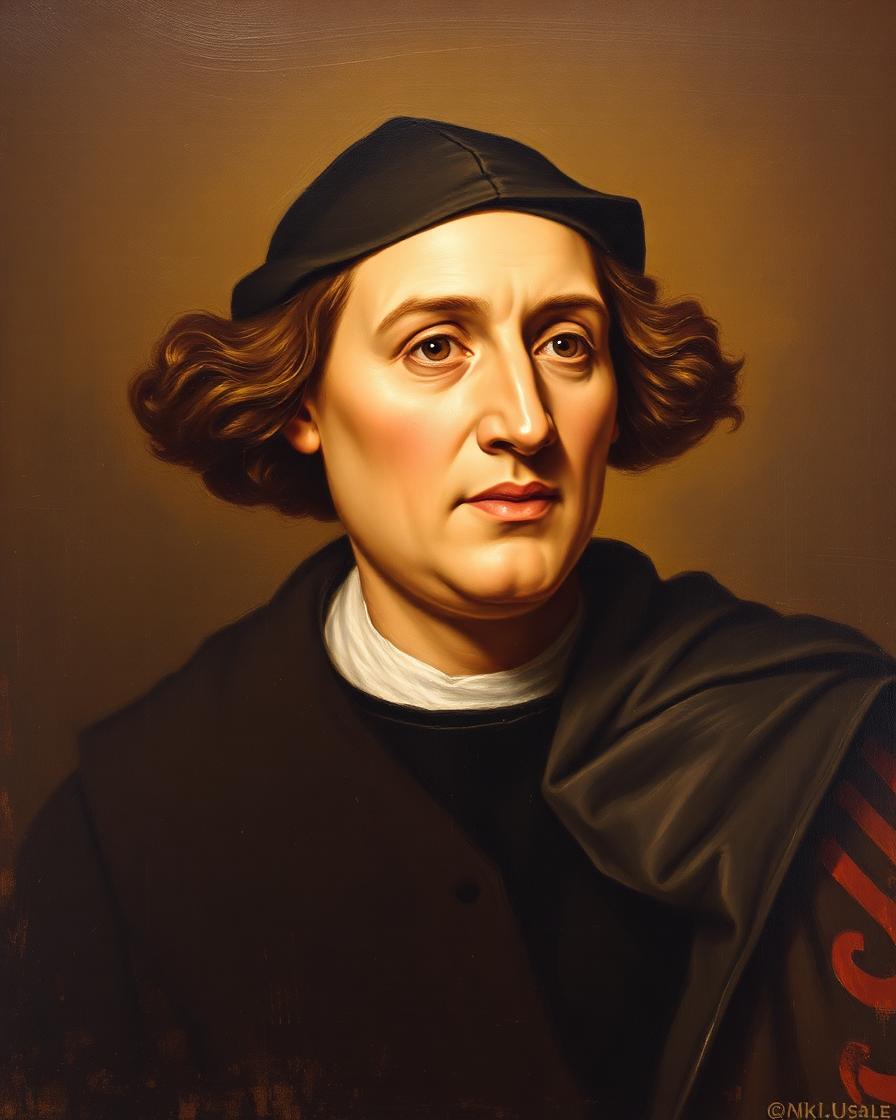
Quick Facts
- Years
- 1451 – 1506
- Category
- Explorers & Adventurers
- Nationality
- Genoese
- Occupation
- Navigator & Explorer
Christopher Columbus
1451 – 1506 · Genoese · Navigator & Explorer
Audiobook

Life Lessons from Christopher Columbus
Marcus Alden
Christopher Columbus was a Genoese navigator and maritime entrepreneur whose four Atlantic voyages for the Spanish Crown, between 1492 and 1504, permanently connected Europe and the Americas. He did not discover an empty continent: millions of Indigenous people already inhabited the Americas, and Norse sailors had reached North America centuries earlier. Columbus nevertheless initiated sustained contact between the eastern and western Atlantic worlds, with immense consequences for commerce, empire, migration, disease, ecology, and culture.
Seeking a westward route to Asia, Columbus secured support from Queen Isabella I of Castile and King Ferdinand II of Aragon. His first expedition reached islands in the Caribbean on 12 October 1492. He subsequently explored parts of the Greater and Lesser Antilles and the coasts of present-day Venezuela, Honduras, Nicaragua, Costa Rica, and Panama. He remained convinced that these lands belonged to the approaches to Asia rather than an unknown continent.
Columbus is studied both for his navigational persistence and for the destructive colonial system associated with his expeditions. His administration of Hispaniola produced rebellion, forced labor, enslavement, and violence. Europeans also introduced epidemic diseases that devastated Indigenous communities. Consequently, Columbus occupies a contested place in public memory: celebrated in some traditions as an explorer while condemned in others as an agent of conquest and dispossession.
Quick Facts
| Field | Details |
|---|---|
| Full Name | Cristoforo Colombo in Italian; Cristóbal Colón in Spanish |
| Common Name(s) | Christopher Columbus; Cristóbal Colón |
| Born | Between 25 August and 31 October 1451 |
| Died | 20 May 1506 |
| Age at Death | About 54 |
| Birthplace | Republic of Genoa, traditionally identified as Genoa itself |
| Nationality | Genoese; served the Crown of Castile |
| Occupation | Navigator, explorer, maritime trader, colonial governor |
| Historical Era | Age of Exploration; early modern period |
| Famous For | Four transatlantic voyages sponsored by the Spanish Crown |
| Political Affiliation | Crown of Castile and the joint monarchy of Ferdinand and Isabella |
| Religion | Roman Catholic |
| Education | No formal university education recorded; largely practical and self-directed |
| Parents | Domenico Colombo and Susanna Fontanarossa |
| Spouse(s) | Filipa Moniz Perestrelo; relationship with Beatriz Enríquez de Arana |
| Children | Diego Colón and Ferdinand Columbus |
| Major Works | Book of Privileges; writings and letters describing his voyages; unfinished Book of Prophecies |
| Major Achievements | First documented European Atlantic crossing to the Caribbean in 1492; four voyages; exploration of Caribbean islands and portions of Central and South American coasts |
Early Life
Columbus was born in 1451 in the Republic of Genoa, a major Mediterranean commercial and maritime power. A surviving Genoese notarial document identifies him as the son of Domenico Colombo, a wool worker and occasional cheese seller, and Susanna Fontanarossa. His brothers included Bartolomeo and Giacomo, later known in Spanish as Bartolomé and Diego.
Claims that Columbus was secretly Portuguese, Catalan, Jewish, or from another region continue to circulate. Most professional historians accept his Genoese origin because it is supported by contemporary legal records and Columbus's own testamentary references to Genoa. Uncertainty remains about his exact birth date.
His schooling is poorly documented. He probably acquired basic literacy and commercial arithmetic rather than a university education. As a young man he learned through maritime work, studying winds, currents, charts, navigation, geography, and sailors' reports. His later writings show extensive reading but also unconventional spelling and a tendency to interpret sources selectively.
Columbus stated that he went to sea at a young age. By the 1470s he was involved in Mediterranean commerce. In 1476, according to the usual reconstruction, he survived a naval engagement off Portugal and reached shore. He then settled within Portugal's dynamic Atlantic maritime world.
Lisbon exposed him to voyages along Africa, Atlantic islands, cartography, and international trade. He may have sailed to places including Madeira, Guinea, and perhaps Iceland, although details are disputed. He married Filipa Moniz Perestrelo, whose family had connections to Portuguese Atlantic colonization. Their son Diego was born around 1479 or 1480.
The historical context was crucial. Portuguese expeditions were probing the African coast in search of gold, trade, Christian allies, and a sea route to Asia. European demand for Asian spices encouraged geographical experimentation. Mariners also understood that Earth was spherical; Columbus's innovation was not proving a round Earth but arguing that Asia could be reached quickly by sailing west. He seriously underestimated the Earth's circumference and overestimated Asia's eastward extent.
Rise to Prominence
During the 1480s Columbus developed a proposal to reach the riches of Asia by crossing the Atlantic westward. His calculations drew on classical and medieval authorities, reports of objects drifting from the west, and the ideas of the Florentine scholar Paolo dal Pozzo Toscanelli. Because his estimated distance was far too short, experts had good reason to doubt the plan.
Columbus presented his project to King John II of Portugal, whose advisers rejected it. Portugal was already investing in the more promising route around Africa. After Filipa's death, Columbus moved to Castile with Diego, probably in 1485. He developed contacts at the Franciscan monastery of La Rábida and gained supporters at court.
A royal commission initially rejected his proposal. Beyond the navigational risks, Columbus demanded substantial rewards: noble status, the titles Admiral of the Ocean Sea and viceroy and governor of newly encountered territories, and a share of profits. The war against Granada also absorbed royal resources.
After Granada surrendered in January 1492, Columbus's proposal was reconsidered. Court supporters, including Luis de Santángel, helped make the case. The Capitulations of Santa Fe, signed in April, granted Columbus extraordinary titles and financial privileges if he succeeded.
Columbus departed Palos de la Frontera on 3 August 1492 with the Niña, Pinta, and Santa María. After repairs and provisioning in the Canary Islands, the fleet sailed west on 6 September. Crew anxiety grew during the long passage, but on 12 October land was sighted. Columbus became internationally famous after returning to Iberia in March 1493 with news of islands, gold prospects, and Indigenous captives.
Major Achievements
The First Atlantic Voyage, 1492–1493
Columbus's expedition made landfall on an island called Guanahaní by its inhabitants, likely in today's Bahamas, though its precise modern identification remains disputed. Columbus renamed it San Salvador and claimed it for the Castilian monarchs. He encountered Lucayan Taíno people, then explored Cuba and Hispaniola.
The Santa María grounded on Hispaniola in December 1492. Columbus left about 39 men at a settlement called La Navidad and returned aboard the Niña. The voyage mattered because it demonstrated a practicable Atlantic sailing circuit using the trade winds westward and higher-latitude winds eastward.
Its long-term impact was far greater than Columbus anticipated. The crossing initiated sustained interaction between Europe and the Americas, accelerating imperial competition and the movement of peoples, crops, animals, pathogens, and ideas known as the Columbian Exchange.
Establishing a Durable Transatlantic Connection
Earlier Norse explorers had reached North America around the year 1000, but their settlements did not create continuous contact with Europe. Columbus's return in 1493 prompted immediate follow-up expeditions, colonization, missionary efforts, and geopolitical negotiations.
The papal bulls of 1493 and the Treaty of Tordesillas in 1494 attempted to divide non-Christian overseas territories between Castile and Portugal. Although Indigenous sovereignty was ignored, the arrangements shaped the future of European empires, including Portuguese colonization of Brazil.
This durable connection transformed world history. American crops such as maize and potatoes later supported population growth elsewhere, while European livestock and crops altered American landscapes. Enslaved Africans were forcibly transported across the Atlantic on a massive scale. Epidemic diseases, especially smallpox after Columbus's lifetime, caused catastrophic Indigenous mortality.
Four Voyages of Exploration
Columbus crossed the Atlantic four times. His second voyage, beginning in 1493, involved 17 ships and roughly 1,200–1,500 people, making it an expedition of colonization as well as exploration. It visited islands in the Lesser Antilles, Puerto Rico, and Hispaniola and founded La Isabela.
On the third voyage in 1498 he reached Trinidad and the Gulf of Paria, encountering the South American mainland in present-day Venezuela. The volume of fresh water flowing from the Orinoco led him to recognize that a very large landmass must be nearby, although he interpreted it through biblical geography rather than identifying a separate continent.
His fourth voyage, from 1502 to 1504, explored the Caribbean coast of Central America from present-day Honduras toward Panama while searching for a passage to the Indian Ocean. No passage was found, but the expedition added European knowledge of the region's coastline.
Navigational Skill and Atlantic Seamanship
Columbus was an effective dead-reckoning navigator with practical knowledge of Atlantic wind patterns. His choice to sail southwest toward the Canary Islands and then west with the trade winds helped establish a route repeatedly used by later vessels. For the return, he sailed north before turning east to catch prevailing westerlies.
He maintained logs, estimated distance and direction, observed weather and currents, and adapted when ships were damaged. His geographical interpretation was profoundly wrong, but his capacity to organize and complete long ocean crossings was substantial.
The routes he helped demonstrate became foundations of Spain's Atlantic system. At the same time, navigational achievement cannot be separated from the conquest and exploitation that followed.
Leadership and Work
Columbus combined persistence, maritime competence, religious confidence, and forceful self-promotion. He spent years seeking patronage and refused to abandon his project after repeated rejection. At sea, he could manage uncertain conditions, read winds, and preserve enough cohesion to complete dangerous passages.
His leadership ashore was much weaker. As governor of Hispaniola, he and his brothers struggled to regulate colonists who expected rapid wealth. Columbus imposed harsh punishments, demanded tribute from Indigenous communities, and relied upon coercive labor. Food shortages, disease, factionalism, and unrealistic expectations destabilized the colony.
His decision-making was shaped by several priorities:
- Fulfilling promises of gold and profit to the Crown.
- Defending his titles and hereditary privileges.
- Converting Indigenous people to Christianity.
- Demonstrating that he had reached lands associated with Asia.
- Maintaining family control over colonial administration.
Columbus formed useful relationships with patrons, shipowners, pilots, clerics, and monarchs, but he could be suspicious and inflexible. His insistence on personal rights generated prolonged litigation by his heirs, known as the Pleitos Colombinos.
His strengths included endurance, persuasive ambition, seamanship, and close observation. His weaknesses included poor civil administration, geographical dogmatism, financial mismanagement, severe treatment of subordinates and Indigenous people, and a willingness to enslave human beings.
Personal Life
Columbus married Filipa Moniz Perestrelo in Portugal, probably around 1479. She belonged to a family connected with Porto Santo in the Madeira archipelago. Their son Diego later became second admiral of the Indies and governor of Hispaniola. Filipa probably died before Columbus moved to Castile, although the date is unknown.
In Córdoba, Columbus formed a relationship with Beatriz Enríquez de Arana. Their son Ferdinand, or Hernando Colón, was born in 1488. Columbus did not marry Beatriz, but he recognized Ferdinand and later instructed Diego to support her. Ferdinand became a scholar, collector, and author of a biography of his father.
Columbus maintained close working ties with his brothers Bartolomé and Diego. Their prominence in Hispaniola also intensified resentment among Spanish colonists who objected to governance by the Genoese family.
His writings suggest a personality marked by determination, sensitivity to status, strong providential belief, and concern for his reputation. He read geography, travel literature, scripture, and prophecy. He annotated books and assembled documents protecting his privileges.
In later life Columbus suffered recurrent pain and immobility, often described in sources as gout or arthritis. Modern retrospective diagnoses remain uncertain. He died in Valladolid on 20 May 1506, still pursuing recognition of his rights and apparently still believing that his voyages had reached the margins of Asia.
Philosophy and Beliefs
Columbus was a devout Latin Christian whose religion cannot be treated merely as a public disguise for profit. He repeatedly interpreted favorable events as signs of divine guidance. He believed his voyages would spread Christianity and help generate wealth for projects such as the recovery of Jerusalem—an aspiration expressed in his later writings.
His unfinished Book of Prophecies assembled biblical and theological texts that he believed foretold his mission and the approaching culmination of sacred history. This worldview strengthened his perseverance but also encouraged certainty that his enterprise possessed divine approval.
Politically, Columbus accepted dynastic monarchy and sought authority through royal grants. He viewed newly encountered lands as claimable for Christian sovereigns, a position typical of European imperial thought but one that denied the existing rights and political autonomy of Indigenous societies.
His ethical record is deeply troubling. He praised the generosity and intelligence of Indigenous people, discussed their conversion, and at times objected to uncontrolled abuses. Yet he also captured and transported captives, advocated enslavement, imposed tribute, and helped create coercive colonial arrangements. His religion coexisted with commercial ambition, hierarchy, and violence rather than preventing them.
Challenges and Controversies
“Discovery” and Historical Language
Calling Columbus the “discoverer of America” presents a European-centered version of events. Indigenous peoples had lived throughout the Americas for thousands of years, and Norse voyagers had reached Newfoundland around 1000. A more precise claim is that Columbus initiated sustained contact between Europe and the Caribbean in 1492.
Supporters emphasize the voyage's global historical importance and navigational audacity. Critics stress that “discovery” can erase Indigenous presence and turn colonization into a heroic inevitability. Modern scholarship generally acknowledges both the voyage's world-changing significance and the inadequacy of the traditional label.
Enslavement, Tribute, and Violence
Columbus seized Indigenous people on his first voyage and sent captives to Spain. During the second expedition, hundreds were enslaved and shipped across the Atlantic; many died. On Hispaniola, his regime imposed tribute demands and participated in military campaigns against Taíno resistance.
Some practices reflected wider fifteenth-century Mediterranean and Atlantic systems of warfare and slavery. That context explains but does not excuse them. Queen Isabella sometimes objected to enslaving people considered her subjects, and the legal status of captives was debated, but coercion continued in multiple forms.
Historians distinguish policies directly ordered by Columbus from later atrocities under other governors. Even with that distinction, strong documentary evidence ties him to enslavement, forced tribute, punitive violence, and the beginnings of colonial exploitation.
Failed Government of Hispaniola
The colony suffered hunger, disease, rebellion, factional conflict, and shortages of expected gold. Colonists accused Columbus and his brothers of tyranny and incompetence. In 1500 the Crown sent Francisco de Bobadilla to investigate. Bobadilla arrested Columbus and returned him to Spain in chains.
Columbus was released, and the monarchs allowed another voyage, but he was not restored as governor. Bobadilla's inquiry included testimony from hostile colonists, so historians assess individual allegations carefully. Nevertheless, the overall record supports the conclusion that Columbus's administration was unstable and frequently brutal.
Miscalculation and Misidentification
Columbus underestimated the distance westward to Asia by thousands of miles. Had the Americas not intervened, his expedition could not have reached East Asia with its available supplies. He also interpreted Caribbean geography through expectations drawn from Marco Polo and biblical tradition.
Even after reaching South America, he did not accept that he had found a previously unknown continent. Amerigo Vespucci and later cartographers more clearly recognized a “New World.” Columbus's error does not eliminate his navigational achievement, but it undermines portrayals of him as a uniquely farsighted scientific genius.
Disease and Demographic Catastrophe
European contact opened pathways for diseases to which Indigenous populations had little previous exposure. The most devastating epidemics intensified after Columbus's death, and precise mortality totals remain debated because population estimates are uncertain.
Disease was not the only cause of collapse. Warfare, enslavement, forced labor, displacement, famine, and social disruption compounded mortality. Columbus did not understand germ theory and cannot be said to have intentionally introduced epidemics. He did, however, initiate and administer a colonial process whose consequences were catastrophic.
Legacy
Columbus's voyages helped create the modern Atlantic world. They accelerated European imperial expansion, the Columbian Exchange, Christian missions, global trade, forced migration, and the development of racialized slavery. Spain's American empire soon extended far beyond the areas Columbus personally visited.
His reputation changed over time. Nineteenth- and twentieth-century commemorations often presented him as a heroic symbol of courage, progress, immigration, Catholic achievement, or Italian American identity. The United States established Columbus Day as a federal holiday in 1937. Many jurisdictions now pair or replace it with Indigenous Peoples' Day.
Monuments stand in cities including Barcelona, Genoa, Madrid, New York, and Santo Domingo. Some statues have been removed, relocated, or reinterpreted amid debates over colonialism. Institutions and places bearing his name include the District of Columbia, Columbia University, Columbus, Ohio, and numerous schools and streets, although Columbus did not found these institutions.
Sites associated with him include La Rábida in Spain, the Columbus House in Las Palmas, and memorial complexes in the Dominican Republic and Genoa. His remains were moved several times; Seville Cathedral houses remains identified as his, while Santo Domingo has maintained a rival claim. Genetic research has supported the identification of the Seville remains, but debate over whether other remains also belong to him has persisted.
Modern relevance lies not in choosing between uncomplicated hero worship and historical erasure. Columbus's career offers evidence about exploration, ambition, empire, knowledge, error, and moral responsibility. Studying him requires holding technological achievement and human suffering within the same historical account.
Interesting Facts
- Columbus made four round-trip Atlantic voyages, not just the famous voyage of 1492.
- Educated Europeans in his time generally knew the Earth was spherical.
- His proposal was controversial because he underestimated the ocean's width, not because others believed Earth was flat.
- The three ships of 1492 were the Niña, Pinta, and Santa María.
- Niña and Pinta were nicknames; the Niña was formally the Santa Clara.
- The exact Caribbean island of the first landfall remains disputed.
- Columbus never reached the territory that now forms the United States mainland.
- He reached the South American mainland on his third voyage.
- He explored parts of Central America's Caribbean coast during his fourth voyage.
- He called the inhabitants “Indians” because he thought he had reached Asia's Indies.
- He was arrested and returned to Spain in chains in 1500.
- The monarchs freed him but did not restore him as governor of Hispaniola.
- His son Ferdinand created one of Renaissance Europe's notable private libraries.
- Columbus compiled a Book of Privileges to preserve grants made by the Crown.
- His Book of Prophecies connected his voyages to biblical expectations.
- The first European settlement he established, La Navidad, was destroyed before he returned.
- The colony of La Isabela was named for Queen Isabella.
- “Columbian Exchange” is a modern scholarly term popularized by historian Alfred W. Crosby.
- Columbus died in Valladolid in 1506.
- He apparently died believing he had reached lands connected to Asia.
Famous Quotes
Columbus's words survive through logs copied or summarized by Bartolomé de las Casas, royal correspondence, and other documents. English wording varies by translation.
- “In thirty-three days I passed from the Canary Islands to the Indies.” — Letter announcing the first voyage, 1493. It summarizes the crossing while revealing his belief that he had reached Asia.
- “I found very many islands, filled with people without number.” — 1493 letter. The statement publicized both the scale of the encounter and Columbus's imperial perspective.
- “Of all I have taken possession for their Highnesses.” — 1493 letter. It expresses his claim that symbolic ceremonies transferred lands to the Spanish Crown, without Indigenous consent.
- “They are so guileless and so generous with all they possess.” — First-voyage journal as summarized by Las Casas, 1492. Columbus admired Indigenous generosity while simultaneously evaluating opportunities for domination.
- “They should be good servants and intelligent.” — Journal entry attributed through Las Casas, 12 October 1492. It exposes how quickly curiosity became linked to exploitation.
- “With fifty men they can all be subjugated and made to do what is required of them.” — Journal summary associated with the first encounters. It is often quoted as evidence of colonial intent; exact English translations differ.
- “Gold is most excellent; gold constitutes treasure.” — Letter from Jamaica, 1503. The broader passage associates wealth with worldly power and even spiritual projects, illustrating Columbus's fusion of material and religious goals.
- “The world is small.” — From Columbus's later geographical reasoning. It captures the central error behind his estimate of the distance to Asia.
- “Our Lord made me the messenger of the new heaven and the new earth.” — Book of Prophecies, early 1500s. Columbus portrayed his voyage as a providential mission.
- “You can never cross the ocean until you have the courage to lose sight of the shore.” — Disputed and almost certainly apocryphal. No reliable contemporary source connects this popular motivational saying to Columbus.
Timeline
- 1451 — Born in the Republic of Genoa.
- 1470s — Works in Mediterranean maritime commerce.
- 1476 — Probably reaches Portugal after a naval encounter off its coast.
- Late 1470s — Settles in Portugal and develops Atlantic experience.
- About 1479 — Marries Filipa Moniz Perestrelo.
- About 1479–1480 — Son Diego is born.
- Early 1480s — Develops his westward-voyage proposal.
- 1484–1485 — Portuguese authorities reject his plan.
- About 1485 — Moves to Castile.
- 1486 — Presents his project to Isabella and Ferdinand.
- 1488 — Son Ferdinand is born to Beatriz Enríquez de Arana.
- 17 April 1492 — Capitulations of Santa Fe define his prospective titles and rewards.
- 3 August 1492 — First voyage leaves Palos.
- 12 October 1492 — Expedition reaches Guanahaní in the Bahamas.
- December 1492 — Santa María wrecked; La Navidad established.
- 15 March 1493 — Columbus returns to Palos.
- 25 September 1493 — Second voyage departs with a large colonizing fleet.
- 1494 — La Isabela develops on Hispaniola; Treaty of Tordesillas signed.
- 1496 — Returns to Spain from the second voyage.
- 30 May 1498 — Third voyage begins.
- July–August 1498 — Reaches Trinidad and the South American mainland region.
- 1500 — Francisco de Bobadilla arrests Columbus and sends him to Spain.
- 1501 — Nicolás de Ovando is appointed governor, replacing Columbus's authority.
- 9 May 1502 — Fourth voyage departs Spain.
- 1502–1503 — Explores the Caribbean coast of Central America.
- 1503–1504 — Stranded in Jamaica for about a year.
- 7 November 1504 — Returns to Spain.
- 20 May 1506 — Dies in Valladolid.
- 1509 onward — His heirs pursue claims against the Crown in the Pleitos Colombinos.
Frequently Asked Questions
When and where was Christopher Columbus born?
Columbus was born in 1451 in the Republic of Genoa, most likely in the city of Genoa. The exact date is unknown; documentary evidence places it between 25 August and 31 October. Numerous alternative birthplace theories have been proposed, but the strongest surviving evidence identifies him as the son of the Genoese wool worker Domenico Colombo and Susanna Fontanarossa. Columbus also referred to Genoa in his testamentary arrangements.
Was Christopher Columbus Italian?
“Italian” is convenient but anachronistic if it implies citizenship in modern Italy, which did not exist until the nineteenth century. Columbus was Genoese, born in the independent Republic of Genoa. He later lived in Portugal and served the Crown of Castile. He normally used Spanish forms in surviving writings and is known in Spanish as Cristóbal Colón. His identity therefore combined Genoese origin with an international maritime career and Spanish royal service.
Did Columbus prove that the Earth was round?
No. Educated Europeans had known for many centuries that Earth was spherical. Classical scholars had even estimated its circumference. Debate focused on Earth's size and the proportion covered by land and sea. Columbus underestimated the westward distance from Europe to Asia. His critics were substantially correct that Asia was much farther away than he claimed; the unexpected existence of the Americas made his voyage survivable.
Did Columbus discover America?
Not in the literal sense. Indigenous peoples had inhabited the Americas for thousands of years, and Norse explorers reached North America around 1000. Columbus did not reach the North American mainland on his first voyage and never visited what is now the continental United States. His historical importance rests instead on initiating sustained transatlantic contact that led to continuing European colonization and global exchange.
Where did Columbus first land in 1492?
He landed on 12 October 1492 on Guanahaní, an island in the present-day Bahamas, and renamed it San Salvador. Its precise modern identification is disputed because the voyage record permits several route reconstructions. San Salvador Island is the conventional candidate, while other Bahamian islands have also been proposed. The inhabitants were Lucayan Taíno people with their own society, territory, and name for the island.
Who financed Columbus's voyage?
The expedition sailed under Isabella I of Castile and Ferdinand II of Aragon, but its financing involved multiple sources. The Crown supplied authority and resources, while officials and private participants helped arrange funds and ships. Luis de Santángel played an important role in facilitating support. The port of Palos also had obligations that contributed to fitting out vessels. It is therefore misleading to describe the voyage as funded solely by Queen Isabella's personal jewels—a popular story without sound evidence.
What ships did Columbus use?
The first voyage used three vessels: the Niña, Pinta, and Santa María. The Niña and Pinta were caravels, maneuverable ships suited to exploration. The larger Santa María was the flagship, probably a nao. Martín Alonso Pinzón commanded the Pinta, Vicente Yáñez Pinzón commanded the Niña, and Columbus commanded the expedition aboard the Santa María. After the flagship wrecked on Hispaniola, Columbus returned on the Niña.
How many voyages did Columbus make?
He made four transatlantic voyages between 1492 and 1504. The first reached the Bahamas, Cuba, and Hispaniola. The second brought a large colonizing expedition. The third reached Trinidad and the northern coast of South America. The fourth explored the Caribbean coast of Central America while searching for a strait to Asia. Each voyage expanded European geographical knowledge, but each also advanced colonial intrusion into Indigenous lands.
Did Columbus know he had reached a new continent?
Columbus recognized that he had encountered substantial lands, especially after seeing the great freshwater outflow near the Orinoco on his third voyage. Nevertheless, he continued to fit them into a geography centered on Asia, describing islands and continental regions as parts of or approaches to the Indies. Amerigo Vespucci and later mapmakers more clearly argued that the lands constituted a continent unknown to classical European geography.
Why did Columbus call Indigenous people “Indians”?
He believed he had reached islands near Asia, a broad region Europeans called the Indies. He therefore described the inhabitants using a term translated as “Indians.” The label survived despite the geographical error and was imposed on extraordinarily diverse peoples. Many communities today prefer their specific national or tribal names, “Indigenous peoples,” “Native Americans,” or locally appropriate terminology, although usage and legal definitions vary by country.
What happened to the Taíno after 1492?
Taíno communities faced warfare, tribute demands, enslavement, forced labor, displacement, food disruption, and disease. Their population fell catastrophically during the decades after contact. Scholars debate pre-contact population figures and exact mortality rates, but not the severity of the collapse. Taíno people were not simply “extinct”: descendants and cultural continuities survive throughout the Caribbean and its diasporas, and many people actively identify as Taíno today.
Was Columbus arrested?
Yes. In 1500 royal commissioner Francisco de Bobadilla investigated disorder and complaints on Hispaniola, arrested Columbus and his brothers, and sent them to Spain in chains. The monarchs ordered Columbus released after his arrival. They continued to recognize some privileges and authorized his fourth voyage, but they did not restore him as governor. His removal reflected both colonial instability and allegations of harsh, ineffective administration.
Was Columbus responsible for slavery?
Columbus did not invent slavery, which existed in Europe, Africa, and the Americas before 1492. He was nevertheless directly involved in enslaving Indigenous people, transporting captives to Spain, recommending slave trading, and creating coercive tribute and labor systems on Hispaniola. The later transatlantic slave trade expanded far beyond his personal actions, but his voyages helped open the imperial Atlantic structures in which racialized mass enslavement developed.
What was the Columbian Exchange?
The Columbian Exchange describes the movement of plants, animals, diseases, people, and cultures between the Americas and Afro-Eurasia after 1492. Potatoes, tomatoes, maize, and cacao traveled eastward; horses, cattle, wheat, sugar, and many pathogens moved westward. The exchange reshaped diets, economies, environments, and populations worldwide. It included beneficial crops and new cultural connections, but also epidemic death, plantation exploitation, conquest, and forced migration.
Why is Columbus Day controversial?
Columbus Day developed as a commemoration of the 1492 voyage and became important to many Italian American and Catholic communities confronting discrimination. Critics argue that honoring Columbus without qualification celebrates colonization, enslavement, and Indigenous dispossession. Some governments now observe Indigenous Peoples' Day instead of, or alongside, Columbus Day. The debate concerns public values and whose historical experiences civic commemorations should foreground.
Where is Columbus buried?
Seville Cathedral contains remains officially identified as Columbus's, and genetic comparison has supported their relationship to known family remains. The Dominican Republic has also claimed that remains in Santo Domingo belong to him. Columbus's body was moved repeatedly after his death, creating uncertainty and the possibility that remains were divided or misidentified. Seville's claim has strong scientific support, though the full history of the transfers remains complicated.
What did Columbus die from?
Columbus died in Valladolid on 20 May 1506 after periods of severe pain and reduced mobility. Contemporary descriptions have traditionally been interpreted as gout or arthritis. Modern authors have proposed reactive arthritis or other illnesses, but diagnosing a person centuries later from limited descriptions is uncertain. No single medical conclusion can be treated as established fact. He was approximately 54 years old.
Lessons We Can Learn
- Persistence needs accurate assumptions. Columbus pursued patronage for years, but his distance estimate was badly wrong. Determination is valuable only when paired with rigorous evidence.
- Technical success does not guarantee ethical success. His Atlantic seamanship was impressive, while his colonial policies inflicted suffering. Modern achievement should be evaluated by both results and human consequences.
- Listen seriously to expert criticism. Portuguese and Castilian advisers questioned his calculations for defensible reasons. Rejection can reflect evidence, not merely lack of vision.
- Leadership contexts differ. Columbus performed better as an expedition organizer than as a civil governor. Organizations should match responsibility to demonstrated skills.
- Do not confuse naming with ownership. Columbus renamed inhabited places and claimed them for distant monarchs. Labels and ceremonies cannot erase existing peoples' rights.
- Economic incentives shape conduct. Pressure to produce gold encouraged tribute, captivity, and violence. Institutions must design incentives that do not reward exploitation.
- Correct beliefs when evidence changes. Columbus continued interpreting new lands as Asian despite mounting contradictions. Intellectual humility remains essential in research and leadership.
- Historical context explains but does not excuse. Slavery and conquest existed in his world, yet contemporaries also disputed aspects of his actions. Context should deepen moral understanding, not eliminate accountability.
- Global exchange brings unequal effects. The Columbian Exchange connected continents but distributed benefits and harms unevenly. Today's globalization likewise requires attention to vulnerable communities.
- Public memory should include multiple perspectives. Columbus can be studied as navigator, colonizer, and historical symbol. Mature commemoration allows evidence-based complexity rather than simple heroism or caricature.
Related Historical Figures
- Isabella I of Castile — Co-monarch who authorized and supported Columbus's voyages; her policies shaped early Spanish expansion.
- Ferdinand II of Aragon — Isabella's husband and co-ruler, involved in royal agreements and oversight of Columbus's enterprise.
- John II of Portugal — Rejected Columbus's plan while supporting Portuguese exploration around Africa.
- Martín Alonso Pinzón — Experienced mariner who commanded the Pinta and was crucial to organizing the first voyage.
- Vicente Yáñez Pinzón — Commander of the Niña who later led expeditions to the South American coast.
- Bartolomé de las Casas — Dominican friar and critic of colonial abuses who preserved an abstract of Columbus's journal.
- Amerigo Vespucci — Explorer whose accounts helped Europeans recognize the Americas as a separate continental region.
- Vasco da Gama — Portuguese navigator who reached India by sailing around Africa, achieving the Asian sea route Columbus sought.
- Francisco de Bobadilla — Royal commissioner who investigated Hispaniola, arrested Columbus, and removed him from government.
- Ferdinand Columbus — Columbus's younger son, a humanist scholar and biographer who preserved important information about his father.
Related Historical Figures