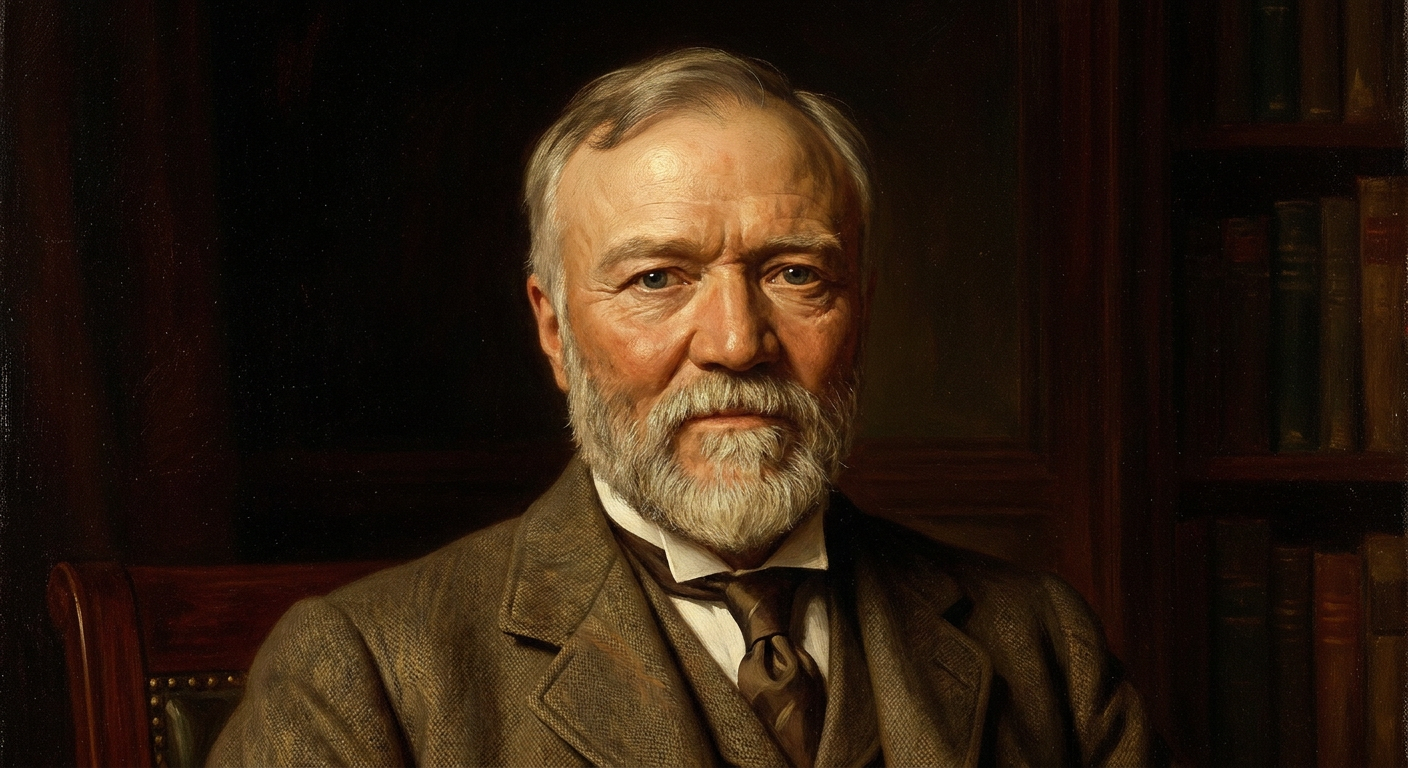
Quick Facts
- Years
- 1835 – 1919
- Category
- Social Reformers & Humanitarians
- Nationality
- Scottish-American
- Occupation
- Industrialist, steel manufacturer, author, and philanthropist
Andrew Carnegie
1835 – 1919 · Scottish-American · Industrialist, steel manufacturer, author, and philanthropist
Recommended Audiobooks
Listen next from Marcus Alden

Life Lessons from Harriet Beecher Stowe
Marcus Alden · 53 min

Life Lessons from Florence Nightingale
Marcus Alden · 48 min
Andrew Carnegie rose from poverty in Scotland to become one of the most powerful industrialists—and most ambitious philanthropists—of the modern age. After emigrating to the United States as a child, he worked in a textile mill, delivered telegrams, mastered railroad management, and invested successfully in the industries transforming nineteenth-century America. His steel empire supplied the rails, bridges, buildings, and machinery of a rapidly industrializing nation.
Yet Carnegie’s story is filled with tension. He presented himself as a friend of working people while his companies demanded long hours, reduced labor costs, and resisted unions. The violent 1892 Homestead Strike remains inseparable from his reputation. His enormous fortune arose within an economic system that created spectacular wealth but exposed laborers to dangerous and insecure conditions.
After selling Carnegie Steel to J. P. Morgan in 1901, Carnegie devoted most of his remaining life to giving money away. He financed more than 2,500 public-library buildings worldwide and established universities, research organizations, pension funds, cultural institutions, and foundations for education and peace. Carnegie still matters because he helped shape both modern industrial capitalism and large-scale philanthropy. His life raises enduring questions: How should wealth be created? What responsibilities accompany it? Can charitable giving repair harms associated with the accumulation of a fortune?
Quick Facts
| Field | Information |
|---|---|
| Full Name | Andrew Carnegie |
| Common Name(s) | Andrew Carnegie; the “Steel King” |
| Born | November 25, 1835 |
| Died | August 11, 1919 |
| Age at Death | 83 |
| Birthplace | Dunfermline, Fife, Scotland |
| Nationality | Scottish-American; became a U.S. citizen in 1885 |
| Occupation | Industrialist, investor, author, and philanthropist |
| Historical Era | Industrial Revolution and Gilded Age |
| Famous For | Building Carnegie Steel and funding libraries, education, research, and peace initiatives |
| Political Affiliation | Generally Republican in U.S. politics, though independent on issues such as imperialism |
| Religion | Raised Presbyterian; later adopted a nonsectarian and religiously skeptical outlook |
| Education | Limited formal schooling; extensive self-education |
| Parents | William Carnegie and Margaret Morrison Carnegie |
| Spouse(s) | Louise Whitfield Carnegie, married 1887 |
| Children | Margaret Carnegie Miller |
| Major Works | Triumphant Democracy, The Gospel of Wealth, Round the World, The Empire of Business, and Autobiography of Andrew Carnegie |
| Major Achievements | Created a leading steel corporation; funded over 2,500 library buildings; founded or endowed major educational, scientific, cultural, and peace organizations |
Early Life
Andrew Carnegie was born in Dunfermline, a Scottish textile center, to handloom weaver William Carnegie and Margaret Morrison Carnegie. His father belonged to a skilled trade threatened by mechanized production. The family valued education, political reform, and independence, but declining demand for handwoven cloth brought severe financial hardship.
Carnegie attended a local school only briefly. His uncle George Lauder encouraged his interest in Scottish history, literature, and democratic reform. His mother, a determined and practical figure, helped support the household by sewing shoes and running a small food business.
In 1848 the family borrowed money and emigrated to the United States, settling in Allegheny, Pennsylvania, now part of Pittsburgh. At thirteen, Carnegie became a bobbin boy in a cotton factory, earning about $1.20 a week. The noisy, exhausting work gave him firsthand knowledge of industrial labor, although his later career placed him among those directing rather than performing it.
A local benefactor, Colonel James Anderson, opened his private library to working boys. Carnegie used it eagerly and later remembered the opportunity as transformative. This experience strongly influenced his belief that libraries could provide motivated individuals with the tools for self-education.
Rise to Prominence
Carnegie soon left the factory to become a telegraph messenger. He memorized Pittsburgh’s streets and prominent business addresses, then taught himself to recognize incoming messages by sound. His skill brought promotion to telegraph operator and placed him near the information networks of business and government.
In 1853 Thomas A. Scott of the Pennsylvania Railroad hired Carnegie as his personal telegraph operator and secretary. Scott became an important mentor, teaching him railroad organization, cost control, personnel management, and investment. During the Civil War, Carnegie helped supervise military rail and telegraph operations in the North, although he was not a combat soldier.
His wages alone did not make him wealthy. With guidance from Scott and Pennsylvania Railroad president J. Edgar Thomson, Carnegie invested in enterprises connected to expanding transportation, including the Adams Express Company, sleeping cars, bridges, oil, and ironworks. Such opportunities also reflected the importance of insider relationships in Gilded Age business.
By 1865 Carnegie had left railroad employment to concentrate on manufacturing and investment. He recognized that iron bridges would replace wooden ones and that steel would increasingly replace iron. After observing efficient steelmaking in Britain, he committed heavily to the new industry.
The Edgar Thomson Steel Works opened near Pittsburgh in 1875. Named for the railroad president whose business Carnegie hoped to attract, it used modern equipment and strict accounting. Carnegie continually reinvested profits in better furnaces and machinery. By lowering the cost of each ton, his companies could underprice competitors while continuing to expand.
Major Achievements
Building Carnegie Steel
Carnegie assembled mills, coke supplies, transportation systems, and sales operations into an increasingly coordinated enterprise. Vertical integration—controlling several stages of production—reduced dependence on outsiders. Managers measured costs closely, replaced outdated equipment, and pushed plants to operate at high capacity.
In 1892 the businesses were consolidated as the Carnegie Steel Company. Steel from its mills helped construct railroads, bridges, ships, machinery, and skyscrapers. The company demonstrated how large-scale organization and technological investment could make steel cheaper and more widely available.
Creating U.S. Steel
In 1901 financier J. P. Morgan purchased Carnegie Steel and combined it with other firms to create United States Steel, the world’s first corporation valued at more than $1 billion. Carnegie received securities worth approximately $225 million, making him among the richest individuals of his era.
The transaction marked a transition from owner-managed industrial empires toward enormous corporations coordinated through finance. It also allowed Carnegie to retire from steel and focus on philanthropy.
Public Libraries
Carnegie financed more than 2,500 library buildings in English-speaking countries and beyond, including roughly 1,700 in the United States. Communities generally had to provide land, books, and continuing tax support. This requirement was intended to ensure local commitment rather than permanent dependence on the donor.
The program expanded free access to books, reference materials, lectures, and civic space. Not every community welcomed the gifts: some critics called them monuments to wealth gained through underpaid labor. Nevertheless, many Carnegie libraries remain active public institutions.
Education, Science, and Culture
Carnegie founded Carnegie Technical Schools, which later became Carnegie Mellon University, and supported institutions including the Carnegie Institution of Washington, Carnegie Foundation for the Advancement of Teaching, Carnegie Hero Fund, Carnegie Trust for the Universities of Scotland, and Carnegie Corporation of New York.
He also financed Carnegie Hall in New York and supported scientific research, museums, teacher pensions, and scholarships. His foundations helped establish the professional administration and long-term endowments associated with modern philanthropy.
International Peace
Carnegie funded the Peace Palace at The Hague and created the Carnegie Endowment for International Peace. He believed arbitration and international law could replace warfare. The outbreak of the First World War in 1914 devastated these hopes, but institutions he established continued studying diplomacy and conflict prevention.
Leadership or Work
Carnegie combined optimism, competitiveness, delegation, and relentless attention to costs. He recruited talented managers, rewarded selected partners with ownership interests, and expected them to deliver increasing output. Henry Clay Frick, Charles Schwab, and Captain Bill Jones were among the strong figures who helped run his operations.
He was skilled at publicity and maintained relationships with politicians, editors, financiers, and intellectuals. Although he celebrated cooperation, his partnerships could become bitter when control or strategy was disputed. His conflict with Frick eventually destroyed their friendship.
Carnegie’s greatest business strengths were timing, reinvestment, personnel selection, and willingness to adopt new technology. His weaknesses included inconsistency between public ideals and workplace policy, a desire to control his historical image, and physical distance from harsh decisions carried out by subordinates.
Personal Life
Carnegie remained closely attached to his mother, Margaret, and did not marry until after her death. In 1887 he married Louise Whitfield, more than twenty years his junior. Their only child, Margaret, was born in 1897. The marriage appears to have been affectionate and stable, and Louise participated in philanthropic work.
Carnegie divided his later years between the United States and Skibo Castle in Scotland, purchased in the late 1890s. He enjoyed travel, music, literature, golf, and gatherings of political and cultural leaders. Small in stature and socially energetic, he cultivated a cheerful public manner but could be stubborn and highly competitive.
His health declined in old age. He died of bronchial pneumonia at Shadow Brook, his estate in Lenox, Massachusetts, on August 11, 1919.
Philosophy or Beliefs
Carnegie’s best-known statement of social philosophy appeared in his 1889 essay commonly called The Gospel of Wealth. He argued that industrial concentration produced efficiencies and that unequal fortunes were an unavoidable result of economic development. However, he also insisted that millionaires were trustees of surplus wealth rather than morally entitled to use it solely for luxury or inheritance.
He preferred gifts that enabled self-improvement—libraries, schools, universities, and research organizations—to indiscriminate charity. This approach reflected his own rise through work, education, opportunity, and influential connections. Critics note that it could underestimate structural barriers facing people without those advantages.
Politically, Carnegie favored republican government, international arbitration, free speech, and closer relations between Britain and the United States. He opposed American annexation of the Philippines and joined the Anti-Imperialist League. Raised in a Presbyterian environment, he moved toward a broad, nonsectarian outlook influenced by evolutionary thought and intellectual skepticism.
His beliefs contained a central contradiction: he advocated social harmony and dignity for labor while benefiting from aggressive cost reduction and opposition to organized workers.
Challenges and Controversies
The Homestead Strike
The defining controversy of Carnegie’s career occurred at the Homestead steelworks in 1892. As a contract with the Amalgamated Association of Iron and Steel Workers approached expiration, management proposed wage changes and prepared to operate without the union. Carnegie left for Scotland after giving Frick broad authority.
Frick locked out workers, fortified the plant, and hired Pinkerton guards. When the guards arrived by barge, armed fighting erupted. Workers and Pinkertons were killed, with exact totals described somewhat differently across accounts. Pennsylvania militia eventually occupied the town, strike leaders were arrested, and replacement workers reopened the mill. The union was defeated.
Carnegie later expressed sorrow and suggested that he would have handled the dispute differently. Yet surviving communications show that he supported the effort to defeat the union and did not intervene to reverse Frick’s strategy. Historians therefore generally reject attempts to place responsibility on Frick alone, while recognizing that Carnegie was abroad during the battle itself.
Labor Conditions and Inequality
Steelworkers endured dangerous plants, irregular employment, exhausting shifts, and—in some departments—twelve-hour schedules. Carnegie’s firms paid some skilled workers well by contemporary standards, but they also sought lower labor costs and greater managerial control.
Supporters credit Carnegie with making steel affordable, creating employment, and later distributing most of his fortune for public purposes. Critics argue that philanthropy did not compensate workers who helped create that fortune or alter unequal industrial power. Modern scholarship usually treats both the productive achievements and human costs as essential to understanding him.
Failed Peace Campaign
Carnegie believed personal influence and funded institutions could help prevent war. World War I demonstrated the limits of that confidence. His failure was not dishonesty—his peace commitment was genuine—but an overestimation of what wealthy individuals, arbitration treaties, and personal diplomacy could accomplish against nationalism and military rivalry.
Legacy
Carnegie gave away roughly $350 million, the majority of his fortune. His libraries reshaped public access to knowledge, while his universities, foundations, museums, concert halls, and research institutions continue to operate.
Carnegie Mellon University, Carnegie Hall, the Carnegie Museums of Pittsburgh, Carnegie Institution for Science, Carnegie Corporation of New York, and Carnegie Endowment for International Peace preserve parts of his name and mission. Numerous library buildings and monuments commemorate him in North America, Britain, Ireland, Australia, New Zealand, and elsewhere.
His legacy is deliberately debated rather than simply celebrated. He helped democratize knowledge and develop strategic philanthropy, but his wealth was inseparable from severe labor conflict and concentrated corporate power. That tension makes him especially relevant to present-day debates about billionaires, taxation, unions, charitable foundations, and social responsibility.
Interesting Facts
- Carnegie began industrial work at thirteen as a bobbin boy.
- He learned to interpret telegraph messages by sound rather than relying only on written tape.
- His first major mentor was railroad executive Thomas A. Scott.
- The Edgar Thomson Works was named to honor a potential railroad customer.
- Carnegie became a naturalized U.S. citizen in 1885.
- He married Louise Whitfield when he was fifty-one.
- His only child, Margaret, was born when he was sixty-one.
- Carnegie Hall opened in New York in 1891.
- Tchaikovsky participated in the hall’s opening festival.
- Carnegie personally received about $225 million in securities from the 1901 steel sale.
- His library grants usually required communities to fund operations.
- Some labor activists rejected or criticized Carnegie library gifts.
- He supported simplified English spelling as an educational reform.
- He opposed U.S. rule over the Philippines.
- He purchased Scotland’s Skibo Castle and made it a summer home.
- The Carnegie Hero Fund recognizes civilians who risk their lives to save others.
- His autobiography was published after his death.
- He was buried at Sleepy Hollow Cemetery in New York.
Famous Quotes
- “The man who dies thus rich dies disgraced.” — The closing judgment of The Gospel of Wealth; it expressed Carnegie’s belief that great fortunes should be distributed during their owners’ lives.
- “The best means of benefiting the community is to place within its reach the ladders upon which the aspiring can rise.” — From The Gospel of Wealth; Carnegie used “ladders” to mean institutions such as libraries and schools.
- “In bestowing charity, the main consideration should be to help those who will help themselves.” — From The Gospel of Wealth; it summarizes his preference for opportunity-building philanthropy, though critics consider the principle too narrow.
- “There is no class so pitiably wretched as that which possesses money and nothing else.” — From The Gospel of Wealth; a warning that wealth without public purpose was spiritually empty.
- “Put all your eggs in one basket, and then watch that basket.” — Associated with Carnegie’s published business advice; it defended focused investment followed by close supervision.
- “My heart is in the work.” — Sent in connection with the founding of Carnegie Technical Schools and adopted as Carnegie Mellon University’s motto.
- “A library outranks any other one thing a community can do to benefit its people.” — From Carnegie’s writing on libraries; wording can vary slightly between reprints.
- “All is well since all grows better.” — A phrase Carnegie proposed for his epitaph, reflecting his faith in progress; it is often quoted as a personal creed.
- “I resolved to stop accumulating and begin the infinitely more serious and difficult task of wise distribution.” — From his autobiographical account, describing his decision to devote himself to philanthropy; editions sometimes punctuate it differently.
- “Teamwork is the ability to work together toward a common vision.” — Frequently attributed to Carnegie online, but reliable evidence that he originated this wording is lacking; it should not be treated as authenticated.
Timeline
- 1835 — Born in Dunfermline, Scotland.
- 1848 — Emigrated with his family to Allegheny, Pennsylvania, and entered textile work.
- 1849 — Became a telegraph messenger.
- 1853 — Joined the Pennsylvania Railroad under Thomas A. Scott.
- 1856 — Began making significant business investments.
- 1861–1865 — Assisted Union railroad and telegraph operations during the Civil War.
- 1865 — Left railroad employment to concentrate on industry.
- 1875 — Opened the Edgar Thomson Steel Works.
- 1885 — Became a U.S. citizen and published Triumphant Democracy.
- 1887 — Married Louise Whitfield.
- 1889 — Published the essays known as The Gospel of Wealth.
- 1891 — Carnegie Hall opened.
- 1892 — Carnegie Steel was organized; the Homestead Strike ended in violence and union defeat.
- 1897 — Daughter Margaret was born.
- 1901 — Sold Carnegie Steel; U.S. Steel was formed.
- 1902 — Founded the Carnegie Institution of Washington.
- 1904 — Established the Carnegie Hero Fund in the United States.
- 1905 — Created the Carnegie Foundation for the Advancement of Teaching.
- 1910 — Founded the Carnegie Endowment for International Peace.
- 1911 — Established the Carnegie Corporation of New York.
- 1914 — World War I shattered his hopes for near-term international peace.
- 1919 — Died in Lenox, Massachusetts.
Frequently Asked Questions
1. How did Andrew Carnegie become rich?
Carnegie combined railroad experience, timely investments, influential business connections, technological modernization, and strict cost control. Early investments in express companies, sleeping cars, oil, bridges, and iron gave him capital for steel. He then reinvested profits in efficient mills and integrated raw materials, transportation, production, and sales. His fortune was not simply the result of personal labor: managers, investors, favorable markets, infrastructure, and thousands of steelworkers were indispensable.
2. Was Andrew Carnegie born poor?
His family was not originally destitute, but the decline of handloom weaving brought serious poverty. Mechanized textile production undermined his father’s occupation, and the family borrowed money to emigrate. In Pennsylvania, thirteen-year-old Carnegie worked long hours in a cotton factory. Later retellings sometimes turn this into a simple “rags-to-riches” legend, but his literacy, family support, mentors, and access to investment opportunities also mattered.
3. What was Carnegie Steel?
Carnegie Steel was the consolidated company formed in 1892 from Carnegie’s various steel interests. Its mills used modern technology, high-volume production, detailed cost accounting, and increasingly integrated supplies and transportation. It became one of America’s largest and most efficient steel producers. J. P. Morgan purchased it in 1901 and combined it with other businesses to establish U.S. Steel.
4. Why did Carnegie sell his company?
By 1901 Carnegie was in his mid-sixties, immensely wealthy, and increasingly interested in philanthropy. Competition and conflict among major steel interests also made consolidation attractive. Charles Schwab helped encourage negotiations with J. P. Morgan. The sale gave Carnegie secure securities worth about $225 million and allowed Morgan to create U.S. Steel, a corporation of unprecedented size.
5. What was the Homestead Strike?
The Homestead Strike was an 1892 labor conflict at Carnegie’s Pennsylvania steelworks. Management, led on site by Henry Clay Frick, locked out union workers and hired Pinkerton guards. A gun battle killed people on both sides. State militia secured the town, replacement labor entered the plant, and the union lost. The defeat weakened organized labor throughout the steel industry for decades.
6. Was Carnegie responsible for the Homestead violence?
Responsibility was shared, but Carnegie cannot reasonably be separated from management policy. He was in Scotland during the battle and did not direct its immediate tactics. Nevertheless, he had approved a hard line against the union, empowered Frick, and failed to intervene. Frick made operational decisions, while armed participants contributed to the violence. Historians generally assign Carnegie substantial moral and executive responsibility.
7. How many libraries did Carnegie fund?
Carnegie financed more than 2,500 library buildings around the world, commonly estimated at 2,509. Roughly 1,700 were in the United States, with many others in Britain, Ireland, Canada, Australia, New Zealand, the Caribbean, and elsewhere. Exact categorization can vary because grants, branches, and completed buildings are counted differently, but the scale of the program is undisputed.
8. Did Carnegie give libraries free of conditions?
Usually not. A community generally had to provide a site, commit public funds for maintenance, and make library service freely available. Carnegie supplied construction money but expected local taxpayers to support books, staff, and operations. The model encouraged lasting public responsibility, though poorer or politically divided communities sometimes struggled to meet its requirements.
9. How much money did Carnegie give away?
He distributed roughly $350 million during his lifetime, representing most of his fortune. Historical dollar comparisons are difficult because measures of inflation, economic output, and relative wealth produce different modern equivalents. The important point is scale: Carnegie transferred an extraordinary private fortune into libraries, universities, research bodies, foundations, cultural institutions, pensions, and peace projects.
10. What was The Gospel of Wealth?
The Gospel of Wealth refers to Carnegie’s 1889 essays arguing that great inequality accompanied industrial progress but imposed duties on the rich. Millionaires, he said, should live without extravagance, provide moderately for dependents, and administer surplus wealth for public benefit. The essay shaped modern philanthropy, yet critics argue that it allowed wealthy donors—not democratic institutions or workers—to decide society’s priorities.
11. Did Carnegie support workers’ rights?
Carnegie publicly praised labor, supported workers’ access to education, and sometimes favored arbitration in theory. In practice, his steel companies demanded managerial control, reduced costs aggressively, and opposed a powerful union at Homestead. The difference between his rhetoric and corporate policy is one of the central criticisms of his career. He supported opportunity for workers more consistently than worker control over industrial decisions.
12. Was Carnegie a self-made man?
He rose remarkably far from modest circumstances through ability and sustained effort, so the description has some basis. However, “self-made” can conceal the support he received from family, mentors, business partners, public infrastructure, investors, and employees. His access to information and investment through railroad connections was especially important. A balanced account recognizes both his talents and the social networks that enabled them.
13. What institutions did Carnegie establish?
Major examples include Carnegie Technical Schools, Carnegie Institution of Washington, Carnegie Foundation for the Advancement of Teaching, Carnegie Hero Fund, Carnegie Trust for the Universities of Scotland, Carnegie Endowment for International Peace, and Carnegie Corporation of New York. He also funded Carnegie Hall, libraries, museums, and educational programs. Several institutions later changed names or expanded their original purposes.
14. Why did Carnegie care about peace?
Carnegie believed technological progress, trade, democracy, arbitration, and international law could make war obsolete. His friendships with political leaders encouraged his hope that influential individuals could mediate disputes. He financed the Peace Palace and Carnegie Endowment for International Peace. World War I exposed the limits of his optimism and caused him profound distress, but his peace institutions survived.
15. What was Carnegie’s relationship with Henry Clay Frick?
Frick supplied coke and became a central executive in Carnegie’s steel organization. The two initially benefited from each other’s abilities: Carnegie brought capital and strategic vision, while Frick was a forceful operator. Homestead damaged Carnegie’s reputation, and later disagreements over finances and authority led to a bitter separation. Their partnership illustrates both Carnegie’s talent for selecting managers and his difficulty sharing control.
16. Is Carnegie remembered as a hero or a villain?
Neither label is sufficient. Admirers emphasize affordable steel, public libraries, scientific research, universities, cultural institutions, and the decision to give away most of his wealth. Critics emphasize dangerous work, union suppression, concentrated power, and the paternalism of billionaire philanthropy. His importance lies partly in this unresolved duality: Carnegie was both a builder of public institutions and a dominant industrial capitalist.
Lessons We Can Learn
- Education can multiply opportunity. Carnegie’s use of Colonel Anderson’s library shaped his later giving; modern interpretation should not ignore the material barriers education alone cannot remove.
- Learn emerging systems early. Telegraphy and railroads placed him near fast-growing industries and valuable information.
- Reinvest for long-term advantage. Carnegie repeatedly replaced profitable but aging machinery rather than protecting short-term returns.
- Choose capable colleagues. Managers such as Schwab and Jones expanded his effectiveness, although dependence on Frick also carried reputational costs.
- Measure results carefully. Detailed cost accounting helped his mills improve, a method still relevant when balanced against human welfare.
- Public values should match private conduct. Homestead shows the damage created when humane rhetoric conflicts with organizational practice.
- Wealth creates responsibility, not automatic wisdom. Carnegie’s philanthropy achieved much, but donor control remains open to democratic criticism.
- Build institutions that outlast individuals. Endowed organizations preserved his educational and scientific goals after his death.
- Good intentions have limits. His peace campaign could not prevent World War I; complex problems require more than influence and money.
- Study legacies in full. Carnegie’s libraries and labor record belong to the same history, warning against both hero worship and one-dimensional condemnation.
Related Historical Figures
- Henry Clay Frick — Carnegie’s partner, coke supplier, and manager during the Homestead Strike.
- J. P. Morgan — Financier who purchased Carnegie Steel and created U.S. Steel.
- Charles M. Schwab — Carnegie executive who helped negotiate the 1901 sale and became U.S. Steel’s first president.
- Thomas A. Scott — Pennsylvania Railroad executive and Carnegie’s early mentor.
- John D. Rockefeller — Fellow Gilded Age industrialist and large-scale philanthropist.
- Cornelius Vanderbilt — Railroad magnate whose career reflected the consolidation of American industry.
- Samuel Gompers — Labor leader representing the organized workers often opposed by industrial corporations.
- Alexander Berkman — Anarchist who attempted to assassinate Frick after Homestead; Carnegie was not involved in the attack.
- Booker T. Washington — Educator whose institution and programs received Carnegie support.
- Herbert Spencer — Philosopher whose evolutionary and social ideas influenced Carnegie’s worldview.
Watch and Learn
Video: Gilded Age Politics: Crash Course US History #26
Channel: CrashCourse
Approximate duration: 14 minutes
This established educational video places industrial fortunes such as Carnegie’s within the broader politics, inequality, patronage, and reform movements of the Gilded Age. It is recommended as concise historical context rather than as a complete stand-alone biography of Carnegie.
Watch and Learn
Gilded Age Politics: Crash Course US History #26 · CrashCourse
Related Historical Figures