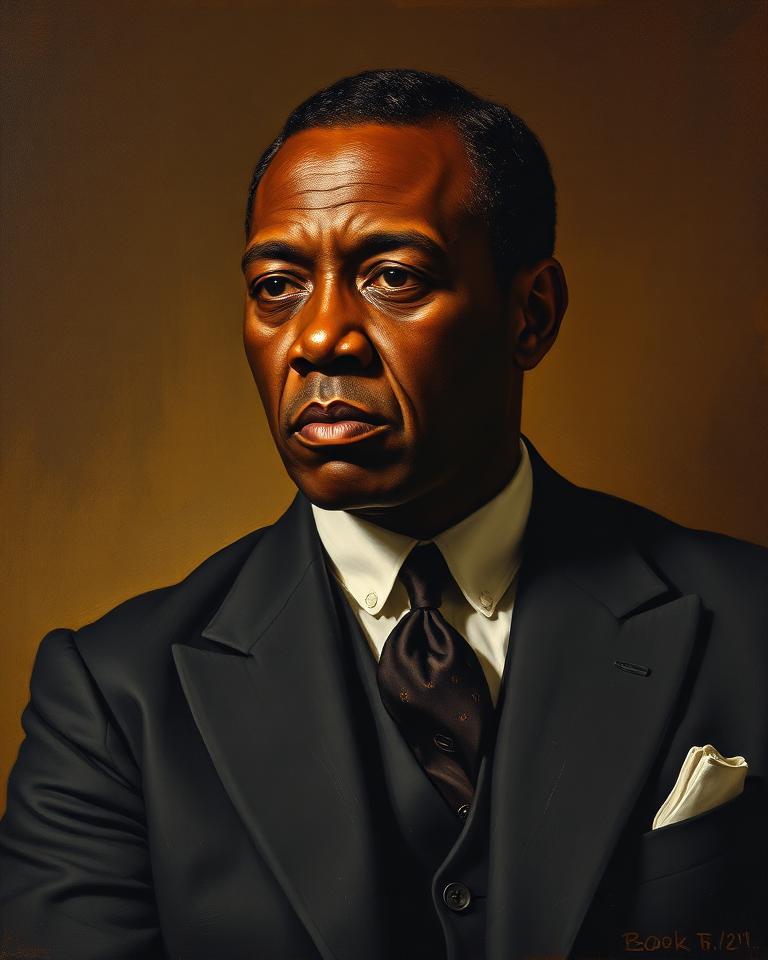
Quick Facts
- Years
- 1856 – 1915
- Category
- Social Reformers & Humanitarians
- Subcategory
- Educational Leadership
- Nationality
- American
- Occupation
- Educator and Author
Booker T. Washington
1856 – 1915 · American · Educator and Author
Audiobook

Life Lessons from Booker T. Washington
Marcus Alden · 51 min
Booker T. Washington was an American educator, author, institution builder, and one of the most influential Black leaders of the late nineteenth and early twentieth centuries. Born enslaved in Virginia in 1856, he pursued education under extraordinary hardship, studied at Hampton Normal and Agricultural Institute, and in 1881 became the founding principal of the school later known as Tuskegee Institute.
Washington built Tuskegee into a nationally prominent center of teacher training, agriculture, trades, and academic instruction. His 1895 Atlanta Exposition address made him famous for advocating economic advancement, vocational preparation, thrift, property ownership, and interracial cooperation. Through books, speeches, fundraising networks, political contacts, and organizations such as the National Negro Business League, he exercised enormous influence over Black education and public policy.
His leadership was also controversial. Critics, most famously W. E. B. Du Bois, argued that Washington placed too little public emphasis on voting rights, higher education, and direct resistance to segregation. Later scholarship has shown a more complicated figure: while publicly conciliatory, Washington sometimes financed legal challenges to discrimination and quietly supported opponents of racial injustice.
Washington remains important because his life illuminates emancipation, education, institution building, Black political strategy, philanthropy, and the difficult choices African Americans faced during the Jim Crow era.
Quick Facts
| Field | Information |
|---|---|
| Full Name | Booker Taliaferro Washington |
| Common Name(s) | Booker T. Washington |
| Born | April 5, 1856; the exact date was selected later because no birth record is known |
| Died | November 14, 1915 |
| Age at Death | 59 |
| Birthplace | Burroughs plantation, near Hale's Ford, Franklin County, Virginia, United States |
| Nationality | American |
| Occupation | Educator, author, orator, institution builder, adviser |
| Historical Era | Reconstruction, Gilded Age, Progressive Era, Jim Crow era |
| Famous For | Leading Tuskegee Institute; the Atlanta Exposition address; Up from Slavery |
| Political Affiliation if applicable | Republican-aligned, though not primarily an elected partisan official |
| Religion if significant | Protestant Christian; associated with the Baptist tradition |
| Education | Hampton Normal and Agricultural Institute; Wayland Seminary |
| Parents | Jane, an enslaved cook; biological father not conclusively identified |
| Spouse(s) | Fannie N. Smith; Olivia A. Davidson; Margaret James Murray |
| Children | Portia M. Washington; Booker T. Washington Jr.; Ernest Davidson Washington |
| Major Works | The Future of the American Negro; Up from Slavery; The Story of My Life and Work; The Story of the Negro; My Larger Education |
| Major Achievements | Founding principal of Tuskegee; nationally influential speaker and fundraiser; founder of the National Negro Business League; adviser to presidents and philanthropists |
Early Life
Washington was born enslaved on a small tobacco plantation owned by James Burroughs. His mother, Jane, worked as a cook. Washington later wrote that he knew little about his biological father, who was believed to be a white man from a neighboring plantation. Because enslaved births were often poorly documented, Washington did not know his birth date with certainty; April 5, 1856, became the accepted date.
After the Civil War brought emancipation, Jane moved her family to Malden, West Virginia, where her husband, Washington Ferguson, worked in the salt and coal industries. The young Booker labored in a salt furnace and coal mine. He wanted schooling, but poverty required him to work. He attended classes when possible and adopted “Washington” as a surname; “Taliaferro,” apparently a name given during childhood, was later restored as his middle name.
A decisive influence was Viola Ruffner, the wife of a mine owner who employed Washington as a house servant. Known as demanding, she taught him habits of cleanliness, punctuality, and careful work. He saved money and in 1872 traveled roughly 500 miles to Hampton Normal and Agricultural Institute in Virginia.
At Hampton, principal Samuel Chapman Armstrong promoted education combining academic study, manual labor, discipline, and moral formation. Washington worked as a janitor to help pay expenses and graduated in 1875. After teaching in Malden, he attended Wayland Seminary in Washington, D.C., briefly, then returned to Hampton as an instructor. Armstrong became his central mentor and later recommended him to lead a new school in Alabama.
Rise to Prominence
In 1881 Alabama authorized a normal school for Black teachers at Tuskegee. Armstrong recommended Washington as principal. Arriving at age twenty-five, Washington found an appropriation for salaries but no permanent campus. Classes began on July 4, 1881, in a church and a borrowed building.
Washington secured a former plantation and organized students to construct buildings, cultivate crops, and learn trades while studying academic subjects. This method reflected Hampton's model but also addressed immediate rural needs. Students' labor reduced costs, supplied practical training, and helped create a visible institution from limited resources.
He proved exceptionally effective at fundraising. Washington cultivated Northern philanthropists while building support among Alabama's Black communities. Olivia Davidson, a teacher who became his second wife, was instrumental in early fundraising and school administration. Supporters eventually included industrialists and philanthropists such as Andrew Carnegie, John D. Rockefeller, and Julius Rosenwald.
Washington achieved national fame on September 18, 1895, when he addressed the Cotton States and International Exposition in Atlanta. Speaking to a predominantly white audience, he urged Black southerners to build economic strength and asked white employers to hire Black workers. His “cast down your bucket” metaphor emphasized cooperation and local opportunity.
Many white newspapers celebrated the speech. Some Black listeners initially welcomed its recognition of Black labor and achievement, while others believed Washington conceded too much to segregation. The address nevertheless transformed him into a national spokesman whose approval was sought in educational appointments, philanthropy, and Republican politics.
Major Achievements
Building Tuskegee Institute
Washington's greatest institutional achievement was transforming a small teacher-training school into a major educational center. By his death, Tuskegee possessed substantial land, dozens of buildings, a large faculty and student body, and programs in teaching, agriculture, industry, and other fields.
Its graduates staffed schools, managed farms and businesses, and carried practical knowledge across the South. Tuskegee demonstrated that Black-led institutions could survive and expand despite segregation, chronic underfunding, and racial violence.
The Atlanta Exposition Address
The 1895 speech established Washington as the era's best-known Black American leader. He presented economic interdependence as an argument against exclusion: Black and white southerners could cooperate in work while remaining, in his famous metaphor, socially “as separate as the fingers.”
Supporters saw a pragmatic program capable of attracting resources in a hostile political climate. Critics saw accommodation to disenfranchisement and segregation. Its long-term importance lies partly in the debate it generated over economic power, civil rights, and political strategy.
Promoting Black Enterprise
In 1900 Washington founded the National Negro Business League. It brought together entrepreneurs, farmers, professionals, and community leaders to share methods and publicize Black economic achievement.
The league strengthened business networks and challenged racist claims that African Americans lacked commercial ability. It also reflected Washington's conviction that ownership and occupational skill could provide foundations for broader advancement.
Writing Up from Slavery
Washington's autobiography, serialized and published as a book in 1901, became an international success. It described his journey from slavery to educational leadership while emphasizing work, discipline, self-improvement, and cooperation.
The book shaped Washington's public image and introduced Tuskegee's program to a wide audience. Historians also read it critically as a crafted public argument rather than a complete private record.
National Political Influence
Washington advised Republican officials on patronage and racial matters. President Theodore Roosevelt invited him to dine at the White House in October 1901, provoking a racist backlash across the South. Washington also interacted with President William Howard Taft and numerous public officials.
His informal network, sometimes called the “Tuskegee Machine,” influenced appointments, journalism, and the distribution of philanthropic funds. This provided leverage for Black causes, but critics objected to his power over rival leaders and institutions.
Supporting Rural Education and Agriculture
Tuskegee promoted agricultural improvement through conferences, demonstrations, and outreach. George Washington Carver, who joined its faculty in 1896, became its most famous scientist and agricultural educator.
Washington later collaborated with Julius Rosenwald on pilot programs that helped inspire the Rosenwald school-building movement. Those schools dramatically expanded educational facilities for Black children across the segregated South, although local Black communities often had to contribute money and labor despite unequal taxation.
Leadership and Work
Washington led through institution building, personal networks, relentless travel, public speaking, and carefully managed publicity. He tailored appeals to different audiences. To wealthy donors, he stressed stability, measurable progress, and practical education. To Black audiences, he emphasized self-reliance, organization, property, and racial pride.
His strengths included discipline, strategic patience, financial skill, and an exceptional ability to connect local needs with national philanthropy. He valued visible results: buildings, trained teachers, productive farms, businesses, and employment.
His decision-making was often centralized. He expected loyalty and used trusted allies to monitor newspapers, appointments, and opponents. His network could protect Tuskegee and direct funds toward Black education, but it could also marginalize critics. Scholars have documented efforts by his circle to influence or subsidize publications and to contest rival leadership.
Washington maintained relationships across racial and class boundaries. He worked with Black teachers and entrepreneurs, white southern officials, Northern reformers, and industrial philanthropists. Such alliances expanded his influence but encouraged dependence on wealthy donors whose priorities did not always match those of Black communities.
His central weakness was the gap between what political conditions demanded and what his public language acknowledged. His caution preserved access and resources, yet it could make segregation and disenfranchisement appear more acceptable than they were.
Personal Life
Washington married three times. In 1882 he married Fannie N. Smith, a former student from Malden. Their daughter, Portia, was born in 1883. Fannie died in 1884.
In 1885 he married Olivia America Davidson, an early Tuskegee teacher and administrator who had helped raise funds for the school. They had two sons, Booker T. Washington Jr. and Ernest Davidson Washington. Olivia died in 1889.
Washington married Margaret James Murray in 1893. A Fisk University graduate and Tuskegee administrator, she helped rear all three children and became a significant clubwoman and advocate for women, families, and education. Their partnership was also professional; she organized community programs and represented Tuskegee publicly.
Washington lived on the Tuskegee campus in a house called The Oaks. Visitors described him as composed, energetic, observant, and intensely hardworking. He traveled frequently, dictated correspondence, entertained influential guests, and managed overlapping educational and political responsibilities.
Years of work and travel damaged his health. He suffered from hypertension and related illness. After becoming seriously ill in New York, he chose to return to Tuskegee, where he died on November 14, 1915. He was buried on the campus.
Philosophy and Beliefs
Washington believed freedom required material foundations: literacy, skilled work, land, savings, business ownership, sanitation, and stable institutions. His philosophy joined Victorian ideals of character with the practical constraints confronting formerly enslaved people and their descendants.
He did not argue that Black Americans were inherently suited only for manual labor. Tuskegee offered academic subjects as well as industrial training, and Washington valued professional advancement. Nevertheless, his public emphasis fell on vocational and agricultural education, especially for the rural southern majority.
Politically, he favored gradualism and strategic cooperation. He believed aggressive public confrontation could trigger retaliation and endanger fragile institutions. In the Atlanta address, he accepted social separation in language that critics interpreted as surrender to segregation.
Yet Washington did not simply endorse white supremacy. He condemned lynching, maintained that constitutional rights ultimately belonged to Black citizens, and covertly assisted some legal challenges to discrimination. Scholars debate whether this private activism fundamentally revises his accommodationist reputation or merely qualifies it.
His religious outlook emphasized providence, service, moral discipline, and reconciliation. He framed work as dignified and education as a means of individual development and community uplift. At its best, this ethic inspired collective construction; at its weakest, it risked implying that oppressed people could overcome systemic injustice primarily through personal conduct.
Challenges and Controversies
Washington operated during the consolidation of Jim Crow. Southern states disfranchised Black voters, segregated public life, tolerated racial terrorism, and distributed education funds unequally. His strategy cannot be evaluated apart from this danger.
The largest controversy concerned the Atlanta Compromise. W. E. B. Du Bois argued in The Souls of Black Folk that Washington effectively asked Black people to surrender, at least temporarily, political power, civil rights, and higher education. William Monroe Trotter and other activists confronted him more directly. At a 1903 Boston meeting, disorder surrounding Trotter's protest became known as the Boston Riot.
Washington's defenders argued that outspoken resistance could close schools, destroy livelihoods, and provoke violence. They credited him with building durable institutions and speaking carefully enough to obtain resources from powerful white Americans.
His educational model was another point of dispute. Critics feared industrial education would confine Black students to subordinate labor. Washington answered that practical training created economic leverage and met rural needs. In practice, Tuskegee combined trades with academic and teacher education, but donor enthusiasm often favored labor training over equality.
The “Tuskegee Machine” generated criticism because Washington and his associates influenced newspapers, federal appointments, and philanthropy. He sometimes worked against opponents, making his leadership less open than his message of cooperation suggested.
His reliance on wealthy benefactors also imposed limits. Donors often admired his emphasis on order while resisting demands for structural equality. Washington gained resources by navigating those expectations, but his rhetoric sometimes reassured whites more than it challenged injustice.
Modern historians commonly reject both the image of Washington as merely submissive and the opposite claim that he was secretly as confrontational as later civil-rights leaders. The evidence presents a pragmatic, ambitious, constrained, and sometimes controlling leader whose choices produced both major gains and serious costs.
Legacy
Washington helped establish Black education and enterprise as national priorities. Tuskegee University remains his foremost institutional legacy and is recognized as a historically Black university with an international reputation.
His influence extended through teachers, farmers, business owners, and civic leaders trained or supported by Tuskegee networks. Collaboration with Rosenwald helped lay foundations for a school-building program that eventually produced thousands of facilities for Black southern children.
His birthplace is preserved as Booker T. Washington National Monument in Virginia, administered by the National Park Service. The Oaks and Washington's grave are part of Tuskegee Institute National Historic Site in Alabama. Numerous schools, parks, roads, and memorials bear his name. In 1940 he became the first African American depicted on a United States postage stamp; he later appeared on a commemorative half dollar.
Washington's reputation has shifted repeatedly. He was celebrated as a self-made educator, criticized as an accommodationist, and reassessed as a sophisticated political operator. Modern study places him alongside Du Bois rather than simply beneath him: their conflict represents enduring debates over whether marginalized communities should prioritize institutions, economic capacity, political protest, litigation, elite education, or mass training.
His continued relevance lies in this unresolved tension. Economic opportunity and civil rights are not substitutes, but Washington's career shows why leaders under repression sometimes treat them as competing immediate priorities.
Interesting Facts
- Washington was born enslaved and was about nine when the Civil War ended.
- His exact birth date was not recorded at the time; April 5, 1856, was adopted later.
- As a child, he worked in salt furnaces and a coal mine.
- He traveled roughly 500 miles to attend Hampton Institute.
- Hampton admitted him after an entrance test involving cleaning a recitation room.
- He worked as Hampton's janitor to meet expenses.
- He became Tuskegee's principal at only twenty-five.
- Tuskegee's first classes met in borrowed facilities.
- Students helped make bricks and erect campus buildings.
- His 1895 Atlanta address made him nationally famous.
- He founded the National Negro Business League in 1900.
- Up from Slavery was first serialized before book publication.
- Theodore Roosevelt hosted him at a White House dinner in 1901.
- The dinner caused a fierce racist reaction in southern newspapers.
- George Washington Carver taught at Tuskegee during Washington's presidency.
- Washington received honorary degrees from Harvard and Dartmouth.
- He made a European tour in 1899.
- He was married three times and had three children.
- The Oaks, his Tuskegee home, is preserved by the National Park Service.
- He was the first African American portrayed on a U.S. postage stamp.
Famous Quotes
- “Cast down your bucket where you are.” — Repeated in the 1895 Atlanta address. It urged both races to recognize opportunity and interdependence in the South.
- “In all things that are purely social we can be as separate as the fingers, yet one as the hand in all things essential to mutual progress.” — Atlanta address, 1895. It summarized the compromise that won praise and provoked enduring criticism.
- “No race can prosper till it learns that there is as much dignity in tilling a field as in writing a poem.” — Atlanta address. Washington challenged contempt for labor while arguing for practical education.
- “The opportunity to earn a dollar in a factory just now is worth infinitely more than the opportunity to spend a dollar in an opera-house.” — Atlanta address. The statement prioritized immediate economic access over social integration.
- “The wisest among my race understand that the agitation of questions of social equality is the extremest folly.” — Atlanta address. This controversial sentence reflects his public gradualism, not the full range of his private political activity.
- “I have learned that success is to be measured not so much by the position that one has reached in life as by the obstacles which he has overcome while trying to succeed.” — Up from Slavery. It interprets achievement through struggle rather than status alone.
- “There are two ways of exerting one's strength: one is pushing down, the other is pulling up.” — Up from Slavery. Washington contrasted destructive rivalry with constructive service.
- “I will permit no man to narrow and degrade my soul by making me hate him.” — Up from Slavery. The line expresses his ethic of self-command amid racism.
- “Among a large class there seemed to be a dependence upon the Government for every conceivable thing.” — Up from Slavery. In context, Washington criticized dependency after emancipation, a judgment historians examine alongside the government's failures toward freedpeople.
- “Character, not circumstances, makes the man.” — Commonly credited to Washington and consistent with his thought, but the precise original source is uncertain; treat the attribution cautiously.
Timeline
- 1856 — Born enslaved near Hale's Ford, Virginia.
- 1865 — Emancipated after the Civil War; moved with his family to West Virginia.
- 1872 — Entered Hampton Normal and Agricultural Institute.
- 1875 — Graduated from Hampton and returned to teach in Malden.
- 1878 — Studied briefly at Wayland Seminary.
- 1879 — Returned to Hampton as an instructor.
- 1881 — Appointed founding principal of Tuskegee Normal School; classes opened July 4.
- 1882 — Married Fannie N. Smith.
- 1883 — Daughter Portia was born.
- 1884 — Fannie died.
- 1885 — Married Olivia A. Davidson.
- 1887 — Son Booker T. Washington Jr. was born.
- 1889 — Son Ernest was born; Olivia died.
- 1893 — Married Margaret James Murray.
- 1895 — Delivered the Atlanta Exposition address; received an honorary master's degree from Harvard.
- 1896 — George Washington Carver joined Tuskegee's faculty.
- 1899 — Published The Future of the American Negro and toured Europe.
- 1900 — Founded the National Negro Business League.
- 1901 — Published Up from Slavery; dined at the White House with Theodore Roosevelt.
- 1903 — Faced organized protest at a Boston speech; Du Bois published The Souls of Black Folk.
- 1907 — Received an honorary doctorate from Dartmouth.
- 1909 — Published The Story of the Negro.
- 1911 — Published My Larger Education.
- 1912 — Worked with Julius Rosenwald on rural school initiatives.
- 1915 — Died at Tuskegee on November 14.
- 1940 — Became the first African American portrayed on a U.S. postage stamp.
- 1956 — Booker T. Washington National Monument was authorized.
Frequently Asked Questions
Who was Booker T. Washington?
Booker T. Washington was an educator, author, speaker, and institution builder born into slavery in Virginia. He became the founding principal of Tuskegee Institute in Alabama and one of the United States' most influential Black public figures between the 1890s and his death in 1915. He promoted education, skilled work, farming, business ownership, thrift, and institution building. His public willingness to postpone direct confrontation over segregation drew support from many whites and some Black Americans, but strong criticism from activists who demanded immediate civil and political rights.
Was Booker T. Washington born enslaved?
Yes. He was born on the Burroughs plantation in Franklin County, Virginia, in 1856. His mother, Jane, was enslaved, so Virginia law classified him as enslaved at birth. He later recalled plantation life in Up from Slavery, although autobiography must be read as both memory and public argument. Emancipation came when he was a child, after the Civil War. His transition from slavery to freedom did not eliminate hardship: he then worked in West Virginia's salt and coal industries while seeking an education.
Why is his birth date uncertain?
No contemporary birth certificate or plantation record establishing an exact date has been found. Such gaps are common in the biographies of enslaved people because slaveholders frequently recorded them as property rather than documenting their lives fully. Washington knew the approximate year but not the precise day. April 5, 1856, was later accepted and is used by Tuskegee University, the National Park Service, and standard reference works. It should therefore be presented as the conventional date, not as an independently documented birth entry.
How did Washington obtain an education?
He first attended school intermittently while working in West Virginia. Determined to study at Hampton Institute, he traveled hundreds of miles to Virginia in 1872, sometimes walking and working along the way. Hampton official Mary F. Mackie reportedly tested him by asking him to clean a room; his thorough work helped secure admission. Washington supported himself partly as a janitor. He graduated in 1875, taught in West Virginia, studied briefly at Wayland Seminary, and returned to Hampton as an instructor.
What was Tuskegee Institute?
Tuskegee began in 1881 as an Alabama normal school intended to train Black teachers. Washington, its founding principal, developed it from classes in borrowed buildings into a large campus. Students studied academic subjects and also learned agriculture, construction, printing, domestic science, and trades. The school later became Tuskegee Institute and is now Tuskegee University. Its importance extended beyond campus: teachers and outreach workers carried education, agricultural methods, health information, and organizational skills into Black communities throughout the South.
What was the Atlanta Compromise?
The term refers to Washington's 1895 Atlanta Exposition address and the strategy associated with it. He urged Black southerners to pursue education, useful work, property, and business while avoiding immediate agitation for social equality. He asked white southerners to employ Black workers and support their advancement. Supporters regarded this as realistic under violent Jim Crow conditions. Critics believed it accommodated segregation and disfranchisement. “Atlanta Compromise” was not Washington's own title for the speech; it became a critical label for his approach.
Did Washington support segregation?
His public rhetoric accepted social separation as a temporary political reality, most famously in the “separate as the fingers” passage. That language reassured white audiences and has understandably been criticized. However, evidence does not show that Washington considered racial subordination morally desirable. He opposed lynching, believed Black Americans deserved constitutional rights, and secretly aided certain challenges to discriminatory laws. The fairest conclusion is that he accommodated segregation strategically in public while opposing aspects of it privately, a method whose effectiveness and moral cost remain debated.
How did Washington differ from W. E. B. Du Bois?
Washington emphasized vocational education, economic foundations, southern institution building, and cautious negotiation with white power. Du Bois emphasized immediate voting and civil rights, liberal higher education, organized protest, and the development of Black professional leadership. Their differences were real but not absolute: Washington supported some higher education and legal action, while Du Bois valued economic development. The conflict also concerned leadership and access to funds. Together, their arguments define a major debate about how oppressed communities can pursue security and equality.
What was Up from Slavery about?
Published in 1901 after serialization, Up from Slavery recounts Washington's movement from enslavement and industrial labor to Hampton and Tuskegee. It celebrates education, discipline, work, interracial cooperation, and institution building. The book made him internationally famous and attracted support for Tuskegee. Readers should not treat it as a neutral transcript of his life. Washington shaped episodes for moral and political purposes, emphasized reconciliation, and omitted some behind-the-scenes political activity. It remains both a historical source and a carefully constructed leadership narrative.
Why did Theodore Roosevelt invite him to dinner?
Roosevelt invited Washington to dine with his family at the White House in October 1901 after consulting him about southern political appointments. Black visitors had previously met presidents there, but the highly publicized social meal challenged racial conventions. White supremacist politicians and newspapers reacted furiously, while many Black Americans saw it as a significant breach in social exclusion. The backlash showed both Washington's extraordinary access and the rigid racism of the period. Roosevelt continued to consult him, although the administration became more cautious about public social symbolism.
What was the National Negro Business League?
Washington founded the league in Boston in 1900 to connect and promote Black businesspeople and professionals. Members discussed practical experience in banking, farming, retail, manufacturing, insurance, and other occupations. The organization publicized economic successes that racist society often ignored. It embodied Washington's conviction that enterprise and property could strengthen communities and command respect. Critics argued that business advancement could not replace political rights, but the league became an important predecessor to later Black professional and commercial organizations.
Did Washington secretly support civil-rights lawsuits?
Yes, in some cases. Historical research based on correspondence and organizational records shows that Washington privately provided money, contacts, or strategic assistance for challenges to discriminatory practices, including voting restrictions and segregation. He often worked through intermediaries to protect his public position and Tuskegee's funding. This evidence complicates the image of total accommodation. It does not erase his conciliatory speeches or his efforts against critics, but it demonstrates that his private political conduct could be more assertive than his public persona suggested.
What was his relationship with George Washington Carver?
Washington recruited Carver to Tuskegee in 1896 to direct agricultural work. Carver became celebrated for teaching soil conservation, crop diversification, and practical uses for farm products. Both men wanted to improve the lives of southern farmers, but their working relationship was sometimes strained. Washington stressed administration, schedules, and institutional accountability, while Carver preferred research and considerable autonomy. Despite tensions, Tuskegee gave Carver a lasting platform, and his fame strengthened the institution's reputation for agricultural education.
How many times did Washington marry?
He married three times. His first wife, Fannie N. Smith, died in 1884 after the birth of their daughter, Portia. His second wife, Olivia A. Davidson, was a crucial Tuskegee educator and fundraiser; she died in 1889 after they had two sons, Booker Jr. and Ernest. In 1893 Washington married Margaret James Murray, a Tuskegee administrator and prominent clubwoman. She helped raise his children, led women's and community work, and remained his partner until his death.
What caused Booker T. Washington's death?
Washington died after a period of severe illness associated with hypertension and related cardiovascular decline. Some older accounts used outdated diagnostic language or offered speculation about particular diseases. Modern historical summaries should avoid certainty beyond the medical evidence. He became gravely ill while in New York, was hospitalized, and requested to return to Tuskegee. He reached the campus shortly before dying on November 14, 1915, at age fifty-nine. His exhausting travel and workload likely compounded his poor health.
Where is Booker T. Washington buried?
He is buried on the campus of Tuskegee University in Tuskegee, Alabama, near the institution to which he devoted most of his career. His grave and The Oaks, his campus residence, form part of Tuskegee Institute National Historic Site. The site interprets Washington's life, family, educational work, and the broader history of Tuskegee. His birthplace in Virginia is separately preserved as Booker T. Washington National Monument, where visitors can learn about slavery, emancipation, farming, and his childhood environment.
Why is Washington still controversial?
He is controversial because his genuine achievements were tied to a strategy that often muted public demands for equality. He built schools, created economic networks, attracted major resources, and sometimes supported resistance privately. At the same time, his rhetoric could validate white claims that civil rights should wait, and his political network sometimes suppressed Black dissent. Assessing him requires holding these facts together. The debate concerns not only his character but the severe limits, dangers, and competing responsibilities facing Black leadership under Jim Crow.
Lessons We Can Learn
- Build durable institutions. Washington turned a borrowed classroom into Tuskegee. Lasting organizations can outlive even charismatic founders.
- Connect education with lived needs. Tuskegee linked study to teaching, agriculture, health, and trades. Learning has greater reach when communities can apply it.
- Work strategically under constraint. Washington negotiated within a violent racial order. Modern leaders should assess risks without mistaking caution for a complete solution.
- Economic power and civil rights must reinforce each other. His program showed the value of assets and skills, while criticism exposed the danger of treating them as substitutes for legal equality.
- Tailor communication without losing principles. Washington addressed donors and Black communities differently. Audience awareness is useful, but excessive accommodation can obscure core commitments.
- Use networks to multiply impact. His alliances mobilized money and political access. Networks are powerful when they remain accountable rather than becoming gatekeeping machines.
- Respect the dignity of work. Washington rejected disdain for manual labor. Modern education benefits from valuing technical, intellectual, caregiving, and creative work alike.
- Read autobiographies critically. Up from Slavery is inspiring and strategically composed. Personal narratives reveal experience while also shaping reputation.
- Allow disagreement within movements. Conflict with Du Bois and Trotter sharpened important questions, but efforts to marginalize critics weakened open debate.
- Judge decisions in context—and by consequences. Jim Crow constrained Washington severely, yet context does not end moral evaluation. Historical understanding requires empathy and scrutiny together.
Related Historical Figures
- Samuel Chapman Armstrong — Hampton's principal and Washington's mentor; his educational model strongly influenced Tuskegee.
- W. E. B. Du Bois — Scholar and activist who became Washington's most famous intellectual critic.
- William Monroe Trotter — Newspaper editor who opposed Washington's accommodationism and challenged his leadership publicly.
- Frederick Douglass — Earlier abolitionist and civil-rights leader whose more confrontational legacy provided a comparison with Washington.
- George Washington Carver — Agricultural scientist recruited to Tuskegee's faculty in 1896.
- Margaret Murray Washington — Washington's third wife, Tuskegee administrator, clubwoman, and community organizer.
- Theodore Roosevelt — President who consulted Washington and hosted him at the White House.
- Julius Rosenwald — Philanthropist who worked with Washington on rural Black school initiatives.
- Ida B. Wells-Barnett — Anti-lynching journalist whose activism represented a more direct challenge to racial violence.
- Andrew Carnegie — Industrialist and philanthropist whose financial support aided Tuskegee and Washington's broader educational work.
Related Historical Figures