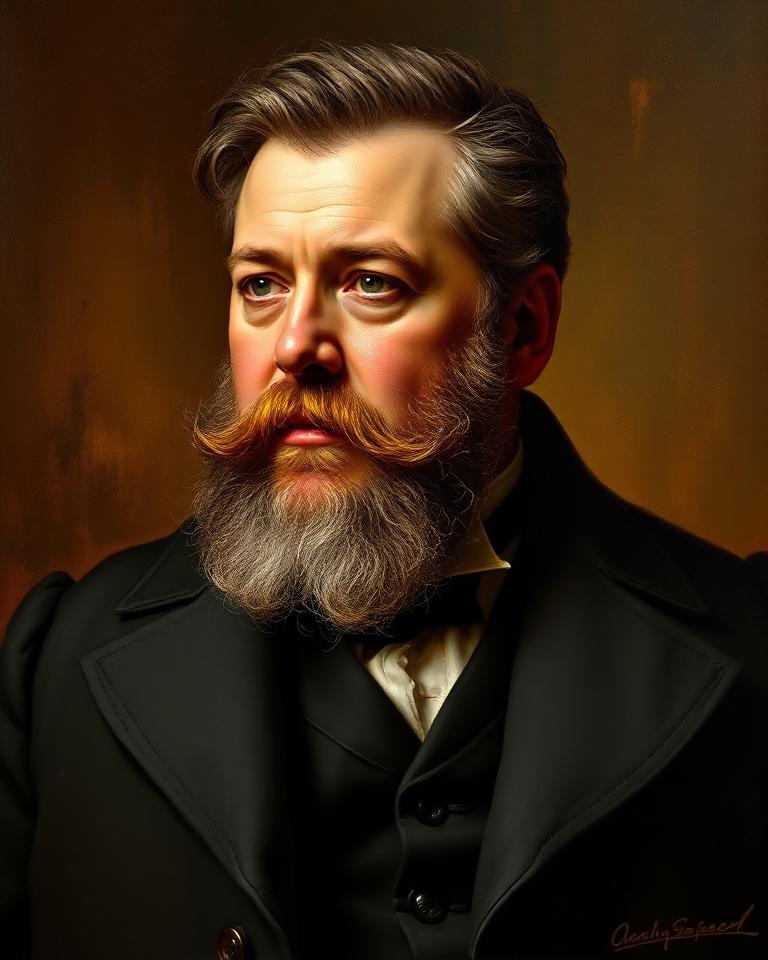
Quick Facts
- Years
- 1834 – 1892
- Category
- Social Reformers & Humanitarians
- Subcategory
- Theology & Oratory
- Nationality
- British
- Occupation
- Preacher and Philanthropist
Charles Spurgeon
1834 – 1892 · British · Preacher and Philanthropist
Audiobook

Life Lessons from Charles Spurgeon
Marcus Alden · 1 hr
Charles Haddon Spurgeon (1834–1892) was an English Baptist preacher, author, educator, and philanthropist whose extraordinary public ministry earned him the enduring nickname “the Prince of Preachers.” Beginning as a teenage pastor with little formal theological education, he became one of Victorian Britain’s most recognizable religious figures. Thousands gathered to hear his sermons, while printed versions circulated internationally in many languages.
Spurgeon’s importance extended far beyond eloquence. At London’s New Park Street Chapel and later the Metropolitan Tabernacle, he built a ministry combining evangelical preaching with practical social action. He founded the Pastors’ College, supported orphanages, encouraged colporteurs and evangelists, and helped sustain numerous charitable organizations. His sermons, books, lectures, and devotional writings created a literary legacy that remains influential among Protestant Christians.
His career also reveals the tensions within nineteenth-century British Nonconformity. Spurgeon opposed slavery, defended Baptist religious liberty, criticized ritualism, and eventually withdrew from the Baptist Union during the bitter “Downgrade Controversy” over biblical authority and theology. He struggled throughout adulthood with recurrent illness and depression, yet maintained a demanding workload until his death at fifty-seven. Historians continue to study him as a pioneering mass communicator, a major evangelical leader, a social philanthropist, and a controversial defender of Reformed Baptist belief in an age of rapid urban, scientific, and theological change.
Quick Facts
| Field | Details |
|---|---|
| Full Name | Charles Haddon Spurgeon |
| Common Name(s) | Charles Spurgeon; C. H. Spurgeon; “Prince of Preachers” |
| Born | 19 June 1834 |
| Died | 31 January 1892 |
| Age at Death | 57 |
| Birthplace | Kelvedon, Essex, England |
| Nationality | British (English) |
| Occupation | Baptist minister, preacher, author, educator, philanthropist |
| Historical Era | Victorian era; nineteenth-century evangelical revival |
| Famous For | Metropolitan Tabernacle ministry, published sermons, Pastors’ College, orphanage work |
| Political Affiliation if applicable | No formal party affiliation firmly established; broadly Nonconformist and reform-minded |
| Religion if significant | Particular Baptist; evangelical and Calvinistic Protestant |
| Education | Local schools, including Stockwell House School and an agricultural school at Maidstone; largely self-educated in theology; no university degree |
| Parents | John Spurgeon and Eliza Jarvis Spurgeon |
| Spouse(s) | Susannah Thompson Spurgeon, married 1856 |
| Children | Twin sons Charles Spurgeon Jr. and Thomas Spurgeon |
| Major Works | The Treasury of David; Morning by Morning; Evening by Evening; Lectures to My Students; John Ploughman’s Talk; The Soul Winner; All of Grace; published sermon series |
| Major Achievements | Pastor of the Metropolitan Tabernacle; internationally circulated sermons; founded the Pastors’ College; established orphanage ministries; supported extensive charitable and evangelistic work |
Early Life
Charles Haddon Spurgeon was born on 19 June 1834 in Kelvedon, Essex, the eldest surviving child of John and Eliza Spurgeon. His father was a clerk and an Independent, or Congregationalist, minister. His grandfather James Spurgeon also served as an Independent minister.
Because of family circumstances, Charles spent much of his early childhood with his grandparents at Stambourne, Essex. The household exposed him to Puritan books, Protestant Nonconformity, and disciplined Bible reading. The seventeenth-century Puritans—especially John Bunyan and theologians in the Reformed tradition—became lasting intellectual and spiritual influences.
Spurgeon attended several local schools but never studied at a university or theological seminary. He worked for a time as a pupil-teacher and acquired some knowledge of Latin, Greek, and philosophy. His education was irregular but extensive in practice: he read voraciously, developed a remarkable memory, and built a large personal library.
His decisive conversion occurred on 6 January 1850. Prevented by a snowstorm from reaching his intended destination, the fifteen-year-old entered a Primitive Methodist chapel in Colchester. A lay preacher expounded Isaiah 45:22: “Look unto me, and be ye saved.” Spurgeon later described this simple appeal as the moment he trusted Christ.
He was baptized by immersion in the River Lark at Isleham on 3 May 1850 and joined the Baptist cause. Soon afterward, he began distributing tracts, teaching Sunday school, and speaking in village gatherings around Cambridge. Britain at the time was experiencing industrial growth, expanding literacy, fierce denominational competition, and widespread evangelical activism—all conditions that helped shape his ministry.
Rise to Prominence
Spurgeon preached his first sermon in 1851, reportedly after an older companion maneuvered him into addressing a small congregation at Teversham. His ability quickly attracted attention. At seventeen, he became pastor of the Baptist chapel at Waterbeach, near Cambridge. The congregation grew as listeners responded to his vivid language, humor, direct appeals, and strongly biblical preaching.
In 1853, London Baptists invited him to preach at New Park Street Chapel in Southwark. Once associated with prominent ministers such as Benjamin Keach, John Gill, and John Rippon, the church had declined. Spurgeon’s trial sermons produced an immediate revival of attendance, and in 1854, aged nineteen, he accepted its pastorate.
His youth, provincial accent, dramatic delivery, and Calvinistic convictions made him both celebrated and mocked. Newspapers caricatured him, while critics dismissed his preaching as theatrical or vulgar. Yet overflowing crowds forced the congregation to rent Exeter Hall and then the much larger Surrey Gardens Music Hall.
Tragedy struck at Surrey Gardens on 19 October 1856. During Spurgeon’s sermon, someone shouted “Fire!” or otherwise created an alarm. The panicked crowd surged toward the exits; seven people died and many were injured. Spurgeon was devastated and experienced severe emotional aftereffects. Nevertheless, he resumed preaching, and public interest continued to grow.
The Metropolitan Tabernacle opened at Newington in 1861 with seating for roughly 5,000 and additional standing capacity. It became the organizational center of Spurgeon’s preaching, training, publishing, missionary, and charitable enterprises. Through weekly printed sermons, his influence reached readers who would never visit London.
Major Achievements
Building the Metropolitan Tabernacle Ministry
Spurgeon transformed a declining chapel into one of the largest Protestant congregations in the English-speaking world. The Metropolitan Tabernacle operated through preaching services, prayer meetings, Sunday schools, membership oversight, and many voluntary associations.
This mattered because it demonstrated how a large urban church could combine mass communication with organized pastoral care. The Tabernacle became a model for later evangelical congregations, although Spurgeon insisted that prayer and conversion—not architecture or marketing—were the true foundations of its success.
Creating a Global Sermon-Publishing Ministry
From 1855 onward, publishers issued Spurgeon’s sermons regularly, first as the New Park Street Pulpit and later as the Metropolitan Tabernacle Pulpit. The series continued posthumously from manuscripts and notes, eventually encompassing more than 3,500 sermons.
Cheap print, expanding literacy, and international distribution made him one of the era’s most widely read preachers. His clear outlines, illustrations, and evangelical appeals influenced homiletics across denominations. The collection remains a major resource for historians and ministers, though readers must consider its Victorian rhetoric and editorial history.
Founding the Pastors’ College
In 1856, Spurgeon began training ministerial students; the work developed into the Pastors’ College. It primarily served men with evident preaching gifts who lacked access to traditional university education. Spurgeon raised funds and taught regularly, emphasizing theology, preaching, pastoral judgment, and practical mission.
The college prepared hundreds of ministers during his lifetime and encouraged the establishment of new churches. Renamed Spurgeon’s College, it remains an educational institution in London and constitutes one of his most visible institutional legacies.
Establishing Orphanage Work
A gift from Anne Hillyard helped Spurgeon establish the Stockwell Orphanage, opened for boys in 1867; a girls’ section followed in 1879. The institution provided housing, schooling, discipline, and vocational preparation to vulnerable children.
The orphanage reflected Victorian paternalism as well as genuine humanitarian commitment. Its successor organization, now known as Spurgeons, has adapted its methods and continues to support children and families. The work shows that Spurgeon understood Christian mission to include material care alongside preaching.
Supporting Wider Philanthropy and Evangelism
The Tabernacle became associated with numerous ministries, including almshouses, Sunday schools, tract distribution, colportage, mission stations, and assistance for poor families. Spurgeon used royalties and public influence to raise money for religious and charitable causes.
He did not personally administer every organization attributed to his circle, so lists describing him as directing dozens of institutions should be read carefully. His central achievement was creating a culture in which congregants converted belief into organized service.
Producing Enduring Religious Literature
Spurgeon wrote devotional works, theological appeals, pastoral lectures, biblical exposition, and popular moral instruction. The Treasury of David, his multi-volume exposition of the Psalms, required decades of research. Morning by Morning and Evening by Evening became enduring devotional classics.
His Lectures to My Students preserved practical instruction on preaching and ministry. These works extended his influence beyond his denomination and lifetime, while also documenting Victorian evangelical assumptions about Scripture, conversion, public speech, and pastoral vocation.
Leadership and Work
Spurgeon led through persuasive preaching, personal relationships, delegation, and institutional vision. He could inspire large audiences, but he also valued membership interviews, prayer meetings, and direct pastoral contact. He expected Christian profession to produce disciplined conduct and service.
His decision-making was anchored in Scripture as he interpreted it. He accepted innovation in communications and organization but resisted theological innovation that appeared to weaken traditional evangelical doctrine. This combination made him technologically adaptive yet doctrinally conservative.
He recruited capable associates, including his brother James, college tutors, deacons, publishers, and charitable administrators. Susannah Spurgeon’s Book Fund independently strengthened his wider ministry by supplying books to financially struggling pastors.
His strengths included memory, humor, emotional intelligence in the pulpit, fundraising ability, literary productivity, and empathy for suffering. He could communicate complex Reformed theology in accessible images drawn from work, nature, home, and city life.
His weaknesses were related to these same convictions. His certainty could become combative, and his public criticism sometimes intensified conflict. The burdens of weekly preaching, writing, controversy, correspondence, and institutional oversight also exceeded what his poor health could safely sustain.
Personal Life
Spurgeon met Susannah Thompson through the New Park Street congregation. They married on 8 January 1856 and had twin sons, Charles and Thomas, born later that year. Both sons eventually became Baptist ministers; Thomas later succeeded his father at the Metropolitan Tabernacle.
The marriage was affectionate and intellectually supportive. Susannah experienced chronic illness that limited her mobility, but she developed the Book Fund, supplying theological books to pastors who could not afford them. After Charles’s death, she helped compile autobiographical materials and preserve his legacy.
Spurgeon enjoyed books, natural settings, humor, and cigars. His smoking was accepted by many contemporaries but later became controversial among temperance-minded admirers. He defended moderate use while rejecting intoxication and enslavement to habit.
Friends and colleagues described a man capable of warmth, wit, generosity, and melancholy. He collected theological works and eventually assembled a library numbering thousands of volumes. He also used a country residence at Westwood, near Beulah Hill, for family life, study, and respite.
His health was frequently poor. He suffered recurrent gout, kidney-related disease, and periods of depression. The Surrey Gardens disaster left a deep psychological wound, and later illness often kept him from the pulpit. He sought relief in Menton, on the French Riviera, where he died on 31 January 1892.
Philosophy and Beliefs
Spurgeon was an evangelical Calvinist in the Particular Baptist tradition. He affirmed human sinfulness, salvation through Christ’s atoning work, justification by faith, the necessity of conversion, divine sovereignty, believer’s baptism, and the authority of Scripture. Although Calvinistic, he freely urged all hearers to trust Christ and rejected fatalistic passivity.
He inherited the Nonconformist defense of religious liberty and church independence from state control. He opposed attempts to make Anglican practices normative for all citizens and criticized sacramental or ritual developments he associated with Roman Catholicism.
Politically, Spurgeon was not a party functionary. His sympathies often aligned with reformist Nonconformity, especially on religious equality, education, and opposition to established privilege. He commented on public issues but believed the church’s primary commission was spiritual rather than partisan.
He strongly condemned slavery and supported emancipation, provoking hostility among some readers in the American South. Surviving evidence establishes his antislavery position, although some dramatic stories about threats and burned sermons rely on reports whose particulars are difficult to verify.
His ethics emphasized generosity, honesty, temperance, care for children and the poor, and practical Christian service. Yet his worldview remained distinctly Victorian and Protestant; modern readers may challenge some of its paternalism, polemical language, and assumptions about gender and society.
Challenges and Controversies
The 1856 Surrey Gardens disaster was the greatest early crisis of Spurgeon’s career. Some critics blamed the choice of a secular entertainment venue or questioned crowd management. Investigations and contemporary accounts generally treated the panic as maliciously or irresponsibly provoked rather than caused by Spurgeon. He nevertheless carried profound guilt and grief.
His popularity generated extensive press ridicule. Critics accused him of sensationalism, crude humor, and encouraging a personality cult. Admirers argued that his plain speech reached people alienated by polished clerical culture. Both judgments illuminate the tension between respectable Victorian religion and popular mass preaching.
Spurgeon’s fierce opposition to slavery made his publications unwelcome in parts of the United States. Conversely, modern scholars examine how British evangelicals discussed race and empire and caution against treating antislavery belief as proof that every aspect of a figure’s outlook met modern standards.
The sharpest controversy came in 1887–1888. Articles in Spurgeon’s magazine, The Sword and the Trowel, warned that some Protestant ministers were moving down a theological “downgrade” by abandoning doctrines such as biblical authority, substitutionary atonement, and final judgment. Spurgeon concluded that the Baptist Union was too doctrinally inclusive and withdrew from it.
Supporters saw this as courageous resistance to theological erosion. Opponents considered the charges imprecise, unfair, or damaging to Baptist cooperation. The Baptist Union formally censured him in 1888. Historians continue to debate whether he correctly diagnosed a broad transformation or relied too heavily on generalized accusations. The conflict isolated him and likely aggravated his declining health.
Spurgeon also opposed aspects of modern biblical criticism and evolutionary thought. His defenders view this as consistency with his doctrine of Scripture; critics regard his responses as insufficiently attentive to emerging scholarship. A balanced assessment recognizes both his intellectual range and the confessional limits within which he reasoned.
Legacy
Spurgeon’s most enduring legacy lies in his sermons. Their enormous printed corpus preserves the voice—though not the full sound or spontaneity—of Victorian popular preaching. Ministers across Baptist, Reformed, evangelical, and Pentecostal traditions continue to consult his imagery, outlines, and devotional applications.
Spurgeon’s College remains active in theological education. Spurgeons, the charity descended from his orphanage work, serves children and families. The Metropolitan Tabernacle in Elephant and Castle, rebuilt after wartime destruction, continues as a Baptist congregation and preserves its historical connection to him.
The Spurgeon’s Library collection is housed at Midwestern Baptist Theological Seminary in Kansas City, Missouri, where scholars study his books and annotations. Archival collections, denominational libraries, biographies, and digitized sermons make his work unusually accessible.
Memorials include his tomb at West Norwood Cemetery, where large crowds gathered after his funeral, and statues associated with his institutional legacy, including at Spurgeon’s College. Places connected with him in Essex, Cambridge, London, and Menton attract historical and religious interest.
Modern scholarship treats Spurgeon not merely as a devotional author but as a figure in media history, urban religion, voluntary association, celebrity culture, philanthropy, and Protestant responses to modernity. His accomplishments remain substantial, but his controversies also warn how charismatic leadership and doctrinal conflict can strain institutions.
Interesting Facts
- Spurgeon preached his first sermon while still in his teens.
- He became pastor of New Park Street Chapel at nineteen.
- He had no university or seminary degree.
- His conversion occurred after a snowstorm diverted him into a small Methodist chapel.
- He was baptized in the River Lark in 1850.
- His sermons were sold cheaply and distributed internationally.
- More than 3,500 sermons appeared in the long-running pulpit series.
- The Metropolitan Tabernacle opened in 1861.
- Seven people died in the Surrey Gardens panic of 1856.
- He founded the institution now known as Spurgeon’s College.
- His orphanage initially admitted boys; provision for girls followed later.
- He and Susannah had twin sons, both of whom became ministers.
- Susannah’s Book Fund supplied books to financially struggling pastors.
- The Treasury of David is a multi-volume exposition of all 150 Psalms.
- Spurgeon maintained a personal library of thousands of books.
- He publicly condemned American slavery.
- He withdrew from the Baptist Union during the Downgrade Controversy.
- He often traveled to Menton for his health.
- He died before his fifty-eighth birthday.
- His funeral procession drew enormous crowds in London.
Famous Quotes
- “Look unto me, and be ye saved, all the ends of the earth.” This is Isaiah 45:22, not an original Spurgeon quotation. He repeatedly identified it as the text used at his conversion; its meaning centered on faith directed toward Christ rather than personal merit.
- “I have learned to kiss the wave that throws me against the Rock of Ages.” Found in his sermon “The Minister’s Fainting Fits,” this expresses his belief that suffering can deepen dependence on God.
- “By perseverance the snail reached the ark.” Used in Lectures to My Students, this humorous line commends persistence in study and ministry.
- “The Bible is like a lion. Who ever heard of defending a lion?” Spurgeon expressed this idea in his 1886 sermon “The Bible,” arguing that Scripture should be released to exert its own power. Modern versions often paraphrase his exact wording.
- “If sinners be damned, at least let them leap to hell over our dead bodies.” From “The Wailing of Risca,” preached in 1860, this dramatic statement urges earnest evangelistic concern.
- “A lie will go round the world while truth is pulling its boots on.” Commonly attributed to Spurgeon, but versions of the saying predate him. It should be treated as a disputed attribution.
- “Discernment is not knowing the difference between right and wrong. It is knowing the difference between right and almost right.” Widely credited to Spurgeon online, but a reliable primary source has not been established; attribution is disputed.
- “I would go to the deeps a hundred times to cheer a downcast spirit.” From his reflections on depression in Lectures to My Students, it conveys empathy born from personal suffering.
- “Nobody ever outgrows Scripture; the book widens and deepens with our years.” Recorded in The Talking Book, this summarizes his lifelong confidence in the Bible’s continuing relevance.
- “Visit many good books, but live in the Bible.” Frequently associated with Spurgeon and consistent with his teaching, although circulated forms vary and should not be treated as a verbatim sermon transcript without citation.
Timeline
- 1834 — Born at Kelvedon, Essex, on 19 June.
- Circa 1835–1841 — Lives mainly with his grandparents at Stambourne.
- 1850 — Converted on 6 January; baptized on 3 May.
- 1851 — Preaches his first sermon and begins pastoral work at Waterbeach.
- 1853 — Invited to preach at New Park Street Chapel in London.
- 1854 — Becomes pastor of New Park Street Chapel at nineteen.
- 1855 — Regular publication of his sermons begins.
- 1856 — Marries Susannah Thompson; twin sons are born; Pastors’ College work begins; Surrey Gardens disaster occurs.
- 1861 — Metropolitan Tabernacle opens at Newington.
- 1865 — Morning by Morning appears.
- 1866 — Evening by Evening appears.
- 1867 — Stockwell Orphanage opens for boys; publication of The Treasury of David begins.
- 1869 — First series of Lectures to My Students is published.
- 1879 — Orphanage provision for girls opens.
- 1887 — Downgrade Controversy intensifies; Spurgeon withdraws from the Baptist Union.
- 1888 — Baptist Union censures his course of action.
- 1891 — Preaches his final sermon at the Metropolitan Tabernacle in June; health deteriorates.
- 1892 — Dies at Menton on 31 January; buried at West Norwood Cemetery.
- 1894 — Thomas Spurgeon begins his later pastorate at the Metropolitan Tabernacle.
Frequently Asked Questions
Who was Charles Spurgeon?
Charles Haddon Spurgeon was a nineteenth-century English Baptist minister, author, educator, and philanthropist. He led London’s New Park Street Chapel and Metropolitan Tabernacle from 1854 until his death in 1892. Famous for vivid, direct preaching, he addressed enormous congregations and reached a global readership through inexpensive printed sermons. He also founded a pastors’ training college, supported an orphanage, and encouraged many charitable and missionary projects. His theology was evangelical, Calvinistic, and Baptist, while his public career placed him at the center of Victorian debates about religion, social responsibility, biblical interpretation, and denominational cooperation.
Why was Spurgeon called the “Prince of Preachers”?
The title reflected his unusual command of public speaking and the scale of his influence. Spurgeon combined memorable imagery, humor, emotional urgency, doctrinal argument, and direct appeals to listeners. He could preach without reading a full manuscript and make complex theological ideas accessible to mixed audiences. Newspapers reported his ministry, shorthand writers recorded sermons, and publishers distributed them worldwide. The nickname is honorific rather than an official title, and admirers use it more often than academic historians. Nevertheless, it accurately indicates his exceptional prominence in the history of English-language evangelical preaching.
When and where was Charles Spurgeon born?
Spurgeon was born on 19 June 1834 in Kelvedon, Essex, England. He came from a family with deep roots in Protestant Nonconformity. His father, John Spurgeon, and grandfather, James Spurgeon, were Independent or Congregationalist ministers. During much of his early childhood, Charles lived with his grandparents at Stambourne. Their home gave him access to Puritan literature and a strong culture of biblical reading. This rural Essex upbringing remained important to his imagination: throughout his later sermons, he frequently drew illustrations from farming, village life, weather, animals, and ordinary labor.
How did Spurgeon become a Christian?
According to Spurgeon’s repeated autobiographical accounts, he experienced conversion on 6 January 1850. A snowstorm prevented him from reaching his intended church, so he entered a Primitive Methodist chapel in Colchester. The expected minister was apparently absent, and a lay preacher spoke from Isaiah 45:22: “Look unto me, and be ye saved.” The appeal to look in faith toward Christ resolved Spurgeon’s prolonged anxiety about salvation. He was baptized as a believer in May 1850. Historians rely largely on his later recollections for the episode, but the story’s essential features appear consistently throughout his writings.
How old was Spurgeon when he became a pastor?
Spurgeon was approximately seventeen when he began serving the Baptist congregation at Waterbeach, near Cambridge. He was only nineteen when he accepted the pastorate of New Park Street Chapel in London in 1854. His youth surprised both admirers and critics, particularly because he lacked formal university and seminary training. The congregation initially invited him for a trial period after hearing reports of his preaching. Rapidly increasing attendance persuaded its members to call him as pastor. His early success became central to his public image as a naturally gifted but deeply studied preacher.
Did Charles Spurgeon attend theological seminary?
No. Spurgeon attended local schools and worked as a pupil-teacher, but he never earned a university degree or completed a seminary course. He considered entering Stepney College, yet a failed meeting with its principal contributed to his decision not to pursue that path. He was not anti-education: he read extensively, studied theology independently, and later founded the Pastors’ College. His own experience persuaded him that gifted ministers who lacked social privilege should receive rigorous, practical training. It is therefore misleading to portray him as either conventionally educated or hostile to serious scholarship.
What happened at Surrey Gardens Music Hall?
On 19 October 1856, Spurgeon preached to a vast audience at Surrey Gardens Music Hall because his chapel could not contain the crowds. During the service, a false alarm—reported in varying forms as cries of “Fire!” or warnings that a gallery was collapsing—caused panic. People rushed toward exits; seven died and many were injured. Spurgeon, only twenty-two, suffered severe emotional trauma and temporarily withdrew from public ministry. Critics attacked him, but the disaster did not end his career. It became an enduring source of grief and probably contributed to his later sensitivity to depression and human suffering.
What was the Metropolitan Tabernacle?
The Metropolitan Tabernacle was the large Baptist church built for Spurgeon’s congregation at Newington, south London. Opened in 1861, it seated about 5,000 people, with room for additional attendees. It served not only as a preaching hall but as the center of a broad network of Sunday schools, missions, charitable efforts, ministerial training, and congregational administration. The original structure was later damaged by fire and wartime bombing and underwent rebuilding. A Baptist congregation still worships on the site at Elephant and Castle, maintaining a direct institutional connection to Spurgeon’s ministry.
What were Spurgeon’s most important books?
His most substantial scholarly-devotional work was The Treasury of David, an exposition of the Psalms enriched by quotations from earlier commentators. Lectures to My Students preserved practical teaching given at the Pastors’ College. Morning by Morning and Evening by Evening became widely used daily devotionals. Other influential titles include John Ploughman’s Talk, The Soul Winner, and All of Grace. His greatest literary monument, however, is the multi-volume sermon series known through the titles New Park Street Pulpit and Metropolitan Tabernacle Pulpit, containing more than 3,500 published sermons.
What was the Pastors’ College?
The Pastors’ College grew from ministerial training Spurgeon began in 1856. It aimed especially to prepare men who demonstrated preaching ability and Christian character but lacked the money or conventional educational background required by older institutions. Students studied Scripture, theology, history, preaching, and practical ministry. Spurgeon taught, mentored, raised funds, and encouraged graduates to establish or strengthen churches. The college was later renamed in his honor and is now known as Spurgeon’s College. Its survival demonstrates that his educational influence was institutional, not merely literary.
What charitable work did Spurgeon do?
Spurgeon helped establish the Stockwell Orphanage after receiving a major gift from Anne Hillyard. The boys’ institution opened in 1867, and provision for girls followed in 1879. His congregation also supported almshouses, missions, Sunday schools, tract distribution, colporteurs, and relief for people in need. Spurgeon donated money, promoted appeals, and linked evangelical faith with practical service. Claims that he personally managed every organization associated with the Tabernacle are exaggerated, however. Much depended on deacons, donors, volunteers, administrators, and Susannah Spurgeon’s separate Book Fund.
Was Charles Spurgeon a Calvinist?
Yes. Spurgeon identified with the Calvinistic or Particular Baptist tradition. He emphasized God’s sovereignty, election, human sinfulness, Christ’s substitutionary atonement, justification by faith, and the perseverance of believers. At the same time, he preached direct invitations to everyone to repent and trust Christ. He rejected the idea that Calvinism excused evangelistic inactivity. This combination helps explain his broad appeal: his doctrinal structure was strongly Reformed, but his preaching was urgent and missionary. Different Calvinist groups continue to debate details of his position, yet his own confessional alignment is clear.
What did Spurgeon believe about slavery?
Spurgeon condemned slavery as morally evil and incompatible with Christianity. His statements circulated in Britain and the United States, and his position angered some proslavery readers in the American South. Reports describe hostility toward him and the destruction or rejection of his sermons, although individual dramatic anecdotes vary in their documentation. His antislavery stance was unequivocal, but historians also caution against using one position to assume that every Victorian attitude he held corresponded to modern understandings of race, empire, or equality. He should be assessed through the full historical record.
What was the Downgrade Controversy?
The Downgrade Controversy was a theological dispute that reached its height in 1887–1888. Spurgeon and contributors to The Sword and the Trowel argued that some Protestant ministers were abandoning essential doctrines under the influence of liberal theology and biblical criticism. He believed the Baptist Union tolerated incompatible beliefs and withdrew from it. The Union later censured his action. Supporters regard him as a defender of evangelical orthodoxy; critics argue that his allegations were too broad and insufficiently documented. The controversy damaged relationships, weakened cooperation, and intensified the pressures of his final years.
Did Spurgeon suffer from depression?
Yes, although retrospective medical labels require care. Spurgeon explicitly described recurring periods of profound discouragement and referred to “causeless depression” in ministerial life. The Surrey Gardens tragedy produced severe psychological distress, and chronic pain from gout and other illnesses worsened his emotional condition. He did not treat depression simply as a moral failure; he acknowledged bodily, circumstantial, and spiritual factors. His writings on the subject have remained meaningful to many readers because they combine candor, religious hope, and sympathy. They should not, however, replace modern professional medical care.
Why did Spurgeon smoke cigars?
Cigar smoking was socially common among many Victorian men, and Spurgeon regarded moderate smoking as permissible. He denied that it controlled him and rejected excessive indulgence. His habit became controversial, especially as organized temperance and anti-tobacco opinion strengthened. Some later admirers tried to minimize it, while critics used it to question his consistency. The historical record indicates that he did smoke cigars, though anecdotes about brands, quantities, or supposed endorsements are not always reliable. The episode illustrates how social norms and understandings of health changed after his lifetime.
How did Charles Spurgeon die?
Spurgeon’s health had deteriorated through recurrent gout and kidney-related illness, alongside the effects of sustained overwork. In 1891 he preached his final Tabernacle sermon and traveled again to Menton, France, where the warmer climate had often provided relief. He died there on 31 January 1892, aged fifty-seven. His body was returned to England. After major memorial services and a funeral procession witnessed by large crowds, he was buried at West Norwood Cemetery in London. His death was reported internationally and mourned across denominational boundaries.
Is Charles Spurgeon still influential today?
Yes. His sermons and devotional writings remain continuously in print and are widely available in digital archives. Ministers study his use of illustration, structure, application, and evangelistic appeal. Spurgeon’s College, the charity Spurgeons, and the Metropolitan Tabernacle preserve major institutional connections. Scholars also investigate him as a Victorian celebrity, print entrepreneur, philanthropist, Baptist controversialist, and participant in debates over modernity. His theology is not universally accepted, and some attitudes require historical criticism, but his influence on global evangelical preaching remains substantial.
Lessons We Can Learn
- Communicate clearly. Spurgeon translated difficult theology into familiar images. Modern educators likewise serve audiences best when clarity does not sacrifice substance.
- Begin before credentials are perfect. His ministry started without a degree, although he studied rigorously. Opportunity and disciplined preparation can coexist outside conventional pathways.
- Use available media responsibly. Cheap weekly sermons multiplied his reach. Today’s leaders can use new platforms while maintaining accuracy and accountability.
- Connect belief with service. The orphanage and relief ministries turned doctrine into practical care. Convictions gain credibility when they address real human needs.
- Invest in successors. The Pastors’ College trained others rather than concentrating all work in one personality. Durable leadership creates capable future leaders.
- Delegate substantial work. Tabernacle ministries depended on colleagues, deacons, donors, and volunteers. Large missions fail when founders refuse to share responsibility.
- Acknowledge mental suffering. Spurgeon spoke candidly about depression after trauma and during illness. Honest discussion can reduce shame and encourage appropriate support.
- Defend conscience, but define disagreements carefully. His Downgrade stand showed courage, yet broad accusations deepened division. Principled criticism needs precise evidence and proportionate language.
- Keep learning. Despite lacking formal higher education, he built a vast library and read continuously. Lifelong self-education can strengthen both expertise and imagination.
- Respect physical limits. Spurgeon’s relentless schedule accompanied serious illness. Commitment matters, but sustainable work requires rest, medical care, and realistic boundaries.
Related Historical Figures
- Susannah Spurgeon (1832–1903) — His wife, biographical collaborator, and founder of the Book Fund for pastors.
- John Spurgeon (1810–1902) — Charles’s father and a Nonconformist minister who shaped his religious upbringing.
- James Spurgeon (1776–1864) — His grandfather, in whose Puritan-influenced household Charles spent much of childhood.
- Thomas Spurgeon (1856–1917) — His son and eventual successor as pastor of the Metropolitan Tabernacle.
- Charles Spurgeon Jr. (1856–1926) — His other twin son, also a Baptist minister.
- John Gill (1697–1771) — Influential Calvinistic Baptist theologian and earlier pastor of Spurgeon’s London congregation.
- John Rippon (1751–1836) — Baptist pastor and hymnologist whose long ministry formed part of the church tradition Spurgeon inherited.
- George Müller (1805–1898) — Contemporary evangelical known for orphan care; often compared with Spurgeon’s philanthropic work.
- Dwight L. Moody (1837–1899) — American evangelist and contemporary whose mass preaching represented a parallel transatlantic evangelical movement.
- William Booth (1829–1912) — Founder of the Salvation Army, another Victorian religious leader who combined evangelism with organized social action.
Related Historical Figures