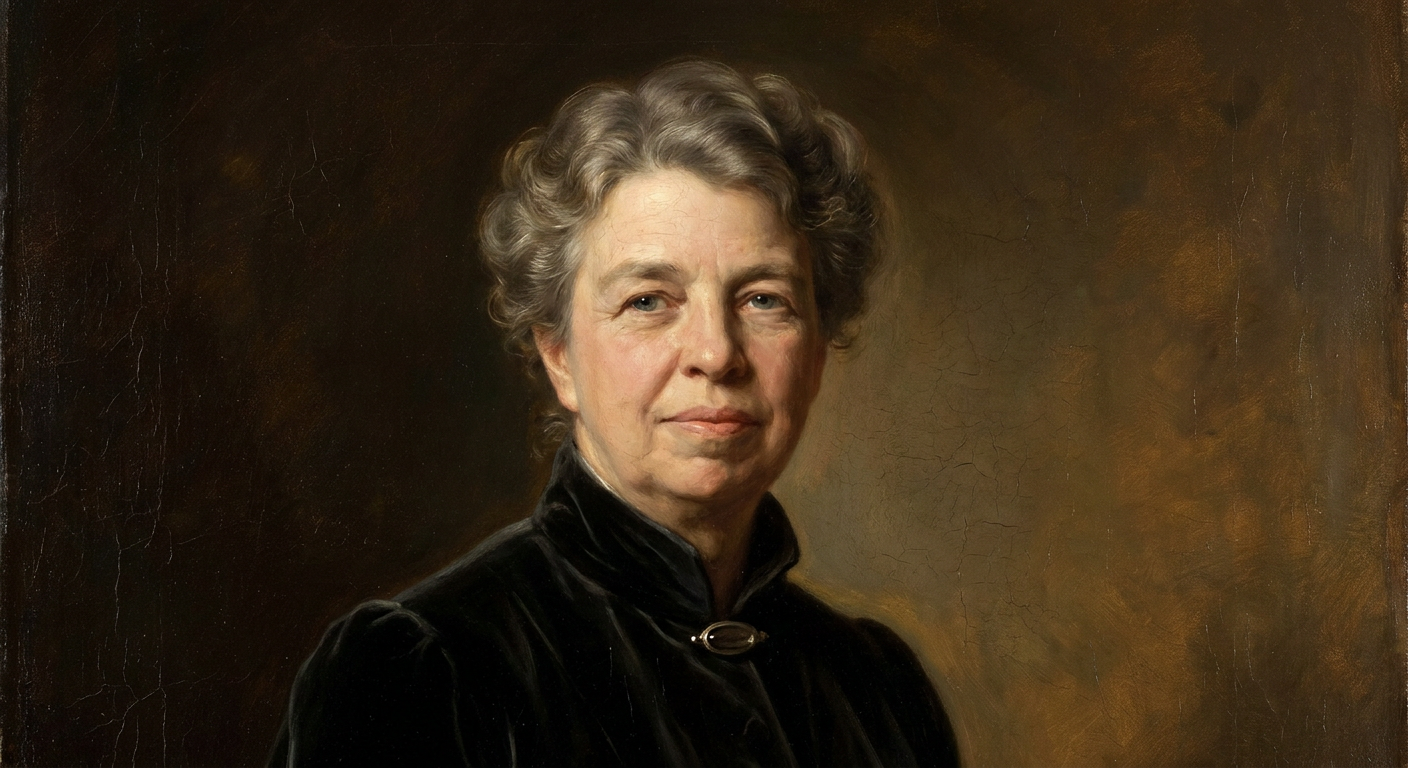
Quick Facts
- Years
- 1884 – 1962
- Category
- Social Reformers & Humanitarians
- Nationality
- American
- Occupation
- First Lady, diplomat, human rights advocate, writer, lecturer
Eleanor Roosevelt
1884 – 1962 · American · First Lady, diplomat, human rights advocate, writer, lecturer
Recommended Audiobooks
Listen next from Marcus Alden

Life Lessons from Harriet Beecher Stowe
Marcus Alden · 53 min

Life Lessons from Florence Nightingale
Marcus Alden · 48 min
Eleanor Roosevelt transformed a ceremonial position into a platform for democratic action. As first lady of the United States from 1933 to 1945, she traveled relentlessly, investigated social conditions, held press conferences for women reporters, defended racial justice and reported what she saw directly to President Franklin D. Roosevelt. After his death, she began another influential career at the United Nations, where she chaired the commission that prepared the Universal Declaration of Human Rights.
Her importance rests not simply on proximity to power. Shy, orphaned young and frequently made to feel unattractive, Eleanor deliberately trained herself for public life. She became a teacher, journalist, labor advocate, political organizer, radio broadcaster and diplomat. She also confronted contradictions: she enjoyed exceptional access while speaking for excluded people; worked within an administration that compromised on civil rights; and belonged to a complicated marriage that became an unusually productive political partnership.
Supporters called her the conscience of the New Deal and, later, the “First Lady of the World.” Critics considered her meddlesome, partisan or dangerously radical. Both reactions reflected the unprecedented reach of her work. Eleanor Roosevelt remains important because she asked a practical question that still shapes human-rights debates: how can principles proclaimed by governments become realities in homes, schools, workplaces and local communities?
Quick Facts
| Field | Details |
|---|---|
| Full Name | Anna Eleanor Roosevelt |
| Common Name(s) | Eleanor Roosevelt; ER |
| Born | October 11, 1884 |
| Died | November 7, 1962 |
| Age at Death | 78 |
| Birthplace | New York City, United States |
| Nationality | American |
| Occupation | First lady, diplomat, activist, writer, lecturer and teacher |
| Historical Era | Progressive Era, New Deal, Second World War and early Cold War |
| Famous For | Redefining the first ladyship and helping produce the Universal Declaration of Human Rights |
| Political Affiliation | Democratic Party |
| Religion | Episcopalian; her faith strongly informed her social ethics |
| Education | Allenswood Academy, London; no university degree |
| Parents | Elliott Roosevelt and Anna Rebecca Hall Roosevelt |
| Spouse(s) | Franklin Delano Roosevelt, married 1905–1945 |
| Children | Anna; James; Franklin (died in infancy); Elliott; Franklin Jr.; John |
| Major Works | My Day column; This Is My Story; This I Remember; On My Own; You Learn by Living |
| Major Achievements | Activist first lady; advocate for women, workers and Black Americans; UN delegate; chair of the UN Human Rights Commission; central participant in drafting the Universal Declaration of Human Rights |
Early Life
Anna Eleanor Roosevelt was born into two prominent New York families. Her father, Elliott, was the younger brother of future president Theodore Roosevelt; her mother, Anna Hall, came from a socially established family. Privilege did not provide security. Anna was emotionally distant and sometimes mocked Eleanor's solemn appearance. Elliott was affectionate but struggled with alcoholism and declining health.
Eleanor's mother died of diphtheria in 1892. One brother died the following year, and her father died in 1894. By ten, Eleanor was effectively orphaned. She and her surviving brother Hall lived with their maternal grandmother, Mary Hall. The losses encouraged caution and self-doubt but also gave her unusual sympathy for loneliness and dependency.
A decisive change came in 1899, when Eleanor entered Allenswood Academy near London. Its headmistress, Marie Souvestre, encouraged independent thought, social responsibility and direct observation rather than passive acceptance. Traveling in Europe with Souvestre and discussing politics helped Eleanor discover that she could think and act for herself. She later regarded these years as among the happiest and most formative of her life.
Returning to New York in 1902, she entered society as expected but also volunteered with the Junior League. She investigated conditions in overcrowded tenements and taught calisthenics and dancing at the Rivington Street Settlement House. Showing Franklin Roosevelt the poverty of the Lower East Side exposed him to a world far removed from their privileged surroundings.
Rise to Prominence
Eleanor married her distant cousin Franklin D. Roosevelt on March 17, 1905. President Theodore Roosevelt, her uncle, escorted her at the wedding. The young couple entered a household dominated by Franklin's forceful mother, Sara Delano Roosevelt. Eleanor initially fulfilled conventional expectations by managing homes and raising children.
Franklin's political career widened her responsibilities. After his election to the New York Senate in 1910, the family moved to Albany. During the First World War, Eleanor volunteered with the Red Cross and Navy relief organizations in Washington. The work increased her confidence and revealed deficiencies in military hospitals.
In 1918, Eleanor discovered Franklin's relationship with her social secretary, Lucy Mercer. Divorce was discussed but rejected, partly because of family, financial and political pressures. Their marriage continued, though its emotional and practical terms changed. Eleanor gradually constructed an independent public life.
Franklin's paralytic illness in 1921 became another turning point. While Sara hoped he would withdraw from politics, Eleanor and adviser Louis Howe encouraged his return. Eleanor traveled, spoke and cultivated political contacts when Franklin could not. She joined the Women's Trade Union League, the League of Women Voters and the women's division of the New York Democratic Party. With friends Nancy Cook and Marion Dickerman, she taught at the Todhunter School and helped establish Val-Kill Industries, an experiment in rural employment near Hyde Park.
By Franklin's 1932 presidential victory, Eleanor was already an experienced organizer, teacher and campaigner. She worried that becoming first lady would destroy her independence. Instead, she remade the office.
Major Achievements
Redefining the first ladyship
Eleanor traveled across the country, inspected relief projects, factories, mines and military installations, and sent detailed observations to the president. Because Franklin's disability limited his mobility, she became his unofficial observer. Her reports sometimes influenced policy and appointments, although she did not control the administration.
She held regular press conferences restricted to women journalists. Newspapers therefore had an incentive to employ women if they wanted access. Her syndicated My Day column, launched in 1935, eventually appeared six days a week and gave readers an unusually direct connection to public affairs.
Advocating social and racial justice
Eleanor supported the National Youth Administration and pressed officials to include women and Black Americans in relief programs. She built relationships with civil-rights leaders including Mary McLeod Bethune and Walter White. In 1939, she resigned from the Daughters of the American Revolution after the organization refused to let contralto Marian Anderson perform at Constitution Hall. Anderson's subsequent outdoor concert at the Lincoln Memorial became a landmark in American cultural and civil-rights history.
Eleanor supported federal anti-lynching legislation, despite Franklin's refusal to spend political capital on a bill that southern Democrats opposed. Her advocacy mattered symbolically and practically, but it did not overcome the administration's compromises or end racial discrimination.
Wartime service
During the Second World War, Eleanor promoted civilian defense, visited wounded service members and toured Britain and the South Pacific. In 1943 she traveled thousands of miles through the Pacific theater, visiting hospitals and bases. Admiral William Halsey initially viewed the visit skeptically but later praised the effect of her attention on morale.
She opposed Franklin's order incarcerating Japanese Americans and privately urged a fairer policy. Nevertheless, she remained part of the presidential household and did not mount a public campaign capable of reversing it—a limitation central to assessments of her wartime record.
The Universal Declaration of Human Rights
After Franklin died in 1945, President Harry Truman appointed Eleanor to the first American delegation to the United Nations. She served on the committee that became the UN Commission on Human Rights and was elected its chair.
Working with representatives including René Cassin, Charles Malik, P. C. Chang and John Humphrey, she helped navigate disagreements among political, legal, religious and cultural traditions. She was not the declaration's sole author; scholarship emphasizes its collaborative and international creation. Her diplomatic authority, persistence and ability to build agreement were nonetheless crucial.
On December 10, 1948, the UN General Assembly adopted the Universal Declaration of Human Rights without a dissenting vote, though eight states abstained. Its thirty articles articulated civil, political, economic, social and cultural rights. It was not a binding treaty, but it became a foundation for later international law, constitutions and rights movements.
Leadership or Work
Eleanor practiced leadership through access, observation and persuasion rather than command. She gathered information by traveling and speaking with people whom senior officials often overlooked. She then used personal meetings, columns, broadcasts and speeches to pressure institutions.
Her working habits were formidable. A typical day could include correspondence, organizational meetings, a press conference, radio work and evening lectures. She answered large quantities of mail with staff assistance and turned public visibility into income as well as political influence.
Her central values included human dignity, useful work, democratic participation and individual responsibility. She was skilled at connecting reformers with officials and translating abstract policy into human stories. Her closeness to Franklin gave her influence, but access also imposed limits: she sometimes pressed him, sometimes accepted compromise and did not always prevail.
Her strengths were stamina, curiosity, empathy and moral persistence. Weaknesses included overwork, occasional impatience and a tendency to support experimental projects before their practical difficulties were fully resolved. Critics also questioned whether an unelected presidential spouse should wield so much influence—a constitutional concern that cannot simply be dismissed as prejudice, although much hostility toward her was plainly sexist or racist.
Personal Life
Eleanor and Franklin had six children, one of whom died in infancy. Their family experienced long separations, demanding public schedules and parental tensions. Eleanor later acknowledged that she had not always understood her children's emotional needs. Several children felt burdened by the family's political life.
After 1918, the Roosevelt marriage survived as a family bond and political partnership but was no longer a conventional intimate marriage. Franklin maintained relationships with other women. Eleanor developed intense friendships of her own, especially with journalist Lorena Hickok, with whom she exchanged affectionate letters. Historians agree that the bond was emotionally intimate; whether it was sexual remains disputed because surviving evidence does not settle the question.
Val-Kill, her cottage near Hyde Park, became Eleanor's true home and a gathering place for friends, students, activists and political leaders. She enjoyed swimming, picnics, reading and purposeful conversation. Her plain dress, direct manner and relentless schedule contrasted with traditional images of elite social life.
Eleanor suffered periods of grief and insecurity but was physically energetic for much of her adulthood. In her final years she developed aplastic anemia and tuberculosis. She died in New York City on November 7, 1962, and was buried beside Franklin at Hyde Park.
Philosophy or Beliefs
Eleanor's liberalism grew from Progressive Era reform, Christian ethics and practical experience. Her Episcopalian faith emphasized personal duty rather than theological debate. She believed every person possessed worth and that governments should create conditions in which dignity could be exercised.
She supported organized labor, social welfare, expanded opportunities for women, racial equality and international cooperation. Yet her views evolved. Like many white reformers of her generation, she began with inherited assumptions and paternalistic language before becoming a more consistent civil-rights ally through relationships with Black leaders.
She opposed both fascism and Soviet totalitarianism. At the UN, she treated rights as universal rather than gifts granted by states. She also insisted that rights involved obligations: citizens had to defend democratic institutions locally. Her worldview combined institutional reform with self-discipline—government mattered, but individuals could not surrender moral responsibility to government.
Challenges and Controversies
Eleanor attracted unusually fierce opposition. Conservative critics argued that she exceeded the proper role of a president's spouse, encouraged expensive federal programs and associated with radicals. Some objections reflected legitimate disputes over policy or unelected influence; others relied on misogyny, antisemitism, homophobia or racism.
Her civil-rights work exposed her to threats and FBI monitoring. Southern segregationists condemned her anti-lynching advocacy and friendship with Black leaders. Conversely, activists sometimes faulted her for failing to secure stronger action from Franklin. Her influence was real but neither unlimited nor consistently successful.
The Arthurdale subsistence-homestead project in West Virginia illustrated the problems of reform by experiment. Eleanor championed it as a community for impoverished miners, but high costs, administrative mistakes and uncertain economic foundations drew criticism. It improved some lives without becoming the self-supporting model its advocates hoped for.
Her response to Japanese American incarceration remains troubling. She criticized racial prejudice, visited the Gila River camp and argued that loyal citizens deserved justice. Yet she did not publicly break with the president or stop the policy. Scholars therefore describe her position as morally better than the administration's policy but politically insufficient.
During the early Cold War, she opposed communism while defending civil liberties and the UN. Conservatives accused her of softness; some left-wing critics considered her too closely aligned with American power. These competing attacks show both her independence and the polarized environment in which she worked.
Legacy
Eleanor Roosevelt expanded expectations for first ladies, women in politics and former presidential spouses. Later first ladies—from Lady Bird Johnson to Hillary Clinton—worked in an environment altered by her example, even when they chose different methods.
The Universal Declaration remains her greatest international legacy. Its language influences treaties, courts, constitutions and advocacy organizations, although governments continue to violate the principles it states. Her question about rights beginning “in small places, close to home” remains a concise explanation of why international ideals depend on local action.
Her principal memorial is Eleanor Roosevelt National Historic Site at Val-Kill, administered by the National Park Service. The Franklin D. Roosevelt Presidential Library and Museum preserves the broader Roosevelt record. Schools, awards, streets and institutions carry her name, while the Eleanor Roosevelt Papers Project supports research into her public life.
Her reputation is not based on perfection. It rests on growth: a privileged and insecure child became a public advocate willing to enter mines, tenements, military hospitals and international negotiations. That trajectory makes her useful to modern students because it joins personal development with institutional change.
Interesting Facts
- Her first name was Anna, but she used Eleanor from childhood.
- Theodore Roosevelt was her uncle, not her father.
- She and Franklin were distant cousins who already shared the Roosevelt surname.
- Theodore Roosevelt escorted her at her wedding.
- Allenswood headmistress Marie Souvestre became her most important early mentor.
- Eleanor taught at New York's Todhunter School before becoming first lady.
- She helped found Val-Kill Industries to create rural jobs.
- She was the first presidential spouse to hold regular press conferences.
- Restricting those conferences to women helped female reporters retain employment.
- Her My Day newspaper column ran from 1935 until shortly before her death.
- She traveled to the South Pacific during wartime despite military concerns about logistics.
- She resigned from the DAR over Marian Anderson's exclusion from Constitution Hall.
- President Truman called her the “First Lady of the World.”
- She served as a UN delegate without having attended university.
- She chaired, but did not single-handedly write, the Universal Declaration of Human Rights.
- She appeared before the House Un-American Activities Committee in 1953 and defended civil liberties.
- President John F. Kennedy appointed her to chair his Commission on the Status of Women.
- Val-Kill is the only National Historic Site dedicated to a first lady.
Famous Quotes
- “No one can make you feel inferior without your consent.” Published in This Is My Story (1937), it summarizes her emphasis on self-respect without denying that social discrimination is real.
- “The future belongs to those who believe in the beauty of their dreams.” Frequently attributed to Eleanor, but researchers have not established a reliable original source; it should be treated as disputed.
- “You gain strength, courage and confidence by every experience in which you really stop to look fear in the face.” From You Learn by Living (1960), reflecting her belief that courage develops through practice.
- “It is not fair to ask of others what you are not willing to do yourself.” From This Is My Story, expressing her standard of leadership by example.
- “Where, after all, do universal human rights begin? In small places, close to home.” From her 1958 speech “The Great Question,” linking international principles to everyday institutions.
- “Without concerted citizen action to uphold them close to home, we shall look in vain for progress in the larger world.” From the same 1958 speech, stressing civic responsibility.
- “The basis of all good human behavior is kindness.” From You Learn by Living, showing that her politics rested on a personal ethic.
- “Do what you feel in your heart to be right—for you'll be criticized anyway.” Appears in How to Stop Worrying and Start Living as advice attributed to her; the wording is less securely documented than quotations from her own books.
- “Do one thing every day that scares you.” Commonly credited to Eleanor but unsupported by a reliable primary source; it is probably a later paraphrase of her writing about confronting fear.
- “Great minds discuss ideas; average minds discuss events; small minds discuss people.” Widely attributed to her, yet earlier variants circulated before the attribution became common. Its authorship is disputed.
Timeline
- 1884 — Born in New York City on October 11.
- 1892 — Her mother dies.
- 1894 — Her father dies, leaving Eleanor orphaned.
- 1899 — Enters Allenswood Academy near London.
- 1902 — Returns to New York and begins settlement-house work.
- 1905 — Marries Franklin D. Roosevelt.
- 1910 — Franklin enters the New York Senate.
- 1917–1918 — Performs wartime relief work in Washington.
- 1918 — Discovers Franklin's relationship with Lucy Mercer.
- 1921 — Franklin contracts the illness that leaves him permanently paralyzed in both legs.
- 1920s — Builds an independent career in teaching, journalism, labor advocacy and Democratic politics.
- 1927 — Helps establish Val-Kill Industries and joins the Todhunter School faculty.
- 1928 — Franklin becomes governor of New York.
- 1933 — Becomes first lady when Franklin is inaugurated president.
- 1935 — Begins the syndicated My Day column.
- 1939 — Resigns from the DAR during the Marian Anderson controversy.
- 1941 — Supports civilian-defense work as the United States enters the war.
- 1943 — Tours military hospitals and bases in the South Pacific.
- 1945 — Franklin dies; Truman appoints her to the US delegation to the UN.
- 1946 — Becomes chair of the UN Commission on Human Rights.
- 1948 — Helps secure adoption of the Universal Declaration of Human Rights.
- 1952 — Leaves the US delegation after the Eisenhower administration takes office.
- 1953 — Defends civil liberties before the House Un-American Activities Committee.
- 1961 — Kennedy reappoints her to the UN delegation and names her chair of the Commission on the Status of Women.
- 1962 — Dies in New York City on November 7.
Frequently Asked Questions
1. Why is Eleanor Roosevelt historically important?
She converted the first ladyship from a largely ceremonial role into a form of public service and later became an influential diplomat. Her travel, reporting and advocacy brought marginalized communities closer to federal decision-making. Internationally, her chairmanship of the UN Human Rights Commission helped competing governments complete the Universal Declaration of Human Rights.
2. Was Eleanor Roosevelt a president?
No. She was first lady during Franklin Roosevelt's presidency and never held elected office. She nevertheless exercised political influence through advocacy, party work, journalism and personal access. After 1945 she held an official appointed position as a United States delegate to the United Nations.
3. How was she related to Theodore Roosevelt?
Theodore Roosevelt was Eleanor's paternal uncle and her childhood hero. At her 1905 wedding, the sitting president escorted her in place of her deceased father. Franklin Roosevelt belonged to another branch of the extended Roosevelt family and was Eleanor's distant cousin.
4. Did Eleanor Roosevelt write the Universal Declaration alone?
No. The declaration was an international, collaborative achievement. John Humphrey prepared an early draft, while René Cassin, P. C. Chang, Charles Malik and many national representatives shaped its language. Eleanor chaired the commission, managed debate and used her diplomatic influence to build agreement; describing her as its sole author obscures other contributors.
5. What did she do as first lady?
She toured relief projects, advised the president, published columns, delivered lectures, made radio broadcasts and supported labor, youth, women's and civil-rights causes. Her women-only press conferences strengthened opportunities for female journalists. She also visited troops and hospitals during the Second World War.
6. Did Eleanor influence the New Deal?
Yes, although she did not design or control it. She reported failures and discrimination within relief programs, supported the National Youth Administration and promoted experiments such as Arthurdale. Franklin listened to her but frequently balanced her advice against Congress, party leaders, courts and other advisers.
7. What was her role in civil rights?
Eleanor opposed lynching, segregation and racial discrimination, cultivated Black advisers and publicly supported Marian Anderson. Her stance helped legitimize civil rights within national liberal politics. Critics correctly note that she could not—or did not—force Franklin's administration to enact major federal civil-rights legislation.
8. Why did she leave the Daughters of the American Revolution?
She resigned in 1939 after the DAR prevented Marian Anderson, a celebrated Black contralto, from performing at Constitution Hall. Eleanor's public resignation gave national attention to the exclusion. Anderson subsequently sang before an integrated audience at the Lincoln Memorial on Easter Sunday.
9. Was her marriage happy?
It was affectionate at times, painful at others and politically productive. Franklin's relationship with Lucy Mercer shattered Eleanor's expectations of marriage in 1918. They remained married, raised a family and developed a close political partnership, but both built substantially independent emotional and social lives.
10. What was Eleanor's relationship with Lorena Hickok?
Hickok was a journalist who became Eleanor's intimate friend and correspondent. Their surviving letters use deeply affectionate language. Historians agree on the relationship's emotional importance but disagree about whether it was sexual; the evidence does not justify presenting either conclusion as certain.
11. Did she support Japanese American incarceration?
She opposed its racial assumptions and expressed concern for citizens deprived of their rights. She visited the Gila River camp and wrote sympathetically about Japanese Americans. However, she did not openly lead resistance to Franklin's executive order, and her interventions failed to end the injustice.
12. Why was she controversial?
She crossed boundaries of gender, class and race while promoting an expanded federal role. Conservatives disputed her policies and unelected influence; segregationists hated her civil-rights advocacy. Some attacks were legitimate political criticism, while many depended on sexist conspiracy theories and racial hostility.
13. What books did she write?
Her major autobiographical works include This Is My Story, This I Remember and On My Own. She also wrote You Learn by Living, a reflective guide to personal and civic growth. Her enormous body of journalism included the long-running My Day column.
14. What did she do after Franklin died?
Rather than retire, she served in the United Nations, chaired the Human Rights Commission, lectured, wrote and supported Democratic candidates. She became one of the best-known advocates of international cooperation and human rights during the early Cold War.
15. How did she die?
Eleanor developed aplastic anemia and later tuberculosis. Her health deteriorated during 1962, and she died in Manhattan on November 7 at age 78. World leaders attended memorial observances, and she was buried beside Franklin at their Hyde Park estate.
16. Where can people learn about her today?
Val-Kill, her home in Hyde Park, is preserved as Eleanor Roosevelt National Historic Site. Nearby, the Franklin D. Roosevelt Presidential Library and Museum contains family and governmental records. The Eleanor Roosevelt Papers Project also publishes searchable editions of her writings and correspondence.
Lessons We Can Learn
- Courage can be practiced. Allenswood and settlement work helped a fearful young woman gain confidence; modern claims about “growth” are interpretations, but her development is well documented.
- Observe before advising. Her field visits gave her reports specificity, a useful model for evidence-based leadership.
- Access can serve excluded people. She brought activists into contact with officials, showing how privilege may be redirected rather than merely enjoyed.
- Institutions change through procedures. Women-only press conferences created employment incentives, not just symbolic encouragement.
- Relationships can change beliefs. Work with Bethune and other Black leaders deepened Eleanor's civil-rights commitment.
- Compromise has moral costs. Her inability to reverse internment or secure anti-lynching legislation shows the limits—and responsibilities—of influence.
- Leadership need not mean command. At the UN she built agreement among people she could not order.
- Credit should be shared. The declaration's history warns against turning collaborative achievements into single-hero stories.
- Failure can still teach. Arthurdale's mixed record demonstrates that good intentions require sound administration and economic planning.
- Rights require local action. Her documented 1958 speech argued that declarations matter only when communities embody them; its modern application remains a reasoned interpretation, not a guarantee.
Related Historical Figures
- Franklin D. Roosevelt — Her husband, political partner and the president whose administration she influenced.
- Theodore Roosevelt — Her uncle and an early model of energetic public service.
- Mary McLeod Bethune — Educator and civil-rights leader who became her trusted friend and adviser.
- Marian Anderson — Singer whose exclusion from Constitution Hall prompted Eleanor's DAR resignation.
- Lorena Hickok — Journalist, New Deal investigator and Eleanor's intimate friend.
- Frances Perkins — Labor reformer and first woman in a US presidential cabinet; a fellow New Deal advocate.
- Harry S. Truman — President who appointed Eleanor to the United Nations and called her the “First Lady of the World.”
- René Cassin — French jurist and major contributor to the Universal Declaration's text.
- P. C. Chang — Chinese diplomat who brought philosophical and cross-cultural insight to the drafting process.
- John F. Kennedy — President who returned her to public service and appointed her to lead the Commission on the Status of Women.
Watch and Learn
“The New Deal: Crash Course US History #34” — CrashCourse — approximately 14 minutes. This widely viewed educational overview explains the political and economic environment in which Eleanor Roosevelt transformed the first ladyship. Although it covers the wider New Deal rather than serving as a complete biography, it provides accessible context for her advocacy, Franklin's administration and the limits of federal reform.
Watch and Learn
The New Deal: Crash Course US History #34 · CrashCourse
Related Historical Figures