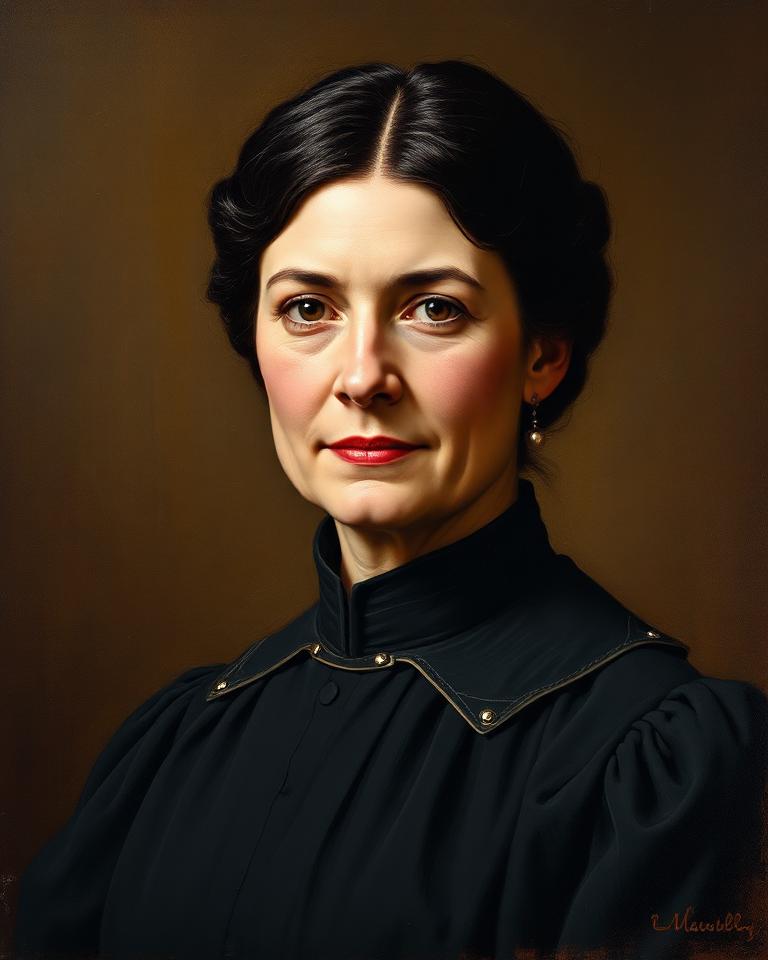
Quick Facts
- Years
- 1821 – 1912
- Category
- Social Reformers & Humanitarians
- Subcategory
- Humanitarianism
- Nationality
- American
- Occupation
- Humanitarian and Nurse
Clara Barton
1821 – 1912 · American · Humanitarian and Nurse
Audiobook

Life Lessons from Clara Barton
Marcus Alden · 53 min
Clara Barton was an American humanitarian, Civil War relief worker, educator, and founder of the American Red Cross. Born in Massachusetts in 1821, she first worked as a teacher and later became one of the earliest women employed by the federal government in a position comparable to a male clerkship. Her national reputation arose during the American Civil War, when she carried food, medicine, and dressings to wounded soldiers and provided care near several major battlefields.
Barton’s importance extended beyond wartime nursing. After the conflict, she directed the Office of Correspondence with Friends of the Missing Men of the United States Army, helping families learn the fate of missing soldiers and identifying thousands of men buried at Andersonville. Following relief work with the International Red Cross during the Franco-Prussian War, she led the campaign for American adherence to the Geneva Convention and founded the American Red Cross in 1881.
Under Barton, the organization responded not only to war but also to floods, fires, epidemics, and hurricanes. This broader mission helped shape modern disaster relief. Although her administration later attracted serious criticism, her courage, persistence, and ability to mobilize aid transformed American humanitarian practice. She remains studied as a pioneer of organized relief, a significant woman in public life, and a complicated institution-builder whose achievements and managerial limitations both shaped the Red Cross.
Quick Facts
| Field | Details |
|---|---|
| Full Name | Clarissa Harlowe Barton |
| Common Name(s) | Clara Barton; “Angel of the Battlefield” |
| Born | December 25, 1821 |
| Died | April 12, 1912 |
| Age at Death | 90 |
| Birthplace | North Oxford, Massachusetts, United States |
| Nationality | American |
| Occupation | Teacher, federal clerk, Civil War relief worker, humanitarian, lecturer, organizational leader |
| Historical Era | Nineteenth-century United States; American Civil War; Progressive Era |
| Famous For | Battlefield relief during the Civil War; founding the American Red Cross |
| Political Affiliation | Generally associated with reform causes; formal party allegiance was not central to her public career |
| Religion | Raised in the Universalist tradition; her ethical outlook retained strong religious and humanitarian elements |
| Education | Local schools; Clinton Liberal Institute, New York; largely self-educated professionally |
| Parents | Stephen Barton and Sarah Stone Barton |
| Spouse(s) | Never married |
| Children | None |
| Major Works | The Red Cross in Peace and War; The Story of My Childhood; lectures, reports, correspondence, and organizational publications |
| Major Achievements | Civil War battlefield relief; Missing Soldiers Office; Andersonville identification work; founding and leading the American Red Cross; promoting U.S. ratification of the Geneva Convention; expanding Red Cross disaster relief |
Early Life
Clarissa Harlowe Barton was born on Christmas Day 1821 in North Oxford, Massachusetts. She was the youngest of five children of Stephen Barton, a farmer, businessman, local official, and former militia captain, and Sarah Stone Barton. Her siblings were Dorothy, Stephen, David, and Sally.
Barton grew up in a household that valued work, education, public responsibility, and religious inquiry. Her father’s stories of military service fascinated her and later helped her communicate comfortably with soldiers. Her family belonged to the Universalist tradition, which emphasized divine benevolence and the worth of every person.
She later described herself as painfully shy in childhood. Family members helped educate her, and she displayed an excellent memory and strong powers of concentration. A formative episode occurred when her brother David suffered a serious injury. Clara spent a prolonged period helping care for him, gaining practical familiarity with nursing tasks long before professional nursing was established in the United States.
At about seventeen, Barton began teaching. She proved capable of managing classrooms despite her shyness. Like many female teachers, however, she faced restricted advancement and unequal pay. In 1850 she attended the Clinton Liberal Institute in New York, broadening her formal education at a school connected with Universalism.
The United States of Barton’s youth was expanding its public-school system while offering women few routes to authority. Reform movements—including abolitionism, women’s rights, temperance, and humanitarian activism—were also gaining force. This combination of opportunity and inequality shaped her career: teaching gave her a public role, but institutional discrimination repeatedly reminded her that women’s work was undervalued.
Rise to Prominence
Barton taught for many years in Massachusetts and elsewhere. In 1852 she established a free public school in Bordentown, New Jersey. Enrollment grew rapidly, demonstrating demand for tax-supported education. Yet when the school expanded, officials appointed a man as principal at a higher salary. Barton resigned rather than accept a subordinate position in an institution she had built.
She moved to Washington, D.C., and in 1854 obtained work at the U.S. Patent Office. Commissioner Charles Mason recognized her ability and allowed her compensation comparable to that of male clerks—an unusual arrangement for a woman. Political opposition and hostility from male employees led to demotion and dismissal during the Buchanan administration. She returned after Abraham Lincoln’s election, although initially in a less secure capacity.
The Civil War transformed her life. After the attack on the 6th Massachusetts Infantry in Baltimore on April 19, 1861, wounded soldiers arrived in Washington. Barton recognized some as former pupils or acquaintances and began collecting supplies for troops. Friends, women’s groups, businesses, and donors sent materials, which she stored and distributed.
Barton soon concluded that supplies were most useful near the fighting rather than in distant hospitals. After persistent appeals, she secured permission to take aid to field hospitals. She worked at or near campaigns including Cedar Mountain, Second Bull Run, Antietam, Fredericksburg, Charleston-area operations, and the Wilderness. She was not a formally trained nurse, and the celebrated label “Angel of the Battlefield” simplifies a role that included logistics, cooking, first aid, emotional support, and direct nursing.
Her courage and vivid postwar lectures made her nationally famous. She used that prominence to pursue another urgent task: finding missing Union soldiers.
Major Achievements
Civil War Battlefield Relief
Barton transported bandages, food, lanterns, clothing, and medical supplies toward active battlefields, frequently working under dangerous conditions. At Antietam in September 1862, she assisted wounded men at makeshift hospitals near the fighting. A bullet reportedly passed through her sleeve and killed the soldier she was supporting—an incident recorded in her own account.
Her work mattered because Civil War medical systems were overwhelmed. Barton did not create military nursing, and she was one among many women and men who provided relief, but she became one of its most visible civilian practitioners. She demonstrated that organized volunteers could move supplies rapidly and respond where formal structures failed.
The long-term impact was cultural as well as practical. Her service helped expand public acceptance of women working in emergency medicine, wartime relief, and national organizations.
The Missing Soldiers Office
In 1865 President Lincoln authorized Barton to correspond with families seeking missing Union soldiers. She established the Office of Correspondence with Friends of the Missing Men of the United States Army in Washington.
Using letters, printed lists, testimony, and military information, Barton and her assistants answered tens of thousands of inquiries and helped determine the fate of more than 22,000 missing soldiers. Numbers vary slightly among historical accounts because different categories—names published, cases answered, and men identified—are not identical.
This effort mattered because families needed confirmation to grieve, settle estates, and obtain pensions. It anticipated later systems for tracing missing persons after wars and disasters. The surviving office site is now interpreted by the National Park Service as Clara Barton’s Missing Soldiers Office Museum.
Identifying the Dead at Andersonville
Former Andersonville prisoner Dorence Atwater had secretly preserved a list of Union prisoners who died at the Confederate camp in Georgia. Barton supported publication and use of his records. In 1865 she traveled to Andersonville with Atwater and a federal expedition. Graves were marked and a national cemetery was established.
Their work enabled the identification of approximately 13,000 graves, with only several hundred remaining unidentified at the time. Atwater’s list was indispensable, and modern accounts emphasize his central contribution rather than assigning sole credit to Barton.
The project represented an early large-scale attempt to identify war dead systematically. It also strengthened Barton’s conviction that humanitarian obligations continue after combat ends.
Founding the American Red Cross
While recovering in Europe, Barton learned about the International Committee of the Red Cross and the 1864 Geneva Convention. During the Franco-Prussian War of 1870–1871, she joined relief efforts in Strasbourg, Paris, and other affected communities. She worked with European Red Cross personnel and saw how an internationally recognized neutral relief movement could operate.
Back in the United States, Barton campaigned for American participation. On May 21, 1881, she and her associates organized the American Association of the Red Cross, later known as the American Red Cross. She became its first president.
The organization created a permanent national framework for humanitarian mobilization. It connected American relief work to international standards and became one of the most important humanitarian institutions in the country.
U.S. Adherence to the Geneva Convention
The United States had not joined the 1864 Geneva Convention when Barton returned from Europe. She lobbied officials, wrote explanatory materials, and cultivated political support. President Chester A. Arthur endorsed the cause, and the United States ratified the convention in 1882.
Ratification committed the country to recognize neutral care for wounded soldiers and the protective Red Cross emblem under the treaty’s terms. Barton’s advocacy helped integrate the United States into an emerging international humanitarian system.
The “American Amendment” and Disaster Relief
Barton argued that the Red Cross should respond during peacetime to natural disasters, epidemics, and other large emergencies. This approach became known as the “American Amendment,” although it was a policy principle rather than simply an amendment adopted by the United States alone. The idea gained international recognition at the 1884 Red Cross Conference in Geneva.
Under Barton, the American Red Cross assisted after the Michigan forest fires of 1881, the Ohio and Mississippi floods of 1884, the Johnstown Flood of 1889, the Russian famine of 1891–1892, the Armenian crisis of the 1890s, the Spanish-American War, and the Galveston hurricane of 1900.
This broader mandate became one of her most durable innovations. Modern disaster-relief organizations routinely work in both war and peace, reflecting the model Barton championed.
Leadership and Work
Barton led through personal example. She entered dangerous environments, inspected needs directly, improvised supply networks, and expected colleagues to share her intense commitment. Her persistence was extraordinary: she repeatedly petitioned military officers, presidents, diplomats, and skeptical administrators until she obtained access or support.
Her methods were highly personal. She relied on correspondence, trusted associates, public lectures, newspaper attention, and donor relationships. In emergencies, this flexibility could produce rapid results. She understood that relief required logistics as much as compassion—warehouses, transport, records, local contacts, and credible appeals.
Her core values included service without discrimination, practical assistance, and neutrality toward suffering. She often worked successfully with soldiers, physicians, government officials, reformers, and international Red Cross leaders. Friends such as Antoinette Margot and collaborators such as Julian Hubbell became important to her work.
The same personal style created weaknesses. Barton concentrated authority, blurred distinctions between personal and organizational finances, resisted governing structures that limited her freedom, and kept records that critics considered inadequate. Loyal service to a cause did not automatically translate into effective administration of a growing national institution.
Her leadership therefore presents a mixed but instructive record: exceptional in crisis, visionary in defining missions, and less successful at building transparent systems of shared governance.
Personal Life
Barton never married and had no children. Remaining single gave her mobility uncommon for women of her era, though it did not free her from social scrutiny. Her closest relationships included family members, longtime friends, colleagues, and correspondents. Historians have examined the emotional intensity of some female friendships, but the surviving evidence does not justify confident claims about a sexual identity in modern terms.
She was small in stature and often described as reserved in ordinary social settings, yet she could speak forcefully before large audiences. Public lecturing became both a source of income and a means of promoting humanitarian causes. Her personality combined shyness, sensitivity, ambition, courage, and a powerful desire to be useful.
Barton traveled widely and worked at a pace that repeatedly damaged her health. She experienced periods described in contemporary language as nervous exhaustion and sought rest in Europe. Modern retrospective diagnoses are speculative and should be treated cautiously.
She enjoyed animals and kept pets, including cats. She also preserved extensive correspondence and autobiographical material, though her recollections sometimes shaped events into a heroic narrative. In later life she lived at Glen Echo, Maryland, which served as both her home and American Red Cross headquarters. She died there on April 12, 1912, from pneumonia and was buried in the family plot in North Oxford, Massachusetts.
Philosophy and Beliefs
Barton’s worldview joined Universalist moral teaching with practical humanitarianism. She believed suffering created an obligation to act, regardless of nationality, region, or political identity. Her relief work generally emphasized need rather than judgment.
She supported major reform movements, including women’s rights and African American civil rights. She knew figures such as Frederick Douglass, Susan B. Anthony, and Elizabeth Cady Stanton and spoke publicly for woman suffrage. Her own federal and educational careers gave her direct experience of gender discrimination.
Barton was patriotic but not narrowly nationalistic. The Civil War strengthened her loyalty to the Union, while her European experience persuaded her that humanitarian rules must cross national boundaries. She regarded the Geneva Convention as a practical moral compact, not merely a diplomatic text.
Her ethics were action-centered. She distrusted delay when people were suffering and preferred direct intervention. This philosophy produced remarkable achievements, but it could also reinforce her impatience with procedures, boards, and administrative oversight.
Challenges and Controversies
Barton faced entrenched sexism throughout her career. School officials denied her leadership after she created a successful school, Patent Office employees opposed her equal status, and military authorities initially resisted allowing a civilian woman near battlefields. Her persistence challenged these barriers, although she did not dismantle them alone.
Her Civil War image has sometimes been romanticized. She was not the sole “first” battlefield nurse, nor did she hold modern nursing credentials. Thousands of nurses, sanitary workers, freedpeople, soldiers, physicians, and local civilians contributed to wartime care. Barton’s distinct importance lay in independent supply work, frontline presence, and her later ability to translate experience into national organization.
The most substantial controversies concern her American Red Cross presidency. Critics charged that the organization lacked professional accounting, clear financial separation, consistent records, and effective board governance. Barton believed a flexible, centrally directed structure was necessary for emergency action and regarded some investigations as politically motivated or personally hostile.
Both interpretations contain relevant evidence. Barton’s model could be highly responsive, but it became increasingly unsuitable as the Red Cross expanded. Congressional scrutiny and internal opposition intensified after the Spanish-American War. She resigned in 1904. Later reforms created a more bureaucratic organization with stronger federal oversight.
Some relief operations also reflected paternalistic attitudes common among nineteenth-century reformers. Modern scholarship asks how recipients experienced aid and whether celebrated leaders overshadowed local actors. Such criticism does not erase Barton’s achievements; it places them within the power relationships of her time.
Legacy
Clara Barton’s most visible legacy is the American Red Cross. Although the modern organization differs greatly from the institution she governed, it continues the wartime and disaster-relief missions she promoted. Her advocacy also helped establish American participation in international humanitarian law.
She widened the accepted sphere of women’s public action. Barton was neither a professionally trained nurse in the modern sense nor the founder of American nursing, but her career became an enduring symbol of women’s capacity for leadership under extreme conditions.
Several historic places preserve her story. Clara Barton National Historic Site at Glen Echo, Maryland, protects her former home and headquarters. The National Museum of Civil War Medicine operates Clara Barton’s Missing Soldiers Office Museum in Washington, D.C. Her birthplace in North Oxford is also preserved as a museum.
Schools, streets, monuments, and institutions bear her name. The U.S. Postal Service has honored her on stamps, and she was inducted into the National Women’s Hall of Fame. Her papers are held principally by the Library of Congress and other repositories.
Modern historians study Barton not only as a heroic caregiver but also as an institution-builder whose administrative flaws affected her organization. That fuller interpretation makes her legacy more useful: moral courage and innovation matter, but enduring humanitarian work also requires accountability, collaboration, and sound governance.
Interesting Facts
- Her full first name was Clarissa, although she became known as Clara.
- She was born on Christmas Day in 1821.
- She was the youngest of five children.
- She began teaching while still in her teens.
- She founded a free public school in Bordentown, New Jersey.
- She left that school after a man was appointed to lead it at a higher salary.
- She obtained an unusually well-paid federal clerkship at the Patent Office.
- Her first Civil War relief efforts aided Massachusetts soldiers in Washington.
- She often purchased or solicited supplies herself before transporting them.
- She worked near the battlefield at Antietam, the bloodiest single day in American history.
- Her Missing Soldiers Office occupied rooms in a Washington boardinghouse.
- Dorence Atwater’s Andersonville death register made thousands of grave identifications possible.
- She witnessed Red Cross relief during the Franco-Prussian War.
- She founded the American Red Cross at age 59.
- She promoted Red Cross action in peacetime disasters as well as war.
- She directed relief after the Johnstown Flood and Galveston hurricane.
- She supported woman suffrage.
- She resigned from the American Red Cross in 1904.
- She later organized the National First Aid Association of America.
- She lived to age 90.
Famous Quotes
“I may be compelled to face danger, but never fear it, and while our soldiers can stand and fight, I can stand and feed and nurse them.”
Barton used this formulation in recounting her Civil War resolve. It expresses her belief that civilian service demanded courage comparable, though not identical, to combat.
“The door that nobody else will go in at, seems always to swing open widely for me.”
This line appears in Barton’s autobiographical writing and describes her attraction to neglected or dangerous work.
“You must never so much as think whether you like it or not, whether it is bearable or not; you must never think of anything except the need, and how to meet it.”
Associated with her reflections on service, the statement summarizes her duty-centered ethics. Exact wording can vary across editions and quotation collections.
“I have an almost complete disregard of precedent, and a faith in the possibility of something better.”
Frequently traced to Barton’s later reflections, this quotation captures both her innovation and her impatience with inherited procedures.
“An institution or reform movement that is not selfish, must originate in the recognition of some evil that is adding to the sum of human suffering.”
From The Red Cross in Peace and War, this connects reform with the identification and relief of suffering.
“The paths of charity are over-roadways of ashes.”
Barton used this image in writing about disaster relief. It conveys the destruction through which aid workers often move.
“What could I do but go with them, or work for them and my country?”
In her Civil War recollections, Barton presented service as an unavoidable moral response to national crisis.
“I went to teach the school, and I went to teach it for nothing.”
This wording is associated with her account of the Bordentown free-school experiment and reflects her determination to prove that a publicly supported school could succeed.
“Everybody’s business is nobody’s business, and nobody’s business is my business.”
This is widely attributed to Barton and fits her habit of assuming neglected responsibilities, but the precise original source is uncertain; it should be treated as a disputed attribution.
“The surest test of discipline is its absence.”
Often attributed to Barton in modern collections, but firm primary-source documentation is difficult to establish. The attribution is disputed.
Timeline
- 1821 — Born in North Oxford, Massachusetts, on December 25.
- 1830s — Helps care for her injured brother David.
- 1839 — Begins teaching in Massachusetts.
- 1850 — Studies at Clinton Liberal Institute in New York.
- 1852 — Establishes a free public school in Bordentown, New Jersey.
- 1854 — Begins work at the U.S. Patent Office in Washington.
- 1857 — Loses her Patent Office position amid political and gender-based opposition.
- 1861 — Returns to federal work and begins assisting Civil War soldiers.
- 1862 — Receives permission to bring supplies toward battlefields; serves during campaigns including Cedar Mountain, Second Bull Run, and Antietam.
- 1862–1864 — Conducts relief work during major Union campaigns.
- 1865 — Receives federal authority to correspond about missing Union soldiers; participates in Andersonville grave identification.
- 1866–1868 — Lectures widely about the war and missing soldiers.
- 1869 — Travels to Europe for rest and recuperation.
- 1870–1871 — Performs relief work during the Franco-Prussian War.
- 1873 — Returns to the United States after further work and illness abroad.
- 1877–1881 — Campaigns for an American Red Cross and Geneva Convention ratification.
- 1881 — Founds the American Red Cross and becomes its president.
- 1882 — United States ratifies the Geneva Convention; Red Cross responds to Mississippi Valley flooding.
- 1884 — International recognition advances for peacetime disaster relief; Barton directs flood relief in the Ohio and Mississippi valleys.
- 1889 — Leads American Red Cross relief after the Johnstown Flood.
- 1891–1892 — Organizes relief for famine-stricken Russia.
- 1893 — American Red Cross headquarters move to Glen Echo, Maryland.
- 1896 — Participates in relief for Armenian communities in the Ottoman Empire.
- 1898 — Directs relief activities during the Spanish-American War.
- 1900 — Oversees Red Cross assistance after the Galveston hurricane.
- 1904 — Resigns as president of the American Red Cross.
- 1905 — Establishes the National First Aid Association of America.
- 1907 — Publishes The Story of My Childhood.
- 1912 — Dies at Glen Echo on April 12 and is buried in North Oxford.
Frequently Asked Questions
Who was Clara Barton?
Clara Barton was an American teacher, federal clerk, Civil War relief worker, and humanitarian. She became famous for carrying supplies and caring for wounded soldiers near battlefields. After the war, she operated an office that helped families discover what had happened to missing Union soldiers. Her experience with the International Red Cross in Europe inspired her to establish the American Red Cross in 1881. She served as its president until 1904 and expanded its work beyond war to include floods, fires, epidemics, famine, and hurricanes.
When and where was Clara Barton born?
Barton was born on December 25, 1821, in North Oxford, Massachusetts. The community was rural, and her family combined farming and business with local civic involvement. She was the youngest of five children. Her New England upbringing exposed her to education, Universalist religion, and traditions of public responsibility. Her birthplace has been preserved as a museum, allowing visitors to examine the family and community setting that shaped her early life.
Was Clara Barton a trained nurse?
No. Barton did not attend a professional nursing school, and modern nursing credentials did not yet exist in their current form. She gained practical caregiving experience while tending her injured brother and later learned through emergency work. During the Civil War, her role included gathering supplies, cooking, dressing wounds, comforting soldiers, and assisting medical personnel. Calling her a nurse is historically reasonable in the broad nineteenth-century sense, but it should not imply formal clinical training.
Why was she called the “Angel of the Battlefield”?
The title referred to Barton’s willingness to bring supplies and care close to active battlefields, where wounded soldiers often lacked food, water, dressings, and attention. Newspapers, admirers, and later biographers helped popularize the phrase. It captures her bravery but can obscure the logistical nature of her work and the contributions of many other caregivers. Historians therefore use the title while also explaining that wartime relief depended on broad networks of nurses, soldiers, physicians, aid societies, donors, and civilians.
What did Clara Barton do at Antietam?
During the Battle of Antietam on September 17, 1862, Barton supplied and assisted wounded soldiers in field hospitals near the combat zone. She brought bandages and food, carried water, helped dress wounds, and worked through the night. In her account, a bullet passed through her sleeve and struck a wounded soldier she was supporting. Her experience at Antietam became one of the best-known episodes of her Civil War service and strengthened her public identity as a fearless battlefield relief worker.
Did Clara Barton found the American Red Cross?
Yes. Barton and a small group of associates established the American Association of the Red Cross in Washington on May 21, 1881. It later became known as the American Red Cross. She served as its first president and defined much of its early mission. She did not invent the international Red Cross movement, which had begun in Europe under the influence of Henry Dunant and the Geneva Committee. Her achievement was creating and promoting the enduring American national society.
What was the Missing Soldiers Office?
The Missing Soldiers Office was Barton’s postwar effort to answer inquiries from families seeking missing Union servicemen. Authorized by President Lincoln in 1865, Barton and her staff gathered names, published lists, checked military information, and corresponded with witnesses and relatives. The office helped establish the fate of more than 22,000 men. Its rediscovered Washington rooms are now a museum. The project was an important predecessor of modern tracing and identification services after wars and mass disasters.
What was her role at Andersonville?
Barton traveled to the former Confederate prison camp at Andersonville, Georgia, in 1865 as part of an expedition to identify and mark the graves of Union prisoners. Dorence Atwater, a former prisoner, had secretly copied the camp’s death register. His records allowed the expedition to match thousands of names with numbered graves. Barton publicized the results and helped families obtain information. Credit should be shared accurately: Atwater produced the crucial list, while Barton helped turn it into a national identification and memorial project.
How did Europe influence Clara Barton?
In Europe, Barton encountered the International Red Cross and learned how neutral volunteers, protected by treaty principles, could assist the wounded during war. During the Franco-Prussian War, she took part in relief activities in French and German-affected areas. This experience convinced her that the United States needed its own Red Cross society and should join the Geneva Convention. European models supplied the international framework, while Barton adapted the movement to American conditions by emphasizing peacetime disaster relief.
What was the “American Amendment”?
The “American Amendment” was Barton’s proposal that Red Cross societies should respond to major peacetime disasters as well as wars. She argued that floods, fires, epidemics, and similar emergencies created humanitarian needs comparable to those caused by battle. International Red Cross discussions recognized this expanded role in the 1880s. The concept helped give the American Red Cross a distinctive early mission and influenced the wider development of organized disaster response.
Did Clara Barton support women’s rights?
Yes. Barton supported woman suffrage and associated with leaders including Susan B. Anthony and Elizabeth Cady Stanton. Her support arose partly from personal experience. She encountered unequal pay, exclusion from leadership, hostility toward women in federal employment, and resistance to women working near battlefields. Although the Red Cross remained her central institutional cause, she lectured for suffrage and represented a powerful example of women exercising national and international leadership before women won federal voting rights.
What religion did Clara Barton follow?
Barton was raised in a Universalist family. Nineteenth-century Universalism stressed divine love and rejected the idea that most humanity was destined for eternal punishment. Its emphasis on human worth and benevolence complemented her humanitarian commitments. Her adult beliefs were personal rather than narrowly doctrinal, and she worked with people of many faiths. It is safest to describe Universalism as a major ethical influence rather than to force all her decisions into a fixed theological system.
Why did Clara Barton leave the American Red Cross?
Barton resigned in 1904 after years of internal conflict, public criticism, and government scrutiny. Opponents argued that the organization needed clearer accounting, professional administration, stronger board authority, and separation between Barton’s personal control and institutional governance. Barton and her supporters believed critics underestimated her accomplishments and used bureaucracy to remove her. The controversy reflected both genuine administrative weaknesses and a struggle over how a rapidly growing humanitarian institution should be governed.
Was Clara Barton an abolitionist?
Barton opposed slavery and supported African American civil rights, but descriptions of her as a major abolitionist organizer can overstate the surviving record. During and after the Civil War, she worked within reform networks and knew Frederick Douglass. Her commitment to equal human worth was consistent with antislavery principles. Historians distinguish between sympathy or advocacy and sustained leadership in formal abolitionist organizations, for which she is less prominently documented than figures such as Douglass or William Lloyd Garrison.
Did Clara Barton ever marry?
No. Barton never married and had no children. Her unmarried status enabled extensive travel and public work, though nineteenth-century expectations made an independent life difficult. She formed close emotional and professional relationships with relatives, friends, and colleagues. Some modern writers have speculated about the nature of her intimate friendships, but evidence does not support definitive labels. Her personal life is best discussed without imposing identities that she did not record for herself.
What books did Clara Barton write?
Barton wrote reports, pamphlets, lectures, and autobiographical works. Her best-known publications include The Red Cross in Peace and War, which described the movement and its relief operations, and The Story of My Childhood, a late memoir about her early years. Her extensive letters and diaries are also crucial historical sources. Like most autobiographical evidence, they reveal both events and the way Barton wished to interpret her life, so scholars compare them with independent records.
Where did Clara Barton die?
Barton died on April 12, 1912, at her home in Glen Echo, Maryland, after suffering from pneumonia. She was 90 years old. Her Glen Echo residence had also served as an American Red Cross headquarters and warehouse. Today it is preserved as Clara Barton National Historic Site. She was buried in her family’s plot in North Oxford, Massachusetts, returning in death to the community where she had been born.
Why is Clara Barton still important today?
Barton helped establish organized American disaster relief, promoted adherence to international humanitarian law, and demonstrated that women could lead large public efforts. Her work on missing soldiers anticipated modern family-tracing and casualty-identification programs. At the same time, controversy over her management shows that humanitarian ideals require transparent finances, reliable records, distributed authority, and professional governance. Her life remains relevant because it combines courage and innovation with cautionary lessons about institutional leadership.
Lessons We Can Learn
- Act when systems fail. Barton brought supplies where military channels were overwhelmed. Today, initiative remains essential—but it should complement coordination rather than create confusion.
- Listen to needs on the ground. She moved closer to field hospitals after seeing that distant collection alone was insufficient. Effective aid begins with direct assessment.
- Persistence can overcome exclusion. Barton repeatedly challenged barriers in schools, federal employment, and wartime service. Institutional rejection need not end a worthwhile effort.
- Logistics are a form of compassion. Her aid depended on transport, storage, lists, and distribution. Good intentions become useful only through practical systems.
- Families need information as well as material aid. The Missing Soldiers Office showed that uncertainty itself causes suffering. Modern humanitarian work must prioritize tracing and communication.
- Learn from international models. Barton adapted European Red Cross practice rather than assuming one nation had every answer. Cross-border learning strengthens institutions.
- Expand missions thoughtfully. Her peacetime-disaster concept was visionary because it applied existing capacity to unmet needs. Innovation works best when mission and resources remain aligned.
- Share credit accurately. Andersonville identifications depended on Dorence Atwater’s register and many workers. Ethical history recognizes networks, not only famous leaders.
- Courage does not replace accountability. Barton’s bravery could not resolve criticism over governance and finances. Modern nonprofits need both moral leadership and transparent administration.
- Build institutions that can outlast founders. The Red Cross survived by evolving beyond Barton’s personal model. Sustainable leadership prepares organizations for succession and reform.
Related Historical Figures
- Henry Dunant — Swiss humanitarian whose experience at Solferino inspired the international Red Cross movement and the Geneva Convention framework Barton brought to the United States.
- Dorence Atwater — Former Andersonville prisoner whose clandestinely copied death register enabled the identification of thousands of Union graves.
- Abraham Lincoln — President who authorized Barton’s correspondence with families of missing Union soldiers shortly before his assassination.
- Frederick Douglass — Abolitionist and civil-rights leader acquainted with Barton through reform circles and shared commitments to human equality.
- Susan B. Anthony — Woman-suffrage leader and Barton contemporary; both challenged restrictions on women’s public authority.
- Elizabeth Cady Stanton — Major women’s-rights theorist and activist connected to the suffrage cause Barton supported.
- Dorothea Dix — Superintendent of Union Army nurses; her more formal nursing administration provides an important comparison with Barton’s independent relief work.
- Mary Ann Bickerdyke — Civil War nurse and sanitary worker whose energetic field service paralleled Barton’s practical approach.
- Walt Whitman — Poet who cared for wounded soldiers in Washington hospitals, representing another civilian response to Civil War suffering.
- Chester A. Arthur — President who supported U.S. adherence to the Geneva Convention, a central goal of Barton’s campaign.
Related Historical Figures