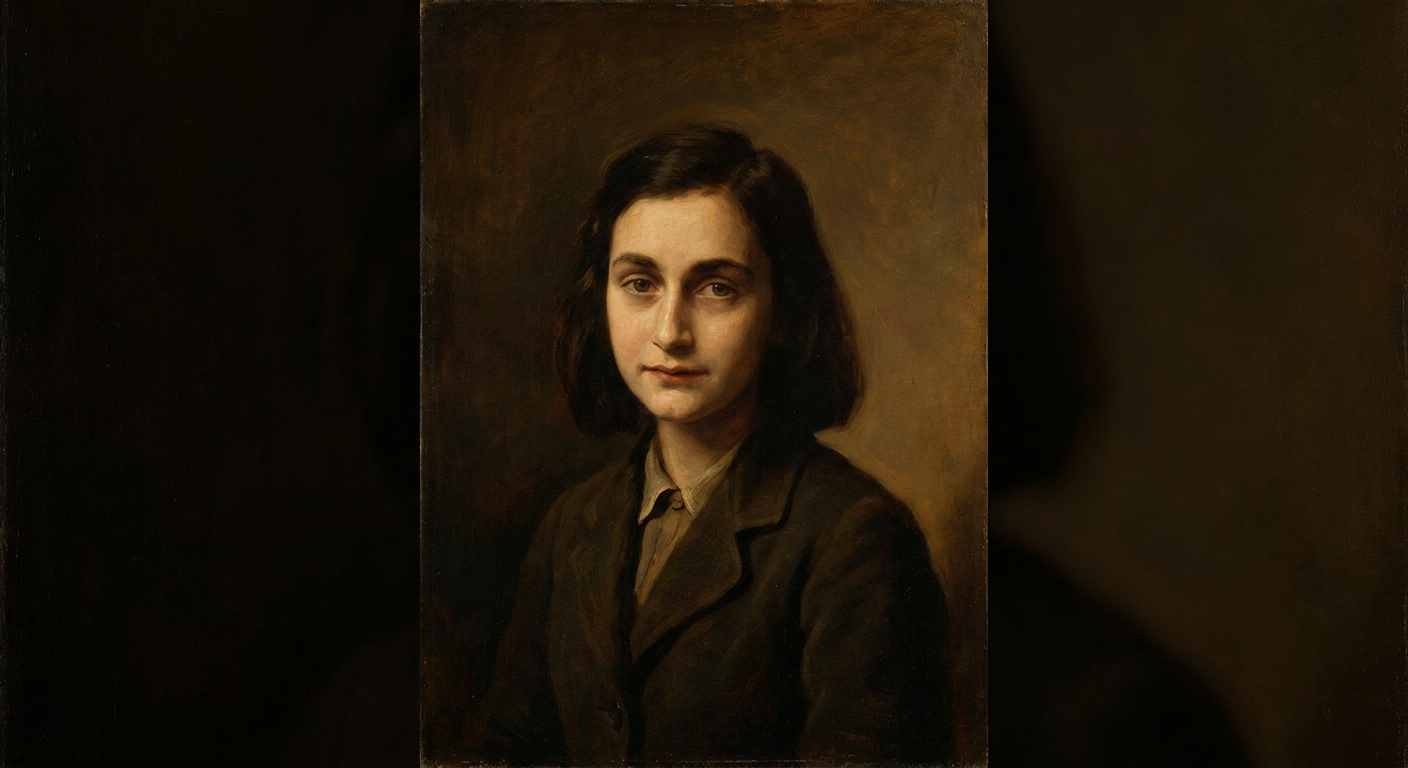
Quick Facts
- Years
- 1929 – 1945
- Category
- Writers & Poets
- Nationality
- German-born Jewish; stateless after 1941
- Occupation
- Diarist, writer, and student
Anne Frank
1929 – 1945 · German-born Jewish; stateless after 1941 · Diarist, writer, and student
Recommended Audiobooks
Listen next from Marcus Alden

Life Lessons from Louisa May Alcott
Marcus Alden · 54 min

Life Lessons from Edgar Allan Poe
Marcus Alden · 48 min
Anne Frank was a German-born Jewish teenager whose diary became one of the world's most widely read accounts of persecution under Nazi rule. For more than two years, Anne, her parents, her sister, and four other people hid in concealed rooms behind Otto Frank's business premises in German-occupied Amsterdam. There she recorded ordinary quarrels, fears, ambitions, and moments of hope against the extraordinary danger of the Holocaust.
Anne did not survive to see her work published. After the hiding place was discovered in August 1944, she was deported through Auschwitz to Bergen-Belsen, where she died at fifteen, probably in February 1945. Her father, Otto Frank, the only one of the eight hidden people to survive, later prepared her diary for publication.
First issued in Dutch in 1947, the diary transformed Anne from an unknown schoolgirl into an internationally recognized writer and witness. Its influence rests not on a complete history of the Holocaust but on its intensely personal view of one young life being restricted and threatened. Anne's literary ambition, powers of observation, and extensive revisions distinguish the diary from a casual notebook. Students continue to study her because her writing connects large historical forces—antisemitism, dictatorship, war, and genocide—with the recognizable inner life of an adolescent. Her story also raises enduring questions about memory, responsibility, prejudice, and how individual testimony can help later generations approach events of overwhelming scale.
Quick Facts
| Field | Details |
|---|---|
| Full Name | Annelies Marie Frank |
| Common Name(s) | Anne Frank; Anne sometimes called herself Anne or Annelies in different contexts |
| Born | 12 June 1929 |
| Died | Probably February 1945; the precise date is unknown |
| Age at Death | 15 |
| Birthplace | Frankfurt am Main, Germany |
| Nationality | Born German; the Nazi regime deprived the Frank family of German citizenship in 1941, leaving Anne stateless |
| Occupation | Student, diarist, and aspiring writer |
| Historical Era | Nazi era, Second World War, and Holocaust |
| Famous For | Writing a diary while hiding from Nazi persecution in Amsterdam |
| Political Affiliation | None |
| Religion | Born into a liberal Jewish family; Jewish identity became central under persecution |
| Education | Montessori schools and the Jewish Lyceum in Amsterdam |
| Parents | Otto Heinrich Frank and Edith Holländer Frank |
| Spouse(s) | None |
| Children | None |
| Major Works | Het Achterhuis, published in English as The Diary of a Young Girl |
| Major Achievements | Created an influential literary and historical record of adolescence under Nazi occupation |
Early Life
Anne was born into a financially comfortable, liberal Jewish family in Frankfurt. Her father, Otto, had served in the German army during the First World War and later worked in banking and business. Her mother, Edith, came from a prosperous family in Aachen. Anne's older sister, Margot, born in 1926, was studious and reserved; Anne was generally remembered as more talkative and openly expressive.
The Nazi rise to power in 1933 transformed the family's future. Adolf Hitler's government steadily excluded Jews from public life through propaganda, intimidation, discriminatory laws, and violence. Otto moved to Amsterdam, where he established a business selling pectin used in jam-making. Edith and the children followed, with Anne arriving in the Netherlands in 1934.
Amsterdam initially offered security. Anne learned Dutch, attended a Montessori school, made friends, and developed a strong interest in reading, mythology, film stars, and writing. No single mentor created her literary ambitions, but teachers recognized her lively personality and verbal ability. Her family maintained Jewish traditions without being strictly observant.
Germany invaded the Netherlands in May 1940. Dutch resistance could not prevent occupation, and Nazi authorities gradually imposed restrictions on Jews. Jewish residents had to register, wear the yellow star, surrender bicycles, obey curfews, avoid many public places, and attend segregated schools. Anne and Margot were transferred to the Jewish Lyceum in 1941. These measures were not isolated inconveniences: they formed part of a systematic process that separated Jews from neighbors and made deportation easier.
For Anne's thirteenth birthday on 12 June 1942, she received a red-and-white checked autograph book, which she began using as a diary. Addressing many entries to an imaginary friend named Kitty, she wrote about classmates, family tensions, and her developing identity. Within weeks, the diary became the record of a life in hiding.
Rise to Prominence
Anne did not become publicly prominent during her lifetime. Her fame emerged from the preservation, revision, and postwar publication of her writing.
On 5 July 1942, Margot received an order to report for what the Nazis described as labor in Germany. The family understood that obeying could mean extreme danger. Their planned disappearance was brought forward, and on 6 July they entered a concealed annex behind Otto's business at 263 Prinsengracht.
The Frank family was joined by Hermann and Auguste van Pels and their son Peter, followed in November by dentist Fritz Pfeffer. Anne used pseudonyms for several people when revising her manuscript; early editions retained some of them, while later scholarly editions restored historical names.
Employees and trusted associates—including Miep Gies, Jan Gies, Johannes Kleiman, Victor Kugler, Bep Voskuijl, and Johannes Voskuijl—helped the hidden group. They provided food, news, books, and practical assistance at enormous personal risk. During working hours, the residents had to remain quiet so warehouse employees would not hear them.
A major turning point came in March 1944, when Anne heard Dutch minister Gerrit Bolkestein say in a radio broadcast from exile that wartime diaries and letters should be collected after liberation. Anne began revising her entries for a possible book called Het Achterhuis, meaning “The House Behind” or “The Secret Annex.” She cut passages, expanded others, changed names, and sharpened descriptions. This surviving revision proves that she was not merely keeping private notes; she was learning to shape experience into literature.
After the arrest, Miep Gies and Bep Voskuijl recovered Anne's papers from the annex. Gies kept them without reading them and gave them to Otto after the war, when the family learned that Anne and Margot had died. Otto combined material from Anne's original diary and revised version. The Dutch edition appeared in 1947. Translations, theatrical and film adaptations, and school use later made Anne internationally famous.
Major Achievements
Creating a literary record of life in hiding
Anne documented fear and confinement while also describing food shortages, family arguments, jokes, studies, first love, and changing self-understanding. That combination matters because persecution did not erase the residents' ordinary personalities. Her diary helps readers see Holocaust victims as individuals rather than statistics.
Revising the diary as a book
Her 1944 rewriting was a serious literary undertaking. Anne reorganized events, refined character portraits, and considered an outside audience. She wanted to become a journalist and writer. Although death prevented her from completing the project, the revisions reveal discipline, narrative judgment, and unusual self-awareness for a teenager.
Becoming a global point of entry into Holocaust education
The diary has been translated into more than seventy languages and read by millions. It is not a comprehensive explanation of Nazi genocide: Anne wrote from one hiding place and knew only part of what was happening. Its achievement is different. It gives readers an accessible human connection from which broader study can begin.
Influencing literature and public memory
Anne's writing helped establish diaries and personal testimony as central forms of Holocaust remembrance. Plays, films, exhibitions, biographies, and educational programs have carried her story across cultures. Its long-term impact includes both empathy and debate about how one individual should represent millions of victims with different experiences.
Leadership or Work
Anne held no official leadership position, but her working methods can be reconstructed from her manuscripts. She wrote frequently, reread earlier entries, and revised heavily. She observed behavior closely and could be witty, severe, affectionate, or self-critical.
Her core values increasingly included independence, honesty, usefulness, and intellectual growth. She resisted being treated as a superficial child and wanted her inner life taken seriously. She studied languages, history, literature, mythology, shorthand, and family genealogy while in hiding.
Relationships shaped her work. Margot often served as a comparison against which Anne judged herself. Her relationship with Edith was strained, although Anne later reconsidered some harsh judgments. She idealized Otto as a confidant but also recognized limits in their closeness. Her developing relationship with Peter van Pels gave her companionship, though she eventually questioned whether it provided the deep understanding she wanted.
Anne's strengths included curiosity, humor, descriptive skill, persistence, and willingness to examine her own faults. Her weaknesses included impatience, cutting judgments, and a tendency to interpret conflicts through intense adolescent emotions. Because the diary is her perspective, it cannot be treated as a neutral transcript of every disagreement.
Personal Life
Anne never married and had no children. Before hiding, she enjoyed friends, school, cinema culture, photographs of performers, table tennis, reading, and conversation. Her diary mentions crushes and her wish to be admired, alongside a growing desire for emotional intimacy.
Life in the annex followed restrictive routines. The group listened to radio news, shared household duties, studied, read, celebrated birthdays and religious occasions, and worried about burglary or discovery. Food became increasingly scarce. Privacy was almost impossible, and conflicts arose over parenting, meals, noise, politics, and use of shared rooms.
Anne experienced puberty during confinement. She wrote candidly about menstruation, her body, sexuality, affection, and relationships between women. Some passages were omitted from early editions, partly because Otto wished to protect family privacy and partly because publishers considered them unsuitable. Later critical editions restored more of this material.
Witnesses who encountered Anne after arrest described the devastating effects of imprisonment, hunger, disease, and separation. At Bergen-Belsen, she and Margot contracted typhus amid catastrophic sanitary conditions. Both died shortly before British forces liberated the camp on 15 April 1945.
Philosophy or Beliefs
Anne had no developed political program. Her worldview emerged through personal reflection under persecution. She valued democracy, freedom of expression, women's independence, education, and the ability to contribute meaningfully to society.
Her relationship to religion was complex. She belonged to a Jewish family and became more conscious of Jewish identity as Nazi policies targeted her. She sometimes expressed faith in God and moral purpose, yet her diary is not a systematic religious text. Readers should avoid turning individual hopeful passages into a complete summary of her beliefs.
Anne believed writing could outlast physical life. She wanted to do more than follow a conventional domestic path and hoped to remain useful even after death. That ambition shaped her revisions. She also wrestled with human goodness and cruelty. Her optimistic statements are powerful precisely because the diary contains fear, anger, despair, and awareness of mass persecution as well.
Challenges and Controversies
The greatest challenge Anne faced was not personal failure but state-organized persecution. Nazi Germany and its collaborators stripped Jews of rights, deported them, exploited their labor, and murdered six million Jewish people. Presenting her story merely as an inspiring tale of optimism risks obscuring that political reality.
The identity of whoever revealed the annex, if anyone did, remains unresolved. Investigators have considered deliberate betrayal, information obtained through questioning, and accidental discovery during an investigation of illegal activity. Claims against various suspects have lacked conclusive proof. A widely publicized 2022 theory naming Jewish notary Arnold van den Bergh was strongly criticized by historians and researchers for speculative assumptions and weak evidence. It should not be presented as a solved case.
Otto's editing has also produced debate. He combined Anne's original and revised texts and removed material concerning sexuality, criticism of her mother, and private family matters. Critics argue that early editions softened Anne's complexity; defenders note that parental discretion and publishing conventions influenced his choices. Modern critical editions allow comparison of the manuscript versions.
Holocaust deniers have falsely claimed that the diary was forged. Extensive handwriting, paper, ink, document, and textual examinations support its authenticity. Anne wrote the surviving manuscripts; later pen marks and editorial work do not alter that conclusion.
Adaptations have sometimes emphasized universal hope while reducing the diary's Jewish and Holocaust context. Universal themes help the work reach broad audiences, but responsible teaching must preserve the specific history of antisemitic persecution.
Legacy
Anne Frank has become one of the best-known individual victims of the Holocaust. The Anne Frank House opened as a museum in Amsterdam in 1960 and preserves the former hiding place while teaching about antisemitism, dictatorship, and discrimination. The empty rooms are especially significant because furniture was removed after the arrest and Otto requested that they remain unfurnished.
The Anne Frank Fonds in Basel, established by Otto, manages family archives and aspects of the literary legacy. Educational organizations worldwide use traveling exhibitions and classroom materials inspired by Anne's story. Schools, streets, gardens, statues, and youth centers bear her name, and an asteroid was named 5535 Annefrank.
Her legacy is not without tension. Fame can make Anne seem like the representative of all Holocaust victims, even though millions left no diary and many endured ghettos, shootings, camps, forced labor, or hiding under very different conditions. Educators increasingly place her alongside other testimonies rather than allowing one story to stand alone.
Her modern relevance lies in the combination of personal testimony and historical warning. The diary demonstrates how discrimination advances through laws, bureaucracy, social exclusion, and public compliance before culminating in mass violence. It also preserves the voice of a young person insisting on intellectual and emotional dignity when a racist state had marked her for destruction.
Interesting Facts
- Anne received her first diary on her thirteenth birthday.
- The checked book was originally designed as an autograph album.
- She addressed many entries to an imagined correspondent called Kitty.
- The annex entrance was concealed behind a movable bookcase.
- Eight people lived in the hiding place for more than two years.
- Anne rewrote much of her diary after hearing a government radio appeal.
- She planned to title the resulting book Het Achterhuis.
- The helpers were not all aware of the hiding operation to the same degree.
- Miep Gies preserved the scattered diary papers without reading them.
- Otto Frank was the only one of the eight annex residents to survive.
- Anne maintained more than one manuscript version of parts of the diary.
- She hoped to become both a journalist and a published writer.
- Early editions omitted some passages later restored by scholars.
- The arresting authorities emptied the annex after its occupants were taken.
- The Anne Frank House opened to the public in 1960.
- Anne lost German citizenship under Nazi policy and died stateless.
- Her precise date of death remains unknown.
- An asteroid, 5535 Annefrank, carries her name.
Famous Quotes
Translations differ among editions, so wording may vary. Dates refer to diary entries.
- “Paper has more patience than people.” — 20 June 1942. Anne explains why private writing felt safer than ordinary conversation.
- “I want to go on living even after my death!” — 5 April 1944. This expresses her literary ambition; publication gave it tragic fulfillment.
- “I know what I want, I have a goal, an opinion.” — 11 April 1944. She asserts independence and purpose.
- “Who else but me is ever going to read these letters?” — 20 June 1942. Initially, she expected the diary to remain private.
- “In spite of everything I still believe that people are really good at heart.” — 15 July 1944. Often quoted alone, this appears within a longer, conflicted reflection on chaos and suffering.
- “I must uphold my ideals.” — 15 July 1944. The line conveys determination rather than ignorance of danger.
- “I can shake off everything as I write.” — 5 April 1944. Writing served as emotional release and disciplined work.
- “Memories mean more to me than dresses.” — 8 July 1942. Anne contrasts valued personal keepsakes with possessions left behind.
- “How wonderful it is that nobody need wait a single moment.” — 26 March 1944. The larger passage concerns beginning to improve the world.
- “Dead people receive more flowers than the living ones.” — Commonly attributed to Anne online, but not reliably documented in her diary; the attribution is disputed.
Timeline
- 1929 — Anne is born in Frankfurt on 12 June.
- 1933 — The Nazis take power; Otto relocates to Amsterdam.
- 1934 — Anne joins her family in the Netherlands.
- 1940 — Germany invades and occupies the Netherlands.
- 1941 — Anne transfers to the Jewish Lyceum; the family loses German citizenship.
- 12 June 1942 — Anne receives her diary on her thirteenth birthday.
- 6 July 1942 — The Frank family enters hiding.
- 13 July 1942 — The van Pels family joins them.
- 16 November 1942 — Fritz Pfeffer becomes the eighth annex resident.
- March 1944 — Anne hears the appeal to preserve wartime documents.
- May–August 1944 — She intensively revises her diary for publication.
- 4 August 1944 — German and Dutch officers raid the annex and arrest its occupants.
- 8 August 1944 — The prisoners are sent to Westerbork transit camp.
- 3 September 1944 — They are deported to Auschwitz-Birkenau.
- Late October or early November 1944 — Anne and Margot are transferred to Bergen-Belsen.
- Probably February 1945 — Margot and Anne die during a typhus epidemic.
- 15 April 1945 — British troops liberate Bergen-Belsen.
- 1947 — The first Dutch edition of Het Achterhuis is published.
- 1952 — An English-language edition appears in the United States and Britain.
- 1955 — A stage adaptation opens on Broadway.
- 1959 — A major film adaptation is released.
- 1960 — The Anne Frank House opens as a museum.
Frequently Asked Questions
1. Why is Anne Frank famous?
Anne is famous because her diary offers an unusually detailed account of adolescence under Nazi persecution. She wrote about hiding, fear, relationships, education, and her ambition to become an author. Its publication after her death gave millions of readers a personal route into Holocaust history. The diary's fame should not be confused with historical completeness: it records one young person's limited viewpoint, not every aspect of the genocide.
2. Where was Anne Frank born?
She was born in Frankfurt am Main, Germany, on 12 June 1929. The Frank family had deep roots in Germany, and Otto Frank had served in the German army during the First World War. Nazi antisemitism made continued life there increasingly dangerous. The family relocated to Amsterdam after Hitler came to power, and Anne spent most of her remembered childhood speaking Dutch and attending Dutch schools.
3. Why did the Frank family leave Germany?
They left because the Nazi movement's rise brought growing antisemitism, intimidation, and exclusion. Otto also faced economic uncertainty and sought a place where he could rebuild his business. Moving to the Netherlands was an effort to secure safety and stability, not initially a plan to hide. Germany's 1940 invasion of the Netherlands placed the family under Nazi authority again.
4. Why did the family go into hiding?
The immediate trigger was a summons ordering Margot Frank to report for supposed labor service on 5 July 1942. Jewish families understood that such orders could lead to deportation and grave danger. Otto had already prepared a hiding place with trusted employees. The family entered it the following morning, earlier than originally planned, carrying layers of clothing to avoid attracting attention with luggage.
5. Who hid in the secret annex?
The eight residents were Otto, Edith, Margot, and Anne Frank; Hermann, Auguste, and Peter van Pels; and Fritz Pfeffer. Anne gave several of them pseudonyms in her revised manuscript. They differed in age, habits, temperament, and expectations, creating frequent tensions in a cramped space. Their helpers outside were essential because the residents could not safely purchase food or move freely.
6. How long was Anne in hiding?
Anne lived in the annex from 6 July 1942 until 4 August 1944, just over two years. The residents had limited access to fresh air and had to remain especially quiet during business hours. Their confinement was dangerous but not isolated from the outside world: helpers brought news and supplies, while radio broadcasts allowed them to follow the war's changing course.
7. Who helped the people in hiding?
The principal helpers included Miep and Jan Gies, Victor Kugler, Johannes Kleiman, Bep Voskuijl, and Johannes Voskuijl. Their roles varied, and not every employee in the building knew the full secret. They obtained rationed food, carried messages, supplied books, and provided emotional contact. Helping Jews violated Nazi rules and could result in imprisonment or death, so their assistance involved serious risk.
8. Who betrayed Anne Frank?
No person has been conclusively identified. Numerous suspects and scenarios have been proposed, including deliberate betrayal and accidental discovery during another investigation. Surviving evidence is incomplete, and claims of certainty exceed what historians can prove. The controversial 2022 accusation against Arnold van den Bergh was rejected by many specialists because its chain of assumptions was not supported by sufficiently strong documentation.
9. Is Anne Frank's diary authentic?
Yes. Forensic and scholarly examinations of the handwriting, paper, glue, ink, manuscript history, and surviving versions support Anne's authorship. Holocaust deniers have misrepresented later annotations and editorial decisions as proof of forgery. Those claims fail to distinguish Anne's manuscripts from notes added during preservation and publication. The Netherlands Institute for War Documentation produced a detailed critical edition addressing the evidence.
10. Did Otto Frank change the diary?
Otto edited it for publication by combining Anne's original entries with her own revised version. He omitted some passages about sexuality, marital tensions, and Anne's criticism of her mother and other residents. That process affected early readers' impression of Anne, but it was openly studied and does not mean he authored the diary. Later editions publish substantially more of the surviving text.
11. What happened after the arrest?
The eight residents were detained, sent to the Westerbork transit camp, and deported to Auschwitz-Birkenau in September 1944. Men and women were separated. Anne and Margot were later transported to Bergen-Belsen, while Edith remained at Auschwitz and died there. Disease, starvation, crowding, exposure, and the collapse of camp administration caused mass death as Germany neared defeat.
12. How did Anne Frank die?
Anne probably died from typhus and its complications at Bergen-Belsen in February 1945, shortly after Margot. Earlier accounts placed their deaths in March, but later research based on survivor testimony and disease progression suggests they likely died sooner. No exact date or individual grave is known. The camp was liberated only weeks later, on 15 April.
13. How did the diary survive?
After the raid, Miep Gies and Bep Voskuijl found Anne's notebooks and loose pages scattered inside the annex. Gies stored them, intending to return them to Anne. When Otto learned that his daughters had died, she gave the papers to him. Had she read them during the occupation, she later observed, she might have destroyed them because they named helpers and could have endangered people.
14. What did Anne want to become?
Anne wanted to become a journalist and writer. In 1944 she wrote that she hoped not to have lived in vain and wanted her words to endure. Her response to the Dutch government's request for wartime documents shows practical commitment to that goal: she began transforming private entries into a structured manuscript intended for readers after liberation.
15. Why did Anne call her diary Kitty?
Anne addressed entries to several imagined friends before settling mainly on Kitty. The name was influenced by characters in popular Dutch books by Cissy van Marxveldt, although Anne developed her own private correspondent rather than simply copying a character. Writing to Kitty allowed the diary to take the form of intimate letters and gave Anne a listener to whom she could disclose thoughts she felt unable to share elsewhere.
16. What is the Anne Frank House?
The Anne Frank House is a museum at 263 Prinsengracht in Amsterdam, incorporating the building where the annex residents hid. Opened in 1960, it preserves the concealed rooms, historical documents, photographs, and context of Nazi occupation. It also runs educational programs about antisemitism and discrimination. The rooms remain largely empty, emphasizing the removal of their occupants and possessions after the arrest.
17. Is the diary suitable as a complete Holocaust history?
No single diary can provide a complete history. Anne did not witness extermination centers while writing and possessed incomplete wartime information. The diary is best taught alongside evidence about Nazi ideology, ghettos, mass shootings, deportations, camps, resistance, collaboration, and other victims' experiences. Its great value lies in personal testimony, literary quality, and the detailed record of persecution's impact on one family.
Lessons We Can Learn
- Discrimination often advances gradually. Anti-Jewish registration, exclusions, and restrictions preceded deportation. Modern comparisons require care, but the evidence shows why attacks on equal citizenship deserve early attention.
- Personal testimony makes history tangible. Anne's daily observations connect policy with lived experience. Today, testimony should supplement—not replace—broader research.
- Writing can preserve threatened voices. Anne revised her work despite danger. Her survival through words demonstrates the value of documenting events responsibly.
- Helpers matter. The annex could not have functioned without outside assistance. Their example shows the practical importance, and sometimes the risk, of helping persecuted people.
- Courage does not remove fear. Residents and helpers remained frightened. Historically, courage here meant acting while danger was understood, not feeling invulnerable.
- Young people are serious historical witnesses. Anne analyzed family, society, war, and identity. Her age should inform interpretation without diminishing her intelligence.
- Hope should not obscure injustice. Her hopeful lines coexist with terror and murder. Modern readers should resist using optimism to soften the perpetrators' responsibility.
- Sources have viewpoints. Anne could be unfair or incomplete, as she sometimes acknowledged. Careful history compares diaries with documents and other testimony.
- Editing shapes memory. Differences among diary editions show how publication choices influence reputation. Transparency about those choices strengthens understanding.
- Uncertainty should be admitted. The unknown betrayal and death date illustrate the limits of evidence. Honest qualification is more responsible than dramatic certainty.
Related Historical Figures
- Otto Frank — Anne's father, annex organizer, sole survivor of the eight residents, and editor of the first published diary.
- Edith Frank — Anne's mother, whose difficult relationship with her daughter appears candidly in the manuscripts.
- Margot Frank — Anne's older sister, whose deportation summons triggered the family's move into hiding.
- Miep Gies — Helper who supplied the annex and preserved Anne's papers after the arrest.
- Peter van Pels — Fellow resident with whom Anne formed a close emotional and romantic attachment.
- Hannah Goslar — Anne's childhood friend who encountered her again through the fence at Bergen-Belsen.
- Gerrit Bolkestein — Dutch minister whose radio appeal encouraged Anne to revise her diary for publication.
- Etty Hillesum — Dutch Jewish diarist whose writings offer another distinct perspective on Nazi persecution.
- Elie Wiesel — Auschwitz and Buchenwald survivor whose memoir Night became central to Holocaust education.
- Primo Levi — Auschwitz survivor and writer whose analytical testimony complements Anne's account of hiding.
Watch and Learn
“Who Was Anne Frank?” — HISTORY
Approximate duration: 4 minutes
This concise overview introduces Anne's childhood, the Nazi occupation, the secret annex, her deportation, and the diary's publication. It is recommended as an accessible visual introduction from an established history channel, but viewers should pair its short summary with museum resources and fuller Holocaust scholarship.
Watch and Learn
Who Was Anne Frank? · HISTORY
Related Historical Figures