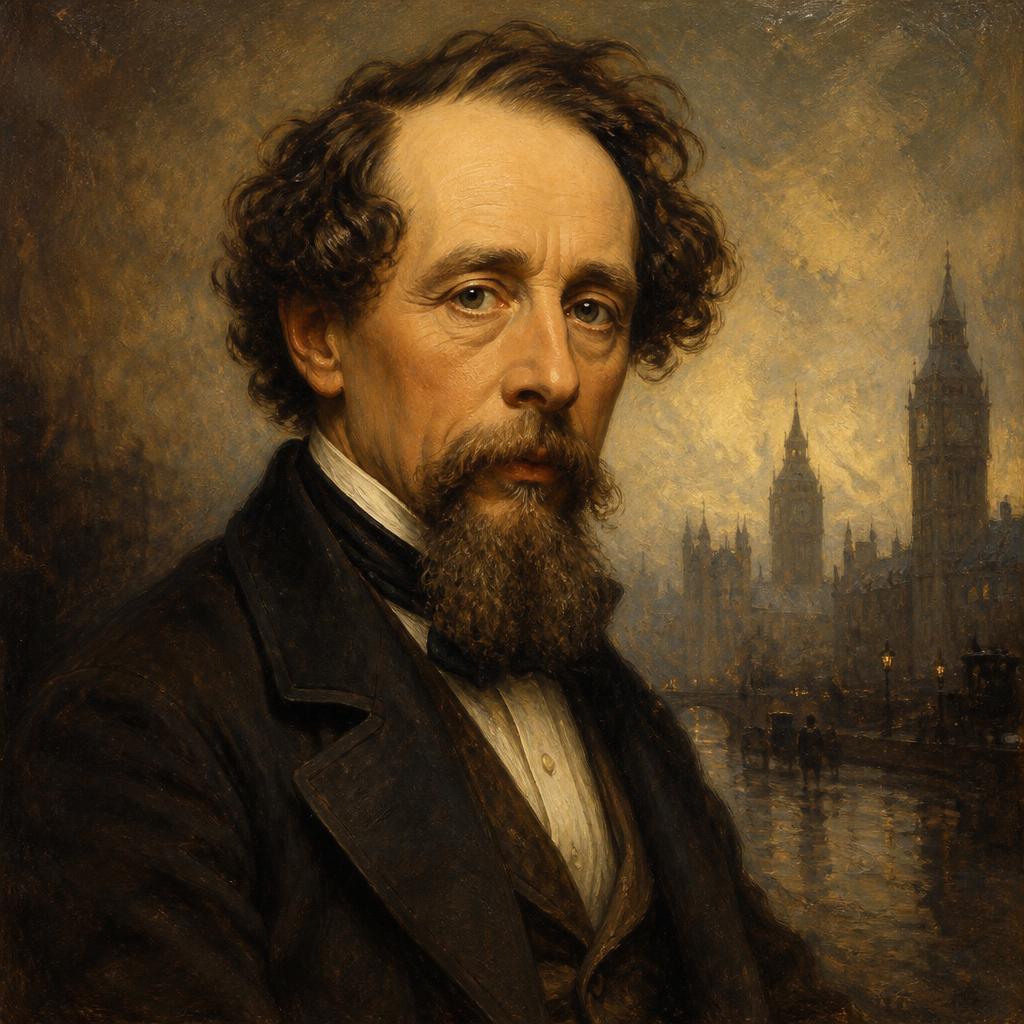
Quick Facts
- Years
- 1812 – 1870
- Category
- Writers & Poets
- Subcategory
- Novelists
- Nationality
- English
- Occupation
- Novelist & Social Critic
Charles Dickens
1812 – 1870 · English · Novelist & Social Critic
Audiobook

Life Lessons from Charles Dickens
Marcus Alden · 54 min
Charles Dickens (1812–1870) was an English novelist, journalist, editor, performer, and social critic whose stories transformed Victorian literature. Combining memorable characters, suspenseful plots, comic invention, and moral urgency, he brought the experiences of debtors, prisoners, factory workers, abandoned children, and the urban poor before a vast international readership.
Dickens first became famous with The Pickwick Papers and went on to write such enduring novels as Oliver Twist, David Copperfield, Bleak House, Hard Times, Little Dorrit, A Tale of Two Cities, and Great Expectations. Many initially appeared in monthly or weekly installments, a publishing method that enabled him to respond to readers while sustaining suspense. His fiction criticized the workhouse system, legal delay, educational neglect, industrial exploitation, and complacent privilege without offering a simple political program.
His childhood shaped his writing profoundly. When his father was imprisoned for debt, twelve-year-old Dickens worked in a blacking warehouse—an experience he found humiliating and disclosed fully to very few people. It informed his lifelong sympathy for vulnerable children and his preoccupation with shame, social insecurity, and self-reinvention.
Dickens remains important not only for his literary artistry but also because his works illuminate the opportunities and inequalities of nineteenth-century Britain. Adaptations, scholarship, public readings, museums, and ordinary readers continue to renew his influence worldwide.
Quick Facts
| Field | Details |
|---|---|
| Full Name | Charles John Huffam Dickens |
| Common Name(s) | Charles Dickens; early pseudonym “Boz” |
| Born | 7 February 1812 |
| Died | 9 June 1870 |
| Age at Death | 58 |
| Birthplace | Landport, Portsea Island, Hampshire, England |
| Nationality | British (English) |
| Occupation | Novelist, journalist, editor, essayist, social critic, public reader |
| Historical Era | Victorian era |
| Famous For | Major English novels, social criticism, serialized fiction, public readings |
| Political Affiliation | No formal party affiliation; generally reformist and politically independent |
| Religion | Raised Anglican; Christian moral outlook, critical of sectarianism and hypocrisy |
| Education | Several schools, including Wellington House Academy; largely self-educated after limited formal schooling |
| Parents | John Dickens and Elizabeth Dickens, née Barrow |
| Spouse(s) | Catherine Thomson Hogarth, married 1836; separated 1858 |
| Children | Ten, one of whom died in infancy |
| Major Works | The Pickwick Papers, Oliver Twist, Nicholas Nickleby, A Christmas Carol, David Copperfield, Bleak House, Hard Times, Little Dorrit, A Tale of Two Cities, Great Expectations, Our Mutual Friend |
| Major Achievements | International literary fame; development of serialized fiction; influential social criticism; celebrated public readings; editor of Household Words and All the Year Round |
Early Life
Charles Dickens was born on 7 February 1812 in Landport, near Portsmouth. He was the second of eight children of John Dickens, a clerk in the Navy Pay Office, and Elizabeth Barrow Dickens. His father's work took the family to London and then Chatham, Kent. Dickens later remembered the Chatham years as comparatively happy. He read voraciously, especially novels by Tobias Smollett, Henry Fielding, Oliver Goldsmith, and Miguel de Cervantes, and enjoyed amateur theatricals.
The family's finances were unstable. John Dickens was sociable and optimistic but often lived beyond his means. In 1822 the family moved to London, where its situation deteriorated. In February 1824 John entered the Marshalsea debtors’ prison. Most of the household joined him there, as families of imprisoned debtors sometimes did, while Charles lodged nearby and worked at Warren's Blacking warehouse.
At twelve, Dickens spent long days pasting labels onto bottles of shoe blacking. The labor itself was less extraordinary than the shame and abandonment he felt after having expected a respectable education. A family inheritance helped secure John Dickens's release after a few months. Charles returned to school only after his father removed him from the factory; his mother initially favored his continuing there, a memory that wounded him deeply.
Dickens attended Wellington House Academy from 1824 to 1827 but never received a university education. At fifteen he became a clerk in a solicitors’ office. He taught himself shorthand and developed exceptional powers of observation while working among lawyers, clerks, journalists, litigants, and parliamentary politicians. These experiences supplied characters, settings, and institutions for his later fiction.
Britain was entering an age of rapid urbanization, industrial growth, political reform, and severe inequality. Dickens matured amid debates over the Poor Law, factory labor, prisons, public health, education, and parliamentary representation. His writing would translate these large historical changes into individual stories.
Rise to Prominence
Dickens left legal clerking for shorthand reporting. By the early 1830s he was covering court proceedings and parliamentary debates, eventually working for the Morning Chronicle. Reporting demanded speed, accuracy, travel, and close attention to speech—all useful preparation for a novelist renowned for distinctive voices and crowded social scenes.
He began publishing short sketches in periodicals in 1833. Using the pen name “Boz,” derived from a family nickname, he wrote humorous and observant pieces about London life. Collected as Sketches by Boz in 1836, they attracted the attention of publishers Chapman and Hall.
That firm asked Dickens to provide text for a series of sporting illustrations. Dickens reshaped the project into The Posthumous Papers of the Pickwick Club, usually called The Pickwick Papers. Its early numbers sold modestly, but the introduction of the resourceful servant Sam Weller helped make the serial a phenomenon. By its conclusion in 1837, the twenty-five-year-old Dickens was famous.
He immediately undertook several projects, including editing Bentley’s Miscellany and serializing Oliver Twist. The novel's criminal underworld, workhouse child, and denunciation of institutional cruelty revealed that Dickens was more than a comic entertainer. Nicholas Nickleby followed, attacking abusive Yorkshire boarding schools.
Success brought punishing workloads. Dickens often wrote overlapping serials to strict deadlines while managing editorial duties and a growing household. Yet serialization also sharpened his command of suspense, recurring characters, reversals, and emotional climaxes. His novels reached readers across classes and rapidly crossed the Atlantic, although weak international copyright protection initially meant that American publishers often reprinted them without payment.
Major Achievements
Transforming Serialized Fiction
Dickens did not invent serialization, but he became its supreme nineteenth-century practitioner. Monthly parts made substantial novels affordable in installments, while weekly publication in his journals reached an even broader audience. Cliff-hangers, interwoven plots, memorable entrances, and delayed revelations encouraged communal anticipation.
This mattered commercially and artistically. Dickens could observe reader response and occasionally adjust emphasis, although claims that audiences dictated his stories are exaggerated. His method influenced popular fiction, television drama, comics, and other episodic storytelling forms.
Creating an Enduring Fictional World
Dickens populated his books with figures whose names became cultural shorthand: Scrooge, Fagin, Uriah Heep, Mr. Micawber, Miss Havisham, Gradgrind, and the Artful Dodger. His best characters combine caricature with psychological force. Through recurring gestures, verbal habits, clothing, rooms, and names, he made personalities instantly recognizable.
The novels also offered panoramic portraits of London and Victorian society. Bleak House connects aristocratic households, slums, law offices, philanthropy, disease, and policing. Our Mutual Friend turns dust heaps, refuse, money, and the Thames into symbols of a society that both discards and recycles human lives.
Advancing Social Criticism Through Story
Dickens exposed abuses without writing documentary reports disguised as novels. Oliver Twist challenged the dehumanizing administration of poor relief. Nicholas Nickleby drew attention to brutal private schools. Bleak House attacked legal delay and irresponsible philanthropy, while Little Dorrit satirized bureaucracy and imprisonment. Hard Times criticized reductive utilitarian education and industrial relations.
His fiction did not by itself produce particular reforms, and historians caution against attributing legislative change to one author. Nevertheless, Dickens helped shape public feeling. He made institutional suffering emotionally vivid, strengthened humanitarian debate, and expanded the moral subjects available to popular fiction.
Reinventing the Modern Christmas Story
A Christmas Carol appeared in December 1843. Through Ebenezer Scrooge's conversion from isolation and greed to generosity, Dickens joined supernatural storytelling with a social ethic of fellowship. The book was immediately popular, though its expensive production reduced Dickens's initial profits.
Dickens wrote four further Christmas books and many seasonal stories. He did not “invent Christmas,” but he helped popularize an ideal of the holiday centered on family, memory, charity, reconciliation, food, and communal warmth. The tale remains one of the most frequently adapted works in English.
Editing Influential Journals
Dickens founded and edited Household Words from 1850 to 1859 and All the Year Round from 1859 until his death. These weekly journals mixed fiction, essays, travel writing, science, history, and social commentary. Contributors included Elizabeth Gaskell and Wilkie Collins, although Dickens exercised strong editorial control and much material appeared anonymously.
The journals gave him a continuing public platform and enabled serialization of works including Hard Times, A Tale of Two Cities, and Great Expectations. They also demonstrated his abilities as an organizer, publisher, and cultural entrepreneur.
Mastering Public Performance
Beginning with charitable appearances and moving into professional tours, Dickens became a celebrated public reader of his own works. He condensed and dramatized scenes, shifting voice and posture to represent multiple characters. Audiences in Britain, Ireland, and the United States responded enthusiastically.
These performances increased his independence and international celebrity, anticipating modern author tours. They also endangered his health: the exhausting schedule and emotional intensity continued despite medical warnings.
Leadership and Work
Dickens led through energy, example, and close personal supervision. As an editor, he revised contributions, proposed subjects, managed publication schedules, and insisted on accessibility. Writers benefited from his readership and editorial intelligence but could find his intervention demanding. Elizabeth Gaskell, for example, sometimes resisted pressures created by weekly serialization.
His creative method was disciplined. He kept planning notes for later novels, tested character names, walked extensively through London, and composed according to tight serial schedules. Long nighttime walks allowed him to observe neighborhoods and think through plots. He could work with astonishing intensity, but overcommitment contributed to physical and emotional strain.
In reform projects he preferred practical action to abstract platforms. He supported the establishment of Urania Cottage, a home intended to rehabilitate vulnerable and formerly imprisoned women, working with philanthropist Angela Burdett-Coutts. He involved himself in admissions and plans for education and emigration. Modern scholars recognize both the project's benevolent aims and its paternalistic Victorian assumptions.
Dickens's strengths included imagination, stamina, organizational ability, theatrical skill, and sensitivity to institutional cruelty. His weaknesses included impatience, a desire for control, harshness in conflict, and difficulty separating public image from private disputes. Loyal friendships coexisted with decisive ruptures.
Personal Life
Dickens married Catherine Hogarth, daughter of journalist George Hogarth, on 2 April 1836. They had ten children between 1837 and 1852; their daughter Dora died in infancy. The demands of a large household, Dickens's work, and his increasing dissatisfaction strained the marriage.
Catherine's younger sister Mary Hogarth lived with the couple and died suddenly in 1837 at seventeen. Dickens was devastated and idealized her memory. Another sister, Georgina Hogarth, joined the household and later helped manage it, remaining devoted to Dickens and his children.
In 1857 Dickens met Ellen Ternan, a young actress. Evidence from correspondence, travel arrangements, and later research indicates an intimate attachment, but much of the relationship was deliberately concealed. Scholars still debate its precise nature and whether it became sexual. Dickens and Catherine separated in 1858. He published a defensive public statement about domestic rumors, worsening the scandal and placing Catherine under unfair scrutiny.
Dickens formed important friendships with writers and artists including Wilkie Collins, John Forster, Daniel Maclise, and William Makepeace Thackeray, though the Thackeray friendship suffered a temporary breach. Forster became his confidant and first major biographer.
He loved theater, performance, travel, elaborate social gatherings, and long walks. His personality could be warm, generous, magnetic, restless, and controlling. After surviving the Staplehurst railway accident in 1865, he reportedly suffered continuing nervous effects. Heavy work and reading tours compounded declining health. He died after a stroke at Gad's Hill Place on 9 June 1870.
Philosophy and Beliefs
Dickens's worldview centered on sympathy, conscience, personal responsibility, and the moral value of human fellowship. He attacked systems that reduced people to numbers or cases. Children were especially important in his moral imagination because their treatment revealed a society's character.
Politically, he was a reformer rather than a systematic radical. He criticized aristocratic privilege, official incompetence, the workhouse, corrupt elections, and industrial exploitation. Yet he distrusted ideological movements, mass political rhetoric, and bureaucratic solutions. He often emphasized moral renewal by individuals, a position admired for its humanity but criticized for underestimating structural change.
Dickens retained a broadly Christian outlook. In The Life of Our Lord, written privately for his children, he presented Jesus as a model of compassion, forgiveness, and humility. He opposed religious hypocrisy and sectarian self-righteousness. His fiction commonly values active mercy above professions of faith.
His views were also shaped by Victorian prejudices. Some depictions of foreigners, colonial peoples, women, and Jews reflect stereotypes of his time. His later creation of Mr. Riah in Our Mutual Friend appears partly to answer criticism of Fagin, but it does not erase the earlier portrayal's harmful legacy.
Challenges and Controversies
Marriage Breakdown
Dickens's separation from Catherine remains a central biographical controversy. He portrayed the marriage as incompatible and denied certain rumors. Catherine left the family home, while most of the children remained within Dickens's household. Surviving evidence suggests he exercised his celebrity and authority in ways that damaged her reputation. Some earlier biographies accepted his version too readily; modern scholarship generally treats Catherine more sympathetically while acknowledging that private motives cannot be reconstructed completely.
Ellen Ternan and Secrecy
The relationship with Ellen Ternan has generated extensive debate because both parties destroyed or concealed evidence. Most modern biographers accept that she was central to Dickens's later life. Claims about a secret child or the exact nature of their intimacy remain unproven. Responsible accounts distinguish strong evidence for a concealed attachment from speculation about details.
Antisemitism and Fagin
In Oliver Twist, Dickens repeatedly identifies Fagin by his Jewishness, drawing upon long-standing antisemitic stereotypes linking Jews with criminality. After Eliza Davis, a Jewish acquaintance, challenged him, Dickens defended himself but later reduced such references in revisions and created the benevolent Jewish character Mr. Riah. Critics differ over how much weight to give this later response, but the original representation remains offensive and influential.
Race, Empire, and Violence
Dickens sometimes expressed racial and imperial attitudes now recognized as deeply prejudiced. His reaction to the 1857 Indian Rebellion included calls for severe collective punishment. Such statements conflict sharply with his reputation as a humanitarian. Historians place them within imperial Victorian culture without treating context as an excuse.
Reform Without Systemic Politics
Some critics, including later Marxist commentators, have argued that Dickens exposed misery while resolving stories through charity, inheritance, coincidence, or individual transformation rather than political reconstruction. Others contend that fiction's role is not to draft legislation and that his exposure of institutional indifference was itself politically significant. Both perspectives illuminate the tension between his radical sympathy and limited program for reform.
Exhausting Public Readings
Dickens's dramatic readings thrilled audiences but harmed his health, especially the violent murder scene from Oliver Twist. Friends and physicians urged restraint. His decision to continue illustrates both professional dedication and compulsive overwork. It may have contributed to his early death, though a direct causal judgment cannot be proved.
Legacy
Dickens reshaped the English-language novel by joining popular entertainment with social range, symbolic complexity, and moral criticism. His influence can be traced in writers as different as Fyodor Dostoevsky, George Orwell, Franz Kafka, Tom Wolfe, and many contemporary novelists. “Dickensian” now describes vivid characters and labyrinthine plots, but also poverty, oppressive institutions, and extreme social contrasts.
His novels have generated countless stage, film, television, radio, and graphic adaptations. A Christmas Carol, Oliver Twist, Great Expectations, and David Copperfield remain embedded in global culture. Modern scholarship examines his narrative techniques alongside questions of gender, class, disability, race, empire, urban space, media, and celebrity.
Dickens was buried in Poets’ Corner at Westminster Abbey, despite his expressed preference for a quiet burial near his Kent home. His former residence at 48–49 Doughty Street is now the Charles Dickens Museum. The Charles Dickens Birthplace Museum preserves the Portsmouth house where he was born, while Broadstairs and Rochester maintain strong associations with his life and work. Gad's Hill Place later became part of a school and has been the focus of preservation efforts.
Memorials include a statue in Portsmouth's Guildhall Square and the Dickens and Little Nell sculpture in Philadelphia. Dickens reportedly disliked the idea of statues to himself, making the history of these memorials especially notable. Manuscripts, letters, and proofs are preserved by institutions including the British Library and the Victoria and Albert Museum.
His legacy is neither simple nor saintly. The same record contains extraordinary empathy, artistic innovation, personal cruelty, prejudice, generosity, and relentless ambition. That complexity helps explain why Dickens remains rewarding to read and debate.
Interesting Facts
- “Boz,” Dickens's early pen name, evolved from a family nickname for his younger brother Augustus.
- He worked at Warren's Blacking warehouse when he was twelve.
- He learned Gurney shorthand to become a reporter.
- The Pickwick Papers began as text intended to accompany sporting illustrations.
- Sam Weller's arrival helped accelerate the serial's popularity.
- Dickens was only twenty-five when Pickwick finished publication.
- He visited the United States twice, in 1842 and 1867–68.
- His disappointment with aspects of American society informed American Notes and Martin Chuzzlewit.
- He helped manage Urania Cottage with Angela Burdett-Coutts.
- He sometimes used a small Swiss chalet at Gad's Hill as a writing room.
- He performed in amateur theatrical productions and loved stagecraft.
- A Christmas Carol was written in roughly six weeks in 1843.
- Dickens personally supervised many details of his books’ presentation and illustration.
- The Staplehurst railway accident occurred on 9 June 1865—exactly five years before his death.
- He rescued manuscript pages of Our Mutual Friend after the Staplehurst crash.
- His final novel, The Mystery of Edwin Drood, remained unfinished.
- Dickens requested an unostentatious funeral.
- His burial in Westminster Abbey made his grave a national literary memorial.
Famous Quotes
- “Please, sir, I want some more.” — Oliver Twist (1837–39). Oliver's request exposes hunger and the punitive workhouse response to basic human need.
- “It was the best of times, it was the worst of times.” — A Tale of Two Cities (1859). The balanced opposites introduce an age of contradiction and revolution.
- “Marley was dead: to begin with.” — A Christmas Carol (1843). The blunt opening establishes the supernatural tale's essential premise.
- “God bless Us, Every One!” — Tiny Tim in A Christmas Carol. The blessing summarizes the book's ideal of inclusive compassion.
- “Mankind was my business.” — Marley's Ghost in A Christmas Carol. Marley recognizes too late that commercial success cannot replace social responsibility.
- “I wear the chain I forged in life.” — Marley's Ghost in A Christmas Carol. The chain symbolizes consequences created through repeated selfish choices.
- “Take nothing on its looks; take everything on evidence.” — Jaggers in Great Expectations (1860–61). The lawyer's maxim warns against appearances, a central concern of the novel.
- “No one is useless in this world who lightens the burden of it for anyone else.” — Our Mutual Friend (1864–65). The line states Dickens's ethic of practical kindness.
- “There was a long hard time when I kept far from me the remembrance of what I had thrown away.” — Pip in Great Expectations. Pip's confession links ambition with ingratitude and moral blindness.
- “Whether I shall turn out to be the hero of my own life, or whether that station will be held by anybody else, these pages must show.” — David Copperfield (1849–50). The opening frames identity as something narrated, tested, and formed.
Timeline
- 1812 — Born at Landport, Portsmouth, on 7 February.
- 1817 — Family settles in Chatham, Kent.
- 1822 — Family moves to London.
- 1824 — Works at Warren's Blacking; John Dickens is imprisoned for debt in the Marshalsea.
- 1824–1827 — Attends Wellington House Academy.
- 1827 — Begins work as a solicitor's clerk.
- 1829 — Becomes a freelance shorthand reporter.
- 1833 — Publishes his first known sketch, “A Dinner at Poplar Walk.”
- 1836 — Sketches by Boz and The Pickwick Papers begin; marries Catherine Hogarth.
- 1837 — Oliver Twist serialization begins; Mary Hogarth dies.
- 1838 — Nicholas Nickleby begins.
- 1842 — Makes his first American tour; publishes American Notes.
- 1843 — Publishes A Christmas Carol.
- 1846 — Begins publishing Dombey and Son; works on Urania Cottage.
- 1849 — David Copperfield begins serialization.
- 1850 — Launches Household Words.
- 1852 — Bleak House begins.
- 1854 — Publishes Hard Times.
- 1857 — Meets Ellen Ternan; performs in The Frozen Deep.
- 1858 — Separates from Catherine; begins professional reading tours.
- 1859 — Launches All the Year Round; publishes A Tale of Two Cities.
- 1860–1861 — Great Expectations appears weekly.
- 1864–1865 — Our Mutual Friend is serialized.
- 1865 — Survives the Staplehurst railway accident.
- 1867–1868 — Undertakes a second American tour.
- 1870 — Gives final readings; begins The Mystery of Edwin Drood; dies on 9 June and is buried in Westminster Abbey.
Frequently Asked Questions
Who was Charles Dickens?
Charles Dickens was a nineteenth-century English novelist, journalist, editor, and performer. He became one of the Victorian era's most popular authors by combining humor, melodrama, suspense, social observation, and memorable characterization. His novels explored poverty, childhood, law, education, class ambition, family, and urban life. Dickens also edited major weekly journals and toured as a public reader. His continuing importance rests on both literary artistry and his ability to make social institutions emotionally visible.
When and where was Charles Dickens born?
Dickens was born on 7 February 1812 at 1 Mile End Terrace in Landport, on Portsea Island near Portsmouth, Hampshire. His father worked as a clerk in the Navy Pay Office. Because the job required several moves, Dickens's childhood included periods in London and Chatham, Kent. The Portsmouth birthplace survives as the Charles Dickens Birthplace Museum, furnished to evoke an early nineteenth-century household.
Why did Dickens work in a blacking factory?
His family fell deeply into debt, and in 1824 his father was imprisoned in London's Marshalsea debtors’ prison. Twelve-year-old Charles was sent to Warren's Blacking warehouse to help support himself, pasting labels on bottles of shoe blacking. He worked there for several months. Dickens later described the episode in a private autobiographical fragment. The humiliation and fear of abandonment left a lasting mark on his fiction, especially its vulnerable children and anxious social climbers.
How did Charles Dickens become famous?
He first established himself through newspaper reporting and humorous urban sketches published under the name Boz. His breakthrough came with the monthly serial The Pickwick Papers in 1836–37. The early installments were not immediately sensational, but popularity surged as the story developed, particularly after Sam Weller appeared. Dickens then consolidated his reputation with Oliver Twist and Nicholas Nickleby, proving that he could combine comedy with forceful social criticism.
What are Dickens's most famous books?
His best-known works include The Pickwick Papers, Oliver Twist, A Christmas Carol, David Copperfield, Bleak House, Hard Times, Little Dorrit, A Tale of Two Cities, Great Expectations, and Our Mutual Friend. Different works excel in different forms: Bleak House offers complex social plotting, Great Expectations explores memory and ambition, and A Christmas Carol presents a compact moral fable. The Mystery of Edwin Drood was unfinished when he died.
Did Dickens invent Christmas as we know it?
No. Christmas traditions involving worship, feasting, gifts, charity, greenery, and family gatherings long predated Dickens. Nineteenth-century Britain was already experiencing a revival and reshaping of the holiday. A Christmas Carol nevertheless had enormous influence because it presented Christmas as a time of memory, reconciliation, generosity, domestic warmth, and responsibility toward the poor. Dickens helped popularize and emotionally consolidate that ideal rather than inventing the festival.
Was David Copperfield autobiographical?
It is a novel, not a direct autobiography, but it draws substantially on Dickens's life. David's early labor, legal employment, reporting career, literary development, and emotional relationships contain transformed autobiographical material. Mr. Micawber owes much to John Dickens, though he is not a simple portrait. Dickens told John Forster that David Copperfield was a “favourite child” among his books. Scholars study it as imaginative self-reconstruction rather than literal confession.
What social reforms did Dickens support?
Dickens advocated improved education, sanitation, housing, prison administration, and treatment of poor and vulnerable people. He criticized workhouses, legal delay, bureaucracy, exploitative schools, and neglect. He also worked with Angela Burdett-Coutts on Urania Cottage for women considered at risk or “fallen.” His direct responsibility for specific laws should not be exaggerated. His greatest public effect was to influence attitudes by turning institutional injustice into compelling human stories.
What was Dickens's political affiliation?
He did not maintain a formal allegiance to a political party. His outlook was broadly reformist: he criticized inherited privilege, corruption, administrative incompetence, and indifference to poverty. However, he also distrusted party machinery, doctrinaire politics, and some mass movements. He tended to emphasize responsible leadership and personal moral change. This independence enabled wide-ranging criticism but also limited his engagement with structural programs proposed by organized reformers.
What were Dickens's religious beliefs?
Dickens was raised within Anglican Christianity and retained a strong attachment to the ethical teachings of Jesus. He valued compassion, forgiveness, humility, and active service. He distrusted theological quarrels, outward piety, and religious hypocrisy. The Life of Our Lord, written for his children and published only after the family's authorization in the twentieth century, shows his accessible moral Christianity. His beliefs were sincere but not conventionally doctrinal in emphasis.
Why did Charles and Catherine Dickens separate?
Their marriage deteriorated after twenty-two years and ten children. Dickens described them as temperamentally incompatible and complained about domestic unhappiness. His attachment to Ellen Ternan was also significant, although surviving evidence does not permit every detail to be established. In 1858 Charles and Catherine formally separated without divorce. Dickens publicly defended himself, using his fame to shape the narrative. Modern historians often judge his treatment of Catherine harshly and approach his explanations critically.
Who was Ellen Ternan?
Ellen Lawless Ternan was an actress whom Dickens met in 1857 when she and members of her family appeared in a theatrical production connected with him. She was eighteen; Dickens was forty-five. Evidence indicates a long, carefully concealed relationship. Because letters and records were destroyed, historians disagree about its exact character and reject sensational claims lacking documentation. Ternan later married George Wharton Robinson and lived long after Dickens's death.
Was Dickens antisemitic?
The portrayal of Fagin in Oliver Twist relies heavily on antisemitic literary stereotypes and repeatedly foregrounds his Jewish identity. Eliza Davis later confronted Dickens about the harm caused by this representation. Dickens initially defended himself but revised some wording and created the kindly Mr. Riah in Our Mutual Friend. These actions suggest responsiveness but do not remove the damage of Fagin's portrayal. Scholars examine both the historical context and Dickens's individual responsibility.
How were Dickens's novels originally published?
Many appeared in monthly parts sold separately, often with illustrations and advertisements. Others were serialized weekly in journals before book publication. This system broadened access because readers could spread the cost, and it created anticipation between installments. Dickens planned carefully around serial rhythms, ending numbers with revelations or uncertainty. Publication in parts shaped the novels’ architecture, though he also revised texts when they were issued in complete volumes.
Did Dickens perform his books publicly?
Yes. He began with charitable readings and launched professional tours in 1858. He did not merely read in a neutral voice: he adapted passages, performed characters, and used carefully rehearsed gestures and vocal changes. The murder of Nancy from Oliver Twist became an especially intense piece. These tours drew large crowds and considerable income, but repeated travel and performance placed dangerous pressure on his already weakening health.
How did Charles Dickens die?
Dickens suffered a stroke at Gad's Hill Place in Kent on 8 June 1870 and died the following day, aged fifty-eight. Years of demanding writing, editing, travel, and public readings had accompanied declining health, although assigning a single cause beyond the stroke would be speculative. He was buried in Poets’ Corner, Westminster Abbey, on 14 June. His unfinished manuscript of The Mystery of Edwin Drood left its central mystery unresolved.
Where can people learn about Dickens today?
The Charles Dickens Museum in London's Doughty Street preserves the home where he wrote portions of Oliver Twist, Nicholas Nickleby, and The Pickwick Papers. Portsmouth maintains his birthplace museum. Rochester, Chatham, Broadstairs, and London all contain landscapes associated with his life and fiction. Westminster Abbey holds his grave. Libraries and museums—including the British Library and Victoria and Albert Museum—preserve manuscripts, letters, corrected proofs, illustrations, and personal objects.
Lessons We Can Learn
- Turn adversity into understanding. Dickens transformed the shame of factory labor into lifelong attention to vulnerable children. Pain can inform empathy when it is neither denied nor romanticized.
- Observe closely. His reporting and city walks supplied speech patterns, settings, and institutional knowledge. Careful observation remains essential to writing, research, and leadership.
- Make complex issues human. Dickens connected abstract systems such as debt law and poor relief to individual consequences. Facts become more persuasive when joined to responsible storytelling.
- Master the medium. He shaped plots for installments rather than treating serialization as a constraint. Effective creators adapt their work to how audiences receive it.
- Combine entertainment with purpose. Humor and suspense carried serious criticism to a broad readership. Educational work need not be dull to remain rigorous.
- Revise opinions when challenged. His response to criticism of Fagin was incomplete, but later revisions and Mr. Riah show movement. Listening matters, even when correction comes late.
- Beware overwork. Dickens continued exhausting tours despite declining health. Ambition without sustainable limits can damage both life and work.
- Do not confuse public virtue with private fairness. His sympathy for fictional sufferers coexisted with troubling treatment of Catherine. Ethical reputations must be tested across private and public conduct.
- Use influence practically. Through journals, charity performances, and Urania Cottage, Dickens moved beyond commentary. Expertise gains value when connected to responsible action.
- Accept complexity in historical judgment. Dickens was humane and prejudiced, generous and controlling. Studying contradictions produces better lessons than either worship or dismissal.
Related Historical Figures
- John Forster — Dickens's close friend, adviser, literary executor, and first major biographer; he preserved crucial autobiographical evidence.
- Catherine Dickens — His wife and the mother of their ten children; their separation is central to reassessing his private life.
- Ellen Ternan — The actress whose concealed relationship with Dickens shaped his later biography and remains a subject of scholarship.
- Georgina Hogarth — Catherine's sister, household manager, and guardian of Dickens's domestic and literary legacy.
- Angela Burdett-Coutts — Wealthy philanthropist who collaborated with Dickens in founding and operating Urania Cottage.
- Wilkie Collins — Novelist, friend, traveling companion, and collaborator whose sensation fiction intersected with Dickens's journals.
- Elizabeth Gaskell — Major Victorian novelist whose work appeared in Household Words and whose editorial relationship with Dickens could be productive and tense.
- William Makepeace Thackeray — Contemporary novelist and friendly rival; their careers helped define Victorian fiction.
- Hans Christian Andersen — Danish author who admired and visited Dickens, though an extended stay strained the relationship.
- George Cruikshank — Illustrator of Sketches by Boz and Oliver Twist whose images helped establish Dickens's early characters in the public imagination.
Related Historical Figures