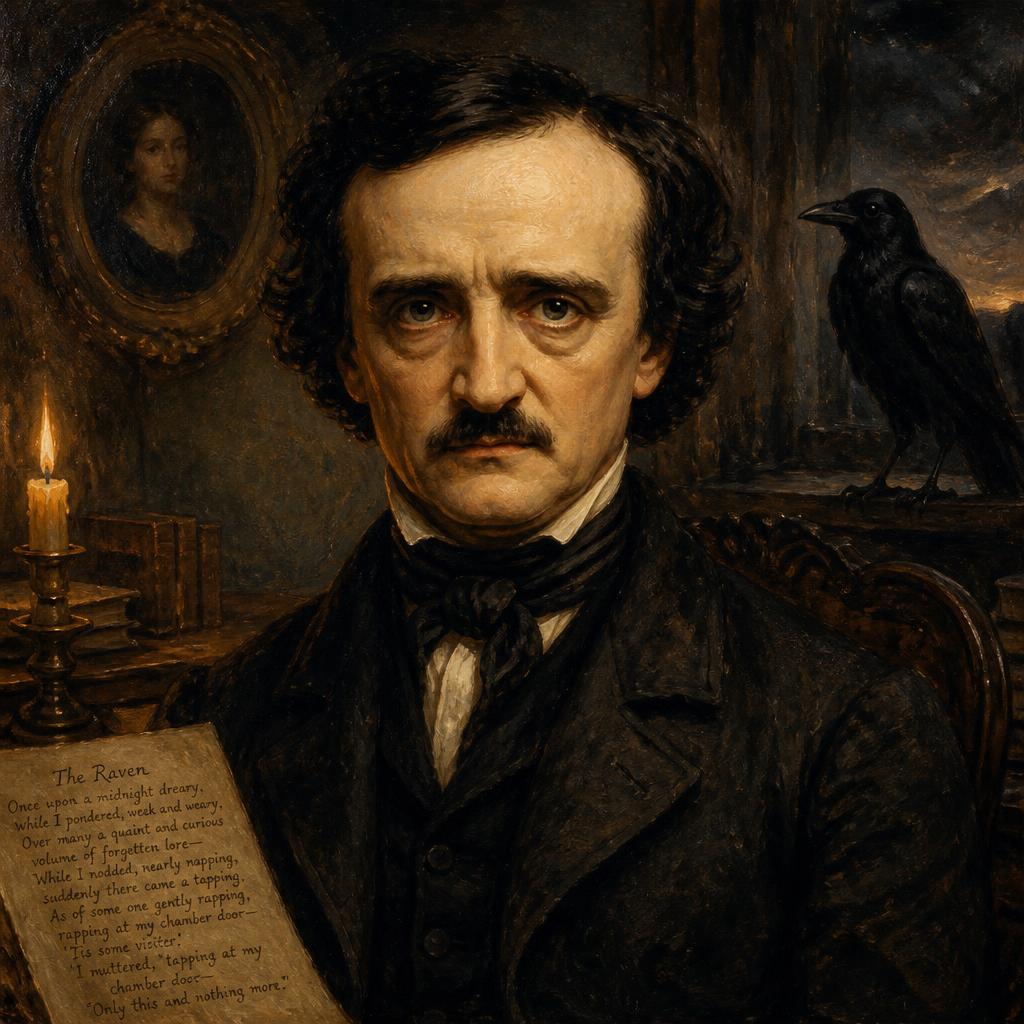
Quick Facts
- Years
- 1809 – 1849
- Category
- Writers & Poets
- Subcategory
- Poets
- Nationality
- American
- Occupation
- Poet & Short Story Writer
Edgar Allan Poe
1809 – 1849 · American · Poet & Short Story Writer
Audiobook

Life Lessons from Edgar Allan Poe
Marcus Alden · 48 min
Edgar Allan Poe was an American poet, short-story writer, critic, and editor whose work helped transform modern literature. Best known for tales of psychological terror and poems of grief, Poe brought unusual precision to subjects such as guilt, madness, premature burial, lost love, and death. His most celebrated writings include “The Raven,” “The Tell-Tale Heart,” “The Fall of the House of Usher,” “The Black Cat,” and “The Cask of Amontillado.”
Poe was also an important literary theorist. He argued that short works should be designed to produce a unified emotional effect, an idea that influenced later practitioners of the short story. With “The Murders in the Rue Morgue,” he established many conventions of detective fiction decades before Sherlock Holmes. His stories also contributed to science fiction, cryptography writing, and modern horror.
His professional life was far less secure than his later reputation suggests. Poe moved among magazines, struggled with poverty, quarreled with literary rivals, and repeatedly sought an independent journal. His marriage to Virginia Clemm ended with her early death, deepening themes already central to his poetry. Poe himself died in Baltimore in 1849 under circumstances that remain uncertain. He is still studied for his command of language, pioneering genres, provocative criticism, and immense international influence.
Quick Facts
| Field | Information |
|---|---|
| Full Name | Edgar Poe |
| Common Name(s) | Edgar Allan Poe; Edgar A. Poe |
| Born | January 19, 1809 |
| Died | October 7, 1849 |
| Age at Death | 40 |
| Birthplace | Boston, Massachusetts, United States |
| Nationality | American |
| Occupation | Poet, short-story writer, literary critic, editor |
| Historical Era | Antebellum America; American Romanticism |
| Famous For | Gothic fiction, “The Raven,” detective fiction, literary criticism |
| Political Affiliation | No sustained formal affiliation clearly documented |
| Religion | Raised in an Episcopalian household; mature beliefs remain debated |
| Education | University of Virginia; United States Military Academy, neither completed |
| Parents | David Poe Jr. and Elizabeth Arnold Hopkins Poe |
| Foster Parents | John and Frances Allan, who never formally adopted him |
| Spouse(s) | Virginia Eliza Clemm Poe, married 1836–1847 |
| Children | None |
| Major Works | “The Raven,” “The Tell-Tale Heart,” “The Fall of the House of Usher,” “The Murders in the Rue Morgue,” “The Black Cat,” “The Cask of Amontillado,” “Annabel Lee,” The Narrative of Arthur Gordon Pym of Nantucket |
| Major Achievements | Pioneer of detective fiction; major innovator in the short story, horror, criticism, and early science fiction |
Early Life
Edgar Poe was born in Boston to actors David Poe Jr. and Elizabeth Arnold Hopkins Poe. His father disappeared from the family record while Edgar was very young, and his mother died in Richmond, Virginia, in December 1811. Edgar was separated from his brother William Henry Leonard and sister Rosalie and taken into the household of Richmond merchant John Allan and Allan’s wife, Frances.
The Allans gave Poe their surname in common usage, but they did not legally adopt him. John Allan traded in tobacco and other goods and could be affectionate, severe, or financially withholding. Frances Allan offered steadier warmth. This unstable relationship—privilege without secure belonging—shaped Poe’s youth and later conflicts over money and status.
From 1815 to 1820, Poe lived with the Allans in Britain. He attended schools in Scotland and England, including the Manor House School at Stoke Newington. These years exposed him to classical instruction, British poetry, old architecture, and landscapes later associated with Gothic atmosphere. After returning to Richmond, he studied languages and literature and showed skill in athletics and verse.
Poe entered the University of Virginia in 1826. He performed well academically, especially in ancient and modern languages, but accumulated gambling and other debts. How much support John Allan had promised remains disputed; what is clear is that Poe lacked enough money to remain comfortably enrolled. He left after one year. His youthful attachment to Sarah Elmira Royster also ended when her family discouraged the relationship and she married another man.
Rise to Prominence
Estranged from Allan, Poe went to Boston and published Tamerlane and Other Poems in 1827 under the name “A Bostonian.” Few copies appeared, and the book attracted little notice. Short of money, he enlisted in the U.S. Army as “Edgar A. Perry.” He served capably, became a sergeant major, and revealed his identity when seeking discharge and reconciliation with Allan.
After Frances Allan died in 1829, Poe published Al Aaraaf, Tamerlane, and Minor Poems. He entered West Point in 1830 but soon sought release. When Allan refused to assist, Poe deliberately neglected duties and was court-martialed and dismissed in 1831. A new poetry volume followed, supported by subscriptions from cadets.
Poe then turned toward fiction, partly because magazines offered better prospects than poetry. Living in Baltimore with his aunt Maria Clemm and her daughter Virginia, he won a prize from the Baltimore Saturday Visiter in 1833 for “MS. Found in a Bottle.” Judge John Pendleton Kennedy recognized his talent and helped him contact Thomas W. White of Richmond’s Southern Literary Messenger.
As an editor and critic at the Messenger, Poe increased his visibility through fiction, reviews, and often severe judgments. Circulation grew substantially during his association with the magazine, though the precise degree of his responsibility is debated. His career thereafter took him to Philadelphia and New York, where he worked for journals including Burton’s Gentleman’s Magazine, Graham’s Magazine, and the Broadway Journal.
“The Raven,” published in January 1845, made Poe nationally famous. Its refrain, sound patterning, supernatural atmosphere, and portrait of inconsolable grief invited recitation and parody. Fame did not bring lasting financial security, however. Poe continued to depend on editorial work, lectures, and small publication payments.
Major Achievements
Establishing Detective Fiction
“The Murders in the Rue Morgue,” published in 1841, introduced C. Auguste Dupin, an analytical amateur who solves an apparently impossible crime. Poe followed it with “The Mystery of Marie Rogêt” and “The Purloined Letter.”
These stories established durable conventions: the brilliant detective, less perceptive companion-narrator, baffled police, hidden clue, and rational reconstruction. Arthur Conan Doyle openly acknowledged Poe’s foundational importance. Modern detective novels, mystery films, and forensic dramas still employ structures he helped define.
Advancing the Modern Short Story
Poe did not invent short prose fiction, but he gave the form a powerful theory. In his review of Nathaniel Hawthorne’s tales, he argued that a work readable in one sitting could create a “unity of effect.” Every incident and sentence should contribute to a predetermined impression.
This emphasis on concentration, design, and emotional control influenced later short-story writers. It also helps explain the economy of “The Tell-Tale Heart” and “The Cask of Amontillado,” in which perspective, setting, and rhythm serve a single mounting effect.
Transforming Gothic and Psychological Horror
Poe adapted Gothic conventions—decaying houses, confinement, disease, burial, doubles, and unreliable narrators—to investigate the mind. His terror often arises not from an external monster but from obsession, guilt, compulsion, or unstable perception.
“The Fall of the House of Usher,” “The Black Cat,” and “The Tell-Tale Heart” became models for psychological horror. Their legacy extends through writers such as H. P. Lovecraft and filmmakers interested in subjective fear.
Creating an Enduring Poetic Masterpiece
“The Raven” turned private grief into a carefully staged dramatic encounter between a bereaved student and a mysterious bird. Its internal rhyme, trochaic rhythm, repeated sounds, and refrain made it memorable to mass audiences.
The poem established Poe as a public literary figure and remains one of the best-known American poems. It influenced popular culture, music, illustration, theater, and the public image of Poe himself.
Contributing to Early Science Fiction and Cosmological Writing
Poe used contemporary science, speculative travel, ballooning, mesmerism, and astronomy in works such as “The Unparalleled Adventure of One Hans Pfaall,” “The Balloon-Hoax,” and The Narrative of Arthur Gordon Pym. His 1848 prose poem Eureka proposed an expanding and contracting universe from an original unity.
Eureka is not modern scientific theory and contains errors, but it demonstrates Poe’s ambition to connect imagination with cosmology. Later writers, especially Jules Verne, responded to his speculative fiction.
Becoming a Formidable Literary Critic
Poe reviewed widely and demanded technical discipline from American writers. He attacked imitation, inflated reputation, moralizing, and careless construction. His sharpness earned him the nickname “tomahawk man.”
Although personal rivalry sometimes affected his criticism, he helped make reviewing a serious professional activity. His essays “The Philosophy of Composition” and “The Poetic Principle” remain central to debates over artistic method, beauty, length, and authorial intention.
Leadership and Work
Poe held no major public office, so his leadership appeared chiefly in editorial rooms and literary debate. He was ambitious, exacting, and strongly committed to professional standards. At magazines, he selected material, wrote reviews, corrected prose, and supplied fiction and poetry under tight deadlines.
His method favored deliberate construction. He claimed that an author should decide the intended effect before choosing incidents and tone. Scholars often treat his account of writing “The Raven” in “The Philosophy of Composition” cautiously: it may be partly a theoretical demonstration rather than a literal diary of composition.
Poe’s strengths included analytical power, ear for rhythm, command of suspense, and willingness to challenge fashionable reputations. His weaknesses included volatility, public attacks, damaged professional relationships, and difficulty sustaining stable employment. He dreamed of founding his own journal—first called The Penn and later The Stylus—which would be independent, rigorous, and nationally influential. He never secured enough capital to launch it.
His relationship with editors was mixed. John Pendleton Kennedy and George Rex Graham assisted him, while Poe criticized Graham after leaving his magazine. With Rufus Wilmot Griswold, literary competition became lasting hostility. Poe’s working life reveals both the possibilities and precariousness of authorship in a rapidly expanding but poorly paid magazine culture.
Personal Life
Poe married his cousin Virginia Eliza Clemm in Richmond in 1836. She was 13 and he was 27; the marriage bond listed her age as 21. Such a marriage was legal at the time but remains troubling to modern readers. Surviving accounts depict a close household centered on Poe, Virginia, and her mother Maria Clemm, whom Poe affectionately called “Muddy.” They had no children.
Virginia showed signs of tuberculosis in 1842 and died in January 1847 at their cottage in Fordham, then outside New York City. Her prolonged illness and death severely affected Poe. The repeated figure of the beautiful dead or dying woman predated Virginia’s death, but her suffering intensified the personal force of his later life and work.
Poe maintained friendships and literary relationships with figures including John Pendleton Kennedy, Frederick W. Thomas, Frances Sargent Osgood, and Sarah Helen Whitman. Some relationships became entangled in gossip. His public exchange of poems with Osgood contributed to conflict with Elizabeth F. Ellet and others.
Evidence shows that alcohol sometimes caused Poe serious problems, though claims that he was continuously intoxicated or habitually addicted to opium are unsupported or disputed. Contemporary testimony is contradictory and often partisan. His health was fragile, especially after Virginia’s illness and death.
In 1849 Poe renewed contact with his widowed childhood sweetheart Sarah Elmira Royster Shelton in Richmond. They may have intended to marry, but surviving evidence does not establish every detail of an engagement.
Philosophy and Beliefs
Poe resisted the idea that poetry’s primary duty was moral instruction. In “The Poetic Principle,” he argued against what he called the “heresy of The Didactic,” maintaining that poetry should pursue beauty and elevate the soul rather than function as a sermon.
His aesthetic thought emphasized unity, brevity, musicality, and controlled emotional effect. Beauty, melancholy, and loss were closely connected in his theory, although readers should not assume that every fictional statement represents his personal belief.
Poe was skeptical of literary nationalism when it excused mediocre writing. He wanted American literature judged by high standards rather than praised merely for being American. Politically, he left no coherent party program. Some writings reflect prejudices and racial assumptions common in antebellum America, and scholars continue to debate his position within the slaveholding culture of Virginia and the national politics of his era.
His religious outlook is also uncertain. He used biblical imagery and was raised in an Episcopalian environment, yet his fiction often dramatizes doubt, judgment, and the unknowable. Eureka presents a metaphysical universe governed by unity and divine creation, but it does not fit neatly into orthodox theology.
Challenges and Controversies
Poverty was Poe’s most persistent obstacle. American copyright protections were weak, magazines paid modestly, and imported British writing could be reprinted cheaply. Yet his financial difficulties also reflected unstable employment, debts, and fractured relationships.
His drinking has generated competing portraits. Some acquaintances reported extreme sensitivity to alcohol and episodes of incapacity. Others, especially defenders, argued that hostile biographers exaggerated the problem. The safest conclusion is that alcohol periodically harmed his health and career, while the stereotype of a permanently drunken writer is misleading.
Poe’s criticism could be insightful but also aggressive. His campaign against Henry Wadsworth Longfellow over alleged plagiarism became known as the “Longfellow War.” Admirers view Poe as resisting literary complacency; critics see self-promotion and personal hostility.
His relationship with Rufus Wilmot Griswold proved especially consequential. After Poe’s death, Griswold published a hostile obituary under the name “Ludwig” and later an influential memoir portraying Poe as morally depraved and chronically unstable. Griswold used some authentic documents but distorted the record, made unsupported claims, and shaped Poe’s reputation for decades.
Poe’s death remains unresolved. He was found in distress in Baltimore on October 3, 1849, wearing clothes reportedly not his own, and died four days later at Washington College Hospital. Medical records and his death certificate have not survived. Proposed causes include illness, alcohol-related complications, trauma, and the election fraud practice called “cooping,” but no theory has been proved. Accounts of his final words also vary and should not be treated as certain.
Legacy
Poe’s reputation became international partly through French translations and advocacy by Charles Baudelaire, Stéphane Mallarmé, and others. In France, he was treated as a major theorist and symbol of the modern artist. His influence then returned to English-language literature through Symbolism, Decadence, detective fiction, and psychological horror.
Arthur Conan Doyle credited Poe’s Dupin stories as a foundation of detective literature. Jules Verne wrote a sequel to Arthur Gordon Pym. H. P. Lovecraft regarded Poe as a central master of weird fiction. Later writers, filmmakers, musicians, artists, and game designers repeatedly adapted his settings and themes.
Important Poe sites include the Edgar Allan Poe National Historic Site in Philadelphia; the Poe Museum in Richmond; the Edgar Allan Poe House and Museum in Baltimore; and Poe Cottage in the Bronx. His grave at Westminster Hall and Burying Ground in Baltimore is a major memorial site. Statues and plaques stand in Boston, Baltimore, Richmond, and elsewhere.
The Mystery Writers of America named its Edgar Awards after him. The Baltimore Ravens football team took its name from his poem. Poe remains relevant because his work asks enduring questions about unreliable perception, self-deception, grief, violence, and the boundary between reason and irrationality.
Interesting Facts
- Poe was born Edgar Poe; “Allan” came from his foster family.
- His first book was credited only to “A Bostonian.”
- He enlisted in the Army under the name Edgar A. Perry.
- He rose to the enlisted rank of sergeant major.
- West Point dismissed him after a court-martial for neglecting duties and disobeying orders.
- “MS. Found in a Bottle” won a $50 literary prize in 1833.
- He married Virginia Clemm, his first cousin.
- He wrote the only complete novel published during his lifetime, Arthur Gordon Pym.
- C. Auguste Dupin appeared before Sherlock Holmes by more than four decades.
- “The Balloon-Hoax” was printed as a newspaper report in 1844.
- “The Raven” brought fame but did not make Poe wealthy.
- He repeatedly tried to establish a magazine called The Stylus.
- He was an enthusiastic analyst of codes and cryptograms.
- French poet Charles Baudelaire became one of his greatest early champions.
- The cause of Poe’s death is unknown.
- His present Baltimore monument was dedicated in 1875.
- An anonymous “Poe Toaster” left cognac and roses at his grave for decades.
- The Baltimore Ravens are named for Poe’s poem.
Famous Quotes
- “Once upon a midnight dreary, while I pondered, weak and weary” — Opening of “The Raven” (1845). It establishes fatigue, isolation, and musical gloom.
- “Quoth the Raven ‘Nevermore.’” — “The Raven.” The repeated answer turns grief into an inescapable mental refrain.
- “All that we see or seem / Is but a dream within a dream.” — “A Dream Within a Dream” (1849). Poe questions whether experience and loss can be securely grasped.
- “The boundaries which divide Life from Death are at best shadowy and vague.” — “The Premature Burial” (1844). The line captures his fascination with uncertain states of consciousness.
- “I became insane, with long intervals of horrible sanity.” — Letter to George W. Eveleth, January 4, 1848. Poe described his response to Virginia’s illness and defended his conduct.
- “There is no exquisite beauty…without some strangeness in the proportion.” — “Ligeia” (1838). The narrator associates beauty with irregularity; it should not automatically be read as Poe’s complete aesthetic creed.
- “The death, then, of a beautiful woman is, unquestionably, the most poetical topic in the world.” — “The Philosophy of Composition” (1846). This controversial theoretical claim explains a recurring literary device, not an ethical endorsement of death.
- “A short story is not a short story” — Often attributed to Poe, but disputed and not traceable to his authenticated writings.
- “I was never really insane except upon occasions when my heart was touched.” — Commonly attributed to Poe, but its documentary basis is uncertain and it should not be quoted as securely authenticated.
- “Deep into that darkness peering, long I stood there wondering, fearing” — “The Raven.” The line demonstrates Poe’s use of sound to enact psychological suspense.
Timeline
- 1809 — Born in Boston on January 19.
- 1811 — Mother dies; Edgar enters John and Frances Allan’s household.
- 1815–1820 — Lives and studies in Britain.
- 1826 — Attends the University of Virginia; leaves after one year.
- 1827 — Publishes Tamerlane and Other Poems; enlists in the Army.
- 1829 — Frances Allan dies; Poe publishes Al Aaraaf, Tamerlane, and Minor Poems.
- 1830 — Enters West Point.
- 1831 — Court-martialed and dismissed; publishes Poems.
- 1833 — Wins a prize for “MS. Found in a Bottle.”
- 1835 — Joins the Southern Literary Messenger in Richmond.
- 1836 — Marries Virginia Clemm.
- 1838 — Publishes The Narrative of Arthur Gordon Pym and “Ligeia.”
- 1839 — Publishes “The Fall of the House of Usher” and Tales of the Grotesque and Arabesque.
- 1841 — Publishes “The Murders in the Rue Morgue.”
- 1842 — Virginia develops tuberculosis symptoms; “The Masque of the Red Death” appears.
- 1843 — Publishes “The Tell-Tale Heart” and “The Black Cat”; wins a prize for “The Gold-Bug.”
- 1844 — Moves to New York; publishes “The Balloon-Hoax.”
- 1845 — Publishes “The Raven”; becomes associated with the Broadway Journal.
- 1846 — Publishes “The Philosophy of Composition” and “The Cask of Amontillado.”
- 1847 — Virginia dies at Fordham.
- 1848 — Publishes and lectures on Eureka; courts Sarah Helen Whitman.
- 1849 — Publishes “Annabel Lee” posthumously after circulating it before death; reconnects with Sarah Elmira Royster Shelton; found ill in Baltimore and dies October 7.
- 1875 — A new monument is dedicated over his Baltimore grave.
Frequently Asked Questions
Who was Edgar Allan Poe?
Edgar Allan Poe was an American writer, poet, editor, and critic active during the first half of the nineteenth century. He became famous for tightly constructed tales of terror, poems about mourning and beauty, and a confrontational style of literary criticism. He also created C. Auguste Dupin, a model for later fictional detectives. Although Poe struggled financially and died at 40, his work became central to horror, detective fiction, the short story, and literary theory.
What is Edgar Allan Poe most famous for?
Poe is most famous for “The Raven,” a narrative poem in which a grieving speaker questions a mysterious bird whose only answer is “Nevermore.” He is also widely known for “The Tell-Tale Heart,” “The Black Cat,” “The Fall of the House of Usher,” and “The Cask of Amontillado.” Beyond individual works, his greatest historical importance may be his role in developing detective fiction and defining the short story as a concentrated artistic form.
Did Edgar Allan Poe invent detective fiction?
Poe did not create every element of mystery writing, but historians commonly credit him with establishing modern detective fiction. “The Murders in the Rue Morgue” introduced an eccentric analytical investigator, a companion-narrator, an apparently insoluble crime, inadequate police, and a final explanation. Its sequels strengthened this pattern. Arthur Conan Doyle later stated that Poe’s detective stories provided a root from which the broader literature developed.
Why did Poe use the name Allan?
After his mother died, Poe was raised by John and Frances Allan of Richmond. He was never formally adopted, but he used Allan as a middle name. His relationship with John Allan deteriorated over debts, money, discipline, and expectations of inheritance. Allan ultimately left Poe out of his will. The name therefore reflects both Poe’s upbringing in the household and a painful, unresolved family relationship.
Was Poe expelled from West Point?
Poe was dismissed after a court-martial in 1831. He had entered the United States Military Academy with John Allan’s assistance but soon wanted to leave. Because resignation required consent that Allan would not provide, Poe deliberately stopped attending formations and classes. He pleaded not guilty to some charges but was found guilty of gross neglect of duty and disobedience of orders. Cadet subscriptions then helped finance his 1831 poetry volume.
How old was Virginia Clemm when Poe married her?
Virginia was 13 when she and Poe, then 27, married in Richmond in May 1836. She was his first cousin, and the marriage document overstated her age as 21. The union was legal under contemporary Virginia law, but modern readers appropriately examine its age imbalance critically. Surviving evidence indicates an affectionate household shared with Virginia’s mother, Maria Clemm, though the private nature of the marriage cannot be completely reconstructed.
Did Edgar Allan Poe have children?
No children of Edgar and Virginia Poe are recorded. Their household included Virginia’s mother, Maria Clemm, who managed domestic affairs and supported Poe through periods of illness and poverty. Poe addressed Maria as “Muddy” and relied heavily on her. After Virginia’s death, Maria continued to defend his memory and correspond with people interested in his life and work.
Was Poe addicted to alcohol or opium?
Evidence supports episodes in which alcohol seriously affected Poe, perhaps in unusually small quantities. It does not support the simplistic image of uninterrupted drunkenness. Claims of habitual opium addiction are even less secure; his fiction’s drug references and hostile testimony are insufficient proof. Biographers must weigh contradictory witnesses, including friends, rivals, and Griswold’s damaging account. The most responsible conclusion is that substance use was a real but frequently exaggerated part of Poe’s difficulties.
How did Edgar Allan Poe die?
The cause is unknown. Poe was found confused and physically distressed in Baltimore on October 3, 1849, and taken to Washington College Hospital, where he died on October 7. No reliable medical chart or death certificate survives. Theories include disease, alcohol-related illness, trauma, and election “cooping.” None explains all evidence, and later reports conflict. Claims that his final words were “Lord help my poor soul” come from later testimony and cannot be verified conclusively.
Was Poe poor despite writing “The Raven”?
Yes. “The Raven” made Poe famous but did not provide long-term wealth. Payments to nineteenth-century magazine writers were often small, and copyright arrangements offered limited protection. Poe earned money through editing, reviews, lectures, and publication fees, yet illness and unstable jobs repeatedly undermined the household. The exact payment for the poem is debated in retellings, but there is no doubt that its enormous cultural success greatly exceeded Poe’s financial reward.
What did Poe mean by “unity of effect”?
Poe believed an author should choose a desired emotional impression before composing and then make every element contribute to it. Short fiction was especially suited to this method because readers could finish it in one sitting without worldly interruptions weakening the experience. Setting, plot, point of view, imagery, and sentence rhythm should all reinforce the intended effect. This theory helped elevate the short story from casual entertainment to a deliberately engineered literary form.
Is “The Tell-Tale Heart” based on a true story?
No specific real crime has been conclusively established as its source. Poe drew on contemporary interests in insanity defenses, criminal confession, sensation journalism, and psychological medicine. The story’s power comes from its unreliable narrator, who insists on sanity while describing obsessive surveillance and murder. Historical cases may have provided general inspiration, but claims that one documented incident is the definitive source usually exceed the surviving evidence.
Why is “The Raven” important?
“The Raven” combines accessible storytelling with extraordinary formal control. Its refrain, internal rhymes, repeated consonants, and driving meter create an incantatory quality suited to public recitation. The poem also dramatizes how grief can become self-torment: the speaker asks questions despite knowing that the bird cannot offer genuine wisdom. Its immediate popularity made Poe nationally recognizable and helped create his enduring public identity as a poet of darkness and mourning.
What was Poe’s only novel?
The Narrative of Arthur Gordon Pym of Nantucket, published in 1838, was Poe’s only completed novel. It follows a young seafarer through mutiny, shipwreck, starvation, rescue, and a strange Antarctic journey. Its abrupt, enigmatic ending has inspired extensive interpretation and later continuations. The book influenced Herman Melville, Jules Verne, and other writers of maritime adventure and speculative fiction, although the degree of particular influence varies by scholar.
Did Poe write science fiction?
Several Poe works are recognized as important precursors of science fiction. He combined speculative technology or scientific ideas with adventure in “Hans Pfaall,” “The Balloon-Hoax,” and Arthur Gordon Pym. “The Facts in the Case of M. Valdemar” used mesmerism in a deliberately documentary style. Eureka went further by proposing a cosmological vision. These writings mingle fact, hoax, and imagination rather than following modern genre boundaries.
What was Poe’s relationship with Charles Dickens?
Poe met Charles Dickens in Philadelphia in 1842. They discussed literary matters, and Poe asked Dickens to help find an English publisher. Dickens made inquiries but secured no decisive result. Poe had previously written perceptively about the serialized mystery in Dickens’s Barnaby Rudge, correctly anticipating important plot elements. The two authors were not close friends, but their meeting illustrates Poe’s desire for international publication and recognition.
Why did Rufus Griswold damage Poe’s reputation?
Griswold and Poe had a complicated professional rivalry. After Poe’s death, Griswold published an obituary depicting him as envious, arrogant, and depraved, then expanded that portrait in a memoir attached to editions of Poe’s work. Some documents were genuine, but Griswold used distortions and unsupported accusations. Ironically, his editions helped keep Poe in print while establishing a sensational biography that later scholars had to correct.
Where is Edgar Allan Poe buried?
Poe is buried at Westminster Hall and Burying Ground in Baltimore, Maryland. He was initially placed in an unmarked family plot. Fundraising later produced a prominent monument, dedicated in 1875, and his remains were transferred to the more visible site near the cemetery entrance. Virginia Poe’s remains were eventually placed there as well. The grave became associated with the mysterious Poe Toaster tradition of roses and cognac.
Lessons We Can Learn
- Master form, not only ideas. Poe coordinated sound, structure, and viewpoint in “The Raven.” Today, strong execution still determines whether an idea reaches an audience.
- Design for a clear effect. His short-story theory began with the reader’s intended experience. Modern communicators likewise benefit from defining purpose before choosing details.
- Innovate by combining traditions. Poe joined Gothic atmosphere to analytical reasoning, helping create detective fiction. New genres often emerge from unexpected combinations.
- Financial success does not automatically follow fame. “The Raven” brought celebrity, not security. Creators need sustainable contracts and business planning.
- Criticism requires fairness. Poe’s standards strengthened literary culture, but personal attacks damaged relationships. Honest evaluation is most useful when separated from rivalry.
- Protect professional relationships. Repeated disputes narrowed Poe’s opportunities. Talent matters, but trust and collaboration also shape a career.
- Question powerful myths. Griswold’s portrait dominated for decades. Historical claims should be tested against provenance, motive, and competing evidence.
- Adversity can deepen art without excusing harm. Bereavement informed Poe’s writing, but suffering should not be romanticized as necessary for creativity.
- Experiment across disciplines. Poe explored poetry, fiction, cryptography, journalism, and cosmology. Intellectual range can generate lasting innovations.
- Accept uncertainty honestly. The circumstances of his death remain unknown. Responsible history distinguishes evidence from attractive speculation.
Related Historical Figures
- Virginia Eliza Clemm Poe — Poe’s wife and first cousin; her illness and death profoundly affected his personal life.
- Maria Clemm — Virginia’s mother and Poe’s aunt, household manager, supporter, and defender.
- John Allan — Poe’s foster father; their troubled financial and emotional relationship shaped his youth.
- Frances Allan — Poe’s foster mother, who provided affection and stability during childhood.
- John Pendleton Kennedy — Writer and judge who recognized Poe’s talent and assisted his early career.
- Thomas W. White — Proprietor of the Southern Literary Messenger, where Poe became a prominent critic and editor.
- Rufus Wilmot Griswold — Editor, rival, and posthumous biographer whose hostile account distorted Poe’s reputation.
- Charles Baudelaire — French poet and translator who secured Poe’s major European reputation.
- Arthur Conan Doyle — Creator of Sherlock Holmes, who acknowledged Poe’s foundational detective stories.
- Nathaniel Hawthorne — American short-story writer whose tales prompted Poe’s influential statements about unity of effect.
Watch and Learn
Edgar Allan Poe - Writer | Mini Bio | BIO · Biography
Related Historical Figures