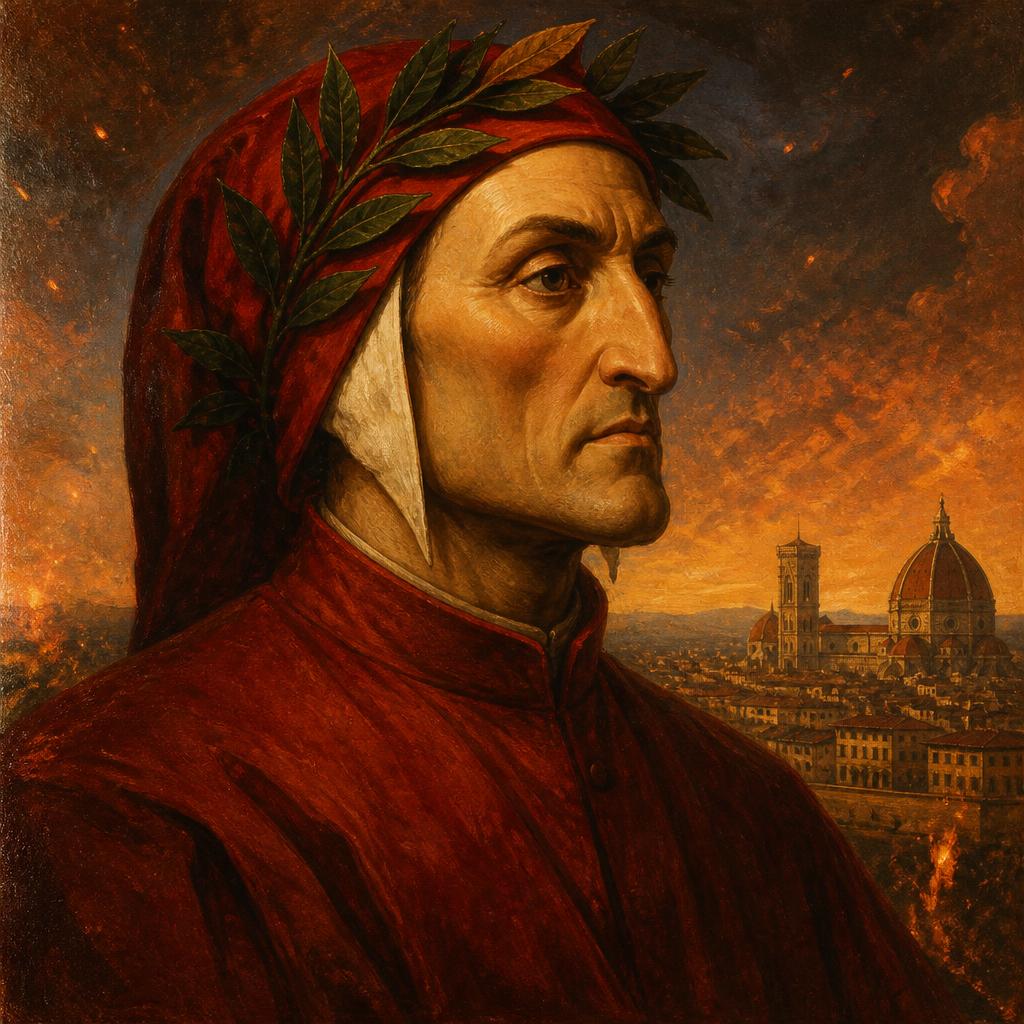
Quick Facts
- Years
- 1265 – 1321
- Category
- Writers & Poets
- Subcategory
- Poets
- Nationality
- Italian
- Occupation
- Poet
Dante Alighieri
1265 – 1321 · Italian · Poet
Audiobook

Life Lessons from Dante Alighieri
Marcus Alden · 48 min
Dante Alighieri was a Florentine poet, political thinker, and prose writer whose Commedia—later called the Divine Comedy—became one of world literature’s defining works. Born in 1265, he lived amid the violent factional politics of medieval Florence. His participation in public affairs ended in exile, but that personal disaster created the conditions under which he wrote his greatest poetry.
The Divine Comedy follows an imagined journey through Hell, Purgatory, and Paradise. It combines Christian theology, classical learning, political criticism, moral philosophy, autobiography, and vivid observation. Dante wrote the poem in the Tuscan vernacular rather than Latin, demonstrating that an everyday language could carry ambitious intellectual and artistic expression. His influence helped establish Tuscan as the leading literary basis of modern Italian.
Dante also produced lyric poetry and major works on language, politics, philosophy, and love. Beatrice, a Florentine woman whom he idealized in his writing, became central to his poetic and spiritual imagination. Exile sharpened his criticism of Florence, the papacy, and rulers who placed private interest above justice.
More than seven centuries after his death, Dante remains important to literature, theology, political thought, visual art, music, and popular culture. Readers still study him because his works confront enduring questions about responsibility, corruption, freedom, grief, knowledge, and humanity’s search for moral order.
Quick Facts
| Field | Information |
|---|---|
| Full Name | Durante degli Alighieri, traditionally understood as his formal name; documentary usage varies |
| Common Name(s) | Dante; Dante Alighieri |
| Born | Traditionally May or June 1265; exact date not recorded |
| Died | Night of 13–14 September 1321 |
| Age at Death | About 56 |
| Birthplace | Florence, Republic of Florence |
| Nationality | Florentine; conventionally described as Italian, though Italy was not yet a unified state |
| Occupation | Poet, prose writer, political thinker, public official, diplomat |
| Historical Era | Late Middle Ages |
| Famous For | The Divine Comedy; advancing literary Italian |
| Political Affiliation | Florentine Guelf; later associated with the White Guelfs |
| Religion | Roman Catholic Christianity |
| Education | No university attendance securely documented; educated in grammar, rhetoric, philosophy, theology, and literature through Florentine intellectual circles |
| Parents | Alighiero di Bellincione and Bella, whose family identity is uncertain |
| Spouse(s) | Gemma Donati |
| Children | Pietro, Jacopo, Antonia, and possibly Giovanni; Giovanni’s status is debated |
| Major Works | Vita nuova, Divine Comedy, Convivio, De vulgari eloquentia, Monarchia, Rime, Epistles, Eclogues, Quaestio de aqua et terra |
| Major Achievements | Created a landmark of world literature; elevated the vernacular; shaped Italian language and culture; developed influential political and literary ideas |
Early Life
Dante was born in Florence in 1265, probably between late May and late June. His own statements place his birth under Gemini, but no contemporary birth record supplies an exact day. Florence was a wealthy, expanding commune divided by bitter political rivalries.
His father, Alighiero di Bellincione, belonged to a family of respectable but not aristocratically powerful standing. Dante’s mother, Bella, died while he was young. His father later married Lapa di Chiarissimo Cialuffi. Dante had half-siblings, including Francesco and Tana.
Little documentation survives about his childhood or formal schooling. He almost certainly learned Latin grammar and rhetoric, encountered classical authors, and later studied philosophy and theology. Brunetto Latini, a Florentine statesman and writer, was an important intellectual model, though the common claim that he was Dante’s formal teacher is not securely documented.
Dante later wrote that he first saw Beatrice when both were children. Scholars usually identify her as Bice, daughter of Folco Portinari and wife of Simone de’ Bardi, but the identification is probable rather than absolutely certain. In Dante’s poetry, Beatrice is both a remembered Florentine woman and an increasingly complex literary and theological figure.
The young Dante entered the culture of Tuscan lyric poetry. He learned from Provençal troubadours, Sicilian poets, classical writers, and contemporaries such as Guido Cavalcanti. He became associated with the dolce stil novo, or “sweet new style,” which treated love through refined language and philosophical introspection.
He also experienced war. In 1289 he fought at the Battle of Campaldino, where Florentine Guelf forces defeated Ghibelline Arezzo. He may also have taken part in the subsequent campaign against Pisa, including operations around Caprona.
Rise to Prominence
Dante first became known as a lyric poet. His early poems circulated among educated readers, often as part of exchanges in which poets posed and answered questions about love. His friendship with Guido Cavalcanti was especially important to his artistic development.
Around 1292–1295, Dante assembled the Vita nuova (“New Life”), mixing prose commentary with poems. The work narrates his transformed life through love for Beatrice, her death in 1290, and his effort to understand that loss. It was innovative in linking individual lyrics into an interpreted spiritual autobiography.
Public life then became increasingly important. Florence’s Ordinances of Justice restricted political office to members of recognized guilds. Dante enrolled in the physicians’ and apothecaries’ guild, which also accommodated intellectual and book-related occupations. He served on councils, undertook diplomatic responsibilities, and became one of Florence’s six priors for the term from 15 June to 15 August 1300.
The city’s Guelf ruling class had split into White and Black factions. Dante aligned with the Whites, who resisted excessive papal intervention in Florentine affairs. During his priorate, leaders from both groups—including Cavalcanti—were banished in an attempt to control violence. The decision illustrates both Dante’s willingness to place civic policy above friendship and the limited effectiveness of factional compromise.
In 1301 Dante was probably part of an embassy to Pope Boniface VIII. While he was away, Charles of Valois entered Florence with papal support, and the Black Guelfs seized power. In January 1302 Dante was condemned on charges including corruption and opposition to the pope. He denied the legitimacy of the proceedings. When he did not appear or pay the fine, a second sentence threatened execution by burning if he returned.
Exile was the decisive turning point of his life. He initially cooperated with other White exiles but later distanced himself from their strategies. Moving among courts and patrons in northern and central Italy, he expanded his intellectual ambitions and composed the works that made him internationally famous.
Major Achievements
Transforming the Vernacular into a Literary Language
Dante wrote his greatest poem in a Tuscan vernacular at a time when Latin remained the principal language of theology, scholarship, and much official writing. In De vulgari eloquentia, composed in Latin, he examined Italian speech varieties and sought an illustrious vernacular suitable for elevated poetry.
This mattered because it challenged assumptions about which languages could express philosophy and theology. Dante did not single-handedly create Italian, but the authority of his writing—together with Petrarch and Boccaccio—helped make Tuscan foundational to standard literary Italian.
Creating the Divine Comedy
Dante’s supreme achievement was the Commedia, probably written over many years of exile and completed near the end of his life. The adjective “Divine” was attached later; Boccaccio helped popularize it, and it appeared in a printed title in the sixteenth century.
The poem contains 100 cantos: an introductory canto followed by 33 cantos in each of three realms. Its interlocking rhyme scheme, terza rima, moves in chains such as ABA BCB CDC. The fictional journey occurs in Holy Week 1300.
Virgil guides Dante through Hell and most of Purgatory. Beatrice becomes his guide through Paradise, and Bernard of Clairvaux leads the final stage. The work’s moral geography dramatizes how choices shape character and destiny. Its portraits range from popes and emperors to teachers, lovers, soldiers, and ordinary citizens.
Its long-term impact is immense. It influenced writers including Chaucer, Milton, T. S. Eliot, Primo Levi, and Jorge Luis Borges, while inspiring Botticelli, William Blake, Gustave Doré, Auguste Rodin, composers, filmmakers, and game designers.
Uniting Poetry, Theology, and Politics
The Comedy does not merely retell doctrine. It turns ethical and theological questions into encounters with memorable individuals. Dante explores free will, justice, repentance, knowledge, violence, love, and the proper ends of political authority.
He placed recent history beside biblical and classical history, treating Florence’s turmoil as morally significant. This integration gave European literature a model for combining personal experience with universal intellectual claims.
Developing a Theory of Universal Monarchy
In Monarchia, Dante argued that humanity’s temporal peace was best secured by a universal emperor whose authority did not derive from the pope. Spiritual and temporal powers had distinct purposes, although both ultimately existed under God.
The theory reflected medieval imperial ideals rather than modern democracy or nationalism. Nevertheless, its defense of a legitimate secular sphere became important in later discussions of church-state relations and political authority.
Reimagining Literary Autobiography
The Vita nuova organized earlier poems within prose explanations that reinterpret the poet’s emotional development. Beatrice’s death becomes the beginning of a new poetic and spiritual vocation rather than simply a private tragedy.
The book helped establish an influential form in which memory, commentary, poetry, and self-fashioning interact. Its account is literary construction, not a straightforward diary, but precisely that artistry made it foundational.
Leadership and Work
Dante held office only briefly, yet his public record and writings reveal a demanding ideal of leadership. He valued civic order, justice, intellectual competence, and independence from factional pressure. As prior, he accepted the banishment of allies as well as opponents, suggesting a willingness to make painful institutional decisions.
His strengths included analytical ambition, moral seriousness, exceptional memory, and the ability to connect individual conduct with institutional failure. Exile also showed resilience: without a permanent home or stable office, he sustained major projects across poetry, philosophy, linguistics, and politics.
His weaknesses were related to those strengths. Dante’s moral judgments could be severe, personal, and uncompromising. The Comedy grants him poetic authority to condemn enemies and criticize former allies. Readers therefore must distinguish his extraordinary diagnosis of corruption from impartial historical reporting.
Patronage shaped his working life. He depended at various times on hosts such as the Malaspina family, Cangrande della Scala in Verona, and Guido Novello da Polenta in Ravenna. He praised generosity but remained intensely protective of his dignity. In Convivio, he described exile as humiliating dependence on others’ hospitality.
Personal Life
Dante married Gemma Donati, probably in the 1280s; a marriage arrangement had been made when they were young. The couple had at least three securely attested children: Pietro, Jacopo, and Antonia. A Giovanni named in a document may also have been his son, but scholars disagree. Antonia is traditionally identified with Sister Beatrice, a nun in Ravenna.
Gemma does not appear in Dante’s surviving literary works, and there is no firm evidence that she joined him in exile. Her absence from his poetry should not be treated as proof of an unhappy marriage. Medieval marriage and courtly love belonged to different social and literary frameworks.
Dante’s friendship with Guido Cavalcanti was artistically formative but became complicated by politics and intellectual differences. Other important relationships included Cino da Pistoia and patrons encountered during exile.
Descriptions of Dante’s appearance come mostly from later sources. Boccaccio portrayed him as reserved, dignified, and absorbed in study, but such testimony was written decades after Dante’s death and may contain literary shaping. His writings reveal strong attachments, pride, anger at injustice, vulnerability to shame, and sustained fascination with astronomy, music, ethics, language, history, and theology.
No reliable medical history survives. Dante died in Ravenna in 1321 after returning from a diplomatic mission to Venice. Tradition identifies malaria as the cause, but the precise diagnosis cannot be established with certainty.
Philosophy and Beliefs
Dante’s worldview was Christian, sacramental, and deeply shaped by medieval Catholic theology. He believed that human life had a divinely ordered purpose and that freedom made people responsible for their choices. Love was the basic energy of moral life: rightly directed love leads toward God and community, while disordered love produces sin.
He drew on Aristotle, Scripture, Thomas Aquinas, Augustine, Boethius, and many other sources without simply repeating any one thinker. In Paradiso, different theological voices coexist within a larger harmony. This intellectual pluralism is one reason scholars resist labeling him exclusively “Thomist.”
Politically, Dante condemned factionalism because it replaced the common good with family and party interest. He came to support the Holy Roman Empire as a potential source of peace, especially during Emperor Henry VII’s Italian campaign. His imperialism was idealized and proved politically unsuccessful.
Dante criticized corrupt clergy and popes, especially Boniface VIII, while remaining committed to Christianity and the church’s spiritual mission. His criticism was reformist, not a rejection of faith. He distinguished between sacred office and the misconduct of officeholders.
His ethics also emphasized reason. Virgil represents the grandeur—and limits—of natural reason, while Beatrice signifies revealed wisdom, grace, and transformed love. Humanity requires both disciplined understanding and divine assistance.
Challenges and Controversies
Dante’s exile arose from partisan trials conducted after a violent change of government. Black Guelf authorities accused him of financial wrongdoing and political offenses. Many historians view the convictions as politically motivated, though the incomplete record prevents reconstruction of every allegation.
His political strategy failed. The White Guelfs did not regain Florence, and Henry VII’s intervention did not restore just imperial order. Dante’s later writings could project universal theories onto institutions incapable of fulfilling them.
The Comedy is controversial for assigning recognizable people to the afterlife. Its judgments are poetically powerful but reflect Dante’s loyalties, grievances, and medieval assumptions. Some enemies receive unexpected sympathy, while some admired figures are condemned; nevertheless, Dante is both author and interested participant.
Modern readers also confront representations of non-Christian religions, sexual behavior, gender, and punishment that arise from medieval Latin Christian frameworks. The poem can be studied historically without treating all its judgments as timeless ethical conclusions. Its placement of Muhammad among the sowers of division, for example, has rightly prompted discussion of medieval Christian polemic and limited knowledge of Islam.
Dante’s political vocabulary does not align neatly with modern categories. Calling him a nationalist, liberal advocate of church-state separation, or supporter of totalitarian empire can each distort his context. His universal monarchy was intended to secure peace and human flourishing, but its assumptions remain hierarchical.
Questions of authorship and dating persist around some minor works. Most scholars accept Monarchia, the Epistles, and Quaestio de aqua et terra to varying degrees, but particular texts and dates have generated debate. Claims about Dante’s precise travels are also often more confident than surviving evidence permits.
Legacy
Dante was buried in Ravenna, where his tomb remains. Florence repeatedly sought the return of his remains, but Ravenna retained them. Franciscan friars concealed the bones when transfer seemed possible; they were rediscovered in 1865.
His reputation grew quickly. Boccaccio delivered public lectures on the Comedy in Florence and wrote an influential life of Dante. Manuscripts spread widely before printing multiplied the readership. Commentaries began within decades of his death and have never ceased.
Dante’s linguistic influence contributed to his reputation as the “father of the Italian language,” though that title simplifies a collective history involving many speakers and writers. Italy observes Dantedì on 25 March, the conventional date associated with the beginning of the Comedy’s journey.
Major sites include Dante’s tomb and museum in Ravenna; the Museo Casa di Dante in Florence, located in a reconstructed area associated with his family rather than an intact authenticated birthplace; the church of Santa Margherita dei Cerchi; and monuments in Florence, Verona, Ravenna, and elsewhere. The Società Dantesca Italiana, founded in 1888, promotes research and critical editions.
His influence extends through literature, painting, sculpture, opera, film, comics, and digital media. “Inferno” has entered common vocabulary, while the opening image of being lost in a dark wood remains a potent metaphor for moral and psychological crisis.
Interesting Facts
- Dante’s exact birthday is unknown; his reference to Gemini suggests late May or June.
- “Dante” is generally treated as a shortened form of Durante.
- He fought at Campaldino in 1289.
- He belonged to Florence’s guild of physicians and apothecaries.
- His term as prior lasted only two months in 1300.
- He was sentenced in absentia and never returned permanently to Florence.
- The Comedy’s journey is set in the year 1300.
- The poem has 100 cantos.
- Dante developed terza rima, an interlocking three-line rhyme form.
- He called his poem a Commedia, not the Divine Comedy.
- Virgil guides the pilgrim through Hell and most of Purgatory.
- Dante wrote De vulgari eloquentia in Latin to defend vernacular literary language.
- His son Pietro became an early commentator on the Comedy.
- His daughter Antonia is traditionally believed to have become a nun named Beatrice.
- Florence formally annulled Dante’s medieval sentence in a symbolic proceeding in 2008.
- Dante’s bones were hidden by friars and rediscovered in 1865.
- The first illustrated printed edition of the Comedy appeared in 1481 with designs associated with Botticelli.
- Italy’s annual Dante observance, Dantedì, falls on 25 March.
Famous Quotes
Translations differ; citations below identify the original locations.
- “Midway upon the journey of our life, I found myself within a dark wood.” — Inferno I. The opening turns personal confusion into a universal moral crisis.
- “Abandon every hope, you who enter.” — Inferno III, the inscription above Hell’s gate. It marks damnation as the permanent loss of hope.
- “There is no greater sorrow than to recall happiness in times of misery.” — Francesca, Inferno V. The line captures memory’s power while occurring inside a self-justifying account.
- “Consider your origin: you were not made to live as brutes, but to pursue virtue and knowledge.” — Ulysses, Inferno XXVI. The appeal is inspiring yet dangerously manipulative in context.
- “And then we came out to see the stars again.” — Inferno XXXIV. Stars signal release and renewed orientation after Hell.
- “Freedom he seeks, which is so dear, as one who gives his life for it would know.” — Purgatorio I. Virgil describes the pilgrim’s quest as liberation from sin.
- “Love, which excuses no beloved from loving.” — Inferno V. Francesca presents love as irresistible; the poem invites readers to question that evasion of responsibility.
- “You have made yourselves a god of gold and silver.” — Inferno XIX. Dante denounces simony and ecclesiastical greed.
- “The glory of Him who moves all things penetrates the universe.” — Paradiso I. Paradise opens with creation understood as an expression of divine glory.
- “The love that moves the sun and the other stars.” — Paradiso XXXIII. The final line identifies divine love as the source of cosmic and human order.
The popular saying “The hottest places in hell are reserved for those who remain neutral in times of moral crisis” is often attributed to Dante but does not appear in his works. It loosely echoes the neutrals outside Hell in Inferno III and should be marked disputed/spurious.
Timeline
- 1265 — Dante is born in Florence, probably in May or June.
- 1274 — Traditional date of his first childhood encounter with Beatrice, based on Vita nuova.
- About 1277 — A marriage arrangement with Gemma Donati is traditionally dated to this period.
- 1283 — Dante exchanges poetry with Guido Cavalcanti and enters Florence’s lyric circles.
- 1289 — Fights at the Battle of Campaldino; probably participates in the Caprona campaign.
- 1290 — Beatrice dies.
- About 1292–1295 — Composes and arranges the Vita nuova.
- 1295 — Enrolls in the physicians’ and apothecaries’ guild and becomes eligible for office.
- 1300 — Serves as one of Florence’s six priors; fictional date of the Comedy’s journey.
- 1301 — Travels on a diplomatic mission connected with Pope Boniface VIII as Florence falls to the Black Guelfs.
- 1302 — Condemned, fined, banished, and later threatened with death if captured in Florence.
- 1304 — Breaks increasingly from fellow White Guelf exiles; traditionally associated with Verona and other northern courts.
- About 1304–1307 — Works on Convivio and De vulgari eloquentia, both unfinished.
- About 1308 onward — Composes major portions of the Comedy; exact chronology remains debated.
- 1310–1313 — Supports Henry VII’s Italian expedition and writes political letters.
- About 1312–1313 — Likely period for Monarchia, though dating is disputed.
- 1315 — Rejects or cannot accept humiliating conditions proposed for a Florentine return; another sentence follows.
- About 1315–1318 — Associated with Cangrande della Scala’s Verona.
- By 1318 — Settles in Ravenna under Guido Novello da Polenta.
- 1320 — Presents or circulates the Quaestio de aqua et terra, according to its textual tradition.
- 1321 — Completes Paradiso near the end of his life; dies in Ravenna after a mission to Venice.
- 1321 — Buried in Ravenna near the Franciscan church of San Francesco.
Frequently Asked Questions
Why is Dante Alighieri important?
Dante created a work that united literary artistry with theology, politics, science, autobiography, and classical tradition on an extraordinary scale. The Divine Comedy shaped European ideas about the afterlife and demonstrated the expressive power of vernacular Tuscan. His influence reaches beyond literature into visual art, music, philosophy, and political thought. He is also a vital witness to the civic culture and factional violence of medieval Florence. Dante matters not because every judgment he made remains acceptable, but because he transformed the conflicts of his life into a sustained inquiry into freedom, justice, love, and responsibility.
When and where was Dante born?
Dante was born in Florence in 1265. The exact date is not documented. In Paradiso, he associates his birth with the zodiacal sign Gemini, leading scholars to place it in late May or June. Some traditions name dates more precisely, but they lack firm contemporary evidence. Florence was then an independent and prosperous commune rather than a city in a unified Italian nation. Its commercial growth, guild politics, family rivalries, and conflict between Guelfs and Ghibellines formed the social environment that shaped Dante’s life.
What is the Divine Comedy about?
The poem describes Dante the pilgrim’s imagined journey through Hell, Purgatory, and Paradise during Holy Week in 1300. Virgil represents reason and classical wisdom; Beatrice guides Dante toward revealed truth; Bernard of Clairvaux prepares him for the final vision of God. The journey is both cosmic and personal. Souls reveal how repeated choices have formed their identities, while Dante learns to judge without surrendering compassion. The poem also comments on contemporary Italy, church corruption, empire, art, friendship, and the limits of human knowledge.
Why is it called a “comedy”?
In medieval usage, “comedy” did not necessarily mean a humorous work. Dante’s poem begins in terror and confusion but ends in blessed vision, moving from misery toward happiness. Its mixed style also ranges from rough insult and grotesque imagery to philosophical argument and sublime praise. Dante called it the Commedia. “Divine” was a later honorific, associated especially with Boccaccio’s admiration and eventually incorporated into printed titles. The familiar name therefore reflects the poem’s reception rather than Dante’s original title.
Did Dante invent the Italian language?
No individual invented Italian. The peninsula contained many evolving Romance speech varieties, and writers before Dante had already composed important vernacular literature. Dante’s achievement was to use Tuscan with unmatched range and prestige. He could write street-level invective, intimate lyric, technical philosophy, political prophecy, and elevated theology in the same large work. Petrarch and Boccaccio reinforced Tuscan’s authority, while later scholars, institutions, print culture, and national education helped standardize Italian. Calling Dante the “father of Italian” recognizes enormous influence but should not erase this broader development.
Who was Beatrice?
Beatrice is the central beloved in the Vita nuova and Dante’s guide through most of Paradiso. Scholars generally identify her with Bice Portinari, a Florentine woman who married Simone de’ Bardi and died in 1290. Documentation does not prove every detail of the identification. Dante transformed the historical woman into a literary figure representing beauty, moral rebuke, revelation, and divine grace. Their relationship should not be imagined as a modern romance; surviving evidence for direct interaction is minimal, and Dante’s treatment of her is highly stylized.
Was Dante married?
Yes. Dante married Gemma Donati, from a prominent Florentine family. A contract arranging the marriage was probably made while they were young, as was common among families concerned with property and alliances. They had at least Pietro, Jacopo, and Antonia, with Giovanni possibly another son. Gemma does not appear in Dante’s poetry, and no secure evidence shows that she accompanied him in exile. That silence has encouraged speculation, but it cannot establish the quality of their marriage. Courtly poetry about Beatrice operated differently from domestic marital documentation.
Why was Dante exiled?
Florence’s Guelf government divided into White and Black factions. Dante supported the Whites, who opposed domination by the Blacks and resisted extensive papal interference. In 1301 the Black Guelfs seized Florence after Charles of Valois entered the city. Dante, then absent, was prosecuted in 1302 for alleged corruption and political offenses. He was fined and banished, then threatened with death when he did not comply. The trials were conducted by his victorious enemies and are widely regarded as partisan, although gaps in the records prevent certainty about every charge.
Did Dante ever return to Florence?
He never returned permanently. Dante hoped at different times for military restoration, imperial intervention, or an honorable invitation. In 1315 Florence offered terms of return to certain exiles, but these involved financial payment and a humiliating public ritual. Dante rejected conditions he believed would imply guilt. He spent his later years under patrons in places including Verona and Ravenna. Florence later celebrated him as a foundational cultural figure, creating an enduring irony: the city that expelled Dante became one of the principal guardians of his memory.
When did Dante write the Divine Comedy?
The exact composition schedule is uncertain because drafts do not survive. Most scholars think Dante began the poem during exile, perhaps around 1307–1308, and worked on it until 1321. Inferno and Purgatorio circulated before the entire work was complete. Paradiso belongs primarily to his later years and may have been finished shortly before his death. Claims assigning every canto to a precise place or year usually go beyond the evidence. The poem’s historical references nevertheless help establish broad phases of composition.
Was Virgil Dante’s favorite poet?
Virgil was certainly one of Dante’s most important authorities. In Inferno I, the pilgrim calls him master and author, and Virgil guides him through Hell and up Mount Purgatory. He represents poetic excellence, ethical reason, and the classical inheritance. Yet Virgil cannot enter Paradise because, within the poem’s Christian chronology, he lacked revelation and baptism. This creates profound tension: Dante reveres his guide while presenting reason’s limits. Other essential influences included Aristotle, Ovid, Lucan, Scripture, Augustine, Boethius, Aquinas, Provençal poets, and Tuscan contemporaries.
Did Dante believe Hell looked exactly as he described it?
Dante accepted Christian teachings about judgment and the afterlife, but the Inferno’s detailed geography is a poetic construction drawing on Scripture, theology, classical mythology, legend, and imagination. Its circles, monsters, punishments, and named inhabitants should not be mistaken for an official medieval church map. The contrapasso—the relation between sin and punishment—turns moral conditions into visible scenes. Medieval readers could treat the poem as spiritually serious while recognizing its literary invention. Modern readers should likewise distinguish doctrine from Dante’s specific architecture and narrative choices.
What political system did Dante support?
Dante eventually argued for a universal monarchy under a Holy Roman emperor. In Monarchia, he claimed that an impartial universal ruler could restrain greed and secure peace, allowing humanity to develop its intellectual potential. He also argued that imperial temporal authority did not come through the pope. This was neither modern constitutional democracy nor Italian nationalism. It emerged from medieval disputes among communes, emperors, and popes. His enthusiasm for Henry VII showed how urgently he desired supralocal order, though the emperor’s failed expedition exposed the ideal’s practical weakness.
Was Dante opposed to the Catholic Church?
No. Dante was a committed Christian whose greatest work is structured by Catholic sacramental and theological beliefs. He was, however, a fierce critic of clerical corruption, simony, greed, and papal political ambition. Several popes are condemned or anticipated in Hell, especially in passages attacking Boniface VIII. Dante distinguished the church’s sacred mission from the misconduct of its leaders. Describing him as anti-church misses this reforming commitment; describing him as uncritical also fails. His poetry combines orthodoxy in core belief with audacious judgment of ecclesiastical officeholders.
Where is Dante buried?
Dante is buried in Ravenna in a neoclassical tomb beside the Basilica of San Francesco. He died there in September 1321 while under the protection of Guido Novello da Polenta. Florence made repeated attempts to recover his remains. Franciscan custodians secretly removed and concealed the bones, which were rediscovered in 1865 during building work. Ravenna still guards the tomb, while Florence’s Basilica of Santa Croce contains a monumental cenotaph without his body. The divided commemoration reflects both his exile and his later national status.
How did Dante die?
Dante died in Ravenna during the night of 13–14 September 1321, after returning from a diplomatic mission to Venice undertaken for Guido Novello da Polenta. A longstanding account attributes his death to malaria, possibly contracted while traveling through marshy territory. That explanation is plausible but cannot be medically confirmed from contemporary clinical evidence. He was about 56 years old. His death came near the completion of Paradiso, giving his final vision of divine love an especially powerful place in accounts of his life, though legends about the last cantos should be treated cautiously.
Lessons We Can Learn
- Turn adversity into disciplined work. Exile destroyed Dante’s public career, yet he transformed displacement into sustained intellectual production. Modern setbacks need not define the limits of achievement.
- Use accessible language for serious ideas. By choosing the vernacular for the Comedy, Dante widened literature’s possibilities. Expertise becomes more valuable when communicated beyond elite circles.
- Place the common good above faction. Florence’s parties repeatedly treated victory as more important than civic stability. The result warns against allowing identity groups to replace institutions.
- Combine traditions rather than merely repeating them. Dante brought classical poetry, Christian theology, science, and contemporary politics into dialogue. Innovation often comes from creative synthesis.
- Recognize that talent does not guarantee political success. Dante was brilliant but could not overcome Florence’s power struggles. Intelligence must be joined to workable coalitions and realistic strategy.
- Criticize institutions without abandoning their ideals. His attacks on corrupt clergy drew force from his commitment to spiritual integrity. Reform is strongest when standards are clear.
- Understand how choices form character. The afterlife in the Comedy dramatizes habits hardened over time. Repeated small decisions can become enduring dispositions.
- Preserve dignity without ignoring practical costs. Dante rejected degrading terms for return to Florence. The episode encourages reflection on when compromise is prudent and when it destroys integrity.
- Question persuasive rhetoric. Ulysses’ speech celebrates knowledge while leading his companions to death. Inspiring language should be judged by motives, evidence, and consequences.
- Accept intellectual limits. Virgil’s guidance is indispensable but incomplete. Dante’s structure reminds modern readers that every method and field has boundaries requiring humility.
Related Historical Figures
- Beatrice Portinari — Probable historical model for Dante’s beloved and heavenly guide; central to his poetry of love and grace.
- Guido Cavalcanti — Dante’s friend and fellow lyric poet; a major influence within the dolce stil novo and a participant in Florentine factional politics.
- Brunetto Latini — Florentine statesman and author whom Dante honored as an intellectual guide, though formal tutorship is unproven.
- Gemma Donati — Dante’s wife and member of the Donati family, whose political prominence connected his domestic life to Florence’s factional society.
- Pope Boniface VIII — Powerful pope whose intervention in Tuscan affairs Dante blamed for Florence’s crisis and his exile.
- Charles of Valois — French prince whose entrance into Florence in 1301 enabled the Black Guelf takeover.
- Emperor Henry VII — Holy Roman emperor whom Dante welcomed as a potential restorer of peace and legitimate imperial authority.
- Cangrande della Scala — Lord of Verona and important patron associated with Dante’s later exile and the circulation of Paradiso.
- Giovanni Boccaccio — Fourteenth-century writer, biographer, lecturer, and major promoter of Dante’s posthumous reputation.
- Francesco Petrarch — Along with Dante and Boccaccio, one of medieval Italy’s “Three Crowns”; his vernacular prestige further shaped literary Italian.
Watch and Learn
Why should you read Dante’s “Divine Comedy”? · TED-Ed
Related Historical Figures