Quick Facts
- Years
- 1830 – 1886
- Category
- Writers & Poets
- Subcategory
- Poets
- Nationality
- American
- Occupation
- Poet
Emily Dickinson
1830 – 1886 · American · Poet
Audiobook

Life Lessons from Emily Dickinson
Marcus Alden · 54 min
Emily Elizabeth Dickinson (1830–1886) was an American poet whose compressed language, unconventional punctuation, and penetrating treatment of death, faith, nature, love, and consciousness helped transform modern poetry. She spent nearly her entire life in Amherst, Massachusetts, and published fewer than a dozen poems in versions scholars can confidently identify during her lifetime. Yet she privately created almost 1,800 poems, many preserved in hand-sewn manuscript booklets now called fascicles.
Dickinson’s significance lies not in public celebrity—she had almost none while alive—but in the originality and enduring force of her writing. Her short lyrics use hymn meters, slant rhyme, startling metaphors, and dramatic speakers to test ideas rather than merely state them. Poems such as “Because I could not stop for Death,” “I heard a Fly buzz—when I died—,” and “ ‘Hope’ is the thing with feathers—” have become central works of American literature.
After Dickinson’s death, her sister Lavinia discovered the manuscript poems and helped initiate their publication. Early editors altered punctuation, capitalization, wording, and rhyme to fit contemporary conventions. Twentieth-century scholarship restored much of Dickinson’s textual distinctiveness and revealed the scale of her achievement. She remains widely studied because her work combines formal daring with unresolved questions about mortality, belief, identity, artistic ambition, and the limits of human knowledge.
Quick Facts
| Field | Information |
|---|---|
| Full Name | Emily Elizabeth Dickinson |
| Common Name(s) | Emily Dickinson |
| Born | December 10, 1830 |
| Died | May 15, 1886 |
| Age at Death | 55 |
| Birthplace | Amherst, Massachusetts, United States |
| Nationality | American |
| Occupation | Poet |
| Historical Era | Nineteenth-century American literature; American Renaissance and Civil War era |
| Famous For | Innovative lyric poetry, manuscript fascicles, unconventional syntax and punctuation |
| Political Affiliation | Not recorded; she lived in a politically active Whig and Republican family |
| Religion | Raised in Congregationalist New England; resisted making a public conversion and expressed complex, changing religious views |
| Education | Amherst Academy; Mount Holyoke Female Seminary, 1847–1848 |
| Parents | Edward Dickinson and Emily Norcross Dickinson |
| Spouse(s) | Never married |
| Children | None |
| Major Works | “Because I could not stop for Death,” “I heard a Fly buzz—when I died—,” “ ‘Hope’ is the thing with feathers—,” “There’s a certain Slant of light,” “My Life had stood—a Loaded Gun—,” “I’m Nobody! Who are you?” |
| Major Achievements | Wrote nearly 1,800 known poems; reshaped the possibilities of lyric poetry; became a central figure in American and world literature after her death |
Early Life
Emily Dickinson was born in the Dickinson Homestead in Amherst. Her family belonged to the town’s educated civic elite. Her paternal grandfather, Samuel Fowler Dickinson, helped found Amherst College, although financial difficulties complicated the family’s circumstances. Her father, Edward Dickinson, was a lawyer, Amherst College treasurer, Massachusetts legislator, and one-term member of the U.S. House of Representatives. Her mother, Emily Norcross Dickinson, managed the household and experienced recurring illness later in life.
Emily was the second of three children. Her older brother, William Austin Dickinson, generally called Austin, became a lawyer and succeeded their father as Amherst College treasurer. Her younger sister, Lavinia, known as Vinnie, became Emily’s closest household companion and later played a decisive role in preserving her poetry.
Dickinson attended Amherst Academy, where she studied English and classical literature, Latin, history, botany, geology, mathematics, and religious subjects. Her education was unusually substantial for an American girl of her period. Botany became a lifelong interest. As a teenager she assembled an herbarium containing more than 400 carefully identified specimens, demonstrating both scientific discipline and aesthetic sensitivity.
The religious culture of Amherst strongly shaped her youth. Evangelical revivals urged students to declare conversion publicly. Dickinson did not make the expected profession of faith. At Mount Holyoke Female Seminary, which she attended for roughly one academic year, students were classified according to their religious standing; Dickinson was placed among those considered without hope of conversion. This label should not be mistaken for atheism. Her poems and letters show sustained engagement with Scripture, immortality, Christ, doubt, and divine absence.
Her early reading included the Bible, Shakespeare, hymns, contemporary newspapers, and British and American literature. Among writers important to her intellectual world were Ralph Waldo Emerson, Elizabeth Barrett Browning, Charlotte and Emily Brontë, George Eliot, and the poet and essayist Thomas Wentworth Higginson. Some influences came through books rather than personal mentorship.
The historical setting was equally important. Dickinson matured amid religious revival, expanding print culture, debates over women’s roles, national conflict over slavery, and the Civil War. Although her poetry rarely functions as direct political commentary, it emerged from this unsettled world.
Rise to Prominence
Dickinson did not follow a conventional literary career. After leaving Mount Holyoke in 1848, she returned to Amherst. She performed household duties, cultivated the garden and conservatory, read widely, exchanged letters, and increasingly devoted herself to poetry.
Her surviving work suggests an extraordinary creative acceleration around 1858. She began copying poems into small folded sheets, arranging them into hand-sewn packets later called fascicles. Scholars generally regard these manuscripts as evidence of sustained artistic organization, though they disagree about whether the sequences constitute intentional books in the modern sense.
Between about 1858 and the mid-1860s, Dickinson wrote hundreds of poems. The Civil War coincided with her most productive period. Her brother did not serve in the army, but Amherst families suffered wartime losses, newspapers carried casualty reports, and acquaintances such as Colonel Thomas Wentworth Higginson participated directly in the conflict.
In April 1862, Dickinson wrote to Higginson after reading his essay “Letter to a Young Contributor” in The Atlantic Monthly. “Are you too deeply occupied to say if my Verse is alive?” she asked, enclosing poems. Higginson became a valued correspondent. He recognized her unusual talent but found her technique difficult and apparently advised caution about publication. Their relationship was neither a simple apprenticeship nor an editorial rejection: Dickinson sought judgment while defending her artistic independence.
Only a small number of her poems appeared in print during her lifetime, usually anonymously and often altered. “A narrow Fellow in the Grass,” for example, was printed in the Springfield Daily Republican in 1866 with punctuation she disliked. Publication practices of the period tended to regularize rhyme and grammar, making them poorly suited to her textual experiments.
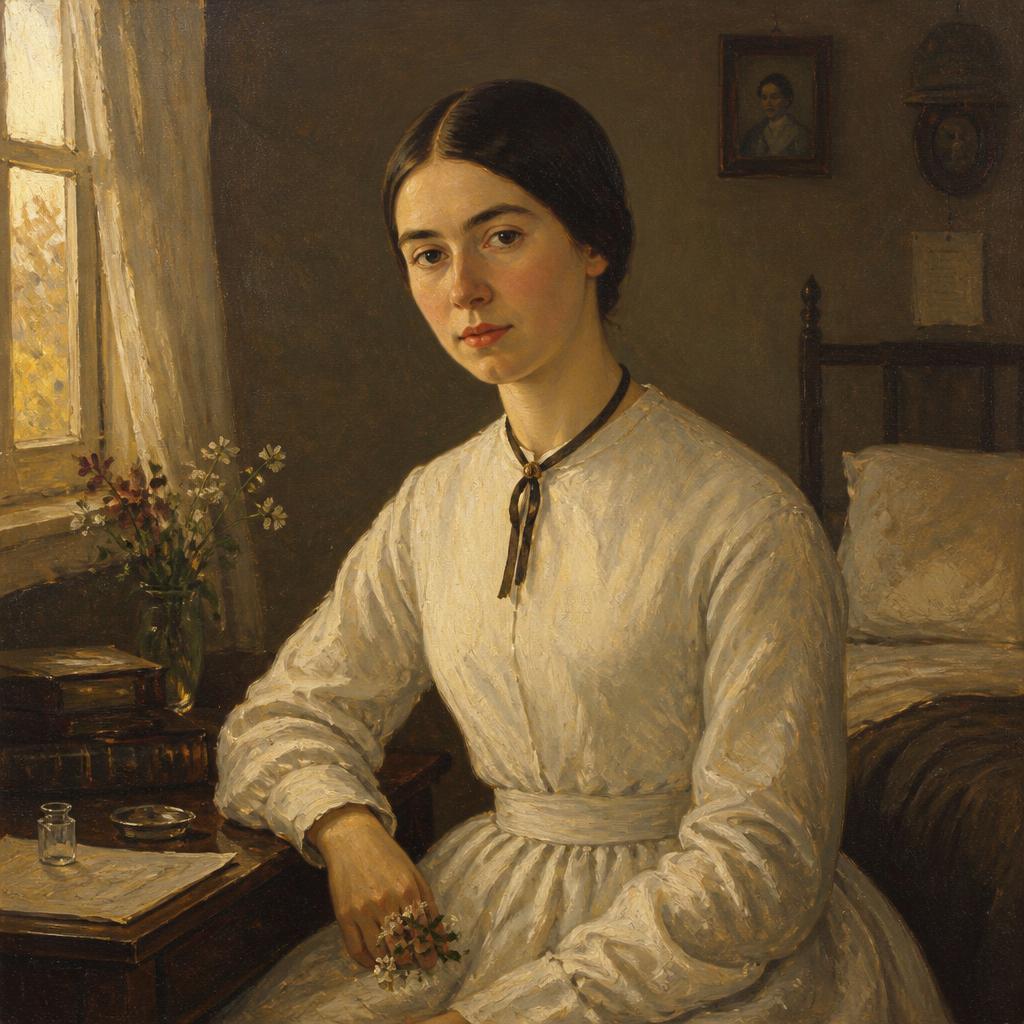
Her withdrawal from public life intensified over time. By the 1860s and 1870s she often avoided visitors, sometimes speaking from another room, and became associated with white clothing. Nevertheless, she maintained active relationships through letters, poems, flowers, and gifts. Describing her simply as an isolated recluse obscures this rich network.
Dickinson became famous only after death. Lavinia found the poems, recognized their importance, and pressed for publication. Mabel Loomis Todd and Higginson edited Poems by Emily Dickinson in 1890. It sold well and was followed by additional volumes. Her prominence grew gradually, especially once more faithful scholarly editions appeared in the twentieth century.
Major Achievements
Creation of Nearly 1,800 Poems
Dickinson produced one of the most distinctive bodies of lyric poetry in English. Her poems range from brief epigrams to complex meditations on death, desire, perception, pain, fame, and eternity.
The achievement mattered because she made small poetic forms bear immense philosophical pressure. Her poems often end without resolution, compelling readers to inhabit uncertainty. Their long-term impact can be seen in modernist, feminist, devotional, experimental, and confessional traditions.
Reinvention of Poetic Form
Dickinson frequently adapted common meter and hymn meter, forms familiar from Protestant worship. Against that regular framework, she used irregular capitalization, syntactic compression, unexpected pauses, and rhymes that do not fully match.
These methods mattered because they made poetic form enact unstable thought. A dash can delay closure; a slant rhyme can suggest doubt; a broken sentence can embody emotional strain. Although early editors treated such features as defects, later readers recognized them as central to her art.
The Fascicles and Manuscript Practice
From roughly 1858 to 1864, Dickinson copied hundreds of poems onto folded sheets and stitched them into about forty fascicles. She also left poems on loose sheets, envelopes, scraps, and other pieces of paper.
These manuscripts preserve alternative words and reveal composition as an open process. They have influenced textual scholarship and book history, while digital archives now allow readers to compare manuscripts with printed editions.
Exploration of Death and Immortality
Dickinson’s death poems are among her most famous achievements. She personified Death as a courteous driver, imagined the sensory details of a deathbed, and examined grief without reducing it to doctrine.
Her importance lies in the coexistence of belief and skepticism. Immortality may appear as promise, possibility, desire, or troubling unknown. That openness gives the poems continuing relevance across religious and secular contexts.
Posthumous Transformation of American Literature
The 1890 collection brought Dickinson to a broad readership, but its editors standardized many features. Later editions expanded and corrected the record. Thomas H. Johnson’s 1955 variorum edition offered the first substantially complete chronological text, while R. W. Franklin’s later edition reconsidered dates, groupings, and readings.
These editorial achievements established Dickinson as a major writer rather than a regional curiosity. Her reception also changed how critics understood literary fame: private or unpublished work could prove culturally transformative.
Leadership and Work
Dickinson held no public office and led no literary movement, so “leadership” must be understood as artistic self-direction and influence. She managed her work with remarkable concentration. The fascicles indicate systematic copying, revision, preservation, and arrangement even though she did not prepare a conventional book for publication.
Her decision-making combined receptiveness with independence. She asked Higginson for evaluation but did not reshape her poetry fully according to conventional advice. She sent poems to trusted correspondents, sometimes embedding them in letters, and used variant words rather than always imposing a single final reading.
Her core working values included precision, intensity, privacy, and intellectual freedom. Gardening, reading, household observation, and correspondence supplied imagery and occasions. She transformed familiar objects—birds, frost, windows, flies, trains, flowers—into instruments of inquiry.
Her strengths were metaphorical boldness, concentrated language, tonal range, and resistance to easy answers. From the standpoint of public career-building, her weaknesses included limited engagement with publishers and an unwillingness or inability to supervise a collection. Yet calling these choices weaknesses can impose modern professional expectations upon a writer whose intended audiences and purposes remain debated.
Relationships were central to her work. Poems circulated among family members and friends, including Susan Gilbert Dickinson, Higginson, Samuel Bowles, and others. Rather than operating outside all community, Dickinson created a selective literary community on her own terms.
Personal Life
Dickinson never married and had no children. Claims identifying a single definitive romantic partner remain uncertain. Her passionate letters and poems have prompted theories involving Samuel Bowles, Charles Wadsworth, Judge Otis Phillips Lord, Susan Gilbert Dickinson, or an unidentified person addressed in the “Master Letters.” Evidence varies, and literary voice cannot automatically be treated as autobiography.
Susan Gilbert, Emily’s close friend and later sister-in-law, was among her most important intellectual companions. Emily sent Susan hundreds of poems and letters. Scholars debate the precise nature of their emotional relationship, but its literary importance is indisputable.
The Dickinson households stood next to one another after Austin and Susan moved into The Evergreens. Family life was complicated by Austin’s later relationship with Mabel Loomis Todd. The resulting divisions shaped the preservation and editing of Emily’s writings after her death.
Dickinson became increasingly home-centered and was often reluctant to meet visitors face to face. She communicated through notes, gifts, flowers, and conversation from a distance. Accounts of her wearing white are supported, but later legend amplified the practice into a complete costume mythology.
She enjoyed gardening, baking, music, children, and dogs. Her Newfoundland dog, Carlo, was a beloved companion for many years. She cultivated exotic plants in the Homestead conservatory and frequently included flowers with messages.
Family illness placed demands upon her. Her mother required care, and Dickinson herself experienced health problems, including eye trouble treated in Boston by Dr. Henry Willard Williams in the 1860s. Her death certificate listed Bright’s disease, a historical term for kidney disease, as the cause of death, although modern retrospective diagnosis remains uncertain.
Philosophy and Beliefs
Dickinson’s worldview was exploratory rather than systematic. Biblical language saturates her poetry, yet she resisted the certainty expected by revivalist Congregationalism. God can appear intimate, absent, arbitrary, or unknowable. Christ may be savior, sufferer, or imaginative counterpart. Heaven is alternately desired and questioned.
She treated doubt as a serious mode of thought rather than a simple failure of faith. Poems often dramatize a mind testing propositions about resurrection, pain, and eternity. This method explains why opposing interpretations can each find evidence in her writing.
Her ethical imagination emphasized attention to individual suffering and the dignity of inward experience. She distrusted fame and public conformity, while valuing truth even when it arrived indirectly: “Tell all the truth but tell it slant—.”
Dickinson’s politics are less explicit. Her father participated in Whig and Republican politics, and she lived through abolitionist debate and civil war. Some poems use martial language or respond to wartime death, but scholars caution against assigning her a complete political program from indirect evidence.
On gender, her refusal of ordinary publication and domestic expectations can appear resistant, but she did not write a public feminist manifesto. Her life and poems nevertheless challenged assumptions about women’s intellectual authority. By making domestic spaces sites of philosophical and linguistic experiment, she expanded what American poetry could contain.
Challenges and Controversies
The greatest obstacle to Dickinson’s recognition was the mismatch between her style and nineteenth-century editorial convention. Irregular rhyme, dashes, compressed grammar, and unusual capitalization looked unfinished to many readers. Early editors normalized these features to make her work acceptable, enabling popularity while obscuring her technique.
Her reclusiveness remains contested. Older biographies sometimes portrayed her withdrawal as pathology, disappointed romance, or eccentricity. More recent scholars emphasize agency, household circumstances, health, artistic discipline, and the possibility that selective seclusion allowed control over time and contact. No single explanation is proven.
The “Master Letters”—three emotionally intense draft-like texts addressed to “Master”—have generated extensive speculation. Their recipient is unknown, and it is uncertain whether they were sent. Proposed identities include Wadsworth, Bowles, and others, but no theory commands consensus.
Another controversy concerns Susan Dickinson. Earlier editorial narratives sometimes minimized Susan’s role while elevating Todd, who helped publish the poems but had a relationship with Susan’s husband. Later scholarship recovered Susan as a major reader, correspondent, and influence. Interpretations of Emily and Susan as lovers remain debated; the documents establish profound intimacy but do not settle every modern category.
Textual disputes also persist. Dickinson left variants and often no final authorized version. Johnson and Franklin numbered and dated poems differently, while newer manuscript-centered approaches question whether print can reproduce spatial arrangement and visual marks adequately.
Finally, readers debate whether Dickinson consciously rejected publication. Her poem “Publication—is the Auction / Of the Mind of Man—” criticizes commodification, but she also circulated poems and contacted Higginson. Her attitude was likely more complex than simple refusal.
Legacy
Dickinson is now considered one of the foundational American poets, often discussed alongside Walt Whitman as a creator of a distinctly modern poetic language. Where Whitman expanded the poetic line outward, Dickinson compressed language inward. Both altered assumptions about voice, form, and selfhood.
Her influence extends to poets as varied as Hart Crane, Marianne Moore, Elizabeth Bishop, Sylvia Plath, Adrienne Rich, and contemporary experimental writers. Feminist criticism has highlighted her negotiation of gender, authority, domestic space, and desire. Philosophical and theological critics continue to examine her treatment of knowledge and belief.
The Emily Dickinson Museum in Amherst preserves the Dickinson Homestead and The Evergreens. Amherst College holds major manuscript collections, as does Harvard University’s Houghton Library. The open-access Emily Dickinson Archive provides digital images and transcriptions from multiple repositories.
Dickinson has inspired biographies, plays, novels, musical settings, films, and television productions. Amherst commemorates her through educational programs and literary tourism. More important than any monument is the continued global readership of her poems.
Modern textual study has restored the importance of her handwriting, page layout, variants, and material choices. Her legacy therefore concerns not only what poems mean, but also what a poem is: fixed printed object, evolving manuscript, private communication, or all three.
Interesting Facts
- Dickinson wrote nearly 1,800 known poems.
- Fewer than a dozen appeared in print during her lifetime in securely identifiable form.
- She attended Mount Holyoke Female Seminary for less than a year.
- Her teenage herbarium contains more than 400 plant specimens.
- She bound hundreds of poems into about forty manuscript fascicles.
- Her poems generally had no titles; editors identify them by first lines or numbers.
- Different editions use different numbering systems, especially those of Johnson and Franklin.
- She wrote her first known letter to Thomas Wentworth Higginson in 1862.
- Higginson met her in person only twice.
- Her Newfoundland dog was named Carlo.
- She was an accomplished baker and reportedly won local recognition for bread.
- The Dickinson Homestead stood beside The Evergreens, Austin and Susan’s house.
- Lavinia found Emily’s cache of poems after her death.
- Mabel Loomis Todd helped edit the first published collections but apparently never met Dickinson face to face.
- Early editions regularized many dashes, rhymes, and capital letters.
- Her white clothing became famous, though popular legend oversimplified the habit.
- She received specialist treatment for eye problems in Boston.
- “A narrow Fellow in the Grass” appeared in a newspaper without her name.
- Her only authenticated mature photograph is the well-known daguerreotype taken around 1847–1848.
- The Homestead and The Evergreens now form the Emily Dickinson Museum.
Famous Quotes
- “Because I could not stop for Death— / He kindly stopped for me—” — Opening of a poem probably composed around 1863. Death becomes a courteous carriage driver, making mortality familiar but not necessarily comforting.
- “ ‘Hope’ is the thing with feathers— / That perches in the soul—” — This metaphor presents hope as a bird that persists through hardship without demanding payment.
- “I’m Nobody! Who are you? / Are you—Nobody—too?” — A playful rejection of public identity and self-advertisement, often read in relation to Dickinson’s suspicion of fame.
- “Tell all the truth but tell it slant—” — The poem argues that overwhelming truth may need indirect presentation. It also describes Dickinson’s own elliptical art.
- “The Brain—is wider than the Sky—” — A meditation on consciousness and its capacity to contain or conceptualize the world.
- “I dwell in Possibility— / A fairer House than Prose—” — Poetry is imagined as an expansive dwelling with many windows and doors.
- “Forever—is composed of Nows—” — Dickinson compresses eternity into present moments, joining metaphysical thought with practical immediacy.
- “Success is counted sweetest / By those who ne’er succeed—” — The poem suggests that deprivation can sharpen understanding of what others possess.
- “If I can stop one Heart from breaking / I shall not live in vain” — A statement of compassionate purpose, preserved in Dickinson’s manuscripts and commonly dated to about 1864.
- “Are you too deeply occupied to say if my Verse is alive?” — From her 1862 letter to Higginson, this question reveals both vulnerability and artistic seriousness.
The frequently repeated line “Not knowing when the dawn will come, I open every door” is associated with Dickinson through editorial arrangements of manuscript fragments, but its familiar punctuation and standalone form require textual caution.
Timeline
- 1830 — Born on December 10 in Amherst, Massachusetts.
- 1840 — Begins attending Amherst Academy.
- 1844 — Experiences the death of her friend Sophia Holland, an important early bereavement.
- 1847 — Enters Mount Holyoke Female Seminary.
- 1848 — Leaves Mount Holyoke and returns permanently to Amherst.
- 1850s — Reads widely, gardens, develops close correspondences, and writes increasingly ambitious poetry.
- 1855 — Travels with Lavinia to Washington, D.C., and Philadelphia; the family later returns to the Homestead.
- About 1858 — Begins assembling manuscript fascicles.
- 1858–1865 — Produces the largest concentration of her poems.
- 1861 — The Civil War begins, forming the backdrop to her most productive period.
- 1862 — Writes her first letter to Thomas Wentworth Higginson.
- 1864–1865 — Receives extended eye treatment in Boston.
- 1866 — “A narrow Fellow in the Grass” appears anonymously in the Springfield Daily Republican.
- 1870 — Higginson visits Dickinson for the first time.
- 1874 — Her father dies unexpectedly in Boston.
- 1875 — Her mother suffers a disabling stroke.
- 1878 — Higginson makes his second visit.
- 1882 — Dickinson’s mother dies.
- 1883 — Her young nephew Gilbert Dickinson dies, deeply affecting the family.
- 1884 — Judge Otis Phillips Lord, a close later-life correspondent, dies.
- 1886 — Emily Dickinson dies on May 15 and is buried in Amherst’s West Cemetery.
- 1890 — The first volume of Poems by Emily Dickinson, edited by Higginson and Todd, is published.
- 1891 — A second series of poems appears.
- 1896 — Todd publishes a third series.
- 1914 — Martha Dickinson Bianchi publishes additional poems.
- 1955 — Thomas H. Johnson publishes a substantially complete variorum edition.
- 1958 — Johnson’s edition of Dickinson’s letters appears.
- 1981 — The manuscript books are published in facsimile under R. W. Franklin’s editorship.
- 1998 — Franklin publishes a new variorum edition of the poems.
- 2003 — The Emily Dickinson Museum opens as a unified museum organization.
- 2013 — The Emily Dickinson Archive launches online.
Frequently Asked Questions
Why is Emily Dickinson famous?
Dickinson is famous for radically original lyric poems that combine familiar hymn rhythms with compressed syntax, unconventional punctuation, slant rhyme, and surprising metaphors. She wrote about death, immortality, nature, pain, love, faith, and consciousness without forcing these subjects into simple conclusions. Although scarcely known publicly during her lifetime, she left nearly 1,800 poems. Posthumous publication and increasingly accurate editions established her as a central American writer whose methods anticipated many features of modern poetry.
How many poems did Emily Dickinson write?
The accepted total is nearly 1,800 known poems, though exact counts depend on how editors distinguish drafts, variants, and separate works. Thomas H. Johnson numbered 1,775 poems, while R. W. Franklin’s later system counted 1,789. Differences do not mean that hundreds of new poems were discovered; they reflect editorial decisions about manuscripts. Dickinson preserved many poems in fascicles and left others on loose sheets and scraps.
Was Emily Dickinson published during her lifetime?
Yes, but only rarely. Fewer than a dozen poems can be confidently identified as having appeared during her lifetime. They were generally published anonymously, sometimes without her direct involvement, and editors often changed punctuation, wording, or rhyme. Dickinson circulated far more work privately through letters and manuscript copies. Her first major book appeared in 1890, four years after her death, and became a commercial success.
Why did Dickinson use so many dashes?
The marks in Dickinson’s manuscripts vary in length, direction, and function, so the familiar printed “dash” simplifies a more complex practice. These marks can create pauses, connect phrases, suspend conclusions, or give several meanings room to coexist. Early editors replaced many with conventional punctuation. Modern scholarship treats them as meaningful components of rhythm and thought, although critics continue to debate how consistently they function and how printed editions should represent them.
Was Emily Dickinson a recluse?
She became markedly home-centered and often avoided face-to-face meetings, especially in later life. However, “recluse” can mislead if it suggests complete isolation. Dickinson maintained extensive correspondence, exchanged poems and flowers, interacted with family and neighborhood children, and followed literary and public events. Scholars propose multiple reasons for her withdrawal, including temperament, illness, family obligations, social preference, and the protection of creative time. No single explanation has been proven.
Did Emily Dickinson always wear white?
Evidence indicates that Dickinson frequently wore white in later years, and family recollections helped create the famous image of the “woman in white.” Yet claims that she wore nothing else or adopted white as a fixed mystical uniform go beyond what surviving evidence establishes. White housedresses were not unknown in the period. The habit may have involved convenience, personal preference, symbolism, or several factors, but Dickinson left no definitive explanation.
Was Emily Dickinson religious?
Dickinson was deeply engaged with religion but did not fit comfortably within orthodox expectations. Raised in Congregationalist Amherst, she knew the Bible and hymn tradition intimately. She declined to make the public conversion encouraged during religious revivals. Her poetry alternately invokes, questions, challenges, and longs for God and immortality. It is more accurate to describe her faith as searching and contested than to label her simply devout, atheist, or agnostic.
Did Emily Dickinson marry or have children?
No. Dickinson never married and had no children. Her letters reveal intense attachments, but the identities and nature of her romantic relationships remain subjects of debate. Proposed objects of affection include Susan Gilbert Dickinson, Samuel Bowles, Charles Wadsworth, Otis Lord, and the unknown recipient of the “Master Letters.” The available documents support emotional intensity but do not justify a definitive biography of her private desires.
Who was Susan Gilbert Dickinson?
Susan Gilbert Dickinson was Emily’s close friend, literary reader, and sister-in-law. She married Austin Dickinson in 1856 and lived next door at The Evergreens. Emily sent her hundreds of poems and letters, requested criticism, and marked important occasions with written messages. Recent scholarship has emphasized Susan’s central intellectual role. Debate continues about whether their bond should be understood as romantic, erotic, familial, literary, or some combination.
What were Dickinson’s fascicles?
The fascicles were small manuscript packets made from folded sheets that Dickinson stacked and stitched together. About forty survive, containing hundreds of poems copied primarily between the late 1850s and mid-1860s. They show deliberate preservation and organization, but scholars disagree about whether they form sequenced books intended for publication. Their variants and visual arrangements make them crucial evidence for understanding her creative process.
What is Dickinson’s most famous poem?
“Because I could not stop for Death—” is probably her most internationally recognized poem. Its speaker rides with personified Death past scenes resembling stages of life before reaching a grave and contemplating eternity. Other exceptionally famous works include “ ‘Hope’ is the thing with feathers—,” “I heard a Fly buzz—when I died—,” and “I’m Nobody! Who are you?” No definitive ranking exists.
Did the Civil War influence her poetry?
Yes, although usually indirectly. Dickinson’s period of greatest productivity overlapped with the Civil War, and her poems include battle imagery, death, sacrifice, defeat, and national crisis. She read newspapers and knew people affected by military service. Critics debate which poems refer specifically to the war because she often transformed historical circumstances into psychological or metaphysical drama rather than naming battles and political leaders.
Why were her early editions changed?
Nineteenth-century editors expected regular grammar, punctuation, meter, and full rhyme. Dickinson’s manuscripts appeared irregular or unfinished according to those standards. Higginson, Todd, and other early editors adjusted her texts to make them readable and publishable for contemporary audiences. Their efforts introduced her work to the public, but also concealed important artistic features. Later editors returned to the manuscripts and produced more faithful, though still interpretive, texts.
How did Emily Dickinson die?
Dickinson died at the Homestead on May 15, 1886, aged 55. Her death certificate named Bright’s disease, then a broad term for kidney disorders. She had suffered declining health, but diagnosing a nineteenth-century patient retrospectively is uncertain. Accounts that assign a precise modern disease should therefore be treated cautiously. She was buried in the Dickinson family plot at West Cemetery in Amherst.
Who discovered her poems after her death?
Her sister Lavinia discovered the manuscript cache and understood that the poems should be published. Emily had asked Lavinia to burn her correspondence, and Lavinia reportedly did so, but the poems had been stored separately and were not explicitly included in that request. Lavinia enlisted Mabel Loomis Todd and Thomas Wentworth Higginson in the editorial project. Without her persistence, Dickinson’s work might not have reached the public in its surviving form.
Are Dickinson’s poems autobiographical?
They draw upon her language, reading, relationships, environment, and experiences, but they should not be treated as transparent diary entries. Dickinson used speakers, personae, riddles, dramatic situations, and imaginative transformations. A poem about death does not prove a specific bereavement, and a love poem does not identify its recipient. Biography can illuminate the work, but responsible interpretation distinguishes the historical Dickinson from each poetic “I.”
Why do editions number her poems differently?
Most poems lacked authorial titles, so editors numbered them. Johnson’s 1955 edition and Franklin’s 1998 edition made different decisions about dating, order, textual boundaries, and variants. Consequently, the same poem can have a Johnson number beginning “J” and a Franklin number beginning “Fr.” Quoting the first line is often the clearest method of identification, especially for general readers.
Lessons We Can Learn
- Protect concentrated work. Dickinson organized much of her life around reading and writing. Today, sustained attention remains essential for difficult creative or intellectual work.
- Question inherited conventions. She adapted hymn meter rather than merely obeying it. Innovation often begins with deep knowledge of tradition.
- Use limits creatively. A geographically restricted life produced poetry of enormous range. Limited circumstances need not limit imagination.
- Preserve drafts. Her fascicles and variants reveal how art develops. Keeping records allows future revision and understanding.
- Seek criticism without surrendering judgment. Dickinson asked Higginson for guidance but retained her distinctive style. Advice is useful when balanced with independence.
- Accept uncertainty. Her poems often leave religious and philosophical questions unresolved. Intellectual honesty sometimes means resisting premature certainty.
- Attend to ordinary things. Flies, birds, frost, flowers, and household rooms became profound symbols. Careful observation can transform familiar experience.
- Build relationships in forms that work. Dickinson sustained friendships through letters, poems, and gifts. Meaningful connection does not require one social model.
- Do not equate visibility with value. She lacked public fame while producing major art. Recognition and achievement are not the same.
- Preserve cultural work responsibly. Lavinia’s actions and later manuscript scholarship rescued Dickinson’s poetry. Archives, accurate editing, and stewardship shape historical memory.
Related Historical Figures
- Lavinia Dickinson — Emily’s younger sister, household companion, and the discoverer who initiated publication of the poems.
- William Austin Dickinson — Emily’s brother, Amherst lawyer, and resident of neighboring The Evergreens.
- Susan Gilbert Dickinson — Close friend, sister-in-law, correspondent, and one of Dickinson’s most important readers.
- Thomas Wentworth Higginson — Writer, abolitionist, Civil War officer, correspondent, and co-editor of the 1890 poems.
- Mabel Loomis Todd — Editor of early posthumous volumes whose work promoted Dickinson while creating lasting textual and family controversies.
- Samuel Bowles — Influential editor of the Springfield Republican, family friend, and recipient of Dickinson’s letters and poems.
- Charles Wadsworth — Philadelphia minister and correspondent sometimes proposed as an important emotional influence, though claims require caution.
- Otis Phillips Lord — Massachusetts judge and close later-life correspondent; surviving letters suggest deep affection.
- Elizabeth Barrett Browning — British poet admired by Dickinson and an important model of female poetic authority.
- Walt Whitman — Dickinson’s great American contemporary; their contrasting expansive and compressed styles helped redefine modern poetry.
Watch and Learn
The Poetry of Emily Dickinson · CrashCourse
Related Historical Figures