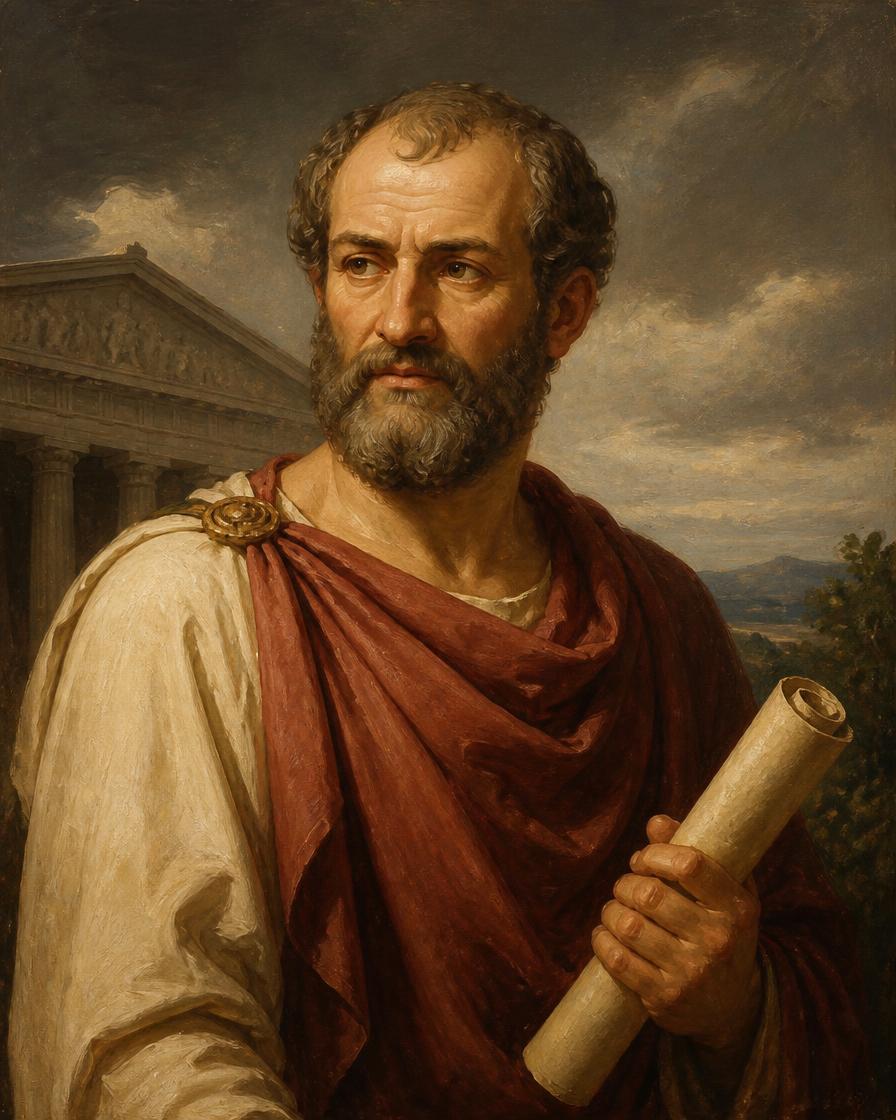
Quick Facts
- Years
- 384 BC – 322 BC
- Category
- Philosophers & Thinkers
- Subcategory
- Ancient Greek Philosophy
- Nationality
- Greek
- Occupation
- Philosopher & Polymath
Aristotle
384 BC – 322 BC · Greek · Philosopher & Polymath
Audiobook

Life Lessons from Aristotle
Marcus Alden · 51 min
Aristotle (384–322 BC) was one of the most influential thinkers in world history: a Greek philosopher, scientist, teacher, and system-builder whose ideas shaped Western, Islamic, and Jewish intellectual traditions for more than two thousand years. Born in Stagira in northern Greece, trained in Plato’s Academy, and later tutor to the young Alexander the Great, Aristotle worked at the intersection of philosophy, politics, biology, logic, ethics, literature, and natural science.
His greatest achievements include founding the Lyceum in Athens, developing formal logic, writing foundational works on ethics and political theory, classifying living things through observation, and offering enduring analyses of drama, rhetoric, causation, knowledge, and human happiness. Unlike Plato, who often emphasized ideal forms beyond the physical world, Aristotle studied the world as it appears: animals, constitutions, speeches, poems, habits, and arguments.
People still study Aristotle because many of his questions remain alive: What makes a life good? How should citizens and governments act? What counts as knowledge? How do we reason well? Why do stories move us? Some of his scientific claims are obsolete, and some of his social assumptions are rightly criticized today. Yet his method—careful observation, classification, definition, and argument—helped create the intellectual habits of philosophy and science.
Section 1 — Quick Facts
| Category | Details |
|---|---|
| Full Name | Aristotle of Stagira |
| Common Names | Aristotle; Aristoteles |
| Born | 384 BC |
| Died | 322 BC |
| Age at Death | About 62 |
| Birthplace | Stagira, Chalcidice, northern Greece |
| Nationality | Greek; born in a region closely connected to Macedonia |
| Occupation | Philosopher, scientist, teacher, writer |
| Historical Era | Classical Greece; late Classical and early Hellenistic period |
| Famous For | Logic, ethics, metaphysics, biology, political theory, rhetoric, literary criticism, founding the Lyceum, tutoring Alexander the Great |
| Political Affiliation (if applicable) | No modern political affiliation; associated with the Macedonian court through family and teaching connections |
| Religion (if historically significant) | Lived in a Greek polytheistic culture; philosophically argued for an “unmoved mover,” not a personal religious creed in the modern sense |
| Education | Studied for about twenty years at Plato’s Academy in Athens |
| Parents | Nicomachus, physician to King Amyntas III of Macedon; Phaestis |
| Spouse(s) | Pythias of Assos; later companion or partner Herpyllis of Stagira |
| Children | Pythias the Younger; Nicomachus |
| Major Works | Nicomachean Ethics, Politics, Metaphysics, Physics, Categories, Prior Analytics, Posterior Analytics, De Anima, Poetics, Rhetoric, History of Animals |
| Major Achievements | Founded the Lyceum; developed syllogistic logic; advanced virtue ethics; studied constitutions; made major contributions to biology, literary theory, metaphysics, and rhetoric |
| Signature | No authenticated signature survives |
Section 2 — Early Life
Aristotle was born in 384 BC in Stagira, a Greek city on the Chalcidic peninsula in northern Greece. Stagira was not Athens, and that mattered. Aristotle grew up on the edge of the Greek world’s political and cultural centers, near Macedonia, a kingdom that would soon transform Greek history.
His father, Nicomachus, was a physician connected with the Macedonian royal court, probably serving King Amyntas III. This family background may have shaped Aristotle’s lifelong interest in living bodies, classification, anatomy, and natural explanation. Ancient biographical traditions should be used carefully, but the connection between Aristotle’s family and medicine is widely accepted.
Aristotle’s mother was named Phaestis. Both parents appear to have died while he was young, and he was later associated with a guardian named Proxenus of Atarneus. Details of his childhood are limited, and many later stories about his early personality are impossible to verify.
Education at Plato’s Academy
Around age seventeen, Aristotle went to Athens and entered Plato’s Academy, the most famous philosophical school in the Greek world. He remained there for roughly twenty years, first as a student and later as a mature thinker in his own right.
The Academy exposed him to mathematics, dialectic, metaphysics, ethics, and political theory. Plato’s influence on Aristotle was enormous, even where Aristotle disagreed with him. Aristotle inherited from Plato the belief that philosophy should seek deep explanations, not merely practical opinions. But he became less comfortable with Plato’s theory that eternal “Forms” existed separately from the physical world.
Historical Context
Aristotle’s youth unfolded after the Peloponnesian War, when Athens had lost much of its imperial power but remained intellectually vibrant. Meanwhile, Macedonia was rising. The old city-state world was changing, and Aristotle’s life would eventually connect Athens, Asia Minor, Macedonia, and the expanding empire of Alexander.
Section 3 — Rise to Prominence
After Plato died in 347 BC, Aristotle left Athens. Ancient sources suggest that leadership of the Academy passed not to Aristotle but to Plato’s nephew Speusippus. Whether Aristotle left because of philosophical disagreement, political tension, personal opportunity, or some combination remains debated.
He traveled to Assos in Asia Minor, where he joined a circle connected to Hermias, ruler of Atarneus. There Aristotle continued philosophical work and married Pythias, who was probably related to Hermias. He later spent time on the island of Lesbos, especially around Mytilene, where he conducted biological research. His careful observations of marine life, animals, and reproduction later appeared in works such as History of Animals and Parts of Animals.
Around 343 or 342 BC, Aristotle was invited by Philip II of Macedon to tutor his son Alexander. The exact curriculum is not fully known. Later tradition exaggerated Aristotle’s role in shaping Alexander’s conquests, and modern historians are cautious. Still, the appointment shows Aristotle’s high reputation and his strong Macedonian connections.
After Alexander became king and began his campaigns, Aristotle returned to Athens in 335 BC. There he founded his own school, the Lyceum, named after a sanctuary of Apollo Lyceus. Aristotle and his students became known as Peripatetics, a term traditionally connected with walking while teaching, though the exact origin is debated.
At the Lyceum, Aristotle organized research on an astonishing scale. His school collected constitutions, studied animals, analyzed literature, investigated logic, and debated ethics. This institutional research program helped make Aristotle not only a philosopher but also a founder of systematic scholarship.
Section 4 — Major Achievements
Founding the Lyceum
Aristotle’s Lyceum was more than a classroom. It functioned as a research community, lecture hall, archive, and philosophical school. Students and associates gathered information about politics, natural history, rhetoric, and philosophy.
Why it mattered: The Lyceum helped create a model of organized inquiry. Instead of relying only on abstract debate, Aristotle’s circle collected data and compared examples.
Long-term impact: Later universities and scholarly institutions did not descend directly from the Lyceum, but Aristotle’s school became an enduring symbol of disciplined research.
Creating Formal Logic
Aristotle’s logical works, later grouped as the Organon, analyzed valid reasoning. His theory of the syllogism showed how conclusions follow from premises:
- All humans are mortal.
- Socrates is human.
- Therefore, Socrates is mortal.
Why it mattered: Aristotle made reasoning itself an object of study.
Long-term impact: His logic dominated education in Europe and the Islamic world for centuries. Modern symbolic logic eventually moved beyond Aristotle, but his work remains foundational.
Developing Virtue Ethics
In the Nicomachean Ethics, Aristotle argued that the goal of human life is eudaimonia, often translated as flourishing, well-being, or happiness. It is not a passing mood but a whole life lived well through reason and virtue.
Virtue, for Aristotle, is a trained excellence of character. Courage, for example, lies between cowardice and recklessness.
Why it mattered: Ethics became a study of character, habit, judgment, and practical wisdom.
Long-term impact: Virtue ethics is again influential in modern philosophy, education, leadership studies, and moral psychology.
Political Analysis
Aristotle’s Politics examined constitutions, citizenship, law, education, and the purposes of the city-state. He compared political systems and argued that humans are “political animals” because they live in communities shaped by speech, justice, and shared ideas of the good.
Why it mattered: Aristotle treated politics as a practical science rooted in human nature and civic life.
Long-term impact: His ideas influenced republican thought, medieval political theory, civic humanism, and debates about citizenship.
Contributions to Biology
Aristotle studied animals through observation, dissection, and comparison. Some of his biological claims were wrong, but others were remarkably careful. He described marine creatures, reproduction, organs, and animal behavior.
Why it mattered: Aristotle treated living things as worthy of systematic study.
Long-term impact: His biological writings remained influential until early modern science. Historians now recognize him as one of antiquity’s most important naturalists.
Literary Theory in the Poetics
The Poetics is one of the earliest surviving works of literary criticism. Aristotle analyzed tragedy, plot, character, recognition, reversal, and catharsis.
Why it mattered: He explained drama as a crafted art with internal principles, not merely entertainment.
Long-term impact: Playwrights, critics, and screenwriters still use Aristotelian ideas about plot and emotional effect.
Section 5 — Leadership and Work
Aristotle’s leadership style was intellectual, organizational, and methodical. He did not rule a state or command an army; he built a school and a research tradition.
Working Methods
Aristotle’s method often followed several steps:
- Gather reputable opinions or observed facts.
- Define the subject carefully.
- Classify types and causes.
- Identify puzzles or contradictions.
- Offer an explanation that preserves evidence where possible.
This approach appears in ethics, biology, politics, and metaphysics. He frequently begins with what “seems to be the case” and then refines it through argument.
Research Program
The Lyceum studied:
- Logic and demonstration
- Animal life and reproduction
- Constitutions of Greek city-states
- Rhetoric and persuasion
- Poetry and tragedy
- Ethics and political institutions
- Metaphysics, causation, motion, and the soul
A famous ancient report says Aristotle’s school collected 158 constitutions. The surviving Constitution of the Athenians is usually associated with the Aristotelian school, though scholars debate the exact authorship.
Strengths
Aristotle’s strengths included range, clarity of classification, attention to ordinary experience, and respect for empirical observation. He could move from octopuses to justice, from theatrical plots to the structure of reality.
Weaknesses
His weaknesses were also significant. He sometimes relied on limited evidence, accepted social hierarchies common in his world, and made scientific claims later proven false. His teleological view—that natural things act for ends or purposes—was powerful but sometimes led him away from mechanistic explanations valued in modern science.
Section 6 — Personal Life
Aristotle married Pythias, who was connected to Hermias of Atarneus. They had a daughter, also named Pythias. After Pythias’s death, Aristotle lived with Herpyllis of Stagira. Ancient sources differ over whether Herpyllis was his wife, concubine, or long-term companion; the evidence does not allow certainty. They had a son, Nicomachus, after whom the Nicomachean Ethics is traditionally named—though the title may refer to Aristotle’s father, son, or an editor in the family.
Aristotle’s will, preserved in later ancient sources, presents him as attentive to household arrangements, family obligations, and the welfare of dependents. Like all such documents transmitted through antiquity, it should be treated with caution, but it is an important source for his private life.
He had friendships and patronage ties across the Greek world, including with Hermias. Aristotle wrote a hymn honoring Hermias after his death, which later contributed to accusations of impiety against him.
In 323 BC, after Alexander the Great died, anti-Macedonian feeling rose in Athens. Aristotle, associated with Macedonia, left the city for Chalcis on Euboea. Ancient tradition says he did not want Athens to “sin twice against philosophy,” referring to Socrates’ execution. The phrase is famous but not securely historical.
He died in 322 BC, probably of natural causes.
Section 7 — Philosophy and Beliefs
Aristotle’s philosophy is vast, but several ideas define his thought.
Four Causes
To understand something, Aristotle argued, we should ask four kinds of questions:
| Cause | Simple Meaning | Example: A Bronze Statue |
|---|---|---|
| Material cause | What it is made of | Bronze |
| Formal cause | Its form or structure | Shape of the statue |
| Efficient cause | What produced it | Sculptor’s work |
| Final cause | Its purpose or end | To honor someone or decorate a space |
Modern science often emphasizes efficient causes, but Aristotle believed full understanding required all four.
Form and Matter
Aristotle rejected Plato’s separate Forms but kept the idea that things have intelligible structures. A horse is not just matter; it is matter organized as a horse. Form is not in another world but present in the thing.
Ethics and the Golden Mean
Virtue lies in choosing well, guided by reason. The “mean” is not mediocrity but the right response in the right way, at the right time, toward the right people.
Examples:
- Courage: between cowardice and rashness
- Generosity: between stinginess and wastefulness
- Truthfulness: between self-deprecation and boastfulness
Politics
Aristotle believed the city-state exists not merely for survival but for living well. His politics are deeply civic: education, law, character, and institutions all matter.
However, his political thought also includes troubling defenses of slavery and gender hierarchy. These views reflected common assumptions in his society but are not excused by that fact. Modern readers often study Aristotle both for insight and for critique.
Metaphysics and the Unmoved Mover
Aristotle argued that change and motion require explanation. His concept of the “unmoved mover” describes a highest principle that causes motion as an object of desire or thought. This idea later influenced Jewish, Christian, and Islamic theology, although Aristotle’s own view was not identical to later religious doctrines.
The Soul
In De Anima, Aristotle treated the soul as the form of a living body: what makes a living thing alive. Plants have nutritive capacities, animals have perception, and humans have reason. This is not “soul” in the modern ghostly sense but a philosophical account of life and function.
Section 8 — Challenges and Controversies
Aristotle’s reputation has never been simple. He has been praised as “the Philosopher” and criticized as an obstacle to scientific progress. Both extremes oversimplify him.
Association with Macedonia
Because Aristotle had ties to the Macedonian court and tutored Alexander, Athenians suspicious of Macedonian power may have viewed him politically. After Alexander’s death, Aristotle left Athens amid hostility.
Viewpoint one: Aristotle was vulnerable because of genuine political association with Macedonian power.
Viewpoint two: He was primarily a philosopher caught in a dangerous political climate.
The available evidence supports caution: he had Macedonian connections, but he was not simply a political agent.
Tutoring Alexander the Great
Aristotle’s role as Alexander’s tutor is established, but its significance is debated.
Some later writers imagined Aristotle as the intellectual architect of Alexander’s empire. Modern scholars usually doubt this. Alexander’s ambitions came from Macedonian kingship, military culture, family politics, and personal genius as much as education.
Still, Aristotle likely introduced Alexander to Greek literature, ethics, politics, and perhaps Homeric ideals.
Slavery and Gender
Aristotle defended forms of natural hierarchy, including the idea that some people were “natural slaves.” He also described women as subordinate to men in household and political life.
These views are among the most criticized parts of his work. Some historians emphasize that Aristotle reflected the assumptions of elite Greek society. Others argue that his own philosophical tools—reason, virtue, human purpose—could have challenged those assumptions more strongly than he did.
Scientific Errors
Aristotle made false claims about physics, astronomy, reproduction, and anatomy. For example, his physics did not include inertia in the modern sense, and some of his biological theories were limited by ancient methods.
Yet it is misleading to dismiss him as “unscientific.” He observed carefully, gathered evidence, and built explanatory systems. His errors show the limits of ancient knowledge, not a lack of intelligence.
Transmission of His Works
The texts we read today are not polished books in the modern sense. Many may be lecture notes, school materials, or edited compilations. This creates interpretive challenges. Scholars often debate whether tensions in Aristotle’s writings reflect development over time, different audiences, or later editorial arrangement.
Section 9 — Legacy
Aristotle’s legacy is enormous because his works became textbooks for civilizations.
Ancient and Hellenistic Influence
His immediate followers, including Theophrastus, continued the Lyceum. Theophrastus became especially important in botany and ethics. Over time, Aristotle’s school preserved and developed his methods, though the history of the manuscripts is complex.
Islamic, Jewish, and Christian Traditions
In the medieval Islamic world, Aristotle was studied by thinkers such as al-Farabi, Avicenna, and Averroes. They interpreted, criticized, and expanded his ideas on logic, metaphysics, soul, and nature.
Jewish philosophers, including Maimonides, engaged deeply with Aristotelian thought. In medieval Christian Europe, Thomas Aquinas integrated Aristotle into Christian theology, especially in metaphysics, ethics, and natural law.
Renaissance and Scientific Revolution
Aristotle’s authority was challenged during the Scientific Revolution by figures such as Galileo and Newton. But even critics learned from a tradition shaped by Aristotelian questions about explanation, motion, and nature.
Modern Relevance
Today Aristotle remains important in:
- Ethics and character education
- Political theory and citizenship
- Logic and argumentation
- Biology’s history
- Literary theory and storytelling
- Philosophy of science
- Leadership and practical judgment
Memorials and Places
Aristotle is remembered in statues, universities, and public spaces, especially in Greece. Important sites include:
- Stagira, his birthplace, where modern memorials honor him
- The archaeological site of the Lyceum in Athens
- Aristotle University of Thessaloniki, one of Greece’s largest universities
- Museums and collections displaying ancient busts associated with him
Section 10 — Interesting Facts
- Aristotle studied at Plato’s Academy for about twenty years.
- He was not Athenian by birth; he came from Stagira in northern Greece.
- His father was connected to medicine and the Macedonian court.
- Aristotle tutored Alexander the Great, though the extent of his influence is debated.
- He founded the Lyceum in Athens in 335 BC.
- His followers were called Peripatetics.
- He wrote on animals, poetry, politics, ethics, logic, memory, sleep, and the heavens.
- The surviving works may be lecture notes rather than polished publications.
- He developed the first systematic theory of syllogistic logic.
- His Poetics is one of the oldest surviving works of literary criticism.
- He believed happiness meant lifelong flourishing, not temporary pleasure.
- He collected and compared political constitutions.
- His school probably helped produce the Constitution of the Athenians.
- He studied marine animals on Lesbos.
- Medieval scholars often called him simply “the Philosopher.”
- Some famous “Aristotle quotes” online are not actually his words.
- He left Athens after Alexander’s death because of anti-Macedonian hostility.
- He died in Chalcis in 322 BC.
Section 11 — Famous Quotes
1. “Man is by nature a political animal.”
Historical Context: From Politics, where Aristotle explains why humans naturally form communities.
Meaning: Human beings develop fully through shared civic life, law, speech, and moral judgment.
2. “All men by nature desire to know.”
Historical Context: Opening sentence of the Metaphysics.
Meaning: Curiosity is not accidental; the search for understanding belongs to human nature. Modern readers should note that “men” in older translations often means “human beings.”
3. “The good for man is an activity of the soul in accordance with virtue.”
Historical Context: From Nicomachean Ethics, Book I.
Meaning: A good life is not merely possession, pleasure, or status, but excellent activity over time.
4. “One swallow does not make a summer.”
Historical Context: From Nicomachean Ethics, where Aristotle argues that happiness requires a complete life.
Meaning: A single good moment does not prove a life is flourishing.
5. “Virtue is a state concerned with choice.”
Historical Context: From Nicomachean Ethics, Book II.
Meaning: Virtue is not just feeling; it is a trained disposition to choose well.
6. “The law is reason unaffected by desire.”
Historical Context: A traditional rendering from Politics.
Meaning: Good law should restrain personal passion and arbitrary rule.
7. “The whole is something besides the parts.”
Historical Context: From Metaphysics, in discussions of substance and unity.
Meaning: A thing is not merely a pile of components; organization matters.
8. “Poetry is more philosophical and more serious than history.”
Historical Context: From Poetics. Aristotle argues poetry deals with universal patterns, while history records particular events.
Meaning: Stories can reveal general truths about human action.
9. “Without friends no one would choose to live.”
Historical Context: From Nicomachean Ethics, Books VIII–IX on friendship.
Meaning: Friendship is not a luxury but part of a good human life.
10. “We are what we repeatedly do.”
Historical Context: Disputed attribution. This is not Aristotle’s wording; it is a modern paraphrase often traced to Will Durant’s summary of Aristotle’s ethics.
Meaning: It accurately reflects Aristotle’s emphasis on habit, but should not be quoted as his exact sentence.
Section 12 — Timeline
- 384 BC — Aristotle is born in Stagira.
- c. 367 BC — Travels to Athens and enters Plato’s Academy.
- 347 BC — Plato dies; Aristotle leaves Athens.
- 347–345 BC — Lives and works in Assos under the patronage circle of Hermias.
- c. 345–343 BC — Conducts research on Lesbos, including biological studies.
- 343/342 BC — Invited by Philip II to tutor Alexander.
- 336 BC — Alexander becomes king of Macedonia.
- 335 BC — Aristotle returns to Athens and founds the Lyceum.
- 335–323 BC — Leads teaching and research at the Lyceum.
- 323 BC — Alexander dies; anti-Macedonian feeling rises in Athens.
- 323 BC — Aristotle leaves Athens for Chalcis.
- 322 BC — Aristotle dies in Chalcis.
Section 13 — Frequently Asked Questions
Who was Aristotle?
Aristotle was a Greek philosopher and scientist born in Stagira in 384 BC. He studied under Plato in Athens, later tutored Alexander the Great, and founded the Lyceum. His writings cover logic, ethics, politics, metaphysics, biology, rhetoric, poetry, psychology, and natural science. He is important because he helped organize knowledge into systematic fields of inquiry. Unlike many thinkers who focused mainly on abstract theory, Aristotle combined philosophical argument with observation of the natural and social world.
Why is Aristotle important?
Aristotle is important because he shaped how later civilizations studied reasoning, nature, ethics, politics, and literature. His logic became a core part of education for centuries. His ethics still influences debates about character and happiness. His political writings remain central to discussions of citizenship and law. His biological works, despite errors, show a serious attempt to understand living things through observation. Few thinkers have influenced so many disciplines for so long.
Was Aristotle a student of Plato?
Yes. Aristotle studied at Plato’s Academy in Athens for about twenty years. Plato deeply influenced him, especially in the belief that philosophy should search for causes and principles. However, Aristotle disagreed with Plato on major issues. Most famously, he rejected the idea that Forms exist separately in a higher realm. Aristotle emphasized that form and structure are found within particular things. Their relationship is best understood as both inheritance and disagreement.
Did Aristotle teach Alexander the Great?
Yes, Aristotle taught Alexander when Alexander was a young prince of Macedonia. The appointment came from King Philip II. However, scholars disagree about how much Aristotle influenced Alexander’s later actions. Ancient stories often exaggerate the philosopher’s role in creating a world conqueror. It is reasonable to say Aristotle contributed to Alexander’s education in Greek literature and thought, but Alexander’s military career had many causes beyond Aristotle’s teaching.
What is Aristotle’s most famous idea?
There is no single answer, but several ideas are especially famous: the “golden mean,” the four causes, the syllogism, the political nature of human beings, and happiness as flourishing. For general readers, his theory of virtue may be the most accessible. Aristotle argued that we become good by practicing good actions until they become stable habits. A good life is built through character, judgment, friendship, and purposeful activity.
What did Aristotle mean by happiness?
Aristotle’s word eudaimonia is often translated as happiness, but it means more than feeling cheerful. It refers to flourishing or living well over a complete life. For Aristotle, happiness is achieved through excellent activity of the soul in accordance with virtue. Pleasure, wealth, and honor may have value, but they are not the highest good. The happy life requires reason, character, friendship, and practical wisdom.
What is the golden mean?
The golden mean is Aristotle’s idea that moral virtue often lies between two extremes. Courage, for example, stands between cowardice and rashness. Generosity lies between stinginess and wastefulness. This does not mean the middle is always mathematically equal or emotionally moderate. The right action depends on the situation, person, motive, and timing. Aristotle’s point is that virtue requires judgment, not rigid rule-following.
What did Aristotle contribute to science?
Aristotle contributed to science by observing, classifying, and explaining natural phenomena, especially living organisms. His biological writings include studies of animal anatomy, reproduction, behavior, and classification. Some conclusions were wrong, partly because ancient tools were limited. But his commitment to systematic observation was historically significant. He helped establish the idea that nature could be studied through organized inquiry rather than myth alone.
Was Aristotle always right?
No. Aristotle was wrong about many scientific matters and held social views that modern readers reject, including defenses of slavery and male superiority. His importance does not depend on being correct about everything. He matters because he asked foundational questions, created powerful methods of reasoning, and influenced later inquiry. Studying Aristotle responsibly means appreciating his achievements while openly criticizing his errors and assumptions.
What is the Lyceum?
The Lyceum was Aristotle’s school in Athens, founded in 335 BC. It was named after a sanctuary of Apollo Lyceus. The Lyceum became a center for teaching, debate, and research. Aristotle and his associates studied philosophy, politics, biology, rhetoric, literature, and logic. The school’s research culture was unusually broad for its time. It helped preserve and develop Aristotle’s methods after his death.
Why were Aristotle’s followers called Peripatetics?
Aristotle’s followers were called Peripatetics, a term traditionally connected with walking while teaching. The Greek word relates to walking around, and ancient schools often used covered walkways. However, scholars caution that the exact origin of the name is not completely certain. Whether or not Aristotle literally lectured while walking, the term became permanently associated with his school and philosophical tradition.
What are Aristotle’s four causes?
Aristotle’s four causes are four ways of explaining a thing: material, formal, efficient, and final. The material cause is what something is made of. The formal cause is its structure or form. The efficient cause is what produced it. The final cause is its purpose or end. Aristotle believed full understanding requires more than identifying physical ingredients; it also requires knowing structure, origin, and function.
What is Aristotle’s Poetics about?
The Poetics is Aristotle’s study of poetry and drama, especially tragedy. It discusses plot, character, imitation, recognition, reversal, and catharsis. Aristotle argued that tragedy can produce powerful emotional and intellectual effects through well-structured action. Although the work is brief and partly incomplete, it became one of the most influential texts in literary criticism. Many ideas about plot structure still trace back to Aristotle.
How did Aristotle influence medieval thought?
Aristotle influenced medieval thought through translations and commentaries in Arabic, Hebrew, and Latin. Islamic philosophers such as Avicenna and Averroes interpreted his logic and metaphysics. Jewish thinkers such as Maimonides engaged with Aristotelian philosophy. Christian theologians, especially Thomas Aquinas, incorporated Aristotle into theology and natural philosophy. By the later Middle Ages, Aristotle became a central authority in university education.
Why did Aristotle leave Athens?
Aristotle left Athens in 323 BC after Alexander the Great died. Anti-Macedonian feeling increased, and Aristotle’s Macedonian connections made his position dangerous. Ancient sources say he was accused of impiety, possibly connected to a hymn he wrote for Hermias. The exact legal and political details are uncertain. He withdrew to Chalcis, where he died the next year. His departure shows how closely philosophy and politics could intersect in ancient Greece.
What works by Aristotle should beginners read?
Beginners often start with selections from the Nicomachean Ethics, especially Books I and II on happiness and virtue. The Politics is important but more difficult because of its ancient context. The Poetics is short and rewarding for readers interested in literature. For logic and metaphysics, modern introductions are helpful before reading Aristotle directly. His style can be compressed because many surviving texts may have originated as lecture materials.
Are Aristotle’s writings complete?
No. Many works Aristotle wrote are lost, and the surviving writings may not be polished books intended for public reading. They often appear like lecture notes, outlines, or school texts. Ancient editors helped organize them, and later manuscript transmission introduced complications. This is one reason Aristotle can be difficult to interpret. Scholars debate how his works developed and how different treatises relate to one another.
Section 14 — Lessons We Can Learn
-
Build knowledge systematically. Aristotle organized subjects into fields. Historically, the Lyceum gathered and classified information. Today, this reminds us that curiosity becomes powerful when disciplined.
-
Practice shapes character. In the Ethics, Aristotle argues virtue grows through habit. The modern lesson is interpretation, but it fits his evidence: repeated choices form who we become.
-
Observe before judging. Aristotle studied animals and constitutions. His example shows the value of looking carefully at real cases before creating theories.
-
Ask better questions. His four causes show that explanation has layers. Modern readers can use this as a tool for problem-solving.
-
Value friendship. Aristotle devoted major attention to friendship. He treated it as essential to flourishing, not merely pleasant.
-
Seek balance, not passivity. The golden mean is active judgment. It teaches that courage and generosity require context-sensitive wisdom.
-
Connect ethics and politics. Aristotle believed communities shape character. Today, this encourages reflection on how institutions influence behavior.
-
Learn from flawed thinkers critically. Aristotle’s errors on slavery and gender show that brilliance does not guarantee moral clarity.
-
Use reason against impulse. His praise of law as reason reflects concern about arbitrary power. The lesson remains relevant to leadership and governance.
-
Accept that influence can be complicated. Aristotle shaped civilizations, but later thinkers changed, challenged, and corrected him. Legacy is not simple repetition.
Section 15 — Related Historical Figures
- Plato — Aristotle’s teacher at the Academy; central influence and philosophical opponent.
- Socrates — Plato’s teacher; shaped the ethical tradition Aristotle inherited.
- Alexander the Great — Aristotle’s student; king of Macedonia and conqueror.
- Philip II of Macedon — Invited Aristotle to tutor Alexander.
- Theophrastus — Aristotle’s successor at the Lyceum and major philosopher-naturalist.
- Hermias of Atarneus — Patron and family connection; honored by Aristotle.
- Speusippus — Plato’s successor as head of the Academy after Plato’s death.
- Averroes — Medieval Islamic commentator whose Aristotle interpretations influenced Europe.
- Maimonides — Jewish philosopher deeply engaged with Aristotelian ideas.
- Thomas Aquinas — Christian theologian who integrated Aristotle into medieval scholastic thought.
Watch and Learn
Aristotle & Virtue Theory: Crash Course Philosophy #38 · CrashCourse
Related Historical Figures