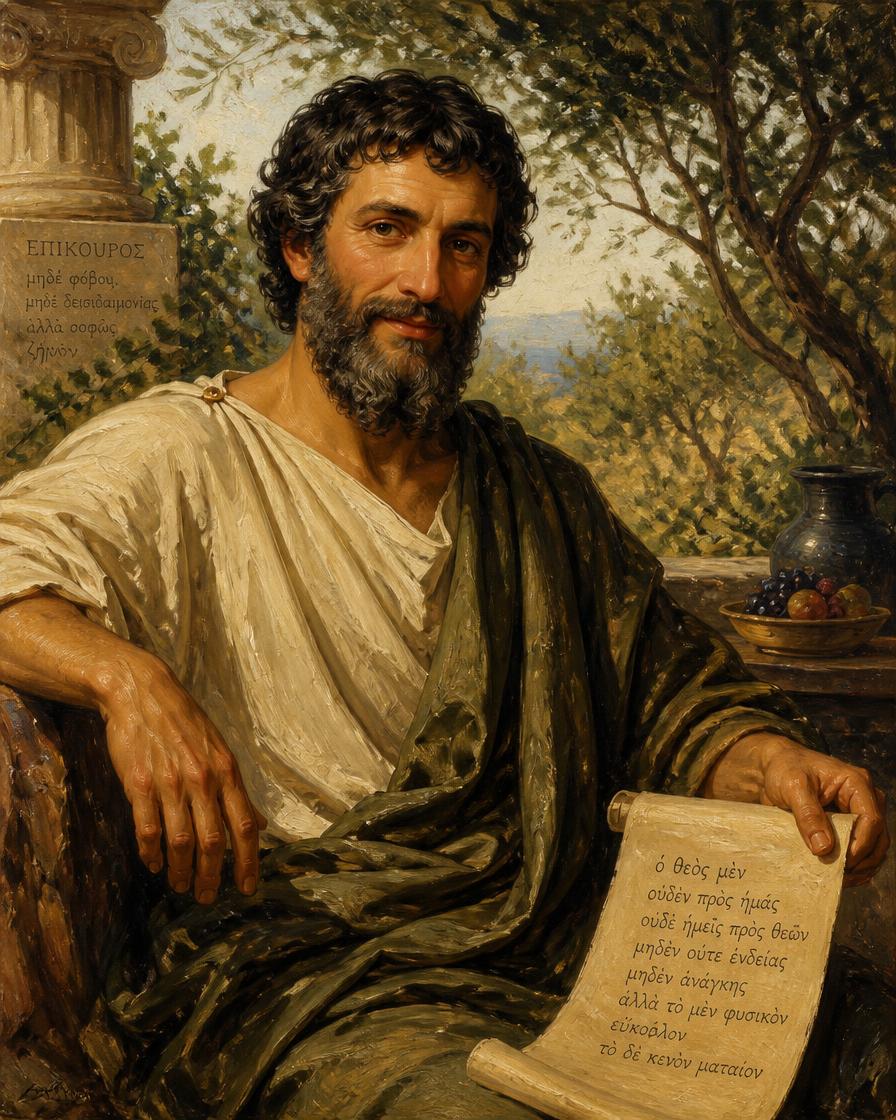
Quick Facts
- Years
- 341 BC – 270 BC
- Category
- Philosophers & Thinkers
- Subcategory
- Ancient Greek Philosophy
- Nationality
- Greek
- Occupation
- Philosopher & Founder of Epicureanism
Epicurus
341 BC – 270 BC · Greek · Philosopher & Founder of Epicureanism
Audiobook

Life Lessons from Epicurus
Marcus Alden · 51 min
Epicurus was an ancient Greek philosopher who founded Epicureanism, one of the most influential schools of thought in the Hellenistic world. Born in 341 BCE on the Athenian island of Samos, he taught that the best life was one of lasting pleasure—but by “pleasure” he chiefly meant freedom from bodily pain, mental disturbance, irrational fear, and unnecessary desire. His ideal was therefore far removed from reckless luxury.
Around 306 BCE, Epicurus established a philosophical community in Athens known as the Garden. Unlike schools centered on public debate or political advancement, the Garden emphasized friendship, modest living, philosophical study, and personal security. Ancient testimony indicates that women and enslaved people participated, making the community unusually inclusive by contemporary standards.
Epicurus developed a materialist account of nature based on atoms and void. He argued that natural explanations could release people from fear of divine punishment, while reflection on mortality could overcome fear of death. Although most of his extensive writings have disappeared, three letters, two collections of maxims, fragments, and reports by later authors preserve the outlines of his system.
Frequently misrepresented as an advocate of indulgence or atheism, Epicurus instead promoted disciplined desire, prudence, friendship, and tranquility. His ethics, atomism, theology, and arguments about death continue to influence philosophy, science, secular ethics, and debates about well-being.
Quick Facts
| Field | Information |
|---|---|
| Full Name | Epicurus (Greek: Epikouros) |
| Common Name(s) | Epicurus |
| Born | February 341 BCE, traditionally dated to the seventh day of the month Gamelion |
| Died | 270 BCE |
| Age at Death | 71 or 72, depending on calendar reckoning |
| Birthplace | Samos, an Athenian settlement on the island of Samos |
| Nationality | Athenian Greek |
| Occupation | Philosopher, teacher, school founder, writer |
| Historical Era | Hellenistic period |
| Famous For | Founding Epicureanism; the Garden; ethics of tranquility; atomism; arguments against fear of death |
| Political Affiliation | None recorded; generally discouraged conventional political ambition |
| Religion | Believed gods existed but denied that they governed or punished human beings |
| Education | Studied under Pamphilus; later associated with Nausiphanes’ atomist teaching |
| Parents | Neocles and Chaerestrate |
| Spouse(s) | None recorded |
| Children | None recorded |
| Major Works | On Nature; Letter to Herodotus; Letter to Pythocles; Letter to Menoeceus; Principal Doctrines; Vatican Sayings |
| Major Achievements | Founded the Garden; systematized Epicurean ethics, physics, theology, and epistemology; created a durable philosophical community |
Early Life
Epicurus was born in 341 BCE on Samos. His parents, Neocles and Chaerestrate, were Athenian citizens living in a cleruchy, an overseas settlement in which Athenian colonists retained civic identity. Neocles is traditionally described as a schoolteacher. Later hostile anecdotes portrayed Chaerestrate as performing household purification rites, but such reports may have been shaped by polemic and cannot be accepted uncritically.
Epicurus had three known brothers: Neocles, Chaeredemus, and Aristobulus. Sources suggest that they later joined his philosophical circle. Little reliable evidence survives about his childhood. A later tradition says that he became interested in philosophy at fourteen after teachers failed to explain Hesiod’s statement that Chaos came first. The story may express his lifelong demand for natural explanations rather than preserve a literal event.
He reportedly studied with Pamphilus, a Platonist, on Samos. At eighteen, he went to Athens, probably to perform the military and civic service expected of young Athenian citizens. His stay coincided with dramatic changes following Alexander the Great’s death in 323 BCE. Macedonian power reshaped Greek political life, while Athens suffered defeat in the Lamian War.
In 322 BCE, Athenian settlers were expelled from Samos. Epicurus rejoined his displaced family at Colophon in Asia Minor. During these formative years he encountered the teachings of Democritus, whose atomism profoundly influenced him. Diogenes Laertius reports that Epicurus studied under Nausiphanes, a follower of Democritean thought, probably at Teos. Epicurus later spoke critically of teachers and emphasized his intellectual independence, making the exact extent of this mentorship difficult to determine.
The instability of the early Hellenistic age formed the background to his philosophy. Alexander’s empire fragmented among rival dynasties, warfare remained common, and traditional city-state autonomy weakened. Epicurus responded not with a program for political restoration but with an ethics of security, friendship, and self-governed happiness.
Rise to Prominence
Epicurus began teaching philosophy around the age of thirty. Ancient accounts place his early schools at Mytilene on Lesbos and then at Lampsacus on the Hellespont. His time at Mytilene appears to have ended after conflict with local intellectual or civic authorities, although surviving sources do not establish the details.
Lampsacus proved more successful. There he gathered several lifelong associates, including Metrodorus, Hermarchus, Polyaenus, Leonteus, Themista, Colotes, and Idomeneus. These friendships became the nucleus of the Epicurean movement. Rather than presenting philosophy as the achievement of an isolated genius, Epicurus developed a community in which teaching, correspondence, mutual aid, and shared practice reinforced doctrine.
Around 306 BCE, Epicurus moved to Athens and purchased property that became known as the Garden. The school stood apart from the Academy and Lyceum both geographically and institutionally. It offered a stable setting for study and communal life rather than training for public office. Ancient testimony indicates that women—including Themista and Leontion—and enslaved people participated. The precise legal and social status of every participant is uncertain, but the Garden’s membership was broader than that of many elite philosophical circles.
Epicurus became prominent through teaching and an enormous literary output. Diogenes Laertius credits him with roughly 300 scrolls, including the thirty-seven-book On Nature. Most are lost. His school nevertheless survived because doctrines were summarized in letters and memorable sayings that students could learn and apply.
His reputation also grew through controversy. Rival schools accused Epicureans of impiety, selfishness, and sensual excess. Epicureans answered that their pleasure consisted principally in sober reasoning, freedom from pain, and freedom from anxiety. This clash between doctrine and caricature followed Epicurus throughout antiquity and continues to shape his popular image.
Major Achievements
Founding the Garden
Epicurus established the Garden at Athens around 306 BCE and made it the headquarters of a lasting philosophical movement. Its organization centered on friendship, teaching, correspondence, and a relatively simple way of life.
This mattered because philosophy became a practiced community rather than merely a body of arguments. Members supported one another against insecurity and cultivated habits intended to produce tranquility. The school continued after Epicurus’ death under Hermarchus and survived for centuries.
Redefining Pleasure as Tranquility
Epicurus made pleasure the goal of life, but he carefully distinguished stable well-being from constant stimulation. The ideal conditions were aponia, freedom from bodily pain, and ataraxia, freedom from mental disturbance.
His approach mattered because it joined hedonism to restraint. Natural and necessary desires—such as those for food, shelter, and friendship—should be met simply. Empty desires for unlimited wealth, fame, or power should be reduced. This remains an important model of moderate, psychologically informed hedonism.
Developing a Therapeutic Philosophy
For Epicurus, philosophy was medicine for the soul. It addressed four major anxieties: fear of gods, fear of death, fear that good things are unattainable, and fear that pain is unbearable. Later Epicureans summarized these remedies as the “fourfold cure,” although that compact formula survives from Philodemus rather than Epicurus himself.
The achievement was practical as well as theoretical. Philosophy was valuable at every age because it taught people how to live, choose, endure, and form relationships.
Reviving and Revising Atomism
Building on Leucippus and Democritus, Epicurus argued that reality consists fundamentally of bodies and void. Bodies are composed of indivisible atoms moving through empty space. Sensory phenomena arise through material processes rather than supernatural intervention.
Epicurus modified atomism in ways intended to accommodate agency and avoid rigid determinism. Later sources, especially Lucretius, describe an unpredictable atomic “swerve.” The surviving writings of Epicurus do not fully explain this doctrine, so its exact role remains debated.
His natural philosophy helped preserve atomistic thinking for Roman and early modern readers, even though ancient atoms differ substantially from those of modern physics.
Challenging Fear of Death
Epicurus argued that death is “nothing to us.” Good and bad depend on sensation; death is the absence of sensation. While people exist, death is not present, and when death is present, they no longer exist to experience it.
This argument became one of philosophy’s most famous approaches to mortality. It does not prove that dying is painless or that grief is irrational. Rather, it targets the idea that being dead is itself a condition of suffering for the deceased.
Creating a Coherent Account of the Gods
Epicurus affirmed the existence of blessed and immortal gods while denying that they created the universe, controlled weather, rewarded virtue, or punished wrongdoing. Perfect beings, he reasoned, would not be burdened by anger, administration, or intervention.
This allowed him to reject superstition without simply presenting himself as an atheist. His theology challenged civic assumptions and later drew strong criticism from pagan and Christian writers.
Preserving Doctrine Through Summaries
Epicurus wrote concise letters and maxims alongside technical works. The surviving letters to Herodotus, Pythocles, and Menoeceus summarize physics, celestial phenomena, and ethics. The Principal Doctrines condensed central teachings for memorization.
This pedagogical method helped Epicureanism endure after most of its larger treatises vanished. The texts remain among the clearest direct sources for Hellenistic philosophy.
Leadership and Work
Epicurus led primarily as a teacher and community founder. He did not seek elected office or command armies. His authority came from doctrine, personal example, writing, and relationships.
The Garden’s culture emphasized loyalty and friendship. Epicurus corresponded with members outside Athens and encouraged communities in Asia Minor. He also arranged succession: his will placed the school under Hermarchus and provided for memorial observances, dependents, and members of his household.
His method began with observation. Sensations, feelings of pleasure and pain, and basic preconceptions served as standards of judgment. Reason then worked from these foundations. He opposed explanations that multiplied fear unnecessarily and accepted multiple possible natural explanations for some celestial events when evidence could not decide among them.
His strengths included systematic thinking, pedagogical clarity, personal loyalty, and the ability to connect physics with ethics. His memorable formulations made complex teachings usable in daily life.
Possible weaknesses arose from his school’s inward-looking character. Withdrawal from competitive politics could protect individuals, but it offered limited guidance for institutional reform or collective resistance. Strong loyalty to the founder may also have encouraged doctrinal conservatism among later Epicureans. These are interpretive criticisms rather than evidence of personal misconduct.
Personal Life
No reliable source records that Epicurus married or had children. His closest relationships were with relatives, pupils, friends, and household members. Metrodorus was especially important; after Metrodorus died, Epicurus helped provide for his children. His surviving will also shows concern for the children of other associates and for enslaved members of his household, several of whom he ordered freed.
Epicurus praised friendship as one of the greatest sources of security and happiness. The Garden was not merely a classroom: it was a network of mutual assistance. Members commemorated Epicurus and Metrodorus on the twentieth day of each month and celebrated Epicurus’ birthday annually.
Ancient hostile writers alleged luxury and sexual misconduct. These claims conflict with Epicurean texts emphasizing plain food, water, moderation, and careful control of desire. Epicurus reportedly remarked that bread and water could produce great pleasure when one genuinely needed them. He did not claim that richer foods were always wrong, only that dependence on them created vulnerability.
He suffered severe illness late in life, traditionally identified as kidney stones and dysentery or urinary obstruction. In his final letter to Idomeneus, he described intense physical pain while saying that memories of philosophical conversations brought counterbalancing mental joy. He died in 270 BCE.
Descriptions of his personality come largely from followers or enemies. Admirers presented him as kind, grateful, and loyal; critics called him dogmatic or self-satisfied. His own letters support an image of a teacher who valued affection, memory, and emotional steadiness.
Philosophy and Beliefs
Epicurus’ philosophy joined epistemology, physics, theology, and ethics into one therapeutic system.
In epistemology, he treated sensations as direct effects of external bodies and therefore as basic evidence. Error arises not from sensation itself but from judgments added to it. Feelings of pleasure and pain guide choice and avoidance, while preconceptions provide general concepts formed through repeated experience.
In physics, everything that occurs has a natural basis. Nothing comes from nothing, and nothing is reduced to absolute nonbeing. Atoms and void are eternal; worlds form and dissolve without divine creation. The universe is unlimited and contains innumerable worlds. Natural inquiry matters because it removes terror generated by eclipses, storms, celestial motions, and myths of punishment.
Epicurean gods are immortal and perfectly happy. Scholarly debate concerns whether Epicurus regarded them as materially existing beings or as ideal constructions arising in thought. The traditional interpretation treats them as real, exceptionally fine atomic beings living undisturbed between worlds; some modern scholars favor an idealist reading. The surviving evidence does not settle every detail.
Ethically, pleasure is the natural good, but prudence governs how it should be pursued. Some pleasures produce greater pain and should be rejected; some pains produce future benefit and should be accepted. Justice is not an eternal command imposed by gods. It is an agreement neither to harm nor be harmed, varying with circumstances while remaining grounded in mutual advantage.
Epicurus advised avoiding political life when possible because competition, dependence, and ambition disturb tranquility. This was a general strategy, not an absolute ban: Epicureans maintained friendships with influential people, and later adherents sometimes held office.
He also defended a form of agency against necessity. Exactly how atomic motion, the swerve, and human responsibility fit together remains one of the most debated parts of Epicurean philosophy.
Challenges and Controversies
Epicurus faced criticism from Platonists, Stoics, skeptics, and later Christian authors. Much of the controversy centered on the word “pleasure.” Opponents treated hedonism as morally degrading, while Epicureans insisted that stable freedom from pain and disturbance was superior to excess.
Charges of atheism were also common. Epicurus denied providence, creation, divine anger, and an afterlife of punishment, but he continued to speak of gods and encouraged conventional piety purified of fear. Critics regarded this as disguised atheism; defenders saw it as a consistent nonprovidential theology.
His attitude toward politics remains disputed. The slogan “live unnoticed” is associated with the Epicurean tradition, although its exact context is uncertain. Critics argue that withdrawal can become civic irresponsibility, especially during injustice. Supporters reply that Hellenistic politics was often dangerous and that peaceful communities can have social value without pursuing power.
Epicurus’ treatment of justice as conventional and useful drew objections from thinkers who believed justice must rest on universal nature or divine law. Yet his contractual account anticipated later theories based on reciprocity and mutual benefit.
His physics was not modern science. Atomic shapes, falling atoms, and image films cannot simply be equated with contemporary theories. Its historical importance lies in naturalism, causal explanation, and rejection of supernatural intervention—not in experimental accuracy.
The school’s loyalty was another point of criticism. Epicureans preserved the founder’s doctrines with unusual consistency. This ensured continuity but may have discouraged revision. On the other hand, surviving works by Lucretius, Philodemus, and Diogenes of Oenoanda show adaptation to new audiences.
Finally, evidence about Epicurus is uneven. Most of his books are lost, and many personal stories come from partisan traditions. Responsible biography must therefore distinguish direct writings, credible testimony, hostile gossip, and later interpretation.
Legacy
Epicureanism remained influential throughout the Hellenistic and Roman periods. The Roman poet Lucretius presented its physics and ethics in On the Nature of Things. Philodemus developed Epicurean approaches to ethics, rhetoric, music, and social life. Around the second century CE, Diogenes of Oenoanda had an enormous summary of the philosophy carved on a public wall in Lycia.
Christian writers attacked Epicurean denial of providence and postmortem punishment, contributing to the school’s decline. Nevertheless, manuscripts and quotations preserved parts of the tradition. The rediscovery of Lucretius’ poem in 1417 helped renew European interest in atomism and naturalistic explanation.
Early modern thinkers—including Pierre Gassendi—adapted Epicurean atomism while reconciling it with Christianity. Epicurus subsequently influenced debates about materialism, happiness, toleration, mortality, and the limits of desire. Thomas Jefferson called himself an Epicurean, though his views were his own modern synthesis.
Modern readers study Epicurus in ethics, philosophy of religion, metaphysics, political thought, and psychology. His distinction between necessary and empty desires resonates with minimalism and critiques of consumerism, while his account of death remains central to philosophical discussions of harm.
Ancient sites associated with him are fragmentary. The probable district of the Garden lies within modern Athens, but no complete school complex survives as a public monument. Important material legacies include Epicurean papyri from the Villa of the Papyri at Herculaneum and the inscription of Diogenes at Oenoanda in modern Turkey. Busts and copies of portraits of Epicurus are held by institutions such as the National Archaeological Museum in Naples and other classical collections.
Interesting Facts
- Epicurus was an Athenian citizen born outside mainland Athens.
- His birthplace, Samos, was then home to an Athenian cleruchy.
- He had three known brothers who reportedly joined his school.
- He founded teaching communities before settling in Athens.
- His Athenian school was called the Garden after its property.
- Women were among the recorded members of his circle.
- Enslaved people also participated in the Epicurean community.
- Ancient sources credited him with about 300 scrolls.
- His largest known work, On Nature, comprised thirty-seven books.
- Carbonized fragments of On Nature survive among the Herculaneum papyri.
- Epicurus believed that the universe contained innumerable worlds.
- He taught that gods do not punish human beings after death.
- He classified desires as natural and necessary, natural but unnecessary, or empty.
- He regarded prudence as indispensable to pleasure.
- His school commemorated him monthly on the twentieth day.
- His will freed several enslaved members of his household.
- Hermarchus succeeded him as head of the Garden.
- “Epicurean” later acquired a luxurious meaning at odds with his usual diet and ethics.
Famous Quotes
Translations vary; references identify the ancient source.
- “Death is nothing to us.” — Letter to Menoeceus. Epicurus means that death cannot be experienced by the person who has died, weakening fear of postmortem suffering.
- “When we exist, death is not present, and when death is present, we do not exist.” — Letter to Menoeceus. This states the core logic of his argument against fear of death.
- “Pleasure is the beginning and end of the blessed life.” — Letter to Menoeceus. The context makes clear that pleasure is governed by prudent calculation, not excess.
- “It is impossible to live pleasantly without living prudently, honorably, and justly.” — Principal Doctrines 5. Epicurean pleasure and virtue are interdependent.
- “Of all the things wisdom provides for the complete happiness of one’s whole life, by far the greatest is friendship.” — Principal Doctrines 27. Friendship provides affection, confidence, and security.
- “Natural wealth is both limited and easy to acquire; the riches incited by empty opinions extend to infinity.” — Principal Doctrines 15. Basic needs have limits, while status competition does not.
- “The just person is most free from disturbance, while the unjust is full of the greatest disturbance.” — Principal Doctrines 17. Injustice generates fear and insecurity.
- “We must practice the things which produce happiness.” — Letter to Menoeceus. Philosophy is presented as a repeated activity rather than abstract knowledge alone.
- “Empty is the argument of the philosopher by which no human suffering is treated.” — Fragment preserved by Porphyry. The saying expresses philosophy’s therapeutic purpose.
- “Send me a little pot of cheese, so that I may feast luxuriously when I wish.” — Fragment reported by Diogenes Laertius. The humorous request illustrates how modest Epicurus’ idea of luxury could be.
- “Live unnoticed.” — Traditionally attributed to Epicurus and discussed by Plutarch. The phrase is documented in antiquity, but its original setting and whether it was an absolute command are disputed.
Timeline
- 341 BCE — Epicurus is born on Samos to Athenian parents.
- About 327 BCE — Traditional date for his first serious interest in philosophy.
- 323 BCE — Travels to Athens around age eighteen, probably for civic and military training.
- 322 BCE — Athenian settlers are expelled from Samos; his family relocates to Colophon.
- Late 320s–310s BCE — Studies and teaches in Asia Minor; encounters Democritean atomism, probably through Nausiphanes.
- About 311–310 BCE — Begins teaching at Mytilene.
- About 310–307 BCE — Establishes a successful community at Lampsacus.
- 306 BCE — Moves to Athens and founds the Garden.
- 306–270 BCE — Teaches, writes extensively, and directs Epicurean communities through personal instruction and letters.
- Before 270 BCE — Metrodorus dies; Epicurus assumes responsibilities toward his family.
- 270 BCE — Epicurus dies in Athens after severe illness.
- 270 BCE — Hermarchus succeeds him as head of the Garden.
- First century BCE — Lucretius composes On the Nature of Things; Philodemus writes Epicurean works preserved at Herculaneum.
- Second century CE — Diogenes of Oenoanda displays Epicurean doctrine in a monumental inscription.
- 1417 CE — Poggio Bracciolini rediscovers a manuscript of Lucretius, contributing to renewed interest in Epicurean ideas.
Frequently Asked Questions
Who was Epicurus?
Epicurus was an Athenian Greek philosopher born on Samos in 341 BCE. He founded Epicureanism and established the Garden in Athens around 306 BCE. His system linked atomistic physics, nonprovidential theology, empiricist epistemology, and an ethics of pleasure. He believed philosophy should free people from fear and teach them to live happily through prudence, friendship, modest needs, and mental tranquility. He died in 270 BCE, but his school remained active for centuries.
What did Epicurus mean by pleasure?
He did not primarily mean luxury, intoxication, or uninterrupted excitement. The most dependable pleasure was a stable condition: freedom from bodily pain and mental disturbance. Epicurus accepted ordinary sensory pleasures but insisted that their consequences must be evaluated. A pleasure that causes illness, dependence, anxiety, or greater future pain should be refused. Simple food, safety, reflection, and trustworthy friendships were often preferable because they satisfied natural needs without creating new forms of insecurity.
Was Epicurus a hedonist?
Yes, in the philosophical sense that he regarded pleasure as the ultimate good and pain as the ultimate bad. However, his hedonism was disciplined and prudential. He believed some pains should be accepted for greater future pleasure, while some pleasures should be rejected because of harmful consequences. Virtue was essential because prudence, justice, and moderation make secure pleasure possible. Calling him a hedonist is accurate, but equating his position with uncontrolled indulgence is not.
Was Epicurus an atheist?
Not according to his surviving writings. He affirmed that gods are blessed and immortal but denied that they created or governed the world, answered prayers, or punished people after death. Scholars debate exactly what kind of existence he attributed to them. Ancient critics sometimes called his position practical atheism because the gods had no providential role. Epicureans instead claimed that they honored divine perfection more consistently by refusing to attribute anger, jealousy, labor, or cruelty to gods.
What was the Garden?
The Garden was Epicurus’ school and community in Athens, founded around 306 BCE. It took its name from the property associated with the group. Unlike institutions closely tied to public rhetoric or political careers, it emphasized shared philosophical practice, friendship, correspondence, and comparative withdrawal from civic competition. Ancient evidence records women and enslaved participants as well as citizen men. Details of daily organization remain incomplete, so it should not automatically be imagined as either a modern university or a fully communal household.
Did Epicurus believe in an afterlife?
No surviving Epicurean doctrine supports personal survival after death. The soul, like the body, was composed of fine atoms and dispersed at death. Without a functioning soul-body compound, sensation ended. Epicurus therefore rejected eternal punishment and argued that death itself cannot be experienced. His reasoning was designed to remove fear, although it does not deny that bereavement, the process of dying, or premature loss can be painful for living people.
Why did Epicurus think death was nothing to us?
Epicurus held that all good and bad experience requires sensation. Death is the permanent absence of sensation. Therefore, a dead person cannot experience deprivation, darkness, punishment, or distress. Before death, one is alive and death is not yet present; after death, there is no subject left to suffer it. Philosophers continue to debate this argument, especially whether death can harm someone by depriving that person of future goods even if it is never experienced.
What are ataraxia and aponia?
Ataraxia means freedom from mental disturbance, while aponia means freedom from bodily pain. Together they describe the stable well-being Epicurus valued. Ataraxia requires overcoming irrational fears, limiting empty desires, and developing secure friendships. Aponia does not imply permanent perfect health; Epicurus acknowledged severe illness. Rather, bodily pain should be prevented where possible and understood without exaggeration. Mental joy, memory, and perspective could sometimes help a person endure unavoidable suffering.
What did Epicurus teach about desire?
He distinguished natural and necessary desires, natural but unnecessary desires, and empty desires. Food, shelter, and basic security are natural and necessary. Elaborate food may be natural but unnecessary because hunger can be satisfied more simply. Unlimited wealth, fame, and domination arise largely from false social beliefs and have no natural limit. Happiness depends less on acquiring everything desired than on examining desires and removing those that create dependence, rivalry, or anxiety.
Did Epicurus reject politics?
He generally advised people not to pursue conventional political ambition because office, fame, and faction could destroy tranquility. Yet his position was strategic rather than a fully universal prohibition. Circumstances and personal safety mattered, and later Epicureans sometimes held public roles. Critics see his stance as insufficiently civic; defenders note that the violent politics of the Hellenistic age made withdrawal reasonable. His own community still relied on rules, property, contracts, and social relationships.
What did Epicurus believe about justice?
Justice was an agreement of mutual advantage: people undertake neither to harm nor to be harmed. It was not an independent supernatural command. Laws are just when they serve reciprocal security; when circumstances change and a law no longer benefits social relations, it may cease to be just in application. This view is conventional but not simply cynical, because injustice produces fear of detection and retaliation. Epicurus considered justice indispensable to a tranquil life.
How did Epicurus differ from the Stoics?
Epicurus made pleasure, understood as secure well-being, the goal of life. Stoics identified virtue as the only true good and treated pleasure as morally secondary. Epicureans usually advised withdrawal from political ambition; Stoics more readily accepted public duty when circumstances required it. Both schools valued self-control, rational judgment, and freedom from destructive passions, but their physics and theology differed: Stoics believed in a providentially ordered cosmos, while Epicurus denied divine government of the world.
What survives of Epicurus’ writings?
Three complete letters survive through Diogenes Laertius: those to Herodotus, Pythocles, and Menoeceus. Diogenes also preserves the Principal Doctrines and Epicurus’ will. The Vatican Sayings were discovered in a medieval manuscript. Fragments survive through quotations, inscriptions, and carbonized papyri from Herculaneum, including parts of On Nature. Since ancient sources credited him with around 300 scrolls, the surviving corpus represents only a small portion of his work.
Did Epicurus invent atomism?
No. Leucippus and Democritus developed Greek atomism before him. Epicurus adopted their basic view that bodies consist of indivisible atoms moving in void, but he modified the theory and integrated it into a therapeutic ethical system. Later Epicurean sources describe an atomic swerve that helps prevent strict determinism. Epicurus’ significance lies not in inventing atomism but in revising, systematizing, teaching, and transmitting it.
What was Epicurus’ view of friendship?
Friendship was one of life’s greatest goods. It provided practical protection, emotional reassurance, intellectual companionship, and confidence about the future. Although Epicurus often explained institutions through mutual advantage, friendship was not merely a cold transaction; his letters and will show enduring affection and responsibility. The Garden’s communal structure turned friendship into a daily philosophical practice. For Epicurus, self-sufficiency did not mean isolation but freedom from dependence combined with reliable mutual care.
Was the Garden unusually inclusive?
Ancient sources identify women such as Themista and Leontion within the Epicurean circle, and they also mention enslaved participants, including Mys. This was notable in a society where advanced philosophical institutions were generally dominated by free men. The evidence does not establish modern equality, and the legal constraints of slavery and patriarchy remained. Still, the Garden appears to have admitted a socially broader membership than many contemporary intellectual communities.
How did Epicurus die?
Epicurus died in Athens in 270 BCE after a painful illness. Diogenes Laertius reports urinary or intestinal suffering, often interpreted as kidney stones and related complications. In a final letter to Idomeneus, Epicurus described extreme bodily pain while recalling joyful philosophical discussions. The account became an illustration of his belief that mental pleasure and gratitude could counterbalance—even if not erase—physical distress.
Why is Epicurus still relevant?
Epicurus addresses enduring concerns: fear of death, religious anxiety, consumer desire, political ambition, loneliness, and the pursuit of happiness. His distinction between basic needs and limitless status desires speaks directly to consumer culture. His emphasis on friendship challenges purely individualistic accounts of well-being. His naturalism helped shape later scientific thought, while his death argument remains philosophically controversial. Readers need not accept his complete system to find useful analytical tools within it.
Lessons We Can Learn
- Define happiness carefully. Epicurus distinguished lasting tranquility from momentary stimulation. Today, clear definitions can prevent us from confusing well-being with consumption.
- Examine the consequences of pleasure. He rejected pleasures that produced greater pain. The same calculation applies to addiction, debt, and unhealthy habits.
- Limit desires that have no endpoint. His critique of fame and limitless wealth shows why status competition rarely delivers security.
- Invest in friendship. The Garden made trusted relationships central to happiness. Social connection remains essential to resilience and health.
- Use knowledge to reduce fear. Epicurus studied nature to replace terrifying myths with explanations. Evidence can still counter anxiety and misinformation.
- Separate death from the process of dying. His argument targets imagined suffering after death, encouraging more precise reflection on mortality and care.
- Practice prudence rather than rigid denial. Epicurus did not reject every luxury; he warned against needing luxuries. Flexible moderation is more sustainable than performative austerity.
- Build communities around values. The Garden embodied doctrine through shared practice. Institutions become credible when their organization reflects their principles.
- Question political ambition. Epicurus saw how power-seeking creates dependence and fear. Modern citizens can distinguish meaningful service from status-driven competition.
- Preserve ideas accessibly. His letters and maxims survived when larger works did not. Concise, teachable communication helps valuable knowledge endure.
Related Historical Figures
- Democritus — Earlier atomist whose physics provided a major foundation for Epicurean natural philosophy.
- Nausiphanes — Democritean teacher traditionally associated with Epicurus’ education, though Epicurus later minimized his debt.
- Metrodorus of Lampsacus — Epicurus’ closest associate and a major early exponent of the school.
- Hermarchus — Pupil from Mytilene who succeeded Epicurus as head of the Garden.
- Leontion — Woman philosopher and member of the Epicurean circle, remembered as a writer against Theophrastus.
- Zeno of Citium — Founder of Stoicism and near contemporary whose school became Epicureanism’s major philosophical rival.
- Theophrastus — Aristotle’s successor at the Lyceum and a prominent contemporary intellectual opposed by some Epicureans.
- Lucretius — Roman poet whose On the Nature of Things transmitted Epicurean physics and ethics to later ages.
- Philodemus of Gadara — First-century BCE Epicurean whose works survive among the Herculaneum papyri.
- Diogenes of Oenoanda — Later adherent who publicized Epicurean teaching through a monumental stone inscription.
Related Historical Figures