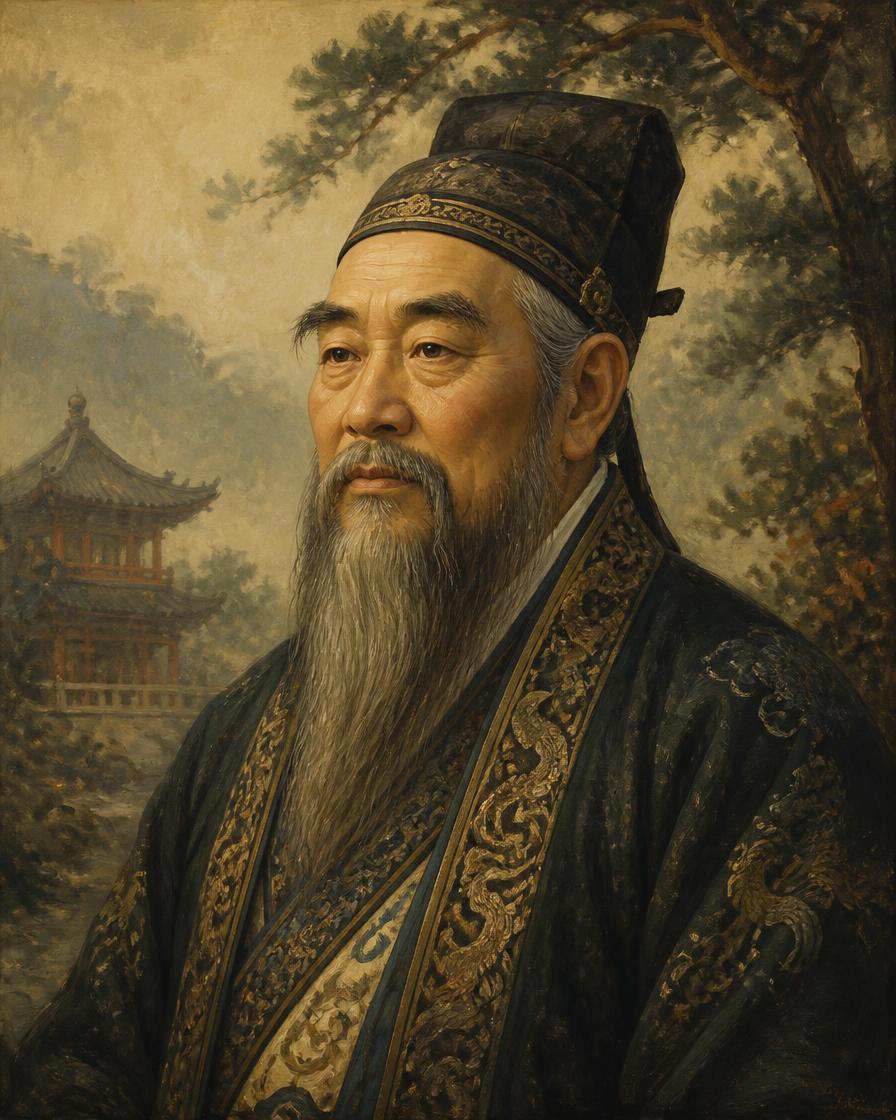
Quick Facts
- Years
- 551 BC – 479 BC
- Category
- Philosophers & Thinkers
- Subcategory
- Eastern Philosophy
- Nationality
- Chinese
- Occupation
- Philosopher & Teacher
Confucius
551 BC – 479 BC · Chinese · Philosopher & Teacher
Audiobook

Life Lessons from Confucius
Marcus Alden · 50 min
Confucius was an ancient Chinese teacher, thinker, and political adviser whose ideas profoundly shaped East Asian civilization. Born in 551 BCE in the state of Lu, during the declining centuries of the Zhou dynasty, he lived amid political fragmentation and social unrest. He responded not by proposing a new religion or a revolutionary state, but by teaching that social order begins with ethical self-cultivation, responsible relationships, humane government, and serious engagement with inherited traditions.
Known in Chinese as Kongzi, or “Master Kong,” Confucius taught students from varied backgrounds and sought public office where he could put his principles into practice. His political career was limited and remains difficult to reconstruct, but his educational influence proved immense. Teachings associated with him were preserved chiefly in the Analects, a collection compiled by disciples and later followers rather than written directly by Confucius.
Confucius’s greatest achievements include redefining education as moral formation, developing an enduring ideal of humane leadership, and transmitting cultural traditions that became central to Chinese intellectual life. Later dynasties made Confucian texts the foundation of elite education and civil-service examinations. His thought also transformed Korea, Japan, Vietnam, and other societies. Confucius remains studied because his questions—how to learn, lead, treat others, honor tradition, and become a better person—still matter.
Quick Facts
| Field | Information |
|---|---|
| Full Name | Kong Qiu (孔丘); courtesy name Zhongni (仲尼) |
| Common Name(s) | Confucius; Kongzi (“Master Kong”); Kong Fuzi |
| Born | Traditionally 28 September 551 BCE |
| Died | 479 BCE |
| Age at Death | About 72 by traditional East Asian reckoning; approximately 71–72 |
| Birthplace | Zou, state of Lu, traditionally identified near modern Qufu, Shandong, China |
| Nationality | Chinese; more precisely, a subject of the ancient state of Lu |
| Occupation | Teacher, philosopher, scholar, political adviser, official |
| Historical Era | Eastern Zhou dynasty; Spring and Autumn period |
| Famous For | Confucian ethics, educational teaching, humane government, ritual propriety, the Analects |
| Political Affiliation if applicable | Served or advised the government of Lu; no modern party affiliation |
| Religion if significant | Participant in Zhou ritual tradition and ancestor veneration; not founder of a religion in the conventional sense |
| Education | Privately educated through study of ritual, music, history, poetry, and traditional arts; details uncertain |
| Parents | Kong He, traditionally called Shuliang He; Yan Zhengzai according to later tradition |
| Spouse(s) | Traditionally Qiguan Shi; early evidence is limited |
| Children | A son, Kong Li; traditions also mention daughters, but details are uncertain |
| Major Works | No surviving text securely authored by him; teachings preserved chiefly in the Analects |
| Major Achievements | Established an influential teaching tradition; articulated ideals of ren, li, and virtuous government; shaped East Asian education and political ethics |
Early Life
Confucius was born in 551 BCE in Lu, a regional state located largely in present-day Shandong. Lu claimed close ties to early Zhou institutions and preserved traditions of court ritual, music, and ceremony. This cultural environment strongly influenced his later conviction that inherited practices could educate emotions and sustain an orderly society.
His family belonged to the shi, a broad social group sometimes translated as “knights,” “retainers,” or lower aristocracy. Later biographies say his father, Kong He, was an elderly military officer who died when Confucius was young. His mother, Yan Zhengzai, reportedly raised him in reduced circumstances. Many colorful details come from sources written centuries later and cannot be independently verified.
In the Analects, Confucius says that at fifteen he set his heart upon learning. He also states that he was poor and of humble status when young, which may explain his familiarity with practical administrative tasks. Later accounts associate him with work involving granaries and livestock.
His education appears to have included poetry, history, ritual, music, archery, charioteering, writing, and calculation—the traditional “six arts.” There is no reliable evidence that he attended a formal academy or studied under one permanent master. He presented himself instead as an eager learner who drew insight from many people.
Confucius grew up as Zhou royal authority weakened. Powerful hereditary families increasingly dominated Lu, while states competed through diplomacy and war. Ministers sometimes displaced rulers, and retainers rebelled against ministers. Confucius interpreted this instability as a moral and institutional crisis: titles, duties, and conduct no longer corresponded. His lifelong project was to restore coherence through education, ritual, and exemplary leadership.
Rise to Prominence
Confucius probably began his career in minor service before becoming known as a teacher. He welcomed students who demonstrated commitment, reportedly refusing no one merely because that person brought only a modest introductory gift. This did not amount to modern universal schooling, but it helped establish an image of education extending beyond hereditary elites.
His teaching was conversational and demanding. Rather than simply dictating doctrines, he questioned students, commented on poems, discussed public affairs, and tailored guidance to individual character. The Analects portrays a community in which students debated, performed ritual, studied music, and reflected on their own conduct.
By middle age, Confucius had acquired enough standing to seek political influence. Traditional histories describe him holding offices in Lu, including administrator, minister of works, and minister of justice. Some modern scholars accept that he occupied significant office; others warn that later writers may have enlarged his official achievements to illustrate ideal government.
Around 497 BCE, conflict involving Lu’s ruler, major aristocratic families, and rebellious retainers contributed to Confucius’s departure. He traveled through several states with disciples, hoping to find a ruler willing to implement government through virtue and ritual. He met political leaders but never secured the sustained authority he desired. At times, his group faced danger, deprivation, and rejection.
The journeys nevertheless broadened his reputation. Confucius became known as a learned adviser who criticized coercive rule and argued that rulers must lead through moral example. He eventually returned to Lu, probably in 484 BCE. His final years were devoted to teaching and engagement with inherited texts. After his death, disciples and later transmitters carried his reputation far beyond anything achieved during his political career.
Major Achievements
Creating an Enduring Educational Tradition
Confucius made learning the center of ethical life. He taught that human character could be improved through study, reflection, practice, and correction. Education was not merely technical preparation; it was the process by which a person became trustworthy, considerate, and capable of public responsibility.
This approach mattered because it made cultivated conduct, rather than birth alone, a central measure of distinction. The long-term result was a powerful East Asian tradition linking education with moral and governmental service.
Formulating the Ideal of Ren
The term ren is translated as humaneness, benevolence, or authoritative humanity. Confucius used it for excellence in relating to other people. It involved care, restraint, courage, loyalty, and the refusal to impose unwanted treatment upon others.
By placing ren at the heart of ethics, he connected personal character with social responsibility. Later Confucian thinkers developed this ideal in different directions, but it remained one of the tradition’s defining concepts.
Reinterpreting Ritual Propriety
Confucius defended li: rites, ceremonies, manners, and appropriate patterns of conduct. He did not treat ritual as empty form. Properly practiced, it disciplined selfish impulses, expressed respect, and trained people to inhabit relationships well.
This interpretation helped preserve Zhou traditions while making them ethically meaningful. Ritual became a method of moral education extending from family behavior to diplomacy and government.
Advancing Government by Moral Example
Confucius argued that rulers relying mainly on punishments might secure outward compliance but not inner shame or loyalty. A virtuous leader, by contrast, could influence society through example, trustworthy appointments, and proper institutions.
His political proposals rarely controlled events in his lifetime. Their long-term impact was enormous, however: later Chinese rulers were repeatedly judged according to ideals of benevolence, learning, filial responsibility, and concern for the people.
Preserving and Interpreting Cultural Heritage
Tradition associated Confucius with the “Five Classics,” especially the Book of Songs, Book of Documents, Book of Rites, Book of Changes, and Spring and Autumn Annals. Older scholarship often credited him with editing or authoring portions of these works.
Modern historians are cautious. The texts developed across long periods, and direct authorship by Confucius cannot generally be demonstrated. His genuine achievement was more likely teaching, interpreting, and transmitting inherited materials within an influential community.
Inspiring the Confucian Tradition
Confucius did not create a fully organized system called “Confucianism.” That broad tradition emerged through later interpreters, institutions, state sponsorship, family practices, and debates with competing schools.
Nevertheless, his name and reported teachings became its central reference point. From the Han dynasty onward, Confucian learning increasingly shaped government and education. Its influence later spread throughout East Asia.
Leadership and Work
Confucius led primarily as a teacher. His authority depended on knowledge, moral seriousness, and the ability to diagnose individual strengths and weaknesses. He expected students to think rather than repeat. One saying suggests that if he raised one corner of a subject and a student could not infer the other three, he would not continue immediately.
His decision-making was guided by appropriateness rather than rigid formulas. The Analects often gives different advice to different students because their temperaments differed. A hesitant student might need encouragement; an impulsive one might need restraint.
Core values included sincerity, trustworthiness, filial respect, courage, loyalty, ritual discipline, and continuous learning. Confucius admired officials willing to correct rulers rather than flatter them. He also emphasized careful speech: a cultivated person should be reluctant to promise more than could be performed.
Relationships were central to his method. He treated friendship as a setting for mutual moral improvement and mourned several disciples deeply. Yan Hui was praised for his love of learning, while Zilu’s boldness drew both affection and criticism.
His strengths included persistence, intellectual curiosity, practical ethical insight, and exceptional influence as a mentor. His weaknesses included an idealized view of early Zhou culture and limited ability to navigate the power politics of his age. His political program depended heavily on finding rulers prepared to reform themselves—an expectation repeatedly disappointed.
Personal Life
Reliable information about Confucius’s private life is scarce. Later tradition says he married a woman from the Qiguan family and had a son, Kong Li, also called Boyu. Traditions mention daughters, but their names and number are uncertain. The Analects offers only brief glimpses of his interactions with his son.
His closest documented relationships are often those with students. The death of Yan Hui devastated him; when companions thought his grief excessive, he replied in effect that if he did not grieve deeply for such a person, for whom would he grieve? He also lamented the violent death of Zilu.
Confucius enjoyed music and poetry. He considered music morally formative and reportedly became so absorbed after hearing the ancient Shao music that he did not notice the taste of meat for three months. Whether literal or rhetorical, the account conveys his intense aesthetic response.
The Analects portrays him as disciplined but not joyless. He ate and dressed according to standards of season, cleanliness, and ritual appropriateness. He enjoyed conversation with friends and described learning practiced over time as a source of pleasure.
He could be exacting, impatient with pretension, and sharply critical of hypocrisy. Yet he also practiced self-examination and denied possessing innate wisdom. Information about his health is fragmentary. He endured hardship during travel and suffered bereavements late in life before dying in 479 BCE.
Philosophy and Beliefs
Confucius’s philosophy begins with moral cultivation. People become better through learning, reflection, ritual practice, and attention to relationships. His ideal person, the junzi—originally “ruler’s son,” but redefined as an exemplary person—acts from principle rather than narrow profit.
Ren describes humane excellence, while li supplies forms through which respect becomes visible. Yi, or moral appropriateness, means doing what is right in the circumstances. Xin signifies trustworthiness, and zhi practical moral understanding. These virtues operate together rather than as isolated rules.
Filial respect, or xiao, was especially important. Confucius regarded the family as the first school of gratitude and responsibility. Yet filial conduct was not necessarily blind obedience: later Confucian tradition emphasized respectfully remonstrating with parents when needed.
Politically, Confucius favored hierarchical but reciprocal relationships. Rulers should rule humanely, ministers should serve loyally while offering correction, parents should care for children, and children should show respect. Authority carried obligations; a ruler who lacked virtue undermined the moral basis of rule.
His “rectification of names” held that titles and realities must agree. A ruler should behave as a ruler, a minister as a minister, and so forth. This was not merely linguistic. It addressed institutional disorder and the misuse of status.
Confucius respected Heaven (Tian), ancestral rites, sacrifice, and spiritual beings, but generally emphasized human duties. He advised respecting ghosts and spirits while keeping an appropriate distance. Asked about death, he redirected attention toward understanding life. Scholars therefore debate whether to classify him chiefly as a religious thinker, ethical philosopher, ritual traditionalist, or all three.
Challenges and Controversies
Confucius’s most obvious failure was political. He wanted to reform government but never obtained lasting power. Traditional accounts sometimes transform brief service into dramatic success, while modern historians question their chronology and scale. His political frustration does not erase his ideas, but it complicates portrayals of him as a triumphant statesman.
His reverence for antiquity is also debated. Admirers see critical recovery of traditions that disciplined power and humanized relationships. Critics see excessive nostalgia for an aristocratic order. Confucius claimed to transmit rather than create, although his reinterpretation of inherited concepts was itself innovative.
Confucian hierarchy has been criticized for supporting authoritarian rule, rigid family structures, age privilege, and social conformity. Defenders reply that classical Confucian relationships were reciprocal and imposed demanding responsibilities on superiors. In practice, however, institutions often emphasized obedience more strongly than reciprocity.
Gender is another major controversy. The Analects contains little sustained discussion of women and includes a difficult remark grouping “women and petty persons” as hard to manage. Interpretations vary, but later Confucian societies undeniably developed patriarchal norms that restricted women. It would be inaccurate to attribute every later practice directly to Confucius, yet his tradition participated in those historical structures.
Textual authenticity presents further problems. The Analects was compiled after his death and contains layers from different periods. Not every saying can be treated as a verbatim transcript. Famous quotations circulating online are frequently paraphrased, mistranslated, or falsely attributed.
Confucius has also been repeatedly politicized. Imperial governments honored him; reformers reinterpreted him; early twentieth-century radicals attacked him as a symbol of feudalism; Communist campaigns denounced him; and modern institutions sometimes present him as an emblem of Chinese culture. Each use reveals as much about its own era as about the historical teacher.
Legacy
Confucius’s immediate followers preserved his teaching, but later thinkers made it a major intellectual tradition. Mencius argued that human nature tends toward goodness, while Xunzi emphasized disciplined transformation. Han dynasty scholars connected Confucian learning to imperial institutions, although legal and administrative practice always drew from multiple traditions.
During the Song dynasty, thinkers such as Zhu Xi developed Neo-Confucian metaphysics and established a curriculum centered on the Four Books. Zhu Xi’s editions and commentaries became foundational for civil-service examinations. For centuries, mastery of Confucian texts offered men a path—unequal and highly competitive—toward government service and social prestige.
Confucian thought shaped Korea, Japan, Vietnam, and other parts of East and Southeast Asia through education, bureaucracy, family ethics, ritual, and political theory. It never operated identically everywhere and coexisted with Buddhism, Daoism, Shinto, local religions, and legal traditions.
In modern times, Confucius has been criticized, revived, secularized, and globalized. Scholars examine his ethics alongside virtue ethics, care ethics, civic education, and leadership studies. Critics continue to question hierarchy and patriarchy, while advocates emphasize reciprocity, learning, social responsibility, and humane government.
Qufu remains the principal center of commemoration. Its Temple and Cemetery of Confucius and the Kong Family Mansion form a UNESCO World Heritage Site. Temples dedicated to Confucius exist across East Asia, and statues stand at universities and cultural institutions worldwide. His traditional birthday is marked as Teachers’ Day in Taiwan and by educational ceremonies elsewhere.
Interesting Facts
- “Confucius” is a Latinized form derived from Kong Fuzi, meaning “Master Kong.”
- His personal name was Qiu, and his courtesy name was Zhongni.
- He lived before China was unified under the Qin dynasty.
- Lu, his home state, lay in present-day Shandong province.
- The Analects was compiled by followers after his death.
- No surviving book can be securely identified as written entirely by Confucius.
- He described himself as a transmitter who loved antiquity.
- His curriculum gave major importance to poetry and music.
- He taught that learning should be joined with reflection.
- His exemplary person, the junzi, was defined ethically rather than merely by noble birth.
- Yan Hui was the disciple he most consistently praised for love of learning.
- Confucius traveled among several states seeking a receptive ruler.
- His teachings competed historically with Mohist, Daoist, and Legalist ideas.
- The civil-service examination system developed centuries after his death.
- Mencius and Xunzi offered different accounts of human nature while claiming his legacy.
- The Kong family lineage at Qufu became one of the world’s most famous recorded lineages.
- Jesuit missionaries helped introduce the name “Confucius” to European readers.
- Qufu’s Confucian monuments received UNESCO World Heritage status in 1994.
Famous Quotes
“Is it not a pleasure to learn and, when it is timely, to practice what you have learned?” — Analects 1.1
Opening the Analects, this saying frames education as repeated practice rather than passive possession of information.
“Do not impose on others what you yourself do not desire.” — Analects 15.24
Given when a disciple asked for one guiding principle, the statement expresses reciprocity through restraint.
“To govern by virtue is like the North Star: it remains in its place while the other stars pay homage to it.” — Analects 2.1
The image explains leadership through moral example rather than constant coercion.
“If you guide them with laws and regulate them with punishments, the people will evade them and have no sense of shame. If you guide them with virtue and regulate them with ritual, they will possess shame and correct themselves.” — Analects 2.3
This contrasts external compliance with internal moral formation.
“At fifteen, I set my heart upon learning; at thirty, I took my stand; at forty, I was free from doubts…” — Analects 2.4
Confucius presents moral development as a lifelong sequence extending to age seventy.
“When walking with three people, I am sure to find a teacher among them.” — Analects 7.22
The saying communicates intellectual humility: others provide examples to follow or faults to avoid.
“The exemplary person is concerned with what is right; the petty person is concerned with profit.” — Analects 4.16
This distinguishes principled judgment from narrow self-interest, not wealth from poverty as such.
“To know what you know and to know what you do not know—that is knowledge.” — Analects 2.17
Addressed to Zilu, it defines wisdom partly as honest recognition of limits.
“The gentleman is not a vessel.” — Analects 2.12
A vessel has one fixed use. The compact statement suggests that an educated person should possess broad judgment rather than function as a narrow tool.
“Study the past if you would define the future.” — Disputed attribution
This popular English wording is not a reliable direct quotation from the Analects. It loosely resembles Confucian themes about reviewing the old to understand the new.
Timeline
- 551 BCE — Confucius is traditionally born in Zou in the state of Lu.
- Circa 548 BCE — His father is traditionally said to have died while Confucius was young; exact date uncertain.
- 536 BCE — At about fifteen, according to his retrospective statement, he sets his heart on learning.
- Circa 533 BCE — Traditional date for his marriage; evidence is late and uncertain.
- Circa 532 BCE — Traditional birth period of his son, Kong Li.
- Early adulthood — Works in minor administrative roles, according to later sources and autobiographical hints.
- Circa 522 BCE — Begins attracting disciples; no exact foundation date for his school is known.
- Circa 501–497 BCE — Traditional period of significant official service in Lu.
- 497 BCE — Leaves Lu amid political conflict and begins extended travels.
- 497–484 BCE — Visits or passes through states including Wei, Song, Chen, and Cai while seeking political employment.
- Circa 489 BCE — His party reportedly suffers hardship between Chen and Cai; details are debated.
- 484 BCE — Returns to Lu, probably with support connected to disciple Ran Qiu.
- 483 BCE — His son Kong Li traditionally dies.
- 481 BCE — Yan Hui dies; Confucius expresses profound grief.
- 480 BCE — Zilu dies during political violence in Wei.
- 479 BCE — Confucius dies in Lu.
- Centuries following — Disciples and later communities compile and transmit material that becomes the Analects.
- 136 BCE — Han emperor Wu establishes official scholarly positions for the Five Classics, strengthening Confucian institutional influence.
- 12th century CE — Zhu Xi systematizes the Four Books curriculum.
- 1302 CE — Confucius receives the imperial title “Ultimate Sage and Great Accomplished One.”
- 1905 CE — Qing government abolishes the traditional civil-service examination system.
- 1994 CE — Confucian monuments at Qufu are inscribed as a UNESCO World Heritage Site.
Frequently Asked Questions
Who was Confucius?
Confucius was a teacher, thinker, and occasional official from the state of Lu in ancient China. He lived from 551 to 479 BCE during the Spring and Autumn period. His teachings emphasized moral cultivation, humane relationships, ritual propriety, education, and government through virtue. Although later generations treated him as the central sage of Confucianism, he did not establish a church or write a systematic creed. Most evidence for his thought comes from the Analects, compiled after his death.
What was Confucius’s real name?
His family name was Kong and his personal name was Qiu, so he is known as Kong Qiu. Zhongni was his courtesy name. Chinese followers commonly called him Kongzi, “Master Kong,” or Kong Fuzi, “Revered Master Kong.” European Jesuit writers Latinized the latter form as “Confucius.” The familiar Western name therefore reflects early modern cultural transmission rather than the pronunciation used during his lifetime.
When and where was Confucius born?
Traditional chronology places his birth in 551 BCE, often specifically on 28 September. He was born in Zou, within the state of Lu, near modern Qufu in Shandong province. Ancient evidence does not establish every detail of the traditional date with equal certainty. Lu was culturally important because it preserved rituals associated with the early Zhou dynasty, and that environment helped shape Confucius’s lifelong interest in ceremony, music, historical models, and legitimate government.
Did Confucius write the Analects?
No. The Analects is a collection of sayings, conversations, and brief descriptions transmitted by disciples and later followers. It reached its received form through a process extending beyond Confucius’s lifetime. Scholars identify differences in vocabulary, themes, and historical setting among its chapters, suggesting multiple layers of compilation. It remains the most important source for his thought, but individual passages should not automatically be treated as exact transcripts of his spoken words.
What did Confucius teach?
He taught that people can improve through study, reflection, ritual practice, and responsible relationships. Central concepts include ren (humaneness), li (ritual propriety), yi (moral appropriateness), xiao (filial respect), and xin (trustworthiness). He urged rulers to lead through virtue and competent example rather than relying chiefly on punishment. He also valued poetry and music as forms of emotional and moral education.
What is Confucianism?
Confucianism is a broad, later name for traditions rooted in Confucius and developed by many thinkers and institutions. It includes ethics, political theory, education, ritual, family practice, textual scholarship, and—in some forms—religious reverence. Mencius, Xunzi, Dong Zhongshu, Zhu Xi, and Wang Yangming all reshaped it. Because it developed over more than two millennia and across several countries, Confucianism should not be treated as one unchanging doctrine.
Was Confucius religious?
Confucius respected Heaven, ancestral ceremonies, sacrifice, and spiritual beings. He participated in a ritual culture that modern categories cannot neatly classify as either secular philosophy or organized religion. At the same time, he often redirected speculation toward human responsibilities. His advice to respect spirits while keeping an appropriate distance and to understand life before death illustrates that practical emphasis. Scholars therefore differ over whether “religious,” “humanistic,” or “ritual-philosophical” best describes him.
What does ren mean?
Ren is commonly translated as humaneness, benevolence, or humanity. No single English word captures its full range. In the Analects, it concerns excellent conduct toward others and includes care, self-restraint, courage, loyalty, and reciprocity. It is not merely an emotion. A humane person must translate concern into disciplined action within families, friendships, public service, and political leadership.
What is the junzi?
The junzi is the exemplary or noble person. Before Confucius, the term often referred to someone of aristocratic birth. Confucian teaching increasingly gave it an ethical meaning: a junzi is guided by righteousness, learns continuously, behaves appropriately, and resists narrow self-interest. The contrast is the “petty person,” whose judgment is dominated by immediate advantage. This redefinition made cultivated character a more important standard than inherited rank alone.
Did Confucius believe in the Golden Rule?
He expressed a principle closely related to the Golden Rule: “Do not impose on others what you yourself do not desire.” This formulation is sometimes called the negative Golden Rule because it emphasizes restraint. Confucian reciprocity, or shu, also requires attention to roles, circumstances, and the needs of particular people. It is therefore broader than mechanically treating everyone in precisely the same way.
Was Confucius a government official?
Probably, although the scale and chronology of his service are disputed. Traditional accounts say he administered a district and held senior posts such as minister of works or justice in Lu. The earliest sources support political involvement, but later biographies may have embellished his success. What is clear is that Confucius wanted to influence government, advised rulers, and spent years seeking a position where his ethical program could be implemented.
Why did Confucius leave Lu?
He left around 497 BCE amid struggles involving Lu’s ruler, powerful hereditary families, and their retainers. Traditional stories add that the ruler neglected government after receiving entertainers and horses from a rival state, prompting Confucius to depart. Historians treat this moralized account cautiously. His departure probably reflected a larger failure to obtain political support for weakening aristocratic strongholds and restoring orderly authority.
How many disciples did Confucius have?
Later tradition claims 3,000 disciples, with 72 or 77 especially accomplished students. These symbolic-looking numbers cannot be verified as precise enrollment records. The Analects names a smaller circle of recognizable followers, including Yan Hui, Zilu, Zigong, Zengzi, and Ran Qiu. His community was nevertheless substantial enough to preserve varied memories and create an enduring lineage of teaching.
How did Confucius die?
Confucius died in 479 BCE in Lu, apparently from natural causes. Early sources do not provide a reliable modern medical diagnosis. His final years included painful losses: his son Kong Li, favored disciple Yan Hui, and bold student Zilu died before him. Later tradition records mourning by disciples and burial near Qufu, where the Cemetery of Confucius subsequently developed around the Kong lineage.
Did Confucius invent civil-service examinations?
No. China’s examination institutions developed centuries after his death and changed greatly over time. Confucian texts eventually became central to those examinations, especially under later imperial dynasties. Confucius contributed the deeper ideal that learning and cultivated character should qualify people for service, but he did not design the mature examination system often associated with his legacy.
Why was Confucius criticized in modern China?
Reformers and revolutionaries often viewed Confucianism as supporting monarchy, patriarchy, family hierarchy, and resistance to scientific or political modernization. The May Fourth movement criticized traditional culture, while campaigns during the Maoist era attacked Confucius as a representative of reactionary social order. Later assessments became more varied. Some scholars now recover his ethics and educational insights while continuing to criticize historical inequalities associated with Confucian institutions.
Why is Confucius still relevant?
Confucius addresses enduring issues: how leaders earn trust, how education shapes character, how traditions should be interpreted, and how people balance personal ambition with obligations to others. His model of lifelong learning remains influential, as does his warning that punishment alone cannot create ethical citizens. Modern readers need not accept ancient hierarchy uncritically to engage productively with his ideas about reciprocity, integrity, reflection, and responsible authority.
Lessons We Can Learn
- Make learning a lifelong practice. Confucius described moral growth across his entire life. Today, expertise and character likewise require repeated study, application, and revision.
- Join knowledge with reflection. He warned that study without thought leads to confusion, while thought without study is dangerous. Reliable judgment needs both evidence and analysis.
- Lead by example. His North Star analogy shows that conduct shapes institutions. Leaders who demand standards they ignore weaken trust.
- Recognize the limits of your knowledge. Confucius defined knowledge partly as knowing what one does not know. Intellectual honesty prevents overconfidence and invites better advice.
- Practice reciprocity. His instruction not to impose unwanted treatment on others offers a practical test for decisions in workplaces, families, and public life.
- Adapt guidance to the person. Confucius gave different advice to impulsive and hesitant students. Effective teaching and management respond to individual needs rather than applying one formula blindly.
- Use tradition critically. He studied the past to improve the present. Traditions can provide resources without being copied uncritically.
- Match titles with conduct. The rectification of names required officeholders to fulfill their roles. Modern institutions also fail when authority is disconnected from responsibility.
- Value humane relationships over narrow gain. His contrast between righteousness and profit warns against decisions based solely on short-term advantage.
- Persevere without confusing effort with success. Confucius failed to achieve lasting political power yet transformed history through teaching. Influence may emerge through students and institutions rather than immediate victory.
Related Historical Figures
- Laozi — Traditional accounts describe a meeting with Confucius, but its historicity is uncertain. Laozi represents the Daoist tradition often compared with Confucianism.
- Duke of Zhou — An early Zhou statesman whom Confucius revered as a model of ritual order and responsible government.
- Yan Hui — Confucius’s most praised disciple, admired for learning, humility, and contentment despite poverty.
- Zilu — A courageous, outspoken disciple whose impulsiveness frequently prompted Confucius’s corrective teaching.
- Zigong — A talented disciple associated with diplomacy, commerce, and the spread of his teacher’s reputation.
- Zengzi — A younger follower linked to teachings on filial conduct and self-examination; later traditions gave him major importance.
- Mozi — Founder of Mohism, which challenged Confucian ritual expenditure and promoted impartial concern and practical benefit.
- Mencius — A fourth-century BCE Confucian thinker who defended humane government and argued that human nature tends toward goodness.
- Xunzi — A later Confucian philosopher who stressed ritual, education, and deliberate transformation, arguing that untutored human tendencies are problematic.
- Zhu Xi — A Song dynasty scholar who systematized Neo-Confucian thought and shaped the educational canon studied for imperial examinations.
Watch and Learn
Who was Confucius? · TED-Ed
Related Historical Figures