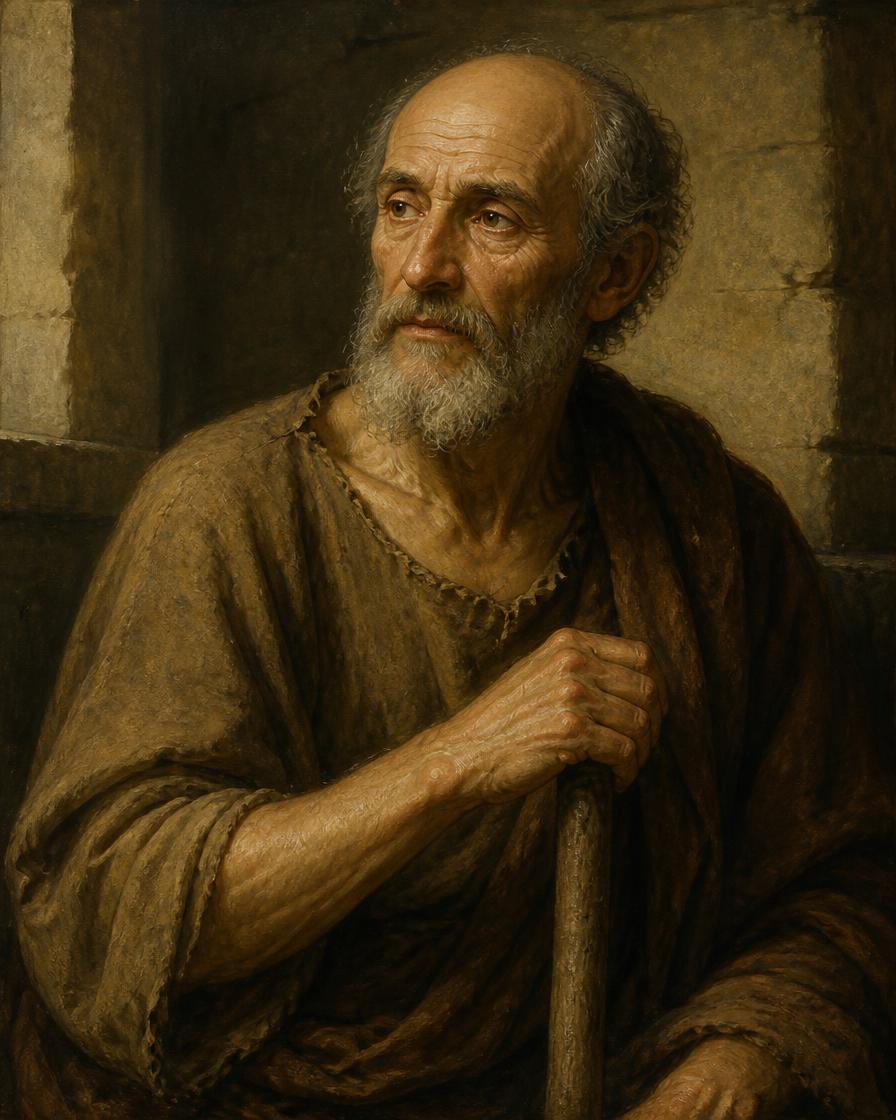
Quick Facts
- Years
- 50 – 135
- Category
- Philosophers & Thinkers
- Subcategory
- Stoicism
- Nationality
- Greek
- Occupation
- Stoic Philosopher
Epictetus
50 – 135 · Greek · Stoic Philosopher
Audiobook

Life Lessons from Epictetus
Marcus Alden · 46 min
Epictetus was a Greek-speaking Stoic philosopher who lived under the Roman Empire, probably from about 50 to about 135 CE. Born enslaved at Hierapolis in Phrygia, he later gained freedom, taught philosophy at Rome, and founded a school at Nicopolis in northwestern Greece. His life gave unusual force to his central teaching: external circumstances do not determine moral character; what matters is how a person judges and responds to them.
Epictetus wrote no surviving books himself. His thought is known chiefly through the Discourses and Enchiridion recorded or compiled by his student Arrian. These works transformed Stoicism from an abstract philosophical system into a demanding program of daily discipline. Epictetus taught students to distinguish what is “up to us”—judgment, intention, desire, and aversion—from what is not, including reputation, wealth, office, illness, and death.
His achievement was not political power or scientific discovery but the creation of one of antiquity’s most influential schools of ethical training. Emperor Marcus Aurelius drew upon his ideas, and later readers included Christian thinkers, Renaissance humanists, soldiers, prisoners, psychotherapists, and advocates of resilience education. Epictetus remains important because he confronted permanent human problems: anxiety, loss, anger, status, responsibility, and freedom. His answer was austere but hopeful—inner liberty depends upon disciplined moral choice.
Quick Facts
| Field | Information |
|---|---|
| Full Name | Epictetus; his birth name is not recorded |
| Common Name(s) | Epictetus; Epiktetos |
| Born | c. 50 CE |
| Died | c. 135 CE; exact date unknown |
| Age at Death | Approximately 85, if the conventional dates are accepted |
| Birthplace | Hierapolis, Phrygia, Roman Empire; near modern Pamukkale, Türkiye |
| Nationality | Greek-speaking subject of the Roman Empire; “nationality” in the modern sense is anachronistic |
| Occupation | Stoic philosopher and teacher |
| Historical Era | Roman Imperial period; Silver Age of Roman literature |
| Famous For | Teaching the distinction between what is and is not within our control |
| Political Affiliation | None recorded |
| Religion | Stoic philosophical theology within Greco-Roman polytheistic culture |
| Education | Studied Stoic philosophy under Gaius Musonius Rufus in Rome |
| Parents | Unknown |
| Spouse(s) | Not recorded; late in life he reportedly lived with a woman who helped care for an adopted child |
| Children | No biological children recorded; reportedly adopted or raised an abandoned child |
| Major Works | No works written by him survive; teachings preserved in Arrian’s Discourses and Enchiridion |
| Major Achievements | Founded a major Stoic school at Nicopolis; shaped later Stoicism and traditions of practical ethics |
Early Life
Epictetus was born around 50 CE at Hierapolis, a prosperous city in Phrygia in Asia Minor. Ancient evidence provides no information about his parents, ancestry, or childhood. Even his familiar name may not have been a personal name in the modern sense: the Greek word epiktētos can mean “acquired,” a possible reference to enslaved status, although scholars caution against treating that interpretation as certain.
He was enslaved and taken to Rome, where he belonged to Epaphroditus. This owner is usually identified as a powerful freedman and imperial secretary under Nero, though ancient people with the same name have sometimes complicated the identification. Enslavement placed Epictetus within a violent legal system in which he could be bought, punished, and denied an independent civic identity.
In Rome he was permitted to study with Gaius Musonius Rufus, one of the leading Stoic teachers of the first century. Musonius emphasized endurance, simple living, practical moral training, and the application of philosophy to ordinary conduct. These themes deeply shaped Epictetus.
Epictetus walked with a pronounced limp. The early Christian writer Origen claimed that his master broke his leg, whereas the Suda, a much later Byzantine encyclopedia, described him as lame through illness. The cause cannot be established. Accounts that dramatize Epictetus calmly predicting the breaking of his leg are memorable but not securely documented contemporary evidence.
His formative years unfolded amid Nero’s rule, court politics, persecution, civil war in 69, and repeated tensions between autocratic emperors and philosophers. Stoicism could encourage public resistance, but Epictetus concentrated primarily on moral independence rather than organized political action.
Rise to Prominence
The date and circumstances of Epictetus’s manumission are unknown. He was free by the time he established himself as a teacher. His experience of enslavement undoubtedly makes his language of freedom striking, although surviving sources do not permit a complete psychological reconstruction of its effects.
He taught at Rome until Emperor Domitian expelled philosophers from Italy, conventionally dated to about 89 or 93 CE. The precise scope and date of Domitian’s measures remain debated, but philosophical teachers associated with moral criticism were clearly vulnerable. Exile became the decisive turning point in Epictetus’s career.
He moved to Nicopolis in Epirus, a city founded by Augustus near the site of the Battle of Actium. Located on major travel routes, it attracted officials, soldiers, aristocrats, and students. There Epictetus founded a school that acquired a wide reputation.
His teaching was conversational and confrontational. Rather than deliver only polished lectures, he questioned students, exposed contradictions, interpreted earlier Stoic texts, and assigned forms of practical self-examination. His audience included young elite men preparing for public careers, but visitors also came from wider Roman society.
Arrian of Nicomedia, later a prominent administrator and historian, attended the school and recorded Epictetus’s discussions. Arrian circulated eight books of Discourses, of which four survive, and prepared the shorter Enchiridion, or “Handbook.” These records gave Epictetus a readership far beyond his classroom and made him one of the best-documented teachers of practical Stoicism.
Major Achievements
Establishing the School at Nicopolis
After imperial expulsion disrupted his work in Rome, Epictetus rebuilt his career in provincial Greece. His Nicopolis school became an influential center of Stoic education.
Its importance lay in joining textual study to moral training. Students were not merely expected to define virtue; they had to examine desires, rehearse adversity, govern anger, and fulfill social responsibilities. This model helped preserve philosophy as a lived discipline rather than a purely academic subject.
Defining the Sphere of Moral Control
Epictetus’s most famous contribution is the distinction that opens the Enchiridion: some things are up to us, while others are not. Judgments, impulses, desires, aversions, and uses of impressions belong to moral agency. Bodies, property, reputations, offices, and many outcomes do not lie wholly within it.
This teaching mattered because it relocated freedom from external power to responsible judgment. It did not promise control over events. Instead, it asked people to direct effort toward their own choices while meeting uncontrollable events without treating them as moral evils.
The distinction remains influential in psychotherapy, resilience training, military education, and popular philosophy. Modern versions sometimes oversimplify it into passive acceptance, whereas Epictetus linked inner discipline to vigorous fulfillment of one’s duties.
Developing Philosophy as Daily Practice
Epictetus organized ethical progress around three areas of training: desire and aversion, action, and assent. The student first learns to desire rightly, then to act appropriately in relationships, and finally to test impressions before accepting them as true.
His method included self-observation, logical analysis, repeated exercises, and preparation for loss. He compared philosophical development to athletic training: principles became useful only when practiced under pressure.
This practical framework influenced later traditions of spiritual exercises. It also supplied a distant intellectual ancestor to cognitive approaches that examine how interpretations contribute to emotional distress.
Preserving a Distinctive Model of Freedom
For a formerly enslaved teacher, Epictetus’s insistence that powerful rulers could be morally enslaved while the externally powerless could be free carried exceptional force. Freedom meant not obtaining every desired object but correcting desire so that it depended upon moral choice.
The argument challenged ordinary hierarchies of wealth, status, and office. Its long-term impact can be seen in readers who used Epictetus under conditions of imprisonment, military danger, illness, or political subordination.
Influencing Marcus Aurelius and Later Ethics
Marcus Aurelius mentions receiving access to Epictetus’s lectures through Junius Rusticus. The emperor’s Meditations repeatedly echoes Epictetan themes: governing impressions, accepting nature, remembering mortality, and serving the human community.
Through Marcus, Christian and Byzantine readers, Renaissance editions, and modern translations, Epictetus entered a broad ethical canon. His works are now among the most widely read surviving texts of ancient philosophy.
Leadership and Work
Epictetus led as a teacher rather than an officeholder. His authority rested on argument, personal discipline, and the ability to diagnose self-deception. He used questions, analogies, imagined objections, sarcasm, and sharp rebuke. Students were expected to become better people, not collectors of quotations.
His decisions followed several values:
- Moral purpose over status: Character mattered more than rank or applause.
- Practice over display: Knowing Stoic doctrine without living it was a form of vanity.
- Role-based responsibility: People should act well as children, siblings, parents, citizens, and officials.
- Careful assent: First impressions should be tested before action.
- Universal fellowship: Human beings share rational capacities and belong to a wider moral community.
His relationship with students could be severe. He exposed ambition and hypocrisy, but his criticism aimed at reform rather than humiliation for its own sake. His strength was clarity: he converted complex Stoic theory into memorable tests for conduct. A limitation was that his uncompromising rhetoric could appear insensitive to grief, poverty, bodily vulnerability, or structural injustice. Sympathetic readers answer that he was not denying suffering; he was denying that suffering by itself could corrupt character.
Personal Life
Evidence for Epictetus’s private life is sparse. He lived simply, and later tradition associated him with few possessions. A famous story says that after an iron lamp was stolen, he replaced it with a cheaper clay one. The anecdote appears in the Discourses and illustrates his refusal to let loss dictate his peace of mind.
He apparently remained unmarried for most of his life. The later biographer Simplicius reports that in old age Epictetus took in an infant who had been abandoned and would otherwise have died. He then lived with a woman who helped rear the child. Whether this was a formal marriage is not stated.
His closest identifiable intellectual relationships were with Musonius Rufus, his teacher, and Arrian, his student and recorder. He also refers to associates and visitors, but the surviving material is not a diary and rarely supplies intimate detail.
Epictetus’s limp was a persistent physical condition. There is no reliable diagnosis and no detailed account of his final illness or death. His habits, as reflected in the teachings, favored modest food, limited luxury, rigorous conversation, and regular self-examination. Arrian’s portrait presents him as intense, humorous, demanding, religiously confident, and deeply concerned with his students’ moral welfare.
Philosophy and Beliefs
Epictetus accepted the basic Stoic claim that virtue is the only true good and vice the only true evil. Health, wealth, reputation, and even life are “indifferents”: they may be naturally preferred, but they do not determine whether someone is morally good.
At the center of his ethics stands prohairesis, often translated as moral purpose, faculty of choice, or volition. This is the capacity to evaluate impressions and choose a response. External force may constrain the body, but it cannot directly compel honest assent or corrupt purpose without a person’s participation.
His three disciplines were:
- Desire: Want only what accords with nature and moral agency.
- Action: Perform appropriate duties toward other people.
- Assent: Examine impressions before accepting them as facts.
Epictetus was profoundly religious. He spoke of Zeus or God as providentially ordering the cosmos and giving humans reason. He urged gratitude, trust in providence, and acceptance of one’s assigned role. His theology was Stoic, not Christian, even though Christian writers later admired parts of his ethics.
Politically, he offered no party platform and did not advocate withdrawal from society. Citizens and officials should perform their roles justly, but office was not required for a worthwhile life. His cosmopolitanism taught that all rational humans are kin and, in a sense, children of God.
Acceptance for Epictetus was therefore not simple resignation. A person should try to heal illness, protect relationships, or perform public duty while recognizing that success is not entirely controllable. The morally decisive question is whether one acts wisely, courageously, justly, and with self-command.
Challenges and Controversies
Epictetus endured enslavement, physical disability, and exile. Yet several issues complicate modern interpretation of his work.
Slavery: He repeatedly used slavery as a metaphor for dependence on desire. Some readers find powerful resistance in a former slave redefining freedom. Others note that he did not develop a surviving systematic condemnation of Roman slavery as an institution. His moral universalism could undermine status distinctions, but it should not be converted into an abolitionist program he did not explicitly articulate.
Political quietism: Critics argue that concentrating on inner control can discourage collective reform. Defenders respond that Epictetus demanded justice, duty, and resistance to moral compromise; he simply refused to make external victory the measure of goodness.
Emotion: His strict language about grief and attachment can sound cold. Stoicism, however, distinguished involuntary first reactions from judgments that intensify passions. Epictetus encouraged affection without the false belief that loved ones could never die or change.
Providence: His confidence in a rationally ordered cosmos is difficult for readers who reject ancient theology or confront apparently meaningless suffering. Secular adaptations often retain his psychology while setting aside providence, raising debate over how much of his system can be separated from its religious foundation.
Textual reliability: Epictetus authored no extant text. Arrian claimed to preserve the spontaneity of his speech, but the Discourses are still mediated records, possibly edited. Only half of the original eight books survives. Historians therefore distinguish Epictetus’s probable teaching from Arrian’s literary presentation.
Legacy
Epictetus’s immediate legacy flowed through students, especially Arrian. Marcus Aurelius regarded access to his teachings as an intellectual gift, helping place Epictetan ethics near the center of later Roman Stoicism.
Early Christian writers sometimes compared his moral seriousness with Christian teaching, although his theology and doctrine of salvation were different. Simplicius wrote an extensive sixth-century commentary on the Enchiridion. The work survived in Greek manuscripts and inspired adaptations for Christian audiences.
During the Renaissance and early modern period, printed editions and translations widened his readership. Thinkers including Justus Lipsius contributed to a revival of Stoic ethics. In later centuries, Epictetus became especially attractive to people confronting constrained circumstances. U.S. Navy pilot James Stockdale credited him with helping him endure imprisonment during the Vietnam War.
Modern cognitive behavioral approaches often note a family resemblance between Epictetus’s view and the idea that interpretations shape emotional responses. Albert Ellis explicitly acknowledged Stoic influence. The connection is significant, though modern clinical methods are not simply ancient Stoicism in therapeutic form.
Epictetus is commemorated less by grand monuments than by his texts, university courses, Stoic organizations, translations, podcasts, and resilience programs. Hierapolis and Nicopolis preserve the archaeological settings of his birth and teaching, although no securely identified personal residence or school building survives. His most durable memorial is the Enchiridion: a compact manual still read nearly two millennia later.
Interesting Facts
- Epictetus was born in Hierapolis, now an archaeological site in Türkiye.
- He spent part of his life legally enslaved in Rome.
- His owner, Epaphroditus, was probably an imperial freedman.
- Musonius Rufus was his principal known teacher.
- Epictetus had a lasting limp, but its cause is disputed.
- He wrote no surviving philosophical book himself.
- Arrian preserved his teaching in eight books of Discourses; four survive.
- The Enchiridion is a short digest rather than a separate systematic treatise.
- Its title means “handbook” or something kept ready at hand.
- Domitian’s expulsion of philosophers drove him from Italy.
- His school stood at Nicopolis in Epirus.
- Hadrian probably encountered or knew of him, but stories of a close friendship are uncertain.
- Epictetus taught that external rank cannot create genuine freedom.
- He used athletic training as a metaphor for ethical practice.
- He reportedly raised an abandoned child late in life.
- Marcus Aurelius learned from records of his teaching.
- A stolen iron lamp became one of his best-known lessons about attachment.
- His thought influenced Albert Ellis and the development of rational-emotive therapy.
- James Stockdale used Epictetan principles during years as a prisoner of war.
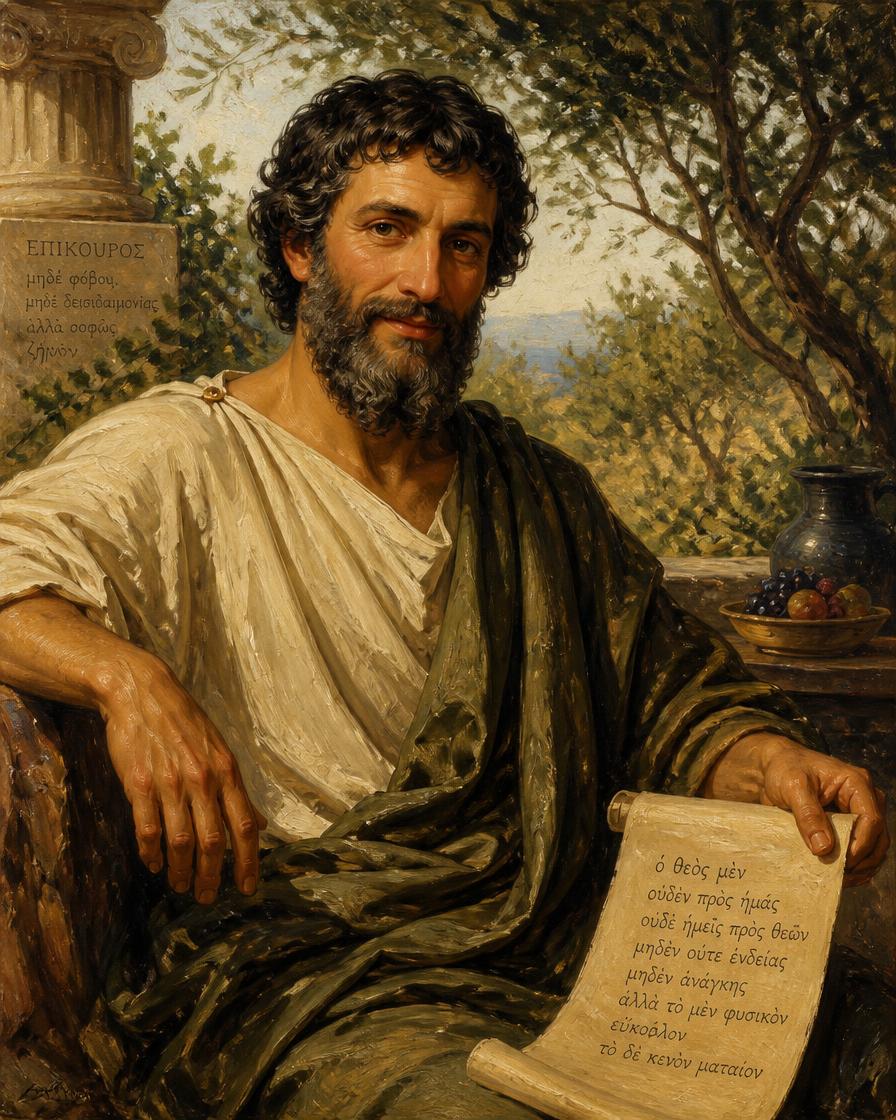
- No securely authenticated ancient portrait of Epictetus is known.
Famous Quotes
Translations vary because Epictetus taught in Greek. References below identify the ancient source.
-
“Some things are up to us and some are not.” — Enchiridion 1. This opening sentence defines the boundary between moral agency and external circumstance.
-
“It is not things themselves that disturb people, but their judgments about those things.” — Enchiridion 5. Epictetus argues that interpretation, rather than an event alone, generates many destructive emotions.
-
“Do not seek to have events happen as you want them to, but instead want them to happen as they do happen.” — Enchiridion 8. The advice expresses alignment with nature, not a prohibition against responsible action.
-
“Remember that you are an actor in a play, which is as the playwright wants it to be.” — Enchiridion 17. The metaphor counsels excellence in one’s assigned role, whether prominent or obscure.
-
“Never say about anything, ‘I have lost it,’ but rather, ‘I have given it back.’” — Enchiridion 11. The passage frames possessions and relationships as temporary trusts.
-
“No one is free who is not master of himself.” — Discourses 2.1, in common translation. Freedom requires government of desire rather than unlimited external choice.
-
“If anyone tells you that a certain person speaks ill of you, do not make excuses.” — Enchiridion 33. Epictetus humorously recommends answering that the critic does not know one’s other faults.
-
“When you are about to undertake some action, remind yourself what kind of action it is.” — Enchiridion 4. His example of going to a public bath illustrates preparation for predictable frustrations.
-
“You are a little soul carrying a corpse.” — Discourses 4.7. The stark image reduces fear of bodily threat by separating moral identity from the vulnerable body.
-
“First say to yourself what you would be; and then do what you have to do.” — Discourses 3.23, in a widely used translation. The context concerns matching philosophical aspiration with disciplined conduct.
A popular saying—“We have two ears and one mouth so that we can listen twice as much as we speak”—is often attributed to Epictetus, but no secure passage in his surviving works supports the attribution.
Timeline
- c. 50 CE — Born at Hierapolis in Phrygia.
- Mid-first century — Enslaved and brought to Rome; the precise date is unknown.
- c. 60s–70s — Studies under Musonius Rufus in Rome.
- Unknown date — Gains legal freedom.
- Before c. 89–93 — Teaches philosophy in Rome.
- c. 89 or 93 — Leaves Italy during Domitian’s expulsion of philosophers.
- Late first century — Establishes a Stoic school at Nicopolis in Epirus.
- Early second century — Arrian attends his teaching and records the discussions.
- c. 108 CE, approximate — Arrian’s period of study is often placed around this time, though exact dates are uncertain.
- Reign of Hadrian, 117–138 — Epictetus remains a celebrated teacher; reports of personal closeness to Hadrian are uncertain.
- Late life — Reportedly takes responsibility for an abandoned child.
- c. 135 — Dies, probably at Nicopolis; exact date and circumstances unknown.
- Second century — Arrian’s Discourses and Enchiridion circulate widely.
- c. 170s — Marcus Aurelius records Epictetan influence in the Meditations.
- Sixth century — Simplicius composes a major commentary on the Enchiridion.
- Modern era — Epictetus influences revived Stoicism, psychotherapy, military ethics, and resilience education.
Frequently Asked Questions
Who was Epictetus?
Epictetus was a Greek-speaking Stoic philosopher of the Roman imperial era. Born enslaved in Hierapolis, he lived in Rome, studied under Musonius Rufus, became free, and taught philosophy. After Domitian expelled philosophers from Italy, he established a school at Nicopolis. He is best known for teaching that moral freedom depends on governing one’s judgments and choices rather than controlling external events.
When was Epictetus born and when did he die?
His dates are approximate. Most reference works place his birth around 50 CE and his death around 135 CE. Ancient evidence does not preserve exact dates. If those conventional estimates are correct, he lived into his eighties. He experienced the reigns of several Roman emperors, from the Julio-Claudian period through much of Hadrian’s rule.
Was Epictetus really a slave?
Yes. Ancient sources identify him as enslaved in Rome and owned by Epaphroditus, probably the influential imperial freedman associated with Nero’s administration. How and when Epictetus gained freedom is not known. His social experience gives special resonance to his philosophical distinction between legal or bodily constraint and the inner freedom of moral choice.
How did Epictetus become disabled?
Epictetus had a pronounced limp, but the cause remains uncertain. Origen wrote that his master broke his leg. The later Suda attributed the disability to illness or bodily weakness. Because the sources disagree and are not contemporary medical records, responsible biographies should not present either explanation as established fact.
Did Epictetus write the Enchiridion?
Not directly, as far as the evidence shows. Epictetus apparently wrote nothing for publication. His student Arrian recorded his conversations in the Discourses and compiled the Enchiridion as a concise selection of practical principles. It is therefore customary to call these works Epictetus’s teachings while recognizing Arrian’s role in preserving and shaping their written form.
What does “some things are up to us” mean?
It means that certain moral activities—especially judgment, intention, desire, aversion, and assent—belong to our agency. Other things, such as reputation, other people’s decisions, illness, wealth, and final outcomes, are never wholly ours to command. Epictetus advises focusing ethical effort on one’s own use of impressions while responding intelligently to external conditions.
Did Epictetus teach passivity?
No, although isolated quotations can sound passive. Epictetus taught people to fulfill duties as family members, citizens, officials, and friends. They should pursue reasonable objectives but avoid treating success as a moral entitlement. Acceptance concerns outcomes beyond complete control; it does not excuse cowardice, injustice, laziness, or neglect of practical action.
What is prohairesis?
Prohairesis is a key Greek term translated as choice, moral purpose, or faculty of volition. For Epictetus, it is the rational capacity that evaluates impressions and directs intention. Bodies and possessions can be constrained, but a person’s moral purpose is harmed only when it assents to falsehood or chooses vice. It is therefore the central location of freedom and responsibility.
What were Epictetus’s three disciplines?
They were the disciplines of desire, action, and assent. Desire training prevents dependence on uncontrollable outcomes. Action training guides appropriate behavior within social relationships. Assent training requires examining impressions before accepting them as true. Together they turn Stoic doctrine into a structured practice for emotional regulation, ethical duty, and clear reasoning.
Was Epictetus religious?
Yes. He frequently referred to Zeus, God, divine providence, and humanity’s kinship with the divine. His beliefs belonged to Stoic theology, which understood the cosmos as rationally ordered. He was not a Christian, although later Christians admired and adapted his ethics. Secular modern readers often use his practical methods without adopting his providential worldview.
Did Epictetus know Emperor Hadrian?
Later tradition states that Hadrian respected or befriended Epictetus, and an emperor interested in Greek culture could plausibly have known his reputation. Direct evidence for a close personal friendship, however, is weak. It is safer to say that Epictetus taught during Hadrian’s reign and was sufficiently famous to attract elite attention.
Was Epictetus married or did he have children?
No biological children or conventional marriage are securely recorded. Simplicius reports that late in life Epictetus rescued an abandoned infant and lived with a woman who helped care for the child. The report suggests a household formed through moral responsibility, but the woman’s name, legal status, and exact relationship to Epictetus are unknown.
How did Epictetus influence Marcus Aurelius?
Marcus Aurelius thanked Junius Rusticus for introducing him to records of Epictetus’s teaching. The Meditations shares several Epictetan practices: testing impressions, accepting mortality, distinguishing character from externals, and performing social duty. Marcus was not merely copying Epictetus, but Epictetus was one of the emperor’s most important ethical influences.
How is Epictetus connected to cognitive behavioral therapy?
His claim that judgments about events contribute to distress resembles a basic principle of cognitive therapies. Psychologist Albert Ellis explicitly drew upon Stoic thought while developing rational-emotive behavior therapy. The connection should not be exaggerated: modern therapies depend on clinical research and techniques unavailable in antiquity. Epictetus is an intellectual precursor, not the sole founder of CBT.
What did Epictetus think about emotions?
He opposed passions understood as excessive and mistaken judgments, not every spontaneous feeling. A first shock, bodily reaction, or moment of sadness may occur without deliberate assent. Training concerns what follows: whether the person converts an impression into panic, rage, despair, or unjust action. His ideal was rational, humane affection rather than emotional numbness.
Where did Epictetus teach?
He first taught at Rome after gaining freedom. Following Domitian’s expulsion of philosophers, he moved to Nicopolis in Epirus, near modern Preveza in Greece. There he founded the school associated with the surviving Discourses. No building at Nicopolis has been conclusively identified as his school.
Why is Epictetus still studied?
His works combine philosophical depth with direct advice about anxiety, insult, loss, ambition, mortality, and responsibility. Readers value his insistence that dignity does not require wealth or power. Scholars also study him for evidence about Roman education, slavery, Stoic theology, ethics, and the relationship between oral teaching and literary preservation.
Lessons We Can Learn
-
Separate effort from outcome. Epictetus rebuilt his work after exile. Today, people can prepare carefully without making self-worth depend on results they cannot guarantee.
-
Question first impressions. His discipline of assent required pausing before belief. This remains useful when responding to rumors, anger, and emotionally charged online information.
-
Define freedom inwardly. A formerly enslaved man located freedom in moral purpose. The lesson is not to ignore oppression, but to preserve agency where circumstances restrict options.
-
Practice before crisis. Epictetus compared ethics to athletic training. Small daily exercises prepare judgment for illness, failure, bereavement, or public pressure.
-
Fulfill relationships responsibly. He taught students to ask what their roles require. Modern autonomy is strengthened, not weakened, by dependable conduct toward family, colleagues, and communities.
-
Do not confuse status with worth. Roman society prized rank, yet Epictetus judged emperors and slaves by character. Titles and income remain unreliable measures of integrity.
-
Use setbacks as material. Exile produced the setting for his great school. Obstacles can sometimes be redirected into new work without pretending that the original loss was desirable.
-
Accept mortality without withholding love. Epictetus urged awareness that people are vulnerable and temporary. Remembering this can deepen gratitude and reduce possessiveness.
-
Match principles with behavior. He mocked students who displayed philosophical vocabulary but lacked discipline. Ethical language matters only when visible in choices.
-
Remain accountable for judgment. Epictetus would not let insult automatically justify rage. Taking responsibility for one’s response supports clearer action and reduces needless escalation.
Related Historical Figures
- Gaius Musonius Rufus — Epictetus’s Stoic teacher, whose practical asceticism and emphasis on moral training profoundly shaped him.
- Arrian of Nicomedia — Student who recorded the Discourses and compiled the Enchiridion, making Epictetus’s legacy possible.
- Epaphroditus — Epictetus’s owner in Rome, probably the imperial freedman who served Nero.
- Domitian — Emperor whose expulsion of philosophers forced Epictetus from Italy and led to his school at Nicopolis.
- Marcus Aurelius — Stoic emperor who read Epictetus and echoed his teachings in the Meditations.
- Junius Rusticus — Marcus Aurelius’s mentor, credited with giving the future emperor access to Epictetus’s lectures.
- Seneca — Earlier Roman Stoic who addressed wealth, anger, death, and adversity from a very different social position.
- Chrysippus — Foundational Hellenistic Stoic whose logic and doctrines formed part of the tradition Epictetus taught.
- Socrates — Epictetus’s model of integrity, self-examination, courage, and obedience to reason over public opinion.
- Simplicius of Cilicia — Sixth-century Neoplatonist whose commentary preserved and interpreted the Enchiridion for later readers.
Watch and Learn
The philosophy of Stoicism · TED-Ed
Related Historical Figures