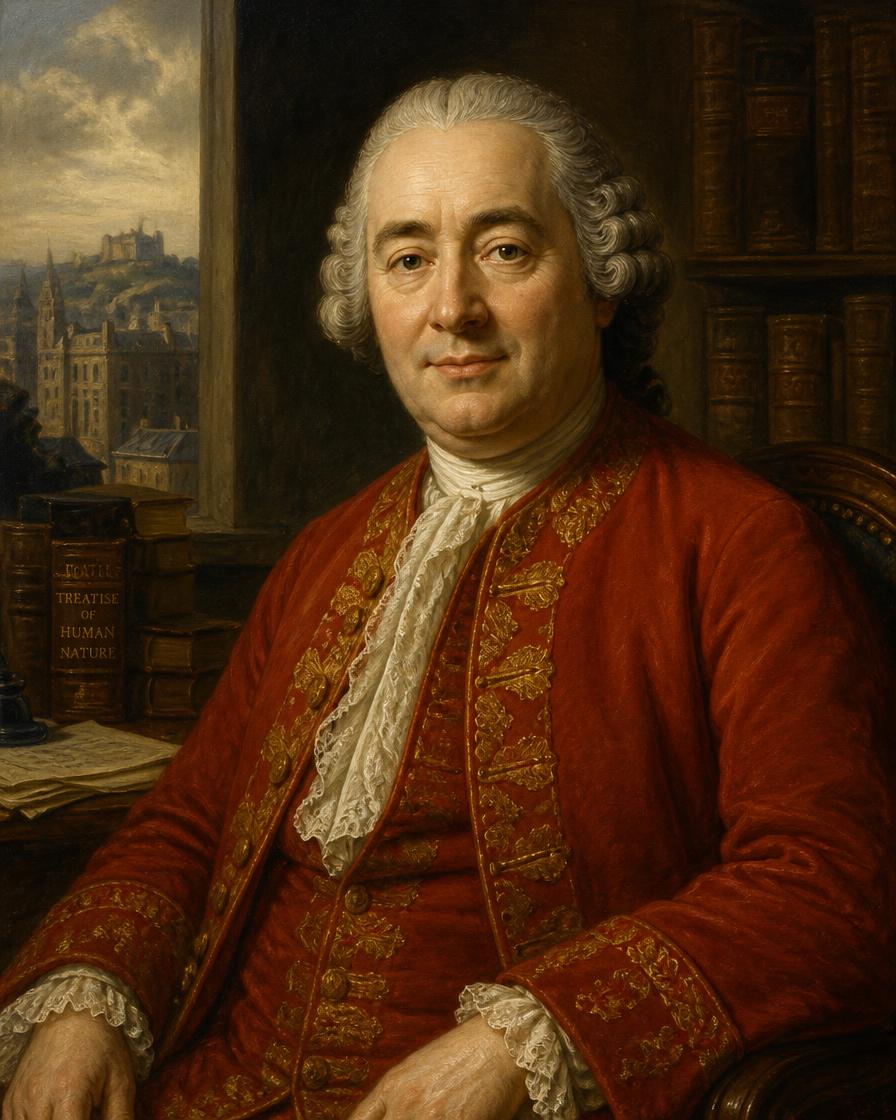
Quick Facts
- Years
- 1711 – 1776
- Category
- Philosophers & Thinkers
- Subcategory
- Empiricism
- Nationality
- Scottish
- Occupation
- Philosopher & Historian
David Hume
1711 – 1776 · Scottish · Philosopher & Historian
Audiobook

Life Lessons from David Hume
Marcus Alden · 54 min
David Hume (1711–1776) was a Scottish philosopher, historian, essayist, and leading figure of the Enlightenment. Best known today for his rigorous empiricism and skeptical arguments, he examined how human beings form beliefs about causation, identity, morality, religion, and the external world. Rather than treating reason as an independent source of certainty, Hume emphasized experience, habit, sentiment, and the limits of human understanding.
His youthful masterpiece, A Treatise of Human Nature, initially attracted little attention, but its arguments became central to modern philosophy. Hume later recast many of them in the more accessible Enquiry Concerning Human Understanding and Enquiry Concerning the Principles of Morals. His essays helped shape economics and political thought, while his six-volume History of England made him one of the most successful historians of the eighteenth century.
Hume influenced Adam Smith, Immanuel Kant, Jeremy Bentham, Charles Darwin, logical empiricists, and contemporary philosophers of mind, science, ethics, and religion. He remains important because his questions are still unresolved: What justifies induction? Is the self more than a succession of perceptions? Does morality arise from reason or feeling? How much can testimony establish? His clear prose, intellectual boldness, and willingness to question inherited assumptions continue to make him one of the most studied thinkers in Western philosophy.
Quick Facts
| Field | Details |
|---|---|
| Full Name | David Hume; born David Home |
| Common Name(s) | David Hume |
| Born | 7 May 1711 (26 April, Old Style) |
| Died | 25 August 1776 |
| Age at Death | 65 |
| Birthplace | Edinburgh, Scotland |
| Nationality | Scottish |
| Occupation | Philosopher, historian, essayist, librarian, diplomat, civil servant |
| Historical Era | Scottish Enlightenment; Age of Enlightenment |
| Famous For | Empiricism, philosophical skepticism, the problem of induction, moral sentimentalism, critique of natural religion, History of England |
| Political Affiliation if applicable | No formal party affiliation; often described as politically moderate, skeptical of faction, and sympathetic to some Country or Tory historical arguments |
| Religion if significant | Raised in the Church of Scotland; later a prominent critic of religious doctrine and natural theology, commonly regarded as religiously skeptical |
| Education | University of Edinburgh; left without taking a degree |
| Parents | Joseph Home of Ninewells and Katherine Falconer Home |
| Spouse(s) | Never married |
| Children | None recorded |
| Major Works | A Treatise of Human Nature; Essays, Moral and Political; An Enquiry Concerning Human Understanding; An Enquiry Concerning the Principles of Morals; Political Discourses; The Natural History of Religion; History of England; Dialogues Concerning Natural Religion |
| Major Achievements | Formulated enduring problems concerning causation and induction; developed influential accounts of mind and morality; advanced philosophical criticism of religion; wrote a bestselling history of England; contributed to political economy and the Scottish Enlightenment |
Early Life
Hume was born in Edinburgh on 7 May 1711 under the modern Gregorian calendar. His family surname was Home, pronounced in Scotland much like “Hume.” He adopted the spelling Hume in the 1730s because English readers frequently mispronounced the original form.
His father, Joseph Home, was a lawyer and modest landowner associated with Ninewells, the family estate near Chirnside in Berwickshire. His mother, Katherine Falconer, came from a legal family. Joseph died while David was still a small child, leaving Katherine to raise David, his elder brother John, and their sister Katherine. The family belonged to the lesser Scottish landed gentry but was not wealthy.
Hume entered the University of Edinburgh at an unusually young age, probably around twelve, as was not uncommon in eighteenth-century Scotland. He studied Latin, Greek, logic, metaphysics, natural philosophy, mathematics, and moral philosophy. He did not graduate, because Scottish universities did not always require degree completion for students pursuing learned careers.
His family expected him to study law, but he found legal training unattractive. Classical literature, history, and philosophy absorbed him. Cicero, Virgil, Seneca, Plutarch, and modern thinkers such as John Locke, Pierre Bayle, Isaac Newton, and Francis Hutcheson helped define the intellectual world in which his ideas developed.
Around 1729, Hume experienced what he later called a “new scene of thought.” Intense private study followed, but overwork damaged his health. His surviving letters describe lethargy, anxiety, and physical symptoms. After trying unsuccessfully to adapt himself to commerce in Bristol, he withdrew to France in 1734. At Reims and then La Flèche in Anjou—home to the Jesuit college once attended by René Descartes—he began composing the work that became A Treatise of Human Nature.
Rise to Prominence
Hume returned to Britain with an ambitious philosophical system. The first two books of A Treatise of Human Nature appeared anonymously in 1739; the third followed in 1740. Hume later said the book “fell dead-born from the press.” That famous judgment exaggerates its complete neglect: reviewers noticed it, but it did not produce the intellectual revolution its young author expected.
He responded pragmatically. An anonymous Abstract summarized the Treatise, and Essays, Moral and Political appeared in 1741–1742. The essays were clearer, shorter, and more successful. They established Hume as an elegant writer on politics, commerce, culture, and human behavior.
His skepticism and reputation for irreligion nevertheless obstructed an academic career. In 1745, supporters sought the chair of ethics and “pneumatical philosophy” for him at Edinburgh. Clerical opposition helped defeat the candidacy. Another attempt, at Glasgow in 1751–1752, also failed.
Hume instead served as tutor to the mentally troubled Marquess of Annandale, secretary to General James St Clair, and participant in diplomatic and military missions. These posts brought money and experience but little intellectual satisfaction.
In 1748 he published Philosophical Essays Concerning Human Understanding, later renamed An Enquiry Concerning Human Understanding. It refined the Treatise arguments on knowledge, causation, miracles, and liberty. An Enquiry Concerning the Principles of Morals followed in 1751. Hume considered it his finest work.
His appointment as keeper of the Advocates Library in Edinburgh in 1752 gave him access to an outstanding collection. Using its resources, he began History of England. The first volume, on the Stuart period, appeared in 1754. Though initially attacked from opposing political and religious directions, later volumes won a vast readership. By the 1760s, Hume was internationally famous and financially independent.
Major Achievements
A New Science of Human Nature
The Treatise attempted to apply an experimental method to moral subjects. Hume argued that serious inquiry should begin with how the mind actually operates rather than with unsupported metaphysical systems. All simple ideas, he proposed, ultimately derive from prior impressions—more vivid experiences of sensation or feeling.
This mattered because it supplied a test for philosophical concepts: ask from what impression an idea originates. The method challenged abstract claims lacking an experiential basis and helped establish Hume as a foundational figure in modern empiricism and philosophy of mind.
Causation and the Problem of Induction
Hume observed that experience reveals one event following another, not a necessary power binding them. After repeatedly seeing similar sequences, the mind forms an expectation through custom or habit. Likewise, predictions about unobserved cases assume that nature will continue regularly, but that assumption cannot be demonstrated without circularity.
Later philosophers named this difficulty the “problem of induction.” It remains central to the philosophy of science, probability, statistics, and artificial intelligence. Hume did not recommend abandoning ordinary inference; he explained it as a natural and indispensable human practice rather than a product of deductive proof.
The Bundle Account of the Self
When looking inward, Hume said, he encountered particular perceptions—sensations, emotions, and thoughts—but no separate, permanent self. He therefore described the mind as a bundle or collection of perceptions connected by memory, resemblance, and causal relations.
This account challenged traditional substance theories of personal identity. Its influence extends into psychology, neuroscience, Buddhist-comparative philosophy, and contemporary debates about consciousness. Hume admitted that his treatment of personal identity left him dissatisfied, making this both a landmark insight and an acknowledged problem.
Moral Sentimentalism
Hume argued that moral distinctions are not produced by reason alone. Reason discovers facts and relations, but approval and disapproval arise through sentiment. Sympathy allows people to respond to the happiness and suffering of others, while utility helps explain why traits such as justice and benevolence receive praise.
This theory helped redirect ethics toward human psychology and social life. It influenced Adam Smith, utilitarianism, evolutionary accounts of morality, and modern research on moral emotions. Hume’s famous warning against moving unnoticed from statements about what “is” to claims about what “ought” to be remains fundamental to ethical argument.
Criticism of Miracles and Natural Religion
In the first Enquiry, Hume argued that testimony for a miracle should be weighed against the uniform experience supporting laws of nature. His position was not simply that miracles are logically impossible, but that belief must be proportioned to evidence and that misleading testimony is often more probable than a violation of nature.
The Natural History of Religion examined religion as a human phenomenon shaped by fear, uncertainty, and anthropomorphism. The posthumous Dialogues Concerning Natural Religion subjected design arguments to sustained criticism. These works transformed philosophy of religion and continue to frame debates over testimony, evil, design, and religious epistemology.
Political Economy and Political Thought
Hume’s essays discussed money, trade, taxation, public credit, luxury, population, and the balance of power. His price-specie-flow mechanism explained how international flows of precious metal tend to correct trade imbalances by altering domestic prices. He opposed simplistic mercantilism and stressed the mutual benefits of prosperity among trading nations.
These writings influenced Adam Smith and the development of classical economics. Politically, Hume emphasized convention, opinion, established authority, liberty under law, and the dangers of ideological faction.
A Major History of England
Between 1754 and 1762, Hume published six volumes covering English history from Julius Caesar’s invasion to the Revolution of 1688. He wrote the Stuart volumes first and moved backward chronologically before completing the Tudor and ancient periods.
The history combined political narrative, character analysis, constitutional discussion, and attention to manners, commerce, and culture. It became Hume’s chief source of fame and income during his lifetime. Although later archival scholarship superseded it and critics disputed its political balance, it shaped historical understanding in Britain, Europe, and America for generations.
Leadership and Work
Hume did not lead a political movement or institution. His leadership was intellectual and social: he influenced readers through argument, edited his writing carefully, supported fellow authors, and participated in Enlightenment networks.
His method was empirical, comparative, and psychological. He tested grand claims against ordinary experience, historical evidence, and observed human behavior. When the Treatise failed commercially, he changed presentation rather than abandoning its core inquiries. This adaptability was a major professional strength.
As keeper of the Advocates Library, he accepted a small salary and used the collection to conduct historical research. After controversy over his ordering allegedly improper books, he resigned the salary in 1757 but retained access for a time. In diplomatic service, he was considered competent and discreet. As acting chargé d’affaires in Paris, he managed correspondence and official business during a politically delicate period.
Hume valued civility, moderation, conversation, and independence from faction. Friends described him as generous and good-humored. Yet his confidence could become complacency. His historical generalizations sometimes outran his evidence, and several comments—most notoriously a racist footnote—display prejudices that seriously diminish claims to universal impartiality.
His relationship with Jean-Jacques Rousseau revealed both strengths and limits. Hume initially offered extensive practical help to the exiled philosopher. When Rousseau became suspicious and accused him of conspiracy, Hume felt deeply injured and published documents defending himself. The episode showed generosity under strain, but also an inability on both sides to contain a private conflict.
Personal Life
Hume never married and had no recorded children. For much of his adult life, he lived among relatives, friends, employers, or diplomatic households before establishing a comfortable home in Edinburgh’s New Town. The street where he lived became known as St David Street, reportedly through local usage connected with him.
His closest intellectual friendship was with Adam Smith. They discussed philosophy, economics, religion, and publishing, and Hume appointed Smith one of his literary executors. Other associates included William Robertson, Hugh Blair, Adam Ferguson, Joseph Black, and members of Edinburgh’s Select Society and Poker Club.
Contemporaries frequently portrayed Hume as cheerful, sociable, witty, and fond of good food. James Boswell’s record of visiting him near death depicts a calm conversationalist who retained humor while rejecting hopes of an afterlife. Adam Smith’s published account praised Hume’s wisdom, virtue, and equanimity, provoking religious critics who thought it idealized an unbeliever.
Hume traveled widely by eighteenth-century standards. He lived in France during the composition of the Treatise, accompanied General St Clair’s missions, and enjoyed celebrity in Parisian salons from 1763 to 1765. Figures such as Baron d’Holbach and leading French philosophes welcomed him warmly.
In 1775, Hume developed what physicians diagnosed as a disorder of the bowels, probably intestinal cancer, though the exact diagnosis cannot be certain retrospectively. He wrote the short autobiography My Own Life while terminally ill. He died in Edinburgh on 25 August 1776 and was buried on Calton Hill.
Philosophy and Beliefs
Hume’s philosophy begins with a distinction between impressions and ideas. Impressions are vivid experiences; ideas are fainter copies used in thought and memory. Complex mental contents may be rearranged imaginatively, but meaningful simple ideas must ultimately be traceable to experience.
He divided objects of inquiry into “relations of ideas,” such as mathematical truths, and “matters of fact,” which concern the world and could be otherwise. Knowledge extending beyond immediate observation depends on causal reasoning, and causal expectations arise from repeated experience and habit.
Hume’s skepticism was usually mitigated rather than absolute. Radical doubt may appear powerful in the study, but nature returns people to eating, talking, working, and expecting regularities. Philosophy should therefore expose dogmatism while remaining connected to common life.
In ethics, Hume treated human beings as emotional and social creatures. His statement that reason is “the slave of the passions” means that reason alone does not generate ultimate motivation; it helps people understand facts and select means to ends. Sympathy and concern for utility make moral evaluation possible beyond narrow self-interest.
His politics favored stability, limited government, property, commerce, and liberty secured through institutions. He rejected divine-right absolutism but also criticized speculative social-contract theories and romanticized accounts of ancient constitutions. Allegiance, in his view, rests largely on social utility, habit, and opinion.
Religiously, labels require care. Hume criticized miracles, providential history, arguments for design, and confident claims about immortality. His works often used dialogue, irony, or indirect presentation because open irreligion carried social and professional risks. Scholars debate whether “atheist,” “agnostic,” “skeptic,” or “naturalist” best describes him. What is clear is that he found traditional rational proofs of religion inadequate.
Challenges and Controversies
The poor reception of the Treatise was Hume’s first major disappointment. Some scholars think his “dead-born” remark understated its early discussion, but it unquestionably failed to deliver the recognition he sought. His later revisions improved accessibility while also leaving portions of the original system—especially the detailed account of passions—without a direct replacement.
Religious controversy followed him throughout his career. Scottish clergy associated him with skepticism and possible atheism. Opponents blocked his university ambitions, and an attempt was made in 1756 to subject him to ecclesiastical censure. Defenders regarded his criticism as an honest demand for evidential discipline; critics believed it undermined revelation, morality, and social order.
His History of England attracted charges of Tory bias, particularly for its treatment of the Stuarts and the English Civil Wars. Hume denied being a party historian and revised passages repeatedly. Modern scholars generally see him as a complex political moderate rather than a straightforward partisan, while recognizing his sympathy for order and his criticism of Whig historical mythology.
The Rousseau quarrel of 1766 became a European scandal. Hume had arranged travel, housing, and a royal pension for Rousseau in Britain. Rousseau’s suspicion—intensified by a mocking forged letter written by Horace Walpole—led him to accuse Hume publicly of treachery. Hume published correspondence to vindicate himself. Most contemporaries sided with Hume, although some criticized making the dispute public and modern readers often consider Rousseau’s mental distress relevant.
Hume’s 1753–1754 essay “Of National Characters” included a footnote asserting the natural inferiority of Black people and dismissing Black achievement. The claim was unsupported and racist. It influenced later racial theorists and cannot be excused merely as skepticism or neutral observation. Scholars debate how this prejudice relates to Hume’s broader philosophy, but there is broad agreement that the passage represents a grave intellectual and moral failure.
His economic and political essays also contain elite assumptions and limited attention to women, colonial violence, and unequal power. These omissions reflect his period but remain necessary to examine when assessing the reach of his claims about humanity.
Legacy
Hume’s philosophical reputation rose dramatically after his death. Immanuel Kant famously wrote that Hume interrupted his “dogmatic slumber,” prompting Kant’s attempt to explain how necessary structures of experience are possible. Jeremy Bentham drew inspiration from Humean attention to utility, while John Stuart Mill inherited elements of his empiricism.
In the nineteenth and twentieth centuries, Hume influenced naturalistic psychology, evolutionary theory, pragmatism, analytic philosophy, and logical empiricism. Charles Darwin recorded the influence of Hume’s writings on his thinking. Contemporary philosophers continue to debate “Humean” theories of causation, laws of nature, motivation, personal identity, and practical reason.
His historical writing no longer serves as a standard factual authority, but it remains important to historiography. It shows an Enlightenment historian interpreting institutions through politics, commerce, manners, and human psychology rather than providence alone.
Hume’s tomb stands in the Old Calton Burial Ground in Edinburgh. A bronze statue by Alexander Stoddart was installed on Edinburgh’s Royal Mile in 1997. The University of Edinburgh commemorates him through Hume Tower—renamed 40 George Square in 2020 amid debate over his racist footnote—and through continuing teaching and scholarship. His birthplace and family landscapes in Edinburgh and the Scottish Borders also feature in historical accounts, though no single museum serves as a comprehensive Hume museum.
His modern relevance lies not in offering a final system but in demanding intellectual proportion: beliefs should reflect evidence, political loyalties should resist fanaticism, and philosophical theories should remain answerable to human experience.
Interesting Facts
- Hume was born with the surname Home and changed its spelling to aid English pronunciation.
- He entered the University of Edinburgh at about twelve years old.
- He never completed a university degree.
- He wrote much of the Treatise while living in France.
- He was only twenty-seven when its first volumes appeared.
- His early attempt at a business career in Bristol was brief and unsuccessful.
- He twice failed to obtain a Scottish university professorship.
- He participated in military-diplomatic missions but was not known as a combat soldier.
- He served as keeper of the Advocates Library in Edinburgh.
- He wrote the History of England out of chronological order, beginning with the Stuarts.
- The history, not his philosophy, brought him the greatest fame during his lifetime.
- Hume became a celebrated guest in Parisian Enlightenment salons.
- He briefly held senior diplomatic responsibility at the British embassy in Paris.
- He helped Jean-Jacques Rousseau seek refuge in Britain before their public quarrel.
- Adam Smith was one of his closest friends and a literary executor.
- Hume wrote My Own Life while terminally ill.
- The Dialogues Concerning Natural Religion appeared after his death.
- He was buried in a mausoleum on Edinburgh’s Calton Hill.
- Hume considered the second Enquiry the best of his writings.
- His racist footnote in “Of National Characters” has become an important subject of modern criticism.
Famous Quotes
- “Reason is, and ought only to be the slave of the passions.” — A Treatise of Human Nature, Book II. Hume meant that reason informs action but does not by itself supply ultimate motives.
- “Custom, then, is the great guide of human life.” — An Enquiry Concerning Human Understanding, Section V. The line summarizes his account of how repeated experience produces expectation.
- “A wise man, therefore, proportions his belief to the evidence.” — First Enquiry, Section X. In the discussion of miracles, Hume urges calibrated judgment rather than automatic acceptance or rejection of testimony.
- “The contrary of every matter of fact is still possible.” — First Enquiry, Section IV. Matters of fact differ from demonstrable relations of ideas because denying them creates no logical contradiction.
- “Beauty in things exists merely in the mind which contemplates them.” — “Of the Standard of Taste.” Hume acknowledges variation in taste while asking how critical standards can nevertheless emerge.
- “It is not contrary to reason to prefer the destruction of the whole world to the scratching of my finger.” — Treatise, Book II. This deliberately extreme example illustrates that reason alone cannot rank ultimate desires; it is not an endorsement of selfish destruction.
- “Generally speaking, the errors in religion are dangerous; those in philosophy only ridiculous.” — Treatise, Book I. Hume contrasts the social dangers of religious fanaticism with the usually limited consequences of speculative error.
- “The rules of morality are not the conclusion of our reason.” — Treatise, Book III. Moral approval, for Hume, depends on sentiment rather than deduction alone.
- “Nothing is more surprising than the easiness with which the many are governed by the few.” — “Of the First Principles of Government.” Hume explains political power through opinion and accepted authority.
- “Truth springs from argument amongst friends.” — Often attributed to Hume, but no secure source in his works has been established; treat this attribution as disputed.
Timeline
- 1711 — Born in Edinburgh and raised chiefly at Ninewells in Berwickshire.
- 1713 — His father died around this period, leaving his mother to manage the family.
- 1723 — Entered the University of Edinburgh at approximately twelve.
- 1729 — Experienced his “new scene of thought” and began intensive philosophical study.
- 1734 — Briefly worked in Bristol, then moved to France.
- 1734–1737 — Developed the Treatise at Reims and La Flèche.
- 1739 — Published Books I and II of A Treatise of Human Nature anonymously.
- 1740 — Published Book III and an anonymous Abstract of the work.
- 1741–1742 — Published Essays, Moral and Political.
- 1745 — Failed to secure an Edinburgh professorship; became tutor to the Marquess of Annandale.
- 1746–1749 — Served General James St Clair on military and diplomatic missions.
- 1748 — Published the work later titled An Enquiry Concerning Human Understanding.
- 1751 — Published An Enquiry Concerning the Principles of Morals.
- 1752 — Became keeper of the Advocates Library; published Political Discourses.
- 1754 — Published the first volume of History of England, covering the early Stuarts.
- 1756 — Published the second historical volume; faced an attempted ecclesiastical prosecution.
- 1757 — Published Four Dissertations, including The Natural History of Religion.
- 1759 — Published Tudor volumes of the history.
- 1761–1762 — Completed the ancient and medieval volumes of History of England.
- 1763–1765 — Served Lord Hertford at the British embassy in Paris.
- 1765 — Acted as British chargé d’affaires in Paris.
- 1766 — Brought Rousseau to Britain; their friendship collapsed publicly.
- 1767–1768 — Served as under-secretary of state in London.
- 1769 — Returned permanently to Edinburgh.
- 1775 — Became seriously ill.
- 1776 — Wrote My Own Life and died on 25 August.
- 1777 — My Own Life and Adam Smith’s letter on Hume’s death were published.
- 1779 — Dialogues Concerning Natural Religion was published posthumously.
Frequently Asked Questions
Who was David Hume?
David Hume was an eighteenth-century Scottish philosopher, historian, essayist, and diplomat. He was a central figure in the Scottish Enlightenment and one of the most influential empiricists in Western philosophy. His work addressed knowledge, causation, personal identity, morality, politics, economics, history, and religion. Although philosophy now defines his reputation, his multivolume History of England was his greatest popular success during his lifetime.
What is David Hume best known for?
Hume is best known for arguing that knowledge of the world begins with experience and that causal expectations arise from repeated observation and habit. He exposed the difficulty of rationally proving induction—the assumption that observed regularities will continue. He is also famous for moral sentimentalism, skepticism about a permanent self, criticism of miracle testimony, and analysis of natural religion.
What was Hume’s problem of induction?
The problem concerns how people justify predictions from past experience. We expect fire to burn or the sun to rise because similar events have occurred before. Yet proving that the future will resemble the past already assumes nature’s regularity, making the argument circular. Hume concluded that induction rests on custom or habit, not demonstrative proof. The problem remains central to scientific reasoning, even though successful inquiry cannot operate without inductive practices.
Did Hume deny causation?
Not simply. Hume denied that sensory experience reveals a mysterious necessary connection between cause and effect. We observe events repeatedly conjoined, and habit produces an expectation that one will follow another. Scholars disagree over whether he reduced causation entirely to regularity or believed real causal powers might exist but remain unknowable. Either way, his analysis shifted attention from metaphysical necessity to evidence and mental expectation.
What did Hume believe about the self?
Hume reported that introspection reveals particular perceptions but no constant, separate self. He described a person as a changing bundle of perceptions linked through memory and imagination. He did not deny that people, responsibilities, and identities exist in ordinary life; he questioned the philosophical claim that an unchanging mental substance underlies experience. He later admitted unresolved difficulties in explaining the unity of consciousness.
Was David Hume an atheist?
The answer is debated. Hume rejected or undermined many traditional arguments for God, miracles, providence, and immortality, and many contemporaries called him an atheist. Yet he rarely declared a simple doctrinal position and often wrote through fictional speakers or cautious formulations. Scholars variously call him an atheist, agnostic, skeptic, or philosophical naturalist. “Religious skeptic” is the safest broad description supported by his published arguments.
What did Hume say about miracles?
Hume argued that a rational person must compare the reliability of testimony with the evidence supporting the regularity of nature. A miracle report should be believed only if its falsehood would be even more extraordinary than the event reported. He also examined how enthusiasm, misunderstanding, and transmission can weaken testimony. Critics argue that his standard is too restrictive; defenders view it as an early model of probabilistic evidence assessment.
What is Hume’s is–ought distinction?
In the Treatise, Hume noticed that writers often move from descriptions of what “is” to claims about what “ought” to be without explaining the transition. The passage is commonly interpreted to mean that purely factual premises cannot alone produce a moral conclusion; some evaluative premise is required. Philosophers debate its exact scope, but the distinction remains a basic tool for detecting gaps in ethical, political, and scientific arguments.
Why did the Treatise fail initially?
The Treatise was long, difficult, anonymous, and extraordinarily ambitious. Its compressed arguments and technical structure made it hard for general readers, while its skeptical implications alarmed religious critics. Hume’s statement that it fell “dead-born from the press” was rhetorical and not literally accurate, since reviews appeared. Nevertheless, it sold poorly and did not bring the acclaim he expected. He later repackaged many arguments in essays and shorter enquiries.
Why could Hume not become a professor?
Hume sought academic posts at Edinburgh and Glasgow, but his reputation for skepticism and irreligion provoked opposition, especially among influential clergy. Critics feared that appointing him to teach moral philosophy would legitimize dangerous doctrines. Political and institutional circumstances also mattered, so religion was not necessarily the sole factor. Exclusion from university life pushed Hume toward essays, private employment, librarianship, diplomacy, and historical writing.
Was Hume a Whig or a Tory?
Hume belonged to no modern-style political party. Critics called his history Tory because he challenged Whig narratives and treated some Stuart monarchs sympathetically. Yet he supported constitutional liberty, commerce, balanced institutions, and the post-1688 settlement. Historians often describe him as a moderate, skeptical of both court absolutism and revolutionary faction. Applying a single party label obscures changes and tensions within his thought.
How did Hume influence Adam Smith?
Hume and Smith were close friends and major participants in the Scottish Enlightenment. Hume’s discussions of sympathy, convention, commerce, money, and unintended social order provided an important intellectual background for Smith’s moral philosophy and economics. Smith did not merely repeat Hume and disagreed with him on significant questions. Their relationship illustrates how conversation, criticism, and friendship helped generate Enlightenment ideas.
Why did Hume quarrel with Rousseau?
Hume helped the persecuted Rousseau travel to Britain, find accommodation, and pursue a pension. Rousseau, already highly suspicious, came to believe Hume was secretly humiliating him. A satirical forged letter by Horace Walpole worsened the situation. Rousseau accused Hume of conspiracy; Hume published correspondence in self-defense. Most contemporaries supported Hume, while modern accounts also consider Rousseau’s deteriorating psychological condition and Hume’s decision to publicize the conflict.
Was Hume an important historian?
Yes. His History of England was among the eighteenth century’s most widely read historical works. It integrated political narrative with constitutional analysis, literature, commerce, and manners. Hume sought psychological and institutional explanations rather than a purely providential story. Modern research has superseded many details, and his interpretations remain controversial, but his history is still studied as an influential example of Enlightenment historiography.
What was objectionable about Hume’s writing on race?
A footnote in “Of National Characters” asserted the natural inferiority of Black people and denied evidence of Black civilization and achievement. The claim lacked sound evidence and contradicted Hume’s professed emphasis on experience. Later writers used it in racial theorizing. Current scholarship treats the passage as a serious racist failure while debating whether it exposes broader limitations in his empiricism, universalism, and social outlook.
How did David Hume die?
Hume suffered a prolonged intestinal illness in 1775–1776, commonly identified by biographers as bowel or intestinal cancer, though a precise modern diagnosis is impossible. He remained mentally active, completed his autobiography, met friends, and reportedly approached death calmly. He died at his Edinburgh home on 25 August 1776, aged sixty-five, and was buried in the Old Calton Burial Ground.
What should a beginner read by Hume?
A beginner usually starts with An Enquiry Concerning Human Understanding, especially its sections on causation, induction, and miracles. An Enquiry Concerning the Principles of Morals offers an accessible introduction to his ethics. Essays such as “Of the First Principles of Government” and “Of the Standard of Taste” demonstrate his range. The Treatise is indispensable but more demanding; a scholarly edition helps explain historical vocabulary and structure.
Lessons We Can Learn
- Match confidence to evidence. Hume’s analysis of testimony teaches that strong claims require correspondingly strong support—essential in medicine, journalism, and public policy.
- Question hidden assumptions. His problem of induction exposed an assumption embedded in everyday prediction. Today, examining assumptions improves research and decision-making.
- Revise presentation after failure. When the Treatise struggled, Hume rewrote its central ideas in clearer forms. Valuable work may need better communication, not abandonment.
- Recognize emotion in judgment. His moral theory showed that reasoning and feeling interact. Effective leadership must understand motives, empathy, and social trust.
- Avoid political fanaticism. Hume criticized faction and ideological certainty. Modern pluralistic societies likewise depend on compromise and institutional restraint.
- Study human behavior, not ideals alone. Hume grounded philosophy in observation. Policies work better when based on realistic incentives and habits.
- Value intellectual friendship. His exchanges with Adam Smith strengthened both thinkers. Constructive communities often produce better ideas than isolated brilliance.
- Keep skepticism practical. Hume challenged certainty without abandoning ordinary life. Healthy skepticism should improve judgment rather than become paralysis.
- Examine admired thinkers critically. Hume’s racist footnote demonstrates that major intellectual achievements do not erase serious prejudice. Education requires evaluation, not hero worship.
- Face limitations honestly. Hume acknowledged difficulties in his theory of personal identity. Admitting unresolved problems preserves intellectual integrity and invites future progress.
Related Historical Figures
- Adam Smith (1723–1790) — Hume’s close friend; their work on sympathy, commerce, and social institutions helped define the Scottish Enlightenment.
- John Locke (1632–1704) — An earlier empiricist whose account of ideas formed part of the background Hume radically revised.
- George Berkeley (1685–1753) — An empiricist and idealist whose arguments about perception and matter preceded Hume’s skepticism.
- Francis Hutcheson (1694–1746) — Scottish moral philosopher whose theory of moral sense influenced the intellectual setting of Hume’s ethics.
- Isaac Newton (1642–1727) — Hume admired Newtonian experimental inquiry and sought an analogous science of human nature.
- Jean-Jacques Rousseau (1712–1778) — French-speaking philosopher whom Hume assisted in exile before their notorious quarrel.
- Immanuel Kant (1724–1804) — German philosopher who credited Hume with awakening him from dogmatic assumptions about metaphysics.
- Voltaire (1694–1778) — Fellow Enlightenment critic of intolerance and religious dogmatism; both achieved international literary celebrity.
- James Boswell (1740–1795) — Scottish biographer who interviewed Hume during his final illness and recorded his views about death.
- Jeremy Bentham (1748–1832) — English reformer whose utilitarian thought drew significantly on Hume’s treatment of utility and human motivation.