Quick Facts
- Years
- 1707 – 1778
- Category
- Scientists & Inventors
- Subcategory
- Natural History
- Nationality
- Swedish
- Occupation
- Botanist & Taxonomist
Carl Linnaeus
1707 – 1778 · Swedish · Botanist & Taxonomist
Audiobook

Life Lessons from Carl Linnaeus
Marcus Alden · 42 min
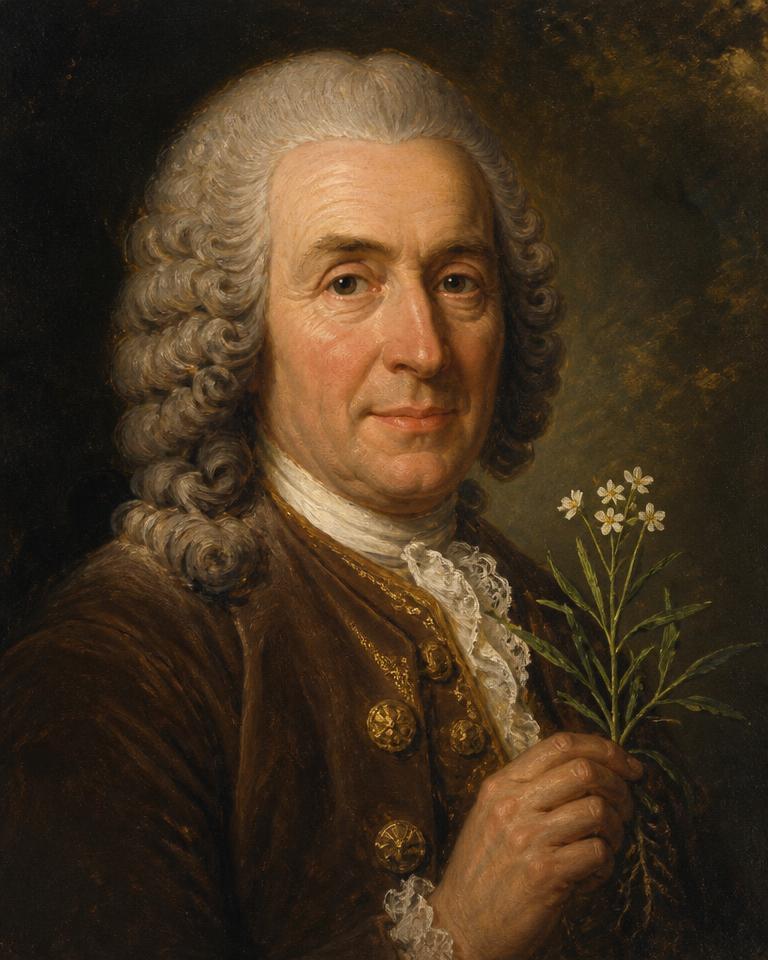
Carl Linnaeus (1707–1778), known after his ennoblement as Carl von Linné, was a Swedish botanist, physician, zoologist, and teacher who transformed how people identify and name living things. Earlier naturalists often used inconsistent, lengthy descriptive labels. Linnaeus promoted a practical system in which each species received a two-part Latin name: a genus followed by a specific epithet. This binomial method became the foundation of modern biological nomenclature.
His most influential books included Systema Naturae, Species Plantarum, and Genera Plantarum. Through repeated editions, extensive correspondence, university teaching, specimen collecting, and the travels of his students, Linnaeus attempted to organize the known natural world. His hierarchical ranks—especially class, order, genus, and species—made comparison and communication easier across languages and national borders.
Not every part of his science endured. His plant “sexual system” was designed chiefly for identification rather than as a natural account of relationship, and later biology revised many of his classifications. His treatment of human variation also helped establish racial categories that subsequent writers turned into harmful hierarchies, making this an important part of his contested legacy.
Linnaeus remains central to the history of biology because modern scientists still use standardized scientific names and nomenclatural practices shaped profoundly by his work.
Quick Facts
| Field | Details |
|---|---|
| Full Name | Carl Linnaeus; after ennoblement, Carl von Linné |
| Common Name(s) | Carl Linnaeus; Carolus Linnaeus; Carl von Linné |
| Born | 23 May 1707, Old Style (13 May in the Swedish calendar then in use) |
| Died | 10 January 1778 |
| Age at Death | 70 |
| Birthplace | Råshult, Stenbrohult Parish, Småland, Sweden |
| Nationality | Swedish |
| Occupation | Botanist, physician, zoologist, taxonomist, professor |
| Historical Era | Enlightenment; eighteenth-century Scientific Revolution and natural history |
| Famous For | Binomial nomenclature; systematic classification; Systema Naturae; Species Plantarum |
| Political Affiliation | Not applicable; served Swedish academic and state-supported scientific institutions |
| Religion | Lutheran Christianity; son of a Lutheran pastor |
| Education | Växjö school and gymnasium; Lund University; Uppsala University; medical doctorate, University of Harderwijk |
| Parents | Nils Ingemarsson Linnaeus and Christina Brodersonia |
| Spouse(s) | Sara Elisabeth Moraea, married 1739 |
| Children | Seven were born; five survived childhood |
| Major Works | Systema Naturae, Fundamenta Botanica, Genera Plantarum, Flora Lapponica, Philosophia Botanica, Species Plantarum, Fauna Suecica |
| Major Achievements | Standardized binomial naming; classified plants and animals; advanced Swedish natural history; trained influential collectors and naturalists |
Early Life
Linnaeus was born at Råshult in rural Småland. His father, Nils, was a Lutheran clergyman and enthusiastic gardener; his mother, Christina, came from a clerical family. Nils adopted the surname Linnaeus from the Latinized Swedish word for the linden tree, reflecting a clerical convention of forming learned family names.
The family moved to the rectory at Stenbrohult while Carl was young. He grew up among cultivated plants and local landscapes, reportedly developing an early fascination with flowers. His father instructed him in gardening and basic learning, although later anecdotes about an almost predestined childhood vocation were shaped by family memory and Linnaeus’s own autobiographical accounts.
He attended school in Växjö. Teachers initially expected him to enter the clergy, but he showed limited enthusiasm for conventional theological study. Johan Rothman, a physician and teacher, recognized his interest in medicine and botany. Because physicians depended heavily on medicinal plants, the subjects were closely linked.
Linnaeus entered Lund University in 1727 and studied under Kilian Stobaeus, who offered access to specimens and books. In 1728 he transferred to Uppsala University, Sweden’s leading center for medicine and natural history. Money was scarce, and the young student sometimes depended on patrons. Olof Celsius the Elder, a theologian and botanist, supported him and encouraged his research.
At Uppsala, Linnaeus met Olof Rudbeck the Younger, who employed him in teaching and household duties. He also formed an important intellectual partnership with Peter Artedi, whose work focused on fish. These mentors and colleagues helped turn his enthusiasm for plants into a systematic program of classification.
Rise to Prominence
Linnaeus first attracted notice through a manuscript about plant sexuality. Building on earlier observations by botanists such as Rudolf Jakob Camerarius and Sébastien Vaillant, he proposed identifying and arranging flowering plants by their stamens and pistils. His “sexual system” was artificial—it prioritized convenient visible features rather than overall natural relationship—but it allowed students to identify plants efficiently.
In 1732 the Royal Society of Sciences at Uppsala funded his journey to Lapland. He traveled through northern Scandinavia, observing plants, animals, minerals, livelihoods, and Sámi communities. The expedition later produced Flora Lapponica. Some popular retellings exaggerate the distance traveled or depict him as exploring untouched territory; in fact, northern Sweden was inhabited and connected by existing routes and local knowledge.
After further Swedish travel, Linnaeus went to the Dutch Republic in 1735 to complete a medical degree at Harderwijk. That year he issued the first edition of Systema Naturae in Leiden. Initially a brief set of tables, it divided nature into three kingdoms—animal, vegetable, and mineral—and provided a framework that expanded dramatically in later editions.
The Netherlands offered wealthy patrons, publishers, botanical gardens, and international networks. Linnaeus worked with the physician and collector Johannes Burman and supervised George Clifford’s garden at Hartekamp. His lavish Hortus Cliffortianus catalogued Clifford’s plants and demonstrated his descriptive skill.
He returned to Sweden in 1738, established a medical practice in Stockholm, and helped found the Royal Swedish Academy of Sciences in 1739. Appointment as professor at Uppsala in 1741 finally gave him a stable platform. His lectures, field excursions, garden, publications, and international correspondence then made him one of Europe’s best-known naturalists.
Major Achievements
Establishing Binomial Nomenclature
Naturalists before Linnaeus sometimes used two-word names, but species labels were often unwieldy Latin descriptions that changed between authors. Linnaeus consistently separated a stable two-part name from the longer diagnostic description. For example, humans became Homo sapiens.
In botany, Species Plantarum (1753) applied binomials comprehensively to the plants Linnaeus recognized. In zoology, the tenth edition of Systema Naturae (1758) did the same on a broad scale. Modern nomenclatural codes treat these works as key starting points—1753 for most botanical names and 1758 for most zoological names.
The lasting benefit is communicative precision. Common names vary among regions and languages, whereas a regulated scientific name gives researchers a shared reference, even when classifications are later revised.
Creating a Hierarchical Classification
Linnaeus arranged organisms in nested ranks, prominently kingdom, class, order, genus, and species. He did not invent every rank or the general idea of classification, but he imposed extraordinary consistency on a rapidly growing body of knowledge.
This structure made catalogs searchable and comparisons manageable. Modern taxonomy adds and rearranges ranks and uses evolutionary evidence unavailable to Linnaeus, yet the principle of nested classification remains fundamental.
Publishing Species Plantarum
The two-volume Species Plantarum listed roughly 6,000 plant species known to Linnaeus. It brought together names, concise descriptions, synonyms, geographical information, and references.
Its importance was practical as much as theoretical. Botanists could connect scattered literature and specimens within a common framework. Although thousands of its classifications have changed, the book remains a nomenclatural landmark.
Expanding Systema Naturae
The first edition of Systema Naturae appeared in 1735 and was only a small folio presentation. Linnaeus repeatedly revised it as specimens and reports arrived. The tenth edition, published in 1758–1759, became especially important for zoological nomenclature.
Placing humans among animals and within the primate order was intellectually significant. Linnaeus still understood nature through theology, but his arrangement emphasized anatomical comparison rather than granting humans a wholly separate biological kingdom.
Reforming Botanical Description and Terminology
Works such as Fundamenta Botanica and Philosophia Botanica codified principles for naming, description, diagnosis, and botanical vocabulary. Linnaeus favored concise descriptions and standardized terms over literary ornament.
This disciplined language made natural history more reproducible. Students could learn the same structural vocabulary and apply it to unfamiliar specimens, an essential step toward professional biological science.
Teaching and Directing Global Collection
At Uppsala, Linnaeus made outdoor excursions central to instruction. Students observed habitats, collected specimens, and practiced identification. He trained a group later called his “apostles,” including Pehr Kalm, Daniel Solander, Anders Sparrman, and Carl Peter Thunberg.
They traveled through Europe, Asia, Africa, the Americas, and the Pacific, often under dangerous conditions. Their specimens expanded European collections, though their work also operated within commercial, imperial, and colonial networks that appropriated knowledge and biological resources from local societies.
Advancing Swedish Natural History
Linnaeus catalogued Sweden’s plants and animals and investigated their potential economic uses. Like many Enlightenment naturalists, he hoped useful crops could reduce imports and strengthen the state.
Some acclimatization projects failed because Sweden’s climate could not support tropical commodities. Nevertheless, his surveys encouraged systematic attention to agriculture, forestry, materia medica, and local ecosystems.
Leadership and Work
Linnaeus led through organization, memorable rules, energetic teaching, and a powerful sense of mission. He reduced complicated observations to tables, ranks, definitions, and short diagnoses. His classifications functioned as tools: they helped users determine where a specimen belonged and what literature to consult.
As a professor, he was charismatic and theatrical. His Uppsala field excursions became public academic events involving observation, collection, and instruction. He cultivated loyalty among students and assigned promising pupils regions of the world from which to gather information.
His decision-making valued visible, repeatable characters. That method was a strength because it offered consistency; it was also a weakness because a few selected traits could obscure broader relationships. Linnaeus knew his sexual system of plants was artificial and also searched for more “natural” groupings, but he never solved that larger problem.
He maintained a vast correspondence and depended on gardeners, physicians, missionaries, ship personnel, collectors, Indigenous informants, and other local experts. Yet published European works frequently compressed these contributions under the classifier’s authority.
Linnaeus could be generous toward students but highly competitive with critics. He carefully managed his reputation and wrote autobiographical accounts that emphasized his accomplishments. His confidence accelerated reform, while his dogmatism sometimes hardened disputes.
Personal Life
While practicing medicine in Falun, Linnaeus became engaged to Sara Elisabeth Moraea, daughter of physician Johan Moraeus. They married in 1739. Seven children were born to the couple, and five survived childhood: Carl, Elisabeth Christina, Sara Christina, Lovisa, and Sophia.
The family lived primarily in Uppsala and later spent substantial time at the rural estates of Hammarby, Sävja, and Edeby. Hammarby provided space for collections and distance from the fire risks of the city. Today it preserves an important association with his domestic and scientific life.
Linnaeus’s friendships included Peter Artedi, whose ichthyological manuscripts he edited after Artedi drowned in 1735. He also corresponded with leading naturalists across Europe, including Albrecht von Haller, Antoine de Jussieu, and Joseph Banks, though not all relationships remained cordial.
He was an avid collector and observer. His notes reveal attention to diet, medicine, climate, domestic economy, and everyday behavior as well as plants and animals. Contemporary reports portray him as animated, ambitious, devout, emotionally expressive, and acutely conscious of status.
His later health deteriorated. He suffered illness associated with Uppsala fever in the 1760s and strokes in the 1770s, which impaired his movement and mental powers. He died at Uppsala on 10 January 1778 and was buried in Uppsala Cathedral.
Philosophy and Beliefs
Linnaeus understood nature as divinely ordered. A Lutheran worldview shaped his belief that classifying creation revealed the wisdom of its Creator. The often-quoted principle “God created, Linnaeus arranged” captures his confidence, although its exact wording and original context require caution.
His concept of species changed over time. Early statements suggested species had remained fixed since creation. Later, experiments and observations of hybridization led him to allow that new forms—and perhaps some new species—could arise through crossings among originally created types. He did not anticipate Darwinian evolution, but his thinking was less static in later life than simple summaries suggest.
Economically, he shared the eighteenth-century ideal that science should serve the public good. He wanted natural history to improve medicine, agriculture, manufacturing, and national self-sufficiency. Many projects reflected mercantilist assumptions about replacing imported products with domestic ones.
Linnaeus was not a modern party-political figure. His work relied on royal, university, academy, and commercial patronage. His ethical framework mixed Christian natural theology, practical utility, social hierarchy, and confidence in Europe’s right to collect and reorganize global knowledge.
Challenges and Controversies
Linnaeus’s plant system attracted criticism because counting stamens and pistils did not necessarily reveal natural relationships. Johann Georg Siegesbeck also attacked its sexual terminology as indecent. Linnaeus and his supporters defended the system’s clarity, while later botanists developed more natural classifications.
He had professional disputes with contemporaries, notably Albrecht von Haller, over botanical principles and priority. Such conflicts reflected both genuine scientific disagreements and competition for authority in the eighteenth-century republic of letters.
His economic botany sometimes overpromised. Attempts to grow tea, mulberry, and other valuable plants in Sweden faced biological and climatic limits. These failures show the gap between cataloguing organisms and understanding ecological requirements.
The most consequential controversy concerns human classification. Linnaeus placed all humans in one species, Homo sapiens, but subdivided people using continental labels and attached physical, behavioral, and cultural stereotypes to those groupings. Across editions, these descriptions became more elaborate.
Scholars debate how closely his categories correspond to later scientific racism. He did not construct the fully developed racial hierarchy promoted by some nineteenth-century thinkers, and his classifications varied over time. Nevertheless, he helped make continental human categories appear systematic and natural. Later authors used classificatory science to justify racism, enslavement, colonial domination, and exclusion. Recognizing this does not erase his contribution to nomenclature; it places that contribution within its historical consequences.
His travelers also participated in colonial systems. Their achievements depended partly on ships, trading companies, plantations, missions, and local expertise. Modern scholarship increasingly asks whose labor and knowledge entered European collections without equal recognition.
Legacy
Linnaeus’s most durable legacy is the regulated two-part scientific name. Every formal species description today belongs to an international nomenclatural system that, despite major revisions, owes much to Linnaean practice. Taxonomists still append abbreviated author names; “L.” after a botanical name indicates Linnaeus.
Evolutionary theory transformed classification by making common ancestry central. Genetics and molecular phylogenetics have moved many organisms into groups Linnaeus could not have imagined. Even so, researchers need named units to communicate about biodiversity, disease, agriculture, and conservation.
His collections had a complex afterlife. Following negotiations with his heirs, the English naturalist James Edward Smith purchased much of the library, manuscripts, and specimens in 1784. These became foundational holdings of the Linnean Society of London, founded in 1788.
Major places associated with him include Linnaeus’s Hammarby, the Linnaean Garden and museum in Uppsala, his birthplace at Råshult, and his tomb in Uppsala Cathedral. His portrait has appeared on Swedish currency, and countless streets, schools, institutions, organisms, and geographic features bear Linnaean names.
Commemoration has become more critical in the twenty-first century. Museums and universities increasingly present both his scientific innovations and his role in classifying humanity through racialized stereotypes. This broader interpretation makes Linnaeus not less relevant but more instructive: he illustrates how useful scientific systems can coexist with culturally embedded errors.
Interesting Facts
- Linnaeus was born before Sweden adopted the Gregorian calendar.
- His father’s surname referred to a linden tree associated with the family.
- He began at Lund University before transferring to Uppsala.
- His Lapland expedition took place when he was 25.
- The first Systema Naturae was far shorter than later editions.
- He earned his medical doctorate at Harderwijk in 1735.
- He worked at George Clifford’s Hartekamp estate in the Netherlands.
- His friend Peter Artedi specialized in fish classification.
- Linnaeus helped found the Royal Swedish Academy of Sciences.
- He became professor at Uppsala in 1741.
- His botanical author abbreviation is simply “L.”
- Species Plantarum appeared in 1753.
- The tenth Systema Naturae is a starting point for zoological nomenclature.
- He placed humans in the order Primates.
- His traveling pupils became known as the Linnaean apostles.
- He was ennobled in 1757, with the ennoblement taking effect after later confirmation.
- He owned country properties including Hammarby.
- Five of his seven children survived childhood.
- James Edward Smith purchased much of his collection after his death.
- The twinflower, Linnaea borealis, was named in his honor.
Famous Quotes
Translations vary because Linnaeus generally wrote scholarly works in Latin and personal or official material in Swedish.
- “The first step in wisdom is to know the things themselves.” — From Critica Botanica in Latin. It expresses his conviction that accurate knowledge begins with recognizing and naming objects.
- “If you do not know the names of things, the knowledge of them is lost too.” — A common translation of the continuation of the same passage. It explains why stable terminology mattered to his program.
- “The names of plants must be stable.” — From his botanical rules, often rendered from Latin in slightly different wording. It summarizes his pursuit of nomenclatural consistency.
- “All the real knowledge which we possess depends on methods by which we distinguish the similar from the dissimilar.” — Attributed to the methodological principles in his botanical writings; English wording varies by translator. It emphasizes comparison.
- “Nature does not make leaps.” — Natura non facit saltus, used by Linnaeus and other writers before and after him. It describes an expectation of continuity in nature, not a uniquely Linnaean phrase.
- “We count as many species as there were different forms created in the beginning.” — From his early botanical philosophy, in translation. It reflects his initial commitment to created, fixed species.
- “Minerals grow; plants grow and live; animals grow, live, and feel.” — A translated formula associated with Systema Naturae. It states how he distinguished the three kingdoms.
- “I saw certain plants feeding on insects.” — A translated observation from his work on carnivorous plants; wording differs among editions and translations. It challenged simple assumptions about plant passivity.
- “God created, Linnaeus arranged.” — Frequently associated with Linnaeus, usually from the Latin Deus creavit, Linnaeus disposuit. The exact origin and whether he coined it are disputed; it should not be treated as a securely documented personal utterance.
- “There is no better occupation than to follow nature.” — Often attributed to Linnaeus in English collections, but a secure primary-source wording is difficult to establish; attribution is disputed.
Timeline
- 1707 — Born at Råshult in Småland on 23 May New Style.
- 1709 — Family settles at the Stenbrohult rectory.
- 1716–1727 — Studies in Växjö; receives encouragement from Johan Rothman.
- 1727 — Enters Lund University.
- 1728 — Transfers to Uppsala University.
- 1730 — Begins lecturing and developing his sexual system of plant classification.
- 1732 — Undertakes the Lapland expedition.
- 1734 — Travels through Dalarna.
- 1735 — Receives medical doctorate at Harderwijk; publishes first Systema Naturae.
- 1735–1737 — Works in the Netherlands and at George Clifford’s Hartekamp estate.
- 1737 — Publishes Genera Plantarum, Flora Lapponica, and Hortus Cliffortianus.
- 1738 — Returns to Sweden and practices medicine in Stockholm.
- 1739 — Marries Sara Elisabeth Moraea; helps found the Royal Swedish Academy of Sciences.
- 1741 — Becomes professor at Uppsala and journeys to Öland and Gotland.
- 1745 — Publishes Flora Suecica and Fauna Suecica.
- 1746–1749 — Conducts or reports Swedish provincial journeys.
- 1751 — Publishes Philosophia Botanica.
- 1753 — Publishes Species Plantarum.
- 1757 — Ennobled; later takes the name Carl von Linné.
- 1758 — Publishes volume one of the tenth Systema Naturae and acquires Hammarby.
- 1759 — Completes the tenth edition’s second volume.
- 1761 — Ennoblement is formally registered; uses von Linné.
- 1762–1763 — Issues Species Plantarum in a second edition.
- 1766–1768 — Publishes the expanded twelfth edition of Systema Naturae.
- 1774 — Suffers a serious stroke; health declines.
- 1776 — Experiences another stroke.
- 1778 — Dies on 10 January and is buried in Uppsala Cathedral.
- 1784 — James Edward Smith purchases much of his scientific collection.
- 1788 — The Linnean Society of London is founded.
Frequently Asked Questions
Who was Carl Linnaeus?
Carl Linnaeus was an eighteenth-century Swedish botanist, physician, zoologist, and professor. He organized plants and animals into hierarchical categories and consistently promoted two-part scientific names. His books made natural-history information easier to compare across countries. Although biological classification now rests on evolutionary relationships and genetic evidence, nomenclature still follows conventions profoundly shaped by Linnaeus. He is therefore often called the father of modern taxonomy, though that title should not obscure the work of earlier classifiers and the many collectors and local experts who supplied his evidence.
What did Carl Linnaeus invent?
Linnaeus did not invent classification, Latin species names, or every element of binomial naming from nothing. Earlier naturalists had used genera, species, and occasional two-word names. His achievement was to standardize these practices and apply binomial nomenclature comprehensively and consistently. He also devised an influential sexual system for identifying flowering plants by their reproductive structures. That particular classification was later replaced, but the naming method and emphasis on shared rules endured.
What is binomial nomenclature?
Binomial nomenclature gives a species a two-part scientific name. The first word identifies the genus and begins with a capital letter; the second is the specific epithet and is lowercase. Both are conventionally italicized, as in Homo sapiens. The complete species name combines both words—the epithet alone is not the species name. International codes now regulate how names are published, prioritized, and changed. The system allows scientists who speak different languages to refer to the same organism precisely.
Why is Species Plantarum important?
Published in 1753, Species Plantarum systematically applied two-part names to thousands of plants known to Linnaeus. It linked concise descriptions with synonyms, references, and geographical information, helping botanists reconcile inconsistent literature. Under modern botanical nomenclature, 1753 serves as the principal starting date for most plant names. This does not mean every Linnaean name remains accepted; many species have been renamed or moved to other genera as evidence improved.
Why is the tenth edition of Systema Naturae significant?
The tenth edition began appearing in 1758 and comprehensively applied binomial names to animals. Modern zoological nomenclature generally treats 1 January 1758 as its starting point, with the edition considered published on that date for regulatory purposes. Linnaeus classified mammals, birds, fish, insects, and other organisms within a hierarchy. Many placements are obsolete, but the edition established a standardized reference framework for zoologists.
Did Linnaeus discover plant sexuality?
No. The reproductive roles of flowers had been investigated before him, notably by Rudolf Jakob Camerarius and Sébastien Vaillant. Linnaeus’s contribution was to build an identification system around the number and arrangement of stamens and pistils. The method was easy to teach and use, which made it internationally influential. Because unrelated plants can possess similar reproductive counts, however, Linnaeus himself recognized that the scheme was artificial rather than a definitive map of natural relationships.
Did Linnaeus believe species never changed?
His early writings commonly treated species as forms created at the beginning and remaining fixed. Later observations, especially of hybrid plants, complicated that view. Linnaeus came to accept that hybridization could generate new forms and possibly new species from originally created types. He never developed a theory of evolution by natural selection and should not be described as a Darwinian precursor in any simple sense. His changing views instead show an attempt to reconcile empirical evidence with natural theology.
Why did Linnaeus classify humans as primates?
Linnaeus grouped humans with monkeys and apes because he recognized anatomical similarities among them. In the tenth edition of Systema Naturae, humans appeared in the order Primates under the name Homo sapiens. This was bold within a culture that often emphasized humanity’s complete separation from animals. Yet Linnaeus remained religious and did not infer common evolutionary ancestry. His placement was based on comparative organization, not Darwinian descent.
What is controversial about his classification of humans?
Linnaeus divided humanity into geographically labeled varieties and attached generalized physical, cultural, and behavioral traits to them. These descriptions incorporated European stereotypes and helped present continental categories as if they were natural scientific divisions. He did not create all later racist theory, and he classified all living humans within one species. Nevertheless, subsequent racial science built upon taxonomic habits that he helped formalize. Historians therefore examine both his context and the damaging afterlife of his categories.
What happened on the Lapland expedition?
In 1732 Linnaeus traveled through northern Sweden and neighboring areas to document plants, animals, minerals, economies, and cultures. The journey supplied material for Flora Lapponica and strengthened his reputation as a field naturalist. He recorded information about Sámi people but interpreted it through an outsider’s eighteenth-century perspective. Later accounts sometimes inflated the expedition’s distance and solitude. It was demanding, but Linnaeus used inhabited routes and benefited from local assistance and knowledge.
Who were the Linnaean apostles?
The “apostles” were students whom Linnaeus encouraged to collect natural-history specimens abroad. They included Pehr Kalm in North America, Daniel Solander in the Pacific, Carl Peter Thunberg in southern Africa and Japan, and Anders Sparrman in Africa and the Pacific. Their journeys expanded European knowledge and supplied Uppsala’s networks. Several died while traveling. Historians also stress that their work depended on colonial infrastructure and on people whose contributions were rarely credited equally.
Was Linnaeus a physician?
Yes. Botany formed part of medical training because plants supplied many medicines. Linnaeus earned a medical doctorate at Harderwijk in the Dutch Republic in 1735. After returning to Sweden, he practiced medicine in Stockholm and gained patients, including through treatment connected with venereal disease. His later professorship at Uppsala included medical as well as botanical responsibilities. His career illustrates how closely medicine and natural history were linked in the eighteenth century.
Why did he use Latin names?
Latin was the international scholarly language of early modern Europe. A Latinized naming system allowed naturalists from Sweden, Britain, France, the Netherlands, and elsewhere to communicate without relying on variable local names. Linnaeus himself published major works in Latin and used the Latin form Carolus Linnaeus. Scientific names remain Latin or Latinized today, although diagnoses and descriptions may be published under modern code provisions in other languages.
What does “L.” mean after a plant name?
In botanical nomenclature, an author abbreviation identifies the person who validly published a scientific name. The abbreviation “L.” denotes Linnaeus. For example, Plantago major L. indicates that Linnaeus is the naming authority for that combination. The abbreviation is not italicized. Author citations help taxonomists trace names through historical literature, distinguish identical names coined by different people, and determine nomenclatural priority.
Was Linnaeus ennobled?
Yes. The Swedish crown ennobled him in 1757, and the ennoblement was formally registered later. He then used the name Carl von Linné. Different sources may call him Carl Linnaeus, Carolus Linnaeus, or Carl von Linné depending on language and period. “Linnaeus” remains the most familiar international form, especially when discussing his scientific publications and botanical author abbreviation.
Where are Linnaeus’s specimens and papers today?
After his death, much of his collection—including specimens, books, and manuscripts—was sold by his heirs to the English naturalist James Edward Smith in 1784. Smith’s holdings became central to the Linnean Society of London. Additional material survives in Sweden and other collections. These objects are historically valuable, and some specimens serve as name-bearing types or as evidence used to stabilize the application of Linnaean names.
How did Carl Linnaeus die?
Linnaeus’s health declined substantially in his final years. He experienced strokes during the 1770s, with resulting physical and cognitive impairment. He died in Uppsala on 10 January 1778 at the age of 70. Sources do not support reducing his death to a single precisely diagnosed modern cause with certainty. He was buried in Uppsala Cathedral, where his tomb remains a major memorial.
Is Linnaean taxonomy still used?
Parts of it are. Scientists continue to use binomial species names and hierarchical ranks such as genus and family. However, modern systematics seeks classifications that reflect evolutionary ancestry, drawing on fossils, anatomy, ecology, and DNA. Many Linnaean groups have therefore been revised or abandoned. His contribution survives less as an unaltered catalog than as a standardized naming infrastructure that enables biological information to be organized and debated.
Lessons We Can Learn
- Standardization multiplies knowledge. Linnaeus replaced inconsistent labels with shared conventions. Today, common standards likewise make research, medicine, and data interoperable.
- Useful systems need not be final systems. His sexual classification identified plants efficiently despite misrepresenting many relationships. Temporary models can be valuable if their limits are stated.
- Clear language is scientific infrastructure. His controlled vocabulary reduced ambiguity. Precise definitions remain essential in every technical field.
- Fieldwork tests books. The Lapland expedition exposed Linnaeus to organisms and communities beyond university collections. Direct observation can correct inherited assumptions.
- Networks drive discovery. His achievements depended on students, correspondents, gardeners, collectors, and local guides. Modern scholarship should recognize collaborative labor openly.
- Teaching can amplify an idea. Uppsala excursions trained students to apply methods rather than merely memorize facts. Active learning remains powerful.
- Revision is a strength. Successive editions of Systema Naturae incorporated new evidence. Responsible expertise changes when information improves.
- Ambition requires ecological realism. Failed acclimatization schemes showed that organisms cannot simply be moved without regard to climate and habitat. Environmental context matters.
- Classification can carry prejudice. Linnaeus’s human categories gave stereotypes scientific form. Designers of modern datasets and categories must examine embedded bias.
- Honor achievement without suppressing harm. His nomenclature transformed biology, while aspects of his anthropology contributed to racialized thought. Mature historical judgment can hold both truths together.
Related Historical Figures
- Peter Artedi — Linnaeus’s close friend and fellow classifier; his posthumous work helped establish systematic ichthyology.
- Olof Rudbeck the Younger — Uppsala professor and mentor who supported Linnaeus’s early teaching and botanical development.
- Olof Celsius the Elder — Botanist and theologian who assisted Linnaeus during his financially difficult student years.
- Johan Rothman — Växjö teacher and physician who encouraged him to pursue medicine and botany rather than the clergy.
- George Clifford III — Wealthy Dutch banker whose garden and collections inspired Hortus Cliffortianus.
- Albrecht von Haller — Swiss anatomist and botanist who corresponded and later disputed with Linnaeus over botanical issues.
- Georges-Louis Leclerc, Comte de Buffon — French naturalist whose broad historical approach offered an influential alternative to rigid classificatory schemes.
- Pehr Kalm — Linnaean apostle who collected and reported on plants in North America.
- Daniel Solander — Student of Linnaeus who joined James Cook’s first Pacific voyage and worked with Joseph Banks.
- Charles Darwin — Later naturalist whose evolutionary theory transformed the meaning of classification while continuing to rely on named species and comparative organization.
Related Historical Figures