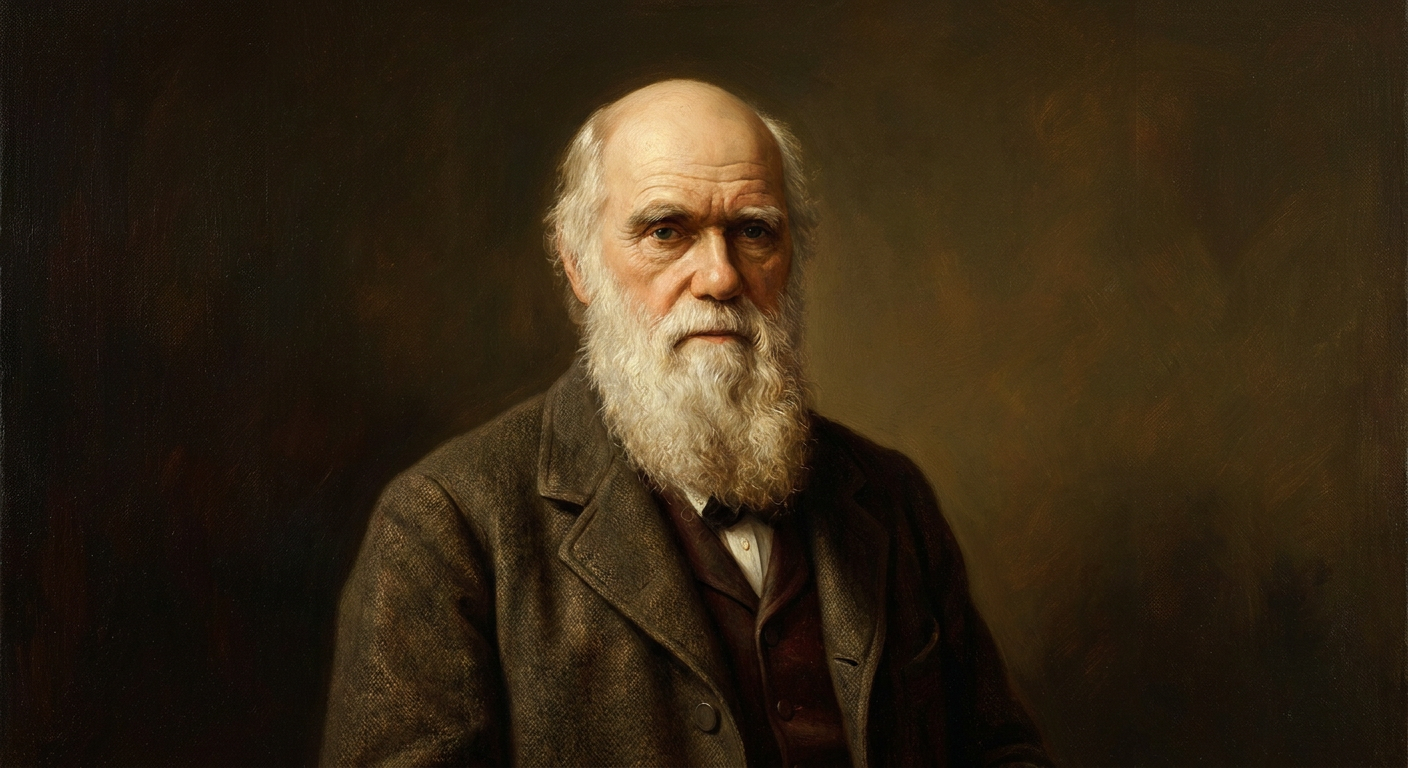
Quick Facts
- Years
- 1809 – 1882
- Category
- Scientists & Inventors
- Nationality
- British (English)
- Occupation
- Naturalist, geologist, biologist and author
Charles Darwin
1809 – 1882 · British (English) · Naturalist, geologist, biologist and author
Recommended Audiobooks
Listen next from Marcus Alden

Life Lessons from James Clerk Maxwell
Marcus Alden · 42 min

Life Lessons from Archimedes
Marcus Alden · 48 min
Charles Darwin transformed humanity’s understanding of life. A quiet English naturalist who initially seemed destined for the clergy, he spent decades gathering evidence that species are not fixed creations but populations that change over generations. His central explanation—evolution by natural selection—showed how inherited variations that improve survival or reproduction can gradually become common.
Darwin’s five-year voyage aboard HMS Beagle gave him an extraordinary education in geology, fossils, animals, plants and the vast timescale of Earth’s history. Yet his theory did not arise from one sudden revelation in the Galápagos Islands. It developed slowly through observations, reading, specimen analysis, experiments and discussions with other scholars. Alfred Russel Wallace independently reached a similar idea, prompting their joint presentation in 1858. Darwin then presented the fullest early case in On the Origin of Species in 1859.
His work unified biology and influenced medicine, ecology, genetics, anthropology and conservation. It also provoked religious, philosophical and political controversy. Some people later misused evolutionary language to justify racism, imperialism and harsh social policies—applications that must be distinguished from biological evolution itself.
Darwin remains compelling because his life reveals science as a human process: patient, collaborative, uncertain and open to correction. He did not answer every question, but he supplied biology with its most powerful organizing idea.
Quick Facts
| Field | Details |
|---|---|
| Full Name | Charles Robert Darwin |
| Common Name(s) | Charles Darwin |
| Born | 12 February 1809 |
| Died | 19 April 1882 |
| Age at Death | 73 |
| Birthplace | The Mount, Shrewsbury, Shropshire, England |
| Nationality | British; English by birth |
| Occupation | Naturalist, geologist, biologist and author |
| Historical Era | Victorian era; nineteenth-century scientific revolution |
| Famous For | Evolution by natural selection, common descent and On the Origin of Species |
| Political Affiliation | No formal party affiliation; associated with a Whig and liberal family culture |
| Religion | Baptized Anglican; studied for the clergy; later described himself most accurately as agnostic |
| Education | Shrewsbury School; University of Edinburgh; Christ’s College, Cambridge |
| Parents | Robert Waring Darwin and Susannah Wedgwood Darwin |
| Spouse(s) | Emma Wedgwood Darwin, married 1839 |
| Children | Ten, of whom seven survived to adulthood |
| Major Works | Journal of Researches, On the Origin of Species, The Descent of Man, The Expression of the Emotions, The Variation of Animals and Plants under Domestication |
| Major Achievements | Developed natural selection, advanced the case for common descent, helped establish evolutionary biology and produced influential research in geology, botany and animal behavior |
Early Life
Charles Darwin was born into a prosperous and intellectually active family. His father, Robert, was a successful physician; his mother, Susannah, belonged to the Wedgwood pottery family. His grandfathers were the physician and evolutionary thinker Erasmus Darwin and the industrialist Josiah Wedgwood. Susannah died in 1817, when Charles was eight, and his older sisters helped supervise the household.
As a boy, Darwin collected shells, minerals, coins and birds’ eggs. He enjoyed outdoor observation more than the classical curriculum at Shrewsbury School. Later recollections sometimes make him appear an unsuccessful student, but the reality is subtler: he disliked rote instruction while showing intense curiosity about nature.
In 1825 his father sent him to study medicine at Edinburgh. Darwin found surgery horrifying in an age before effective anesthesia and abandoned the medical path. Edinburgh nevertheless introduced him to marine zoology, geology and freethinking scientific circles. He learned taxidermy from John Edmonstone, a formerly enslaved Black man from British Guiana, and worked with naturalist Robert Grant on marine invertebrates.
His father next proposed an Anglican clerical career. Darwin entered Christ’s College, Cambridge, in 1828. Clergymen commonly studied nature, so this path did not conflict with natural history. Botanist John Stevens Henslow became his most important mentor, while geologist Adam Sedgwick trained him in fieldwork. Darwin graduated in 1831 and accepted orthodox Christianity at this stage, although his views later changed substantially.
Rise to Prominence
Henslow recommended Darwin for an unpaid position aboard HMS Beagle, commanded by Robert FitzRoy. The ship’s main task was to survey South American coasts; Darwin would serve as a gentleman naturalist and companion to the captain. His father initially objected, but Josiah Wedgwood II persuaded him to approve the voyage.
The Beagle sailed on 27 December 1831. During nearly five years, Darwin explored South America, oceanic islands, Australia and southern Africa. He collected thousands of specimens, found fossils of extinct mammals and observed earthquakes, uplifted coastlines and the geographical distribution of species. Charles Lyell’s geology encouraged him to interpret large changes as the accumulated result of processes operating over immense periods.
The Galápagos Islands were important, but the popular story of an instant breakthrough there is misleading. Darwin initially failed to label every finch by island and did not immediately recognize their significance. After returning to England in 1836, specialists—including ornithologist John Gould—showed that several Galápagos birds classified differently were closely related species. Geographic patterns then helped Darwin consider how ancestral populations might diverge.
By 1837 he was keeping private transmutation notebooks and sketching a branching tree of life. In 1838, reading Thomas Robert Malthus on population gave him a mechanism: more organisms are born than can survive, so favorable inherited variations may be preserved in the struggle for existence.
Darwin became respected through his travel journal, geological studies and expert networks. Nevertheless, he withheld his evolutionary theory from publication while accumulating evidence. In 1858 Wallace sent him an essay outlining natural selection. Friends arranged a joint presentation of Wallace’s essay and Darwin’s earlier writings to the Linnean Society. Darwin’s public prominence grew dramatically after On the Origin of Species appeared the next year.
Major Achievements
Evolution by natural selection
Darwin argued that individuals within a population vary, some variation is inherited, and more offspring are produced than can survive. If a heritable characteristic improves reproductive success in a particular environment, it tends to spread over generations.
This mattered because it offered a natural mechanism for adaptation. Darwin did not discover evolution as a general possibility; earlier thinkers had proposed species change. His achievement was to construct a detailed, evidence-rich explanation powerful enough to guide a research program.
Common descent and the branching tree of life
Darwin proposed that diverse organisms descend from shared ancestors. Species therefore form branches rather than a fixed ladder of progress. Evidence came from classification, embryology, fossils, geographical distribution and homologous structures.
Modern genetics and molecular biology have strongly confirmed common ancestry, although scientists have substantially refined Darwin’s account of inheritance and evolutionary mechanisms.
On the Origin of Species
Published on 24 November 1859, the book assembled observations from domestication, nature, paleontology and biogeography. Darwin openly discussed difficulties, including an incomplete fossil record and the evolution of complex organs.
The first printing sold quickly. The book did not immediately persuade everyone that natural selection was the main mechanism, but it rapidly made evolution a central scientific question. Within decades, common descent had gained broad scientific support.
Human evolution and sexual selection
In The Descent of Man (1871), Darwin explicitly applied evolutionary reasoning to humans and developed sexual selection: traits can evolve because they improve success in attracting mates or competing for them. This helped explain characteristics that seemed unrelated—or even disadvantageous—to ordinary survival.
Some of Darwin’s statements about peoples and sexes reflected Victorian prejudices and are scientifically obsolete. His broader claim that all humans belong to one species and share ancestry opposed doctrines of separately created human races.
Wider natural-history research
Darwin also made major contributions beyond evolution. He explained how coral reefs could form as volcanic islands slowly subsided; studied barnacle classification for eight years; investigated orchid pollination, climbing plants and insect-eating plants; and showed how earthworms reshape soil. These projects supplied independent tests of adaptation and demonstrated his remarkable experimental range.
Leadership or Work
Darwin led no laboratory or institution. His influence came through evidence, correspondence and publication. Working at Down House in Kent, he turned his home, garden and surrounding countryside into a research station.
His methods included:
- Observing small changes over long periods.
- Breeding pigeons and consulting animal breeders.
- Conducting simple but revealing experiments on seeds, plants and worms.
- Sending questionnaires and exchanging specimens worldwide.
- Testing objections rather than hiding them.
- Revising arguments repeatedly before publication.
Darwin was cautious, persistent and unusually willing to acknowledge uncertainty. His long delay in publishing evolution reflected both rigorous preparation and concern about controversy. Critics may reasonably see excessive hesitation, yet it also allowed him to build a formidable case.
His relationship with Wallace illustrates his professional ethics. Darwin had priority through earlier notes, but Wallace independently discovered natural selection. Their 1858 joint presentation preserved both claims. Historians debate whether the arrangement fully served Wallace’s interests because Wallace was overseas, though available evidence does not establish deliberate theft by Darwin.
Personal Life
Darwin married his first cousin Emma Wedgwood on 29 January 1839. Their marriage was affectionate and intellectually significant. Emma read drafts, managed the household and worried that Charles’s religious doubts might separate them spiritually. They had ten children; Mary Eleanor, Anne Elizabeth and Charles Waring died young. Anne’s death in 1851 caused profound grief.
The family moved to Down House in 1842. Darwin followed a structured routine of work, walks along his Sandwalk path, correspondence, reading and family life. He enjoyed music without considering himself musically gifted, played backgammon with Emma and took pleasure in novels.
For much of adulthood he experienced nausea, vomiting, fatigue, headaches, skin problems and episodes of anxiety. Many diagnoses have been proposed, including gastrointestinal, infectious and psychosomatic conditions, but no retrospective diagnosis is conclusive. Illness restricted his public activity while shaping a carefully regulated working day.
Friends and colleagues included Henslow, Lyell, botanist Joseph Dalton Hooker and zoologist Thomas Henry Huxley. Huxley became a forceful public defender of evolution, whereas Darwin generally preferred written argument to public confrontation.
Philosophy or Beliefs
Darwin began adulthood within conventional Anglican belief. During and after the Beagle voyage, biblical criticism, natural explanations and the suffering he observed weakened his faith. The death of Anne intensified his alienation from Christianity, although historians caution against reducing a gradual intellectual change to one event.
He rejected atheism as a fully accurate label for himself and later said that “agnostic” best described his position. His views varied over time, and he sometimes acknowledged uncertainty about ultimate causes. Natural selection addressed biological change, not by itself the philosophical question of whether a deity exists.
Darwin came from an anti-slavery family and was appalled by slavery in South America. He supported shared human ancestry, which undermined claims that racial groups were separately created species. Nevertheless, his writings sometimes used hierarchical and colonial language characteristic of his society. Recognizing both aspects avoids turning him either into a modern egalitarian or a simple advocate of racial ideology.
Politically, he leaned toward moderate liberal reform rather than activism. His ethical outlook emphasized sympathy, cooperation and social instincts as important parts of human evolution—not only competition.
Challenges and Controversies
Religious opposition
Some Christians saw evolution as contradicting special creation and biblical authority. Others, including clergymen and theologians, accepted forms of evolution or argued that natural selection could operate under divine providence. The historical response was therefore more diverse than a simple war between science and religion.
Scientific limitations
Darwin lacked a correct theory of genetics. He experimented with heredity but did not know Gregor Mendel’s work, and his proposed “pangenesis” hypothesis was unsuccessful. Twentieth-century genetics supplied the inheritance mechanism that helped create the modern evolutionary synthesis.
Wallace and priority
Wallace’s independent discovery created an ethical dilemma. The joint Linnean presentation credited both men, but Darwin’s larger archive and rapid completion of the Origin secured greater fame. Most historians describe natural selection as a co-discovery while recognizing Darwin’s uniquely extensive synthesis.
Human hierarchy and social misuse
Passages in The Descent of Man contain Victorian assumptions about race, gender and civilization that are objectionable and unsupported today. Separately, “social Darwinism” was used to defend inequality, eugenics, imperialism and laissez-faire policies. Darwin did not create most of these political doctrines, and evolution does not prescribe moral policy. Still, some advocates borrowed his language, and his own writings cannot be entirely detached from nineteenth-century imperial culture.
The myth of a deathbed conversion
A later story claimed Darwin renounced evolution and returned to Christianity shortly before death. His children denied it, and historians find no reliable evidence for the account.
Legacy
Darwin gave biology a framework connecting anatomy, fossils, behavior, ecology and geographical distribution. Genetics, DNA research and population biology later transformed evolutionary theory, but natural selection and common descent remain foundational.
His influence extends to antibiotic resistance, viral evolution, agriculture, conservation and the study of emerging diseases. Evolutionary theory explains why populations adapt, why biodiversity develops and why medical treatments can lose effectiveness.
Down House is preserved by English Heritage, while Darwin’s grave lies in Westminster Abbey near Isaac Newton. His portrait has appeared on British currency, and his name marks species, institutions, awards and places, including Darwin in Australia’s Northern Territory. Darwin Day events are held around 12 February, though they are commemorations rather than universal public holidays.
Modern scholarship also examines his network of collaborators, family members, collectors and colonial contacts. This broader view does not diminish his achievement; it shows that even a famous theory emerged through a global community and within the inequalities of the British Empire.
Interesting Facts
- Darwin and Abraham Lincoln were born on the same day: 12 February 1809.
- He intended for a time to become an Anglican clergyman.
- His Beagle position was unpaid, and his family financed him.
- Captain FitzRoy initially doubted Darwin’s suitability partly because of physiognomic ideas about the shape of his nose.
- Darwin was seasick throughout much of the voyage.
- He spent more time exploring on land than living aboard the ship.
- The Galápagos finches did not produce an instant theory of evolution.
- His first known evolutionary tree sketch was headed “I think.”
- He waited more than twenty years after developing natural selection to publish its full case.
- Wallace independently conceived natural selection while working in the Malay Archipelago.
- Darwin studied barnacles for roughly eight years.
- He kept numerous pigeon breeds to investigate artificial selection.
- He tested whether seeds could survive saltwater to explain plant dispersal.
- His children sometimes helped with experiments at Down House.
- He published an entire book on insect-eating plants.
- His final book examined earthworms and soil formation.
- Darwin did not coin the modern political doctrine called social Darwinism.
- Seven of his ten children survived to adulthood.
- He was buried in Westminster Abbey, although he had expected a local burial.
- More than 7,500 surviving letters document his international scientific network.
Famous Quotes
- “I think.” — Written above Darwin’s 1837 branching-tree sketch. Its tentativeness captures a theory under construction.
- “There is grandeur in this view of life.” — The concluding paragraph of On the Origin of Species frames evolution as intellectually inspiring rather than merely destructive of older beliefs.
- “From so simple a beginning endless forms most beautiful and most wonderful have been, and are being, evolved.” — Also from the Origin’s conclusion, summarizing diversification from common ancestry.
- “Light will be thrown on the origin of man and his history.” — Darwin’s restrained reference to humanity in the first edition of the Origin; he addressed the subject directly later.
- “I have called this principle, by which each slight variation, if useful, is preserved, by the term Natural Selection.” — From the Origin, defining his central mechanism.
- “Ignorance more frequently begets confidence than does knowledge.” — From The Descent of Man, criticizing certainty unsupported by understanding.
- “The difference in mind between man and the higher animals, great as it is, certainly is one of degree and not of kind.” — From The Descent of Man, expressing psychological continuity among animals.
- “Man in his arrogance thinks himself a great work, worthy the interposition of a deity.” — From an 1838 notebook, revealing Darwin’s private movement toward human-animal continuity.
- “A man who dares to waste one hour of time has not discovered the value of life.” — Recorded in Darwin’s autobiographical recollections and frequently quoted as a statement of his disciplined outlook.
- “My mind seems to have become a kind of machine for grinding general laws out of large collections of facts.” — From his autobiography, combining pride in analysis with concern that specialization had narrowed his aesthetic life.
Timeline
- 1809 — Born in Shrewsbury, England.
- 1817 — His mother, Susannah, dies.
- 1825 — Begins medical study at Edinburgh.
- 1828 — Enters Christ’s College, Cambridge.
- 1831 — Graduates and joins HMS Beagle.
- 1831–1836 — Travels around the world, collecting specimens and making geological observations.
- 1835 — Visits the Galápagos Islands.
- 1837 — Opens transmutation notebooks and sketches a branching evolutionary tree.
- 1838 — Formulates natural selection after reading Malthus.
- 1839 — Marries Emma Wedgwood and publishes his Beagle journal.
- 1842 — Writes a private evolutionary sketch and moves to Down House.
- 1844 — Expands the sketch into an unpublished essay.
- 1851 — His daughter Anne dies.
- 1858 — Darwin and Wallace’s natural-selection writings are jointly presented.
- 1859 — Publishes On the Origin of Species.
- 1868 — Publishes The Variation of Animals and Plants under Domestication.
- 1871 — Publishes The Descent of Man.
- 1872 — Publishes The Expression of the Emotions in Man and Animals.
- 1881 — Publishes his study of earthworms.
- 1882 — Dies at Down House and is buried in Westminster Abbey.
Frequently Asked Questions
1. What did Charles Darwin discover?
Darwin developed the most influential early explanation of evolution by natural selection and assembled extensive evidence for common descent. He was not the first person to suggest that species change, and Alfred Russel Wallace independently discovered natural selection. Darwin’s distinctive contribution was the breadth of his synthesis: he connected domestication, anatomy, fossils, geographical distribution, behavior and ecology in a coherent argument capable of generating new research.
2. What is natural selection?
Natural selection occurs when individuals differ in inherited characteristics and some differences lead to greater reproductive success in a particular environment. Across generations, advantageous variants may become more common. Selection does not consciously plan improvements, and organisms do not evolve because they “try” to change. Populations evolve through differences in survival and reproduction, while changing environments may make a formerly useful trait neutral or harmful.
3. Did Darwin invent the idea of evolution?
No. Ancient thinkers and earlier modern naturalists had considered species change, while Darwin’s grandfather Erasmus and French zoologist Jean-Baptiste Lamarck proposed evolutionary ideas before him. Darwin and Wallace identified natural selection as a major mechanism. Darwin also made a comprehensive case for common descent. Scientific originality often consists not of imagining a possibility first, but of finding a persuasive mechanism and demonstrating its explanatory power.
4. Why was the Beagle voyage important?
The voyage exposed Darwin to extraordinary geological and biological diversity. Fossils in South America, island species, earthquakes and raised coastlines encouraged him to think historically about Earth and life. It also connected him with specialists who later analyzed his specimens. The voyage supplied essential evidence and habits of comparison, but natural selection emerged only after his return, through years of reflection and reading.
5. Did the Galápagos finches inspire the theory immediately?
No. That familiar story compresses a complicated process. Darwin observed Galápagos organisms but did not immediately understand the finches or label all specimens carefully by island. In London, John Gould recognized that the birds represented related but distinct species. Together with mockingbirds, tortoises and South American evidence, these findings helped Darwin appreciate geographic divergence. His theory arose gradually rather than in one dramatic moment.
6. What role did Alfred Russel Wallace play?
Wallace independently formulated evolution by natural selection while collecting specimens in the Malay Archipelago. In 1858 he sent Darwin an essay describing the idea. Lyell and Hooker arranged a joint presentation containing Wallace’s essay and earlier Darwin materials. Wallace later defended Darwin and accepted his greater prominence, but historians rightly recognize both men as co-discoverers of natural selection and continue discussing the fairness of the presentation arrangements.
7. Why did Darwin wait so long to publish?
Darwin wanted enough evidence to answer likely objections, and he pursued extensive studies of variation, geology and classification. He also knew that species transmutation would cause controversy and could trouble Emma’s religious convictions. Illness and other projects slowed him further. The claim that fear alone explains the delay is too simple: caution, perfectionism, family considerations, scientific strategy and health all contributed.
8. Did Darwin say humans descended from monkeys?
Darwin argued that humans and other primates share ancient common ancestors, not that modern humans descended from monkeys living today. Evolution resembles a branching tree: related lineages separate and continue changing. Humans are primates and remain biologically related to apes and monkeys. Modern genetic evidence strongly supports this relationship while providing details unavailable to Darwin.
9. Was Darwin an atheist?
His beliefs changed. As a young man he accepted Christianity and studied for the Anglican clergy. Over decades he became increasingly skeptical, influenced by scientific reasoning, theological questions and suffering. Late in life he said “agnostic” was generally the most accurate description. Calling him a lifelong atheist or claiming a Christian deathbed conversion both misrepresent the evidence.
10. How did Darwin’s theory affect religion?
It challenged literal interpretations of separate creation and altered arguments about design in nature. Responses varied: some religious leaders rejected evolution, while others accepted evolution as compatible with divine action. Darwin’s theory concerns natural mechanisms and does not logically prove or disprove God. Modern religious positions remain diverse, ranging from creationism to full acceptance of evolutionary science.
11. What evidence did Darwin use?
Darwin drew on artificial selection by breeders, variation within species, fossils, geographical distribution, embryology, comparative anatomy and classification. Island organisms and similarities between living South American species and local fossils were especially suggestive. He also examined apparent counterexamples. DNA was unknown in his lifetime, but later genetics and molecular comparisons provided powerful independent confirmation of common descent.
12. Was Darwin’s theory complete?
No. He did not understand genes, mutations, chromosomes or DNA, and his pangenesis theory of heredity failed. He also gave different levels of emphasis to possible mechanisms beyond natural selection. Twentieth-century population genetics united selection with Mendelian inheritance, while later research added genetic drift, gene flow and molecular evolution. Science retained Darwin’s central insights while correcting and extending them.
13. What was Darwin’s relationship to racism?
Darwin opposed slavery and argued that all living humans share ancestry, positions that challenged theories of separately created races. However, he also repeated Victorian hierarchies and stereotypes, sometimes describing peoples through colonial concepts of “civilization.” His record therefore cannot be reduced to either modern anti-racism or straightforward racial advocacy. Current science rejects biological racial hierarchies and recognizes extensive shared human ancestry and genetic overlap.
14. Did Darwin create social Darwinism?
No. The label emerged around social and political doctrines developed by several thinkers, especially Herbert Spencer, who applied competitive language to economics and society. Darwin’s biology was sometimes invoked to justify inequality, imperialism and eugenics, but scientific descriptions of nature do not determine moral policy. Darwin did discuss human society and struggle, yet he also emphasized sympathy, cooperation and care for vulnerable people.
15. What illness did Darwin have?
Darwin suffered recurring nausea, vomiting, weakness, headaches, palpitations and skin symptoms for decades. Suggested diagnoses include Chagas disease, gastrointestinal disorders, migraine, anxiety-related illness and combinations of physical and psychological conditions. The evidence is insufficient for certainty, especially because retrospective diagnosis lacks modern examinations and tests. Whatever its cause, illness limited travel and public debate but did not prevent sustained work.
16. Where did Darwin live and work?
After periods in Shrewsbury, Edinburgh, Cambridge, London and aboard the Beagle, Darwin settled with his family at Down House in Kent in 1842. He used its rooms, greenhouse, gardens and nearby Sandwalk for observation and experimentation. The house became the center of an international correspondence network and is now preserved as a historic site by English Heritage.
17. How many children did Darwin have?
Charles and Emma Darwin had ten children. Three—Mary Eleanor, Anne Elizabeth and Charles Waring—died in childhood, and seven survived to adulthood. Darwin was an affectionate, involved father who observed his children’s emotional and behavioral development. Their illnesses also intensified his concerns about heredity and cousin marriage, although the causes of individual deaths cannot be confidently attributed to the parents’ close relationship.
18. Why is Darwin still important?
Evolution provides the organizing framework of modern biology. It guides research into pathogens, drug resistance, agriculture, ecosystems, genetics and conservation. Darwin is also important as a model of how major theories develop through observation, collaboration, argument and revision. Studying his limitations shows that scientific greatness does not make a person infallible or free from the assumptions of their historical setting.
Lessons We Can Learn
- Collect evidence patiently. Darwin spent decades testing his theory; strong conclusions require more than an exciting first idea.
- Study apparent exceptions. He devoted substantial space to difficulties, showing that objections can improve an argument.
- Revise when knowledge advances. Modern genetics corrected Darwin’s heredity ideas; good science is not loyalty to every claim of a founder.
- Credit independent discovery. Wallace’s role shows why transparent recognition matters in collaborative research.
- Use simple experiments creatively. Darwin’s seed, plant and worm studies demonstrate that important evidence need not require elaborate equipment.
- Build intellectual networks. His correspondence with collectors and specialists made a global synthesis possible.
- Separate facts from moral prescriptions. Evolution describes biological processes; using it to declare social inequality desirable is an added ideology.
- Recognize historical bias. Darwin transcended some Victorian assumptions but shared others. Achievement and criticism can be considered together.
- Work within personal limits. His regulated routine helped him remain productive despite chronic illness; its broader value is a modern interpretation, not a medical prescription.
- Remain willing to say “I think.” His notebook phrase symbolizes provisional reasoning: confidence should grow with evidence, not precede it.
Related Historical Figures
- Alfred Russel Wallace — Independently discovered natural selection and shared the 1858 presentation with Darwin.
- Charles Lyell — Geologist whose vision of gradual change over deep time strongly influenced Darwin.
- Joseph Dalton Hooker — Botanist, confidant and key organizer of the Darwin–Wallace presentation.
- Thomas Henry Huxley — Anatomist and prominent public defender of evolutionary science.
- John Stevens Henslow — Cambridge mentor who recommended Darwin for the Beagle voyage.
- Robert FitzRoy — Captain of HMS Beagle, whose surveying expedition enabled Darwin’s travels.
- Jean-Baptiste Lamarck — Earlier evolutionist who proposed a different mechanism of species transformation.
- Gregor Mendel — Founder of genetics whose work later helped resolve Darwin’s inheritance problem.
- Erasmus Darwin — Charles’s grandfather, a physician and poet who had advanced early evolutionary ideas.
- Emma Darwin — His wife, editor, caregiver and intellectual companion, whose religious views shaped family discussions.
Watch and Learn
Video: Darwin and Natural Selection: Crash Course History of Science #22
Channel: CrashCourse
Approximate duration: 13 minutes
URL: https://www.youtube.com/watch?v=dfsUz2O2jww
This concise educational overview places Darwin’s theory within nineteenth-century science and explains natural selection in accessible language. It is especially useful as an introduction before reading the more detailed history of Darwin, Wallace, the Beagle voyage and evolutionary debate.
Watch and Learn
Darwin and Natural Selection: Crash Course History of Science #22 · CrashCourse
Related Historical Figures