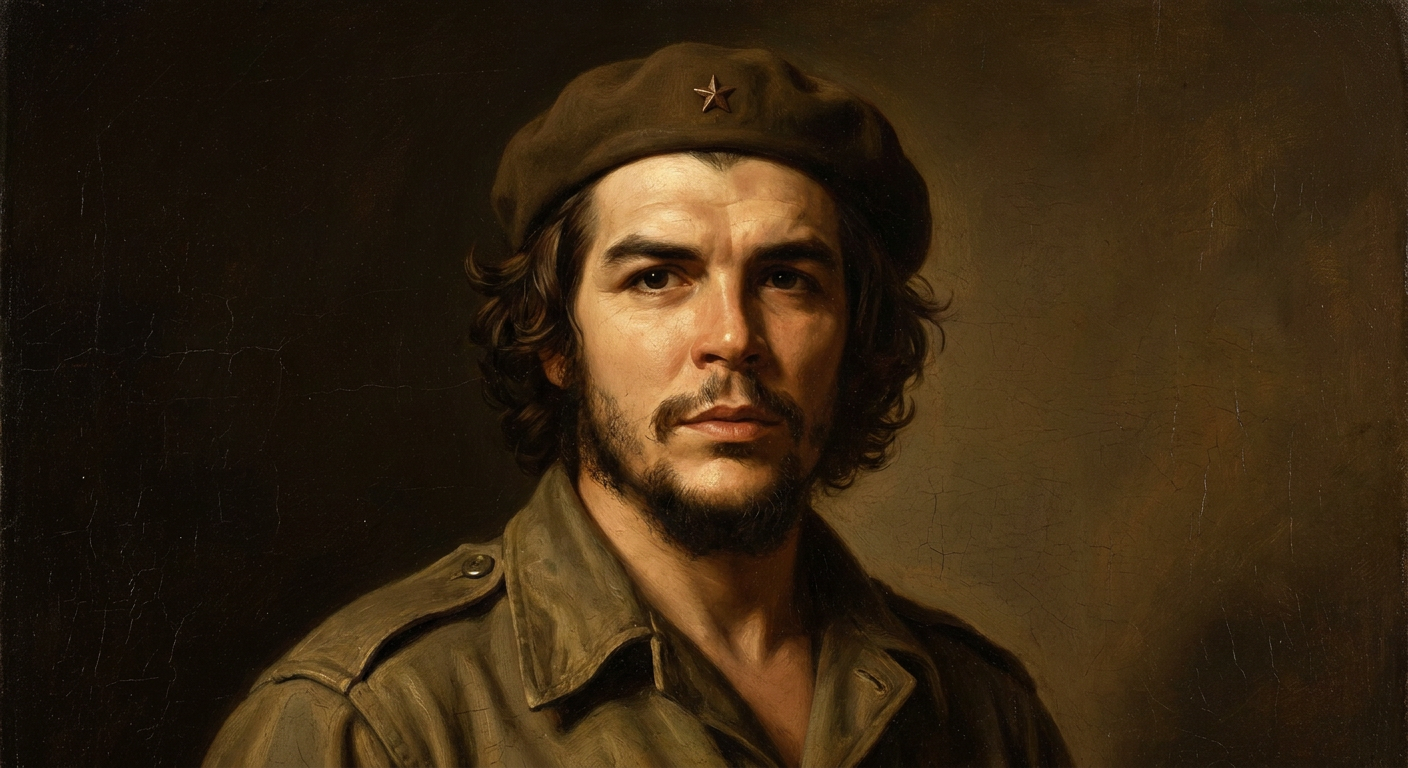
Quick Facts
- Years
- 1928 – 1967
- Category
- World Leaders & Revolutionaries
- Nationality
- Argentine-born Cuban
- Occupation
- Physician, Marxist revolutionary, guerrilla commander, diplomat and government minister
Che Guevara
1928 – 1967 · Argentine-born Cuban · Physician, Marxist revolutionary, guerrilla commander, diplomat and government minister
Recommended Audiobooks
Listen next from Marcus Alden

Life Lessons from Simon Bolivar
Marcus Alden · 55 min

Life Lessons from George Washington
Marcus Alden · 54 min
Ernesto “Che” Guevara was an Argentine physician who became one of the best-known revolutionaries of the twentieth century. As a guerrilla commander, he helped Fidel Castro’s rebel movement overthrow Cuban dictator Fulgencio Batista in 1959. He then served the new Cuban government as a military official, economic administrator, central-bank president, industry minister and international spokesman.
Guevara believed that armed revolution could liberate societies from dictatorship, economic inequality and foreign domination. That conviction took him from Argentina through much of Latin America, into revolutionary Cuba, and eventually to unsuccessful insurgencies in the Congo and Bolivia. Bolivian forces captured him in October 1967 and executed him the following day.
His historical reputation remains sharply divided. Admirers remember his personal austerity, internationalism and willingness to risk his life for his ideals. Critics emphasize his defense of one-party revolutionary rule, participation in executions after the Cuban Revolution and readiness to use political violence. His famous portrait, based on Alberto Korda’s photograph, transformed him into a worldwide symbol whose commercial use often bears little relation to his actual Marxist beliefs.
Guevara still matters because his life raises difficult questions about inequality, imperialism, idealism, violence and political power. Studying him requires looking beyond both romantic legend and hostile caricature.
Quick Facts
| Field | Details |
|---|---|
| Full Name | Ernesto Guevara de la Serna |
| Common Name(s) | Che Guevara; El Che |
| Born | 14 June 1928 |
| Died | 9 October 1967 |
| Age at Death | 39 |
| Birthplace | Rosario, Santa Fe Province, Argentina |
| Nationality | Argentine by birth; granted Cuban citizenship after the revolution |
| Occupation | Physician, revolutionary, guerrilla commander, diplomat and minister |
| Historical Era | Cold War; Cuban Revolution; decolonization |
| Famous For | Helping lead the Cuban Revolution and promoting international guerrilla warfare |
| Political Affiliation | Marxist-Leninist; leading member of revolutionary Cuba’s governing movement |
| Religion | Raised in a culturally Catholic family; became secular and Marxist |
| Education | Medical degree, University of Buenos Aires, 1953 |
| Parents | Ernesto Guevara Lynch and Celia de la Serna y Llosa |
| Spouse(s) | Hilda Gadea; Aleida March |
| Children | Hilda Beatriz, Aleida, Camilo, Celia and Ernesto |
| Major Works | The Motorcycle Diaries; Guerrilla Warfare; Reminiscences of the Cuban Revolutionary War; “Socialism and Man in Cuba” |
| Major Achievements | Commanded rebels at Santa Clara; helped establish revolutionary Cuba; became an influential Marxist theorist and anti-imperialist symbol |
Early Life
Ernesto Guevara was born in Rosario, Argentina, into a relatively comfortable, politically unconventional family of Spanish and Irish ancestry. He was the eldest of five children. His parents opposed fascism, sympathized with the Spanish Republic during the Spanish Civil War and maintained a home filled with books and political discussion.
Severe asthma shaped Guevara’s childhood. Attacks could leave him unable to breathe normally, yet he pursued rugby, swimming, cycling and hiking. The condition encouraged disciplined self-management and a reputation for enduring physical discomfort, although it later created serious problems during guerrilla campaigns.
His family moved frequently, partly in search of a climate that would ease his asthma, and settled for years in Alta Gracia. Guevara read widely, including poetry, adventure literature, philosophy, psychology and political theory. Among the authors who influenced him were Karl Marx, Friedrich Engels, Sigmund Freud, Pablo Neruda and Jack London. No single mentor created his worldview; it developed through reading, travel and political experience.
He entered the University of Buenos Aires to study medicine, eventually focusing particular attention on allergies and leprosy. In 1952 he traveled across South America with his friend Alberto Granado, partly by motorcycle. They visited mining districts, Indigenous communities and a leprosy colony in Peru. Guevara’s later memoir presents the trip as an awakening to continental inequality. Historians caution that his political transformation was gradual rather than the product of one dramatic revelation.
After completing his medical degree in 1953, he traveled again through Latin America. In Guatemala he witnessed the reformist government of Jacobo Árbenz, which pursued land redistribution and challenged the powerful United Fruit Company. A CIA-supported operation helped overthrow Árbenz in 1954. Guevara concluded that the United States would oppose fundamental social reform and that revolutionaries needed armed power rather than reliance on existing institutions.
Rise to Prominence
Guevara escaped Guatemala and settled in Mexico City. There he married Peruvian economist and activist Hilda Gadea, who had introduced him to left-wing political networks. In 1955 he met Fidel and Raúl Castro, Cuban exiles planning an expedition against Batista. Guevara joined their 26th of July Movement as its doctor.
His Argentine habit of saying “che,” an informal expression meaning something like “hey” or “friend,” gave him the nickname by which he became famous. After military training in Mexico, he sailed for Cuba aboard the overcrowded yacht Granma in November 1956 with 81 other expeditionaries.
The landing was disastrous. Batista’s forces killed or scattered most of the group, and only a small core regrouped in the Sierra Maestra. Guevara treated wounded fighters but increasingly acted as a combatant. Castro promoted him to comandante, the rebels’ highest field rank, in 1957.
Guevara became known for strict discipline, political education and personal courage. He also approved severe punishment, including executions, for informers, deserters or people accused of serious crimes. Supporters considered such measures necessary in a brutal civil conflict; critics see them as evidence of an early disregard for due process.
In 1958 Castro sent Guevara’s column westward. His forces derailed an armored train carrying Batista’s troops and supplies and helped capture Santa Clara in late December. The victory accelerated the collapse of the dictatorship. Batista fled Cuba on 1 January 1959, making Guevara an internationally recognized revolutionary.
Major Achievements
Victory at Santa Clara
Guevara’s most important military success came during the final rebel offensive. His smaller force disrupted government communications, captured strategic positions and helped seize Santa Clara. The battle demonstrated the regime’s loss of morale as much as rebel tactical skill, but its political effect was decisive: Batista’s government disintegrated soon afterward.
Building Revolutionary Cuba
After victory, Guevara supervised the La Cabaña fortress in Havana, where revolutionary tribunals tried officials associated with Batista’s dictatorship. He later led the National Bank and became minister of industries. These appointments reflected Castro’s trust in him, despite Guevara’s limited formal training in economics.
He supported agrarian reform, nationalization, mass literacy, expanded health care and the replacement of capitalist incentives with socialist planning. Cuba achieved notable advances in education and public health, but its economy remained vulnerable, inefficient and dependent first on sugar exports and later on Soviet support.
International Diplomacy
Guevara represented Cuba across Latin America, Africa, Asia and Europe. At the United Nations in 1964, he defended Cuba’s revolution, denounced colonialism and racial oppression, and accused the United States of aggression. His speeches helped connect Cuba with anti-colonial movements, although his confrontational rhetoric also deepened Cold War hostility.
Revolutionary Theory
In Guerrilla Warfare, Guevara argued that a small insurgent nucleus—a foco—could create conditions for revolution rather than waiting for every political condition to mature. His writings influenced armed movements across Latin America and beyond. Most attempts to reproduce Cuba’s success failed, showing that his theory underestimated differences in geography, institutions, popular support and state capacity.
Internationalist Campaigns
Guevara left high office to promote revolution abroad. Although his Congo and Bolivia campaigns ended in failure, his willingness to abandon power and comfort strengthened his image as an internationalist who tried to live according to his beliefs.
Leadership or Work
Guevara led by demanding from himself what he expected from others. In Cuba he joined voluntary labor, worked long hours and rejected many personal luxuries. Followers admired his courage, literacy and willingness to share hardship.
His methods were also rigid. He valued discipline, ideological commitment and sacrifice more than compromise. He could be impatient with administrative detail and skeptical of material rewards. As industry minister, he promoted centralized planning and “moral incentives”—public duty, recognition and revolutionary consciousness—in place of reliance on higher wages or profits.
This approach expressed his ethical goals but did not solve Cuba’s production problems. Some scholars argue that external pressures, the US embargo and the inherited sugar economy were decisive constraints. Others emphasize unrealistic targets, rapid nationalization and administrative inexperience.
Guevara was close to Fidel Castro but developed disagreements with aspects of Soviet policy. He criticized wealthy socialist countries for trading with poorer allies on terms he considered insufficiently revolutionary. His independence made him influential but also increasingly isolated.
Personal Life
Guevara married Hilda Gadea in Mexico in 1955. They had a daughter, Hilda Beatriz. The marriage ended after the Cuban Revolution, and he married Cuban revolutionary Aleida March in 1959. They had four children: Aleida, Camilo, Celia and Ernesto.
Long separations, secrecy and war placed heavy burdens on his family life. Guevara acknowledged that revolutionary commitments came before domestic stability. Before leaving Cuba, he wrote farewell letters to his children urging them to care about injustice anywhere in the world.
He enjoyed poetry, chess, photography and reading. He was particularly fond of Pablo Neruda’s poetry and carried books even under difficult campaign conditions. Accounts from colleagues describe him as humorous and charismatic in informal settings but severe when enforcing rules.
Asthma remained a constant challenge. During the Bolivian campaign, shortages of medicine and the loss of supply routes weakened him. His ability to continue marching despite attacks contributed to his reputation for endurance but could not overcome the campaign’s strategic isolation.
Philosophy or Beliefs
Guevara became a committed Marxist who interpreted Latin America’s poverty through class conflict, foreign economic domination and unequal land ownership. He viewed US influence as imperialism and believed socialism offered a path toward sovereignty and social equality.
He did not treat socialism solely as an economic system. In “Socialism and Man in Cuba,” he described the creation of a “new man” motivated by solidarity and collective responsibility rather than private profit. Voluntary labor was intended to educate citizens as well as increase production.
His ethics centered on sacrifice, internationalism and action. He believed neutrality in the face of injustice was itself a moral failure. Yet he also accepted coercion, revolutionary courts and armed struggle. That tension—universal solidarity pursued through authoritarian and violent means—is central to debates about him.
Although raised in a Catholic cultural setting, Guevara’s mature worldview was secular and materialist. His later resemblance to a secular martyr emerged mainly after his death rather than from religious belief.
Challenges and Controversies
Revolutionary Executions
At La Cabaña in 1959, Guevara oversaw tribunals of people accused of torture, murder and other crimes under Batista. Executions unquestionably occurred. Exact totals attributed to his command vary because sources count different periods and categories of cases.
Supporters argue that Batista’s security forces had committed grave abuses and that the trials responded to strong public demands for justice. Critics contend that proceedings were rushed, politically influenced and failed to meet acceptable standards of due process. Guevara defended the revolutionary government’s right to execute its enemies.
Authoritarian Politics
Guevara supported a one-party socialist state and rejected liberal multiparty democracy as inadequate for revolutionary transformation. Revolutionary Cuba expanded education and health services while restricting opposition parties, independent media and political dissent. Whether social achievements can justify those restrictions remains a fundamental moral and historical dispute.
Economic Record
His period as an economic leader produced mixed results. Efforts to diversify Cuba away from sugar did not achieve their goals, and production suffered from inexperience, disrupted trade and ambitious planning. The US embargo and hostility created real obstacles, but historians also identify domestic policy errors.
Nuclear Risk
During the 1962 Cuban Missile Crisis, Guevara strongly supported Cuba’s alliance with the Soviet Union and took an uncompromising stance toward the United States. Later comments suggested he would have accepted enormous sacrifice in a confrontation. Critics cite this as dangerous fanaticism; defenders place it within Cuba’s fear of another US-backed invasion after the Bay of Pigs.
Failure in the Congo and Bolivia
In 1965 Guevara joined rebels in the Congo. The mission failed because of internal divisions, weak coordination, foreign intervention and cultural barriers. In Bolivia, he lacked strong local support, received little effective assistance from the Bolivian Communist Party and became isolated from rural communities. These failures exposed the limitations of applying the Cuban model elsewhere.
Legacy
Guevara’s death transformed a defeated guerrilla into an enduring symbol. Alberto Korda’s 1960 photograph, Guerrillero Heroico, became one of history’s most reproduced images. Posters, murals and clothing turned it into an emblem of rebellion, often detached from Guevara’s actual commitment to Marxism.
In Cuba he remains an official revolutionary hero. His remains, recovered from Bolivia in 1997 and identified by a multidisciplinary team, were reburied in a mausoleum at Santa Clara. The city’s memorial complex attracts visitors and commemorates the battle that helped bring the revolution to power.
Across Latin America, activists have invoked his opposition to inequality and foreign intervention. Armed groups also adopted his ideas, often with disastrous results. His broader cultural influence extends to student movements, music, literature, film and political art.
No consensus defines his legacy. He can be understood simultaneously as an opponent of dictatorship, a disciplined idealist, a participant in revolutionary repression, an unsuccessful economic administrator and a global symbol shaped by forces beyond his control.
Interesting Facts
- “Che” was a nickname derived from a common Argentine expression.
- His birth was officially registered as 14 June 1928; claims of an earlier date remain unproven.
- He suffered severe asthma from early childhood.
- He played rugby despite his respiratory illness.
- Guevara qualified as a physician in 1953.
- His famous motorcycle journey began on a 1939 Norton nicknamed La Poderosa II.
- Much of that journey continued by other transport after the motorcycle failed.
- He witnessed the 1954 overthrow of Guatemala’s Árbenz government.
- He joined Castro’s expedition originally as a doctor.
- Guevara was one of the first rebels appointed comandante.
- He signed Cuban currency simply “Che.”
- Alberto Korda photographed him at a memorial service in 1960.
- He addressed the United Nations General Assembly in 1964.
- He enjoyed chess and played in tournaments and exhibitions.
- He undertook secret travel using disguises and false identities.
- His Congo diary frankly acknowledged errors and frustration.
- Bolivian soldiers captured him alive on 8 October 1967.
- His hands were removed after death for identification purposes.
- His burial place remained secret until evidence led investigators to a grave near Vallegrande.
- His image became commercially valuable despite his opposition to capitalism.
Famous Quotes
- “Hasta la victoria siempre.” (“Ever onward to victory.”) Used in his 1965 farewell letter to Fidel Castro; it expressed permanent revolutionary commitment.
- “If you tremble with indignation at every injustice, then you are a comrade of mine.” From a letter associated with his political correspondence; translations vary, but the sentiment reflects his internationalism.
- “The true revolutionary is guided by great feelings of love.” From “Socialism and Man in Cuba” (1965); he meant solidarity, not romantic affection.
- “We must strive every day so that this love of living humanity is transformed into actual deeds.” From the same essay, connecting moral ideals with political action.
- “At the risk of seeming ridiculous, let me say that the true revolutionary is guided by great feelings of love.” The fuller, frequently cited wording from “Socialism and Man in Cuba.”
- “Create two, three… many Vietnams.” From his 1967 Message to the Tricontinental, calling for multiple anti-imperialist struggles; it also reveals his acceptance of prolonged warfare.
- “We cannot be sure of having something to live for unless we are willing to die for it.” From revolutionary writing commonly published under his name; wording differs among translations.
- “The revolution is not an apple that falls when it is ripe. You have to make it fall.” Widely attributed to Guevara and consistent with foco theory, although a definitive primary source is difficult to establish; attribution should therefore be treated cautiously.
- “Be realistic, demand the impossible.” Frequently linked to Guevara, but evidence for his authorship is weak; it became especially associated with the May 1968 protests in France.
- “I know you are here to kill me. Shoot, coward, you are only going to kill a man.” Often reported as his final statement, but eyewitness versions differ. It should not be treated as verbatim certainty.
Timeline
- 1928 — Born in Rosario, Argentina.
- 1940s — Studies widely while managing chronic asthma.
- 1947 — Enters the University of Buenos Aires to study medicine.
- 1952 — Travels through South America with Alberto Granado.
- 1953 — Receives his medical degree and begins another continental journey.
- 1954 — Witnesses the CIA-supported overthrow of Guatemala’s government.
- 1955 — Meets Fidel Castro in Mexico and joins the 26th of July Movement.
- 1956 — Sails to Cuba aboard the Granma and survives the failed landing.
- 1957 — Becomes a rebel comandante in the Sierra Maestra.
- 1958 — Leads a column toward central Cuba and helps capture Santa Clara.
- 1959 — Batista flees; Guevara serves at La Cabaña, marries Aleida March and joins the new government.
- 1959–1961 — Heads the National Bank of Cuba.
- 1961–1965 — Serves as minister of industries.
- 1962 — Participates in Cuba’s revolutionary leadership during the Missile Crisis.
- 1964 — Addresses the United Nations.
- 1965 — Leaves public office and joins an unsuccessful insurgency in the Congo.
- 1966 — Secretly enters Bolivia to organize guerrilla warfare.
- 8 October 1967 — Captured near La Higuera.
- 9 October 1967 — Executed by Bolivian soldiers.
- 1997 — Remains identified and reburied in Santa Clara, Cuba.
Frequently Asked Questions
1. Who was Che Guevara?
Che Guevara was an Argentine-born physician, Marxist revolutionary and Cuban government official. He joined Fidel Castro’s movement in Mexico, fought against Batista in Cuba and became a senior commander. After the revolution he managed economic institutions, represented Cuba abroad and wrote about guerrilla warfare and socialism. He later attempted to organize revolutions in the Congo and Bolivia, where he was captured and executed in 1967.
2. Why was he called “Che”?
“Che” is a familiar Argentine expression used to attract attention or address another person, somewhat like “hey,” “mate” or “friend.” Guevara used it frequently while living among Cubans and other Latin American exiles in Mexico. His companions began calling him Che to emphasize his Argentine speech. The nickname eventually became so closely associated with him that it largely replaced Ernesto in public memory.
3. Was Che Guevara really a doctor?
Yes. Guevara studied medicine at the University of Buenos Aires and completed his degree in 1953. He had a particular interest in allergies and leprosy, partly shaped by his own asthma. He worked in medical settings during his travels and initially joined Castro’s expedition as a physician. During the Cuban guerrilla war, however, he increasingly became a soldier and commander rather than primarily a doctor.
4. What role did he play in the Cuban Revolution?
Guevara served as a doctor, fighter, trainer and commander. In the Sierra Maestra he gained Fidel Castro’s confidence and commanded his own column. His 1958 advance into central Cuba and participation in the capture of Santa Clara helped trigger Batista’s collapse. He was important, but the revolution depended on many rural fighters, urban resistance groups, political organizers and the Batista government’s declining legitimacy.
5. Did Che Guevara personally execute people?
Evidence indicates that Guevara participated in or ordered executions during the guerrilla war and approved executions following revolutionary tribunals at La Cabaña. Claims about exact numbers vary widely and are often politicized. Some condemned prisoners had been accused of torture or murder under Batista; critics argue the proceedings lacked sufficient safeguards. The established point is that Guevara accepted execution as a legitimate instrument of revolutionary justice.
6. Was he a communist?
Yes. By the later 1950s Guevara was a committed Marxist, and he increasingly identified with Marxism-Leninism. He favored collective ownership, centralized economic planning and revolutionary government rather than liberal capitalism. He admired aspects of the Soviet system but criticized Soviet foreign trade and what he considered political caution. His version of socialism placed unusual emphasis on moral commitment, voluntary labor and the transformation of human values.
7. What was his greatest military victory?
His best-known victory was the December 1958 capture of Santa Clara in central Cuba. Guevara’s fighters attacked strategic sites and helped derail and seize an armored train carrying weapons and troops. The success had enormous psychological and political importance. Batista fled shortly afterward. Nevertheless, the regime’s collapse also reflected broader rebel advances, military disaffection, urban resistance and loss of US support for Batista.
8. Why did he leave Cuba?
Guevara believed revolutionaries should assist liberation struggles outside their own countries. He also grew frustrated with bureaucratic government work and disagreed with elements of Soviet economic policy. In 1965 he relinquished his Cuban offices and citizenship privileges in a farewell letter. He first went to the Congo and later Bolivia. Evidence supports ideological commitment as the main motive, although historians debate how disagreements within the socialist bloc affected his departure.
9. Why did the Congo mission fail?
The Congo mission suffered from fragmented rebel leadership, poor discipline, communication barriers and insufficient coordination with local forces. Guevara’s mostly Cuban contingent could not impose unity on a conflict it did not fully understand. Foreign-backed opponents were also better organized than expected. Guevara’s own account acknowledged serious misjudgments. The experience showed that military dedication alone could not replace local legitimacy, political organization and knowledge of regional conditions.
10. Why did the Bolivian campaign fail?
Guevara’s group remained small and isolated. It failed to win sustained support from most local peasants, lost contact with urban networks and did not secure cooperation from Bolivia’s Communist Party leadership. The Bolivian army, aided by US advisers and intelligence support, improved its counterinsurgency operations. Guevara’s asthma, food shortages and broken communications made matters worse. Cuba’s earlier revolutionary path could not simply be transferred to Bolivia.
11. How did Che Guevara die?
Bolivian troops captured Guevara after a battle near the village of La Higuera on 8 October 1967. He was wounded and held in a schoolhouse. The next day Bolivia’s leadership ordered his execution rather than a public trial. Sergeant Mario Terán shot him. US intelligence personnel were present in the broader operation, but the immediate execution order came through Bolivian authorities.
12. Was the United States involved in his capture?
The United States supported Bolivia with training, equipment and intelligence. CIA-linked personnel, including Cuban exile Félix Rodríguez, assisted the operation and questioned Guevara after his capture. Bolivian troops carried out both the capture and execution, and available evidence attributes the death order to Bolivia’s government. Describing the event as solely an American operation therefore oversimplifies a partnership in which Bolivian authorities made the final decision.
13. Why is his photograph so famous?
Cuban photographer Alberto Korda took the image during a Havana memorial ceremony in March 1960. Guevara’s intense expression, long hair and beret made the cropped portrait visually powerful. After his death, publishers and artists reproduced it worldwide. Because Korda initially did little to restrict its use, the picture spread rapidly and became a flexible symbol of youth, rebellion and resistance—often without its Marxist context.
14. Did Guevara improve Cuba’s economy?
His record was mixed and generally disappointing in production terms. He promoted industrialization, centralized management and moral incentives, hoping to reduce Cuba’s dependence on sugar. Diversification targets were not achieved, and administrative problems persisted. Yet assessments must include US sanctions, loss of traditional trade, rapid structural change and inherited weaknesses. His economic ideas remain more influential as revolutionary ethics than as a successful model of administration.
15. Is Che Guevara considered a hero or a villain?
There is no neutral one-word answer. Admirers emphasize his opposition to dictatorship, personal austerity, international solidarity and concern for inequality. Critics emphasize executions, authoritarian government, economic failures and advocacy of violent revolution. Both sets of facts belong in an accurate assessment. Historical study is most useful when it avoids reducing him either to a flawless liberator or to a figure defined by only his worst actions.
Lessons We Can Learn
- Direct experience can reshape beliefs. Guevara’s travels exposed him to poverty across Latin America; modern readers can learn from observation while avoiding the assumption that experience guarantees correct conclusions.
- Personal courage is not strategic wisdom. His bravery was well documented, but the Congo and Bolivia campaigns show that courage cannot overcome weak planning or poor local support.
- Context determines whether models travel well. Cuba’s revolution occurred under distinctive conditions. Copying it elsewhere repeatedly failed.
- Ends do not erase questions about means. Guevara sought equality but accepted executions and coercion. Ethical goals require ethical scrutiny of methods.
- Leaders should understand the fields they manage. His economic responsibilities exceeded his formal expertise, demonstrating the danger of substituting conviction for technical knowledge.
- Symbols can escape their creators. Korda’s portrait became a commercial product opposed to Guevara’s ideals. Public images are rarely controlled by their subjects.
- Self-discipline can inspire others. His voluntary labor and austere habits strengthened his credibility, regardless of judgments about his politics.
- Local relationships are indispensable. Failure to build durable alliances undermined his international campaigns, a lesson applicable to political and humanitarian work.
- Admitting failure has value. Guevara’s Congo writings openly described mistakes. Honest records help later generations assess events more accurately.
- Historical figures require balanced evidence. His polarized reputation shows why modern interpretation should distinguish documented actions from propaganda, mythology and hindsight.
Related Historical Figures
- Fidel Castro — Rebel leader, Cuban prime minister and president; Guevara’s commander, ally and political partner.
- Raúl Castro — Fellow revolutionary who met Guevara in Mexico and fought with him in Cuba.
- Fulgencio Batista — Cuban dictator whose government the revolution overthrew in 1959.
- Camilo Cienfuegos — Popular rebel commander who led a parallel 1958 advance across Cuba.
- Alberto Granado — Biochemist and friend who accompanied Guevara on his formative 1952 journey.
- Hilda Gadea — Peruvian economist, political activist and Guevara’s first wife, who connected him with leftist networks.
- Aleida March — Cuban revolutionary, Guevara’s second wife and mother of four of his children.
- Jacobo Árbenz — Guatemalan president whose 1954 overthrow profoundly influenced Guevara’s politics.
- Nikita Khrushchev — Soviet leader whose relationship with Cuba shaped the Missile Crisis and Guevara’s view of the socialist bloc.
- Patrice Lumumba — Congolese independence leader whose death made him an anti-colonial symbol admired by Guevara and revolutionary Cuba.
Watch and Learn
“History vs. Che Guevara - Alex Gendler” — TED-Ed — approximately 6 minutes. This animated educational video presents competing interpretations of Guevara’s conduct and legacy rather than offering a simple heroic or hostile portrait. Its debate format is a useful introduction to the central historical disputes, although viewers should use longer scholarly works for greater context.
Watch and Learn
History vs. Che Guevara - Alex Gendler · TED-Ed
Related Historical Figures