Quick Facts
- Years
- 69 – 30
- Category
- World Leaders & Revolutionaries
- Nationality
- Ptolemaic Egyptian of Macedonian Greek ancestry
- Occupation
- Queen and pharaoh of Ptolemaic Egypt
Cleopatra
69 – 30 · Ptolemaic Egyptian of Macedonian Greek ancestry · Queen and pharaoh of Ptolemaic Egypt
Recommended Audiobooks
Listen next from Marcus Alden

Life Lessons from Simon Bolivar
Marcus Alden · 55 min

Life Lessons from George Washington
Marcus Alden · 54 min
Cleopatra VII was the last active ruler of Ptolemaic Egypt and one of the most capable—and most misunderstood—political figures of the ancient world. Born into a Macedonian Greek dynasty that had governed Egypt since the age of Alexander the Great, she inherited a wealthy but unstable kingdom increasingly threatened by Roman power. Her reign became inseparable from the final crisis of the Roman Republic.
Cleopatra is often remembered primarily for her relationships with Julius Caesar and Mark Antony. Yet reducing her to romance obscures her real importance. She survived a palace coup, recovered her throne, stabilized royal authority, cultivated support among Egyptians, and used diplomacy, wealth, dynastic symbolism, and military alliances to defend her kingdom. Ancient evidence suggests that she was highly educated, multilingual, politically resourceful, and personally involved in administration.
Her final defeat by Octavian in 30 BCE ended nearly three centuries of Ptolemaic rule and transformed Egypt into a Roman possession. Octavian then became Augustus, Rome's first emperor. Cleopatra therefore stood at the meeting point of Egyptian, Greek, and Roman history.
People still study her because her career illuminates leadership under pressure, the uses of political propaganda, the position of powerful women in antiquity, and the difficulty of separating a historical person from the legend created by enemies, poets, painters, playwrights, and filmmakers.
Quick Facts
| Field | Details |
|---|---|
| Full Name | Cleopatra VII Thea Philopator |
| Common Name(s) | Cleopatra; Cleopatra VII |
| Born | 69 BCE |
| Died | August 30 BCE |
| Age at Death | About 39 |
| Birthplace | Probably Alexandria, Ptolemaic Egypt |
| Nationality | Ptolemaic Egyptian; Macedonian Greek dynasty |
| Occupation | Queen, pharaoh, diplomat, and military-political leader |
| Historical Era | Hellenistic period; late Roman Republic |
| Famous For | Ruling Egypt and forming alliances with Julius Caesar and Mark Antony |
| Political Affiliation | Ptolemaic dynasty |
| Religion | Hellenistic polytheism and Egyptian royal religion; closely associated with Isis |
| Education | Elite royal education in languages, literature, philosophy, rhetoric, administration, and politics |
| Parents | Ptolemy XII Auletes; mother uncertain, possibly Cleopatra V Tryphaena |
| Spouse(s) | Ptolemy XIII and Ptolemy XIV under dynastic custom; political and personal partnership with Mark Antony |
| Children | Caesarion, Alexander Helios, Cleopatra Selene II, and Ptolemy Philadelphus |
| Major Works | No literary works securely survive; royal decrees, coinage, fiscal policies, diplomacy, and building patronage |
| Major Achievements | Restored her throne, preserved Egyptian independence for nearly two decades, strengthened royal administration, expanded Ptolemaic influence, and became a central actor in Mediterranean politics |
Early Life
Cleopatra was born in 69 BCE into the Ptolemaic dynasty, founded by Ptolemy I, a Macedonian officer of Alexander the Great. Although the dynasty ruled Egypt from Alexandria, its court language and culture were primarily Greek. The Ptolemies commonly married within the family, presenting themselves simultaneously as Hellenistic monarchs and traditional Egyptian pharaohs.
Her father, Ptolemy XII Auletes, depended heavily on Roman support. When opposition forced him from Egypt in 58 BCE, Cleopatra may have witnessed the dangers of court politics firsthand. He recovered his throne in 55 BCE with Roman military assistance, leaving Egypt deeply indebted and increasingly vulnerable to Roman interference.
Little reliable information survives about Cleopatra's childhood. Ancient writers describe her as intellectually accomplished and able to speak numerous languages. Plutarch, writing more than a century later, claimed that she could communicate with several peoples without an interpreter. The exact number is uncertain, but she appears to have been unusually skilled in languages and was probably the first member of her dynasty known to have learned Egyptian.
Her education likely included Greek literature, rhetoric, philosophy, mathematics, state finance, diplomacy, and religious ceremony. Alexandria—with its famous library, scholarly institutions, harbor, and diverse population—provided an exceptional intellectual environment. No individual tutor can be identified with confidence.
Rise to Prominence
When Ptolemy XII died in 51 BCE, Cleopatra became co-ruler with her younger brother Ptolemy XIII. She was about eighteen; he was approximately ten. Their nominal marriage followed Ptolemaic dynastic practice and should not be confused with a modern personal marriage.
Cleopatra initially appears to have governed assertively. Early documents sometimes place her name before her brother's, suggesting that she claimed senior authority. Egypt, however, faced poor harvests, debt, unrest, and pressure from Rome. Court officials supporting Ptolemy XIII gradually pushed her aside. By 48 BCE she had left Alexandria and raised forces in the eastern border region.
The Egyptian conflict changed when the Roman general Pompey arrived after losing to Julius Caesar at Pharsalus. Ptolemy XIII's advisers had Pompey murdered, apparently hoping to please Caesar. Instead, Caesar was offended and intervened in the royal dispute.
According to Plutarch, Cleopatra secretly entered Caesar's quarters concealed in bedding or a sack carried by a servant. The precise details may have been dramatized, but she did gain a private meeting and persuade Caesar to support arbitration of her claim. Her bold return to Alexandria became the turning point of her career.
The resulting Alexandrian War ended in 47 BCE with Caesar's victory and Ptolemy XIII's death, probably by drowning while fleeing. Cleopatra was restored alongside another younger brother, Ptolemy XIV. She also became Caesar's partner and gave birth to Ptolemy XV Caesar, known as Caesarion. Caesar acknowledged her publicly as an allied monarch, although whether he formally accepted paternity is debated.
Major Achievements
Restoring and Preserving Her Throne
Cleopatra recovered power after exile and survived a dangerous civil war. She then ruled until 30 BCE, an impressive achievement in a court known for conspiracies and violent succession struggles. Her survival preserved Egypt as a formally independent kingdom while much of the eastern Mediterranean fell under direct or indirect Roman control.
Rebuilding Royal Authority
Evidence from papyri, inscriptions, coinage, and temples shows a ruler actively involved in government. Cleopatra issued currency, dealt with taxation, supported religious institutions, and presented herself to different audiences in different political languages. To Greek subjects she was a Hellenistic queen; in Egyptian settings she appeared as a pharaoh and living manifestation of Isis.
Egypt suffered famine and economic disruption during parts of her reign. It would be misleading to describe the period as uniformly prosperous. Nevertheless, the monarchy retained enough administrative capacity and wealth to supply fleets, armies, and Roman allies.
Mastering International Diplomacy
Cleopatra understood that Egypt could not defeat Rome alone. Her partnerships with Caesar and later Antony were personal, dynastic, and strategic. Through them she secured protection, territorial gains, and a place in Roman decision-making.
After Caesar's assassination in 44 BCE, Cleopatra carefully navigated the struggle among his successors. She eventually allied with Mark Antony, who controlled Rome's eastern territories. Their partnership produced three children and developed into a plan for a powerful eastern dynastic bloc.
Expanding Ptolemaic Influence
In the Donations of Alexandria in 34 BCE, Antony assigned territories and royal titles to Cleopatra and their children. The ceremony elevated Caesarion as Caesar's son and proclaimed Cleopatra “Queen of Kings.” Some territories were promised rather than fully controlled, but the event represented the greatest expansion of her prestige.
Shaping the End of the Roman Republic
Cleopatra's alliance with Antony helped provoke the final war against Octavian. Her defeat enabled Octavian to seize Egypt's enormous resources and eliminate his principal rival. He became Augustus in 27 BCE. Cleopatra did not intend to create the Roman Empire, but her struggle was instrumental in the political transformation that produced it.
Leadership or Work
Cleopatra's leadership combined ceremony, personal diplomacy, financial management, and dynastic planning. She communicated differently with Alexandria's Greek elite, Egyptian priests, regional rulers, and Roman commanders. This flexibility was one of her greatest strengths.
Her coin portraits were often deliberately forceful rather than conventionally idealized. They emphasized royal authority, continuity, and legitimacy. Temple reliefs placed her within ancient pharaonic traditions, especially through her association with Isis and Caesarion's role as heir.
She was willing to take calculated risks: returning secretly to Alexandria, meeting Antony at Tarsus, and committing Egypt to war against Octavian. These decisions sometimes succeeded brilliantly. Her central weakness was that her strategy depended on Roman partners whose political fortunes she could not control.
Cleopatra could also be ruthless. Ptolemy XIV died soon after Caesar's assassination, and many historians suspect that Cleopatra arranged his death, although direct proof is absent. Her sister Arsinoe IV was executed at Antony's order in 41 BCE after Cleopatra had viewed her as a dynastic threat.
Personal Life
Cleopatra had four known children. Caesarion, born in 47 BCE, was presented by her as Julius Caesar's son and became her co-ruler. With Antony she had twins, Alexander Helios and Cleopatra Selene II, followed by Ptolemy Philadelphus.
Her partnerships cannot be understood as either pure romance or pure calculation. Ancient evidence indicates genuine intimacy and sustained cooperation with Antony, but both leaders also gained politically. Modern attempts to separate affection from strategy with certainty go beyond the evidence.
Plutarch portrays Cleopatra as witty, charismatic, conversationally gifted, and able to adapt her manner to different people. His account is important but was written long after her death and shaped by moral storytelling. Claims about extravagant feasts and the famous dissolution of a pearl in vinegar may contain exaggeration or symbolism.
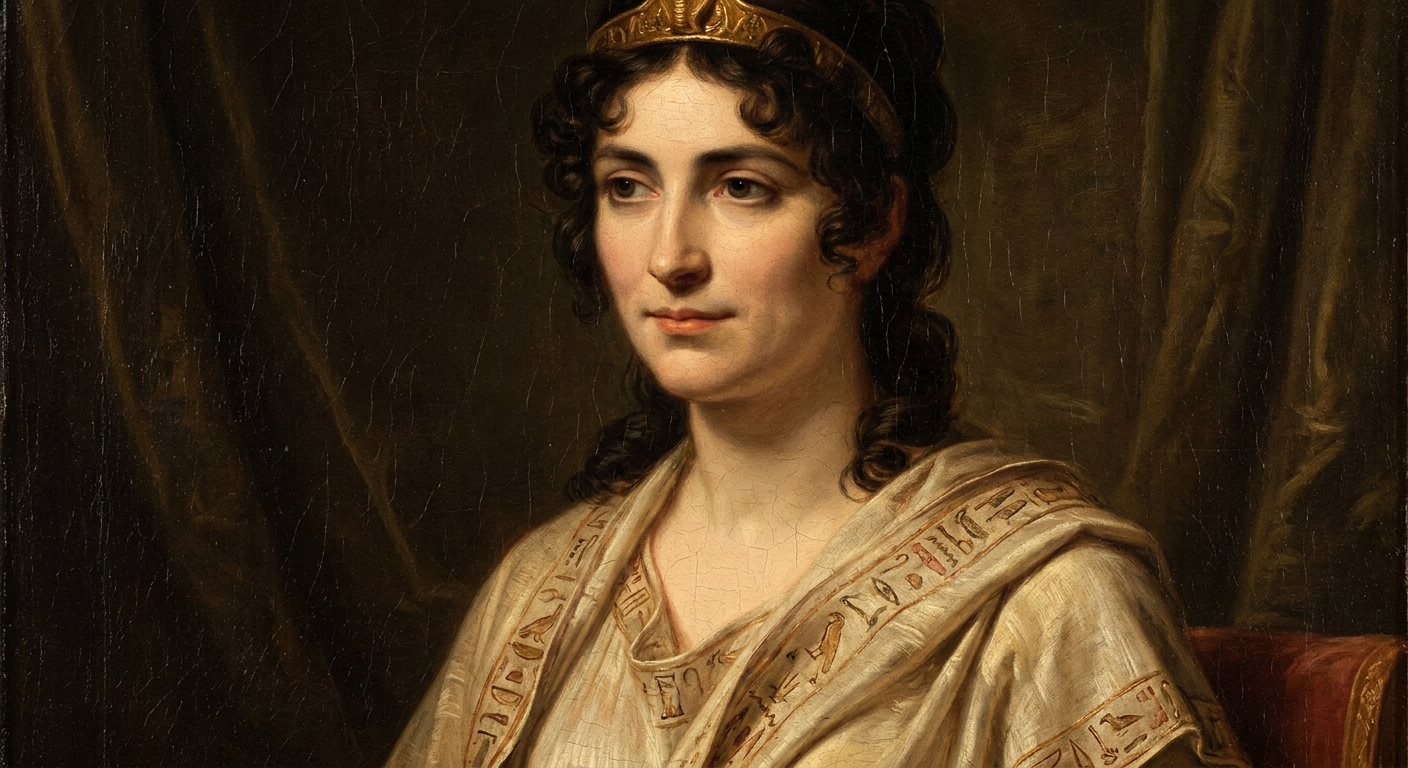
Her appearance is also debated. Coins and sculptural portraits offer inconsistent images, and ancient writers emphasized her voice, intelligence, and presence more than extraordinary physical beauty. Modern arguments over whether she was “beautiful” reveal more about later cultural expectations than about her political ability.
Philosophy or Beliefs
No philosophical writings by Cleopatra survive, so her worldview must be inferred from her actions and official imagery. She appears to have believed strongly in hereditary monarchy, dynastic continuity, and the sacred responsibilities of kingship.
Her religious policy blended Greek and Egyptian traditions. By associating herself with Isis, she adopted the image of a divine mother protecting her son and kingdom. This supported Caesarion's legitimacy and connected the foreign-origin Ptolemaic house with Egyptian religious expectations.
Politically, Cleopatra pursued sovereignty rather than ideological resistance to everything Roman. She cooperated with Romans when cooperation served Egypt and opposed them when Octavian threatened her dynasty. Her guiding principles seem to have been survival, royal legitimacy, territorial security, and the future of her children.
Challenges and Controversies
Cleopatra's greatest challenge was structural: Egypt was wealthy but militarily weaker than Rome. Any independent policy required engagement with Roman leaders. Her enemies later represented that engagement as seduction and corruption rather than diplomacy.
Octavian's propaganda portrayed her as a dangerous foreign queen who had enslaved Antony and threatened Rome. This framing allowed him to declare war on Cleopatra rather than openly presenting another Roman civil war. Roman poets amplified images of luxury, sexuality, intoxication, and eastern decadence.
The Battle of Actium in 31 BCE was her decisive defeat. Antony and Cleopatra faced Octavian's commander Agrippa in a naval campaign off western Greece. During the battle Cleopatra's squadron sailed away through an opening, and Antony followed. Historians disagree over whether this was a planned withdrawal, a response to collapsing conditions, or a disastrous breakdown. Claims that she simply fled from cowardice are too simplistic.
After Actium, their position deteriorated rapidly. Octavian invaded Egypt in 30 BCE. Antony, incorrectly believing Cleopatra dead, attempted suicide and was brought to her before dying. Cleopatra negotiated with Octavian, probably seeking protection for her children and some continuation of her dynasty. When she concluded that no acceptable future remained, she killed herself.
The traditional story says that an asp hidden in a basket of figs delivered the fatal bite. Ancient sources offer differing versions, including poison. The exact method is unknown. There is no strong evidence that Octavian murdered her, although her death was politically convenient for him.
Legacy
Cleopatra's death ended Ptolemaic independence. Caesarion was soon executed on Octavian's orders, while her children by Antony were taken to Rome. Cleopatra Selene later married Juba II of Mauretania and carried elements of her mother's Hellenistic-Egyptian heritage into another royal court.
Roman authors helped establish Cleopatra's hostile image, but even they recognized her courage and intelligence. Horace, initially celebrating her defeat, ultimately described her facing death with resolution. Plutarch's biography later inspired Shakespeare's Antony and Cleopatra, one of the most influential literary portrayals of the queen.
Her image appears in paintings, opera, novels, cinema, television, and advertising. The 1963 film starring Elizabeth Taylor remains especially famous, though it reflects modern spectacle more than precise historical reconstruction.
Material traces connected with her era survive in Alexandria, temple complexes such as Dendera, coins, papyri, and museums around the world. Much of ancient Alexandria is lost or submerged, and archaeologists continue investigating Ptolemaic sites on land and underwater.
Modern scholarship increasingly treats Cleopatra as an Egyptian ruler and Hellenistic monarch rather than merely a character in Roman men's biographies. Debates over her ancestry, appearance, and cultural identity remain intense. Her known paternal line was Macedonian Greek; the identity of her mother is uncertain, so absolute claims about her complete ancestry exceed the surviving evidence.
Interesting Facts
- Cleopatra was the seventh Ptolemaic queen known by that name.
- Her title Philopator means “father-loving” or “one who loves her father.”
- She probably spoke Egyptian, unusual among Ptolemaic rulers.
- She ruled for approximately twenty-one years.
- She became queen at about eighteen.
- Her dynasty had governed Egypt since 305 BCE.
- She met Julius Caesar while fighting her brother for the throne.
- Caesarion's formal name was Ptolemy XV Caesar.
- Cleopatra stayed in Rome during part of Caesar's dictatorship.
- A gilded statue of her reportedly stood in Caesar's temple of Venus Genetrix.
- She met Antony at Tarsus in 41 BCE.
- Her twins' names, Alexander Helios and Cleopatra Selene, invoked the Sun and Moon.
- Some of her coins depict Antony on one side and Cleopatra on the other.
- Octavian declared war formally against Cleopatra, not Antony.
- Actium was a campaign as well as a single battle.
- The famous asp story cannot be verified.
- Her daughter Cleopatra Selene became queen of Mauretania.
- Cleopatra lived closer in time to the Moon landing than to the construction of the Great Pyramid.
- No securely authenticated book written by Cleopatra survives.
- Much familiar imagery about her derives from later Roman propaganda and modern entertainment.
Famous Quotes
No verbatim speech by Cleopatra can be authenticated with complete confidence. Most famous lines come through Greek and Roman authors writing decades later, and several are literary reconstructions.
- “Your fishing, general, is for cities, realms, and continents.” Plutarch attributes this playful rebuke to Cleopatra after Antony unsuccessfully tried to impress her while fishing. It illustrates the wit ancient writers associated with her.
- “I will not be led in triumph.” This familiar formulation summarizes the motive ancient sources assign to her suicide. The exact wording varies and should not be treated as a transcript.
- “I shall not be separated from you.” Plutarch reports a similar statement during Cleopatra's lament at Antony's tomb. It expresses grief but comes through a later literary account.
- “There it is!” In Plutarch's version, Cleopatra speaks these words after feeling a sharp pain in her arm at death. Because the method of suicide is uncertain, the line is likewise uncertain.
- “These things I was keeping for you.” Plutarch attributes this explanation to her when Octavian discovered valuables omitted from her inventory. The scene presents her as still negotiating for survival.
- “Make it happen.” A Greek authorization, ginesthoi, appears on a papyrus granting tax privileges. Some scholars have proposed that the subscription is in Cleopatra's own hand; others dispute that identification.
- “Queen Cleopatra, the goddess Philopator.” This documented official titulature appears in the administrative and ceremonial language of her reign. It proclaimed divine and dynastic legitimacy rather than recording casual speech.
- “Age cannot wither her, nor custom stale her infinite variety.” This is Shakespeare's description of Cleopatra in Antony and Cleopatra, not a quotation by the historical queen. Its fame has profoundly shaped her later image.
Timeline
- 69 BCE — Cleopatra is born, probably in Alexandria.
- 58 BCE — Ptolemy XII is driven from Egypt.
- 55 BCE — Her father regains his throne with Roman assistance.
- 51 BCE — Cleopatra and Ptolemy XIII inherit the kingdom.
- 48 BCE — Cleopatra is forced from power; Pompey is murdered in Egypt; Caesar arrives.
- 48–47 BCE — The Alexandrian War restores Cleopatra.
- 47 BCE — Ptolemy XIII dies; Caesarion is born; Ptolemy XIV becomes co-ruler.
- 46–44 BCE — Cleopatra resides for a period in Rome.
- 44 BCE — Caesar is assassinated; Cleopatra returns to Egypt; Ptolemy XIV dies; Caesarion becomes co-ruler.
- 41 BCE — Cleopatra meets Mark Antony at Tarsus.
- 40 BCE — Alexander Helios and Cleopatra Selene II are born.
- 37–36 BCE — Cleopatra and Antony renew their alliance; Ptolemy Philadelphus is born.
- 34 BCE — The Donations of Alexandria distribute titles and territories.
- 32 BCE — Octavian's conflict with Antony and Cleopatra becomes open war.
- 2 September 31 BCE — Their fleet is defeated at Actium.
- 30 BCE — Octavian invades Egypt; Antony and Cleopatra die; Egypt becomes Roman territory.
- 27 BCE — Octavian becomes Augustus, completing the political transition Cleopatra's defeat helped make possible.
Frequently Asked Questions
1. Why is Cleopatra famous?
Cleopatra is famous because she was the last active pharaoh of Ptolemaic Egypt and a major participant in the wars that ended the Roman Republic. Her alliances with Julius Caesar and Mark Antony connected Egyptian politics with Rome's struggle for power. She also became famous through hostile Roman propaganda and later works of literature and film, which often emphasized romance over government, diplomacy, and strategy.
2. Was Cleopatra Egyptian?
She was born in Egypt, ruled Egypt as pharaoh, used Egyptian religious symbolism, and probably spoke Egyptian. Her dynasty, however, descended chiefly from Macedonian Greeks who had settled in Egypt after Alexander the Great. Her mother's identity is uncertain, preventing complete reconstruction of her ancestry. Describing her as a Ptolemaic Egyptian ruler of Macedonian Greek dynastic background is historically precise.
3. Was Cleopatra Black?
The evidence does not permit a confident modern racial classification. Cleopatra's documented paternal ancestry was Macedonian Greek, while her mother's identity remains uncertain. No secure evidence proves either exclusively European or sub-Saharan African ancestry. Ancient identities did not correspond neatly to modern racial categories. Historians therefore focus on her Ptolemaic lineage, Egyptian kingship, Greek education, and multicultural political environment.
4. Was Cleopatra exceptionally beautiful?
Ancient evidence does not establish extraordinary physical beauty. Plutarch wrote that her appearance alone was not incomparable, but that her voice, intelligence, charm, and conversation were compelling. Coins show a strong-featured royal portrait, although coin images were political symbols rather than photographs. The modern fixation on her beauty largely reflects Roman stereotypes and later artistic traditions.
5. Did Cleopatra marry Julius Caesar?
No. Caesar remained married to Calpurnia, and Roman law did not recognize a royal marriage between them. Cleopatra was Caesar's partner and political ally, and she said that Caesarion was his son. Caesar never made the boy his Roman heir; instead, he adopted Octavian in his will. The precise legal or personal status of their relationship remains uncertain.
6. Did Caesar acknowledge Caesarion?
Cleopatra publicly presented Caesarion as Caesar's child, and some ancient observers accepted the claim. Caesar permitted honors associated with Cleopatra but did not name Caesarion in his will. Octavian later denied the paternity, which served his political interests. Most historians consider Caesar's paternity possible or likely, but the surviving evidence cannot prove it conclusively.
7. Why did Cleopatra ally with Mark Antony?
Antony controlled Rome's eastern provinces and needed Egyptian wealth for military campaigns. Cleopatra needed Roman protection, territorial support, and recognition for her dynasty. Their partnership offered advantages to both and also became personal, producing three children. It should therefore be understood as a combination of affection, diplomacy, military cooperation, and dynastic ambition rather than as romance alone.
8. What were the Donations of Alexandria?
The Donations were a ceremony held in 34 BCE after Antony's Armenian campaign. Cleopatra and her children received royal titles and claims to territories across the eastern Mediterranean. Caesarion was proclaimed Caesar's legitimate son, while Cleopatra was styled Queen of Kings. Octavian used the event to argue that Antony intended to transfer Roman power to an eastern monarchy, although some grants were symbolic or aspirational.
9. What happened at the Battle of Actium?
At Actium in 31 BCE, the naval forces of Antony and Cleopatra confronted Octavian's fleet, commanded by Agrippa. Disease, supply difficulties, defections, and Agrippa's maneuvering had already weakened their position. Cleopatra's squadron broke through and sailed south, followed by Antony. Whether this withdrawal was planned or improvised remains debated, but it left much of their force behind and destroyed their political credibility.
10. Why did Cleopatra lose to Octavian?
Octavian benefited from stronger organization, Agrippa's naval skill, control of western resources, effective propaganda, and defections from Antony's coalition. Antony and Cleopatra faced supply problems and disagreement among commanders. After Actium, former allies abandoned them. Cleopatra's abilities could not overcome Rome's greater military depth or repair the collapse of Antony's political support.
11. How did Cleopatra die?
Cleopatra died by suicide in Alexandria in August 30 BCE after Octavian's victory. Ancient writers mention a venomous snake, a poisoned implement, or another concealed toxin. The asp-in-a-basket story became traditional but cannot be verified. Her decision probably reflected her refusal to appear as a captive in Octavian's triumph and the failure of negotiations to preserve meaningful royal power.
12. Did Octavian murder Cleopatra?
There is no strong evidence that Octavian directly ordered her killing. Ancient accounts say he wanted to keep her alive for his triumph and attempted to prevent suicide. Nevertheless, he placed her under guard and offered little reason to expect an acceptable future. Her death benefited him politically by removing a dangerous symbol while allowing him to claim that she chose her fate.
13. What happened to Cleopatra's children?
Octavian ordered Caesarion's execution, apparently fearing a rival who could claim descent from Caesar. Antony's children by Cleopatra were taken to Rome and raised in the household of Octavia, Antony's former wife. Cleopatra Selene II later married Juba II and became queen of Mauretania. The ultimate fates of Alexander Helios and Ptolemy Philadelphus are not securely known.
14. Was Cleopatra a good ruler?
The answer depends on the standard used. She preserved her kingdom's independence for nearly twenty years, restored herself after exile, maintained administration, and exercised sophisticated diplomacy. She also accepted severe risks, participated in dynastic violence, and ultimately lost Egypt. Judged within the limited choices available to a ruler facing Roman expansion, her record demonstrates substantial skill but not unqualified success.
15. Could Cleopatra speak many languages?
Plutarch says she spoke with numerous peoples without interpreters, naming Ethiopians, Arabs, Syrians, Medes, Parthians, and others. The list may be embellished, but her multilingual ability is generally considered credible. She spoke Greek and probably Egyptian, and may have known additional regional languages. This skill would have strengthened her diplomacy and distinguished her from earlier Ptolemaic rulers.
16. What happened to Egypt after her death?
Octavian annexed Egypt as a Roman province governed by officials responsible directly to him. Its grain, taxes, and treasury strengthened his emerging imperial regime. Egypt remained culturally Greek and Egyptian while becoming deeply integrated into the Roman economy. Cleopatra's death therefore marked both the end of Ptolemaic monarchy and the beginning of almost seven centuries of Roman and Byzantine rule.
Lessons We Can Learn
- Adapt communication to the audience. Cleopatra used Greek, Egyptian, religious, and dynastic imagery in different settings. Modern leaders can learn from this flexibility without assuming that every audience should receive an identical message.
- Education can become political power. Ancient testimony emphasizes her linguistic and rhetorical skill. Knowledge helped her negotiate in a world dominated by larger military powers.
- Understand structural limits. Egypt's wealth could not erase Rome's military superiority. Strategy requires recognizing constraints, not merely displaying confidence.
- Personal relationships can carry institutional consequences. Her alliances with Caesar and Antony protected Egypt but tied its future to individual Roman leaders.
- Control of narrative matters. Octavian's propaganda helped isolate Antony and Cleopatra before military defeat was complete. Public perception can alter political reality.
- Symbolism must support practical policy. Cleopatra's association with Isis strengthened legitimacy, but ceremony alone could not defeat Octavian's fleet and resources.
- Calculated risks need exit plans. Her return to Alexandria succeeded; the Actium campaign did not. The contrast shows that courage and preparation are not the same thing.
- Historical sources require skepticism. Most surviving narratives were written by Romans after her defeat. Readers should compare texts with coins, inscriptions, papyri, and archaeology.
- Avoid reducing leaders to stereotypes. Cleopatra's intelligence and administration were long overshadowed by stories about beauty and seduction. Similar biases still affect assessments of women in power.
- Legacy is not fully controllable. Cleopatra sought dynastic survival, yet became a universal symbol shaped by her enemies and later artists. This is a modern interpretation grounded in the contrast between her aims and posthumous image.
Related Historical Figures
- Ptolemy XII Auletes — Cleopatra's father, whose dependence on Rome shaped the crisis she inherited.
- Ptolemy XIII — Her brother and co-ruler, who opposed her during the Alexandrian War.
- Arsinoe IV — Cleopatra's sister and dynastic rival during the struggle for Alexandria.
- Julius Caesar — Roman dictator, political ally, and probable father of Caesarion.
- Mark Antony — Cleopatra's partner, co-strategist, and father of three of her children.
- Augustus (Octavian) — Her final enemy, whose victory over her enabled his rise as Rome's first emperor.
- Marcus Vipsanius Agrippa — Octavian's commander and chief architect of victory at Actium.
- Caesarion — Cleopatra's son and co-ruler, executed after Octavian conquered Egypt.
- Cleopatra Selene II — Her daughter, who continued aspects of Ptolemaic culture as queen of Mauretania.
- Alexander the Great — Conqueror of Egypt whose empire gave rise to the Ptolemaic dynasty.
Watch and Learn
“History vs. Cleopatra” — TED-Ed — approximately 5 minutes
This concise animated lesson examines the contrast between Cleopatra's historical career and the hostile image created by Roman propaganda. It is recommended as an accessible introduction because it emphasizes source criticism, political context, and the difference between evidence and enduring myth.
Watch and Learn
History vs. Cleopatra · TED-Ed
Related Historical Figures