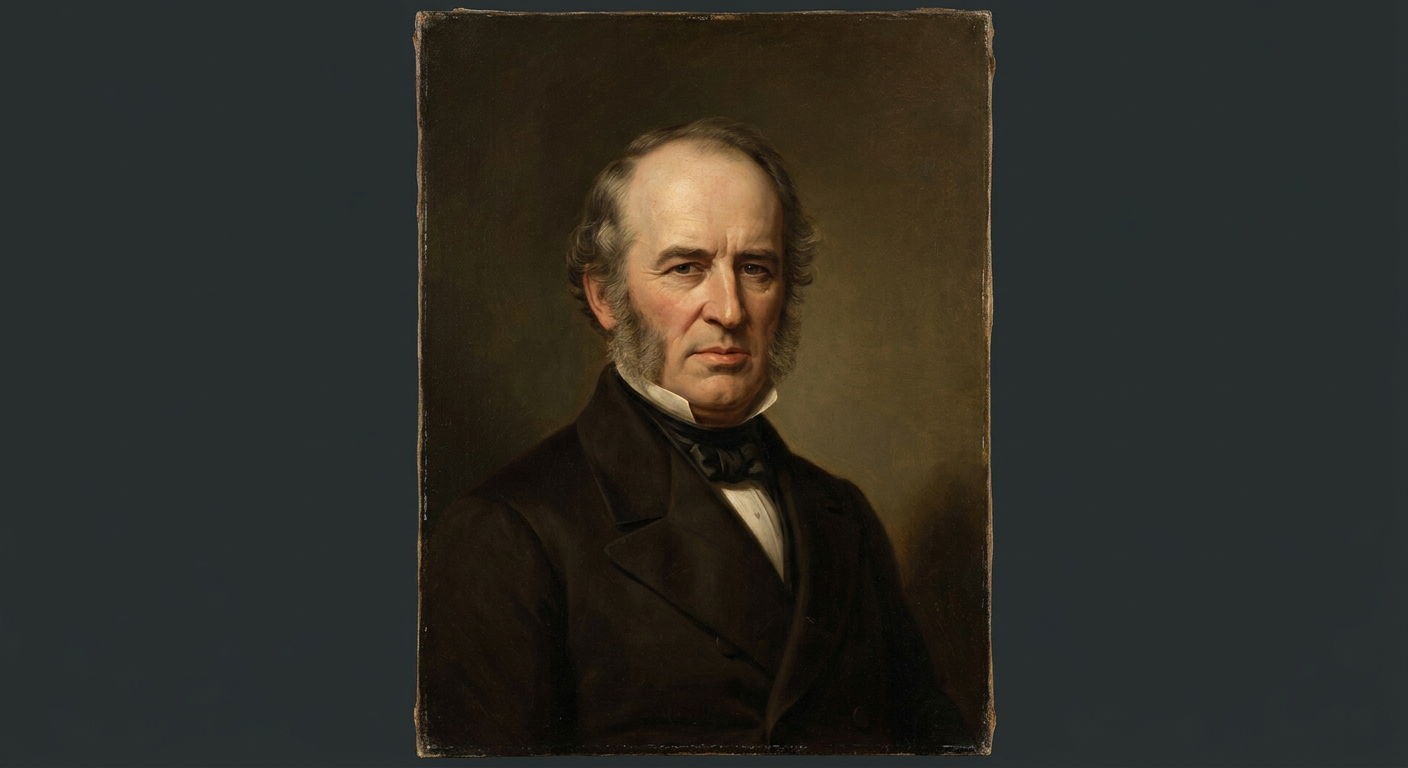
Quick Facts
- Years
- 1794 – 1877
- Category
- World Leaders & Revolutionaries
- Nationality
- American
- Occupation
- Businessman, shipping magnate, and railroad industrialist
Cornelius Vanderbilt
1794 – 1877 · American · Businessman, shipping magnate, and railroad industrialist
Recommended Audiobooks
Listen next from Marcus Alden

Life Lessons from Simon Bolivar
Marcus Alden · 55 min

Life Lessons from George Washington
Marcus Alden · 54 min
Cornelius Vanderbilt rose from modest circumstances on Staten Island to become one of the richest and most powerful businessmen of nineteenth-century America. Known as the Commodore, he first built a fortune by operating ferries and steamboats. In his sixties—an age when many contemporaries withdrew from business—he shifted his attention to railroads and created a transportation network centered on the New York Central.
Vanderbilt mattered because he helped transform transportation from a collection of local services into large, coordinated systems. His vessels challenged monopolies and lowered fares, while his railroads connected New York City more efficiently with the nation’s interior. Grand Central Depot, a predecessor of today’s Grand Central Terminal, symbolized his influence on both commerce and urban life.
His record was also deeply controversial. Vanderbilt could be innovative, disciplined, and unusually willing to risk his own capital, but he used price wars, stock-market maneuvers, political influence, and relentless pressure against competitors. His enormous estate intensified public arguments about concentrated wealth and fractured his family.
He remains worth studying not as a simple hero or villain, but as an architect of modern corporate capitalism. His career reveals how ambition, technology, finance, law, and public infrastructure combined during the United States’ rapid nineteenth-century expansion.
Quick Facts
| Field | Details |
|---|---|
| Full Name | Cornelius Vanderbilt |
| Common Name(s) | Cornelius Vanderbilt; the Commodore |
| Born | May 27, 1794 |
| Died | January 4, 1877 |
| Age at Death | 82 |
| Birthplace | Staten Island, New York, United States |
| Nationality | American |
| Occupation | Ferry operator, steamboat entrepreneur, shipping magnate, railroad executive, investor |
| Historical Era | Market Revolution, antebellum America, Civil War, and early Gilded Age |
| Famous For | Building major steamship and railroad systems; consolidating the New York Central; founding benefactor of Vanderbilt University |
| Political Affiliation | No consistent party leadership role; dealt pragmatically with politicians and governments |
| Religion | Raised in a Dutch Reformed cultural environment; not known for strong public religious observance |
| Education | Limited formal schooling; left school at about age eleven |
| Parents | Cornelius Vanderbilt Sr. and Phebe Hand Vanderbilt |
| Spouse(s) | Sophia Johnson Vanderbilt; Frank Armstrong Crawford Vanderbilt |
| Children | Thirteen with Sophia; eleven survived childhood |
| Major Works | Transportation enterprises including steamship lines, the Accessory Transit Company, and the New York Central and Hudson River Railroad system |
| Major Achievements | Built a shipping fortune, consolidated strategic railroads, developed Grand Central Depot, and gave $1 million to establish Vanderbilt University |
Early Life
Cornelius Vanderbilt was born on Staten Island, then a rural community connected to Manhattan by sailing vessels. He was the fourth of nine children of Cornelius Vanderbilt Sr. and Phebe Hand. His father farmed and carried goods by boat; his mother managed household resources and acquired property. Both exposed their son to the practical economics of New York Harbor.
Vanderbilt received little classroom education. He left school at roughly eleven and worked on his father’s boat, learning tides, weather, bargaining, cargo handling, and the demanding routines of harbor commerce. His later contempt for polished credentials was probably shaped by this experience, although sayings attributed to him about education often survive only in later recollections.
According to family tradition, he began an independent ferry service at sixteen after obtaining a $100 loan from his mother. He carried passengers and freight between Staten Island and Manhattan in a small sailing vessel. The exact details have been embellished in popular retellings, but the essential fact is well established: Vanderbilt entered the harbor trade while still a teenager and quickly reinvested his earnings.
The War of 1812 created demand for transporting military supplies around New York. Government-related contracts gave him useful income and experience. The larger historical setting also favored him. New York’s population and commerce were expanding, while new steam technology promised transportation that was faster and less dependent on wind.
Rise to Prominence
In 1813 Vanderbilt married his cousin Sophia Johnson. She managed inns and household affairs while bearing thirteen children, allowing him to spend long periods on the water and in business. Her labor was essential to the family enterprise, even though nineteenth-century accounts often treated it as secondary.
A decisive turn came in 1818, when Vanderbilt went to work for the wealthy New Jersey entrepreneur Thomas Gibbons. He captained and managed steamboats operating between New Jersey and New York, where a state-granted monopoly protected vessels licensed by Robert Fulton and Robert Livingston.
Gibbons challenged that monopoly. The resulting case, Gibbons v. Ogden, reached the US Supreme Court, which ruled in 1824 that federal authority over interstate commerce limited New York’s power to restrict interstate navigation. Vanderbilt was not the principal litigant, but his work for Gibbons taught him how competition, regulation, and law could reshape an industry.
By the late 1820s, Vanderbilt was operating his own steamboats. He became known for reducing fares, increasing service, controlling costs, and forcing rivals either to compete or negotiate. Price cutting benefited travelers in the short term, although critics argued that he sometimes used temporary losses to weaken competitors before restoring profitability.
During the California gold rush, Vanderbilt entered long-distance steamship transportation. His Accessory Transit Company offered a route through Nicaragua linking Atlantic and Pacific travel. Passengers crossed the country by river and overland transport rather than sailing around Cape Horn. The route shortened travel but involved harsh conditions, political uncertainty, and complicated concessions from the Nicaraguan government.
By the 1850s, Vanderbilt was nationally famous. Newspapers called him the Commodore, a title reflecting his dominance in shipping rather than an official naval rank.
Major Achievements
Building a Competitive Steamship Empire
Vanderbilt helped make scheduled steam travel cheaper and more dependable. He competed on routes around New York and later in coastal and ocean service. His emphasis on frequent departures, speed, and low fares anticipated methods later used by large transportation companies.
His competition with the subsidized Collins Line on Atlantic routes also supported an argument he repeatedly made: private operators could sometimes outperform heavily subsidized companies. That claim served his financial interests, but it contributed to national debate over subsidies and competition.
Developing the Nicaragua Transit Route
The Accessory Transit Company became an important alternative during the California gold rush. It reduced the distance between the eastern United States and California and demonstrated the commercial value of combining sea, river, lake, and land transportation.
The venture also exposed the risks of operating across national borders. Vanderbilt lost control of the company during conflicts with associates Charles Morgan and Cornelius Garrison. He later retaliated through commercial competition and diplomacy. His success in regaining influence contributed greatly to his reputation as an opponent who was dangerous to cross.
Turning from Ships to Railroads
Vanderbilt’s most consequential decision was to transfer much of his attention and capital from ships to railroads. He recognized that rail lines would increasingly carry passengers, food, raw materials, and manufactured goods across the continent.
He acquired control of the New York and Harlem Railroad, the Hudson River Railroad, and the New York Central. In 1869 the New York Central and Hudson River companies were consolidated. This integration reduced administrative fragmentation and created a stronger route between New York City and Buffalo, with connections extending farther west.
Creating Grand Central Depot
Vanderbilt backed the construction of Grand Central Depot in Manhattan, which opened in 1871. It brought several rail services into a shared terminal and helped reorganize transportation on the city’s east side.
The original depot was later expanded and eventually replaced by Grand Central Terminal, opened in 1913. The present building is not Vanderbilt’s depot, but it occupies the institutional and geographic legacy of his railroad complex.
Supporting Vanderbilt University
In 1873 Vanderbilt gave $1 million to establish a university in Nashville associated with the Methodist Episcopal Church, South. His second wife, Frank Armstrong Crawford, and Bishop Holland Nimmons McTyeire helped encourage the gift.
Vanderbilt had little connection with higher education and never visited the completed university. Nevertheless, the donation—one of the largest educational gifts in American history up to that time—gave the institution his name and helped create a major university in the post–Civil War South.
Leadership or Work
Vanderbilt was a hands-on operator before becoming a corporate strategist. His early knowledge of vessels, routes, fuel, crews, and passenger demand gave him advantages over investors who understood finance but not transportation.
His characteristic methods included:
- Studying costs and insisting that equipment earn returns.
- Reinvesting profits rather than displaying wealth early in his career.
- Cutting prices to attract customers and pressure competitors.
- Buying strategic connections rather than isolated properties.
- Concentrating authority in himself and a small circle of trusted managers.
- Using personal reputation as both a business asset and a threat.
He made decisions rapidly and accepted risks that frightened more cautious investors. Yet his leadership was highly autocratic. He could be verbally harsh, dismissive of minority shareholders, and intolerant of disloyalty. His companies depended heavily on his judgment, making succession a serious problem.
Vanderbilt’s greatest strategic strength was his ability to recognize changing technology. His greatest organizational weakness was that he often treated personal control as more important than transparent governance.
Personal Life
Vanderbilt and Sophia Johnson married in 1813 and had thirteen children. Eleven lived to adulthood. Their relationship combined family life with business partnership: Sophia operated a boarding house and later managed domestic properties while Cornelius traveled extensively.
The marriage appears to have been difficult at times. Most disturbing was Vanderbilt’s role in having Sophia confined briefly in a private asylum in the 1840s. Some accounts connect the episode to marital conflict and his relationship with a governess. The surviving evidence does not permit complete certainty about motives, but the incident demonstrates the severe legal and social vulnerability of married women in that period.
Sophia died in 1868. The following year Vanderbilt married Frank Armstrong Crawford, a Southern woman more than four decades younger than he was and distantly related to him. She was religiously active and helped direct his attention toward the proposed university in Nashville.
Vanderbilt was physically robust for much of his life. He enjoyed fast horses, played whist, and was famous for direct, sometimes coarse conversation. He lacked elite manners and did not pretend otherwise. Later in life, however, he entered New York high society, built a large Manhattan residence, and saw his descendants pursue the social prestige associated with the Vanderbilt name.
His relationships with his children were unequal. He doubted the abilities of several sons but gradually came to trust William Henry Vanderbilt, who improved the family’s Staten Island farm and later demonstrated skill in railroad management. Cornelius Jeremiah Vanderbilt, another son, suffered from epilepsy and gambling problems and had a painful relationship with his father.
Philosophy or Beliefs
Vanderbilt left no systematic statement of philosophy. His worldview must therefore be reconstructed cautiously from his actions, testimony, correspondence, and recollections by others.
He believed strongly in competition when it enabled him to challenge monopolies. Low fares and efficient service were both business tools and evidence, in his view, that protected operators could be defeated. Yet once he controlled essential routes, he was willing to consolidate companies and exercise market power himself. His practice was therefore less a consistent defense of open competition than a belief that strong operators should be free to win.
Politically, he was pragmatic rather than ideological. He worked with governments, sought charters and concessions, and opposed subsidies when they favored rivals. During the Civil War he presented his steamship Vanderbilt to the Union government, an important patriotic gesture that also reinforced his national standing.
Religion was not the central public force in his life that it was for many contemporaries. His university donation came partly through family and Methodist influence. Modern claims that the gift proves a late religious transformation go beyond the available evidence.
Challenges and Controversies
Ruthless Competition
Vanderbilt’s price wars could lower fares dramatically, helping consumers. Critics, however, viewed them as predatory: a wealthy operator could tolerate losses until weaker rivals surrendered. In some cases he accepted payments to leave routes, behavior that complicates the image of a pure champion of competition.
Stock-Market Maneuvers
His battles for the Harlem and Erie railroads involved stock speculation, legislative maneuvering, and attempts to corner shares. During the Erie War, Daniel Drew, Jay Gould, and James Fisk issued additional stock that weakened Vanderbilt’s position. He lost millions on paper before reaching a settlement. The episode exposed the poorly regulated and frequently manipulated securities markets of the era.
Labor and Public Responsibility
Vanderbilt focused on owners, traffic, rates, and capital rather than organized worker welfare. Nineteenth-century railroads were dangerous workplaces, and the wider system he helped build relied on employees who possessed little bargaining power. It would be anachronistic to judge him by modern labor law, but contemporaries also criticized the social power of large corporations.
Family Conflict and Inheritance
Vanderbilt left the bulk of his fortune—about $95 million in widely reported estimates—to William Henry Vanderbilt. Most other children received much smaller portions. Daughters and Cornelius Jeremiah challenged the will, claiming undue influence and questioning their father’s mental competence. A settlement preserved the basic distribution.
Supporters argued that Vanderbilt wanted to prevent fragmentation of the railroad empire and considered William the only capable successor. Critics saw the will as an expression of favoritism, patriarchal assumptions, and cruelty toward vulnerable family members.
Wealth and Philanthropy
At his death, Vanderbilt’s fortune exceeded $100 million by common estimates, an extraordinary share of the contemporary economy. Vanderbilt University was a transformative gift, but his total philanthropy was modest relative to his wealth. Historians therefore distinguish him from later industrialists such as Andrew Carnegie, who publicly promoted large-scale giving as a moral obligation.
Legacy
Cornelius Vanderbilt helped establish the integrated transportation corporation as a central institution of American life. By coordinating rail lines, terminals, schedules, and capital, he accelerated the movement of people and goods between the Atlantic coast and the interior.
His descendants expanded both the fortune and the Vanderbilt social legend. William Henry Vanderbilt approximately doubled the inheritance before his death in 1885. Later generations built mansions such as The Breakers in Newport and the Biltmore Estate in North Carolina. Their spending also demonstrated how quickly even enormous dynastic wealth could be dispersed.
Places and institutions connected with his legacy include:
- Vanderbilt University in Nashville.
- Grand Central Terminal and Vanderbilt Avenue in New York City.
- The Vanderbilt family mausoleum in the Moravian Cemetery on Staten Island.
- The Breakers and other properties preserved by the Preservation Society of Newport County.
- Numerous archives, portraits, biographies, and exhibitions devoted to the family and the growth of American business.
Modern scholars generally avoid portraying Vanderbilt solely as either a robber baron or a heroic industrial pioneer. He improved transportation and challenged inefficient privileges, but he also concentrated economic power and exploited weak regulation. That tension makes his career central to debates about entrepreneurship, monopoly, infrastructure, and inequality.
Interesting Facts
- Vanderbilt left formal schooling at approximately eleven years old.
- He entered the ferry business while still in his teens.
- The title Commodore was honorary, not a rank awarded by the US Navy.
- He learned the steamboat trade while working for Thomas Gibbons.
- His career was indirectly connected with the landmark Supreme Court case Gibbons v. Ogden.
- He operated transportation services on both Atlantic and Pacific routes.
- His Nicaragua route competed with the Panama crossing during the gold rush.
- He shifted decisively into railroads after already becoming wealthy from shipping.
- He took control of the New York and Harlem Railroad, whose route included part of Manhattan.
- He donated the steamship Vanderbilt to the Union during the Civil War.
- The vessel participated in the unsuccessful search for the Confederate raider Alabama.
- He was in his seventies when his consolidated railroad system reached its mature form.
- Grand Central Depot opened six years before his death.
- His $1 million university gift was roughly one percent of his fortune.
- Vanderbilt University was originally called Central University before being renamed for him.
- He reportedly never visited the university bearing his name.
- He had thirteen children, but left most of his estate to one son.
- His will produced a prolonged and highly publicized legal challenge.
- His mausoleum stands in Staten Island’s Moravian Cemetery.
- Gloria Vanderbilt and journalist Anderson Cooper were among his later descendants.
Famous Quotes
Vanderbilt did not publish memoirs, and many quotations associated with him were recorded years later. Wording therefore varies, and attribution should be treated cautiously.
- ‘Gentlemen: You have undertaken to cheat me. I won’t sue you, for the law is too slow. I’ll ruin you.’ Traditionally identified as Vanderbilt’s 1853 warning to Charles Morgan and Cornelius Garrison. The letter is widely cited, though printed versions vary. It captures his preference for commercial retaliation.
- ‘I have always served the public to the best of my ability. Why? Because, like every other man, it is to my interest to do so.’ Attributed to Vanderbilt in accounts of his business testimony. It expresses service as enlightened self-interest, not charity.
- ‘I don’t care half so much about making money as I do about making my point, and coming out ahead.’ Reported in later reminiscences. If authentic, it reflects the competitive pride visible in his documented conduct.
- ‘I have been insane on the subject of moneymaking all my life.’ A frequently repeated late-life remark. Its exact source is uncertain, so it should not be treated as a verbatim diary statement.
- ‘If I had learned education, I would not have had time to learn anything else.’ Attributed through later anecdotes, often involving Chauncey Depew. It illustrates Vanderbilt’s suspicion of formal schooling, but the wording is not securely contemporary.
- ‘What do I care about the law? Hain’t I got the power?’ Commonly attached to Vanderbilt, but its documentary basis is weak and historians warn against presenting it as certain. It survives because it summarizes public fears about corporate power.
- ‘Keep the property together.’ Reported as the principle behind Vanderbilt’s estate planning rather than securely established verbatim final words. It helps explain the concentration of his inheritance in William.
- ‘The public be damned.’ This is often wrongly assigned to Cornelius. It was attributed to his son William Henry Vanderbilt in an 1882 newspaper interview, five years after Cornelius died. Even in William’s case, the surrounding remarks concerned running trains at a loss, and the compressed phrase distorted the fuller exchange.
Timeline
- 1794 — Born on Staten Island on May 27.
- About 1805 — Leaves formal schooling and works in family transportation.
- 1810 — Begins an independent ferry venture according to family accounts.
- 1812–1815 — Gains experience and income transporting supplies during the War of 1812.
- 1813 — Marries Sophia Johnson.
- 1818 — Begins working for steamboat entrepreneur Thomas Gibbons.
- 1824 — Supreme Court decides Gibbons v. Ogden, weakening New York’s steamboat monopoly.
- Late 1820s — Expands independent steamboat operations.
- 1840s — Becomes a dominant figure in regional steam navigation.
- 1851 — Develops the Accessory Transit route through Nicaragua.
- 1853 — Loses control of the transit company to former associates and promises retaliation.
- Mid-1850s — Competes successfully against rival Central American transit interests.
- Late 1850s — Reduces shipping interests and increases railroad investment.
- 1862 — Gives the steamship Vanderbilt to the Union.
- 1863 — Gains control of the New York and Harlem Railroad.
- 1864 — Takes control of the Hudson River Railroad.
- 1867 — Gains control of the New York Central Railroad.
- 1868 — Sophia Vanderbilt dies; Vanderbilt battles Drew, Gould, and Fisk in the Erie War.
- 1869 — Marries Frank Armstrong Crawford; consolidates the New York Central and Hudson River lines.
- 1871 — Grand Central Depot opens in Manhattan.
- 1873 — Donates $1 million to establish Vanderbilt University.
- 1877 — Dies in New York City on January 4.
- 1877–1879 — His will is contested before the family reaches a settlement.
Frequently Asked Questions
1. Why was Cornelius Vanderbilt called the Commodore?
The title referred to his commanding position in the steamboat industry. It was an informal nickname rather than a commission in the United States Navy. By the 1840s, Vanderbilt controlled numerous vessels and routes, making the naval-sounding term seem appropriate to journalists and the public. The nickname remained attached to him after railroads became his primary business.
2. Was Vanderbilt born rich?
No. His family owned land and worked in farming and harbor transportation, so he was not destitute, but he did not inherit a great fortune. His parents provided skills, contacts, and limited resources. Family tradition says his mother lent him $100 for his first boat. His wealth came chiefly from reinvested transportation profits, aggressive competition, and later railroad securities.
3. How did he make his first fortune?
Vanderbilt accumulated his initial fortune in ferries and steamboats. He carried passengers and freight, managed vessels for Thomas Gibbons, and then established his own services. He sought busy routes, controlled operating expenses, and often charged less than rivals. By the time he entered ocean shipping and the California transit business, he already possessed substantial capital and industry experience.
4. What was Vanderbilt’s role in Gibbons v. Ogden?
He was not a named Supreme Court litigant or the lawyer who argued the case. Vanderbilt worked for Thomas Gibbons, whose interstate steamboat operation challenged a New York monopoly associated with Aaron Ogden. The 1824 ruling strengthened federal power over interstate commerce. Vanderbilt benefited directly and learned that legal structures could determine which technologies and companies reached a market.
5. Did Vanderbilt invent the steamboat or railroad?
No. Both technologies existed before his rise. His importance lay in operation, finance, competition, and consolidation rather than invention. He deployed existing technology more efficiently, linked routes, lowered some fares, purchased strategic railroads, and combined separate lines into a larger system. Calling him an inventor would misrepresent his genuine talent as an organizer of transportation networks.
6. What was the Nicaragua route?
It was a transportation corridor used by travelers moving between the Atlantic and Pacific during the California gold rush. Ships carried passengers to Nicaragua, where they crossed by river, lake, and a short land segment before boarding another ship. Vanderbilt’s Accessory Transit Company promoted the route as faster than sailing around South America, though travel remained difficult and politically risky.
7. Why did Vanderbilt move into railroads?
He recognized that railroads offered expanding year-round access to inland markets. Steamboats remained useful, but rails could connect farms, factories, cities, canals, and ports within an integrated network. Vanderbilt also understood that controlling terminal facilities and connecting lines could be more valuable than owning scattered routes. The move demonstrated strategic adaptation rather than abandonment of transportation.
8. What railroads did Vanderbilt control?
His principal holdings included the New York and Harlem Railroad, Hudson River Railroad, and New York Central Railroad. He consolidated the latter two into the New York Central and Hudson River Railroad. His family later extended the system through additional connections, helping form the broader New York Central network associated with travel between New York, Buffalo, Chicago, and other cities.
9. Did he build Grand Central Terminal?
Not the present terminal. Vanderbilt developed Grand Central Depot, which opened in 1871 and united several rail services. The depot was expanded as Grand Central Station and eventually replaced by today’s Grand Central Terminal, completed in 1913. He therefore established the transportation complex and location, but the famous Beaux-Arts building belongs to a later generation.
10. Was Vanderbilt a robber baron?
The term is an interpretation, not a neutral job description. Critics apply it because he manipulated markets, pressured competitors, concentrated power, and accumulated extraordinary wealth. Defenders emphasize lower fares, improved service, private investment, and integrated rail systems. Most historians assess both sides: Vanderbilt expanded useful infrastructure, but he did so within a weakly regulated economy that rewarded coercive tactics.
11. How did Vanderbilt help the Union during the Civil War?
In 1862 he gave his powerful steamship Vanderbilt to the federal government. The Union converted it for naval use, and it participated in efforts to locate the Confederate commerce raider Alabama. The gift was valuable and patriotic, although Vanderbilt’s broader career remained commercially motivated. Congress later presented him with a gold medal in recognition of the contribution.
12. Why did he found Vanderbilt University?
Vanderbilt supplied $1 million after encouragement from his second wife, Frank Armstrong Crawford, and Methodist bishop Holland Nimmons McTyeire. The school was intended to support higher education in the South after the Civil War and to serve Methodist interests. Historians debate the relative importance of reconciliation, religion, family influence, and reputation, because Vanderbilt left no detailed philanthropic manifesto.
13. How rich was Vanderbilt when he died?
His estate is usually estimated at more than $100 million in 1877 dollars. Exact comparisons with modern wealth are difficult because inflation, national output, asset values, and population produce different results. What can be said confidently is that his fortune represented an exceptionally large concentration of private economic power and made him one of the richest Americans of his century.
14. Why did he leave most of his money to William?
Vanderbilt believed William Henry had proven capable of managing the railroads and preserving the estate. He feared that dividing control among many heirs would weaken the system. The decision also reflected nineteenth-century patriarchal attitudes and strained family relationships. Other children challenged the will, alleging incapacity and undue influence, but the main distribution survived after a settlement.
15. What happened to the Vanderbilt fortune?
William Henry Vanderbilt substantially increased it, but later generations divided the wealth among many heirs and spent heavily on houses, art, travel, entertainment, and social competition. Economic changes and inheritance taxes also mattered. The familiar claim that one generation simply squandered everything is too simplistic, yet the family’s experience remains a dramatic example of how rapidly concentrated wealth can disperse.
16. What was Vanderbilt’s greatest failure?
The Erie War was his most famous setback. Vanderbilt attempted to gain control of the Erie Railway, but Daniel Drew, Jay Gould, and James Fisk issued new shares, diluting his purchases. Political and legal maneuvering followed. Vanderbilt eventually obtained a settlement, but the conflict showed that even his capital and determination could be defeated by equally aggressive opponents using flexible corporate rules.
Lessons We Can Learn
- Adapt before necessity forces change. Vanderbilt moved from sail to steam and then from ships to railroads. The evidence demonstrates technological adaptability; applying it to modern careers is a reasonable interpretation.
- Operational knowledge matters. Years spent handling boats gave him practical insight before he became an investor. Leaders still benefit from understanding how work is actually performed.
- Networks can be more valuable than isolated assets. His railroad strength came from connecting routes and terminals. Modern logistics and digital platforms follow a comparable principle.
- Low prices do not automatically mean fair competition. Vanderbilt’s fare cuts helped customers but could also eliminate weaker rivals. Consumers and regulators must consider long-term market structure.
- Law shapes markets. Gibbons v. Ogden, charters, concessions, and securities rules repeatedly affected his career. Business success never occurs outside legal institutions.
- Reputation can become capital. Rivals knew Vanderbilt could sustain a long commercial struggle. Trust and fear both influenced negotiations, though fear-based leadership carries lasting costs.
- Concentrated authority creates succession risks. His personal control built speed but contributed to family conflict. Durable organizations need governance beyond one dominant individual.
- Philanthropy can outlast commercial victories. Vanderbilt University remains more visible to many people than his steamboat battles. Long-term public institutions can reshape a donor’s legacy.
- Wealth does not resolve family conflict. His unequal will produced litigation and resentment. Transparent planning and humane communication matter as much as asset preservation.
- Historical achievement can coexist with serious harm. Vanderbilt improved transportation while exploiting weak regulation and unequal power. Studying both realities produces better judgment than hero worship or simple condemnation.
Related Historical Figures
- Thomas Gibbons — Vanderbilt’s employer and mentor in the steamboat trade; his monopoly challenge helped shape Vanderbilt’s approach to competition.
- Aaron Ogden — Gibbons’s rival in Gibbons v. Ogden, the case that transformed interstate navigation law.
- Robert Fulton — Steamboat pioneer whose licensed network formed part of the monopoly environment Vanderbilt opposed.
- Charles Morgan — Shipping associate turned rival in the struggle for control of the Nicaragua transit business.
- Cornelius Garrison — Former Vanderbilt associate involved in taking control of the Accessory Transit Company.
- Daniel Drew — Steamboat and railroad financier who fought Vanderbilt in major stock-market contests.
- Jay Gould — Financier whose tactics helped prevent Vanderbilt from capturing the Erie Railway.
- James Fisk — Gould’s flamboyant partner during the Erie War.
- William Henry Vanderbilt — Cornelius’s son, principal heir, and successor as head of the railroad fortune.
- Andrew Carnegie — A later industrialist whose expansive philosophy of philanthropy offers a revealing contrast with Vanderbilt’s more limited giving.
Watch and Learn
The Industrial Economy: Crash Course US History #23 — CrashCourse — approximately 13 minutes.
This widely viewed educational video explains the industrial and transportation economy in which Vanderbilt’s railroad empire developed. It is not exclusively a Vanderbilt biography, but it provides reliable, accessible context on railroads, corporate growth, labor, and the concentration of wealth—essential themes for evaluating his career without separating him from his era.
Watch and Learn
The Industrial Economy: Crash Course US History #23 · CrashCourse
Related Historical Figures