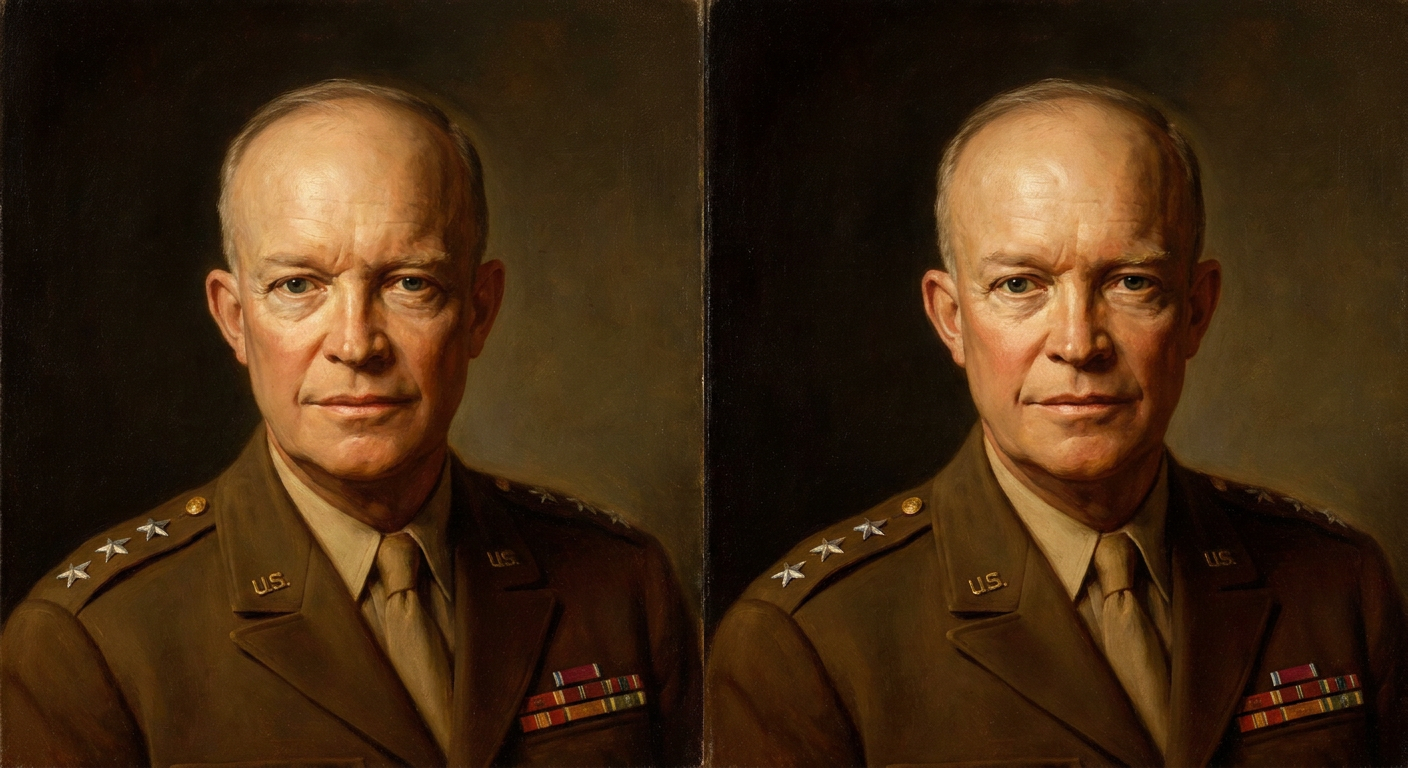
Quick Facts
- Years
- 1890 – 1969
- Category
- World Leaders & Revolutionaries
- Nationality
- American
- Occupation
- U.S. Army general, statesman, and 34th president of the United States
Dwight D. Eisenhower
1890 – 1969 · American · U.S. Army general, statesman, and 34th president of the United States
Recommended Audiobooks
Listen next from Marcus Alden

Life Lessons from Simon Bolivar
Marcus Alden · 55 min

Life Lessons from George Washington
Marcus Alden · 54 min
Dwight D. Eisenhower was one of the few people to exercise supreme authority in both a global war and the presidency of the United States. As Supreme Commander of the Allied Expeditionary Force in Europe, he directed the multinational coalition that invaded Nazi-occupied France on D-Day and helped defeat Germany. Less than a decade later, Americans elected him their 34th president.
Eisenhower’s public image—calm smile, plain language, reassuring confidence—could make leadership look effortless. It was not. His greatest skill was often managerial rather than theatrical: he reconciled forceful personalities, weighed imperfect intelligence, delegated responsibility, and accepted the burden of final decisions. During his presidency, he ended active American involvement in the Korean War, supported the Interstate Highway System, enforced school desegregation at Little Rock, and tried to contain Soviet power without triggering nuclear war.
His record also contains serious controversies. His administration approved covert interventions abroad, expanded nuclear deterrence, enforced discriminatory security policies, and responded cautiously to much of the civil rights movement. Historians consequently debate whether he was a restrained strategist, an overly cautious politician, or both.
Eisenhower still matters because he governed at the meeting point of military power, democratic accountability, technological change, and nuclear danger. His warning about the “military-industrial complex” remains among the most frequently discussed presidential statements in American history.
Quick Facts
| Field | Details |
|---|---|
| Full Name | Dwight David Eisenhower |
| Common Name(s) | Dwight D. Eisenhower; Ike |
| Born | October 14, 1890 |
| Died | March 28, 1969 |
| Age at Death | 78 |
| Birthplace | Denison, Texas, United States |
| Nationality | American |
| Occupation | U.S. Army officer, general, university president, statesman, president |
| Historical Era | World War II and the early Cold War |
| Famous For | Supreme Allied command in Europe; D-Day; 34th U.S. presidency |
| Political Affiliation | Republican Party |
| Religion | Raised in a River Brethren household; baptized Presbyterian as president |
| Education | U.S. Military Academy; Command and General Staff School; Army War College |
| Parents | David Jacob Eisenhower and Ida Elizabeth Stover Eisenhower |
| Spouse(s) | Mamie Geneva Doud Eisenhower |
| Children | Doud Dwight “Icky” Eisenhower; John Sheldon Doud Eisenhower |
| Major Works | Crusade in Europe; Mandate for Change; Waging Peace; At Ease |
| Major Achievements | Directed Allied operations in Europe; served as first NATO supreme commander; ended fighting in Korea; advanced interstate highways, space research, and federal civil rights enforcement |
Early Life
Dwight David Eisenhower was born in Denison, Texas, the third of seven sons. His family soon returned to Abilene, Kansas, where his father worked at a creamery. The Eisenhowers had limited money, but their household emphasized discipline, work, religious devotion, and education.
Known as Ike—several brothers used versions of the nickname—Eisenhower enjoyed hunting, fishing, football, and military history. He read about figures such as Hannibal and George Washington. His mother, a committed pacifist, disapproved of war but did not prevent him from pursuing a military education.
After graduating from Abilene High School in 1909, Eisenhower worked at a creamery so that his brother Edgar could attend college. A friend’s plans for military education alerted him to tuition-free federal academies. Eisenhower won an appointment to the U.S. Military Academy at West Point and entered in 1911.
He was a capable but not outstanding cadet academically. Football mattered greatly to him until a knee injury ended his playing career. His class of 1915 later became known as “the class the stars fell on” because an unusually large number of its members became generals. Eisenhower graduated 61st in a class of 164.
Rise to Prominence
Eisenhower married Mamie Doud in 1916 and spent the next two decades moving among Army assignments. During the First World War, he trained tank crews in the United States but did not serve overseas—a lasting disappointment. His temporary wartime promotion disappeared after demobilization, and postwar advancement was slow.
What distinguished Eisenhower was his ability to learn from talented, demanding superiors. General Fox Conner, whom he served in Panama, became an especially important mentor. Conner encouraged intensive study of history and coalition warfare and helped Eisenhower attend the Command and General Staff School. Eisenhower graduated first in his class in 1926.
He later worked under General John J. Pershing and served as an aide to General Douglas MacArthur, including several years in the Philippines. The relationship with MacArthur was productive but strained. Eisenhower learned staff work, strategic planning, and diplomacy, although he still lacked battlefield command.
The Second World War transformed his career. After the United States entered the conflict in December 1941, Army Chief of Staff George C. Marshall recognized Eisenhower’s strategic judgment and brought him to Washington. Eisenhower helped develop plans for defeating Germany and argued that the Allies should concentrate their main effort in Europe.
In 1942 he became commander of American forces in the European theater and then led Operation Torch, the Allied invasion of North Africa. Despite early mistakes and political controversy, he proved able to coordinate American, British, and French interests. He subsequently directed the invasions of Sicily and Italy.
In December 1943, President Franklin D. Roosevelt selected Eisenhower as Supreme Commander of the Allied Expeditionary Force. His task was to prepare Operation Overlord, the invasion of western Europe. On June 6, 1944, after making the agonizing decision to launch despite uncertain weather, Eisenhower sent Allied forces onto the beaches of Normandy. He later commanded the campaigns that liberated France, invaded Germany, and ended with Germany’s surrender in May 1945.
Major Achievements
Supreme Allied Command and D-Day
Eisenhower coordinated troops, ships, aircraft, intelligence, and logistics from numerous Allied nations. He also managed strong personalities, including Bernard Montgomery, George S. Patton, Omar Bradley, and Charles de Gaulle. D-Day did not win the war by itself, but it established the western front from which Allied armies liberated much of western Europe.
His leadership mattered because coalition warfare can collapse through political rivalry even when armies are powerful. Eisenhower kept Britain and the United States working toward a shared objective while maintaining civilian confidence in the command.
Building NATO’s Military Structure
In 1950, President Harry Truman recalled Eisenhower to active duty as the first Supreme Allied Commander Europe of the North Atlantic Treaty Organization. Eisenhower helped turn NATO from a political pledge into a functioning military alliance. The command arrangements established during this period became central to Western defense throughout the Cold War.
Ending the Korean War Fighting
Eisenhower campaigned in 1952 with a promise to visit Korea. After taking office, his administration increased diplomatic pressure and signaled that continued stalemate carried risks. An armistice was signed in July 1953.
Scholars disagree about exactly what produced the agreement. Stalin’s death, battlefield exhaustion, negotiations over prisoners, and possible American nuclear signals all contributed. Eisenhower did not create a permanent peace treaty, but he ended large-scale fighting involving U.S. forces.
Interstate Highway System
The Federal-Aid Highway Act of 1956 authorized a vast national network of high-speed roads. Eisenhower’s experiences with a slow 1919 Army convoy and Germany’s autobahns influenced his support, though the final law resulted from years of congressional and state planning.
The highways transformed travel, freight, suburbs, and national commerce. They also damaged many urban neighborhoods—often low-income or minority communities—and encouraged automobile dependence. Their legacy is therefore both economically significant and socially contested.
Managing Nuclear-Age Competition
Eisenhower relied on alliances, economic strength, intelligence operations, and nuclear deterrence to contain communism while limiting conventional military costs. His administration ended without a direct war between the United States and Soviet Union.
He promoted “Atoms for Peace,” supported international civilian nuclear cooperation, and created NASA after the Soviet launch of Sputnik. The National Defense Education Act expanded federal support for science, mathematics, and foreign-language education.
Civil Rights Enforcement
Eisenhower signed the Civil Rights Acts of 1957 and 1960, the first federal civil rights laws since Reconstruction. The 1957 act created a Civil Rights Division in the Justice Department and a federal Civil Rights Commission, although Southern senators weakened its enforcement provisions.
In 1957, Arkansas governor Orval Faubus obstructed the integration of Central High School in Little Rock. Eisenhower federalized the Arkansas National Guard and sent soldiers from the 101st Airborne Division to protect nine Black students. His action affirmed that states could not openly defy federal court orders.
Leadership or Work
Eisenhower practiced disciplined delegation. He expected subordinates to debate options vigorously before a decision, but once he decided, he demanded coordinated execution. His wartime headquarters relied on written plans, regular conferences, and clearly defined command relationships.
His strengths included:
- Patience with allies and competing personalities
- Skill at reducing complex problems to central choices
- Attention to logistics and organization
- Willingness to accept responsibility publicly
- A strong understanding of political limits on military action
He was not simply passive or detached. As president, he sometimes concealed the extent of his control, allowing cabinet officers to absorb criticism while he preserved an image of calm leadership. Political scientist Fred Greenstein later described this as a “hidden-hand” style. Earlier scholars had sometimes portrayed Eisenhower as less engaged; access to records changed much of that assessment.
His methods also had weaknesses. Indirect leadership could obscure accountability. He sometimes tolerated disagreement too long, relied excessively on covert action, and failed to explain difficult policies fully to the public.
Personal Life
Eisenhower met Mamie Geneva Doud in Texas, and they married on July 1, 1916. Their first son, Doud Dwight, died of scarlet fever in 1921 at age three. The loss devastated both parents. Their second son, John, became an Army officer, diplomat, and military historian.
The Eisenhowers’ marriage endured long separations caused by military service. During the war, Eisenhower worked closely with his British driver and secretary, Kay Summersby. Summersby later suggested an emotional or romantic relationship, but surviving evidence does not establish that they had a physical affair. Historians remain divided and generally treat stronger claims cautiously.
Eisenhower enjoyed golf, bridge, painting, fishing, cooking, and western novels. He was famous for an energetic grin but possessed a formidable temper, which he usually tried to control. He smoked heavily for years before abruptly giving up cigarettes in 1949.
His health became a national concern. He suffered a heart attack in 1955, underwent intestinal surgery in 1956, and experienced a mild stroke in 1957. He recovered sufficiently to complete two presidential terms, but these illnesses encouraged planning for temporary presidential disability.
Philosophy or Beliefs
Eisenhower was a moderate conservative who valued balanced budgets, private enterprise, federalism, alliances, and social stability. He accepted major New Deal programs such as Social Security rather than trying to dismantle them. His “Modern Republicanism” sought to combine fiscal restraint with a limited but durable welfare state.
Although raised in a deeply religious household, Eisenhower did not formally join a church until his presidency. He was baptized into the Presbyterian Church in 1953. His public language linked religious faith with civic responsibility, a common Cold War theme, while generally avoiding sectarian doctrine.
His strategic worldview rested on balance. National security required military strength, but excessive military spending could weaken the economy and distort democratic government. He believed long-term competition with the Soviet Union would be won through economic vitality, alliances, public confidence, and patience—not merely weapons.
Eisenhower’s beliefs on race were more cautious. He opposed racial discrimination in principle and upheld federal authority, yet he doubted that law alone could quickly change attitudes. Critics argue that this caution slowed moral progress; defenders note that he used federal power decisively at Little Rock and approved meaningful, if limited, legislation.
Challenges and Controversies
Covert Intervention
The Eisenhower administration approved CIA-backed operations that helped overthrow Iran’s prime minister Mohammad Mosaddegh in 1953 and Guatemala’s president Jacobo Árbenz in 1954. Officials defended these actions as necessary to prevent communist expansion and protect strategic interests. Later scholarship emphasizes local politics, economic interests, and the long-term instability produced by intervention.
Nuclear Strategy
The “New Look” defense policy placed heavy reliance on nuclear weapons and threatened massive retaliation. Supporters believed it deterred Soviet aggression at a manageable cost. Critics argue that it normalized catastrophic threats and offered too few options between retreat and nuclear escalation.
Civil Rights Caution
Eisenhower enforced the Supreme Court’s authority at Little Rock but rarely presented desegregation as an urgent moral cause. He privately expressed reservations about the speed of court-ordered change and declined to endorse the Supreme Court’s Brown v. Board of Education decision enthusiastically. Historians therefore distinguish his defense of constitutional order from full support for the movement’s broader aims.
Discriminatory Federal Policies
Executive Order 10450 expanded security investigations of federal employees in 1953. In practice, it helped institutionalize the removal of gay and lesbian workers during the “Lavender Scare.” The policy reflected widespread prejudice but caused lasting injustice and is now a major criticism of his administration.
The administration also pursued mass removals of undocumented Mexican migrants under a program officially given a racist name. Supporters presented it as immigration enforcement; critics document coercive methods, civil rights violations, and harm to people of Mexican descent, including some U.S. citizens.
McCarthyism
Eisenhower disliked Senator Joseph McCarthy but initially resisted a direct public confrontation, fearing it would elevate him or divide Republicans. His administration worked against McCarthy behind the scenes, and McCarthy was censured in 1954. Critics believe presidential moral leadership should have come sooner; supporters consider the quieter strategy politically effective.
U-2 Crisis
In May 1960, the Soviet Union shot down an American U-2 reconnaissance aircraft. The administration first issued a false cover story, which collapsed when the Soviets revealed that pilot Francis Gary Powers was alive. Eisenhower accepted responsibility but refused to apologize for espionage. The episode wrecked a planned Paris summit and exposed the costs of secret operations.
Legacy
Eisenhower left office with high public approval, although early academic surveys often ranked him as an average or passive president. Declassified records and later scholarship revealed a more active strategist. Modern presidential rankings generally place him in or near the upper tier, though judgments differ over civil rights, covert action, and nuclear policy.
His physical legacy includes the Dwight D. Eisenhower Presidential Library, Museum and Boyhood Home in Abilene; the Eisenhower National Historic Site in Gettysburg; the Eisenhower Memorial in Washington, D.C.; and numerous highways, schools, ships, medical facilities, and public buildings. The interstate system formally bears his name.
His strategic legacy remains relevant whenever leaders debate alliances, defense budgets, covert operations, infrastructure, or the relationship between experts and democratic government. The farewell warning about the military-industrial complex endures because Eisenhower delivered it not as an opponent of defense, but as a career soldier who believed power required constant public scrutiny.
Interesting Facts
- Eisenhower was born David Dwight Eisenhower but later used Dwight David consistently.
- All seven Eisenhower brothers were nicknamed “Ike” in some form during childhood.
- He applied to both West Point and the Naval Academy but was too old for naval admission.
- A knee injury ended his competitive football career at West Point.
- He never commanded troops in overseas combat during the First World War.
- He graduated first among 245 officers at the Command and General Staff School.
- Before D-Day, he wrote a note accepting full responsibility in case the invasion failed.
- The note mistakenly carried a July rather than June date.
- He permitted defeated German officers to retain ceremonial sidearms at the surrender signing.
- He served as president of Columbia University before becoming president of the United States.
- He was NATO’s first Supreme Allied Commander Europe.
- He was the only twentieth-century U.S. president to have held the Army’s five-star rank.
- He became the first U.S. president known to be baptized while in office.
- He installed a putting green at the White House and played hundreds of rounds of golf as president.
- Alaska and Hawaii both became states during his second term.
- Camp David was named after his grandson David Eisenhower.
- His presidential retreat had previously been called Shangri-La.
- He painted hundreds of amateur landscapes and portraits after taking up art in middle age.
Famous Quotes
- “You are about to embark upon the Great Crusade.” — Order of the Day for June 6, 1944. Eisenhower framed D-Day as a shared campaign to liberate Europe.
- “The eyes of the world are upon you.” — The same D-Day message emphasized the global importance of the invasion.
- “If any blame or fault attaches to the attempt, it is mine alone.” — Written before D-Day for release if the landings failed; it demonstrates his acceptance of command responsibility.
- “Humility must always be the portion of any man who receives acclaim earned in blood of his followers.” — Guildhall address, London, 1945, acknowledging that victory belonged chiefly to those who fought.
- “I hate war as only a soldier who has lived it can.” — Speech in Ottawa, 1946. Eisenhower used military experience to argue for peace.
- “Every gun that is made, every warship launched, every rocket fired signifies…a theft from those who hunger and are not fed.” — “Chance for Peace” speech, 1953, on the economic cost of armaments.
- “Plans are worthless, but planning is everything.” — 1957 speech on defense planning. Variants are often quoted; the point was that preparation matters even when circumstances overturn a specific plan.
- “Peace and justice are two sides of the same coin.” — Radio and television address, 1957, linking stable peace with lawful treatment.
- “We must guard against the acquisition of unwarranted influence…by the military-industrial complex.” — Farewell Address, 1961, warning against concentrated institutional power.
- “Only an alert and knowledgeable citizenry can compel the proper meshing of the huge industrial and military machinery of defense with our peaceful methods and goals.” — Farewell Address, stressing democratic oversight rather than unilateral disarmament.
Timeline
- 1890 — Born in Denison, Texas, on October 14.
- 1892 — Family settles in Abilene, Kansas.
- 1909 — Graduates from Abilene High School.
- 1911 — Enters the U.S. Military Academy.
- 1915 — Graduates from West Point and receives an Army commission.
- 1916 — Marries Mamie Doud.
- 1917–1918 — Trains tank units in the United States during the First World War.
- 1921 — Son Doud Dwight dies of scarlet fever.
- 1922 — Son John is born; Eisenhower begins service under Fox Conner in Panama.
- 1926 — Graduates first in his Command and General Staff School class.
- 1935–1939 — Serves with Douglas MacArthur in the Philippines.
- 1941 — Assigned to the War Department after Pearl Harbor.
- 1942 — Commands U.S. forces in Europe and Operation Torch.
- 1943 — Directs Allied operations in Sicily and Italy; appointed supreme commander for Overlord.
- 1944 — Launches the Normandy invasion on June 6.
- 1945 — Oversees final operations against Germany; becomes Army chief of staff.
- 1948 — Retires from active duty and becomes president of Columbia University.
- 1950 — Appointed NATO’s first Supreme Allied Commander Europe.
- 1952 — Wins the Republican nomination and presidential election.
- 1953 — Becomes president; Korean armistice signed; delivers “Atoms for Peace.”
- 1954 — Administration supports covert intervention in Guatemala.
- 1955 — Suffers a heart attack; attends Geneva summit.
- 1956 — Signs Interstate Highway Act and wins reelection.
- 1957 — Sends federal troops to Little Rock; signs Civil Rights Act; responds to Sputnik.
- 1958 — Signs legislation creating NASA and the National Defense Education Act.
- 1959 — Alaska and Hawaii enter the Union.
- 1960 — Signs second Civil Rights Act; U-2 crisis disrupts Paris summit.
- 1961 — Delivers Farewell Address and leaves office.
- 1969 — Dies in Washington, D.C., on March 28.
Frequently Asked Questions
1. Why was Eisenhower called “Ike”?
“Ike” was a family nickname derived from Eisenhower. Several Eisenhower brothers were known by variations such as “Big Ike” or “Little Ike.” Dwight eventually became the sibling most closely associated with it. The short, memorable name later proved politically useful. “I Like Ike,” the slogan used in the 1952 presidential campaign, reinforced his approachable public image and became one of the best-known slogans in American electoral history.
2. What was Eisenhower’s role on D-Day?
Eisenhower was Supreme Commander of the Allied Expeditionary Force. He did not design every operational detail or direct soldiers on the beaches. Instead, he held final responsibility for coordinating the multinational invasion, choosing senior commanders, approving the plan, and deciding when to launch. His decision to proceed on June 6 despite uncertain weather was crucial. British, American, Canadian, and other Allied personnel then carried out the landings and airborne operations.
3. Did Eisenhower personally fight in combat?
Eisenhower never experienced front-line combat in the conventional sense. During the First World War, he trained tank crews in the United States and was preparing for overseas service when the armistice intervened. In the Second World War, he served at theater and coalition command level rather than leading troops under direct fire. His expertise lay in strategy, administration, logistics, diplomacy, and command of large organizations.
4. Why was Eisenhower selected as supreme commander?
George C. Marshall and Franklin Roosevelt valued Eisenhower’s strategic judgment, emotional control, political awareness, and ability to work with British leaders. Other officers possessed greater battlefield experience, but coalition command demanded tact as well as military knowledge. Eisenhower could mediate among commanders with strong egos while maintaining Allied unity. His performance in North Africa and the Mediterranean demonstrated that rare ability, even though those campaigns also exposed mistakes.
5. Was Eisenhower a Republican or a Democrat?
Both major parties considered Eisenhower an attractive presidential candidate because of his immense popularity and initially unclear partisan identity. He declared himself a Republican and won that party’s 1952 nomination over Senator Robert Taft. As president, he followed a moderate Republican approach, accepting Social Security and other established federal programs while advocating balanced budgets, private enterprise, and limits on government growth.
6. How did Eisenhower help end the Korean War?
Eisenhower visited Korea after his election and sought ways to break the negotiating deadlock. His administration increased pressure while accepting a compromise that allowed unwilling prisoners of war to avoid forced repatriation. The armistice took effect in July 1953. Historians debate how much American nuclear signaling influenced the outcome; Stalin’s death and exhaustion among the combatants were also important. The agreement ended fighting but did not formally end the war.
7. What was Eisenhower’s civil rights record?
His record was consequential but limited. Eisenhower desegregated additional federal facilities, signed the Civil Rights Acts of 1957 and 1960, appointed federal judges, and used troops to enforce integration at Little Rock. Yet he seldom used the presidency to champion racial equality morally and expressed caution about rapid change. Civil rights leaders considered his enforcement valuable but his public leadership inadequate. Historians continue to weigh both dimensions.
8. Why did Eisenhower send troops to Little Rock?
Arkansas governor Orval Faubus used the National Guard to prevent nine Black students from entering Central High School despite federal court orders. After negotiations failed and disorder threatened the students, Eisenhower federalized the Guard and sent the 101st Airborne Division. He acted primarily to uphold federal law and judicial authority. Whatever his personal caution about integration, the intervention established that a governor could not nullify constitutional rulings through force.
9. What was Eisenhower’s “New Look” strategy?
The New Look sought to contain the Soviet Union without maintaining prohibitively expensive conventional forces everywhere. It emphasized nuclear weapons, strategic air power, alliances, intelligence, and the threat of massive retaliation. Supporters argue that it preserved economic strength and deterred major war. Critics contend that dependence on nuclear threats was dangerous and ill-suited to smaller conflicts, encouraging the administration to use covert operations as a less visible alternative.
10. What did Eisenhower do after Sputnik?
The Soviet Union’s 1957 launch of Sputnik created fears that the United States was falling behind technologically. Eisenhower resisted panic but approved major institutional responses. Congress and the administration created NASA in 1958, increased scientific research, and enacted the National Defense Education Act, which supported instruction in science, mathematics, and foreign languages. He also accelerated reconnaissance and missile programs, although some had already begun before Sputnik.
11. Did Eisenhower create the Interstate Highway System?
Eisenhower strongly supported and signed the 1956 law that funded the system, but he did not devise it alone. Earlier administrations, Congress, state officials, engineers, and business interests had developed national highway proposals over decades. His leadership gave the project decisive political momentum. The resulting network promoted trade and travel while also displacing communities, reshaping cities, encouraging suburban growth, and increasing dependence on automobiles.
12. What was the U-2 incident?
On May 1, 1960, Soviet forces shot down a high-altitude American U-2 spy plane piloted by Francis Gary Powers. Washington issued a cover story, assuming the pilot had died and the aircraft was destroyed. Soviet leader Nikita Khrushchev revealed that both Powers and much of the plane had survived. Eisenhower accepted responsibility for reconnaissance but would not apologize. The crisis undermined trust and helped destroy the Paris summit.
13. Why is Eisenhower’s Farewell Address important?
The January 1961 address warned that the permanent combination of a large military establishment and an arms industry could acquire “unwarranted influence.” Eisenhower did not advocate eliminating national defense; he considered military strength necessary. His concern was that concentrated power, spending, and technical expertise might distort democratic priorities. The speech remains relevant to debates about defense contracting, lobbying, secrecy, scientific policy, and civilian oversight.
14. Was Eisenhower an effective president?
Most modern historians regard him as effective, especially in strategic restraint, economic management, infrastructure, and maintaining alliances. He avoided direct superpower war and left office with prosperity and high approval. Critics emphasize covert coups, discriminatory personnel policies, nuclear brinkmanship, and insufficient civil rights leadership. Earlier portrayals of him as passive have largely faded because archival evidence showed close involvement in policy, but his moral and strategic choices remain debated.
15. How did Eisenhower die?
Eisenhower experienced significant cardiovascular illness after his 1955 heart attack and suffered additional health problems during and after his presidency. He spent his final months at Walter Reed Army Medical Center in Washington, D.C., and died of congestive heart failure on March 28, 1969. Following ceremonies in Washington and Abilene, he was buried at the Place of Meditation on the grounds of his presidential library beside Mamie and their first son.
Lessons We Can Learn
- Preparation matters even when plans change. Allied planners revised Overlord repeatedly. The evidence supports Eisenhower’s emphasis on flexible preparation; applying it to modern work is a later interpretation.
- Coalitions require patience. Eisenhower kept competing Allied commanders focused on a common objective, showing why listening and compromise can be strategic strengths.
- Leaders must accept responsibility. His unused D-Day failure note placed blame on himself rather than subordinates, a documented example of command accountability.
- Logistics can decide great events. Victory required ports, fuel, transport, and supply systems as much as battlefield courage. Modern organizations likewise depend on unglamorous infrastructure.
- Economic strength is part of security. Eisenhower resisted unlimited defense spending because he believed national power required a healthy economy.
- Restraint is an active choice. Avoiding escalation during Cold War crises required planning and judgment, not simple inaction.
- Institutions need oversight. His military-industrial complex warning illustrates how necessary organizations may still accumulate excessive influence.
- Legal authority sometimes requires enforcement. At Little Rock, presidential action made a federal court order effective, though it did not eliminate racial injustice.
- Secrecy carries long-term costs. Iran, Guatemala, and the U-2 affair show how covert advantages can produce instability and damaged trust.
- A strong record can remain morally mixed. Eisenhower’s achievements coexisted with caution and discriminatory policies. Historical learning requires examining both rather than turning leaders into heroes or villains.
Related Historical Figures
- George C. Marshall — Recognized Eisenhower’s ability and elevated him to key wartime planning and command posts.
- Franklin D. Roosevelt — Selected him to command Operation Overlord and managed the political alliance behind the invasion.
- Winston Churchill — Worked with Eisenhower as Britain’s wartime prime minister and sometimes debated Allied strategy with him.
- Bernard Montgomery — Senior British field commander whose relationship with Eisenhower mixed cooperation and strategic disagreement.
- George S. Patton — Aggressive American general whom Eisenhower supported, disciplined, and employed in Europe.
- Omar Bradley — West Point classmate, trusted subordinate, and major American commander in the European campaign.
- Douglas MacArthur — Eisenhower’s prewar superior in Washington and the Philippines; their relationship became strained.
- John Foster Dulles — Secretary of state and leading architect of Eisenhower’s Cold War foreign policy.
- Nikita Khrushchev — Soviet leader who negotiated and competed with Eisenhower during a dangerous phase of the Cold War.
- Richard Nixon — Eisenhower’s vice president for eight years and later president, carrying parts of the administration’s political legacy forward.
Watch and Learn
“President Eisenhower's Farewell Address” — National Archives — approximately 16 minutes. This primary-source recording allows viewers to hear Eisenhower explain the military-industrial complex warning in its full context rather than as an isolated phrase. The National Archives is an authoritative repository, and the speech provides direct evidence of his concerns about defense, technology, public policy, and democratic oversight.
Watch and Learn
President Eisenhower's Farewell Address · National Archives
Related Historical Figures