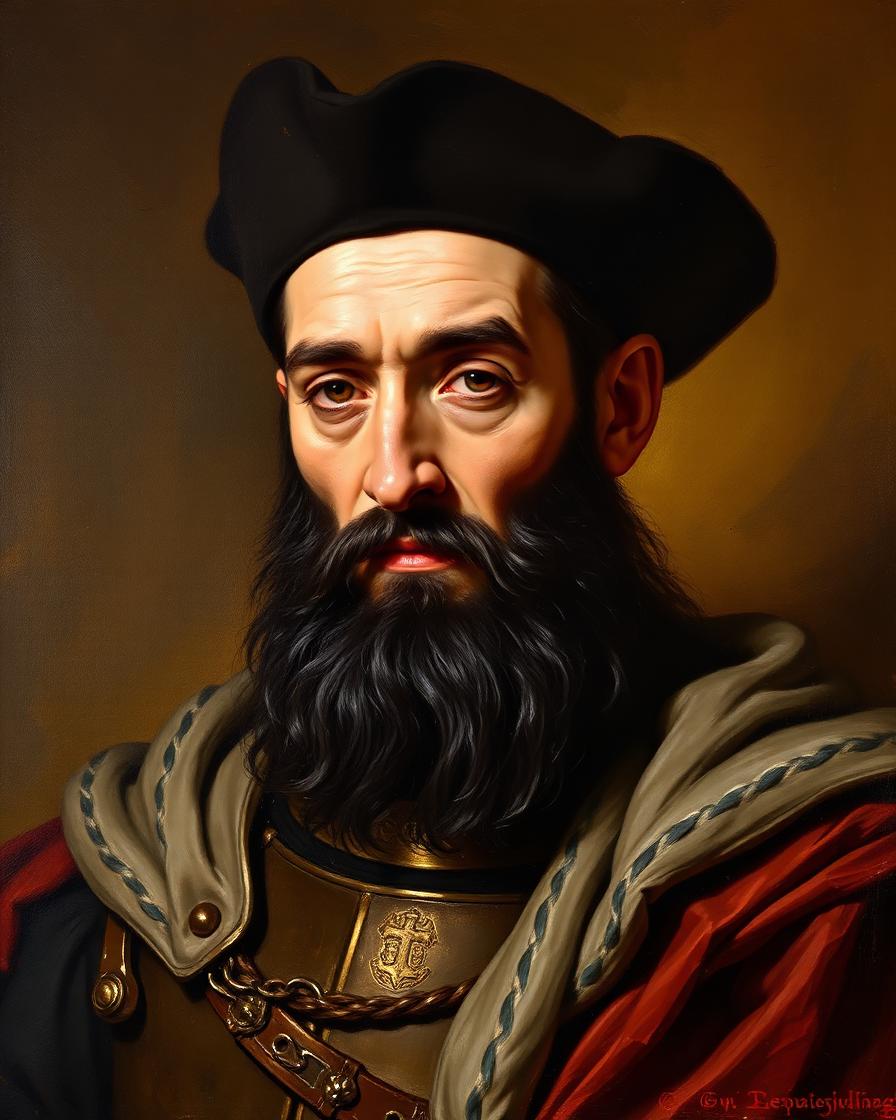
Quick Facts
- Years
- 1480 – 1521
- Category
- Explorers & Adventurers
- Nationality
- Portuguese
- Occupation
- Explorer & Circumnavigator
Ferdinand Magellan
1480 – 1521 · Portuguese · Explorer & Circumnavigator
Audiobook

Life Lessons from Ferdinand Magellan
Marcus Alden
Ferdinand Magellan was a Portuguese-born navigator who organized and commanded the Spanish expedition that achieved the first recorded circumnavigation of Earth. He did not personally complete the voyage: he was killed in the Philippines in 1521, and Juan Sebastián Elcano brought the surviving ship and crew back to Spain in 1522. Nevertheless, Magellan conceived the western route, guided the fleet through the strait now bearing his name, and led the first documented European crossing of the Pacific Ocean.
His expedition transformed geographical knowledge. It demonstrated in practice that ships could sail around the globe, revealed the Pacific's immense scale, and clarified the relationship between the Atlantic, the Americas, and Asia. The voyage also exposed the extreme human costs of early modern exploration—hunger, disease, mutiny, warfare, coerced diplomacy, and encounters shaped by imperial ambition.
Magellan remains important not simply as a heroic explorer, but as a complicated figure in the histories of navigation, globalization, empire, Christianity, and Indigenous resistance. Portuguese by birth and Spanish by service, he pursued commercial access to the spice trade while claiming lands and alliances for the Spanish Crown. His death at Mactan, while intervening in a local conflict, ensured that his reputation would be debated. Studying him reveals both the extraordinary navigational achievement of the first circumnavigation and the violence and inequality accompanying European expansion.
Quick Facts
| Field | Details |
|---|---|
| Full Name | Fernão de Magalhães in Portuguese; Fernando de Magallanes in Spanish |
| Common Name(s) | Ferdinand Magellan; Magellan |
| Born | About 1480; exact date not recorded |
| Died | 27 April 1521 |
| Age at Death | Approximately 40–41 |
| Birthplace | Traditionally identified as Sabrosa or Porto, Kingdom of Portugal; disputed |
| Nationality | Portuguese by birth; later served the Spanish Crown |
| Occupation | Navigator, explorer, naval commander, soldier |
| Historical Era | Age of Exploration; early modern period |
| Famous For | Leading the expedition that began the first circumnavigation; navigating the Strait of Magellan; first recorded European crossing of the Pacific |
| Political Affiliation | Served Manuel I of Portugal, then Charles I of Spain |
| Religion | Roman Catholic |
| Education | Probably educated as a royal page; exact schooling not recorded |
| Parents | Commonly identified as Rui de Magalhães and Alda de Mesquita; documentation is uncertain |
| Spouse(s) | Beatriz Barbosa |
| Children | Rodrigo and Carlos; both apparently died young |
| Major Works | No literary work securely attributed; principal undertaking was the 1519–1522 expedition |
| Major Achievements | Opened a westward route through South America, crossed the Pacific, and initiated the first completed circumnavigation |
Early Life
Magellan was born around 1480 in Portugal. Sabrosa, in the Trás-os-Montes region, and Porto have both been proposed as his birthplace, but surviving evidence does not settle the question. Traditional biographies describe him as belonging to the lesser nobility and identify his parents as Rui de Magalhães and Alda de Mesquita. Some details of this genealogy rest on later or disputed documentation, so they should be treated cautiously.
He reportedly entered the household of Queen Leonor and later that of King Manuel I as a page. Court service could provide a young nobleman with instruction in religion, etiquette, arms, administration, mathematics, maps, and maritime affairs, although no detailed record of Magellan's curriculum survives.
His youth coincided with Portugal's rapid overseas expansion. Bartolomeu Dias rounded southern Africa in 1488, Vasco da Gama reached India by sea in 1498, and Portuguese fleets established trading and military positions around the Indian Ocean. Spices—especially cloves from the Moluccas—were immensely valuable in Europe. Navigation, royal patronage, commerce, and armed conquest were closely connected.
This environment formed Magellan. He learned that advancement could come through service overseas and that geographical information was both strategic and secret. Later testimony indicates that he became an experienced sailor and soldier rather than merely a theoretical mapmaker.
Rise to Prominence
In 1505 Magellan sailed to Portuguese India in the fleet of Francisco de Almeida, the first Portuguese viceroy there. He served amid campaigns and trading ventures intended to secure Portugal's maritime dominance. He probably took part in the Battle of Diu in 1509, a decisive Portuguese victory over a coalition opposing its expansion.
Magellan later traveled eastward toward Malacca. He participated in Diogo Lopes de Sequeira's troubled 1509 mission and was associated with the Portuguese conquest of Malacca under Afonso de Albuquerque in 1511. These years gave him practical knowledge of monsoon routes, Asian trade, naval warfare, and the geography of Southeast Asia.
His servant or enslaved attendant, Enrique of Malacca, entered his household during this eastern service. Enrique's knowledge of Malay later made him a crucial interpreter in the Philippines.
Magellan returned to Portugal and served in the 1513 campaign at Azamor in Morocco, where he was wounded. He became involved in accusations concerning unauthorized trade with local opponents. Although the case did not establish lasting guilt, his relationship with Manuel I deteriorated. Magellan also sought increased royal compensation and support for an expedition to the Spice Islands; the king refused.
With the cosmographer Rui Faleiro, Magellan proposed reaching the Moluccas by sailing west through a passage across or around South America. In 1517 he moved to Seville, married into the Barbosa family, and offered his project to Charles I of Spain. Spain welcomed a plan that might place the Spice Islands within its hemisphere under interpretations of the Treaty of Tordesillas.
The Crown approved the enterprise in 1518. Magellan and Faleiro were appointed captains of the expedition, although Faleiro did not sail. Opposition from Portuguese officials, suspicion among Spanish officers, and the enormous uncertainty of the route all threatened the project. Magellan nevertheless assembled five ships and departed in September 1519.
Major Achievements
Organizing the Armada of the Moluccas
Magellan secured Spanish royal backing for a risky commercial and geographical venture. The five ships—Trinidad, San Antonio, Concepción, Victoria, and Santiago—carried about 270 people, although totals vary among surviving lists.
The expedition sought a western route to the Moluccas without using Portugal's established passage around Africa. Its multinational personnel, sophisticated financing, and mixed commercial-religious objectives made it an early example of global enterprise under royal authority.
Finding the Strait of Magellan
After crossing the Atlantic and exploring South America's coast, the fleet wintered at Puerto San Julián in Patagonia. A mutiny broke out in April 1520. Magellan suppressed it, executing or marooning principal opponents while pardoning many ordinary participants.
The Santiago was wrecked during reconnaissance, but its crew survived. In October the remaining ships entered a complex channel near 52 degrees south. The San Antonio deserted and returned to Spain, taking substantial provisions with it. The other three vessels emerged into the ocean beyond in late November.
The passage—later called the Strait of Magellan—proved that a navigable sea route existed through the southern end of the American mainland. Although difficult and eventually overshadowed commercially by other routes, its discovery permanently changed European cartography.
Leading the First Recorded European Pacific Crossing
Magellan named the newly entered ocean Mar Pacífico, or peaceful sea, because its waters initially appeared calm. The crossing was far longer than he and his advisers anticipated. The fleet sailed for roughly three months and twenty days with few opportunities to replenish supplies.
Antonio Pigafetta described men eating spoiled food and materials such as oxhide; scurvy and starvation killed crew members. In March 1521 the ships reached Guam and then the Philippine archipelago.
The crossing revealed the immense width of the Pacific and showed that contemporary estimates had seriously underestimated Earth's oceanic distances. It helped redraw world maps and altered European conceptions of global scale.
Initiating the First Circumnavigation
Magellan died before the voyage ended, but the route he planned and led made its completion possible. After severe losses in the Philippines, the expedition abandoned and burned the Concepción. The Trinidad and Victoria reached the Moluccas and loaded cloves.
The damaged Trinidad attempted an eastward return across the Pacific but failed and was captured by the Portuguese. Elcano commanded the Victoria westward across the Indian Ocean, around the Cape of Good Hope, and back to Sanlúcar de Barrameda on 6 September 1522. Eighteen European survivors arrived aboard; additional participants survived by other routes.
The completed journey was the first recorded circumnavigation of Earth. It established global continuity by direct voyage and became a landmark in navigation, even though Magellan himself had completed only part of the circuit.
Expanding European Knowledge—at a Human Cost
The expedition collected observations about winds, currents, coastlines, languages, peoples, animals, and trade. Pigafetta's narrative became an invaluable record of the voyage and of communities encountered along the way.
Yet knowledge gathering was inseparable from imperial claims. Magellan asserted Spanish authority, promoted baptism, demanded political submission from some local rulers, and intervened in Philippine rivalries. The resulting violence demonstrates why the expedition's achievements cannot be understood solely as a triumph of discovery.
Leadership and Work
Magellan displayed exceptional endurance, maritime judgment, and commitment to a long-term objective. He kept the fleet moving despite incomplete maps, uncertain longitude, hostile officers, winter conditions, desertion, and dwindling food. His decision to continue searching for the strait proved strategically correct.
His leadership was also authoritarian. Spanish captains resented being commanded by a Portuguese officer and complained that he concealed route information. Secrecy may have protected the mission and limited dissent, but it damaged trust. During the San Julián mutiny, he acted swiftly and ruthlessly, using divided loyalties among the rebels to regain control.
Magellan could be pragmatic. He pardoned many mutineers because the expedition needed their labor. He cultivated alliances through trade, gift exchange, interpreters, Christian ritual, and displays of artillery. However, he sometimes confused ceremonial recognition or tactical alliance with durable submission.
His greatest weakness was overconfidence in the Philippines. At Mactan he entered a local dispute with a small force, apparently hoping to demonstrate Spanish military power. Terrain, distance from the boats, and the number of defenders neutralized European advantages. The decision cost him his life and destabilized the expedition.
Personal Life
In Seville Magellan married Beatriz Barbosa, daughter of Diogo Barbosa, a Portuguese expatriate connected to the city's maritime world. The marriage strengthened Magellan's social base in Spain. They had sons named Rodrigo and Carlos, but both apparently died in childhood. Beatriz died during or shortly after the expedition, before its survivors returned.
Magellan's closest professional associates included Rui Faleiro, though their partnership weakened before departure, and Duarte Barbosa, his brother-in-law, who sailed with the expedition. Enrique of Malacca served as interpreter and was central to communication in Southeast Asia.
Descriptions of Magellan's appearance and personality are limited. Sources portray him as reserved, determined, devout, and physically courageous. His Moroccan wound reportedly left him with a limp. Pigafetta admired him deeply, whereas hostile officers and later testimony emphasized severity, secrecy, and favoritism. These contrasting accounts reflect both his polarizing command and the interests of the witnesses.
Philosophy and Beliefs
Magellan's worldview combined Catholic devotion, royal service, personal advancement, and commercial ambition. He lived before modern separation between exploration, trade, evangelization, and empire. For him, these purposes could reinforce one another.
He believed he could serve Spain honorably after failing to gain support in Portugal. Early modern loyalty was personal and dynastic as well as national, yet his transfer still provoked Portuguese hostility. Spain treated him as a valuable royal servant; Portugal regarded the venture as a threat to its spice monopoly.
In the Philippines, Magellan encouraged baptism and formed an alliance with Rajah Humabon of Cebu. Pigafetta presents his missionary commitment as sincere. Modern historians nevertheless distinguish sincere belief from ethical justification: baptisms occurred within unequal political relationships, and religious conversion accompanied demands for allegiance.
His conduct suggests confidence in hierarchy, discipline, and providential purpose. It also illustrates the danger of assuming that technological superiority or Christian alliance entitled Europeans to reshape local politics.
Challenges and Controversies
Did Magellan Circumnavigate the World?
Magellan commonly receives credit for the first circumnavigation, but he did not survive it. Elcano and the crew of the Victoria completed the continuous voyage. The most accurate formulation is that Magellan led and initiated the expedition, while Elcano commanded its final successful return.
Some writers suggest Magellan had effectively circled the globe in stages because his earlier travels in Asia approached the longitude reached from the east in 1521. There is no secure evidence that his routes overlapped sufficiently to establish a personal circumnavigation.
Enrique of Malacca and the First Personal Circuit
Enrique may have been born in Sumatra or elsewhere in the Malay-speaking world and was taken westward by Magellan before returning to Southeast Asia from the east. He is sometimes called the first person to circumnavigate the globe. This is possible but unproven: his precise birthplace, earlier route, and fate after Cebu are uncertain.
The San Julián Mutiny
Supporters regard Magellan's suppression of mutiny as necessary to save the expedition. Critics emphasize executions, marooning, intimidation, and procedural harshness. Both interpretations have evidence. The rebellion posed a genuine threat, but Magellan's secrecy and strained relations with Spanish officers contributed to the crisis.
Treatment of Indigenous Peoples
Traditional European narratives celebrated exploration while minimizing coercion. In Guam, the expedition retaliated violently after islanders took a boat; European accounts labeled the inhabitants thieves without adequately considering different concepts of property or exchange. In the Philippines, Magellan burned a settlement whose inhabitants resisted demands and intervened militarily at Mactan.
Modern scholarship places greater emphasis on Indigenous agency. Lapulapu was not simply an obstacle to discovery but a local leader who rejected outside pressure and defeated Magellan's force.
Responsibility for the Disaster at Mactan
Magellan reportedly declined substantial support from Humabon's warriors and attacked with about 60 armed Europeans. Reefs prevented boats and artillery from approaching closely. Mactan's defenders outnumbered the landing party and targeted unarmored legs. The battle is widely viewed as an avoidable tactical and political miscalculation.
Legacy
Magellan's expedition reshaped cartography and global history. It demonstrated a viable connection between the Atlantic and Pacific, revealed the Pacific's enormous dimensions, and produced practical evidence of the world's navigable continuity. The voyage also contributed indirectly to recognition of the international date discrepancy: sailors returning westward found their calendar one day behind Europe.
His name appears on the Strait of Magellan, the Magellanic Clouds, the Magellanic penguin, and NASA's Magellan spacecraft. Monuments stand in Portugal, Spain, Chile, Guam, and the Philippines, though their meanings differ sharply by location.
At Mactan, the Magellan Shrine stands near a monument honoring Lapulapu. Their proximity captures the modern debate: one commemorates global navigation and European arrival; the other celebrates resistance to foreign intervention. In 2021–2022, quincentenary programs in Spain, Portugal, the Philippines, and elsewhere reconsidered the expedition from multinational and Indigenous perspectives.
Magellan is still studied because his story joins technical brilliance to moral complexity. His expedition linked oceans but also advanced imperial rivalry. Its history belongs not only to one commander or nation, but to hundreds of sailors and the many communities they encountered.
Interesting Facts
- Magellan's exact birthplace remains disputed.
- His Portuguese name was Fernão de Magalhães.
- He gained Asian experience years before proposing a westward voyage.
- Five ships departed Spain in 1519, but only the Victoria completed the circuit.
- The flagship was the Trinidad.
- The fleet wintered in Patagonia in 1520.
- Magellan survived a major mutiny during that winter.
- The Santiago was wrecked, while the San Antonio deserted.
- The strait crossing took more than a month.
- Magellan named the Pacific for its initially calm conditions.
- His estimate of the Pacific's breadth was far too small.
- Enrique interpreted Malay in Southeast Asia.
- Magellan was killed by Mactan defenders led by Lapulapu.
- His body was not recovered by the expedition.
- Elcano completed the circumnavigation with the Victoria.
- Eighteen European crewmen returned aboard the ship in September 1522.
- Pigafetta's journal is the voyage's best-known eyewitness narrative.
- The expedition's calendar discrepancy helped illustrate the effect of traveling around Earth.
- Magellan's name was given to two nearby galaxies visible from the Southern Hemisphere.
- A NASA mission that mapped Venus was named Magellan.
Famous Quotes
Authentic verbatim quotations from Magellan are scarce. Many popular sayings attributed to him lack contemporary documentation. The following are either reported in early accounts or explicitly identified as disputed.
- “The church will remain in Cebu, and there will always be someone to baptize you.” — Reported in Pigafetta's narrative during the Cebu mission. It reflects Magellan's confidence that conversion would continue, though wording varies by translation.
- “I hope in God that, if I begin the battle, I shall not retreat.” — Reported by Pigafetta before Mactan. It conveys resolve but also foreshadows his refusal to withdraw early; translations differ.
- “They would see how our lances wounded.” — Pigafetta reports this reasoning when Magellan limited allied participation at Mactan. It suggests that he wanted to display European power.
- “Do not be afraid, for God will provide us with victory.” — Reported in translated versions of Pigafetta's Mactan account. It illustrates Magellan's religious confidence.
- “The captain-general sent a message that, if they would obey the king of Spain, recognize the Christian king as their sovereign, and pay tribute, he would be their friend.” — Pigafetta's reported substance rather than a secure verbatim quotation; it reveals the expedition's imperial demands.
- “I will go farther.” — Frequently attributed to Magellan as a personal motto, sometimes in Latin or Portuguese forms, but no firm contemporary source establishes it; disputed.
- “The sea is dangerous and its storms terrible, but these obstacles have never been sufficient reason to remain ashore.” — Widely circulated online but unsupported by reliable primary evidence; probably spurious.
- “He who is born a man must never fear death.” — Often attributed to Magellan without an adequate contemporary citation; disputed.
- “With a strong heart and a good ship, one can cross every sea.” — Popular attribution lacking primary documentation; spurious or unverified.
- “The Pacific is the most peaceful of seas.” — A modern paraphrase based on the naming of Mar Pacífico, not a securely documented quotation; not verbatim.
Timeline
- c. 1480 — Born in Portugal, possibly at Sabrosa or Porto.
- c. 1490s — Traditionally said to serve as a page in the Portuguese royal household.
- 1505 — Sails to India with Francisco de Almeida's fleet.
- 1509 — Probably fights at Diu and joins the Portuguese mission to Malacca.
- 1511 — Participates in the Portuguese conquest of Malacca.
- 1512–1513 — Returns to Portugal.
- 1513 — Serves at Azamor in Morocco and suffers a leg wound.
- 1514–1516 — Fails to obtain Manuel I's backing for his western project.
- 1517 — Moves to Spain; marries Beatriz Barbosa in Seville.
- 1518 — Charles I approves the Moluccas expedition.
- 10 August 1519 — Fleet leaves Seville for Sanlúcar.
- 20 September 1519 — Five ships depart Sanlúcar de Barrameda.
- December 1519 — Expedition reaches the coast of present-day Brazil.
- March 1520 — Fleet winters at Puerto San Julián.
- April 1520 — Magellan suppresses a mutiny.
- May 1520 — Santiago is wrecked during reconnaissance.
- October 1520 — Fleet enters the strait at South America's southern end.
- November 1520 — San Antonio deserts; remaining ships enter the Pacific.
- 6 March 1521 — Expedition reaches Guam.
- 16 March 1521 — Ships reach the Philippine archipelago.
- 14 April 1521 — Rajah Humabon and others are baptized at Cebu.
- 27 April 1521 — Magellan is killed at the Battle of Mactan.
- May 1521 — Survivors abandon and burn the Concepción.
- November 1521 — Trinidad and Victoria reach the Moluccas.
- December 1521 — Victoria, commanded by Elcano, sails west.
- 6 September 1522 — Victoria returns to Sanlúcar, completing the circumnavigation.
- 8 September 1522 — Survivors reach Seville.
Frequently Asked Questions
Who was Ferdinand Magellan?
Ferdinand Magellan was a Portuguese navigator and soldier who entered Spanish service and commanded the 1519 expedition seeking a westward route to the Spice Islands. He guided the fleet across the Atlantic, through the strait now bearing his name, and over the Pacific to the Philippines. He died at Mactan in 1521. His expedition continued under other commanders and completed the first recorded circumnavigation in 1522.
Was Magellan the first person to sail around the world?
Not in a single completed voyage. Magellan died before returning to the expedition's starting point. Juan Sebastián Elcano and the surviving crew of the Victoria completed the continuous circumnavigation. Magellan deserves credit for organizing and leading the voyage through its most important navigational breakthrough, but saying that he personally circumnavigated Earth is misleading. Enrique of Malacca may have completed a circuit in stages, although the evidence is inconclusive.
When and where was Magellan born?
He was born around 1480 in the Kingdom of Portugal. Sabrosa is the birthplace most frequently given, while Porto is another traditional candidate. The evidence is incomplete, and some genealogical records used in older biographies have been questioned. No securely documented birth date survives. Responsible accounts therefore identify both the approximate year and the uncertainty surrounding the precise location.
Why did a Portuguese explorer sail for Spain?
Magellan had served Portugal extensively, but King Manuel I rejected his request for greater rewards and declined to support his western plan. After tensions arising from his Moroccan service, Magellan moved to Spain. Charles I backed the proposal because a western route could challenge Portugal's control of the spice trade while operating within Spain's claimed sphere under the Treaty of Tordesillas.
What was Magellan trying to find?
His immediate objective was a westward maritime route to the Moluccas, the source of valuable cloves. Europeans already knew that land lay across the Atlantic and that another ocean existed beyond it. The central challenge was finding a navigable passage through or around South America and then reaching Asian markets. Circumnavigation was not initially the expedition's primary declared objective; it resulted from the route used by the survivors returning to Spain.
How many ships began and completed the expedition?
Five ships began: Trinidad, San Antonio, Concepción, Victoria, and Santiago. The Santiago was wrecked, the San Antonio deserted and returned to Spain, and the Concepción was burned after casualties left too few sailors. The Trinidad reached the Moluccas but failed during an attempted Pacific return and fell into Portuguese hands. Only the Victoria completed the circumnavigation.
How many people survived the voyage?
About 270 people departed, although crew lists and definitions produce differing totals. Eighteen European survivors returned to Sanlúcar aboard the Victoria in September 1522. Several others survived by separate routes, including men from the Trinidad who eventually returned after Portuguese captivity and members of the San Antonio, which had deserted earlier. Thus, “18 survivors” accurately describes the final shipboard return, not everyone who ultimately lived.
What did Magellan discover?
“Discover” requires qualification because Indigenous peoples already knew their own lands and waters. For Europeans, Magellan's fleet identified and navigated the strait connecting the Atlantic and Pacific at South America's southern end. It then accomplished the first recorded European crossing of the Pacific. The expedition greatly expanded European geographical knowledge, but it did not discover the Philippines or Pacific islands in an absolute sense.
Why did Magellan call it the Pacific Ocean?
After the dangerous strait, the expedition encountered comparatively calm conditions and called the ocean Mar Pacífico, meaning peaceful sea. The name did not imply that the entire ocean was always calm. More importantly, the crossing became a catastrophe because of distance, hunger, scurvy, and inadequate supplies. The peaceful surface therefore contrasted sharply with the crew's suffering.
Why was the Pacific crossing so difficult?
Magellan underestimated the ocean's width, as did many European geographers. The ships found few suitable places to obtain fresh food and water along their route. Supplies decayed, and sailors suffered from malnutrition and scurvy, a disease then poorly understood. The crossing lasted roughly three months and twenty days. Although weather conditions were often favorable, logistical planning was based on an inaccurate conception of global distances.
What happened during the mutiny?
At Puerto San Julián in April 1520, several Spanish officers rebelled against Magellan amid cold, rationing, uncertainty, and resentment of his command. Magellan exploited divisions among them and regained control. Luis de Mendoza was killed; Gaspar de Quesada was executed; Juan de Cartagena and a priest were marooned. Many ordinary mutineers were pardoned because their skills were indispensable. The episode demonstrated both Magellan's decisiveness and his severity.
How did Magellan die?
Magellan died on 27 April 1521 during fighting on Mactan in the Philippines. He had allied with Rajah Humabon of Cebu and moved against Lapulapu, who resisted submission. Reefs forced Magellan's force to wade from its boats, leaving shipboard weapons largely ineffective. Mactan's defenders surrounded the Europeans, who retreated. Magellan was struck repeatedly and killed; his body was never recovered by his companions.
Who was Lapulapu?
Lapulapu was a leader on Mactan who refused the political demands associated with Magellan's alliance in Cebu. His forces defeated Magellan's landing party. Philippine national memory often honors him as an early symbol of resistance to foreign domination. Sources about his life are limited, and later legends should not automatically be treated as documented biography. His historical significance rests securely on the successful defense of Mactan.
Who completed the circumnavigation?
Juan Sebastián Elcano, a Basque mariner who had participated in the earlier mutiny, commanded the Victoria on the final westward journey from the Moluccas. He crossed the Indian Ocean, rounded southern Africa, evaded Portuguese authorities, and returned to Spain. His leadership was essential to completion. The achievement was collective, however, depending on the surviving multinational crew as well as Magellan's earlier navigation.
What was Antonio Pigafetta's role?
Pigafetta was an Italian participant who kept a detailed account of the journey. He observed geography, languages, customs, food, animals, diplomacy, conversion, and combat. His narrative is indispensable, especially for events in the Pacific and the Philippines. Yet it is not neutral: Pigafetta admired Magellan, wrote for European readers, and interpreted unfamiliar societies through his own assumptions. Historians compare his testimony with other records.
Did the expedition prove that Earth was round?
Educated Europeans already generally accepted that Earth was spherical; Magellan's voyage did not overturn a widespread learned belief in a flat Earth. Its importance was practical rather than theoretical. The circumnavigation demonstrated the navigable continuity of the oceans, supplied evidence about global scale, and exposed serious errors in estimates of the Pacific's width. It also dramatized the calendar consequences of traveling westward around the planet.
What happened to Enrique of Malacca?
Enrique served Magellan as an interpreter and had traveled from Southeast Asia to Europe before the expedition. After Magellan's death, a dispute arose over whether Enrique was free under his master's will. Pigafetta reports that Enrique communicated with Humabon before a deadly banquet attack on expedition leaders. He then disappears from reliable records. Claims that he returned home and completed the first personal circumnavigation remain possible but unverified.
Why is Magellan controversial today?
He symbolizes both extraordinary navigation and European imperial expansion. Admirers emphasize courage, planning, endurance, and geographical transformation. Critics stress coercive conversion, violent retaliation, claims of sovereignty over inhabited lands, and intervention in local politics. Modern scholarship does not need to choose between acknowledging navigational achievement and confronting colonial violence; both are essential to an accurate assessment.
Lessons We Can Learn
- Vision requires execution. Magellan converted a geographical theory into a funded fleet; ambitious ideas need logistics and institutional support.
- Experience builds credibility. His years in the Indian Ocean informed his plan; firsthand knowledge remains crucial in complex work.
- Do not confuse secrecy with leadership. Concealing plans may have protected the mission, but it intensified mistrust and mutiny.
- Adapt when conditions change. Magellan kept exploring after winter, wreck, and rebellion; resilient plans must allow revision.
- Estimate uncertainty honestly. Underestimating the Pacific produced extreme suffering; modern projects need realistic margins and risk analysis.
- Cultural assumptions can be dangerous. Conflicts in Guam and the Philippines arose partly from incompatible expectations; cross-cultural engagement requires humility.
- Technology does not guarantee victory. Reefs neutralized European weapons at Mactan; context can overwhelm apparent advantages.
- Avoid mission creep. A trading and navigational expedition became entangled in local warfare; expanding objectives can jeopardize the core mission.
- Great achievements are collective. Pilots, interpreters, sailors, local guides, Pigafetta, and Elcano all shaped the outcome.
- Remember every perspective. Pairing Magellan's achievement with Lapulapu's resistance produces a fuller, more ethical history.
Related Historical Figures
- Juan Sebastián Elcano — Commanded the Victoria home and completed the first circumnavigation.
- Antonio Pigafetta — Eyewitness chronicler whose account preserves much of the voyage's history.
- Enrique of Malacca — Magellan's interpreter and a possible early circumnavigator in stages.
- Lapulapu — Mactan leader whose forces defeated and killed Magellan.
- Rajah Humabon — Cebu ruler who allied with Magellan and accepted baptism.
- Charles I of Spain — Monarch who authorized and financed the expedition; later Holy Roman Emperor Charles V.
- Manuel I of Portugal — Portuguese king who declined to support Magellan's western project.
- Rui Faleiro — Cosmographer who helped formulate and present the plan but did not sail.
- Afonso de Albuquerque — Portuguese commander under whom Magellan served during expansion in Asia.
- Vasco da Gama — Earlier Portuguese navigator whose route around Africa shaped the spice-trade rivalry Magellan sought to challenge.
Watch and Learn
Ferdinand Magellan - First Circumnavigation of the Earth · Kings and Generals
Related Historical Figures