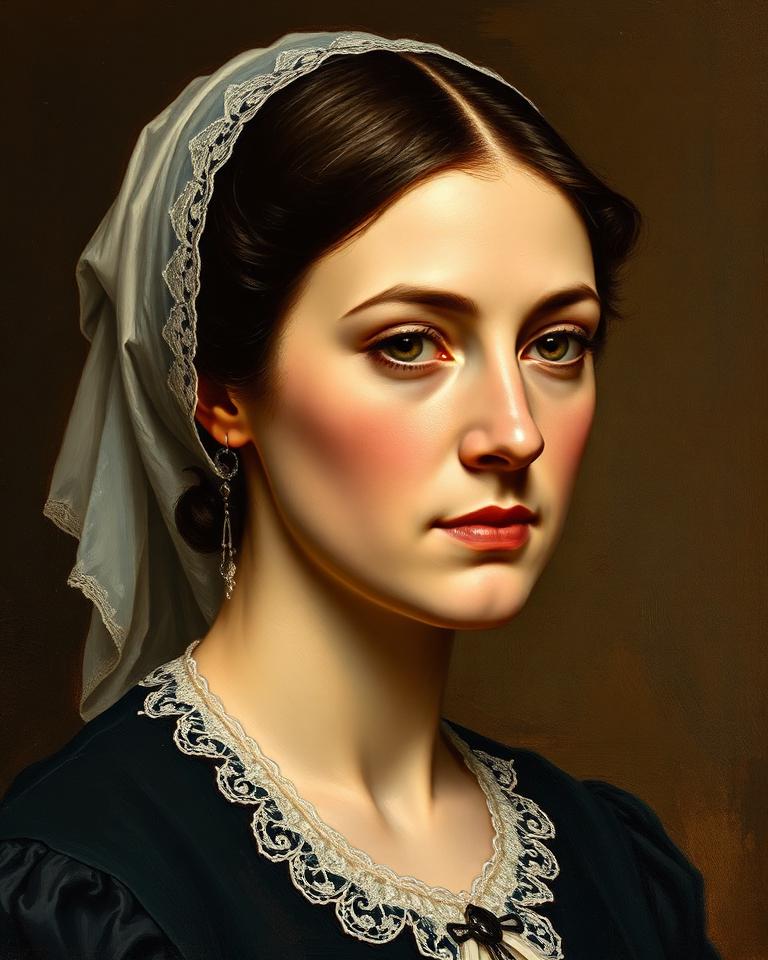
Quick Facts
- Years
- 1820 – 1910
- Category
- Social Reformers & Humanitarians
- Subcategory
- Humanitarians
- Nationality
- British
- Occupation
- Nurse and Statistician
Florence Nightingale
1820 – 1910 · British · Nurse and Statistician
Audiobook

Life Lessons from Florence Nightingale
Marcus Alden · 48 min
Florence Nightingale (1820–1910) was a British nurse, hospital reformer, statistician, and social thinker whose work helped transform nursing into a trained profession. She became internationally famous after organizing nursing care for British soldiers during the Crimean War. Newspapers celebrated her nighttime rounds through the military hospitals at Scutari, creating the enduring image of the “Lady with the Lamp.”
Her importance, however, extends far beyond that image. Nightingale collected and analyzed mortality data, used innovative statistical graphics to communicate preventable deaths, and pressed government officials to reform military sanitation. She later established the Nightingale Training School at St Thomas’ Hospital, supported nursing education in Britain and abroad, and advised on hospital design, public health, and sanitation in India.
Nightingale combined religious conviction, administrative discipline, political influence, and quantitative evidence. Although later research has complicated heroic accounts of her Crimean work—and critics have challenged some of her views and relationships—her long campaign helped establish nursing as skilled, organized, ethically serious work. She is still studied in nursing, statistics, epidemiology, hospital administration, public policy, and women’s history because she demonstrated how observation, data, institutional reform, and persistent advocacy can work together to save lives.
Quick Facts
| Field | Details |
|---|---|
| Full Name | Florence Nightingale |
| Common Name(s) | Florence Nightingale; “The Lady with the Lamp” |
| Born | 12 May 1820 |
| Died | 13 August 1910 |
| Age at Death | 90 |
| Birthplace | Villa Colombaia, Florence, Grand Duchy of Tuscany, now Italy |
| Nationality | British |
| Occupation | Nurse, statistician, hospital reformer, author, administrator |
| Historical Era | Victorian era |
| Famous For | Crimean War nursing, professional nursing education, sanitary reform, statistical graphics |
| Political Affiliation if applicable | No formal party affiliation; worked with Liberal and other reform-minded politicians |
| Religion if significant | Anglican Christian with an independent and strongly vocational theology |
| Education | Privately educated; nursing instruction at Kaiserswerth and practical observation in European hospitals |
| Parents | William Edward Nightingale and Frances “Fanny” Nightingale, née Smith |
| Spouse(s) | Never married |
| Children | None |
| Major Works | Notes on Nursing; Notes on Hospitals; Suggestions for Thought; reports on military health and Indian sanitation |
| Major Achievements | Led nurses at Scutari; promoted military sanitary reform; founded the Nightingale Training School; advanced hospital statistics and evidence-based administration |
Early Life
Florence Nightingale was born on 12 May 1820 while her wealthy English parents were traveling in Italy. They named her after Florence; her elder sister, Parthenope, had similarly been named after the ancient Greek name for Naples. The family later lived principally at Lea Hurst in Derbyshire and Embley Park in Hampshire.
Her father, William Edward Nightingale, had inherited substantial wealth and personally supervised his daughters’ education. Florence studied history, philosophy, literature, languages, and mathematics—an unusually broad curriculum for an affluent Victorian woman. Her mathematical training became especially important when she later analyzed hospital mortality.
The family belonged to elite social circles. Florence was expected to marry appropriately and manage a household, not enter paid work associated with illness, physical labor, and low social status. Yet in 1837 she recorded experiencing what she understood as a call from God to service. The meaning of that vocation developed gradually, but nursing eventually became its practical expression.
Travel exposed her to hospitals and charitable institutions. During a visit to Rome in 1847–1848, she met Sidney Herbert, a politician who became a crucial ally, and his wife, Elizabeth. She also knew reformers including Benjamin Jowett and later corresponded with numerous doctors, officials, and intellectuals.
Her decision to pursue nursing generated prolonged conflict with her mother and sister. Nursing in early Victorian Britain was not generally a standardized, respected profession. Many nurses lacked systematic training, and genteel families considered hospital work unsuitable for women of Nightingale’s class.
She nevertheless studied medical and institutional practice. In 1850 and again in 1851 she visited the Protestant deaconess institute at Kaiserswerth in Prussia, where she received instruction and practical experience. She also examined hospitals in Paris and elsewhere. These experiences taught her that nursing required discipline, sanitation, observation, and competent administration.
Rise to Prominence
In 1853 Nightingale became superintendent of the Institution for the Care of Sick Gentlewomen in Distressed Circumstances on Harley Street, London. She reorganized routines, managed staff, and improved care. This position demonstrated that she could direct a medical institution, not merely nurse individual patients.
The decisive turning point came with the Crimean War. Britain and France entered the conflict against Russia in 1854 in support of the Ottoman Empire. Reports by The Times correspondent William Howard Russell described wounded British soldiers suffering in overcrowded, poorly supplied hospitals.
Sidney Herbert, then secretary at war, asked Nightingale to lead a party of nurses to the East. At nearly the same time, she offered her services. She departed with 38 nurses drawn from Anglican and Roman Catholic communities and hospitals. Their mixed backgrounds required tactful management in a society marked by religious division.
At the Barrack Hospital at Scutari, across the Bosporus from Constantinople, the nurses encountered overcrowding, inadequate drainage, contaminated surroundings, shortages, vermin, and administrative confusion. Military doctors initially resisted civilian women entering their domain. Nightingale proceeded cautiously, built supply systems, established kitchens and laundries, organized nursing routines, and sought help from supporters in Britain.
Her fame grew through press coverage. Accounts of her walking through the wards at night with a lamp made her a symbol of compassionate service. Henry Wadsworth Longfellow’s 1857 poem Santa Filomena helped popularize the image. By the time she returned privately to Britain in 1856, a public fund had already been created in her honor.
Major Achievements
Reforming Care During the Crimean War
Nightingale imposed order on an overwhelmed hospital system. She supervised nurses, secured supplies, improved food preparation and laundry arrangements, and emphasized cleanliness and patient observation. She also supported reading rooms and other measures intended to improve soldiers’ morale.
Mortality at Scutari fell substantially, but historians caution against attributing the decline solely to her nursing measures. In March 1855 a government sanitary commission flushed sewers, improved ventilation, and removed environmental hazards. These interventions were central. Nightingale later recognized that infectious disease and defective sanitation had killed far more soldiers than battlefield wounds.
The lasting significance was institutional: the war revealed that preventable administrative and sanitary failures could be as deadly as combat. Nightingale turned that lesson into a sustained reform campaign.
Using Statistics for Public Health Reform
After the war, Nightingale worked with statistician William Farr and others to examine army mortality. The evidence showed that diseases such as typhus, typhoid, cholera, and dysentery had caused enormous losses.
Her 1858 report, Notes on Matters Affecting the Health, Efficiency, and Hospital Administration of the British Army, used tables and graphics to make complex findings persuasive. Her best-known diagrams were polar-area charts, sometimes called “coxcombs,” in which sectors displayed changing causes of death over time. She did not invent statistical graphics, but she used them with exceptional strategic skill.
This mattered because she treated statistics as an instrument of government accountability. Numbers became a way to expose preventable harm, compare institutions, and test reforms. In 1858 she became the first woman admitted as a member of the Statistical Society of London, now the Royal Statistical Society.
Advancing Military Health Reform
Nightingale gave evidence to the Royal Commission on the Health of the Army, largely through written submissions because of her poor health. She helped shape recommendations concerning barracks, drainage, ventilation, recordkeeping, and medical administration.
The reforms that followed were collective achievements involving commissioners, doctors, engineers, politicians, and military officials. Nightingale’s distinctive contribution was to synthesize evidence, mobilize influential allies, and press relentlessly for implementation.
Her work helped shift military medicine toward systematic prevention. It also demonstrated that institutional mortality should be measured rather than accepted as inevitable.
Founding a Professional Nursing School
Public donations to the Nightingale Fund financed the Nightingale Training School at St Thomas’ Hospital, which opened in 1860. Nightingale did not run its daily operations in person, but she advised its leaders, monitored outcomes, and corresponded with trainees and matrons.
The school combined practical ward experience with moral and professional expectations. Its graduates—often called Nightingale nurses—became matrons and teachers in other hospitals, spreading organized training throughout Britain and overseas.
The school did not create modern nursing single-handedly; religious nursing orders, hospital reformers, doctors, and earlier training initiatives also mattered. Nevertheless, it became an influential model and helped make trained nursing a respectable occupation for women.
Writing Notes on Nursing
Published in 1859, Notes on Nursing: What It Is, and What It Is Not addressed both household caregivers and nurses. It emphasized ventilation, warmth, cleanliness, light, quiet, diet, and close observation of patients.
The book reflected nineteenth-century assumptions and preceded germ theory’s full acceptance. Yet its core argument—that surroundings and attentive care affect recovery—had enduring value. Its clear, practical style made it widely accessible and helped define nursing as knowledgeable work rather than simple obedience to doctors.
Improving Hospital Design and Administration
In Notes on Hospitals and other writings, Nightingale advocated well-ventilated wards, adequate spacing, drainage, sanitation, and standardized hospital statistics. She supported the pavilion plan, in which separate ward blocks reduced crowding and improved airflow.
Some architectural principles later changed as microbiology, surgery, and building technology advanced. Her broader contribution remained influential: hospitals should be designed around patient outcomes, infection prevention, efficient work, and measurable performance.
Campaigning for Sanitation in India
Nightingale never visited India, but she spent decades studying the health of British soldiers and civilians there. She examined official returns, corresponded with administrators, and advocated clean water, drainage, irrigation, famine prevention, and rural health measures.
Her knowledge was necessarily mediated through colonial records, and her proposals operated within the British imperial system. Even so, she repeatedly argued that governance should be judged by its effects on life and health. Her Indian work expanded her focus from hospitals to the environmental and social foundations of public health.
Leadership and Work
Nightingale led through preparation, written argument, detailed oversight, and personal networks. She gathered evidence before demanding action and tailored her message to ministers, military officers, doctors, donors, and the public.
Her leadership combined compassion with strict discipline. She expected sobriety, discretion, cleanliness, and obedience from nurses. During the Crimean War, this helped protect a fragile experiment from scandal, but it could make her controlling and severe.
She was politically astute. Sidney Herbert gave her access to government; William Farr contributed statistical expertise; reform-minded doctors, civil servants, and philanthropists helped implement recommendations. She understood that durable change required alliances as well as moral urgency.
Her strengths included extraordinary stamina for correspondence, administrative memory, quantitative reasoning, and an ability to connect individual suffering with institutional causes. She often worked from bed or a sofa, drafting reports and letters that influenced policy.
Her weaknesses were related to the same intensity. She could be impatient, categorical, and reluctant to share authority. Relationships with colleagues sometimes deteriorated. Her certainty could obscure other people’s contributions, while her elite access gave her influence unavailable to most nurses.
Personal Life
Nightingale never married and had no children. She received a serious proposal from Richard Monckton Milnes, a politician and writer, but eventually rejected marriage. Her surviving writings indicate that she feared conventional domestic life would prevent fulfillment of her vocation.
Her relationship with her family was loving but strained. Her mother and sister initially resisted her nursing ambitions, while her father provided education and eventually financial support. After the Crimean War, Florence increasingly lived apart and guarded her time closely.
Important friendships included Sidney and Elizabeth Herbert, Benjamin Jowett, Mary Clarke, and members of the Bracebridge family. Some relationships were emotionally intense, but claims about her sexuality remain interpretive; the evidence does not justify a definitive modern label.
From 1857 onward, she experienced chronic ill health, including pain, weakness, exhaustion, and periods of confinement. Scholars have proposed brucellosis contracted in Crimea, post-infectious illness, or psychological factors, but no retrospective diagnosis is certain. Despite her limitations, she produced a vast correspondence and continued public work for decades.
She liked cats and kept several over her lifetime. She also read theology, philosophy, poetry, government reports, and statistical material. In old age she became blind and increasingly frail. She died peacefully at her London home on 13 August 1910.
Philosophy and Beliefs
Nightingale understood her work as obedience to God. Raised within Anglicanism, she developed an unconventional theology emphasizing divine law, moral progress, service, and the use of human reason. Her private manuscript Suggestions for Thought criticized aspects of established religion and explored questions of suffering and God’s nature.
Her ethics centered on practical service. Sympathy without competent action was insufficient; caregivers and governments had a duty to identify causes of suffering and remove them. This belief explains her attention to drainage, diet, forms, training, and budgets—details she regarded as morally consequential.
Politically, she was a reformer rather than a party activist. She used existing institutions and relationships with powerful men to pursue change. Her approach was pragmatic, incremental, and administrative rather than revolutionary.
Her views on women were complex. Her life expanded women’s professional possibilities, and her essay “Cassandra” condemned the enforced idleness of privileged women. Yet she did not consistently align herself with organized feminism and sometimes criticized female colleagues harshly. She sought expanded useful work for women while retaining several Victorian assumptions about character, class, and social order.
Challenges and Controversies
The Crimean Mortality Debate
Popular narratives once credited Nightingale personally with an immediate dramatic reduction in deaths at Scutari. Modern scholarship presents a more complicated sequence. Mortality was extremely high during her first winter, partly because the hospital environment itself was dangerous and sanitary engineering reforms had not yet occurred.
A government commission’s work in 1855 was essential to the later decline. Nightingale initially underestimated the role of sanitation but, after examining the evidence, made it central to her postwar campaign. Critics see this as a serious early error; defenders emphasize her willingness to revise her conclusions and pursue structural reform.
Conflict with Mary Seacole
Mary Seacole, a Jamaican-born British entrepreneur and healer of Scottish and Creole heritage, independently traveled to Crimea and operated the British Hotel near Balaclava. Later retellings sometimes cast Seacole and Nightingale as direct enemies or simple alternatives.
The evidence supports a more nuanced view. They met, but their roles, locations, resources, and methods differed. Nightingale did not appoint Seacole to her nursing staff, and racial and class assumptions shaped Victorian opportunities. Both women contributed to wartime care; acknowledging Seacole need not diminish Nightingale, and vice versa.
Authoritarian Management
Nightingale could be domineering toward nurses and associates. She insisted on tight control during the Crimean mission and was skeptical of initiatives she could not supervise. Some contemporaries found her judgment severe.
Supporters argue that discipline was necessary amid military hostility, sectarian tensions, and intense public scrutiny. Critics respond that her methods marginalized colleagues and reinforced hierarchy. Both interpretations illuminate the costs of her highly centralized leadership.
Class, Gender, and Empire
Her reforms depended on wealth, servants, elite education, and access to officials. The nursing model associated with her promoted respectable female authority but could distinguish sharply between trained middle-class leaders and working-class labor.
Her work on India sought improvements in health while remaining embedded in colonial governance. Historians therefore examine both its humanitarian aims and its imperial framework. She challenged official neglect but did not reject British rule itself.
Resistance to Germ Theory and Registration
Nightingale’s sanitary thinking emphasized cleanliness, ventilation, and environmental conditions. She was slow to embrace some bacteriological explanations, although many of her practical recommendations remained effective.
She also opposed certain proposals for compulsory state registration of nurses. She feared that examination and registration alone could certify poorly formed practitioners and preferred character-based hospital training. Later professional organizations generally regarded registration as essential, making her position look conservative.
Legacy
Florence Nightingale’s most durable legacy is the idea that nursing requires structured education, ethical responsibility, careful observation, and institutional authority. The Nightingale Training School evolved into today’s Florence Nightingale Faculty of Nursing, Midwifery & Palliative Care at King’s College London.
Her statistical work remains important in data visualization and public health communication. The Royal Statistical Society recognizes her as a pioneering member, while epidemiologists cite her insistence that mortality patterns can reveal preventable causes.
International Nurses Day is observed on 12 May, her birthday. The Florence Nightingale Medal, established by the International Committee of the Red Cross, honors exceptional nursing courage and service. The Florence Nightingale Museum in London preserves objects and interpretations connected with her life.
Memorials include a statue in Waterloo Place, London, and her grave at St Margaret’s Church, East Wellow, Hampshire. Her family declined burial in Westminster Abbey, where a memorial was later installed.
Modern scholarship has moved beyond uncomplicated hero worship. It examines collaborators, colonial structures, class, gender, military medicine, and the contributions of figures such as Mary Seacole. This fuller history does not erase Nightingale’s achievements; it explains how her influence arose from both individual determination and extensive networks.
Interesting Facts
- She was named after the Italian city where she was born.
- Her sister Parthenope was named after Naples’ ancient Greek name.
- Her father taught her mathematics, languages, philosophy, and history.
- She described receiving a divine call to service in 1837.
- She trained at Kaiserswerth’s deaconess institute in Prussia.
- She became a London institution superintendent before the Crimean War.
- Her initial Crimean party contained 38 nurses.
- The principal hospital she managed was in Scutari, now Üsküdar, Istanbul.
- “The Lady with the Lamp” image was spread by wartime journalism and poetry.
- She returned from Crimea without seeking a public celebration.
- She became the Statistical Society of London’s first female member in 1858.
- Her famous polar-area charts distinguished causes of military death.
- The Nightingale Training School opened in 1860.
- Notes on Nursing was written for household caregivers as well as professionals.
- She advised on Indian sanitation without ever visiting India.
- She kept cats and was notably fond of them.
- She received the Royal Red Cross in 1883.
- She became the first woman awarded the Order of Merit in 1907.
- A brief phonograph recording preserves her voice.
- International Nurses Day falls on her birthday, 12 May.
Famous Quotes
- “God has spoke to me and called me to His service.” — Recorded in a private note about her 1837 vocational experience; it expresses the religious foundation of her career.
- “I attribute my success to this: I never gave or took an excuse.” — Widely associated with Nightingale, but its precise primary-source origin is uncertain; treat the wording as disputed.
- “The very first canon of nursing… is this: to keep the air he breathes as pure as the external air, without chilling him.” — From Notes on Nursing; it summarizes her environmental approach to care.
- “Unnecessary noise, then, is the most cruel absence of care which can be inflicted either on sick or well.” — From Notes on Nursing; it treats quiet as a clinical necessity rather than a luxury.
- “Apprehension, uncertainty, waiting, expectation, fear of surprise, do a patient more harm than any exertion.” — From Notes on Nursing; it emphasizes the psychological effects of poor communication and disorder.
- “The most important practical lesson that can be given to nurses is to teach them what to observe.” — From Notes on Nursing; observation, not passive attendance, defines skilled nursing.
- “If a patient is cold, if a patient is feverish… it is generally the fault not of the disease, but of the nursing.” — From Notes on Nursing; deliberately forceful language used to stress preventable failures in care.
- “To understand God’s thoughts we must study statistics, for these are the measure of His purpose.” — Reported in Karl Pearson’s account of her statistical ideas; authentic in theme, though often quoted without its transmission context.
- “Were there none who were discontented with what they have, the world would never reach anything better.” — From Suggestions for Thought; dissatisfaction can become a force for reform.
- “How very little can be done under the spirit of fear.” — From Notes on Nursing; effective care requires confidence and sound judgment rather than intimidation.
Timeline
- 1820 — Born in Florence on 12 May.
- 1821 — Family returned to Britain after European travel.
- 1837 — Recorded her first divine call to service.
- 1844 — Announced a determination to pursue nursing, intensifying family opposition.
- 1847–1848 — Traveled in Italy and met Sidney Herbert in Rome.
- 1850 — First visited Kaiserswerth.
- 1851 — Returned to Kaiserswerth for practical nursing instruction.
- 1853 — Became superintendent of a London institution for sick gentlewomen.
- 1854 — Led 38 nurses to the Crimean War hospitals at Scutari.
- 1855 — Government sanitary commissioners improved conditions at Scutari; the Nightingale Fund was established.
- 1856 — Returned privately to Britain and met Queen Victoria and Prince Albert.
- 1857 — Began intensive postwar reform work despite chronic illness.
- 1858 — Became the Statistical Society of London’s first female member; published her major army health report.
- 1859 — Published Notes on Nursing and an edition of Notes on Hospitals.
- 1860 — Nightingale Training School opened at St Thomas’ Hospital.
- 1860s — Expanded work on hospital reform and health conditions in India.
- 1883 — Awarded the Royal Red Cross.
- 1907 — Became the first woman to receive the Order of Merit.
- 1908 — Received the Honorary Freedom of the City of London.
- 1910 — Died in London on 13 August and was buried at East Wellow.
Frequently Asked Questions
Why is Florence Nightingale famous?
She became famous for leading British nurses at Scutari during the Crimean War and for making nighttime rounds among wounded soldiers. The press transformed this into the “Lady with the Lamp” image. Her deeper importance lies in what followed: she used military mortality statistics to campaign for sanitary reform, helped establish a lasting nurse-training institution, wrote influential works on nursing and hospitals, and advised governments on public health. Her reputation therefore rests on caregiving, administration, education, statistics, and policy reform—not on one wartime symbol alone.
Did Florence Nightingale invent nursing?
No. People had nursed the sick for millennia, and religious communities, families, paid attendants, military personnel, and reformers all contributed to nursing before her. She also worked within broader nineteenth-century movements to improve hospitals and women’s education. Her major contribution was to help institutionalize systematic training, disciplined practice, observation, and professional standards. The Nightingale Training School became internationally influential, and its graduates carried its model into other hospitals. Calling her the sole “founder of nursing” oversimplifies history, although “founder of modern nursing” remains a common honorific.
What did she do in the Crimean War?
Nightingale supervised a group of nurses at British military hospitals in Scutari. She organized supplies, kitchens, laundry services, ward routines, and nursing discipline while negotiating with military doctors and officials. She cared about soldiers’ morale as well as physical treatment. Conditions remained disastrous during the first winter, and a government sanitary commission later made essential environmental improvements. Nightingale’s greatest Crimean achievement was not a solitary rescue of the hospitals but the creation of more organized care and her later use of wartime evidence to demand systemic reform.
Did she reduce the death rate at Scutari?
Mortality eventually fell dramatically, but assigning the change to one person is misleading. Nightingale and her nurses improved care, supplies, nutrition, cleanliness, and administration. In March 1855, however, a sanitary commission cleaned drains, flushed sewers, improved ventilation, and addressed contaminated conditions. Those engineering measures played a decisive role. Nightingale initially lacked full evidence about the hospital’s environmental dangers; afterward, statistical analysis convinced her that sanitation was central. Her later campaign openly emphasized preventable disease, showing an important capacity to learn from evidence.
Why was she called the Lady with the Lamp?
Wartime reports described Nightingale moving quietly through the wards at night to check on soldiers. An illustration in the Illustrated London News and Henry Wadsworth Longfellow’s poem Santa Filomena helped turn the lamp into an international symbol of compassion. The image was powerful but selective. It foregrounded personal devotion while obscuring her daytime work as an administrator, negotiator, fundraiser, statistician, and policy advocate. It remains an important nursing symbol, provided it is not mistaken for the whole of her career.
Was Florence Nightingale a statistician?
Yes. She worked closely with leading statistician William Farr, analyzed mortality records, advocated standardized data collection, and used tables and graphics to influence policy. Her polar-area diagrams made monthly causes of army deaths visually striking. She did not invent the underlying chart type or work alone, but she was an unusually effective statistical communicator. In 1858 she became the first female member of the Statistical Society of London. Her work is now discussed in the histories of statistics, epidemiology, and evidence-based public administration.
What is a Nightingale rose diagram?
The term generally refers to the polar-area charts used in Nightingale’s report on army mortality. A circle is divided into equal angular sectors representing time periods, while the area extending outward indicates the magnitude of deaths from categories such as preventable disease, wounds, or other causes. Color sharpened the comparison. The charts are also called coxcombs, although historical terminology varies. Their importance lies less in technical invention than in communication: they made it difficult for officials to ignore how many soldiers had died from disease rather than combat.
What was the Nightingale Training School?
The school opened at St Thomas’ Hospital in London in 1860 and was financed by public contributions to the Nightingale Fund. Trainees learned through supervised hospital practice and were expected to meet demanding standards of discipline and character. Graduates became nurses, matrons, and instructors elsewhere, helping disseminate organized nurse training. Early implementation was not flawless, and Nightingale did not manage daily operations personally. Nevertheless, the institution provided a durable model and survives through King’s College London’s nursing faculty.
What did Notes on Nursing teach?
The book taught caregivers to manage ventilation, temperature, cleanliness, light, noise, diet, bedding, and observation. Nightingale argued that nursing should place patients in the best conditions for natural recovery. The text was not merely for formally trained nurses; it also addressed people caring for relatives at home. Some explanations reflect pre-bacteriological medicine, but many practical principles remain recognizable: observe changes carefully, avoid unnecessary disturbance, maintain hygiene, and organize care around the patient rather than institutional convenience.
Did Florence Nightingale believe in germs?
Her relationship to germ theory was complicated. She developed her main sanitary framework when miasmatic and environmental explanations of disease were common, and she was slow to accept some bacteriological claims. She emphasized foul air, drainage, crowding, contaminated water, and cleanliness. Although the theory behind some recommendations was incomplete, many interventions reduced infection risk in practice. Historians should therefore avoid portraying her either as a modern germ theorist or as someone whose sanitation work lacked value. Her ideas evolved within a period of rapid scientific change.
Did Florence Nightingale know Mary Seacole?
They met during the Crimean War. Seacole had traveled independently to Crimea after attempts to join official nursing efforts failed and operated the British Hotel near Balaclava, where she supplied and assisted soldiers. Nightingale managed nurses at Scutari and worked within official military hospitals. Evidence does not support the popular idea that they were simple lifelong rivals, but neither were they close collaborators. Their stories reveal different experiences of race, class, entrepreneurship, nursing, and empire. Both deserve recognition on their own historical terms.
Why did Florence Nightingale never marry?
Nightingale concluded that marriage would interfere with the vocation she believed God had assigned her. She rejected a long-considered proposal from Richard Monckton Milnes, despite valuing him. Affluent Victorian wives faced strong expectations of domestic management, sociability, and obedience to family priorities. Remaining unmarried gave her greater independence, though it also required conflict with her family and social conventions. Statements about her intimate identity beyond this evidence remain speculative; historians cannot confidently assign a modern sexual label based on intense friendships alone.
What illness did she have after Crimea?
From 1857, Nightingale experienced chronic weakness, pain, exhaustion, and periods of severe incapacity. Brucellosis—sometimes called Crimean fever—has often been suggested, as have post-infectious conditions and psychological explanations. No diagnosis can be proved retrospectively. Her illness was real regardless of its precise cause. It limited travel and public appearances but did not end her work: she used correspondence, private meetings, reports, and trusted intermediaries to influence nursing, military health, hospitals, and Indian sanitation for decades.
What did she do for India?
Nightingale analyzed health and mortality reports concerning British India and communicated with officials about barracks, water supply, drainage, irrigation, famine, and village sanitation. She argued that public administration should prevent disease rather than merely respond to it. She never visited India, so her understanding depended on official evidence and correspondents. Her advocacy challenged neglect and broadened sanitary policy, but it also functioned inside colonial rule. Modern assessments therefore recognize both her public-health commitment and the limitations of her imperial perspective.
Was she a feminist?
The answer depends on definition. Nightingale broke powerful gender barriers, established professional opportunities for women, and condemned the enforced purposelessness of affluent Victorian women in “Cassandra.” Yet she did not consistently identify with organized women’s-rights campaigns and sometimes preferred influence through elite male officials. She could also hold hierarchical views about nurses and women’s roles. It is accurate to describe her as a transformative figure in women’s professional history, but misleading to assume that all her opinions matched later feminist movements.
What awards did she receive?
Nightingale received the Royal Red Cross in 1883 for services connected with military nursing. In 1907 she became the first woman appointed to the Order of Merit, one of Britain’s highest honors. She received the Honorary Freedom of the City of London in 1908. These distinctions reflected recognition not simply of her Crimean celebrity but of decades spent reforming nursing, military health, hospital administration, and sanitation. She was elderly and largely out of public view when the highest honors arrived.
Where is Florence Nightingale buried?
She is buried in the churchyard of St Margaret’s Church in East Wellow, Hampshire, near her family home at Embley. Her family declined an offer of burial in Westminster Abbey, preferring the family grave. The headstone is comparatively simple and identifies her by initials and dates. Westminster Abbey nevertheless contains a memorial to her. Other important sites include the Florence Nightingale Museum in London, St Thomas’ Hospital, and the statue in Waterloo Place.
How is she relevant today?
Nightingale remains relevant because she linked frontline care to system design. She asked not only whether an individual caregiver worked hard, but whether buildings, supplies, records, staffing, sanitation, and leadership made safe care possible. Her use of data illustrates how evidence can turn preventable suffering into a policy issue. Contemporary nursing education, infection prevention, quality measurement, hospital design, and public-health communication all address problems she helped define, even though modern science and professional practice have moved far beyond her methods.
Lessons We Can Learn
- Measure outcomes, not intentions. Nightingale compared mortality data rather than accepting reassuring claims. Today, organizations likewise need evidence showing whether policies work.
- Change your mind when evidence changes. Her postwar emphasis on sanitation followed fuller analysis of Crimean deaths. Intellectual flexibility is a leadership strength.
- Fix systems as well as symptoms. She moved from bedside care to drainage, supplies, staffing, and administration. Durable improvement requires structural thinking.
- Communicate data clearly. Her polar-area charts made technical findings understandable to decision-makers. Effective presentation can determine whether evidence produces action.
- Build alliances. Work with Sidney Herbert, William Farr, doctors, nurses, and donors amplified her influence. Reform rarely succeeds through individual effort alone.
- Professionalize through education. The Nightingale Training School linked responsibility to supervised learning. Modern professions also depend on credible preparation and mentoring.
- Treat ordinary details as ethical issues. Food, clean bedding, quiet, and ventilation shaped survival and dignity. Small operational choices can have profound human effects.
- Expect institutional resistance. Military doctors and officials did not immediately welcome her authority. Preparation and persistence help reformers survive opposition.
- Examine celebrated stories critically. The lamp legend inspired millions but obscured collaborators and sanitary engineering. Responsible history separates symbols from complete explanations.
- Use privilege responsibly. Nightingale converted wealth, education, and elite access into public service. The lesson today is to direct social advantage toward accountable, inclusive improvement.
Related Historical Figures
- Sidney Herbert — Political ally who invited Nightingale to lead nurses to Scutari and supported military reform.
- Elizabeth Herbert — Friend and reformer who shared Nightingale’s philanthropic and religious interests.
- William Farr — Statistician and collaborator in analyzing mortality and standardizing health data.
- Mary Seacole — Independent Crimean caregiver whose different experience illuminates race, class, and wartime medicine.
- Queen Victoria — Met Nightingale and supported attention to army health reform.
- Prince Albert — Took an informed interest in her evidence and military reform proposals.
- John Sutherland — Physician and sanitary commissioner whose work at Scutari was crucial to improving conditions.
- Edwin Chadwick — Earlier British sanitary reformer connected to the broader public-health movement in which Nightingale worked.
- Elizabeth Blackwell — Pioneering woman physician who, like Nightingale, challenged gender restrictions in health care.
- Henry Wadsworth Longfellow — Poet whose Santa Filomena helped popularize the “Lady with the Lamp” image.
Related Historical Figures