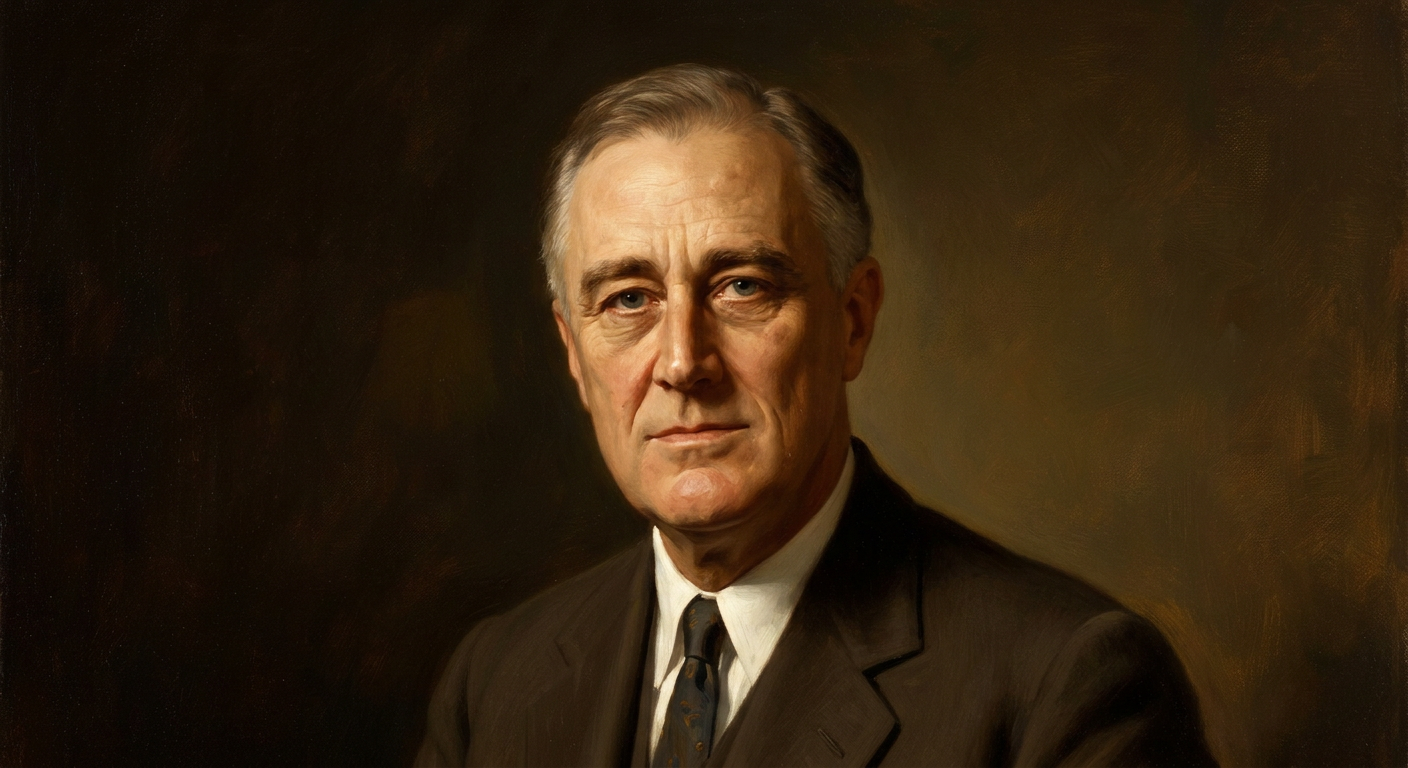
Quick Facts
- Years
- 1882 – 1945
- Category
- World Leaders & Revolutionaries
- Nationality
- American
- Occupation
- 32nd President of the United States, governor, lawyer and statesman
Franklin D. Roosevelt
1882 – 1945 · American · 32nd President of the United States, governor, lawyer and statesman
Recommended Audiobooks
Listen next from Marcus Alden

Life Lessons from Simon Bolivar
Marcus Alden · 55 min

Life Lessons from George Washington
Marcus Alden · 54 min
Franklin Delano Roosevelt led the United States through two of the greatest crises in its history: the Great Depression and World War II. Elected president four times, he transformed the federal government, reshaped the Democratic Party and became the central figure in American public life for more than twelve years.
Roosevelt entered office in 1933 while banks were collapsing, unemployment was near 25 percent and confidence in democratic government was weakening around the world. His New Deal did not end the Depression by itself, but it provided relief, regulated finance, created jobs and established lasting programs such as Social Security. During World War II, he helped build the Allied coalition that defeated Nazi Germany and Imperial Japan, although he died before victory was secured.
His record also contains profound failures. Roosevelt authorized the forced removal and incarceration of Japanese Americans, tolerated racial discrimination within many programs and offered inadequate help to numerous refugees fleeing Nazi persecution. Critics further accused him of expanding presidential power too aggressively.
Students still study Roosevelt because his presidency raises enduring questions: What should government do during catastrophe? How much authority should a leader possess? Can bold reform preserve democracy—and at what cost?
Quick Facts
| Field | Details |
|---|---|
| Full Name | Franklin Delano Roosevelt |
| Common Name(s) | Franklin D. Roosevelt; FDR |
| Born | January 30, 1882 |
| Died | April 12, 1945 |
| Age at Death | 63 |
| Birthplace | Hyde Park, New York, United States |
| Nationality | American |
| Occupation | Lawyer, state senator, assistant secretary of the Navy, governor and president |
| Historical Era | Progressive Era, Great Depression and World War II |
| Famous For | The New Deal; leading the United States during most of World War II |
| Political Affiliation | Democratic Party |
| Religion | Episcopalian |
| Education | Groton School; Harvard College; Columbia Law School attendance |
| Parents | James Roosevelt I and Sara Delano Roosevelt |
| Spouse(s) | Eleanor Roosevelt, married 1905 |
| Children | Anna, James, Franklin, Elliott, Franklin Jr. and John; one son died in infancy |
| Major Works | New Deal programs, Four Freedoms address, Atlantic Charter and wartime addresses |
| Major Achievements | Banking stabilization, Social Security, labor reform, Allied coalition-building and four presidential victories |
Early Life
Franklin Roosevelt was born at Springwood, his family's estate beside the Hudson River. His father, James, was a wealthy landowner and businessman; his mother, Sara Delano Roosevelt, came from a prosperous merchant family. An only child, Franklin grew up with tutors, travel and outdoor recreation. His privileged upbringing gave him confidence and influential connections, although it also separated him from the economic insecurity experienced by most Americans.
At Groton School in Massachusetts, headmaster Endicott Peabody promoted public service as an obligation of privilege. Roosevelt later attended Harvard, edited the student newspaper and admired his distant cousin Theodore Roosevelt, the energetic Republican president.
In 1905 Franklin married Theodore's niece, Eleanor Roosevelt. He attended Columbia Law School but left after passing the New York bar examination. His early legal work at Carter Ledyard & Milburn interested him less than politics.
Rise to Prominence
Roosevelt won election to the New York State Senate in 1910 as a Democrat from a normally Republican district. He attracted attention by opposing the powerful Tammany Hall organization over a United States Senate nomination. Although he later worked pragmatically with party leaders, the confrontation gave him a reform reputation.
President Woodrow Wilson appointed him assistant secretary of the Navy in 1913. Roosevelt supported naval expansion, handled administration during World War I and toured European battle areas after the armistice. In 1920 Democrats nominated him for vice president alongside James M. Cox. They lost decisively to Warren G. Harding, but the campaign made Roosevelt nationally known.
In 1921 he developed a paralytic illness diagnosed at the time as poliomyelitis. Some later medical researchers have proposed Guillain–Barré syndrome, but the diagnosis remains debated and cannot be settled conclusively. His legs never recovered functional strength. Through demanding rehabilitation, especially swimming at Warm Springs, Georgia, he learned to stand with braces and assistance. Political allies such as Eleanor Roosevelt and Louis Howe helped keep his career alive.
Roosevelt returned dramatically by nominating Al Smith at the 1924 Democratic convention. Elected governor of New York in 1928 and reelected in 1930, he created relief programs and argued that government had a responsibility to address unemployment. That record positioned him for the presidency.
Major Achievements
Confronting the Banking Crisis
Roosevelt took office on March 4, 1933, amid widespread bank failures. He declared a national bank holiday, called Congress into emergency session and used radio to explain the crisis. Federal examiners permitted sound banks to reopen, while the Emergency Banking Act strengthened supervision. Deposits soon returned. The Glass–Steagall Act separated commercial and investment banking and created federal deposit insurance, greatly reducing ordinary depositors' risk.
The New Deal
The New Deal was not one fixed blueprint. It was a changing collection of experiments intended to provide relief, encourage recovery and reform institutions. Programs included:
- The Civilian Conservation Corps, which employed young men on environmental projects.
- The Works Progress Administration, which funded construction, arts and public services.
- The Tennessee Valley Authority, which built dams and expanded electrification.
- The Securities and Exchange Commission, which regulated financial markets.
- The National Labor Relations Act, which protected collective bargaining.
- Social Security, which established old-age pensions and unemployment insurance.
These measures reduced suffering and changed citizens' expectations of government. Economists continue to debate their precise contribution to recovery. The economy improved substantially after 1933 but remained below full employment until wartime mobilization.
Redefining Presidential Communication
Roosevelt used press conferences, travel and radio more effectively than any previous president. His “fireside chats” addressed citizens in conversational language, helping restore confidence while building support for his policies. They were occasional strategic broadcasts, not weekly programs as sometimes imagined.
Leading During World War II
Before American entry into the war, Roosevelt promoted aid to countries resisting the Axis powers. Lend-Lease supplied Britain, the Soviet Union, China and other allies without requiring immediate payment. With Winston Churchill, he issued the Atlantic Charter, outlining principles including national self-determination and economic cooperation.
After Japan attacked Pearl Harbor on December 7, 1941, Roosevelt organized American mobilization and worked closely with Churchill and Soviet leader Joseph Stalin. He supported a “Germany first” strategy, coordinated vast industrial production and helped plan the United Nations. He died in April 1945, weeks before Germany's surrender and months before Japan's.
Leadership or Work
Roosevelt was optimistic, flexible and highly political. Rather than rely on a rigid doctrine, he encouraged advisers to propose competing solutions and sometimes assigned overlapping responsibilities. This produced innovation but also confusion and rivalry.
He possessed exceptional skill in identifying public mood and explaining policy. His outward confidence concealed information, managed access and occasionally avoided firm commitments until political conditions became clearer. Supporters regarded this flexibility as practical leadership; critics saw inconsistency and manipulation.
His closest working circle included Frances Perkins, Harry Hopkins, Louis Howe, Cordell Hull and military leaders such as George C. Marshall. Eleanor Roosevelt also served as an independent adviser, traveler and advocate, frequently pushing him on civil rights and social welfare.
Personal Life
Franklin and Eleanor's marriage became both a family relationship and a political partnership. In 1918 Eleanor discovered his relationship with her social secretary, Lucy Mercer. Divorce was discussed but did not occur. The marriage continued with greater personal independence, and historians generally describe it as emotionally complicated rather than conventionally intimate.
Roosevelt found relaxation in sailing, swimming, stamp collecting, poker and convivial gatherings. He was charming and sociable but could remain emotionally guarded. He took great care to limit public images of his wheelchair. Journalists usually cooperated, although his disability was not wholly secret.
Warm Springs became central to his life. He purchased the Georgia rehabilitation facility and shared exercises and conversation with other patients. Years of physical effort did not restore his legs, but they deepened his understanding of dependence, rehabilitation and determination.
Philosophy or Beliefs
Roosevelt was a liberal Democrat shaped by Progressivism, patrician public service and practical experimentation. He did not seek to abolish capitalism; he believed government regulation and social protection could save it from instability and extremism.
His Episcopal faith appeared in speeches through themes of duty, providence and moral struggle. Yet his policies were usually pragmatic rather than theological. He defined freedom broadly: not only protection from government oppression, but also a measure of economic security. His Four Freedoms—speech, worship, freedom from want and freedom from fear—connected domestic reform with an international vision.
Challenges and Controversies
Executive Power and the Supreme Court
After the Supreme Court invalidated major New Deal laws, Roosevelt proposed in 1937 that additional justices be appointed when sitting members over seventy did not retire. Opponents called this “court-packing” and feared an attack on judicial independence. The proposal failed in Congress and damaged his political standing, although the Court soon became more receptive to economic regulation and later vacancies allowed him to reshape it.
The 1937–1938 Recession
Roosevelt reduced spending and supported tighter fiscal policies before recovery was secure. The economy fell sharply again in 1937. Renewed federal spending helped reverse the downturn, but the episode exposed the administration's uncertainty about managing demand.
Race and the New Deal
New Deal programs aided millions of Black Americans, and African American support increasingly shifted toward the Democratic Party. Nevertheless, several programs were locally administered in discriminatory ways. Early Social Security and labor laws excluded many agricultural and domestic workers—occupations heavily populated by Black workers—partly because Southern Democrats demanded those exclusions. Roosevelt also declined to make federal anti-lynching legislation a priority, fearing the loss of congressional support for his broader agenda.
Japanese American Incarceration
In 1942 Roosevelt signed Executive Order 9066. It enabled the forced removal and incarceration of about 120,000 people of Japanese ancestry, most of them American citizens. No individualized evidence of disloyalty was required. The policy is now widely recognized as a grave violation of civil liberties driven by wartime fear, racism and political pressure.
Refugees and the Holocaust
The administration condemned Nazi persecution and eventually established the War Refugee Board in 1944, which helped save lives. However, immigration restrictions remained tight, the United States turned away many refugees and rescue was not made a central wartime objective. Scholars debate what additional measures were feasible, but there is broad agreement that the response was inadequate.
Four Terms
Roosevelt's victories in 1940 and 1944 broke the two-term tradition established by George Washington. Supporters emphasized international danger and continuity; opponents feared personal rule. The Twenty-Second Amendment, ratified in 1951, later limited presidents to two elected terms.
Legacy
Roosevelt permanently enlarged the federal government's role in economic security, labor relations, infrastructure and financial oversight. Social Security remains his most visible domestic legacy, while the modern presidency still reflects his use of mass communication and executive administration.
Internationally, he helped move the United States from relative isolation toward sustained global leadership. The alliance system and United Nations planning associated with his presidency shaped the postwar order, though President Harry S. Truman oversaw their completion.
Roosevelt's home and presidential library at Hyde Park are national historic sites. The Franklin Delano Roosevelt Memorial in Washington presents his presidency, disability, Depression-era hardship and Eleanor's public role. His image also appears on the American dime.
His reputation remains high in many scholarly surveys, but modern assessments place greater emphasis on Japanese American incarceration, racial inequality and refugee policy. His legacy is therefore both foundational and morally complicated.
Interesting Facts
- Roosevelt and Theodore Roosevelt were distant cousins from separate branches of the family.
- Eleanor Roosevelt was Franklin's fifth cousin once removed.
- Theodore Roosevelt escorted Eleanor at her wedding.
- FDR was the first American president elected four times.
- He appointed Frances Perkins, the first woman to serve in a presidential cabinet.
- He held more than 900 presidential press conferences.
- His fireside chats were relatively infrequent but reached enormous audiences.
- He collected stamps from childhood and helped design several issues.
- Roosevelt founded the presidential library at Hyde Park, the first built for a sitting president.
- In 1939 he became the first sitting president to appear on television.
- In 1943 he became the first sitting president to travel by airplane while conducting official overseas business.
- He often used heavy leg braces and another person's arm to appear standing publicly.
- The press rarely photographed him being transferred into his wheelchair.
- His Scottish terrier, Fala, became nationally famous.
- Roosevelt survived an assassination attempt in Miami in 1933; Chicago mayor Anton Cermak was fatally wounded.
- His portrait was being painted when he suffered his fatal cerebral hemorrhage.
- Congress placed his portrait on the dime in recognition of his association with efforts against polio.
Famous Quotes
- “The only thing we have to fear is fear itself.” — First inaugural address, 1933. Roosevelt argued that panic was preventing economic action.
- “I pledge you, I pledge myself, to a new deal for the American people.” — Democratic nomination acceptance speech, 1932. The phrase gave his domestic program its lasting name.
- “These unhappy times call for the building of plans ... that put their faith once more in the forgotten man at the bottom of the economic pyramid.” — Radio address, 1932. He placed ordinary citizens at the center of recovery.
- “The country demands bold, persistent experimentation.” — Oglethorpe University address, 1932. The statement summarized his pragmatic approach.
- “The test of our progress is not whether we add more to the abundance of those who have much; it is whether we provide enough for those who have too little.” — Second inaugural address, 1937.
- “I see one-third of a nation ill-housed, ill-clad, ill-nourished.” — Second inaugural address, 1937. Roosevelt acknowledged that recovery remained incomplete.
- “This generation of Americans has a rendezvous with destiny.” — Democratic convention address, 1936, framing reform as a defense of democracy.
- “The only limit to our realization of tomorrow will be our doubts of today.” — Prepared Jefferson Day address, 1945. Roosevelt died before delivering it; the text was released afterward.
- “A date which will live in infamy.” — Address to Congress, December 8, 1941, after the attack on Pearl Harbor.
- “We look forward to a world founded upon four essential human freedoms.” — State of the Union address, 1941, introducing the Four Freedoms.
Timeline
- 1882 — Born at Hyde Park, New York.
- 1900 — Entered Harvard College.
- 1905 — Married Eleanor Roosevelt and entered Columbia Law School.
- 1907 — Began practicing law.
- 1910 — Elected to the New York State Senate.
- 1913 — Became assistant secretary of the Navy.
- 1920 — Democratic vice-presidential nominee; defeated in the general election.
- 1921 — Developed the paralytic illness that permanently disabled his legs.
- 1924 — Returned to national politics at the Democratic convention.
- 1927 — Established the Warm Springs Foundation.
- 1928 — Elected governor of New York.
- 1932 — Elected president over Herbert Hoover.
- 1933 — Launched the First New Deal during his first Hundred Days.
- 1935 — Signed the Social Security and National Labor Relations Acts.
- 1936 — Won reelection in a landslide.
- 1937 — Proposed judicial reorganization; the court plan failed.
- 1940 — Won an unprecedented third term.
- 1941 — Presented the Four Freedoms, signed Lend-Lease and led the nation after Pearl Harbor.
- 1942 — Authorized Japanese American removal under Executive Order 9066.
- 1943 — Met Allied leaders at Casablanca and Tehran.
- 1944 — Won a fourth term and approved creation of the War Refugee Board.
- 1945 — Attended the Yalta Conference; died at Warm Springs on April 12.
Frequently Asked Questions
1. Why is Franklin D. Roosevelt important?
Roosevelt led the United States through the Great Depression and most of World War II. His New Deal expanded federal responsibility for employment, financial stability and social welfare. He also helped organize the Allied war effort and plan the United Nations. At the same time, decisions such as Japanese American incarceration make his record deeply contested.
2. Did the New Deal end the Great Depression?
Not by itself. New Deal programs relieved suffering, stabilized institutions and encouraged recovery, but unemployment remained high during the 1930s. Massive wartime production finally brought full employment. Historians and economists disagree over how quickly recovery would have occurred under different fiscal or monetary policies.
3. What was Roosevelt's disability?
A severe illness in 1921 left his legs permanently paralyzed. Doctors diagnosed poliomyelitis. Later researchers have suggested Guillain–Barré syndrome, but retrospective diagnosis is uncertain. Roosevelt used wheelchairs, braces and physical assistance while carefully managing his public image.
4. Did Americans know that Roosevelt could not walk?
Many understood that he had suffered paralysis, but the full practical extent of his disability was rarely displayed. News photographers generally avoided showing him in a wheelchair or being lifted. He appeared publicly standing with braces and support, creating an image of physical command without literally hiding his condition from everyone.
5. Why was Roosevelt elected four times?
He built a broad coalition of workers, urban voters, white Southerners, immigrants, many Black voters and reformers. Relief programs, political skill and public confidence strengthened his support. International danger also encouraged voters to retain experienced leadership in 1940 and 1944.
6. What were the fireside chats?
They were radio addresses in which Roosevelt explained policies and crises in accessible language. The first helped reassure Americans during the banking emergency. Their intimacy strengthened his connection with listeners, although opponents objected that he used modern media to bypass critics and shape opinion.
7. What was the Second New Deal?
The term generally refers to the more reform-oriented legislation of 1935–1936. It included Social Security, federal employment programs and stronger protections for organized labor. Compared with the earliest New Deal, it placed greater emphasis on economic security and workers' bargaining power.
8. Why did Roosevelt try to change the Supreme Court?
The Court had struck down important New Deal laws. Roosevelt argued that older justices needed assistance, but his plan would have allowed him to appoint several new members. Critics believed he was attempting to secure favorable decisions. The political backlash weakened his domestic program.
9. What was Roosevelt's relationship with Eleanor?
Their marriage produced six children and an extraordinary political partnership, but it was strained by Franklin's relationship with Lucy Mercer. Eleanor developed an independent public career and often pressed him to act more boldly on civil rights, refugees and poverty. They remained politically connected despite emotional distance.
10. How did Roosevelt prepare for World War II?
He increased defense production, traded destroyers to Britain for base rights, secured Lend-Lease and challenged Axis expansion while officially maintaining neutrality. These steps helped Britain survive but drew criticism from isolationists who feared that he was moving the country toward war.
11. Why did Roosevelt prioritize Germany over Japan?
American and British strategists considered Nazi Germany the more powerful long-term threat because of its industrial base and domination of Europe. The Allies therefore adopted a “Germany first” strategy while still fighting major campaigns across the Pacific.
12. Was Roosevelt aware of the Holocaust?
His administration received increasingly detailed evidence of mass murder. It publicly confirmed Nazi extermination in 1942, but military victory remained its central strategy. The late creation of the War Refugee Board saved lives, yet historians widely criticize the administration for failing to act earlier and more aggressively.
13. Why did he incarcerate Japanese Americans?
Military officials, politicians and West Coast pressure groups claimed removal was necessary after Pearl Harbor, despite the absence of evidence that the population posed a collective threat. Roosevelt accepted those claims and authorized exclusion. The action is now understood as a major civil-liberties failure shaped by racism and wartime hysteria.
14. How did Roosevelt die?
Roosevelt's health deteriorated markedly during his final years. On April 12, 1945, while resting at Warm Springs, Georgia, he suffered a massive cerebral hemorrhage. Vice President Harry S. Truman then became president.
15. Who succeeded Franklin D. Roosevelt?
Harry S. Truman succeeded him. Truman had served as vice president for only eighty-two days and had received limited preparation for major wartime decisions. He oversaw Germany's final defeat, the atomic bombings of Hiroshima and Nagasaki, Japan's surrender and the early postwar settlement.
Lessons We Can Learn
- Communicate clearly in a crisis. Roosevelt's banking address translated technical policy into understandable terms; modern leaders likewise need public trust.
- Experiment, but evaluate results. New Deal programs reflected action under uncertainty, while the 1937 recession showed the cost of changing course prematurely.
- Institutions can be reformed rather than discarded. Roosevelt regulated capitalism in part to preserve democratic stability.
- Coalitions require compromise. His legislative victories depended on diverse allies, but compromises with segregationists also caused lasting injustice.
- Disability does not prevent leadership. His career provides documented evidence of adaptation, though modern portrayals should avoid turning disability into a simplistic inspirational symbol.
- Confidence must not replace evidence. Japanese American incarceration demonstrates how fear and prejudice can overwhelm constitutional judgment.
- Social protection can reshape citizenship. Social Security created lasting expectations about shared responsibility for economic risk.
- Executive energy needs limits. Swift action stabilized banks, but the court plan revealed the dangers of concentrating authority.
- International cooperation matters. Roosevelt's coalition-building helped unite states with conflicting systems against a common threat.
- Great achievements do not erase moral failures. Serious history weighs wartime and economic leadership alongside racism, incarceration and refugee policy.
Related Historical Figures
- Eleanor Roosevelt — His wife, political partner and an influential human-rights advocate.
- Theodore Roosevelt — A distant cousin and presidential model whose progressive style influenced FDR.
- Winston Churchill — Britain's prime minister and Roosevelt's central wartime partner.
- Joseph Stalin — Soviet leader and essential, difficult member of the Allied coalition.
- Harry S. Truman — Roosevelt's final vice president and presidential successor.
- Frances Perkins — Labor secretary, Social Security architect and first female cabinet member.
- Herbert Hoover — The president Roosevelt defeated amid the Great Depression.
- George C. Marshall — Army chief of staff who directed American military expansion.
- Huey Long — Populist critic who argued that the New Deal did not redistribute wealth far enough.
- Wendell Willkie — Roosevelt's Republican opponent in 1940 and later an advocate of international cooperation.
Watch and Learn
The New Deal: Crash Course US History #34 — CrashCourse — approximately 15 minutes.
This widely viewed educational overview explains the major New Deal programs, their political setting and debates over their effectiveness. Its brisk format is useful as an introduction, though viewers should supplement it with detailed scholarship on race, constitutional conflict and the experiences of people affected by individual programs.
Watch and Learn
The New Deal: Crash Course US History #34 · CrashCourse
Related Historical Figures