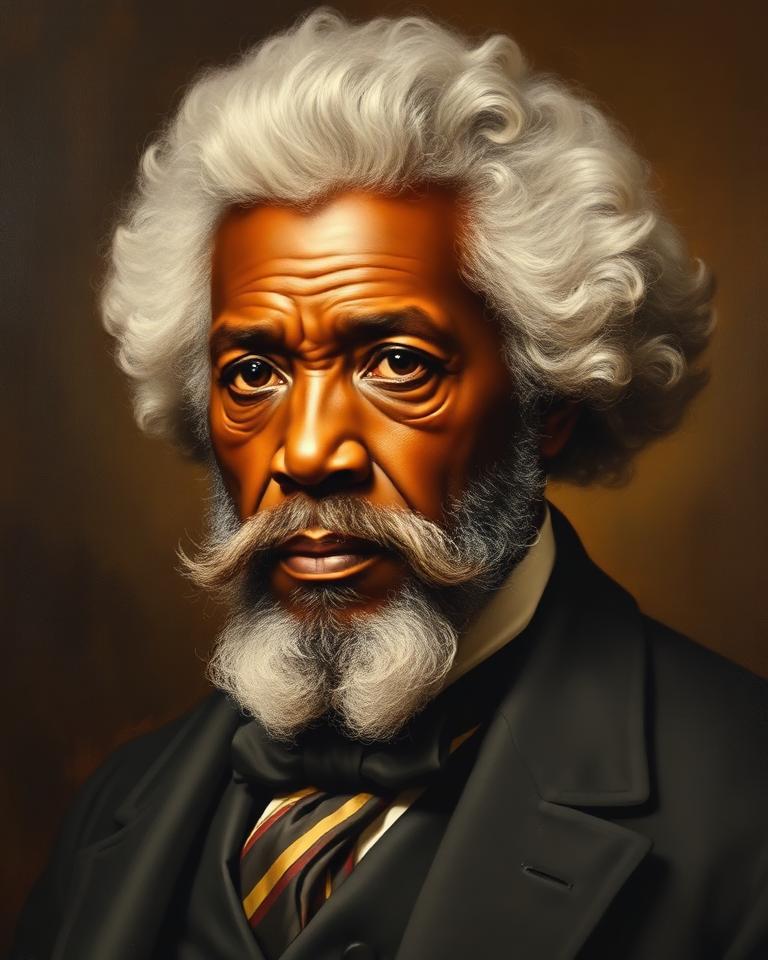
Quick Facts
- Years
- 1818 – 1895
- Category
- Social Reformers & Humanitarians
- Subcategory
- Social Reformers & Humanitarians
- Nationality
- American
- Occupation
- Abolitionist and Statesman
Frederick Douglass
1818 – 1895 · American · Abolitionist and Statesman
Audiobook

Life Lessons from Frederick Douglass
Marcus Alden · 58 min
Frederick Douglass was an American abolitionist, author, orator, newspaper editor, reformer, and diplomat who transformed his experience of enslavement into a lifelong campaign for human freedom. Born into slavery in Maryland in 1818, he secretly learned to read, escaped in 1838, and became one of the nineteenth century’s most influential public speakers. His autobiographies exposed slavery’s brutality while directly disproving racist claims that Black Americans lacked intelligence, dignity, or political capacity.
Douglass helped make abolition a national and international cause. Through speeches, newspapers, political organizing, and personal appeals to government leaders, he demanded immediate emancipation, equal citizenship, voting rights, and access to education. During the Civil War, he urged President Abraham Lincoln to make emancipation a Union objective and recruited Black soldiers, including two of his sons. After slavery ended, Douglass continued fighting racial violence and disfranchisement while also supporting women’s rights.
He later became the first African American confirmed by the U.S. Senate for a presidential appointment and served as U.S. minister resident and consul general to Haiti. Douglass remains important because his writings illuminate slavery, self-emancipation, constitutional conflict, citizenship, race, gender, and the responsibilities of democracy. His insistence that liberty required organized struggle continues to shape historical scholarship and movements for human rights.
Quick Facts
| Field | Details |
|---|---|
| Full Name | Frederick Augustus Washington Bailey; later Frederick Douglass |
| Common Name(s) | Frederick Douglass |
| Born | February 1818; he later selected February 14 as his birthday |
| Died | February 20, 1895 |
| Age at Death | Approximately 77 |
| Birthplace | Tuckahoe, near Easton, Talbot County, Maryland, United States |
| Nationality | American |
| Occupation | Abolitionist, author, orator, editor, reformer, public official, diplomat |
| Historical Era | Antebellum era, Civil War, Reconstruction, Gilded Age |
| Famous For | Escaping slavery; leading abolitionism; writing three autobiographies; advocating Black citizenship and women’s rights |
| Political Affiliation | Liberty Party sympathizer; later Free Soil and Republican supporter |
| Religion | African Methodist Episcopal and broadly Protestant Christian; sharply critical of proslavery churches |
| Education | Largely self-educated; briefly taught letters by Sophia Auld; later received honorary degrees |
| Parents | Harriet Bailey; father not conclusively identified, though Douglass wrote that his enslaver Aaron Anthony was rumored to be his father |
| Spouse(s) | Anna Murray Douglass (married 1838–1882); Helen Pitts Douglass (married 1884–1895) |
| Children | Rosetta, Lewis Henry, Frederick Jr., Charles Remond, and Annie Douglass |
| Major Works | Narrative of the Life of Frederick Douglass; My Bondage and My Freedom; Life and Times of Frederick Douglass; The North Star |
| Major Achievements | International abolitionist leadership; Black military recruitment; advocacy of emancipation and equal citizenship; federal and diplomatic service |
Early Life
Frederick Augustus Washington Bailey was born enslaved on Maryland’s Eastern Shore. The exact date was not recorded, a common consequence of slavery’s denial of legal and familial autonomy. Douglass later chose February 14 because his mother had called him her “Little Valentine.”
His mother, Harriet Bailey, lived on another plantation and could visit only rarely, usually after walking at night. She died when he was young. Douglass knew neither stable family life nor the confirmed identity of his father. His maternal grandmother, Betsy Bailey, cared for him during his earliest years before he was sent to the Lloyd plantation and then to Baltimore.
In Baltimore, Sophia Auld began teaching him the alphabet. Her husband, Hugh Auld, stopped the lessons, warning that literacy would make an enslaved person dissatisfied and difficult to control. Douglass later described that warning as a revelation: if slaveholders feared literacy, education must offer a path toward freedom.
He traded bread to poor white boys for reading lessons and studied newspapers, speeches, and The Columbian Orator. Reading introduced him to arguments about liberty and human rights while making the injustice of his captivity even clearer.
As an adolescent, Douglass was hired to Edward Covey, a farmer notorious for coercing enslaved people into submission. Covey beat and overworked him. In 1834 Douglass resisted physically during a confrontation that lasted roughly two hours. Covey did not whip him again. Douglass regarded this resistance as the recovery of his self-respect, although he remained legally enslaved.
Douglass later taught other enslaved people to read portions of the New Testament. Such activities were dangerous because slaveholders understood literacy, religious interpretation, and collective organization as threats to their authority.
Rise to Prominence
After an unsuccessful escape plan in 1836, Douglass was jailed and returned to Baltimore. On September 3, 1838, he escaped by traveling north using borrowed identification belonging to a free Black sailor and wearing sailor’s clothing. He reached New York City, where abolitionist David Ruggles assisted him.
Anna Murray, a free Black woman who had helped make the escape possible, joined him in New York. They married on September 15 and soon moved to New Bedford, Massachusetts. To reduce the risk of capture, Frederick Bailey adopted the surname Douglass, reportedly following a suggestion inspired by Sir Walter Scott’s poem The Lady of the Lake.
In New Bedford, Douglass worked as a laborer and joined the African Methodist Episcopal Zion Church. He subscribed to William Lloyd Garrison’s abolitionist newspaper, The Liberator, and spoke at Black community meetings. His address at an antislavery convention on Nantucket in August 1841 impressed abolitionist organizers, who hired him as a lecturer.
Douglass’s testimony attracted crowds, but racism remained pervasive even in the North. He encountered segregation and violence while traveling. Some white abolitionists preferred that he limit himself to recounting personal suffering. Douglass increasingly rejected that constraint and developed independent arguments about politics, law, religion, and citizenship.
His first autobiography, published in 1845, named people and places connected to his enslavement. Its success strengthened the danger of recapture under federal law. Douglass traveled through Britain and Ireland from 1845 to 1847, lecturing against slavery. British supporters raised money to purchase his legal freedom from Thomas Auld. Some abolitionists objected that the transaction recognized property claims in a human being; Douglass accepted it as protection for his family and public work.
Returning to the United States, he founded The North Star in Rochester, New York. Editorial independence established him not merely as a witness to slavery but as a leading political thinker.
Major Achievements
Making the Realities of Slavery Public
Douglass’s 1845 Narrative provided detailed testimony about forced labor, family separation, sexual exploitation, physical violence, and resistance. Its literary power and verifiable detail answered critics who doubted that an formerly enslaved man could write so forcefully.
He expanded his account in My Bondage and My Freedom (1855) and Life and Times of Frederick Douglass (1881; revised 1892). Together, these books became foundational texts of American autobiography and slavery studies. Their long-term impact lies in joining personal memory to structural analysis: slavery appeared not as isolated cruelty but as a political, economic, and religious system.
Building an Independent Black Press
Douglass founded The North Star in 1847. Its motto declared, “Right is of no Sex—Truth is of no Color—God is the Father of us all, and all we are Brethren.” The paper addressed abolition, racial discrimination, women’s rights, political strategy, and international affairs.
Renamed Frederick Douglass’ Paper in 1851, it provided Black writers and activists with an influential public forum. Although financial difficulties repeatedly threatened the enterprise, Douglass demonstrated that Black Americans could direct national debate rather than depend entirely on white-led organizations.
Reinterpreting the Constitution
Douglass initially shared Garrison’s belief that the U.S. Constitution protected slavery. After studying antislavery constitutional arguments, especially those associated with Gerrit Smith and Lysander Spooner, he concluded that the document could be interpreted as supporting liberty.
This change caused a serious break with Garrison. It also encouraged Douglass to pursue voting, party politics, and federal action. His constitutional position helped shape an enduring tradition that treats the nation’s founding principles as standards against which discriminatory institutions can be challenged.
Advancing Emancipation and Black Military Service
During the Civil War, Douglass argued that destroying slavery was essential to preserving the Union. Following the Emancipation Proclamation, he recruited Black men for the United States Colored Troops, notably the 54th Massachusetts Infantry. His sons Lewis and Charles enlisted.
Douglass protested unequal pay, discriminatory treatment, and the risk that captured Black soldiers would be enslaved or killed. He discussed these issues with Lincoln in 1863. Black military service strengthened the Union and established a powerful claim to citizenship, although equality remained unfulfilled.
Campaigning for Equal Citizenship
After the Civil War, Douglass supported the Fourteenth and Fifteenth Amendments, federal civil-rights enforcement, public education, and voting rights. He rejected proposals to abandon freedpeople to former Confederate governments and denounced racial terror.
His Reconstruction advocacy mattered because emancipation alone did not create security or political power. Douglass defined freedom as enforceable citizenship, not merely the absence of legal ownership. That principle remains central to debates about civil rights.
Supporting Women’s Rights
Douglass attended the 1848 Seneca Falls Convention and supported Elizabeth Cady Stanton’s resolution for women’s suffrage. He argued that rights should not depend on sex.
During Reconstruction, however, disagreements emerged over whether voting rights for Black men should receive immediate priority. Douglass regarded Black enfranchisement as an urgent defense against lethal racial violence, while some women’s-rights leaders opposed any amendment that excluded women. Despite this conflict, he remained an advocate of women’s suffrage and spoke at a women’s-rights meeting on the day he died.
Serving in Public Office and Diplomacy
Douglass served as marshal of the District of Columbia, recorder of deeds for the district, and U.S. minister resident and consul general to Haiti. His appointments represented important breakthroughs in federal service for African Americans.
His Haiti mission from 1889 to 1891 was complicated by U.S. efforts to obtain Môle-Saint-Nicolas as a naval station. Douglass respected Haitian sovereignty and resisted coercive diplomacy. His service highlighted both his international stature and the tensions between American expansion and Black self-government.
Leadership and Work
Douglass led primarily through language, publication, coalition building, and moral example. His speeches combined personal testimony, biblical imagery, constitutional reasoning, irony, and direct political demands. He adjusted his arguments as evidence and circumstances changed, as shown by his shift on the Constitution.
He believed in alliances but insisted on intellectual independence. Relationships with Garrison, Stanton, Susan B. Anthony, John Brown, Lincoln, and Republican leaders mixed cooperation with disagreement. Douglass could praise incremental progress without treating it as sufficient.
His strengths included courage, disciplined self-education, strategic flexibility, exceptional communication, and the ability to connect individual suffering with public policy. He understood newspapers, lecture networks, photography, and autobiography as tools of political leadership.
His limitations reflected both personal judgment and political circumstance. Critics accused him of becoming too loyal to the Republican Party, even as its commitment to Reconstruction weakened. His confidence and combative style could sharpen disputes. Financial pressures affected his newspapers, and his public prominence rested partly on Anna Douglass’s largely unrecognized domestic labor.
Personal Life
Anna Murray Douglass provided money and practical support for Frederick’s escape. During their marriage, she managed a large household while he traveled extensively. They had five children; Annie died in 1860 at age ten. Their surviving children participated in the family’s publishing, political, and public work.
The marriage faced prolonged absences and strains associated with Douglass’s demanding career. His close intellectual friendships with women, particularly British abolitionist Julia Griffiths and German journalist Ottilie Assing, prompted gossip. Surviving evidence does not establish with certainty the precise emotional or sexual character of these relationships, and historians interpret them differently.
The Douglass home in Rochester served as an antislavery center and a station associated with the Underground Railroad. After the house burned in 1872, the family moved permanently to Washington, D.C. Anna died in 1882.
In 1884 Douglass married Helen Pitts, a white suffragist roughly twenty years younger than he was. The interracial marriage provoked criticism from some members of both families and from the broader public. Douglass defended their right to marry and reportedly answered racial objections with characteristic wit.
Douglass enjoyed music and played the violin. He valued cultivated dress and carefully controlled his photographic image. After suffering a fatal heart attack at Cedar Hill on February 20, 1895, he was buried beside Anna in Mount Hope Cemetery in Rochester. Helen later joined them there.
Philosophy and Beliefs
Douglass’s central ethical conviction was that every human being possessed natural rights that no government, custom, or religious institution could legitimately erase. Literacy, work, family integrity, bodily autonomy, political participation, and equal protection were all elements of freedom.
His Christianity was deeply important but sharply critical. He distinguished the Christianity of Christ from what he called the corrupt, slaveholding Christianity of America. For Douglass, religion had moral value only when it opposed oppression.
Politically, he evolved from Garrisonian moral suasion and distrust of electoral institutions toward antislavery constitutionalism and political participation. He saw federal power as potentially necessary to protect rights when states tolerated oppression.
Douglass believed progress required struggle. His famous 1857 declaration that “Power concedes nothing without a demand” summarized a practical theory: entrenched privilege rarely disappears through goodwill alone. Yet he was not committed to a single tactic. He supported persuasion, voting, journalism, legal reform, military service, civil disobedience, and, under extreme circumstances, resistance.
His universalism included women’s rights and sympathy for oppressed people internationally. Nevertheless, like other reformers of his era, he made strategic choices that produced conflict over whose claims should take priority.
Challenges and Controversies
Douglass lived under threats of kidnapping, mob violence, and assassination. His fame did not shield him from segregation or racial insult. During John Brown’s 1859 raid on Harpers Ferry, authorities found correspondence linking Brown and Douglass. Douglass had rejected participation because he believed the plan would be disastrous, but he fled to Canada and then Britain to avoid arrest.
His break with Garrison concerned both constitutional interpretation and leadership. Garrisonians thought political participation compromised abolitionist principles; Douglass believed refusing electoral action surrendered a useful instrument. Historians generally view this as a substantive strategic disagreement rather than a simple personal quarrel.
The postwar suffrage dispute remains contentious. Douglass supported the Fifteenth Amendment even though it did not enfranchise women. He argued that Black men faced an immediate emergency of racist violence. Stanton and Anthony condemned sex-based exclusion, sometimes using racist rhetoric. Douglass continued to support universal suffrage, but the conflict fractured the reform coalition.
His Republican loyalty also attracted criticism. Douglass saw the party as the principal national vehicle for Black rights, yet later Republican governments retreated from Reconstruction. He criticized that retreat but did not abandon the party. Scholars debate whether this loyalty was pragmatic or overly limiting.
His marriage to Helen Pitts challenged racial convention but distressed his children and others close to him. Modern interpretations often emphasize personal autonomy, while also acknowledging family tensions and the unequal recognition historically given to Anna’s contribution.
As minister to Haiti, Douglass faced claims that he failed to advance U.S. strategic goals. He believed the United States was treating Haiti unfairly and ultimately resigned. From an anti-imperialist perspective, his defense of Haitian sovereignty is often considered principled; contemporary expansionists regarded it as insufficiently supportive of American interests.
Legacy
Douglass reshaped American political language by making formerly enslaved people authorities on slavery and citizenship. His autobiographies remain essential in schools and universities, while his speeches continue to influence discussions of patriotism, protest, constitutional meaning, and racial justice.
His home at Cedar Hill is preserved as the Frederick Douglass National Historic Site in Washington, D.C. The National Park Service also interprets sites connected with his life, and his papers are held by major institutions including the Library of Congress. Statues and memorials stand in Rochester, New York City, Washington, and elsewhere.
The Frederick Douglass National Historic Site, Frederick Douglass Memorial Bridge, Frederick Douglass–Susan B. Anthony Memorial Bridge, and numerous schools and civic organizations bear his name. In 2020, his statue in Rochester was torn from its base; authorities did not establish a clear motive, and it was replaced.
Douglass is still studied not as a flawless symbol but as a developing thinker who confronted competing moral and political demands. His life demonstrates both the possibility of transformative leadership and the unfinished nature of the equality he pursued.
Interesting Facts
- Douglass did not know his exact birth date and chose February 14.
- His birth surname was Bailey, not Douglass.
- He learned to read partly by exchanging bread for lessons.
- The Columbian Orator strongly influenced his intellectual development.
- His 1834 resistance to Edward Covey became a defining moment in his autobiographies.
- He escaped using a free Black sailor’s protection papers.
- Anna Murray helped finance and arrange his escape.
- He adopted “Douglass” after reaching New Bedford.
- His first major abolitionist speech was delivered on Nantucket in 1841.
- British supporters purchased his legal freedom in 1846.
- His newspaper’s motto linked racial equality with women’s rights.
- His Rochester home participated in antislavery assistance networks.
- He consulted with Abraham Lincoln during the Civil War.
- Two of his sons served in the 54th Massachusetts Infantry.
- He was the first African American nominated for vice president, without his consent, on Victoria Woodhull’s 1872 Equal Rights Party ticket; the status and handling of that nomination remain historically unusual.
- He was the first African American confirmed by the Senate for a presidential appointment.
- He was photographed extensively and understood portraiture as a challenge to racist caricature.
- He played the violin.
- He married across the color line in 1884 despite public hostility.
- He spoke at a women’s-rights gathering on the day he died.
Famous Quotes
- “I would unite with anybody to do right and with nobody to do wrong.” — From an 1855 antislavery address. It expressed Douglass’s preference for principled coalition over permanent factional loyalty.
- “What, to the American slave, is your Fourth of July?” — Asked in his July 5, 1852 Rochester speech. The question exposed the contradiction between national celebrations of liberty and continuing slavery.
- “Power concedes nothing without a demand. It never did and it never will.” — From his 1857 West India Emancipation address. Douglass argued that organized pressure is necessary for reform.
- “If there is no struggle there is no progress.” — From the same 1857 speech. The sentence summarizes his understanding of social change.
- “Once you learn to read, you will be forever free.” — Frequently attributed to Douglass, but this exact wording is not securely documented in his authenticated writings. It should be treated as disputed.
- “You have seen how a man was made a slave; you shall see how a slave was made a man.” — From the 1845 Narrative, introducing his resistance to Covey. It connects self-defense with recovered personhood.
- “I prayed for freedom for twenty years, but received no answer until I prayed with my legs.” — Commonly linked to Douglass, but its precise original source and wording are uncertain; attribution should be treated cautiously.
- “The Constitution is a GLORIOUS LIBERTY DOCUMENT.” — From his 1852 Fourth of July address. It reflected his mature antislavery interpretation of the Constitution.
- “Right is of no Sex—Truth is of no Color.” — Part of The North Star’s motto. It joined racial justice with universal human equality.
- “The life of the nation is secure only while the nation is honest, truthful, and virtuous.” — From his 1883 speech on the twenty-first anniversary of emancipation in the District of Columbia. It warned that national survival depends on justice.
Timeline
- 1818 — Born enslaved near Tuckahoe, Maryland.
- 1820s — Separated from his grandmother and sent to the Lloyd plantation.
- 1826 — Sent to live with Hugh and Sophia Auld in Baltimore.
- Early 1830s — Secretly expands his literacy and teaches other enslaved people.
- 1833–1834 — Hired to Edward Covey; resists Covey physically in 1834.
- 1836 — Escape plan fails; Douglass is jailed and returned to Baltimore.
- 1838 — Escapes to New York, marries Anna Murray, and moves to New Bedford.
- 1841 — Speaks at the Nantucket antislavery convention and becomes a lecturer.
- 1845 — Publishes his first autobiography and leaves for Britain and Ireland.
- 1846 — British supporters purchase his legal freedom.
- 1847 — Returns to the United States and establishes The North Star.
- 1848 — Participates in the Seneca Falls women’s-rights convention.
- 1851 — Merges papers and increasingly embraces antislavery constitutionalism.
- 1852 — Delivers his famous Fourth of July address.
- 1855 — Publishes My Bondage and My Freedom.
- 1859 — Rejects participation in John Brown’s raid and temporarily leaves the country.
- 1861–1865 — Advocates emancipation and Black military service during the Civil War.
- 1863 — Recruits for the 54th Massachusetts and meets Lincoln.
- 1865 — Helps lead the postwar campaign for equal citizenship; Lincoln is assassinated.
- 1870 — His newspaper New National Era begins publication in Washington.
- 1872 — Rochester home burns; family relocates to Washington, D.C.
- 1874 — Becomes president of the troubled Freedman’s Savings and Trust Company shortly before its collapse.
- 1877 — Appointed U.S. marshal for the District of Columbia; visits Thomas Auld.
- 1881 — Publishes Life and Times of Frederick Douglass; becomes recorder of deeds.
- 1882 — Anna Murray Douglass dies.
- 1884 — Marries Helen Pitts.
- 1886–1887 — Tours Europe and parts of the Mediterranean with Helen.
- 1889 — Appointed U.S. minister resident and consul general to Haiti.
- 1891 — Resigns his diplomatic post.
- 1892 — Publishes a revised edition of Life and Times.
- 1893 — Speaks prominently at the World’s Columbian Exposition in Chicago.
- 1895 — Dies at Cedar Hill on February 20.
Frequently Asked Questions
When was Frederick Douglass born?
Douglass was born in February 1818 near Tuckahoe in Talbot County, Maryland. Enslavers did not preserve or provide him with a precise birth date. As an adult, he chose February 14 because his mother had reportedly called him her “Little Valentine.” Consequently, biographies commonly list February 1818 or circa February 14, 1818. The uncertainty itself is historically important: denying enslaved people reliable knowledge of age, ancestry, and family history was one way slavery undermined personal identity and legal autonomy.
What was Frederick Douglass’s birth name?
He was born Frederick Augustus Washington Bailey. After escaping, he briefly used other names to avoid capture. In New Bedford, Massachusetts, he adopted Douglass, reportedly at the suggestion of Nathan Johnson, a free Black abolitionist who drew the name from Sir Walter Scott’s The Lady of the Lake. Changing names offered practical security against slave catchers, but Douglass also used his chosen identity to establish a free public life. He retained Frederick, the name by which he had long been known.
How did Frederick Douglass learn to read?
Sophia Auld initially taught young Frederick the alphabet after he was sent to Baltimore. Hugh Auld stopped her, arguing that education would make an enslaved person unmanageable. Douglass then continued secretly. He persuaded local white boys to help him read, sometimes exchanging bread for instruction, and studied signs, discarded writing materials, newspapers, and The Columbian Orator. Literacy enabled him to analyze slavery and imagine freedom, although he recalled that increased knowledge also deepened his anguish by revealing the full injustice of his situation.
How did Frederick Douglass escape slavery?
On September 3, 1838, Douglass traveled from Baltimore toward the North dressed as a sailor and carrying borrowed protection papers belonging to a free Black seaman. The documents did not match his appearance exactly, making the journey highly dangerous. He passed through Philadelphia and reached New York City in less than a day. Abolitionist David Ruggles sheltered him. Anna Murray, the free Black woman who had helped finance and prepare his departure, soon joined him, and they married before relocating to New Bedford.
Why was his first autobiography important?
Narrative of the Life of Frederick Douglass, an American Slave gave readers a named, detailed account of enslavement written by a man who had experienced it. Douglass described family separation, violence, hunger, religious hypocrisy, literacy, and resistance. By identifying locations and enslavers, he made his testimony verifiable but increased his risk of recapture. The book became an international success and challenged racist assumptions about Black intellect. It remains a central source, though historians read it as a crafted abolitionist text as well as personal testimony.
What was The North Star?
The North Star was the antislavery newspaper Douglass founded in Rochester in December 1847 with support from collaborators including Martin R. Delany. It promoted immediate abolition, racial equality, women’s rights, education, and political participation. The newspaper allowed Douglass to develop an independent position rather than remain solely a lecturer for white-led abolitionist organizations. It later merged with another publication and became Frederick Douglass’ Paper. Persistent financial difficulties did not erase its importance in the development of the Black press.
Did Frederick Douglass know Abraham Lincoln?
Yes. Douglass met President Lincoln during the Civil War and pressed him on the treatment of Black soldiers, unequal pay, retaliation against Confederate abuse, and the need to make emancipation irreversible. Douglass sometimes criticized Lincoln for moving too slowly, yet came to respect his political growth and wartime leadership. Lincoln reportedly invited him to a White House reception after the second inauguration. Douglass later called Lincoln “preeminently the white man’s President” while also recognizing his indispensable role in emancipation—a deliberately complex assessment.
What role did Douglass play in the Civil War?
Douglass used speeches and editorials to argue that the Union could not defeat the Confederacy without attacking slavery. After Black enlistment became federal policy, he recruited soldiers for the 54th Massachusetts Infantry and other units. His sons Lewis and Charles served. Douglass also demanded equal pay, commissions, protection, and citizenship for Black troops. He did not hold military command, but his advocacy helped connect Black military service with emancipation and national belonging. Approximately 180,000 Black men eventually served in the Union Army.
Was Frederick Douglass involved in John Brown’s raid?
Douglass knew and admired John Brown’s opposition to slavery, and the two discussed revolutionary plans. Brown invited him to join the 1859 attack on the federal arsenal at Harpers Ferry. Douglass refused, warning that the arsenal was a trap and that the plan would likely fail. After the raid, papers linking him to Brown caused Douglass to fear arrest, so he left for Canada and then Britain. Claims that he participated directly are unsupported; his own account emphasized that he rejected the operation.
Did Douglass support women’s suffrage?
Yes. Douglass attended the 1848 Seneca Falls Convention and supported the controversial resolution calling for women’s voting rights. He continued advocating women’s equality throughout his life. During Reconstruction, however, he supported ratification of the Fifteenth Amendment despite its exclusion of women, arguing that Black men urgently needed the vote as protection from racial terror. This position produced conflict with Stanton and Anthony. The dispute concerned timing and political strategy, although racist language used by some suffragists deepened the rupture.
How many times did Frederick Douglass marry?
Douglass married twice. His first wife, Anna Murray Douglass, was a free Black woman who materially assisted his escape. They married in 1838, raised five children, and remained together until her death in 1882. In 1884 he married Helen Pitts, a white educator and suffragist who had worked in his office. Their interracial marriage violated powerful social conventions and generated criticism from relatives and the public. Douglass defended the marriage as a private choice consistent with his belief in racial equality.
How many children did Frederick Douglass have?
Frederick and Anna Douglass had five children: Rosetta, Lewis Henry, Frederick Jr., Charles Remond, and Annie. Annie died in 1860 at the age of ten, a loss that deeply affected the family. The surviving children assisted with printing, newspaper work, military service, activism, and preservation of their father’s legacy. Family relations were not always easy, particularly after Douglass married Helen Pitts, but the children were participants in the broader Douglass reform network rather than merely private figures.
What public offices did Douglass hold?
Douglass served as U.S. marshal for the District of Columbia beginning in 1877 and later as the district’s recorder of deeds. In 1889 President Benjamin Harrison appointed him minister resident and consul general to Haiti, with additional diplomatic responsibility for Santo Domingo. He resigned in 1891 amid disagreement over U.S. efforts to secure a Haitian naval base. These appointments made him one of the most prominent Black federal officeholders of the nineteenth century and tested whether symbolic inclusion would be accompanied by meaningful authority.
What were Douglass’s religious beliefs?
Douglass identified as a Christian and participated in Black Protestant religious life, especially early in his free career. Yet he fiercely attacked churches that defended slavery or remained silent about it. In the appendix to his 1845 Narrative, he distinguished the “Christianity of Christ” from the slaveholding religion practiced in the United States. His faith emphasized justice, human equality, and moral accountability. He opposed treating religious profession as evidence of virtue when conduct supported exploitation or racial hierarchy.
Why did Douglass disagree with William Lloyd Garrison?
Garrison considered the Constitution fundamentally proslavery and rejected voting or political participation under it. Douglass initially accepted this view. During the 1840s and early 1850s, he studied alternative interpretations and concluded that the Constitution’s text could be used against slavery. He also became more willing to work through elections and political parties. Their split included personal and organizational tensions, but the central issue was strategic: whether abolitionists should reject existing institutions or use them to pursue emancipation.
How did Frederick Douglass die?
Douglass died suddenly at Cedar Hill, his Washington home, on February 20, 1895, after attending a meeting of the National Council of Women. The reported cause was a heart attack. He was approximately 77 years old. His funeral drew Black and white mourners, political leaders, and reformers. He was buried at Mount Hope Cemetery in Rochester, New York, beside Anna Murray Douglass. Helen Pitts Douglass was later buried in the same family plot.
Where can people learn about Douglass today?
The Frederick Douglass National Historic Site preserves Cedar Hill in Washington, D.C., where he lived from 1877 until his death. Visitors can also explore monuments and historical locations in Maryland, New Bedford, Nantucket, Rochester, and New York City. The Library of Congress provides digitized Frederick Douglass papers, while the National Archives and university collections hold related material. His three autobiographies, speeches, newspapers, letters, photographs, and family records provide unusually rich evidence for studying his evolving ideas and public career.
Lessons We Can Learn
- Education can challenge imposed limits. Douglass pursued literacy despite prohibition. Today, access to knowledge remains essential to personal agency and democratic participation.
- Testimony can change public debate. His autobiographies turned lived experience into evidence. Responsible storytelling can reveal systems hidden by abstraction.
- Courage can begin with recovered self-respect. His resistance to Covey did not immediately free him, but it altered his sense of possibility. Internal transformation can precede institutional change.
- Adapt strategy without abandoning principle. Douglass revised his constitutional views after study. Intellectual growth is not inconsistency when evidence supports it.
- Build independent institutions. The North Star gave Black reformers editorial authority. Communities need platforms they can govern rather than merely access.
- Coalitions require honest disagreement. Douglass worked with allies he also criticized. Effective cooperation does not demand silence about fundamental differences.
- Legal freedom needs enforcement. His Reconstruction work showed that rights without protection can be nullified by violence. Laws matter only when institutions uphold them.
- Representation should include real power. Douglass’s offices broke barriers, but his Haiti experience exposed limits on authority. Diverse appointments must carry meaningful responsibility.
- Patriotism can include criticism. His Fourth of July speech invoked national principles to condemn national injustice. Democratic loyalty can require demanding reform.
- Progress is neither automatic nor permanent. Douglass witnessed emancipation followed by racial terror and retreat from Reconstruction. Every generation must defend and extend equal rights.
Related Historical Figures
- Anna Murray Douglass — His first wife, whose financial and practical assistance helped make his escape and public career possible.
- William Lloyd Garrison — Abolitionist editor who launched Douglass’s lecture career before disagreements over politics and the Constitution divided them.
- Harriet Tubman — Formerly enslaved abolitionist and Underground Railroad conductor who shared Douglass’s commitment to direct action against slavery.
- Abraham Lincoln — President whom Douglass pressured on emancipation, Black enlistment, and military equality.
- John Brown — Militant abolitionist admired by Douglass, though Douglass declined to join the Harpers Ferry raid.
- Sojourner Truth — Formerly enslaved speaker who, like Douglass, connected abolition with debates over women’s rights.
- Elizabeth Cady Stanton — Suffrage leader and collaborator whose relationship with Douglass was strained by Reconstruction-era voting-rights disputes.
- Susan B. Anthony — Rochester-based suffragist, political associate, and occasional opponent in debates over the Fifteenth Amendment.
- Martin R. Delany — Black abolitionist, physician, editor, and nationalist who helped publish The North Star before developing different political strategies.
- Ida B. Wells — Anti-lynching journalist of a younger generation whom Douglass supported and whose work extended his campaign against racial violence.
Watch and Learn
Frederick Douglass: Crash Course Black American History #17 · CrashCourse
Related Historical Figures