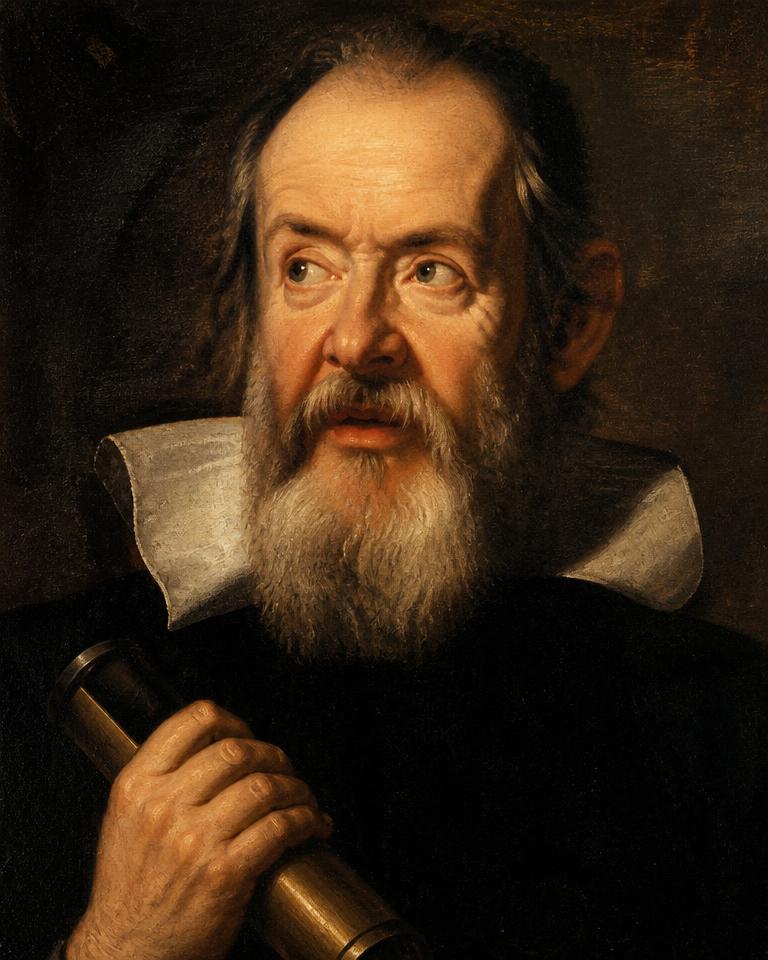
Quick Facts
- Years
- 1564 – 1642
- Category
- Scientists & Inventors
- Subcategory
- Astronomy
- Nationality
- Italian
- Occupation
- Astronomer & Physicist
Galileo Galilei
1564 – 1642 · Italian · Astronomer & Physicist
Audiobook

Life Lessons from Galileo Galilei
Marcus Alden · 1 hr
Galileo Galilei was an Italian astronomer, physicist, mathematician, engineer, and author whose work helped transform the study of nature. Born in Pisa in 1564, he used carefully designed experiments, mathematical analysis, and newly improved telescopes to challenge long-established ideas about motion and the heavens.
His telescopic observations revealed mountains on the Moon, numerous previously unseen stars, four moons orbiting Jupiter, the phases of Venus, and puzzling features around Saturn. These discoveries weakened the traditional Aristotelian-Ptolemaic picture of a perfect, Earth-centered cosmos and strengthened the case for Nicolaus Copernicus's heliocentric system. In physics, Galileo's studies of falling bodies, acceleration, inertia, and projectile motion laid foundations on which later scientists, especially Isaac Newton, built.
Galileo is also remembered for his conflict with Roman Catholic authorities. After publishing Dialogue Concerning the Two Chief World Systems, he was tried by the Roman Inquisition in 1633, compelled to abjure heliocentrism, and kept under house arrest. The episode remains central to discussions of evidence, authority, censorship, and the relationship between science and religion. Yet Galileo was himself a Catholic who argued that Scripture and nature, properly interpreted, could not truly contradict one another. He is still studied because his achievements, errors, rhetoric, and controversies illuminate the emergence of modern science.
Quick Facts
| Field | Details |
|---|---|
| Full Name | Galileo di Vincenzo Bonaiuti de' Galilei |
| Common Name(s) | Galileo Galilei; Galileo |
| Born | 15 February 1564 |
| Died | 8 January 1642 |
| Age at Death | 77 |
| Birthplace | Pisa, Duchy of Florence |
| Nationality | Italian; a subject successively of the Duchy of Florence and Grand Duchy of Tuscany |
| Occupation | Astronomer, physicist, mathematician, engineer, philosopher, author |
| Historical Era | Scientific Revolution; late Renaissance and early modern Europe |
| Famous For | Telescopic astronomy, studies of motion, support for heliocentrism, conflict with the Roman Inquisition |
| Political Affiliation if applicable | None in the modern partisan sense; patronized by the Medici court of Tuscany |
| Religion if significant | Roman Catholic |
| Education | University of Pisa, 1581–1585; left without a degree |
| Parents | Vincenzo Galilei and Giulia Ammannati |
| Spouse(s) | Never married |
| Children | Virginia, Livia, and Vincenzo, with Marina Gamba |
| Major Works | Sidereus Nuncius; Letters on Sunspots; The Assayer; Dialogue Concerning the Two Chief World Systems; Two New Sciences |
| Major Achievements | Improved astronomical use of the telescope; discovered Jupiter's four largest moons; observed Venus's phases and lunar topography; developed mathematical laws of motion; advanced experimental science |
Early Life
Galileo was born in Pisa to Vincenzo Galilei, a musician, music theorist, and wool trader, and Giulia Ammannati. The family belonged to the educated Florentine class but experienced recurring financial pressures. Vincenzo's investigations of musical strings linked measurable quantities—such as length and tension—to pitch. Historians often regard this combination of experiment, mathematics, and skepticism toward inherited authority as an important influence on his son.
The family moved to Florence during Galileo's childhood. He was educated for a time at the monastery of Vallombrosa, where he considered a religious vocation. Vincenzo instead directed him toward medicine, a more lucrative profession. Galileo entered the University of Pisa in 1581 but became increasingly absorbed in mathematics and natural philosophy.
A formative teacher was Ostilio Ricci, a mathematician associated with the Tuscan court, who introduced Galileo to Euclidean geometry and applied mathematics. Galileo left Pisa in 1585 without a degree and supported himself through private teaching. His early work included studies of hydrostatic balance and the centers of gravity of solids.
He grew up amid a revival of ancient learning and energetic debate about Aristotle. European universities still taught an Earth-centered cosmology derived from Aristotle and Ptolemy, while Copernicus's 1543 heliocentric model had proposed that Earth rotates and travels around the Sun. The calendar reform of 1582, new oceanic voyages, military engineering, and practical mechanics all encouraged more precise measurement of nature.
Rise to Prominence
Galileo's mathematical talent earned him the mathematics chair at Pisa in 1589. There he investigated motion and questioned Aristotelian claims that heavier objects fall proportionally faster than lighter ones. The famous story that he dropped weights from the Leaning Tower of Pisa appeared in a later biography by his pupil Vincenzo Viviani; it may preserve a real demonstration, but contemporary confirmation is lacking.
In 1592 Galileo became professor of mathematics at the University of Padua in the Venetian Republic. His eighteen years there were exceptionally productive. He taught geometry, astronomy, mechanics, and military engineering, gave private lessons, and designed practical instruments. His geometric and military compass brought both income and a priority dispute with Baldassarre Capra.
Galileo learned in 1609 that a Dutch optical instrument made distant objects appear nearer. Without having seen the original, he constructed increasingly powerful telescopes and demonstrated them to Venetian officials. The device had military and commercial value, but Galileo turned it toward the sky.
In 1610 he published Sidereus Nuncius (Starry Messenger). Its reports of an irregular lunar surface, innumerable stars, and four bodies circling Jupiter made him famous across Europe. He named the Jovian moons the “Medicean Stars” to honor Cosimo II de' Medici and secured appointment as chief mathematician and philosopher to the Tuscan grand duke. The move brought prestige and freedom from routine teaching, but it placed him closer to Rome and its theological controversies.
Major Achievements
Transforming Telescopic Astronomy
Galileo did not invent the telescope, but he greatly improved its magnification and made it a systematic scientific instrument. In late 1609 and early 1610, he observed shadows and illuminated peaks on the Moon and inferred that it had mountains and valleys. This contradicted the common Aristotelian image of perfectly smooth celestial bodies.
He also saw that the Milky Way consisted of immense numbers of faint stars. The finding expanded the visible universe and demonstrated that unaided sight did not set the limits of natural knowledge. His published drawings, measurements, and repeated observations helped persuade scholars, although early telescopes produced distortions that initially fueled skepticism.
Discovering the Moons of Jupiter
In January 1610 Galileo observed three, then four, small lights changing position near Jupiter. Continued observation showed that they orbited the planet. Now called Io, Europa, Ganymede, and Callisto, they are known collectively as the Galilean moons.
Their existence proved that not every celestial body revolved directly around Earth. This did not by itself prove heliocentrism—geoheliocentric systems could accommodate them—but it dismantled a major objection to Copernicus and provided a visible model of a moving center with orbiting companions.
Observing the Phases of Venus
Later in 1610 Galileo observed Venus displaying a complete sequence of phases and changes in apparent size. The traditional Ptolemaic system could not account for the full set because it kept Venus's orbit between Earth and the Sun.
The observations established that Venus circles the Sun. They decisively refuted the standard Ptolemaic arrangement, although they did not distinguish Copernicus's system from Tycho Brahe's geoheliocentric model, in which the planets orbited the Sun while the Sun orbited a stationary Earth. Galileo often treated the evidence as more conclusive for terrestrial motion than many contemporaries believed it was.
Sunspots and a Changing Heaven
Galileo studied sunspots telescopically and argued that they were features on or close to the Sun rather than small planets passing in front of it. Their motion revealed solar rotation, while their appearance and disappearance challenged the doctrine of celestial incorruptibility.
His published dispute with Jesuit astronomer Christoph Scheiner involved both interpretation and priority. Scheiner later accepted that the spots were associated with the Sun. The controversy illustrates Galileo's observational skill but also his tendency to turn disagreements into personal contests.
Establishing a Mathematical Science of Motion
Galileo's deepest long-term contribution was his analysis of motion. Through inclined-plane experiments and mathematical reasoning, he concluded that bodies undergoing uniform acceleration acquire speed in proportion to elapsed time and travel distances proportional to the square of time.
He argued that, neglecting resistance, bodies of different weights share the same gravitational acceleration. He also analyzed projectile motion as the combination of uniform horizontal movement and accelerated vertical fall, producing a parabolic path under idealized conditions. These results appeared in mature form in Two New Sciences in 1638.
Advancing Inertia and Relativity
Galileo did not formulate Newton's first law exactly, but he moved physics toward the principle of inertia. He recognized that horizontal motion would persist without resistance and used idealization to separate fundamental motion from friction.
His ship argument explained that experiments conducted below deck cannot reveal whether a vessel is stationary or moving uniformly. Flies, dripping water, thrown objects, and jumping passengers behave the same in either case. This principle of Galilean relativity answered a common objection to Earth's motion and remains foundational in classical mechanics.
Promoting Experiment, Measurement, and Mathematical Argument
Galileo combined observation, instrument making, controlled experiments, idealized thought experiments, and geometry. He did not single-handedly invent “the scientific method,” and many predecessors and contemporaries shared these practices. His distinctive achievement was to unite them powerfully and present mathematics as the language in which natural processes could be understood.
This approach influenced Christiaan Huygens, Evangelista Torricelli, Isaac Newton, and later physics. It also demonstrated that instruments could reveal genuine features of nature rather than merely extend ordinary craft knowledge.
Leadership and Work
Galileo led through intellectual confidence, technical skill, teaching, and persuasion rather than through a large formal institution. At Padua he maintained a workshop-like household in which instrument makers, pupils, servants, and visitors participated in his work. Students valued his lively lectures and practical demonstrations.
His decisions joined scientific aims to patronage. Naming Jupiter's moons for the Medici family was a strategic act that helped secure a court position. He cultivated influential correspondents, sought endorsements from respected astronomers, and wrote important works in Italian as well as Latin, widening his audience.
His strengths included extraordinary observational persistence, geometrical imagination, mechanical ingenuity, and forceful prose. He repeatedly checked changing celestial configurations rather than relying on isolated sightings. He also understood how diagrams, analogies, and dialogue could make difficult arguments compelling.
The same confidence could become combative. He sometimes mocked opponents, overstated what his evidence established, and underestimated institutional risks. In the Dialogue, the defender of traditional cosmology is named Simplicio. Although the name came from an ancient commentator, readers could hear “simpleton,” and Pope Urban VIII believed an argument he had supplied was placed insultingly in Simplicio's mouth. Galileo's rhetorical brilliance therefore advanced his ideas while worsening conflicts.
Personal Life
Galileo never married. During his years in Padua, he had a long relationship with Marina Gamba. They had three children: Virginia, born in 1600; Livia, born in 1601; and Vincenzo, born in 1606. The daughters were legally illegitimate and entered the convent of San Matteo at Arcetri, where Virginia became Sister Maria Celeste and Livia became Sister Arcangela.
Maria Celeste maintained an affectionate correspondence with her father. Her surviving letters reveal that she prepared food and medicines for him, repaired clothing, managed requests, and worried about his health and legal ordeal. She died in 1634, a loss that deeply affected him. Galileo later obtained legal recognition for his son Vincenzo, who married and continued the family line.
Galileo enjoyed music, literature, poetry, food, wine, and conversation. He inherited musical training from his father and played the lute. His writing shows admiration for Ariosto and a keen sense of satire. Friends and associates included Benedetto Castelli, Federico Cesi, Filippo Salviati, and the younger scientists Torricelli and Viviani.
He experienced recurring illnesses, including fever, pain, and digestive complaints. His eyesight deteriorated severely, probably from eye disease rather than telescope use, and he was completely blind by 1638. Even under house arrest and in blindness, he continued discussing mechanics with pupils and correspondents.
Philosophy and Beliefs
Galileo was a practicing Catholic, not an atheist secretly opposing religion. He believed that nature was orderly and mathematically intelligible because it was God's creation. In The Assayer, he famously described the universe as a book written in mathematical language.
His letters on Scripture argued that the Bible teaches the path to salvation rather than technical astronomy. When physical demonstration establishes a natural fact, he maintained, interpreters should avoid readings of Scripture that contradict it. This approach drew on Catholic thinkers, including Augustine, who had warned against careless claims about nature made in the name of biblical interpretation.
Politically, Galileo operated within courts and patronage networks rather than modern democratic institutions. He sought Medici favor and respected hierarchy, yet he fiercely defended expert judgment in natural philosophy. His worldview combined deference to religious truth with resistance to imposing non-demonstrative theological interpretations on physical inquiry.
He valued mathematical proof highly, sometimes more highly than the incomplete evidence available to him justified. His proposed physical argument from ocean tides for Earth's motion was wrong: tides are primarily produced by the gravitational influence of the Moon and Sun. This error shows both his commitment to mechanical explanation and his reluctance to accept alternatives he considered occult or insufficiently physical.
Challenges and Controversies
Galileo's support for heliocentrism generated increasing opposition after 1610. Some objections were empirical rather than theological: observers had not detected annual stellar parallax, and contemporary physics struggled to explain why objects were not thrown from a rotating Earth. Tycho Brahe's geoheliocentric model fit much of the same observational evidence without moving Earth.
In 1616, consultants to the Roman Inquisition judged the proposition that the Sun is stationary at the center of the world philosophically absurd and formally heretical, and Earth's motion at least erroneous in faith. Cardinal Robert Bellarmine instructed Galileo not to hold or defend Copernicanism. A disputed documentary issue concerns whether he was also formally ordered not to teach it “in any way.” Galileo complied publicly for several years.
After Cardinal Maffeo Barberini became Pope Urban VIII, Galileo believed circumstances had improved. He received permission to discuss competing cosmologies hypothetically and published the Dialogue in 1632. The work strongly favored Copernican arguments despite its nominal balance.
Summoned to Rome, Galileo was tried in 1633. The tribunal concluded that he had violated the 1616 injunction and found him “vehemently suspected of heresy.” Under threat of punishment—and after formal examination that included a threat of torture, though there is no evidence that torture was inflicted—he abjured heliocentrism. His book was prohibited, and his prison sentence was commuted to house arrest.
The trial is sometimes simplified as science versus religion. That description captures a genuine clash between inquiry and ecclesiastical authority, but it omits political, personal, legal, and scientific complexities. Catholic astronomers had verified many of Galileo's observations; Jesuits contributed substantially to astronomy; and heliocentric proof was not then complete. Nevertheless, Church authorities suppressed a scientifically fruitful position and punished Galileo for advocating it.
The phrase “And yet it moves,” supposedly uttered after his abjuration, lacks contemporary evidence and is generally treated as legendary. Galileo also erred scientifically, most notably about tides, and his disputes with Scheiner and Capra reveal a strong concern for priority. Recognizing these faults does not diminish the importance of his discoveries; it presents him as a historically real, fallible investigator.
Legacy
Galileo's mechanics supplied essential foundations for Newton's synthesis of motion and gravitation. His astronomical observations changed what counted as credible evidence about the heavens, while his use of instruments, experiments, and mathematics became characteristic of modern physical science. He also influenced scientific prose by addressing educated readers in clear, vigorous Italian.
His trial became a lasting symbol of the danger posed when institutions enforce conclusions about nature through censorship. In 1822, Roman authorities formally permitted publication of books treating Earth's motion as physical fact. In 1992, Pope John Paul II acknowledged errors by Church officials involved in the Galileo case, following a long study by a papal commission. The statement did not erase the historical judgment or make Galileo infallible; it recognized a serious institutional failure.
Galileo's remains are housed in a monumental tomb in Florence's Basilica of Santa Croce, opposite Michelangelo's tomb. The Museo Galileo in Florence preserves instruments associated with him and the history of science. NASA's Galileo spacecraft, launched in 1989, studied Jupiter and its moons, while the European global navigation system Galileo bears his name. Lunar and Martian craters, asteroid 697 Galilea, schools, statues, research institutes, and scientific awards also commemorate him.
Modern researchers continue to study his notebooks, experiments, diagrams, correspondence, family relationships, and trial records. Galileo endures not as a flawless lone genius but as a central figure in the collaborative, contentious, and unfinished development of scientific knowledge.
Interesting Facts
- Galileo was born three days before Michelangelo died.
- He entered university intending to study medicine but left without a degree.
- His father, Vincenzo, conducted experiments connecting musical pitch with string properties.
- Galileo improved the telescope but did not invent it.
- He first observed Jupiter's four largest moons in January 1610.
- He initially named those moons the “Medicean Stars.”
- Johannes Kepler quickly supported Galileo's telescopic discoveries.
- The word “telescope” was coined in 1611, after Galileo's first astronomical observations.
- Galileo belonged to Federico Cesi's Accademia dei Lincei, or Academy of the Lynxes.
- His observations of Venus disproved the conventional Ptolemaic arrangement.
- He observed Saturn's rings but could not identify their true form with his telescope.
- He designed a thermoscope, an early ancestor of the thermometer.
- He marketed a geometric and military compass used for calculation.
- His daughter Maria Celeste's letters survive; Galileo's replies to her are lost.
- His 1632 Dialogue was written as a conversation among three speakers.
- He completed Two New Sciences while under house arrest.
- The book was printed in Leiden because publication was prohibited in territories subject to Roman censorship.
- Galileo became completely blind late in life.
- Torricelli and Viviani worked with him during his final period.
- The first spacecraft to orbit Jupiter was named Galileo.
Famous Quotes
- “The universe cannot be read until we have learned the language and become familiar with the characters in which it is written.” — From The Assayer (1623). Galileo continues that the language is mathematical, summarizing his conviction that geometry is essential to physics.
- “Philosophy is written in this grand book—I mean the universe—which stands continually open to our gaze.” — The Assayer. Here “philosophy” means natural philosophy, the early modern study of nature.
- “In questions of science, the authority of a thousand is not worth the humble reasoning of a single individual.” — Commonly attributed to Galileo, but its exact wording and source are uncertain; it should be treated as disputed.
- “I do not feel obliged to believe that the same God who has endowed us with senses, reason, and intellect has intended us to forgo their use.” — From the 1615 letter to Grand Duchess Christina. Galileo was defending reasoned interpretation of nature and Scripture.
- “The intention of the Holy Ghost is to teach us how one goes to heaven, not how heaven goes.” — Quoted by Galileo in the letter to Christina and attributed there to Cardinal Cesare Baronio. Galileo popularized the line but did not originate it.
- “Holy Scripture and nature are both emanations from the divine Word.” — Letter to Grand Duchess Christina. The statement expresses his belief that genuine natural knowledge and correctly interpreted revelation cannot conflict.
- “In my studies of astronomy and philosophy I hold this opinion about the universe, that the Sun remains fixed in the center...” — From Galileo's 1633 abjuration, where he recited the position he was required to renounce; its context is judicial coercion, not free affirmation.
- “And yet it moves.” — Traditionally said to have been whispered after the abjuration. No contemporary evidence supports the story; it is a disputed, probably legendary attribution.
- “Measure what is measurable, and make measurable what is not so.” — Frequently attributed to Galileo, but no secure source in his writings has been established; disputed.
- “You cannot teach a man anything; you can only help him find it within himself.” — Widely credited to Galileo online, but the attribution is unsupported and should not be treated as authentic.
Timeline
- 1564 — Galileo is born in Pisa on 15 February.
- 1570s — The Galilei family relocates to Florence; Galileo studies at Vallombrosa.
- 1581 — He enrolls at the University of Pisa to study medicine.
- 1585 — He leaves the university without a degree and pursues mathematics.
- 1586 — He writes on the hydrostatic balance.
- 1589 — He becomes professor of mathematics at Pisa.
- 1592 — He accepts the mathematics chair at Padua.
- 1597 — In correspondence with Kepler, he indicates sympathy for Copernicanism.
- 1600 — His daughter Virginia, later Sister Maria Celeste, is born.
- 1601 — His daughter Livia is born.
- 1606 — His son Vincenzo is born; Galileo publishes instructions for his calculating compass.
- 1609 — He constructs improved telescopes and begins astronomical observations.
- 1610 — He discovers Jupiter's four large moons, publishes Sidereus Nuncius, observes Venus's phases, and enters Medici service.
- 1611 — He visits Rome, receives recognition from Jesuit astronomers, and joins the Accademia dei Lincei.
- 1612–1613 — His sunspot observations and dispute with Christoph Scheiner appear in print.
- 1613 — He writes to Benedetto Castelli on Scripture and science.
- 1615 — He expands his argument in the letter to Grand Duchess Christina.
- 1616 — Copernican propositions are condemned; Bellarmine admonishes Galileo.
- 1623 — Maffeo Barberini becomes Pope Urban VIII; Galileo publishes The Assayer.
- 1632 — Dialogue Concerning the Two Chief World Systems is published.
- 1633 — Galileo is tried, forced to abjure, and sentenced to house arrest.
- 1634 — Maria Celeste dies.
- 1638 — Two New Sciences is published in Leiden; Galileo is blind.
- 1641 — Torricelli joins Galileo during his final months.
- 1642 — Galileo dies at Arcetri on 8 January.
- 1737 — His remains are transferred to a monumental tomb in Santa Croce.
- 1822 — Roman authorities permit publication of works treating Earth's motion as fact.
- 1992 — Pope John Paul II publicly acknowledges errors in the Church's handling of Galileo's case.
Frequently Asked Questions
Who was Galileo Galilei?
Galileo was an Italian mathematician, astronomer, physicist, engineer, and writer active during the Scientific Revolution. He used telescopes to examine the Moon, stars, planets, and Sun, and he developed mathematical accounts of falling bodies and projectiles. His advocacy of Copernican heliocentrism brought him into conflict with the Roman Inquisition. His importance rests not on one discovery alone but on his powerful combination of observation, experiment, instrumentation, idealization, and mathematics.
Did Galileo invent the telescope?
No. The earliest known telescope patents and demonstrations appeared in the Netherlands in 1608, associated with spectacle makers including Hans Lippershey. Galileo heard reports of the device in 1609 and constructed his own versions without seeing the Dutch instrument. He improved magnification and optical performance, demonstrated its practical value, and pioneered its systematic use in astronomy. His achievement was therefore not invention but rapid improvement, scientific application, interpretation, and publication of telescopic evidence.
What did Galileo discover?
His best-known discoveries include Jupiter's four largest moons, the mountainous character of the Moon, vast numbers of stars invisible to the naked eye, the full phases of Venus, and evidence that sunspots belong to or lie close to the rotating Sun. He also saw Saturn's unusual appearance, although he could not resolve its rings correctly. In physics, he established mathematical relationships governing uniformly accelerated motion and clarified projectile motion, inertia, and relative motion.
Did Galileo prove that Earth orbits the Sun?
Not conclusively by seventeenth-century standards. The phases of Venus disproved the traditional Ptolemaic system, and Jupiter's moons showed that Earth was not the center of every celestial motion. Yet Tycho Brahe's geoheliocentric model explained these observations while keeping Earth stationary. Direct detection of stellar parallax came much later, and Galileo's tidal proof was incorrect. His evidence made heliocentrism increasingly compelling and physically plausible, but “proof” emerged cumulatively through later astronomy and mechanics.
Why did the Catholic Church oppose Galileo?
The conflict involved biblical interpretation, institutional authority, legal procedure, personality, and unresolved science. Certain scriptural passages had traditionally been read as implying a stationary Earth, while heliocentrism lacked decisive physical proof in 1616. Church officials prohibited holding or defending it as fact. Galileo's 1632 Dialogue appeared to violate that restriction and offended Pope Urban VIII. These complexities do not excuse the trial: the Inquisition used coercive authority to silence a productive scientific position.
Was Galileo tortured?
There is no evidence that Galileo was physically tortured. During his 1633 interrogation, he was formally threatened with torture according to inquisitorial procedure. He was elderly and ill, and the threat occurred within a coercive trial that could impose severe penalties. Historians distinguish carefully between being threatened with torture and undergoing it. Galileo ultimately abjured heliocentrism and received a prison sentence that was quickly commuted to restricted residence and then house arrest.
Did Galileo say “And yet it moves”?
Probably not. The phrase—usually given in Italian as Eppur si muove—is said to have been uttered after Galileo renounced Earth's motion in 1633. It does not appear in contemporary trial records, letters, or early reliable accounts. The story became prominent much later. It captures Galileo's eventual symbolic role as a defender of scientific truth, but historians generally classify it as an unsupported legend rather than a documented statement.
Was Galileo imprisoned in a dungeon?
No. He was detained and interrogated in Rome, but he was not left in a dungeon. After sentencing, he stayed first under the supervision of Archbishop Ascanio Piccolomini in Siena and then at his villa near Arcetri outside Florence. House arrest restricted movement, visitors, teaching, and publication, making it a serious punishment. Nevertheless, he retained servants, received selected pupils, corresponded, and completed his major work on mechanics.
What is Sidereus Nuncius?
Sidereus Nuncius, usually translated as Starry Messenger, is Galileo's short Latin book published in Venice in March 1610. It announced telescopic observations of lunar mountains, previously invisible stars, the stellar composition of the Milky Way, and four satellites of Jupiter. The book rapidly made Galileo internationally famous. Its claims were initially controversial because telescopes were unfamiliar and optically imperfect, but independent observations soon confirmed the Jovian moons and much of his report.
What are the Galilean moons?
The Galilean moons are Jupiter's four largest satellites: Io, Europa, Ganymede, and Callisto. Galileo first recorded them in January 1610, although Simon Marius independently observed them at about the same time and supplied the names later adopted. Their motion around Jupiter showed that a center of revolution could itself move and that not all celestial bodies circled Earth. Today these worlds are major targets in planetary science, especially because Europa may contain a subsurface ocean.
What did Galileo contribute to physics?
Galileo established that uniformly accelerated fall follows mathematical rules: speed increases with time, while distance grows with the square of time. He showed that weight does not determine gravitational acceleration in the simple Aristotelian manner, analyzed ideal projectile paths as parabolas, and developed concepts approaching inertia. His principle of relativity stated that uniform motion cannot be detected through ordinary mechanical experiments inside a closed system. Newton later incorporated and extended these insights.
Did Galileo drop objects from the Leaning Tower of Pisa?
The experiment may have occurred, but the evidence is uncertain. Vincenzo Viviani, Galileo's pupil and first biographer, reported decades later that Galileo dropped unequal weights from the tower to challenge Aristotle. No contemporary record securely confirms it. Galileo certainly analyzed falling bodies and may have performed public demonstrations, but his most informative experiments used inclined planes to slow acceleration enough for available timing methods. Historians therefore present the tower episode as possible, not established fact.
What was Galileo's biggest scientific mistake?
His theory of tides was his most consequential error. Galileo argued that tides arose from the combined rotation and orbital motion of Earth, and he regarded them as physical evidence for heliocentrism. The theory did not correctly explain daily tidal timing or the Moon's clear connection to tides. Johannes Kepler proposed lunar influence, which Galileo dismissed. Newtonian gravitation later explained tides principally through the differential gravitational forces of the Moon and Sun.
Was Galileo religious?
Yes. Galileo was baptized, lived as a Catholic, and placed both daughters in a convent, partly because their illegitimate status made suitable marriages difficult and expensive. He believed nature and Scripture came from God and therefore could not genuinely contradict each other. His disagreement concerned how biblical passages about nature should be interpreted and who could decide. Describing him simply as anti-religious misrepresents both his own statements and the complex Catholic intellectual world around him.
Why did Galileo write in Italian?
Latin remained the international language of scholarship, and Galileo used it in works such as Sidereus Nuncius. He also wrote major texts in Tuscan Italian to reach courtly, technical, and educated lay audiences beyond universities. The choice strengthened his influence on Italian prose and enabled public debate about natural philosophy. It was also strategic: dialogue and wit worked especially effectively in the vernacular, though a wider readership could increase political and theological exposure.
How did Galileo become blind?
Galileo's sight deteriorated during the 1630s, and by 1638 he was completely blind. Surviving descriptions suggest eye disease, often identified by historians as cataracts and glaucoma, though retrospective diagnosis cannot be certain. A popular claim says telescope observations blinded him, but ordinary viewing of planets and stars would not explain the condition. He did observe the Sun, generally through safer projection methods in his systematic studies. Blindness did not stop him from dictating and discussing scientific work.
What was Two New Sciences about?
Published in Leiden in 1638, Discourses and Mathematical Demonstrations Relating to Two New Sciences presented Galileo's mature studies of the strength of materials and motion. Written as a dialogue, it addressed scaling, structural failure, falling bodies, accelerated motion, projectile trajectories, and related problems. Because Galileo was under censorship, the book was published outside Italy. It became his most important contribution to physics and a major source for later investigators, including Huygens and Newton.
How did Galileo die?
Galileo died at his villa in Arcetri near Florence on 8 January 1642, after illness involving fever and heart palpitations, as reported by contemporaries. He was 77 and remained under house arrest. Church authorities initially prevented the grand public memorial desired by the Medici. He was buried in Santa Croce, and in 1737 his remains were moved to the elaborate tomb now visible there.
Lessons We Can Learn
- Test inherited claims. Galileo questioned Aristotelian motion through analysis and experiment. Respect for tradition should not replace verification.
- Improve the tool as well as the theory. His telescopic advances opened phenomena that unaided vision could not reach. Better instruments often create better questions.
- Repeat observations. He tracked Jupiter's moons night after night before identifying their orbits. Patterns require sustained evidence.
- Use mathematics to clarify ideas. Galileo converted vague claims about speed into measurable relationships. Quantification can expose hidden assumptions.
- Distinguish evidence from overclaiming. Venus's phases refuted Ptolemy but did not alone prove Copernicus. Modern researchers should state exactly what data establish.
- Communicate clearly. Galileo's dialogues and vernacular prose broadened scientific discussion. Expertise has greater public value when it is intelligible.
- Do not let rhetoric defeat strategy. His mockery of opponents and presentation of Simplicio worsened political danger. Winning an argument requires understanding audiences and institutions.
- Admit the possibility of error. Galileo clung to an incorrect tidal theory and dismissed Kepler's lunar insight. Great ability does not eliminate confirmation bias.
- Continue under constraint. During house arrest and failing health, he completed Two New Sciences. Difficult conditions need not end meaningful work.
- Protect intellectual inquiry while recognizing complexity. The trial involved more than a simple science-versus-religion story, yet coercive censorship clearly harmed knowledge. Institutions should permit evidence-based revision.
Related Historical Figures
- Nicolaus Copernicus — Proposed the heliocentric system that Galileo defended and sought to support physically.
- Johannes Kepler — Supported Galileo's telescopic reports and developed elliptical planetary laws that Galileo did not fully embrace.
- Tycho Brahe — Created the leading geoheliocentric alternative that explained much of Galileo's astronomical evidence without a moving Earth.
- Isaac Newton — Built upon Galilean motion to formulate laws of mechanics and universal gravitation.
- Christoph Scheiner — Jesuit astronomer who disputed Galileo over sunspots, their interpretation, and priority.
- Robert Bellarmine — Cardinal who admonished Galileo in 1616 and articulated the Church's demand for demonstration before reinterpreting Scripture.
- Pope Urban VIII — Former admirer whose relationship with Galileo deteriorated around the publication and trial of the Dialogue.
- Federico Cesi — Founder of the Accademia dei Lincei, patron, friend, and publisher who supported Galileo's work.
- Maria Celeste — Galileo's daughter and devoted correspondent, whose letters provide an intimate record of his household and difficulties.
- Evangelista Torricelli — Physicist and mathematician influenced by Galileo who assisted him near the end of his life and later invented the mercury barometer.
Watch and Learn
Galileo Galilei - in a nutshell · Kurzgesagt – In a Nutshell
Related Historical Figures