Quick Facts
- Years
- 1162 – 1227
- Category
- World Leaders & Revolutionaries
- Nationality
- Mongol
- Occupation
- Founder and Great Khan of the Mongol Empire
Genghis Khan
1162 – 1227 · Mongol · Founder and Great Khan of the Mongol Empire
Recommended Audiobooks
Listen next from Marcus Alden

Life Lessons from Simon Bolivar
Marcus Alden · 55 min

Life Lessons from George Washington
Marcus Alden · 54 min
Genghis Khan rose from a childhood of abandonment, hunger and tribal conflict to create the largest contiguous land empire in history. Born Temüjin on the Mongolian steppe, he united rival peoples under a new political order and was proclaimed universal ruler in 1206. His armies then conquered territories from northern China to Central Asia, transforming the balance of power across Eurasia.
His achievements cannot be separated from their human cost. Mongol campaigns destroyed cities, displaced populations and killed vast numbers of people. Medieval estimates are often exaggerated or impossible to verify, but the violence was unquestionably immense. At the same time, the empire established by Genghis Khan promoted long-distance trade, protected diplomatic envoys, recruited talent across ethnic and religious lines, and connected regions that had previously interacted only unevenly.
Much about his life remains uncertain. The principal Mongol narrative, The Secret History of the Mongols, combines valuable historical memory with literary storytelling, while Persian and Chinese chroniclers wrote from different political perspectives. Modern scholars therefore compare sources rather than accepting any one account uncritically.
Genghis Khan is still studied because he was simultaneously a nation-builder, military innovator and ruthless conqueror. His career raises enduring questions about leadership, state formation, cultural exchange and the terrible price of imperial expansion.
Quick Facts
| Field | Details |
|---|---|
| Full Name | Temüjin, later titled Chinggis Khan |
| Common Name(s) | Genghis Khan; Chinggis Khan; Činggis Qan |
| Born | Traditionally 1162; 1155 and 1167 have also been proposed |
| Died | August 1227 |
| Age at Death | About 65 if the traditional birth year is accepted |
| Birthplace | Delüün Boldog, near the Onon River, in present-day Mongolia; exact site disputed |
| Nationality | Mongol |
| Occupation | Warrior, political unifier, conqueror and Great Khan |
| Historical Era | High Middle Ages; formation of the Mongol Empire |
| Famous For | Uniting the Mongols and founding the largest contiguous land empire in history |
| Political Affiliation | Founder and ruler of the Mongol Empire |
| Religion | Traditional Mongol beliefs centered on Eternal Heaven, with broad religious tolerance |
| Education | No known formal schooling; trained in steppe survival, warfare, diplomacy and customary law |
| Parents | Yesügei and Hö’elün |
| Spouse(s) | Börte was the principal wife; other wives included Yesügen and Yesüi, among others |
| Children | Four recognized sons by Börte—Jochi, Chagatai, Ögedei and Tolui—and several daughters; additional children are reported |
| Major Works | No authored book; associated with imperial decrees and the disputed legal tradition called the Great Yasa |
| Major Achievements | Unified the Mongol tribes, founded the empire, reformed the army, conquered the Jin and Khwarazmian territories, and expanded Eurasian communications |
Early Life
Temüjin was born into the Borjigin lineage, probably in 1162. His father, Yesügei, was a minor Mongol leader. His mother, Hö’elün, had been abducted from another man by Yesügei, a reminder that marriage, alliance and violence were closely intertwined on the twelfth-century steppe.
According to The Secret History, Temüjin received his name after his father captured a Tatar warrior called Temüjin-üge. The source also describes him as born holding a clot of blood, a literary sign of future greatness rather than a verifiable medical fact.
When Temüjin was still a boy, Yesügei arranged his betrothal to Börte of the Onggirat people. On the return journey, Tatars allegedly poisoned Yesügei. His followers then abandoned Hö’elün and her children, leaving them without the livestock and protection essential to steppe life.
The family survived by gathering roots and berries, fishing and hunting small animals. During this period Temüjin killed his older half-brother Begter after a dispute over food and authority. The episode, preserved without disguise in the Mongol tradition, shows both the desperation of the family and Temüjin’s early determination to lead.
He was later captured by the Tayichi’ud but escaped, reportedly with help from a sympathetic guard named Sorqan-shira. Such experiences taught him that loyalty could cross clan boundaries. He never received formal education in the settled-world sense. His education came from migration, animal husbandry, warfare, kinship politics and the difficult art of securing followers.
Rise to Prominence
Temüjin married Börte around 1178. Soon afterward, Merkit raiders abducted her, apparently in revenge for Hö’elün’s earlier abduction. Temüjin appealed to Toghrul, ruler of the Kereit and an ally of his father, and to his childhood blood brother, or anda, Jamukha. Their combined forces recovered Börte.
Temüjin and Jamukha subsequently became rivals. Jamukha represented an older aristocratic order, while Temüjin increasingly rewarded ability and loyalty alongside noble birth. This distinction should not be overstated—Temüjin also depended on family and elite alliances—but it helped him attract ambitious followers.
After an early defeat by Jamukha, Temüjin rebuilt his coalition. He incorporated defeated peoples, distributed captured wealth and organized supporters into disciplined units. In 1201 Jamukha’s allies proclaimed him gur-khan, creating a direct challenge. Temüjin then defeated successive opponents, including the Tatars, Kereit and Naiman.
Toghrul, once his protector, became his enemy and was defeated in 1203. The Naiman ruler Tayang Khan fell in 1204. Jamukha was eventually betrayed by his own followers. The Secret History says Temüjin executed the betrayers for disloyalty and granted Jamukha the bloodless death he requested, although the exact details cannot be independently confirmed.
In 1206 an assembly called a quriltai proclaimed Temüjin “Chinggis Khan.” The title’s precise meaning remains debated; proposed interpretations include universal, oceanic or mighty ruler. This moment conventionally marks the founding of the Mongol Empire.
Major Achievements
Unification of the Mongol Steppe
Genghis Khan broke the cycle of shifting tribal confederations by creating institutions centered on the imperial household. Former rivals were redistributed among military and administrative units, reducing their ability to revive independent tribal power.
This did not erase tribal identity, but it established a more durable state. Modern Mongolia regards the unification as a foundational national event.
Military Reorganization
The army was arranged largely through a decimal system: units of roughly 10, 100, 1,000 and 10,000. Commanders were expected to maintain discipline and coordinate over long distances.
Mongol forces combined mounted archery, speed, intelligence gathering, feigned retreats and multiple converging columns. They also adopted siege engineers, gunpowder specialists and administrators from conquered societies. Their strength came not from a single invention but from organization, adaptability and reliable communication.
Conquest of the Western Xia and War with the Jin
Genghis Khan campaigned against the Tangut-led Western Xia from 1205 and forced its submission in 1209. In 1211 he invaded the Jin dynasty, which ruled northern China. Mongol forces captured Zhongdu, present-day Beijing, in 1215, although the Jin state survived until 1234 under Genghis Khan’s successors.
These wars gave the Mongols access to revenue, engineers and administrative expertise. They also caused extensive destruction and famine.
Destruction of the Khwarazmian Empire
Genghis Khan initially sought trade with the Khwarazmian Empire. In 1218 a Mongol caravan was seized at Otrar, and its members were killed. Shah Muhammad II then rejected demands for redress and reportedly killed or humiliated envoys.
The Mongol invasion of 1219–1221 shattered the Khwarazmian state. Bukhara, Samarkand, Urgench and other centers were captured. Accounts describe mass killing, although exact totals in medieval chronicles are unreliable. The campaign demonstrated exceptional strategic coordination while leaving a legacy of devastation across Central Asia and Iran.
Creation of an Imperial Communication System
Genghis Khan developed the foundations of the yam, a network of relay stations later expanded by his descendants. Authorized messengers could change horses and obtain supplies along imperial routes.
The system accelerated military orders, intelligence and diplomacy. In later generations it also supported merchants and travelers, helping connect East Asia, the Islamic world and Europe.
Government Beyond Tribal Exclusivity
The conqueror employed people from many backgrounds. The Uyghur scribe Tata-tonga helped adapt the Uyghur script for writing Mongolian, while Khitan, Chinese, Persian and other specialists served the empire.
This pragmatic use of talent allowed a pastoral ruling elite to govern cities and agricultural regions. It became a defining feature of Mongol imperial administration.
Leadership or Work
Genghis Khan led through mobility, personal relationships, rewards and severe discipline. He expected units to act collectively: desertion and disobedience could bring harsh punishment, while courage and loyalty could produce rapid advancement.
His closest military commanders included Jebe, Subutai, Muqali and Bo’orchu. Several came from modest or formerly hostile backgrounds. Jebe, according to tradition, had shot Genghis Khan’s horse before joining him. His promotion illustrates the ruler’s willingness to value useful ability over personal resentment.
Important features of his leadership included:
- Merit within limits: capable non-aristocrats could rise, although the imperial family remained supreme.
- Careful intelligence: scouts, merchants, prisoners and local allies supplied information.
- Delegation: trusted generals conducted distant campaigns with substantial independence.
- Adaptation: conquered engineers and officials were incorporated rather than automatically excluded.
- Collective punishment: communities that resisted could face destruction, a policy intended to deter future opposition.
His greatest strengths were strategic patience, coalition-building and the ability to learn. His greatest weakness—morally and politically—was reliance on terror and disproportionate retaliation. Fear accelerated surrender, but it also magnified civilian suffering and created enduring hatred.
Personal Life
Börte remained Genghis Khan’s principal wife and held exceptional status. Her abduction created controversy around the paternity of Jochi, her eldest son. Genghis Khan recognized Jochi as his child, but Chagatai openly questioned him, contributing to succession tensions.
The ruler had several wives and concubines, commonly acquired through political alliances or conquest. Such arrangements reflected elite steppe practice but also involved profound inequalities and, in many cases, coercion.
His four recognized sons by Börte became central to imperial politics. Jochi’s descendants ruled the western steppe; Chagatai’s line dominated Central Asia; Ögedei succeeded as Great Khan; and Tolui’s descendants included Möngke, Kublai and Hülegü. His daughters also mattered politically. Several married allied rulers and governed strategically important territories, though the sources provide less detail about them.
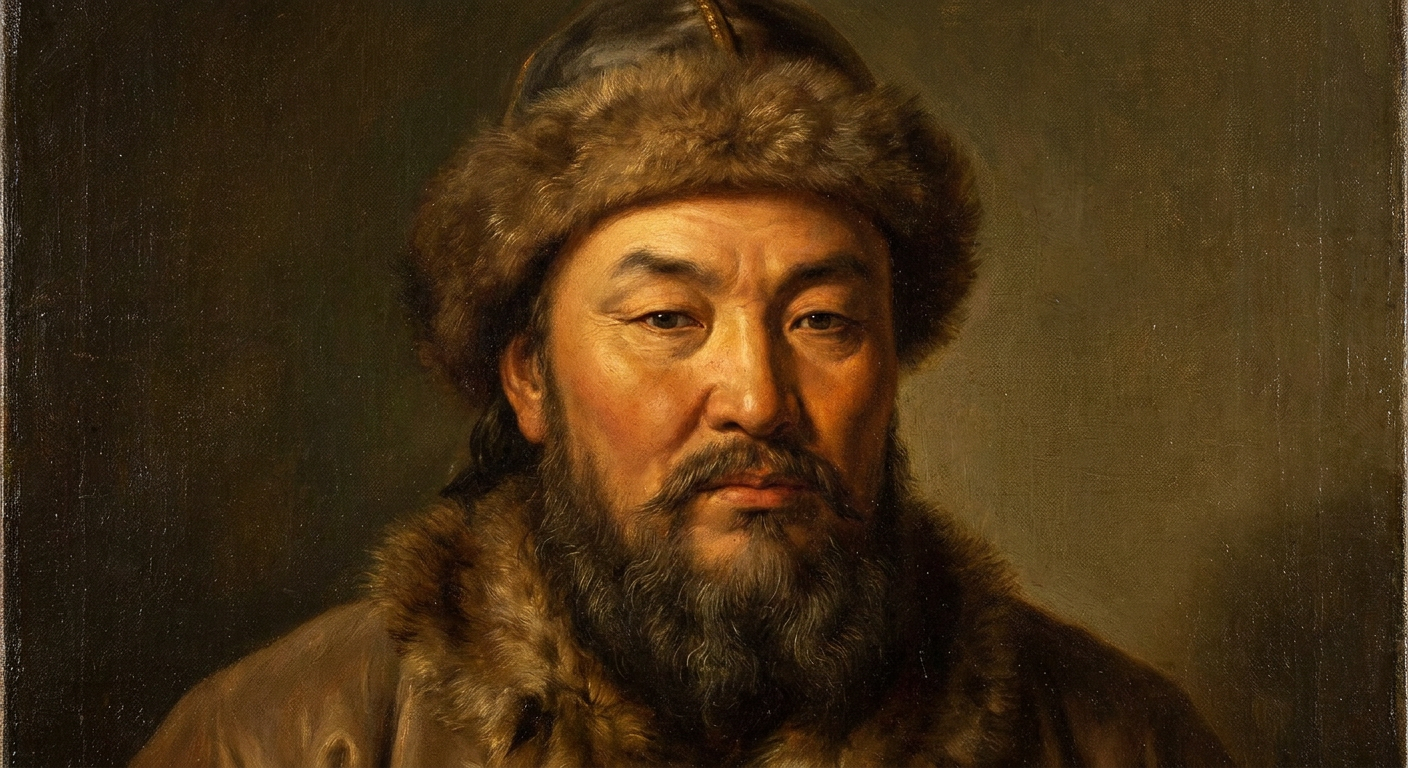
Accounts portray Genghis Khan as physically resilient, attentive to horses and hunting, and comfortable sharing campaign hardships. Reliable evidence about his appearance and private habits is limited. The familiar portraits were created after his death and should not be treated as exact likenesses.
Philosophy or Beliefs
Genghis Khan understood his authority through Tenggeri, or Eternal Heaven. Victories could be interpreted as proof that Heaven had granted him a universal mission. This belief strengthened his legitimacy but did not produce a program of compulsory religious conversion.
He generally protected religious specialists and granted privileges to Buddhist, Daoist, Muslim and Christian communities. His empire included followers of all these traditions as well as Mongol ritual practitioners. Tolerance was both practical and ideological: he sought prayers, expertise and political cooperation from many faiths.
He valued loyalty, obedience, courage and the completion of assigned duties. He condemned betrayal even when it benefited him, as stories about Jamukha’s captors illustrate. Yet his ethical boundaries applied unevenly. Loyalty within his order coexisted with extreme violence against populations judged rebellious.
The “Great Yasa” is often described as a comprehensive law code created by Genghis Khan. Sources confirm that he issued decrees and customary regulations, but no complete contemporary text survives. Scholars disagree over whether the Yasa was a fixed code, an evolving collection of rulings or a later idealization of Mongol law.
Challenges and Controversies
The central controversy is the scale and character of Mongol violence. Cities that resisted were sometimes sacked and inhabitants massacred. Terror was deliberately publicized to encourage surrender elsewhere. Although claims that tens of millions died directly under Genghis Khan cannot be demonstrated from reliable statistics, historians agree that his campaigns caused catastrophic loss of life.
Environmental and economic damage varied by region. Warfare destroyed irrigation systems and disrupted farming, but older claims that the Mongols permanently ruined every conquered area are too broad. Some cities recovered, while others declined for generations.
Genghis Khan also experienced setbacks. Jamukha defeated him early in his career, and sieges exposed the limitations of an army originally built for open terrain. His response was to recruit specialists rather than remain tied to traditional methods.
Succession presented another challenge. Conflict between Jochi and Chagatai made either an unsafe choice as heir, so Genghis Khan designated Ögedei. This compromise preserved unity temporarily, but rival branches of the family later fought civil wars.
Modern interpretations often divide between celebration and condemnation. In Mongolia he is widely honored as a unifier and symbol of independence. In parts of China, Iran, Central Asia and Eastern Europe, memories emphasize invasion and destruction. Both perspectives reflect real aspects of his historical impact, but neither should erase the other.
Legacy
Genghis Khan died before the empire reached its maximum extent. His sons and grandsons conquered the rest of the Jin realm, the Abbasid capital Baghdad, much of Russia and Eastern Europe, and all of China. The empire eventually divided into major khanates, but members of his dynasty continued to claim legitimacy for centuries.
Mongol rule intensified movement across Eurasia. Merchants, diplomats, artisans, missionaries and technologies traveled along protected routes. Historians often call the resulting period the Pax Mongolica, although “peace” is misleading if it hides conquest, rebellion and regional warfare.
In Mongolia, Genghis Khan’s name was restricted in public life during much of the socialist era because authorities feared nationalism. Since the democratic revolution of 1990, he has reemerged as a national symbol. Mongolia’s main international airport bears his name, his portrait appears on currency, and an enormous equestrian statue stands east of Ulaanbaatar.
His genetic legacy is frequently sensationalized. A 2003 study identified a widespread Y-chromosome lineage that may have expanded through the reproductive success of a powerful Mongol-era male line. It did not prove that the lineage belonged personally to Genghis Khan, whose burial remains undiscovered.
His legacy is therefore double-edged: he created institutions that connected continents, but he did so through conquest on an extraordinary and often horrifying scale.
Interesting Facts
- “Genghis Khan” is a title; his birth name was Temüjin.
- His birth year is uncertain, with 1162 the conventional choice.
- His family was abandoned after his father’s death.
- He was captured as a youth and escaped from the Tayichi’ud.
- Börte’s rescue helped launch his first major alliance.
- Jamukha was first his sworn brother and later his rival.
- The title Chinggis Khan was formally granted in 1206.
- The Mongol script was adapted from the Uyghur writing system.
- His armies regularly recruited specialists from defeated societies.
- Mounted couriers connected distant parts of the empire.
- He protected multiple religious communities without adopting their doctrines.
- He recognized Jochi despite disputes about his paternity.
- He selected Ögedei rather than his eldest son as successor.
- He met the Daoist teacher Qiu Chuji during the western campaigns.
- No verified portrait made during his lifetime survives.
- The location of his grave remains unknown.
- He died while campaigning against the Western Xia.
- The Mongol Empire became even larger after his death.
Famous Quotes
No surviving quotation can be treated like a modern transcript. Genghis Khan’s words were recorded through literary narratives, translations and later chronicles.
- “Let us be companions.” In The Secret History, Temüjin appeals to Jamukha during their early alliance. The simple phrase represents the importance of sworn loyalty, though its verbatim accuracy is unknowable.
- “How can we let live men who laid hands on their rightful lord?” The same source attributes this sentiment to Genghis Khan when Jamukha’s followers betrayed him. It expresses his condemnation of treachery.
- “I am the punishment of God.” Persian historian Juvaini associates this idea with the conquest of Bukhara. The famous wording varies by translation and may be literary shaping rather than an exact statement.
- “If you had not committed great sins, God would not have sent a punishment like me upon you.” Also reported by Juvaini in the Bukhara episode. It framed conquest as divine judgment; attribution is mediated and disputed.
- “The greatest joy for a man is to defeat his enemies.” Juvaini records a longer, harsher declaration about victory and possession. It is widely quoted but cannot be independently authenticated.
- “The strength of a wall is neither greater nor less than the courage of the men who defend it.” Commonly attributed to Genghis Khan, but no secure contemporary source establishes the familiar wording.
- “With Heaven’s aid I have conquered for you a huge empire.” Chronicles preserve versions of this succession-era statement. It links his victories to Eternal Heaven, though translations differ.
- “What medicine of immortality have you brought me?” The question is associated with his meeting with Qiu Chuji. Records suggest genuine interest in longevity, but the precise wording comes through later textual transmission.
- “My descendants will wear gold, eat rich food and ride fine horses.” Juvaini reports a warning that luxury might make later rulers forget how the empire was won. Its exact form is uncertain.
- “A man’s greatest work is to break his enemies.” This is another shortened version of Juvaini’s victory passage, not a separately verified statement.
Timeline
- c. 1162 — Temüjin is born near the Onon River.
- c. 1171 — His father dies; the family is abandoned by its followers.
- 1170s — Temüjin kills Begter, is captured by the Tayichi’ud and later escapes.
- c. 1178 — He marries Börte.
- Late 1170s or early 1180s — The Merkit abduct Börte; Temüjin and his allies rescue her.
- c. 1180s — Temüjin and Jamukha separate and become rivals.
- 1201 — Jamukha is proclaimed gur-khan by an opposing coalition.
- 1202 — Temüjin defeats the Tatars.
- 1203 — He defeats Toghrul and the Kereit.
- 1204 — The Naiman confederation is defeated.
- 1206 — A quriltai proclaims him Chinggis Khan.
- 1209 — Western Xia submits after Mongol campaigns.
- 1211 — Invasion of the Jin dynasty begins.
- 1215 — Mongol forces capture Zhongdu.
- 1218 — The Otrar caravan crisis triggers conflict with Khwarazm.
- 1219–1221 — Genghis Khan conquers the core Khwarazmian territories.
- 1221–1223 — Mongol armies pursue enemies through Afghanistan, Iran and the western steppe.
- 1222 — Genghis Khan meets Qiu Chuji.
- 1226 — Final campaign against Western Xia begins.
- August 1227 — Genghis Khan dies during the campaign.
- 1229 — Ögedei is formally installed as Great Khan.
Frequently Asked Questions
1. When was Genghis Khan born?
The conventional date is 1162, but contemporary documentation is insufficient to settle the question. Other traditions point to 1155 or 1167. Historians commonly use 1162 because it became the standard date in Mongolian and later scholarship. This uncertainty also means that his exact age at death cannot be proved. If 1162 is correct, he was approximately 65 when he died in 1227.
2. What was Genghis Khan’s real name?
His personal name was Temüjin. “Chinggis Khan,” rendered as Genghis Khan in English, was a ruling title formally associated with him at the 1206 assembly. Scholars have proposed several meanings for “Chinggis,” including universal, oceanic or fierce, but there is no complete agreement. “Khan” was a title for a ruler. Calling him Genghis Khan is therefore similar to identifying him by the sovereign title under which he became famous.
3. How did he unite the Mongols?
He combined marriage alliances, personal loyalty, military victory and institutional reform. Temüjin defeated or absorbed the Tatars, Kereit, Naiman, Merkit and other rivals. He then mixed members of different groups in military units, weakening older tribal loyalties. Promotions could reward proven service rather than ancestry alone, although noble families remained important. By redistributing followers and demanding loyalty to the imperial order, he created a confederation more centralized than earlier steppe alliances.
4. Was Genghis Khan an especially brilliant military commander?
The evidence supports that assessment, provided his success is not reduced to personal genius. He planned widely separated campaigns, delegated to talented commanders and adjusted tactics to different environments. Mongol victories also depended on disciplined troops, hardy horses, intelligence networks and expertise borrowed from conquered peoples. Generals such as Subutai, Jebe and Muqali deserve substantial credit. Genghis Khan’s distinctive achievement was building and coordinating the system in which they operated.
5. How many people did Genghis Khan kill?
No reliable total exists. Popular figures running into tens of millions are extrapolated from medieval chronicles, demographic guesses and destruction attributed to later Mongol rulers as well as Genghis Khan. Medieval writers frequently used enormous numbers rhetorically and lacked modern census methods. Nevertheless, uncertainty should not minimize the violence: massacres, siege warfare, famine and displacement caused immense mortality. Responsible historians describe the destruction clearly while avoiding a precise number unsupported by evidence.
6. Why did he invade the Khwarazmian Empire?
The immediate cause was a diplomatic and commercial crisis. Officials at Otrar seized a Mongol trading caravan and killed its members. Genghis Khan demanded punishment of the governor, but Shah Muhammad II rejected the demand and mistreated Mongol envoys. The resulting invasion was therefore retaliation, strategic expansion and a defense of diplomatic immunity at once. The Mongol response was vastly disproportionate, destroying cities and overturning the Khwarazmian state between 1219 and 1221.
7. Was Genghis Khan religiously tolerant?
He generally allowed multiple religions to operate and protected or exempted some religious specialists. Buddhists, Daoists, Muslims, Christians and practitioners of Mongol traditions served within his domains. This policy was unusually inclusive for its setting, but it should not be confused with modern religious liberty. Tolerance helped stabilize a diverse empire and encouraged clergy to pray for the ruling family. Communities could still suffer during military conquest regardless of their faith.
8. Did Genghis Khan create a written law code?
He issued rules, judgments and commands associated with the term Yasa or Jasaq. Later writers described a “Great Yasa,” sometimes presenting it as a secret and comprehensive imperial code. No complete contemporary copy survives, however. Some scholars believe it was an evolving collection of decrees and precedents rather than one written constitution. Claims about individual provisions must therefore be treated cautiously, especially when they come from sources written long after his death.
9. Who succeeded Genghis Khan?
His third recognized son, Ögedei, became Great Khan. Genghis Khan selected him as a compromise because Jochi and Chagatai were bitter rivals, while Tolui was the youngest and inherited the core homeland according to steppe custom. After Genghis Khan’s death in 1227, Tolui served as regent until the 1229 quriltai formally installed Ögedei. Under Ögedei, Mongol expansion continued into northern China, Russia, Central Europe and the Middle East.
10. How did Genghis Khan die?
He died in August 1227 during the final campaign against Western Xia. The precise cause is unknown. Later traditions mention illness, a fall from a horse, a wound or other dramatic circumstances, but none can be confirmed. Stories involving assassination by a Tangut princess are generally regarded as legend. His death was initially concealed, probably to prevent disruption of the campaign, and Western Xia was defeated soon afterward.
11. Where is Genghis Khan buried?
The burial site has never been securely identified. Tradition places it somewhere in Mongolia, possibly near the sacred Burkhan Khaldun region, but archaeological proof is absent. Stories that the funeral escort killed witnesses or diverted a river are later legends, not established facts. The tomb remains culturally sensitive, and many Mongolians oppose intrusive excavation. Satellite surveys and field studies have generated possibilities without producing a verified grave.
12. Did Genghis Khan conquer China?
He began the conquest but did not complete it. His armies forced Western Xia to submit and captured large parts of the Jin dynasty’s northern territory, including Zhongdu in 1215. The Jin survived until 1234, seven years after his death. Southern China remained under the Song dynasty until Genghis Khan’s grandson Kublai completed its conquest in 1279. Saying that Genghis Khan conquered all China therefore compresses campaigns spanning several generations.
13. Why were Mongol armies so successful?
Their advantages included mobility, disciplined mounted archery, multiple remounts, intelligence collection and coordinated columns. They could retreat deliberately, draw enemies out of formation and return at an advantageous moment. Commanders used flags, horns and messengers to control units. Just as importantly, the Mongols learned siegecraft and administration from captured specialists. Their reputation for destruction sometimes persuaded cities to surrender, allowing victories without prolonged fighting.
14. Was Genghis Khan a progressive ruler?
“Progressive” is an anachronistic and potentially misleading label. He promoted some men of humble origins, protected diverse religions and supported trade and diplomacy. Those policies can appear flexible compared with rigid aristocratic systems. Yet his government was dynastic, patriarchal and founded through violent conquest. Rather than forcing him into a modern political category, it is more accurate to recognize innovations within the values and power structures of the thirteenth-century steppe.
15. Are millions of people descended from him?
Possibly, but the popular claim is not proven. Genetic researchers identified a Y-chromosome lineage shared by many men across former Mongol territories and proposed that it spread through a powerful Mongol-era dynasty. Because Genghis Khan’s remains have not been identified, the lineage cannot be matched directly to him. It may belong to his wider clan or another successful male line. Genealogically, many more people may have him among their ancestors without carrying that specific Y chromosome.
Lessons We Can Learn
- Adaptability can outweigh tradition. Genghis Khan adopted foreign siege technology and writing systems. Modern organizations likewise benefit from learning beyond their original culture.
- Talent may come from former rivals. Jebe and other one-time enemies became trusted commanders. The evidence supports his pragmatism, though modern ideas of inclusive hiring should not be projected backward unchanged.
- Information is a strategic resource. Scouts and relay communications shaped Mongol victories. Reliable information still improves decisions in government and business.
- Shared institutions can unite divided groups. Mixed military units reduced tribal fragmentation. The broader modern lesson is that common structures can support cooperation across inherited divisions.
- Delegation multiplies leadership. Subutai, Muqali and Jebe operated far from the ruler. Effective leaders establish goals and empower capable colleagues.
- Protecting communication builds trust. The Mongols treated attacks on envoys as grave offenses. Diplomacy and secure exchange remain essential, although their retaliation against Khwarazm was catastrophically excessive.
- Fear brings obedience but carries lasting costs. Terror accelerated surrender while creating trauma and hostility. This is a warning, not a leadership recommendation.
- Succession planning matters. Choosing Ögedei prevented an immediate clash between Jochi and Chagatai, though it did not end dynastic rivalry.
- Religious flexibility can stabilize diverse societies. Genghis Khan’s pragmatic tolerance helped govern a multicultural empire. Modern pluralism rests on different principles but shares the insight that uniformity is not always necessary.
- Achievement does not erase moral responsibility. Administrative and military innovation must be examined alongside civilian suffering. Historical significance and ethical criticism can coexist.
Related Historical Figures
- Hö’elün — His mother, whose resilience held the abandoned family together.
- Börte — His principal wife and mother of his four recognized sons.
- Jamukha — His sworn brother, political rival and alternative claimant to steppe leadership.
- Toghrul — Kereit ruler who served first as protector and later as enemy.
- Jebe — Former opponent who became one of his most successful generals.
- Subutai — Strategist who helped extend Mongol warfare deep into western Eurasia.
- Ögedei Khan — His chosen successor, under whom the empire expanded further.
- Jochi — His eldest recognized son and ancestor of the rulers of the Golden Horde.
- Kublai Khan — His grandson, founder of China’s Yuan dynasty.
- Qiu Chuji — Daoist teacher summoned by Genghis Khan and questioned about government and longevity.
Watch and Learn
“The rise and fall of the Mongol Empire” — TED-Ed, written by Anne F. Broadbridge — approximately 5 minutes.
This concise animated lesson explains how Genghis Khan unified the steppe and how his descendants expanded and divided the empire. It is recommended as an accessible introduction from an established educational channel, although viewers should supplement its broad overview with detailed scholarship on regional destruction and Mongol administration.
Watch and Learn
The rise and fall of the Mongol Empire - Anne F. Broadbridge · TED-Ed
Related Historical Figures