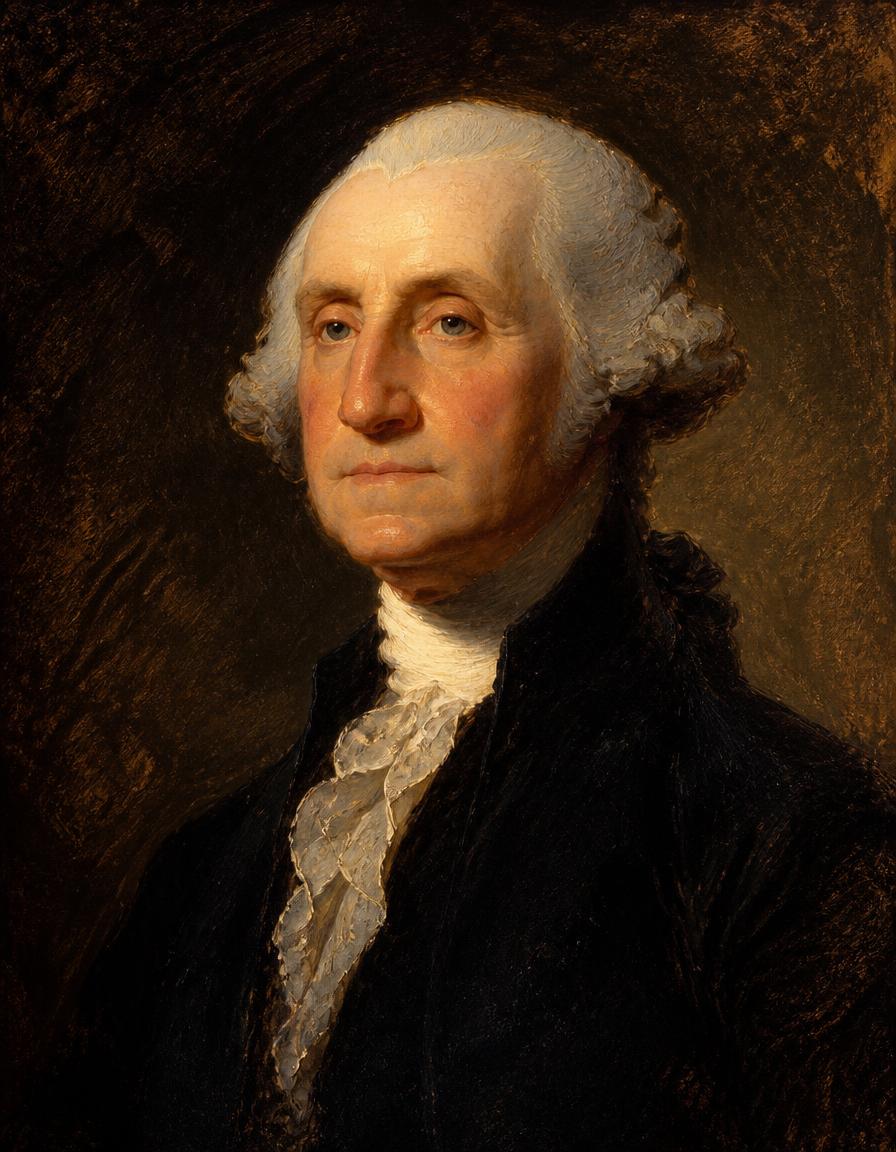
Quick Facts
- Years
- 1732 – 1799
- Category
- World Leaders & Revolutionaries
- Nationality
- American
- Occupation
- General & First President
George Washington
1732 – 1799 · American · General & First President
Audiobook

Life Lessons from George Washington
Marcus Alden · 54 min
George Washington (1732–1799) was the commander in chief who led the Continental Army through the American Revolutionary War and the first president of the United States. Born into Virginia’s planter class, he gained military experience on the contested North American frontier before becoming one of the best-known advocates of colonial resistance to British policy.
Washington’s greatest achievements were not solitary victories. He preserved an often undersupplied revolutionary army, worked with Congress and French allies, accepted the British surrender at Yorktown, and voluntarily returned military authority to civilian leaders. As president from 1789 to 1797, he transformed the new Constitution from a written framework into a working government. His administration established durable precedents, supported public credit, enforced federal law, and pursued neutrality during Europe’s wars.
His historical importance is inseparable from a profound contradiction: Washington defended liberty while enslaving human beings. His changing private views and posthumous emancipation provision were meaningful, but they did not undo decades of exploitation or his efforts to recover people who escaped bondage.
Washington remains studied as a military commander, institution builder, symbol of republican government, and representative of the tensions within the American founding. His example shaped the presidency, civil-military relations, national memory, and debates over freedom, power, race, and citizenship.
Quick Facts
| Field | Details |
|---|---|
| Full Name | George Washington |
| Common Name(s) | George Washington; General Washington |
| Born | February 22, 1732 (February 11 under the Old Style calendar then used in British America) |
| Died | December 14, 1799 |
| Age at Death | 67 |
| Birthplace | Popes Creek, Westmoreland County, Colony of Virginia, British America |
| Nationality | British subject by birth; American after independence |
| Occupation | Surveyor, planter, military officer, commander in chief, president |
| Historical Era | Colonial America, American Revolution, Early Republic |
| Famous For | Leading the Continental Army and serving as the first U.S. president |
| Political Affiliation | No formal party; generally aligned with Federalist policies while warning against faction |
| Religion | Anglican, later Episcopalian; precise personal theology remains debated |
| Education | Privately and locally educated; no college education |
| Parents | Augustine Washington and Mary Ball Washington |
| Spouse(s) | Martha Dandridge Custis Washington, married 1759 |
| Children | No biological children; helped raise Martha’s surviving children and later two grandchildren |
| Major Works | Presidential addresses, Farewell Address, extensive correspondence and diaries |
| Major Achievements | Revolutionary commander; presided over the Constitutional Convention; first U.S. president; established peaceful presidential succession |
Early Life
Washington was born at Popes Creek in Virginia’s Northern Neck to Augustine Washington, a planter and iron-business investor, and his second wife, Mary Ball Washington. The family belonged to Virginia’s landholding gentry but was not among its wealthiest elite. George was the eldest surviving child of Augustine and Mary. He also had older half-siblings from his father’s first marriage.
After Augustine died in 1743, Washington’s formal education became more limited than that of many later founders. He did not attend college or study in Europe. Local schooling taught him reading, writing, arithmetic, geometry, and practical mathematics. He copied maxims on conduct known as the “Rules of Civility,” although he did not compose them.
His older half-brother Lawrence Washington became an important model and social connection. Lawrence had served in the British military and owned Mount Vernon. Through him, George encountered the influential Fairfax family. Lord Fairfax’s extensive western lands gave the young Washington opportunities to survey the Shenandoah Valley.
Washington became a surveyor in 1749. The work strengthened his knowledge of terrain, land values, recordkeeping, and frontier society. Fees and land speculation helped him acquire property. A 1751 journey to Barbados with the ill Lawrence was Washington’s only known trip outside mainland North America. There he contracted smallpox and survived, probably gaining immunity valuable during later epidemics.
Colonial Virginia shaped him deeply. Its society tied land, status, public office, and slavery together. Washington aspired to gentility, expanded his estates, and participated in this slaveholding order. At the same time, frontier competition among Britain, France, Indigenous nations, colonists, and land companies opened a path toward military distinction.
Rise to Prominence
In 1753 Virginia lieutenant governor Robert Dinwiddie sent Washington, then a militia major, to deliver a demand that French forces leave the Ohio Country. His published journal of the dangerous mission made him known on both sides of the Atlantic.
The next year, Washington returned with troops. After a clash at Jumonville Glen, French forces compelled him to surrender Fort Necessity on July 3, 1754. The episode helped ignite the French and Indian War, the North American theater of the Seven Years’ War. Washington’s inexperience showed, and controversy surrounds the killing of French commander Joseph Coulon de Jumonville after the skirmish. Yet failure also gave Washington hard lessons in logistics, diplomacy, fortification, and irregular warfare.
In 1755 he served as a volunteer aide to British general Edward Braddock. When Braddock’s expedition was devastated near the Monongahela, Washington helped organize survivors despite intense fire. Reports of his composure enhanced his reputation. As colonel of the Virginia Regiment from 1755 to 1758, he defended a long frontier with inadequate resources and repeatedly sought a regular British commission, without success.
Washington resigned in 1758, married the wealthy widow Martha Dandridge Custis in 1759, and entered the House of Burgesses. At Mount Vernon he managed plantations, pursued western lands, and became increasingly frustrated with British commercial restrictions and imperial policies. He supported nonimportation and, by 1774, colonial cooperation against Parliament’s Coercive Acts.
Washington attended the First and Second Continental Congresses. His military experience, Virginia identity, reputation, and commitment to the colonial cause made him a unifying choice for commander in chief in June 1775.
Major Achievements
Preserving the Continental Army
Washington took command outside Boston in July 1775. After American forces fortified Dorchester Heights, the British evacuated Boston in March 1776. The campaign demonstrated that colonial forces could compel a major imperial army to withdraw.
Defeat followed in New York. Washington made serious tactical errors, but he saved much of his army from destruction. His Christmas-night crossing of the Delaware and victories at Trenton and Princeton revived morale at a moment when enlistments were expiring and the revolutionary cause appeared close to collapse.
The achievement was persistence rather than uninterrupted battlefield brilliance. Through defeats, supply crises, disease, desertion, and political disputes, Washington kept a national army in existence. That continuity made eventual victory possible.
Building a Professional Fighting Force
The winter at Valley Forge in 1777–1778 became famous for deprivation, though other encampments also brought severe suffering. Baron Friedrich Wilhelm von Steuben introduced standardized drills and organization. Washington supported this professionalization while coordinating with Congress and state authorities for supplies.
He also ordered smallpox inoculation for much of the army in 1777, accepting managed medical risk to counter a dangerous epidemic. Historians regard this as a consequential public-health and military decision.
Winning Independence with French Assistance
France formally allied with the United States in 1778. Washington learned to work with French commanders and diplomats despite differences in language, military culture, and strategic priorities.
In 1781 Washington and the French general Rochambeau moved allied forces toward Virginia while a French fleet under Admiral de Grasse blocked British escape by sea. The siege of Yorktown ended with Lord Cornwallis’s surrender on October 19. Fighting did not immediately cease everywhere, but Yorktown shattered British political support for continuing the war on the same terms.
The victory mattered because Washington coordinated American land forces, French troops, naval power, and deception across great distances. It also demonstrates that American independence depended upon international assistance.
Surrendering Military Power
Washington confronted unrest among officers at Newburgh in 1783, where frustration over unpaid compensation threatened civil-military stability. He sympathized with legitimate grievances but opposed coercion against Congress. His intervention helped defuse the crisis.
On December 23, 1783, he resigned his commission to the Confederation Congress at Annapolis and returned to Mount Vernon. Voluntarily relinquishing command strengthened the principle that armed forces answer to civil authority. King George III reportedly recognized the act’s significance, though some popular versions of his remarks are secondhand.
Supporting the Constitution
The weak Confederation government struggled with revenue, commerce, debt, and interstate disputes. Washington hosted the 1785 Mount Vernon Conference that encouraged cooperation between Virginia and Maryland. Concerned about national weakness, he accepted election to the Constitutional Convention and served as its presiding officer in 1787.
He spoke relatively little during formal debate, but his presence lent legitimacy to the convention. He supported ratification because he believed an energetic yet limited federal government was necessary for union, security, and public credit.
Establishing the Presidency
Washington was unanimously chosen by presidential electors in 1789 and again in 1792. No precedent defined the office in practice. He created a cabinet, communicated with Congress, supervised executive departments, appointed federal judges, and cultivated dignity without monarchical ceremony.
His administration backed Alexander Hamilton’s financial program, including federal assumption of state Revolutionary debts and a national bank. These measures improved credit and expanded federal capacity, while provoking constitutional and sectional opposition.
Washington signed the Bill of Rights amendments for submission through the constitutional process and oversaw their ratification. He also traveled through the states to reinforce national unity.
Maintaining Neutrality and Federal Authority
When war erupted between revolutionary France and European powers, Washington issued the 1793 Neutrality Proclamation. Critics argued that it favored Britain or exceeded presidential authority; supporters believed the vulnerable republic needed peace.
In 1794 the Whiskey Rebellion challenged a federal excise tax in western Pennsylvania. Washington mobilized militia forces and briefly accompanied them, demonstrating that the government could enforce law. The uprising largely dissolved without major combat. He later pardoned the two men convicted of treason.
The controversial Jay Treaty with Britain reduced the danger of war and secured British evacuation of western forts, although it failed to end impressment and angered supporters of France. Washington judged that time and stability were more valuable than a risky confrontation.
Leaving Office Voluntarily
Washington declined a third term and left office in 1797. His Farewell Address urged national unity, fiscal responsibility, religious morality, and caution toward permanent foreign alignments. A peaceful transfer to John Adams showed that republican leadership could change without a coup, hereditary succession, or a leader’s death.
Leadership and Work
Washington’s leadership rested on endurance, self-control, attention to reputation, and an ability to symbolize a common cause. He was physically imposing and usually reserved. Rather than dominate every discussion, he often solicited written advice, weighed competing recommendations, and then made a decision.
He selected talented subordinates, including Hamilton, Henry Knox, Thomas Jefferson, and Edmund Randolph, even when they disagreed. As a commander, he learned to avoid battles that risked annihilating his army. His strategic judgment improved after early errors: preserving the force became more important than defending every city.
His strengths included persistence, administrative discipline, coalition management, and willingness to relinquish authority. He understood that public confidence was itself a political resource.
His weaknesses were substantial. Washington could be distant, intensely status-conscious, and severe when he believed discipline or honor had been violated. He sometimes misjudged military situations and Indigenous diplomacy. As president, he increasingly accepted Federalist interpretations of federal power while struggling to remain above partisan conflict.
His management of Mount Vernon combined close recordkeeping and agricultural experimentation with coerced enslaved labor. That fact complicates admiration for his industry and managerial ability.
Personal Life
Washington married Martha Dandridge Custis, a wealthy widow, on January 6, 1759. No surviving evidence proves the marriage was a romantic courtship in the modern sense, but their partnership endured for four decades. They had no children together. Washington helped raise Martha’s children, John Parke Custis and Martha Parke Custis, and later the Custis grandchildren Eleanor and George Washington Parke Custis.
Mount Vernon was both home and commercial estate. Washington expanded the mansion, entertained many visitors, experimented with crop rotation and fertilizers, bred mules, operated fisheries and a gristmill, and established a commercially successful distillery. He shifted acreage away from tobacco toward wheat and other crops, partly to reduce dependence on British merchants.
He enjoyed horseback riding, hunting, theater, dancing in his younger years, and formal hospitality. He was known for careful dress and concern for etiquette. Contrary to legend, his false teeth were not wooden. His dental appliances used materials including ivory, metal, and human and animal teeth.
Washington endured smallpox, malaria-like fevers, dysentery, dental disease, and other illnesses. He died after an acute throat illness in December 1799. Modern retrospective diagnoses vary, and bloodletting and other contemporary treatments may have weakened him, but certainty is impossible.
Philosophy and Beliefs
Washington favored republican government founded on law, representation, civic virtue, and civilian control of the military. He distrusted concentrated power but came to believe that liberty could not survive under a government too weak to tax, enforce laws, regulate commerce, or defend national interests.
He emphasized union. Sectional, party, and foreign attachments, he feared, could fracture the country. Although he disliked political parties, his own policies helped generate the Federalist and Democratic-Republican opposition. His ideal of disinterested leadership did not eliminate genuine conflict over who benefited from federal policy.
Washington publicly supported religious liberty. His 1790 letter to the Hebrew Congregation in Newport declared that the United States gave “to bigotry no sanction, to persecution no assistance.” He attended Anglican and Episcopal services and used providential language. Scholars debate his private theology because his writings rarely discuss specifically Christian doctrines and evidence about communion is mixed.
His beliefs about slavery changed but remained contradictory. He privately expressed growing discomfort and ultimately directed that the people he personally owned be freed after Martha’s death. Yet during his lifetime he continued to benefit from slavery, signed the Fugitive Slave Act of 1793, and sought the return of escapees. His conception of liberty never became a public campaign for universal emancipation.
Challenges and Controversies
Military Failures
Fort Necessity ended in surrender, and the 1776 New York campaign brought severe defeats. Washington sometimes divided forces unwisely, relied on faulty intelligence, and struggled with militia limitations. Admirers emphasize his capacity to learn and recover; critics caution against turning survival into a myth of flawless generalship.
Enslavement
At Mount Vernon, Washington controlled more than 300 enslaved people by 1799, though only 123 were legally his property; many others were tied to the Custis estate. Enslaved people performed agricultural, domestic, and skilled labor under coercion, with families vulnerable to separation because of differing ownership.
Washington authorized efforts to recapture people who escaped, including Ona Judge, who fled the presidential household in 1796, and Hercules Posey, who escaped later. His will’s emancipation clause was unusual among prominent Virginia founders, but freedom for those he owned was delayed until Martha’s death, and it did not legally cover Custis “dower” slaves. Martha freed Washington’s enslaved people in 1801.
Indigenous Peoples and Western Expansion
Washington’s wartime campaigns and presidential policies promoted U.S. territorial expansion at great cost to Native nations. In 1779 he ordered the Sullivan-Clinton expedition against Haudenosaunee communities allied with Britain; troops destroyed towns, crops, and food supplies.
As president, he sometimes advocated treaty-making, regulated trade, and what officials called “civilization” policies. He also supported expansion and federal campaigns after conflict escalated in the Northwest Territory. Some historians stress his preference for orderly treaties over uncontrolled settler violence; Indigenous-centered accounts emphasize dispossession, coercion, and destruction. Both are necessary to understand the policy’s operation and consequences.
Partisanship and Executive Power
Jeffersonian opponents accused Washington’s administration of monarchical tendencies and favoritism toward wealthy creditors and Britain. The national bank, Neutrality Proclamation, Whiskey Rebellion response, and Jay Treaty raised enduring constitutional questions.
Supporters argue that Washington built essential governmental capacity while exercising restraint. Critics reply that his administration broadened executive and fiscal power in ways not clearly specified by the Constitution. His presidency established precedents, but not all were uncontested or inevitable.
Legacy
Washington became the preeminent national symbol of the United States. The capital city, Washington, D.C., and the state of Washington bear his name, as do counties, towns, schools, universities, roads, and military institutions. His image appears on the one-dollar bill and the quarter.
Major sites include Mount Vernon in Virginia, Washington’s Headquarters at Valley Forge, the Washington Monument and National Portrait Gallery in Washington, D.C., Federal Hall in New York, and the battlefield parks at Yorktown, Trenton, Princeton, and Monmouth. The Washington Presidential Library at Mount Vernon supports research and education.
Artists and writers elevated him into a civic icon, often obscuring complexity. Parson Weems’s cherry-tree story is unsupported, and idealized paintings may reveal more about national memory than literal events. Modern scholarship has restored attention to enslaved communities, Native nations, ordinary soldiers, women, and allies whose labor and sacrifice made his achievements possible.
Washington’s most durable institutional legacies are civilian military control, executive precedent, national fiscal authority, strategic neutrality during vulnerability, and voluntary departure from office. His slaveholding and expansionism, however, prevent a purely celebratory assessment. He remains relevant precisely because his life embodies both republican achievement and the founding era’s exclusions.
Interesting Facts
- Washington was born under the Julian calendar on February 11, 1731/32; the modern equivalent is February 22, 1732.
- He had no college degree.
- His first profession was surveying.
- His 1751 Barbados journey was his only known trip outside mainland North America.
- He survived smallpox as a young man.
- He was about six feet two inches tall, unusually tall for his era.
- He did not wear a powdered wig; portraits generally show his own powdered hair.
- His dentures were not wooden.
- He accepted no salary as Continental commander but submitted expenses.
- He was unanimously elected president by the electors twice.
- New York City was the national capital at his first inauguration.
- He personally selected the federal district site along the Potomac.
- He was the only sitting president to lead troops in the field, during the Whiskey Rebellion mobilization.
- He established one of early America’s largest whiskey distilleries at Mount Vernon.
- He helped popularize mule breeding in the United States.
- He had no biological children.
- Congress promoted him posthumously to General of the Armies in 1976, with rank dated July 4, 1976.
- His will provided for the emancipation of the enslaved people he personally owned, subject to stated conditions.
Famous Quotes
- “I have not only grown gray, but almost blind in service to my country.” — Washington’s 1783 Newburgh address, delivered as he appealed to discontented officers. His use of spectacles dramatized shared sacrifice and helped calm the crisis.
- “Having now finished the work assigned me, I retire from the great theatre of Action.” — His resignation speech to Congress, December 23, 1783. It affirmed civilian authority.
- “There exists in the economy and course of nature, an indissoluble union between virtue and happiness.” — First Inaugural Address, 1789. Washington linked public morality with republican success.
- “The Government of the United States of America gives to bigotry no sanction, to persecution no assistance.” — Letter to Newport’s Hebrew Congregation, 1790. It expressed an inclusive understanding of religious liberty.
- “It is our true policy to steer clear of permanent alliances with any portion of the foreign world.” — Farewell Address, 1796. He warned against binding political entanglements, not all diplomacy or temporary cooperation.
- “The alternate domination of one faction over another…is itself a frightful despotism.” — Farewell Address. The passage conveyed his fear that party revenge would endanger republican government.
- “Observe good faith and justice towards all Nations; cultivate peace and harmony with all.” — Farewell Address. It summarized his preferred foreign policy.
- “The name of American…must always exalt the just pride of Patriotism.” — Farewell Address. Washington placed national union above regional identity.
- “Labor to keep alive in your breast that little spark of celestial fire called conscience.” — From the “Rules of Civility” Washington copied as a youth. It reflects an influence on him, but he was not the original author.
- “I cannot tell a lie” — Disputed/legendary attribution. Parson Weems introduced the cherry-tree tale after Washington’s death; no contemporary evidence verifies it.
Timeline
- 1732 — Born at Popes Creek, Virginia.
- 1743 — Father Augustine Washington dies.
- 1748 — Joins a Fairfax-associated surveying expedition in the Shenandoah region.
- 1749 — Appointed surveyor of Culpeper County.
- 1751 — Travels to Barbados and contracts smallpox.
- 1752 — Lawrence Washington dies; George’s path toward control of Mount Vernon begins.
- 1753 — Carries Dinwiddie’s warning to French forces in the Ohio Country.
- 1754 — Fights at Jumonville Glen and surrenders Fort Necessity.
- 1755 — Serves with Braddock and survives the Monongahela defeat.
- 1755–1758 — Commands the Virginia Regiment.
- 1759 — Marries Martha Custis and enters the House of Burgesses.
- 1774 — Attends the First Continental Congress.
- 1775 — Appointed commander in chief of the Continental Army.
- 1776 — British evacuate Boston; Washington loses New York and wins at Trenton.
- 1777 — Wins at Princeton; orders army inoculation; camps at Valley Forge.
- 1778 — French alliance transforms the war.
- 1781 — Allied victory at Yorktown.
- 1783 — Defuses Newburgh crisis and resigns military commission.
- 1785 — Hosts the Mount Vernon Conference.
- 1787 — Presides over the Constitutional Convention.
- 1789 — Inaugurated as first U.S. president.
- 1791 — Bill of Rights ratified; national bank established.
- 1793 — Begins second term and proclaims neutrality.
- 1794 — Mobilizes militia during Whiskey Rebellion; Jay Treaty negotiated.
- 1796 — Farewell Address published; Ona Judge escapes.
- 1797 — Leaves office and returns to Mount Vernon.
- 1798 — Accepts nominal command of the provisional army during the Quasi-War crisis.
- 1799 — Dies at Mount Vernon on December 14.
- 1801 — Martha Washington emancipates the enslaved people covered by his will.
- 1976 — Congress posthumously establishes his senior rank as General of the Armies.
Frequently Asked Questions
Why was George Washington important?
Washington connected military independence with constitutional government. He held the Continental Army together, coordinated the alliance that produced victory at Yorktown, and then surrendered his command. Later, he helped legitimize the Constitution and established the presidency’s basic practices. His voluntary departure after two terms strengthened peaceful succession. His importance does not make him beyond criticism: his wealth and household depended on slavery, and U.S. expansion under his leadership harmed Indigenous communities.
Was George Washington really the first U.S. president?
Yes. Washington was the first president under the Constitution, serving from April 30, 1789, to March 4, 1797. Earlier officials sometimes carried titles such as “president of Congress” under the Articles of Confederation, but they did not lead an independent executive branch and were not presidents in the modern constitutional sense. Claims that figures such as John Hanson were the “real first president” confuse these very different offices.
How did Washington win the Revolutionary War?
He did not win it alone, nor through constant battlefield success. Washington preserved the Continental Army, adapted after defeats, worked with Congress and state governments, and exploited limited opportunities such as Trenton. French money, arms, soldiers, and naval power were indispensable, especially at Yorktown. Spanish pressure on Britain, Dutch financing, militia service, civilian support, and British political limits also mattered. Washington’s central accomplishment was holding together a coalition and an army long enough for international circumstances to favor independence.
Was Washington a great military strategist?
Historians generally regard Washington as a stronger strategic leader than battlefield tactician. His early campaigns included major errors, and he lost more battles than heroic mythology suggests. Over time, however, he recognized that Britain had to destroy his army to crush the Revolution. By preserving that army, threatening British positions, and coordinating with France, he turned endurance into strategy. Yorktown displayed excellent coalition planning, although French naval superiority made the siege possible.
Did George Washington have wooden teeth?
No. Washington suffered severe dental problems and wore several sets of dentures, but they were not wooden. Surviving evidence shows combinations of ivory, metal, animal teeth, and human teeth. His account books record a payment to enslaved people for teeth in 1784, though whether those specific teeth entered his dentures is not certain. The wooden-teeth story probably arose because stained ivory can develop a grain-like appearance.
Did Washington chop down a cherry tree?
There is no reliable evidence that he did. The story appeared in a biography by Mason Locke “Parson” Weems after Washington’s death. In it, young George confesses because he cannot tell a lie. The episode was designed as a moral lesson and became a popular part of American childhood education. Historians treat it as legend, not documented biography. Its endurance illustrates how national cultures turn political leaders into models of ideal behavior.
Did George Washington own enslaved people?
Yes. Washington inherited enslaved people, acquired others, and used their forced labor across Mount Vernon. At his death, more than 300 enslaved people lived there, although many belonged legally to the Custis estate rather than to him. His will ordered eventual freedom for the people he personally owned, but he did not free them during his lifetime and attempted to recover escapees. Any complete account of Washington must place slavery at the center of his economic and personal world.
Why did Washington free enslaved people in his will?
Washington’s private correspondence shows increasing concern about slavery, influenced by Revolutionary ideals, economic considerations, and relationships with antislavery associates. His will directed that those he personally owned be freed after Martha’s death and provided support or training for some. The provision was significant, but limited. He did not publicly lead an emancipation movement, delayed freedom, and lacked legal authority to free the Custis estate’s enslaved people. Martha implemented the emancipation early in 1801.
Did Washington have children?
Washington had no known biological children. His marriage to Martha produced none, and historians cannot establish why. He acted as a parent or guardian within Martha’s family. He helped raise her surviving children from her first marriage, John Parke Custis and Martha Parke Custis. After John’s death in 1781, George and Martha brought two grandchildren, Eleanor Parke Custis and George Washington Parke Custis, into their household.
What political party did Washington belong to?
Washington never formally joined a political party and warned against faction. Nevertheless, his administration increasingly aligned with policies later identified as Federalist: a strong national government, Hamilton’s financial system, neutrality, and accommodation with Britain. Democratic-Republicans criticized those measures. Calling him simply nonpartisan can therefore mislead; he aspired to stand above parties, but governed amid partisan conflict and generally sided with Federalist advisers on major disputes.
Why did Washington decline a third term?
Age, fatigue, criticism, and a strong desire to return to Mount Vernon all influenced him. He also understood the value of voluntarily transferring power. The Constitution then imposed no term limit, and Washington’s departure created an informal two-term tradition followed by most successors until Franklin D. Roosevelt. The Twenty-Second Amendment, ratified in 1951, later established a formal electoral limit. Washington did not leave because law required him to do so.
What was the Whiskey Rebellion?
The rebellion grew from resistance to a federal excise tax on distilled spirits, especially in western Pennsylvania, where whiskey had commercial and practical importance. Protesters intimidated tax officials and challenged federal enforcement. In 1794 Washington called out militia forces to demonstrate the government’s authority. The resistance dispersed with little violence. Supporters saw constitutional law enforcement; critics saw a distant government favoring eastern financial interests and using excessive force against rural citizens.
What did Washington’s Farewell Address say?
Published in 1796 rather than delivered as a speech, the address defended Washington’s retirement and offered political counsel. It stressed national union, constitutional obedience, public credit, morality, religion, and caution toward sectionalism and parties. In foreign affairs, it urged good faith toward all nations and avoidance of permanent alliances. It did not demand complete isolation from the world. Hamilton helped draft the final text, building on Washington’s ideas and an earlier draft by James Madison.
What were Washington’s religious beliefs?
Washington was raised Anglican and later associated with the Episcopal Church. He attended services, served in parish roles, promoted religious liberty, and frequently invoked Providence. Yet he rarely wrote about Jesus or specific Christian doctrines, and reports differ about his participation in communion. Scholars variously describe him as a conventional Anglican, a latitudinarian Christian, or religiously influenced by Enlightenment language. The evidence supports belief in providential order but does not settle every aspect of his private theology.
How did Washington treat Native Americans?
His record combined diplomacy with coercive expansion. Washington negotiated treaties, sought federal rather than uncontrolled settler management of Indian affairs, and sometimes spoke of justice. Yet his land interests and national policies promoted settlement on Native homelands. During the Revolution he ordered the destructive Sullivan-Clinton expedition, and his administration fought the Northwest Indian Confederacy. Policies described as “civilization” also aimed to transform Native economies and cultures. Indigenous perspectives highlight dispossession beneath the language of order and development.
How did George Washington die?
After riding in cold, wet weather at Mount Vernon, Washington developed a severe throat illness on December 13–14, 1799. Physicians treated him with methods common at the time, including repeated bloodletting and blistering. He died on the evening of December 14. Modern doctors have proposed diagnoses including acute bacterial epiglottitis, severe tonsillitis, or other airway infections, but retrospective certainty is impossible. The treatments probably reduced his strength during a rapidly worsening illness.
Lessons We Can Learn
- Preserve the essential resource. After New York, Washington prioritized keeping his army alive. Today, leaders should distinguish core capacity from positions that can be surrendered.
- Learn publicly from failure. Fort Necessity exposed serious inexperience, but Washington absorbed lessons in logistics and command. Early failure need not define an entire career.
- Build coalitions. Yorktown required American and French cooperation. Complex achievements usually depend on partners with different interests and skills.
- Use expert advice. Washington relied on cabinet members and military specialists. Good leadership includes selecting capable advisers without surrendering final responsibility.
- Adapt strategy to reality. He moved away from seeking one decisive battle and embraced endurance. Plans should change when evidence changes.
- Protect institutional legitimacy. His resignation and retirement placed public systems above personal office. Authority becomes more durable when leaders accept limits.
- Balance firmness with restraint. The Whiskey Rebellion mobilization showed force, but large-scale fighting was avoided and convictions were pardoned.
- Invest in prevention. Army inoculation against smallpox accepted short-term disruption to reduce catastrophic risk. Preventive action often looks costly before its benefits become visible.
- Examine moral contradictions. Washington’s language of liberty coexisted with slaveholding. Modern readers should test declared values against lived practices.
- Reject hero worship in favor of evidence. Myths about teeth and cherry trees obscure more important truths. Responsible citizenship depends on critical, contextual historical understanding.
Related Historical Figures
- Martha Washington — His wife, estate partner, and the nation’s inaugural presidential spouse.
- Alexander Hamilton — Wartime aide and treasury secretary whose financial program defined Washington’s administration.
- Thomas Jefferson — Secretary of state whose disputes with Hamilton accelerated partisan division.
- John Adams — Vice president for eight years and Washington’s presidential successor.
- James Madison — Constitutional collaborator who later opposed important administration policies.
- Marquis de Lafayette — French officer, close wartime associate, and symbolic surrogate son to Washington.
- Comte de Rochambeau — French commander who partnered with Washington in the Yorktown campaign.
- King George III — British monarch during the Revolution and the imperial authority the colonies rejected.
- Henry Knox — Trusted artillery commander and Washington’s secretary of war.
- Ona Judge — Enslaved woman who escaped Washington’s presidential household, illuminating the conflict between his pursuit of freedom and denial of hers.
Related Historical Figures