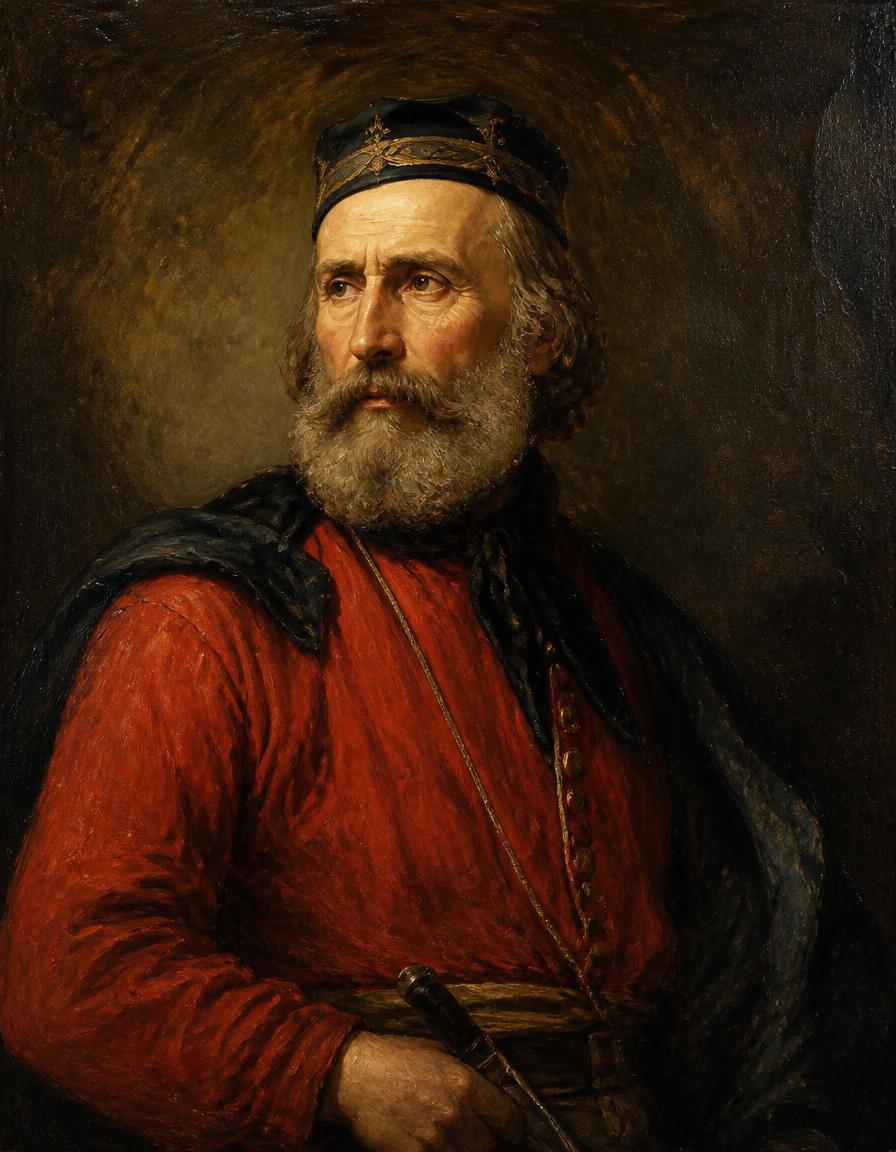
Quick Facts
- Years
- 1807 – 1882
- Category
- World Leaders & Revolutionaries
- Nationality
- Italian
- Occupation
- Revolutionary & General
Giuseppe Garibaldi
1807 – 1882 · Italian · Revolutionary & General
Audiobook

Life Lessons from Giuseppe Garibaldi
Marcus Alden · 57 min
Giuseppe Garibaldi was an Italian revolutionary, soldier, and political activist whose campaigns helped create the unified Kingdom of Italy. Known internationally as the “Hero of the Two Worlds,” he fought in South America and Europe, developing a reputation for personal courage, mobile warfare, and an extraordinary ability to inspire volunteers.
Garibaldi’s greatest achievement came in 1860, when his Expedition of the Thousand overthrew Bourbon rule in Sicily and southern Italy. Instead of retaining power, he transferred his conquests to King Victor Emmanuel II, accelerating national unification. He also defended the short-lived Roman Republic in 1849, led volunteers in later wars against Austria, and supported republican, nationalist, and humanitarian movements across Europe.
His life contained important contradictions. A committed republican, he cooperated with a monarchy to unite Italy. A champion of liberty, he participated in wars that imposed a new political order on populations whose responses ranged from enthusiasm to resistance. Admired for integrity and sacrifice, he was also an irregular commander whose boldness could become strategic impatience.
Garibaldi remains important because his career connects nationalism, revolution, popular warfare, and international activism in the nineteenth century. Historians continue to study both the military accomplishments behind his legend and the political mythology that made the red-shirted general a global symbol of liberation.
Quick Facts
| Field | Details |
|---|---|
| Full Name | Giuseppe Maria Garibaldi |
| Common Name(s) | Giuseppe Garibaldi; Hero of the Two Worlds |
| Born | 4 July 1807 |
| Died | 2 June 1882 |
| Age at Death | 74 |
| Birthplace | Nice, then part of the French Empire; restored to the Kingdom of Sardinia in 1814 |
| Nationality | Italian; born a subject of Napoleonic France and later Sardinia-Piedmont |
| Occupation | Sailor, ship captain, revolutionary, general, politician, farmer, writer |
| Historical Era | Risorgimento; nineteenth-century nationalism and revolution |
| Famous For | Defending the Roman Republic and leading the Expedition of the Thousand |
| Political Affiliation | Italian nationalist; republican and democrat; associated with Young Italy and later served in the Italian Parliament |
| Religion | Baptized Roman Catholic; later strongly anticlerical and sympathetic to deism and freethought |
| Education | Informal private schooling and maritime training; no university education |
| Parents | Domenico Garibaldi and Maria Rosa Nicoletta Raimondi |
| Spouse(s) | Ana Maria de Jesus Ribeiro da Silva (“Anita”); Giuseppina Raimondi, marriage annulled; Francesca Armosino |
| Children | Several, including Menotti, Rosita, Teresita, Ricciotti, Clelia, and Manlio; other children died young |
| Major Works | Memoirs; Clelia, or the Government of the Priests; The Thousand; political letters and proclamations |
| Major Achievements | Expedition of the Thousand; conquest of the Two Sicilies; defense of Rome in 1849; campaigns of 1859, 1866, and 1870–71 |
Early Life
Garibaldi was born in Nice on 4 July 1807. Nice then belonged to Napoleon’s French Empire, although it had long-standing connections with the House of Savoy and returned to the Kingdom of Sardinia in 1814. Its maritime setting shaped his life. His father, Domenico, was a coastal trader and ship captain; his mother, Rosa, came from a family with Ligurian roots.
His parents provided private instruction, but Garibaldi showed little interest in a conventional professional career. He preferred the sea and entered merchant service as a teenager. Voyages around the Mediterranean and Black Sea exposed him to different peoples, ports, and political systems. He qualified as a merchant captain in 1832.
Europe after Napoleon was governed by restored dynasties that attempted to contain constitutionalism and nationalism. The Italian peninsula remained divided among several states, with Austria exercising direct or indirect dominance over much of the north. Secret societies and political exiles advocated constitutions, independence, or national unity.
A decisive influence was Giuseppe Mazzini, the Genoese republican who founded Young Italy. Mazzini argued that Italians had a moral duty to build a united, independent republic through popular action. Garibaldi joined the movement and participated in preparations for a republican uprising in Piedmont in 1834. The plot failed. Condemned to death in absentia, he escaped first to France and then across the Atlantic.
Rise to Prominence
Garibaldi reached South America in the mid-1830s and spent approximately twelve years amid civil wars and independence struggles. In Brazil, he joined rebels of the self-proclaimed Riograndense Republic against the Brazilian Empire. He commanded small vessels, conducted privateering operations under rebel authority, and fought on land.
During this struggle he met Ana Maria de Jesus Ribeiro da Silva, known as Anita. She became his companion and later his wife, sharing campaigns, danger, poverty, and exile. Their partnership became central to Garibaldi’s personal legend, although romantic retellings have sometimes blurred documented events.
After the Brazilian rebellion weakened, Garibaldi moved to Uruguay. There he supported the government in Montevideo during the prolonged regional conflict known as the Great War. He organized an Italian Legion whose members wore red shirts, probably derived from inexpensive work garments available through commercial supplies. The uniform later became the visual emblem of his followers.
His reputation grew after actions such as the battles of Cerro and San Antonio in 1846. Reports reaching Europe portrayed him as an audacious commander defending a republic against stronger enemies. He learned to recruit multinational volunteers, move rapidly, improvise supplies, and use publicity effectively.
The revolutions of 1848 brought him back to Italy. Although King Charles Albert initially distrusted the republican adventurer, Garibaldi raised volunteers against Austria. In 1849 he became one of the principal defenders of the Roman Republic, established after Pope Pius IX fled Rome. French forces restored papal authority after a hard siege, but Garibaldi’s resistance and dramatic retreat made him a European celebrity.
Major Achievements
Fighting in South America
Garibaldi’s Brazilian and Uruguayan campaigns did not produce lasting victories on the scale of his Italian conquests. Their importance lay in experience. He learned naval warfare, irregular tactics, volunteer organization, and coalition politics.
South America also made him internationally recognizable. His Italian Legion provided the model for later red-shirt formations, while his defense of Montevideo linked Italian nationalism to a broader language of republican liberty.
Defense of the Roman Republic
In 1849 Garibaldi commanded forces defending Rome against a French expedition sent to restore Pope Pius IX. The republic introduced reformist measures, but it survived only a few months. Garibaldi’s troops fought fierce engagements at the Janiculum and around the city.
After defeat became inevitable, he led thousands out of Rome in an attempted withdrawal toward Venice. Austrian, French, Spanish, Neapolitan, and papal forces pursued them. The column dissolved under pressure, and Anita died near Ravenna while pregnant and gravely ill.
Militarily, the republic fell. Politically, its defense created a powerful patriotic memory. Garibaldi emerged as a commander willing to share danger with ordinary volunteers and to continue resisting after conventional armies had failed.
Campaign of 1859
During the Second Italian War of Independence, Garibaldi accepted command under the Piedmontese monarchy. His Hunters of the Alps fought Austrian forces in Lombardy, winning engagements including Varese and San Fermo.
The campaign demonstrated that his volunteers could complement a regular army. It also revealed his political pragmatism: although still a republican, he accepted royal authority because Piedmont appeared capable of advancing national unity.
Expedition of the Thousand
In May 1860 Garibaldi sailed from Quarto near Genoa with roughly 1,000 volunteers. They landed at Marsala in Sicily and defeated a larger Bourbon force at Calatafimi. A popular uprising, Bourbon uncertainty, local assistance, and naval and diplomatic circumstances all contributed to his success.
Garibaldi captured Palermo, crossed the Strait of Messina, and entered Naples in September. The decisive Battle of the Volturno checked a Bourbon counterattack. His conquest destroyed the Kingdom of the Two Sicilies and transformed the political map.
At Teano in October, Garibaldi met Victor Emmanuel II and recognized him as king of Italy. He surrendered political control rather than risk civil war with Piedmont. The episode became foundational to Italian national mythology, though historians debate the meeting’s precise ceremonial details and emphasize that unification depended on many actors, not Garibaldi alone.
Campaigns for Rome and Venice
Italy was proclaimed a kingdom in 1861, but Venetia and Rome remained outside it. Garibaldi tried to complete unification. His unauthorized march toward Rome ended at Aspromonte in 1862, where royal troops wounded and arrested him. A second attempt failed at Mentana in 1867, where papal and French forces defeated his volunteers.
In 1866 he commanded volunteers in the war against Austria. His forces won at Bezzecca in Trentino. Ordered to withdraw after the armistice, he famously replied, “Obbedisco”—“I obey.” Venetia nevertheless joined Italy as a result of the wider war.
Service to France
In 1870–71, despite having fought French troops in 1849 and 1867, Garibaldi offered his services to the new French Republic against Prussia. He commanded the Army of the Vosges and achieved limited local successes around Dijon.
His intervention illustrated that his commitments extended beyond Italian nationalism. He saw republican liberty and resistance to foreign domination as international causes, even when political circumstances forced cooperation with former enemies.
Leadership and Work
Garibaldi led principally through example. He dressed simply, endured physical hardship, and placed himself near combat. Volunteers trusted his courage and believed he shared their risks. His charisma helped hold together forces that often lacked training, pay, and equipment.
His preferred methods were speed, surprise, direct attack, and political mobilization. He understood that morale and public perception could compensate for numerical weakness. He also recognized the value of local revolts, sympathetic newspapers, fundraising networks, and expatriate communities.
He was capable of pragmatic decisions. Cooperation with Victor Emmanuel II conflicted with his republican convictions, but he judged unity more urgent than institutional purity. His withdrawal at Teano and obedience in 1866 prevented potentially destructive confrontations with the state he had helped create.
His weaknesses mirrored his strengths. Boldness could become impulsiveness; confidence in popular enthusiasm could obscure logistical or diplomatic realities. Aspromonte and Mentana showed the dangers of volunteer action without government support. He was an inspirational irregular commander rather than a systematic administrator or strategist of the kind found in professional general staffs.
Garibaldi’s relationships with fellow leaders were complicated. He revered Mazzini’s patriotism but rejected some of his insistence on republican revolution. He cooperated with King Victor Emmanuel while distrusting monarchy. He frequently attacked Prime Minister Camillo di Cavour, particularly over the transfer of Garibaldi’s native Nice to France in 1860.
Personal Life
Garibaldi’s first enduring partnership was with Anita, whom he met in Brazil in 1839. They married in Montevideo in 1842 after questions surrounding her earlier marriage were resolved by her first husband’s reported death. Their surviving children included Menotti, Teresita, and Ricciotti; Rosita died in childhood. Anita’s death during the retreat from Rome in 1849 devastated him.
In 1860 Garibaldi married Giuseppina Raimondi, but separated from her immediately after learning she was pregnant by another man. The marriage was eventually annulled after a long legal process.
He later formed a household with Francesca Armosino, with whom he had children including Clelia and Manlio. They married in 1880. His descendants remained visible in Italian military and political life.
Garibaldi purchased much of Caprera, an island off Sardinia, and made it his principal home. He farmed, raised animals, received visitors, corresponded widely, and wrote memoirs and fiction. He cultivated an image of rural simplicity, although Caprera was also a busy center of political communication.
In later life he suffered severely from rheumatism and the lasting effects of wounds, particularly the bullet injury sustained at Aspromonte. He often required assistance with movement. Contemporary accounts describe him as direct, emotionally intense, personally austere, and unusually magnetic, though admiration influenced many such portraits.
Philosophy and Beliefs
Garibaldi believed that peoples possessed a right to national independence and political self-government. His nationalism was generally inclusive in rhetoric: Italy’s liberation formed part of a wider struggle by oppressed peoples rather than a claim to ethnic supremacy.
He remained emotionally republican, regarding citizenship and popular sovereignty as superior to hereditary rule. Nevertheless, he accepted constitutional monarchy as the practical instrument of Italian unity. This compromise distinguished him from Mazzini.
His anticlericalism was fierce. He considered the temporal government of the papacy an obstacle to unity and liberty, and he denounced clerical political power in speeches and writings. Anticlericalism did not necessarily mean simple atheism: his language often invoked God, providence, moral duty, and a broadly deistic spirituality. His precise private beliefs changed over time and cannot be reduced to one label.
He supported causes that he associated with emancipation, including the abolition of slavery, international republicanism, and efforts for peace. He joined Freemasonry and became a prominent figure within Italian Masonic institutions. He also expressed support for women patriots, although his assumptions about gender remained shaped by his century.
Challenges and Controversies
Garibaldi repeatedly failed when political enthusiasm was not matched by diplomatic or military support. The 1834 conspiracy collapsed; the Roman Republic fell; his 1862 and 1867 attempts on Rome ended in defeat. Admirers interpret these episodes as principled sacrifice, while critics see inadequate planning and irresponsible risk.
The conquest of southern Italy remains debated. Traditional nationalist history celebrated it as liberation supported by popular revolt. Revisionist interpretations emphasize elite defections, British interests, Bourbon weaknesses, local grievances, Piedmontese intervention, and subsequent resistance to the new state. No single factor explains the collapse of the Two Sicilies.
Garibaldi’s forces were not free from indiscipline or coercion. At Bronte in Sicily, a violent social uprising was suppressed in August 1860 by troops under Nino Bixio, one of Garibaldi’s senior commanders. Summary trials and executions followed. The episode complicates the liberating image of the expedition and illustrates its dependence on existing landowning interests.
Some older accounts imply decisive official British military sponsorship for the Thousand. Britain’s naval presence, public sympathy, commerce, and diplomacy affected events, but claims that Garibaldi was merely a British instrument exceed the available evidence. Piedmont’s government likewise maintained deliberate ambiguity: it restrained, tolerated, and eventually exploited his expedition.
His anticlerical language offended Catholics who distinguished reform from attacks on religion. Papal supporters regarded him as a violent enemy of legitimate authority; supporters saw temporal papal rule as incompatible with national government.
Garibaldi also participated in nineteenth-century warfare that harmed civilians and prisoners, particularly in confused irregular conflicts. He should neither be isolated from his era nor exempted from scrutiny. Modern scholarship increasingly separates the historical commander from the carefully constructed heroic cult.
Legacy
Garibaldi became one of the first global political celebrities. Newspapers, portraits, biographies, public lectures, and fundraising campaigns turned him into a recognizable symbol from Europe to the Americas. His red shirt, poncho, beard, and brimless cap formed an instantly identifiable public image.
For Italy, he embodied popular participation in the Risorgimento. Victor Emmanuel represented monarchy, Cavour diplomacy, Mazzini republican ideology, and Garibaldi armed action. This simplified quartet remains educationally useful, although unification also depended on ordinary soldiers, rebels, women activists, diplomats, local elites, and foreign powers.
Later movements across the political spectrum attempted to claim him. Republicans emphasized his democratic convictions; monarchists celebrated his transfer of southern Italy to the king; socialists admired his popular activism; nationalists stressed military unity. Such appropriation shows the flexibility—and danger—of heroic memory.
His Caprera home is preserved within the Compendio Garibaldino, a museum complex. The Museo Centrale del Risorgimento in Rome and many regional museums hold objects connected with him. Monuments stand throughout Italy, including prominent equestrian statues on Rome’s Janiculum and in other cities. Streets, squares, schools, ships, and civic institutions bear his name worldwide.
Garibaldi remains relevant to debates about charismatic leadership, volunteer armies, nationalism, political compromise, and the creation of public myths. His career demonstrates that national revolutions are neither purely popular nor purely diplomatic, but emerge from interactions among ideology, force, international politics, and chance.
Interesting Facts
- Garibaldi was born in Nice when it belonged to Napoleon’s French Empire.
- He earned certification as a merchant captain before becoming a revolutionary commander.
- A failed 1834 uprising resulted in a death sentence issued against him in absentia.
- He fought on both water and land during the Brazilian rebellion.
- Anita Garibaldi accompanied him on military campaigns.
- His Italian Legion in Uruguay popularized the red shirt later associated with his volunteers.
- “Hero of the Two Worlds” refers to his campaigns in South America and Europe.
- Alexandre Dumas supported and publicized the 1860 expedition.
- The Thousand departed from Quarto during the night of 5–6 May 1860.
- Garibaldi ruled conquered Sicily in the name of Victor Emmanuel II rather than proclaiming a republic.
- He entered Naples by train before most of his army arrived.
- A royal Italian soldier wounded him in the foot at Aspromonte.
- He answered a withdrawal order in 1866 with the one-word telegram “Obbedisco.”
- He served as an elected deputy but often disliked parliamentary life.
- In 1864 he visited Britain and received an enormous popular welcome.
- He commanded republican French troops during the Franco-Prussian War.
- He became closely involved with Italian Freemasonry.
- He spent much of his later life farming on Caprera.
- The familiar garibaldi biscuit was named after him following his British visit.
- He died at Caprera overlooking the sea.
Famous Quotes
Quotations attributed to Garibaldi vary because he spoke and wrote in several languages, and later admirers polished his words.
- “Here we either make Italy, or we die.” Traditionally associated with the Battle of Calatafimi in 1860. It expresses the expedition’s all-or-nothing resolve, though the exact wording rests on later recollection.
- “I offer neither pay, nor quarters, nor provisions; I offer hunger, thirst, forced marches, battles, and death.” Based on an appeal connected with the 1849 retreat from Rome. Numerous English versions exist, so exact wording should be treated cautiously.
- “Rome or death!” The slogan of the 1862 campaign to capture Rome. It summarized Garibaldi’s determination to make the city Italy’s capital.
- “Obbedisco.” (“I obey.”) His documented reply in 1866 when ordered to withdraw from Trentino. It symbolizes the subordination of personal ambition to national command.
- “Italy and Victor Emmanuel!” Used in proclamations during the 1860 campaign. It signaled his temporary alliance with the monarchy for national unity.
- “The papacy is the most harmful of all secret societies.” Representative of his later anticlerical polemics. Translations differ, and context is essential: his principal target was papal political power.
- “The International is the sun of the future.” Written in support of the International Workingmen’s Association in 1871. His enthusiasm was broad and did not imply agreement with every socialist doctrine.
- “Man is born free and is the brother of man, whatever the country to which he belongs.” Commonly translated from Garibaldian humanitarian language; wording varies among editions of his writings.
- “If these hands, accustomed to fighting, were acceptable to His Holiness, I would devote them to the service of one so deserving of the Church and of the fatherland.” From his 1847 offer to Pope Pius IX, before the revolutionary breach. It reveals how dramatically their relationship changed.
- “Let him who loves Italy follow me.” Traditionally linked to his departure from Rome in 1849. The sentiment is well established, but published forms differ.
Timeline
- 1807 — Born in Nice on 4 July.
- 1820s — Begins a maritime career and voyages around the Mediterranean.
- 1832 — Qualifies as a merchant captain.
- 1833 — Encounters Mazzinian republican ideas and joins Young Italy.
- 1834 — Failed Piedmontese conspiracy; sentenced to death in absentia and exiled.
- 1835–36 — Reaches South America.
- 1836–41 — Fights for the Riograndense Republic in Brazil.
- 1839 — Meets Anita Ribeiro.
- 1841 — Moves to Uruguay.
- 1842 — Marries Anita in Montevideo.
- 1843–46 — Commands the Italian Legion in Uruguay.
- 1848 — Returns to Italy and fights Austrian forces.
- 1849 — Defends the Roman Republic; leads retreat after its fall; Anita dies.
- 1850–54 — Lives in exile and works as a sailor, including time in the United States and Pacific trade.
- 1854 — Returns to Italy and settles increasingly on Caprera.
- 1859 — Commands the Hunters of the Alps against Austria.
- 1860 — Leads the Thousand; conquers Sicily and Naples; meets Victor Emmanuel II at Teano.
- 1861 — Kingdom of Italy proclaimed.
- 1862 — Wounded and arrested at Aspromonte during an unauthorized march on Rome.
- 1864 — Receives a major popular welcome in Britain.
- 1866 — Wins at Bezzecca; sends the “Obbedisco” telegram.
- 1867 — Defeated at Mentana during another attempt to take Rome.
- 1870 — Rome incorporated into Italy after French troops withdraw.
- 1870–71 — Commands the Army of the Vosges for republican France.
- 1871 — Elected to the French National Assembly but resigns amid hostility and controversy.
- 1880 — Marries Francesca Armosino after annulment of his earlier marriage.
- 1882 — Dies at Caprera on 2 June.
Frequently Asked Questions
Who was Giuseppe Garibaldi?
Giuseppe Garibaldi was a sailor, revolutionary, volunteer general, and political activist central to Italian unification. After fighting in Brazil and Uruguay, he returned to Europe during the revolutions of 1848. He defended the Roman Republic, commanded volunteers against Austria, and conquered the Kingdom of the Two Sicilies in 1860. Although personally republican, he transferred his conquests to Victor Emmanuel II, helping establish a unified constitutional monarchy.
Why was Garibaldi called the Hero of the Two Worlds?
The title refers to his military and revolutionary activities in two geographic spheres: South America and Europe. He fought in the Brazilian province of Rio Grande do Sul and in Uruguay before returning to Italy. The phrase promoted an image of Garibaldi as an international champion of liberty rather than merely an Italian national commander. It became especially powerful through nineteenth-century newspapers, biographies, portraits, and public celebrations.
What was the Expedition of the Thousand?
It was Garibaldi’s 1860 volunteer campaign against the Bourbon Kingdom of the Two Sicilies. Roughly 1,000 men sailed from Quarto, landed at Marsala, and helped trigger or coordinate uprisings in Sicily. After victories at Calatafimi and Palermo, Garibaldi crossed to the mainland and entered Naples. Local support, Bourbon failures, foreign circumstances, and eventual Piedmontese intervention all contributed to the campaign’s success.
Did Garibaldi unite Italy by himself?
No. Garibaldi supplied essential popular and military momentum, especially in 1860, but unification resulted from many forces. Mazzini developed nationalist republican ideology; Cavour used diplomacy and Piedmontese state power; Victor Emmanuel II provided dynastic leadership; France helped defeat Austria in 1859; and Prussia’s wars altered the balance of power. Local revolutionaries, soldiers, officials, women activists, and voters also played important roles.
Was Garibaldi a republican or a monarchist?
He was fundamentally a republican, but he cooperated with monarchy for practical reasons. He believed a united Italy was more urgent than immediate establishment of a republic and accepted Victor Emmanuel II as the leader most capable of achieving unity. This pragmatism brought him into conflict with uncompromising republicans, while his enduring democratic views made conservative monarchists suspicious of him.
Who was Anita Garibaldi?
Anita was Garibaldi’s Brazilian-born companion, wife, and fellow campaigner. She joined him during conflict in southern Brazil, endured hardship in Uruguay, and moved with him to Italy. During the retreat from the defeated Roman Republic in 1849, she became gravely ill and died near Ravenna. Her courage and early death made her a major figure in Garibaldian memory, though later accounts often romanticized details.
Why did Garibaldi wear a red shirt?
Red shirts became associated with the Italian Legion he organized in Uruguay. The exact supply story is not entirely certain, but the garments were practical, inexpensive work clothing obtainable in Montevideo, often linked in accounts to slaughterhouse workers or intended commercial stock. Garibaldi’s later Italian volunteers adopted the color, turning it into a recognizable uniform and an enduring symbol of revolutionary patriotism.
What happened at Teano?
Near Teano on 26 October 1860, Garibaldi met King Victor Emmanuel II as Piedmontese forces entered southern Italy. Garibaldi recognized the king’s national authority and soon transferred control of his conquests. Popular art transformed the encounter into a perfectly staged “handshake,” but details of location, wording, and ceremony have been debated. Its political meaning is clear: Garibaldi accepted monarchical unification rather than challenge the royal army.
Why did Garibaldi oppose the pope?
Garibaldi opposed the pope’s temporal sovereignty, which governed central Italian territory and blocked Rome’s incorporation into Italy. His hostility intensified after French forces restored Pius IX in 1849. Over time, his criticism expanded into sweeping anticlericalism directed at clerical influence and institutional privilege. Catholics viewed this as hostility toward religion, while Garibaldi maintained that he opposed priestly political power rather than personal conscience.
Was Garibaldi a successful military strategist?
He was highly effective in mobile volunteer warfare, where morale, surprise, audacity, and local political support mattered greatly. His campaigns in 1859 and 1860 demonstrate real operational skill. Yet he was less successful against well-supported regular armies when diplomacy worked against him, as at Aspromonte and Mentana. Historians generally regard him as a gifted inspirational and irregular commander rather than an consistently successful conventional strategist.
Why did Garibaldi fight for France?
After Napoleon III’s empire collapsed in 1870, France became a republic facing Prussian invasion. Garibaldi distinguished between the fallen imperial government—which had defended papal Rome—and the new republic. He volunteered to fight for it and commanded the Army of the Vosges. His decision reflected international republican solidarity and opposition to foreign conquest, even though French forces had previously fought against him.
Was Garibaldi a Freemason?
Yes. Garibaldi entered Freemasonry in South America and later held prominent honorary and leadership roles in Italian Masonic organizations. Freemasonry’s international networks, anticlerical tendencies, philanthropy, and ideals of fraternity overlapped with his worldview. However, his political career cannot be explained simply as a Masonic project; nationalism, republicanism, personal alliances, and military circumstances were more direct influences.
What happened at Aspromonte?
In 1862 Garibaldi gathered volunteers in Sicily and advanced toward papal Rome without authorization from the Italian government. Determined to avoid war with France, which protected the pope, the government sent troops to stop him. At Aspromonte in Calabria, royal soldiers fired on his force and wounded him in the foot. He ordered limited resistance, was arrested, and later received amnesty.
What was Garibaldi’s role at Mentana?
Garibaldi made another attempt to seize Rome in 1867, expecting an uprising within the papal state. His volunteers achieved some initial success, but the revolt faltered. Papal troops reinforced by a French expedition defeated them at Mentana. Modern French rifles gave the defenders an advantage, although organization, numbers, and strategy also mattered. Rome entered Italy only in 1870, after the Franco-Prussian War forced France to withdraw its garrison.
How did Garibaldi die?
Garibaldi died at his home on Caprera on 2 June 1882, aged 74. Years of rheumatism, wounds, and declining mobility had weakened him. He had requested cremation in a simple ceremony, but his wishes were not fully followed; he was buried on Caprera. His grave remains part of the historic complex associated with his residence and attracts visitors interested in the Risorgimento.
Was the unification of southern Italy universally welcomed?
No. Many Sicilians and southern Italians supported the overthrow of Bourbon rule, but expectations varied. Peasants often wanted land reform, liberals wanted constitutional government, and nationalists sought unity. After annexation, taxation, conscription, administrative centralization, and repression generated resentment. Armed resistance known as brigandage had social, criminal, legitimist, and local dimensions. Historians therefore reject both the idea of unanimous liberation and the claim of purely foreign conquest.
Lessons We Can Learn
- Adapt experience across settings. Garibaldi transferred lessons from South American naval and irregular warfare to Italy. Skills can remain useful when adapted rather than copied mechanically.
- Lead by sharing hardship. His volunteers trusted him because he accepted danger and discomfort. Visible participation strengthens credibility.
- Unite ideals with practical judgment. At Teano, the republican accepted monarchy to avoid civil conflict. Compromise can advance a central objective without erasing disagreement.
- Understand the power of symbols. Red shirts created identity and morale. Modern leaders should use symbols responsibly because imagery can outlive policy.
- Speed can offset limited resources. The Thousand succeeded partly through rapid movement and surprise. Small organizations can compete by acting decisively.
- Political support matters as much as tactical courage. Aspromonte and Mentana failed because diplomatic conditions were unfavorable. Strategy must account for institutions and external stakeholders.
- Public myths require scrutiny. Heroic accounts simplified Teano and the conquest of Sicily. Societies should honor achievement while testing legends against evidence.
- Obedience may prevent greater harm. His “Obbedisco” response accepted an unwanted order for national unity. Responsible leadership sometimes means relinquishing personal plans.
- International experience can broaden solidarity. Service in Uruguay and France shaped his transnational outlook. Exposure to other societies can expand political empathy.
- Achievements have unintended consequences. Unification fulfilled a national goal but did not solve southern inequality or social conflict. Major reforms require long-term administration after dramatic victory.
Related Historical Figures
- Giuseppe Mazzini — Ideological mentor whose Young Italy introduced Garibaldi to republican nationalism; they later differed over monarchy and tactics.
- Camillo di Cavour — Piedmontese prime minister who used diplomacy and state power for unification; Garibaldi cooperated with and bitterly criticized him.
- Victor Emmanuel II — King to whom Garibaldi transferred southern Italy, enabling monarchical unification.
- Anita Garibaldi — His first wife and campaign companion, central to both his life and revolutionary legend.
- Nino Bixio — Trusted lieutenant in the Expedition of the Thousand and controversial suppressor of the Bronte uprising.
- Pope Pius IX — Initially viewed by some patriots as a possible reformer, but later Garibaldi’s principal political and ideological opponent.
- Napoleon III — French emperor whose policies alternately aided Italian unification and protected papal Rome.
- Charles Albert of Sardinia — King whose war against Austria in 1848 created opportunities for Garibaldi, despite mutual distrust.
- Francesco Crispi — Sicilian revolutionary who helped organize the 1860 expedition and later became Italian prime minister.
- Alexandre Dumas — French novelist and republican sympathizer who supported, accompanied, and publicized Garibaldi’s 1860 cause.
Related Historical Figures