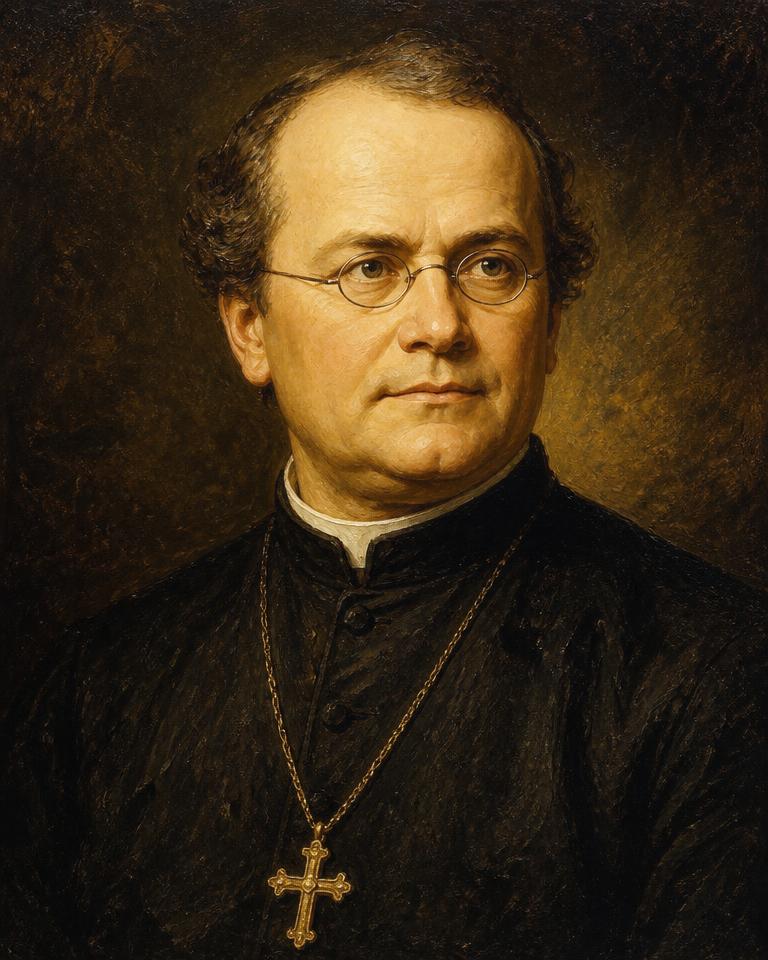
Quick Facts
- Years
- 1822 – 1884
- Category
- Scientists & Inventors
- Subcategory
- Genetics
- Nationality
- Austrian
- Occupation
- Botanist & Geneticist
Gregor Mendel
1822 – 1884 · Austrian · Botanist & Geneticist
Audiobook

Life Lessons from Gregor Mendel
Marcus Alden · 42 min
Gregor Mendel was an Austrian Augustinian friar, teacher, experimental botanist, and pioneer of genetics. Born Johann Mendel in 1822 in the Austrian Empire, he entered the monastery of St. Thomas in Brno, took the religious name Gregor, and pursued scientific questions within a community noted for scholarship. Between 1856 and 1863, he cultivated thousands of pea plants and studied how sharply contrasting traits passed from one generation to the next.
Mendel’s great achievement was to show that inheritance follows regular numerical patterns. From his experiments, he inferred that inherited characteristics are governed by paired, separable factors—what later scientists called genes. His principles of segregation and independent assortment became foundations of classical genetics, although their modern application requires important qualifications.
His 1866 paper, “Experiments on Plant Hybrids,” attracted little attention during his lifetime. Mendel became abbot of his monastery in 1868, and administrative duties increasingly displaced experimentation. Around 1900, botanists brought his work to international notice during renewed research into heredity. Later geneticists connected Mendelian factors with chromosomes and DNA.
Mendel remains important because he united careful experimental design, quantitative analysis, and biological reasoning. His career also illustrates how discoveries can be overlooked, reinterpreted, and debated before becoming central to science.
Quick Facts
| Field | Details |
|---|---|
| Full Name | Johann Mendel; known in religion as Gregor Johann Mendel |
| Common Name(s) | Gregor Mendel; Johann Gregor Mendel |
| Born | 20 July 1822 |
| Died | 6 January 1884 |
| Age at Death | 61 |
| Birthplace | Heinzendorf bei Odrau, Austrian Silesia, Austrian Empire; now Hynčice, Czech Republic |
| Nationality | Austrian; born into a German-speaking family in Austrian Silesia |
| Occupation | Augustinian friar, priest, teacher, botanist, experimental researcher, abbot |
| Historical Era | Nineteenth century; Austrian Empire and Austria-Hungary |
| Famous For | Pea-plant experiments and foundational principles of heredity |
| Political Affiliation | No formal party affiliation recorded |
| Religion | Roman Catholic; Augustinian friar and priest |
| Education | Gymnasium at Troppau; Philosophical Institute at Olmütz; University of Vienna; St. Thomas Monastery, Brno |
| Parents | Anton Mendel and Rosine Schwirtlich Mendel |
| Spouse(s) | None |
| Children | None |
| Major Works | “Experiments on Plant Hybrids” (1866); “On Some Hieracium Hybrids Obtained by Artificial Fertilisation” (1870) |
| Major Achievements | Demonstrated particulate inheritance; formulated principles later called segregation and independent assortment; introduced a rigorous quantitative method into hybrid research |
Early Life
Johann Mendel was born on 20 July 1822 in Heinzendorf bei Odrau, a rural village in Austrian Silesia. The area lies in today’s Czech Republic and was then part of the Austrian Empire. His parents, Anton and Rosine Mendel, were German-speaking farmers. Johann grew up with two sisters, Veronica and Theresia, on a small family holding where fruit trees, crops, livestock, and beekeeping formed part of everyday life.
His father worked both the farm and seasonal labor for a local estate. Johann therefore encountered plant cultivation practically before studying it scientifically. Village teacher Johann Schreiber recognized his academic ability and encouraged further education. Such advancement was difficult for a farming family, and Mendel repeatedly faced financial strain.
He attended school at Leipnik and then the gymnasium at Troppau, now Opava. Illness and poverty interrupted his studies, but he completed them in 1840. He continued at the Philosophical Institute in Olmütz, now Olomouc, studying subjects that included mathematics and physics. His sister Theresia reportedly surrendered part of her dowry to help finance his education; Mendel later assisted her sons in return.
At Olmütz, physicist Friedrich Franz helped shape his intellectual development and recommended the monastery at Brno. In 1843 Mendel entered the Augustinian Abbey of St. Thomas and received the religious name Gregor. The monastery offered material security, a substantial library, and an unusually scholarly community. Abbot Cyrill Napp, himself interested in agriculture and breeding, became an important institutional supporter.
Mendel was ordained a priest in 1847. Parish work proved difficult, partly because he became distressed while ministering to sick people. His superiors redirected him toward teaching. This change, prompted by an apparent weakness, ultimately placed him on the path to experimental science.
Rise to Prominence
Mendel began teaching at a secondary school in Znaim, now Znojmo, in 1849. He was effective in the classroom but lacked the formal certification required for a permanent post. In 1850 he attempted the state teaching examination and failed, doing poorly especially in natural history classification.
Rather than ending his career, the setback led to advanced study. From 1851 to 1853, the monastery sent him to the University of Vienna. There he studied physics, mathematics, botany, chemistry, zoology, and related subjects. Physicist Christian Doppler taught him experimental physics, while botanist Franz Unger discussed cell theory, fertilization, variation, and plant development. Mendel did not earn a university degree, but this training strengthened his ability to design controlled experiments and analyze numerical patterns.
On returning to Brno, he taught physics and natural history at the Realschule. He attempted the certification examination again in 1856 but did not pass. He nevertheless remained a respected substitute teacher for years.
Around 1854 Mendel began preliminary investigations of plant variation, and in 1856 he commenced the systematic pea experiments for which he became famous. He selected garden peas because distinct varieties were available, self-fertilization could maintain stable lines, and controlled cross-pollination was manageable. Over roughly eight years, he studied about 28,000 pea plants, according to a later account by his colleague Gustav von Niessl.
Mendel presented his findings to the Natural Science Society of Brno on 8 February and 8 March 1865. The society published his paper in 1866. Locally, he was known as a teacher, cleric, meteorologist, beekeeper, and naturalist. International scientific fame, however, came only after his death, when researchers around 1900 connected new hybridization results with his neglected publication.
Major Achievements
Establishing Controlled Hybrid Experiments
Mendel chose pea varieties with clear alternative traits, such as round or wrinkled seeds, yellow or green cotyledons, and tall or dwarf stems. He began with lines that bred consistently and controlled fertilization by removing immature anthers and transferring pollen by hand.
This mattered because earlier hybridists often described many traits simultaneously or relied on less sharply defined material. Mendel followed particular characters through successive generations and counted the outcomes. His approach made inheritance experimentally tractable.
The long-term impact extended beyond peas. Controlled crosses, defined variables, large samples, and repeatable counts became characteristic tools of experimental genetics.
Formulating the Principle of Segregation
When Mendel crossed stable lines differing in one character, one form generally appeared in the first hybrid generation while the alternative was hidden. In the next generation, the hidden form reappeared, usually in an approximate three-to-one ratio.
Mendel inferred that hereditary elements occur in pairs and separate during the production of reproductive cells. Offspring receive one element from each parent. This reasoning anticipated the principle later called Mendel’s law of segregation.
Its significance was profound: inheritance could be understood as transmission of discrete information rather than simple blending. Modern genetics explains segregation through the behavior of homologous chromosomes and alleles during meiosis, processes unknown to Mendel.
Identifying Independent Assortment
Mendel also tracked two or more characters at once. He found that factors governing different traits could combine independently, generating predictable classes of offspring. In a standard two-character cross, this produced the famous approximate 9:3:3:1 ratio.
The principle later called independent assortment became a second foundation of classical genetics. It applies most clearly when genes are on different chromosomes or sufficiently far apart on the same chromosome. Linked genes do not assort independently, a limitation established by twentieth-century chromosome research.
Applying Mathematics to Biology
Mendel treated breeding results quantitatively. He counted large populations, organized ratios, compared observed outcomes with theoretical expectations, and constructed a model capable of predicting later generations.
This fusion of mathematics and experiment distinguished his work. Although probability had been used elsewhere, Mendel made numerical relationships central to an explanation of biological inheritance. His method helped establish a broader scientific ideal: biological hypotheses should generate testable predictions.
Publishing “Experiments on Plant Hybrids”
Mendel’s 1866 paper, titled “Versuche über Pflanzen-Hybriden,” described his design, evidence, and theoretical interpretation. He distributed copies to several scientists and corresponded with the prominent botanist Carl Nägeli.
The paper initially had little influence, partly because it appeared in a regional society’s journal, used unfamiliar mathematical reasoning, and addressed questions differently from many contemporary botanists. After 1900, it became one of biology’s canonical publications.
Extending Research Beyond Peas
Mendel investigated hawkweeds, or Hieracium, at Nägeli’s suggestion, and published a paper in 1870. The results did not reproduce the simple pea patterns. Modern botanists know that many hawkweeds reproduce through apomixis, producing seeds without ordinary sexual fertilization.
Although this work frustrated Mendel, it revealed an important scientific truth: reproductive systems differ, and a model’s domain must be tested rather than assumed.
Leadership and Work
Mendel’s working style was patient, systematic, and numerical. He isolated variables, maintained stable lines, made reciprocal crosses, followed generations, and repeated experiments. His training in physics likely encouraged him to search for simple laws beneath complex appearances.
As a teacher, he was remembered as approachable and capable. He taught physics and natural history while conducting experiments in the monastery garden. He also recorded weather observations for many years, investigated bees, and participated actively in Brno’s Natural Science Society and agricultural organizations.
In 1868 Mendel was elected abbot of St. Thomas. The office made him responsible for finances, property, personnel, hospitality, and relations with civil and ecclesiastical authorities. He appears to have been generous toward relatives and students, but the administrative burden sharply reduced his research time.
His most consequential leadership dispute concerned a state tax imposed on religious institutions. Mendel resisted payment because he regarded the measure as unjust and legally objectionable. His persistence showed independence and loyalty to the monastery, yet it also consumed energy and strained relations with officials.
His strengths included persistence, precision, conceptual boldness, and interdisciplinary knowledge. His weaknesses were less scientific than circumstantial: he failed formal teaching examinations, did not promote his results effectively, and could be inflexible during the tax conflict. His experimental model was powerful but not universal, as the hawkweed studies demonstrated.
Personal Life
As a Catholic priest and Augustinian friar, Mendel did not marry and had no children. His closest enduring relationships were with relatives, fellow canons, teachers, students, and scientific colleagues.
He remained grateful to his sister Theresia for supporting his education and later helped educate her sons. Accounts from Brno portray him as kind, humorous, hospitable, and fond of children. He reportedly offered visitors food and enjoyed social life within the abbey rather than living as an isolated recluse.
Mendel had broad interests. Besides cultivating peas and hawkweeds, he bred bees, observed sunspots, kept systematic meteorological records, and participated in horticultural and agricultural discussions. Chess and walking are also associated with his leisure activities.
Health problems recurred throughout his life. Illness disrupted his early education, and emotional distress made parish ministry unsuitable. In later years he became stout and reportedly smoked cigars. He died in Brno on 6 January 1884 from chronic kidney disease, commonly described in modern biographies as nephritis.
Philosophy and Beliefs
Mendel’s religious vocation and scientific work were not presented by him as enemies. St. Thomas was an intellectually active monastery whose members taught, collected specimens, studied agriculture, and participated in civic institutions. Within that environment, investigating nature could be understood as compatible with religious life.
His scientific outlook emphasized regularity, evidence, and mathematical order. He did not merely catalogue hybrids; he sought a general explanation for how characteristics persisted and recombined. His famous conclusion that his experiments appeared to support constant developmental laws captures this orientation.
Mendel’s political views are poorly documented. No reliable evidence places him within a political party. He lived amid Czech-German cultural tensions and major constitutional changes in the Habsburg lands, but his public activity centered on education, science, agriculture, and monastic administration.
Ethically, his conduct suggests a strong sense of obligation—to family members who supported him, to students, and to the abbey he governed. His refusal to yield in the monastery-tax dispute reflected principle, though critics could see it as excessive stubbornness.
Challenges and Controversies
Mendel’s life included repeated institutional failure. He twice failed examinations required for full teaching certification. These failures did not mean he lacked scientific ability; rather, they show that examination success, professional status, and research originality are different measures.
His work was largely ignored before 1900. Historians debate why. Possible reasons include the paper’s provincial venue, limited circulation, mathematical format, specialized terminology, and the scientific community’s stronger interest in species formation than in numerical transmission rules. It is misleading to say that nobody read him: Nägeli and others did, but they did not recognize the paper’s later significance.
The so-called rediscovery of 1900 is also debated. Hugo de Vries, Carl Correns, and Erich von Tschermak published related work and cited Mendel to varying degrees. Correns later emphasized Mendel’s priority. Historians question whether all three independently reached Mendelian principles before reading him and whether “rediscovery” oversimplifies a more gradual reinterpretation.
A statistical controversy arose in 1936 when Ronald A. Fisher argued that Mendel’s published ratios fit theoretical expectations too closely. Fisher admired Mendel’s design but suggested that some observations may have been unconsciously adjusted or selected, perhaps by an assistant. Later scholars have proposed other explanations, including experimental stopping rules, classification practices, selective reporting, or flaws in Fisher’s assumptions. There is no proof that Mendel deliberately falsified data.
Another complication concerns the “laws.” Dominance is not universal; some traits display incomplete dominance or codominance. Independent assortment is limited by genetic linkage. Many human and biological traits involve multiple genes, environmental effects, mitochondrial inheritance, or epigenetic regulation. These exceptions refine Mendel’s framework rather than erase its foundational importance.
Finally, Mendel’s relationship to evolutionary theory is debated. He owned a German edition of Charles Darwin’s On the Origin of Species and annotated it, but his paper did not directly present a theory of evolution. Claims that he was either a committed Darwinian or a scientific opponent of Darwin go beyond the surviving evidence.
Legacy
Mendel died without knowing that he would become known as the “father of genetics.” Around 1900, experimental botanists revived attention to his paper. William Bateson became an energetic advocate of Mendelian inheritance in the English-speaking world and helped establish genetics as a discipline.
During the early twentieth century, chromosome theory connected Mendel’s abstract factors with cellular structures. Thomas Hunt Morgan and his collaborators demonstrated linkage and recombination in fruit flies, explaining both the power and limits of independent assortment. Later molecular biology identified DNA as hereditary material and genes as functional sequences embedded in chromosomes.
Mendelian analysis remains central to plant and animal breeding, medical genetics, genetic counseling, and laboratory research. It helps explain many single-gene disorders, though responsible medical interpretation must account for penetrance, variation, and environmental influence.
Places associated with Mendel preserve his memory. The Augustinian Abbey of St. Thomas in Brno houses the Mendel Museum, and Mendel University in Brno bears his name. His birthplace in Hynčice is maintained as a memorial site. Statues, plaques, schools, streets, scientific societies, and commemorative coins honor him internationally.
His deeper legacy is methodological. Mendel showed that living systems could be studied through controlled crosses, quantitative patterns, and explanatory models. Modern genetics is vastly more complex than his peas, but it still begins by asking how biological information is transmitted.
Interesting Facts
- Mendel was born Johann and adopted the name Gregor when he entered the Augustinian order.
- His birthplace is now in the Czech Republic but belonged to the Austrian Empire in 1822.
- He came from a German-speaking farming family.
- His sister Theresia helped pay for his education.
- Mendel was ordained a Catholic priest in 1847.
- Pastoral care distressed him, so his superiors directed him toward teaching.
- He twice failed the examination for permanent secondary-school certification.
- Christian Doppler was among his teachers at the University of Vienna.
- Mendel examined seven pairs of contrasting pea characteristics in his principal experiments.
- A later colleague estimated that his pea research involved about 28,000 plants.
- He presented his results on two evenings in Brno in 1865.
- His foundational paper appeared in print in 1866.
- He corresponded with Swiss botanist Carl Nägeli.
- Hawkweed reproduction prevented a straightforward repetition of his pea results.
- Mendel kept long-term meteorological observations.
- He conducted experiments with honeybees.
- He became abbot in 1868.
- A prolonged dispute over taxation occupied much of his later life.
- His work gained international recognition around sixteen years after his death.
- Mendel never used the modern terms “gene,” “allele,” or “genetics.”
Famous Quotes
Reliable English wording varies because Mendel wrote mainly in German. The following quotations come from translations of his papers or documented correspondence; context is supplied to avoid treating later paraphrases as exact speech.
-
“The value and utility of any experiment are determined by the fitness of the material to the purpose for which it is used.” — From the introduction to “Experiments on Plant Hybrids” (1866). It explains why his deliberate choice of peas was essential.
-
“It requires indeed some courage to undertake a labor of such far-reaching extent.” — From the 1866 paper. Mendel was acknowledging the scale and duration required for reliable hybrid research.
-
“The selection of the plant group which shall serve for experiments of this kind must be made with all possible care.” — From the 1866 paper. It reflects his emphasis on experimental design.
-
“The hybrids of each pair of differentiating characters are perfectly alike.” — From the 1866 paper, describing uniformity in the first hybrid generation under his conditions.
-
“Those characters which are transmitted entire, or almost unchanged in the hybridization, and therefore in themselves constitute the characters of the hybrid, are termed the dominant.” — From the 1866 paper. This is Mendel’s operational definition of dominance.
-
“The recessive characters, because they are latent in the hybrids, come to light again in the progeny.” — From the 1866 paper in common translation. It summarizes the reappearance of traits in later generations.
-
“The offspring of the hybrids in which several essentially different characters are combined represent the terms of a series of combinations.” — From the 1866 paper. This expresses his combinatorial interpretation of multicharacter crosses.
-
“The experiment just described led to similar results among all the plants.” — From the 1866 paper. It illustrates his concern with recurrence across different characters.
-
“The results of the experiments ... afford the basis for the assumption that short factors may appear in all possible combinations.” — A translation-dependent rendering of his discussion of combinations. “Factors” is often supplied by translators and should not be mistaken for Mendel’s use of the modern word “gene.”
-
“My scientific studies have afforded me great satisfaction.” — From an 1867 letter to Carl Nägeli. It conveys his personal commitment despite limited recognition.
-
“My time will come.” — Widely attributed to Mendel near the end of his life, but the precise wording and documentary chain are uncertain. It should be treated as disputed rather than as a securely recorded quotation.
Timeline
- 1822 — Johann Mendel is born on 20 July in Heinzendorf bei Odrau.
- 1834 — He leaves the village school system for further education at Leipnik.
- 1840 — He completes gymnasium studies at Troppau and enters the Philosophical Institute at Olmütz.
- 1843 — He joins the Augustinian Abbey of St. Thomas in Brno and takes the name Gregor.
- 1847 — He is ordained a priest.
- 1849 — He begins teaching at Znaim.
- 1850 — He fails his first state teaching-certification examination.
- 1851–1853 — He studies science and mathematics at the University of Vienna.
- 1854 — He returns to Brno and teaches at the Realschule; preliminary plant investigations develop.
- 1856 — He fails a second certification attempt and begins systematic pea hybridization.
- 1856–1863 — He conducts his principal pea experiments in the monastery garden.
- 1862 — He becomes a founding participant in the Natural Science Society of Brno.
- 1865 — He presents his pea results on 8 February and 8 March.
- 1866 — “Experiments on Plant Hybrids” is published.
- 1866–1873 — He corresponds with Carl Nägeli about hybridization.
- 1868 — He is elected abbot of St. Thomas.
- 1870 — His paper on Hieracium hybrids is published.
- 1874 onward — He becomes embroiled in conflict over state taxation of monasteries.
- 1884 — Mendel dies in Brno on 6 January.
- 1900 — De Vries, Correns, and Tschermak bring renewed attention to Mendel’s work.
- 1902–1903 — Chromosome theories of inheritance begin connecting Mendelian factors with chromosome behavior.
- 1905 — William Bateson introduces the term “genetics.”
- 1910s — Morgan’s fruit-fly research establishes linkage and expands Mendelian chromosome genetics.
- 1953 — The DNA double-helix model helps explain the molecular basis of heredity.
Frequently Asked Questions
Who was Gregor Mendel?
Gregor Mendel was an Augustinian friar, teacher, botanist, and experimental researcher in Brno. Through controlled crosses of garden peas, he discovered regular numerical patterns in inheritance. He proposed that hereditary determinants occur in pairs, separate during reproduction, and recombine in offspring. These determinants were later called genes. Mendel also studied weather, bees, and other plants, and served as abbot of St. Thomas from 1868 until his death.
Why is Mendel called the father of genetics?
Mendel is given that title because his pea experiments supplied the first powerful quantitative model of particulate inheritance. He showed that traits need not blend irreversibly and that hidden forms can reappear in predictable proportions. Genetics became a named discipline only after his death, and modern heredity includes many phenomena beyond his model. The title therefore recognizes his foundational contribution, not sole authorship of everything genetics later became.
What exactly did Mendel discover?
He discovered that selected pea characteristics followed consistent patterns across generations. Mendel inferred paired hereditary elements, their separation in gamete formation, and the independent combination of elements governing certain different traits. These conclusions became the principles of segregation and independent assortment. He also distinguished dominant from recessive expressions. He did not discover DNA, chromosomes, meiosis, or genes as physical molecular entities.
Why did Mendel use pea plants?
Garden peas offered several experimental advantages. Many stable varieties displayed clear contrasting forms, such as round versus wrinkled seeds. Peas normally self-fertilize, allowing Mendel to maintain true-breeding lines, yet their flowers could also be opened for controlled cross-pollination. They produced numerous offspring within manageable growing seasons. Mendel explicitly stressed that selecting suitable material determined the value of a hybridization experiment.
How many pea plants did Mendel study?
A frequently cited estimate is about 28,000 plants over the course of his research. This figure comes from a later memorial address by Gustav von Niessl rather than from a complete surviving laboratory ledger. Mendel’s published paper nevertheless reports very large counts for individual crosses, confirming that his conclusions rested on thousands of observations rather than a handful of plants.
What is Mendel’s law of segregation?
The principle of segregation states that the two hereditary variants associated with a characteristic separate when reproductive cells are formed, so each gamete receives one. At fertilization, offspring obtain one variant from each parent. Modern biology describes these variants as alleles and explains their segregation through meiosis. Complications can occur through mechanisms such as nondisjunction or meiotic drive, but ordinary segregation remains fundamental.
What is independent assortment?
Independent assortment means that allele pairs for different genes can segregate independently during gamete formation. This produces predictable combinations, including the classical 9:3:3:1 ratio in certain two-gene crosses. The rule is not universal. Genes close together on the same chromosome are linked and tend to travel together, although recombination can separate them. The principle works most directly for unlinked or widely separated genes.
Did Mendel invent the terms gene and genetics?
No. Mendel discussed hereditary “elements” or “factors” in ways that translators render differently, but he did not use the modern vocabulary. William Bateson introduced “genetics” in the early twentieth century. Danish botanist Wilhelm Johannsen coined “gene,” “genotype,” and “phenotype” in 1909. Applying these terms to Mendel is convenient, provided readers remember that their later meanings incorporate discoveries he could not have known.
Was Mendel’s work ignored during his lifetime?
It received very little recognition, but “completely ignored” is too strong. Mendel presented the work publicly, distributed reprints, and exchanged letters with Carl Nägeli. His paper was cited occasionally. However, few readers adopted his model or understood its general importance. Its venue, mathematical style, terminology, and the research priorities of contemporary botany all probably contributed to its limited impact.
Who rediscovered Mendel’s work?
Around 1900, Hugo de Vries, Carl Correns, and Erich von Tschermak published hybridization findings associated with Mendelian ratios. All became linked with the “rediscovery,” though historians debate the independence, timing, and importance of each contribution. Correns strongly asserted Mendel’s priority. The revival was not a single dramatic moment but part of a broader turn toward experimental studies of heredity.
Did Mendel fake his results?
There is no proof of deliberate fraud. Ronald Fisher observed in 1936 that Mendel’s reported numbers matched expected ratios more closely than probability seemed to warrant. Explanations proposed since then include unconscious classification bias, selective presentation, stopping experiments after favorable totals, assistance by others, or statistical assumptions inappropriate to the procedure. Scholars remain divided, but most distinguish possible bias or reporting practices from intentional fabrication.
Why did the hawkweed experiments fail?
Many Hieracium species reproduce through apomixis, forming seeds without normal fertilization. Consequently, crosses may not produce the segregating sexual generations seen in peas. Mendel and Nägeli did not understand this reproductive mechanism. The confusing results did not invalidate the pea work; they showed that different organisms can transmit traits through different biological processes and that sexual inheritance models cannot simply be applied everywhere.
Was Mendel a university professor?
No. He studied at the University of Vienna but did not receive a university degree or professorship. He taught physics and natural history at the Brno Realschule, largely as an uncertified substitute teacher. His repeated failure to pass the state certification examination prevented a standard permanent appointment. Despite this status, he maintained an active scientific life through the monastery and local learned societies.
Did religion conflict with Mendel’s science?
The surviving evidence does not show that Mendel saw a conflict. His Augustinian monastery supported education, scientific collecting, agriculture, and research. Abbot Cyrill Napp encouraged intellectual work, while monastic resources gave Mendel space and time for experiments. His paper argued from observation and numerical reasoning rather than theology. Broader philosophical interpretations should not be attributed to him without evidence.
Did Mendel know about Darwin?
Yes. Mendel owned and annotated a German edition of Darwin’s On the Origin of Species. Both men were concerned with variation, breeding, and heredity, but they asked different questions and used different methods. Mendel did not develop a public evolutionary synthesis, and Darwin apparently never read Mendel’s paper. Historians caution against labeling Mendel simply pro-Darwin or anti-Darwin.
What did Mendel do as abbot?
After his election in 1868, Mendel managed the abbey’s finances, estates, personnel, ceremonies, and relations with public authorities. He supported charitable and educational responsibilities but had far less time for sustained research. A prolonged dispute with the government over a tax on religious institutions dominated part of his tenure. He continued some meteorological and beekeeping activities despite the administrative burden.
How did Mendel die?
Mendel died at the abbey in Brno on 6 January 1884, aged 61. Historical accounts describe chronic kidney disease, often identified as nephritis, as the cause. Leoš Janáček, later a celebrated composer, participated in the music at his funeral. Mendel was buried in Brno’s Central Cemetery, where his grave remains a place of commemoration.
Are Mendel’s laws still valid today?
Yes, within defined conditions. Segregation remains a central rule of chromosome transmission, and independent assortment applies to unlinked genes. However, inheritance also includes linkage, incomplete dominance, codominance, polygenic traits, mitochondrial inheritance, genomic imprinting, variable penetrance, and environmental effects. Modern genetics does not reject Mendel; it embeds his simple, powerful model within a more comprehensive biology.
Lessons We Can Learn
- Choose the right model. Mendel selected peas with clear traits and controllable reproduction. Today, good research still begins with material suited to the question.
- Control variables. He tracked specific characters rather than an undifferentiated mass of variation. Isolating variables makes causal reasoning stronger.
- Count, do not merely describe. His numerical records revealed ratios that visual impressions might miss. Data can expose structures hidden by anecdote.
- Use failure productively. Failed teaching examinations led to further study in Vienna. A setback can redirect a career toward unexpected strengths.
- Build interdisciplinary skills. Physics, mathematics, and botany all shaped his method. Complex problems often reward knowledge drawn from several fields.
- Test ideas across generations. Mendel followed offspring beyond the first cross. Longitudinal evidence prevents premature conclusions.
- Respect the limits of a model. Hawkweeds behaved differently from peas. Useful principles must be tested against biological diversity.
- Communicate discoveries strategically. His paper’s limited early reach shows that publication alone does not guarantee understanding or influence.
- Recognition may be delayed. Mendel’s work became famous after his death. Immediate attention is not a reliable measure of lasting value.
- Revise foundations without discarding them. Linkage and molecular genetics qualified Mendel’s rules while preserving their core. Progress often refines earlier insights.
Related Historical Figures
- Cyrill Napp (1792–1867) — Abbot of St. Thomas who admitted and supported Mendel; his agricultural interests helped create a favorable research environment.
- Friedrich Franz (1783–1860) — Mendel’s physics teacher at Olmütz and an important advocate for his entry into the Brno monastery.
- Christian Doppler (1803–1853) — Viennese physicist who taught Mendel and reinforced his quantitative experimental training.
- Franz Unger (1800–1870) — Botanist whose teaching on cells, variation, and plant development influenced Mendel at Vienna.
- Carl Nägeli (1817–1891) — Prominent botanist who corresponded with Mendel and encouraged the difficult hawkweed experiments.
- Charles Darwin (1809–1882) — Evolutionary theorist whose work addressed variation and descent; Mendel owned and annotated Darwin’s book, though the two never corresponded.
- Hugo de Vries (1848–1935) — Botanist whose 1900 hybrid research helped restore attention to Mendel.
- Carl Correns (1864–1933) — Geneticist who recognized Mendel’s priority and promoted his principles during the 1900 revival.
- William Bateson (1861–1926) — Leading English-language defender of Mendelian inheritance and promoter of genetics as a distinct discipline.
- Thomas Hunt Morgan (1866–1945) — Geneticist whose fruit-fly studies connected inheritance to chromosomes and explained linkage, extending Mendel’s framework.
Watch and Learn
Gregor Mendel · TED-Ed
Related Historical Figures