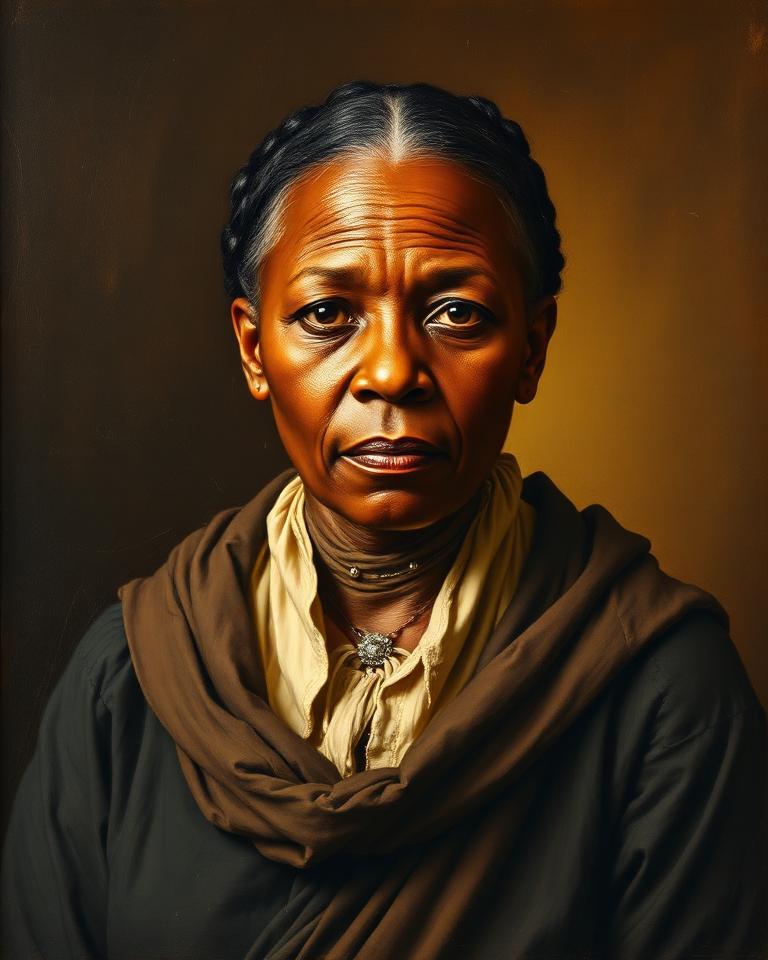
Quick Facts
- Years
- 1822 – 1913
- Category
- Social Reformers & Humanitarians
- Subcategory
- Humanitarians
- Nationality
- American
- Occupation
- Abolitionist
Harriet Tubman
1822 – 1913 · American · Abolitionist
Audiobook

Life Lessons from Harriet Tubman
Marcus Alden · 51 min
Harriet Tubman was an American abolitionist, Underground Railroad conductor, Civil War operative, nurse, and advocate for women’s voting rights. Born enslaved in Maryland around March 1822, she survived forced labor and a traumatic head injury before escaping to Pennsylvania in 1849. Freedom did not end her struggle: she repeatedly returned to Maryland to guide relatives and other enslaved people north, accepting extraordinary personal risk.
Tubman became famous as one of the Underground Railroad’s most effective conductors. Although popular retellings often exaggerate the number of her missions or passengers, historians generally credit her with about 13 journeys and roughly 70 people personally guided to freedom, while she advised many others. During the Civil War, she served the Union as a cook, nurse, scout, spy, and expedition leader. Her intelligence work contributed to the 1863 Combahee River Raid, which liberated more than 700 enslaved people in South Carolina.
After the war, Tubman continued serving others from her home in Auburn, New York. She supported formerly enslaved people, campaigned for women’s suffrage, and helped establish a home for elderly African Americans. Her life illuminates slavery, resistance, war, faith, disability, gender, and citizenship. She remains important not as a figure of legend alone, but as a disciplined organizer whose courage was joined to planning, local knowledge, and collective action.
Quick Facts
| Field | Details |
|---|---|
| Full Name | Araminta Ross; later Harriet Tubman |
| Common Name(s) | Harriet Tubman; “Minty” in childhood; later called “Moses” |
| Born | About March 1822; exact date not recorded |
| Died | March 10, 1913 |
| Age at Death | About 91 |
| Birthplace | Dorchester County, Maryland, United States |
| Nationality | American |
| Occupation | Abolitionist, Underground Railroad conductor, Union scout and spy, nurse, suffragist, humanitarian |
| Historical Era | Antebellum United States, Civil War, Reconstruction, Progressive Era |
| Famous For | Escaping slavery, guiding people to freedom, and assisting the Combahee River Raid |
| Political Affiliation | Republican sympathies after the Civil War; no formal party office recorded |
| Religion | Christian; associated with African American Protestant worship and African Methodist Episcopal Zion circles |
| Education | No formal schooling; denied literacy under slavery |
| Parents | Harriet “Rit” Green and Benjamin Ross |
| Spouse(s) | John Tubman, married about 1844; Nelson Davis, married 1869 |
| Children | Adopted daughter, Gertie Davis |
| Major Works | Underground Railroad missions; Union intelligence work; Combahee River Raid; support for the Harriet Tubman Home |
| Major Achievements | Personally guided about 70 enslaved people to freedom; aided Union operations; advocated abolition, relief, and women’s suffrage |
Early Life
Araminta Ross was born enslaved in Dorchester County on Maryland’s Eastern Shore. Her birth year is usually given as 1822, based on historical research, although surviving records offer conflicting ages. She was one of several children of Harriet Green, known as Rit, and Benjamin Ross. Rit was enslaved by the Brodess family, while Ben was enslaved by Anthony Thompson. Because slavery followed the legal status of the mother, their children were born enslaved.
Family separation shaped Tubman’s childhood. Three of her sisters were sold away, and the family could not recover them. Tubman later recalled her mother resisting an effort to sell one of her sons. That example of resistance, together with Ben’s knowledge of forests, waterways, and survival, influenced her development.
Tubman received no formal education and was never taught to read or write. As a child, she was hired out to other households. She trapped muskrats, performed domestic labor, and worked in fields and woods. She endured hunger, beatings, sickness, and harsh working conditions.
During adolescence, Tubman was struck in the head by a heavy metal weight thrown by an overseer at another enslaved person. The injury nearly killed her. For the rest of her life she experienced headaches, sudden sleep episodes, and vivid dreams or visions. Modern writers have proposed temporal-lobe epilepsy or narcolepsy, but no retrospective diagnosis can be certain.
Her youth unfolded amid expanding plantation agriculture and an interstate slave trade that routinely broke apart Maryland families. At the same time, free Black communities, Black sailors, religious networks, and antislavery activists created channels through which information about escape circulated.
Around 1844, Araminta married John Tubman, a free Black man. She adopted her mother’s first name, Harriet, and her husband’s surname. Maryland law did not make her free through marriage, and any children she bore would have inherited her enslaved status.
Rise to Prominence
In 1849, after the death of enslaver Edward Brodess, Tubman feared that she and members of her family would be sold. She first attempted to escape with two brothers, but they turned back. Soon afterward, she fled alone, traveling through a covert network later called the Underground Railroad. She reached Pennsylvania, where slavery had been abolished.
The passage of the Fugitive Slave Act in 1850 transformed her situation. Federal law empowered slaveholders and their agents to pursue alleged fugitives in free states, while accused people had few legal protections. Tubman consequently helped some freedom seekers reach Canada, beyond the immediate reach of American law.
Instead of remaining safely in the North, Tubman returned to Maryland repeatedly. She relied on secrecy, trusted contacts, knowledge of terrain, careful timing, and assistance from Black and white antislavery networks. Her passengers included siblings, nieces, nephews, and her parents. Historians commonly estimate that she made about 13 rescue missions and personally led approximately 70 people out of slavery. She also gave instructions to others who escaped independently.
Her reputation spread through abolitionist circles. William Still recorded Underground Railroad cases in Philadelphia, while Thomas Garrett assisted freedom seekers in Delaware. Tubman also developed relationships with Frederick Douglass, John Brown, and other antislavery activists. Brown admired her knowledge and called her “General Tubman.” She helped him recruit supporters, although illness apparently prevented her from joining his 1859 raid on Harpers Ferry.
By the Civil War, Tubman was already a nationally known symbol of resistance. Her fame grew further through Union service and later biographies, especially Sarah H. Bradford’s books, which raised money for her but sometimes blurred documentation and heroic storytelling.
Major Achievements
Escaping Slavery and Returning for Others
Tubman’s 1849 escape was itself an extraordinary act in a society that criminalized Black mobility. She then transformed personal freedom into a sustained rescue campaign.
Her journeys mattered because they reunited families, undermined slaveholders’ claims to human property, and demonstrated enslaved people’s central role in destroying slavery. Their long-term impact also lies in the model they provide of resistance as organized, communal work rather than isolated heroism.
Conducting Underground Railroad Missions
Over roughly a decade, Tubman guided about 70 people to freedom on approximately 13 trips. Contrary to folklore, the Underground Railroad was not a literal railway or a single centrally managed organization. It was a flexible network of routes, homes, transportation, communication, and trusted participants.
Tubman’s record reflected preparation rather than luck. She adjusted routes, traveled discreetly, and worked through dependable contacts. She later said she never lost a passenger. No documented passenger is known to have been recaptured while under her direct guidance.
Rescuing and Relocating Her Family
Tubman’s missions were deeply personal. She helped several brothers and other relatives escape. In 1857, she brought her elderly parents out of Maryland, where her father faced danger after assisting fugitives.
She eventually settled them near Auburn, New York. This work shows that abolition was also a struggle to reconstruct families damaged by sale, displacement, and insecure legal status.
Serving the Union During the Civil War
Tubman worked in Union-held portions of South Carolina as a cook, laundress, nurse, scout, and intelligence operative. She recruited and coordinated Black scouts who understood local waterways and Confederate positions.
Her work helped Union forces operate in unfamiliar terrain. It also challenges older accounts of the Civil War that minimized Black women’s military and intelligence contributions.
Helping Lead the Combahee River Raid
On June 2, 1863, Tubman accompanied Colonel James Montgomery and Union troops on a raid along South Carolina’s Combahee River. Intelligence gathered through Tubman and her network helped federal gunboats avoid mines, strike plantations, seize resources, and bring away more than 700 enslaved people.
Tubman is often described as the first American woman to lead an armed military expedition. The exact terminology requires care because Montgomery held formal command, but Tubman unquestionably played a leading intelligence and operational role. The raid weakened Confederate labor systems and converted hundreds of enslaved people into free people, workers, and potential Union recruits.
Advocating Women’s Suffrage and Community Care
After the war, Tubman spoke at meetings for women’s voting rights and worked alongside activists including Susan B. Anthony and Black clubwomen. Her speeches connected women’s citizenship with her own record of sacrifice.
In Auburn, she used her limited resources to help relatives, veterans, displaced people, and the poor. She donated property to support a home for aged and indigent African Americans. The Harriet Tubman Home embodied her belief that freedom required material care as well as legal rights.
Leadership and Work
Tubman’s leadership was practical, disciplined, and relational. She did not command through formal office. She earned trust through experience, courage, spiritual conviction, and detailed knowledge.
Her methods included:
- Gathering information through trusted personal networks.
- Maintaining secrecy and limiting unnecessary disclosure.
- Adapting routes and schedules to changing risks.
- Using environmental knowledge, including forests and waterways.
- Placing collective safety above recognition or comfort.
- Combining direct action with fundraising, public speaking, and caregiving.
Tubman could be uncompromising. According to Bradford’s account, she carried a revolver and warned frightened passengers against turning back because they could expose the group. The famous claim that she threatened to shoot escapees is based largely on later recollection and should not be treated as a documented instance of her killing anyone. There is no evidence that she did so.
Her strengths included decisiveness, endurance, situational awareness, and the ability to inspire confidence. Her lack of literacy was an imposed limitation, not evidence of intellectual weakness. It did, however, force her to depend on memory, oral communication, and literate allies in legal and financial matters. She was also chronically underfunded and sometimes trusted people or arrangements that did not protect her interests.
Personal Life
Tubman’s first husband, John Tubman, was free. When she returned after escaping and sought to bring him north, she learned that he had married another woman. Tubman continued her rescue work without him. John was killed in Maryland in 1867.
In 1869, she married Nelson Davis, a Civil War veteran who was considerably younger than she was. Their marriage lasted until his death in 1888. They adopted a daughter named Gertie.
Tubman’s Auburn home became a center of family and community life. She supported relatives and welcomed people in need despite persistent financial strain. Friends and allies included Frederick Douglass, William H. Seward and his family, Thomas Garrett, Sarah H. Bradford, Martha Coffin Wright, and various abolitionists and suffragists.
Her health remained difficult. The childhood head injury caused lifelong pain and sleep disturbances. In the late 1890s, she underwent brain surgery in Boston to relieve symptoms. Accounts say she declined anesthesia and bit on a bullet, but this vivid detail comes from later reporting and cannot be independently verified in full.
Those who knew her described a small, physically resilient woman with forceful presence, humor, faith, and determination. In old age, pneumonia weakened her. She died at the home established in her name on March 10, 1913.
Philosophy and Beliefs
Tubman’s worldview centered on Christian faith, freedom, justice, and service. Biblical stories—especially Exodus and deliverance from bondage—gave language to her struggle. She interpreted some dreams and sudden intuitions as divine guidance. Her spirituality combined Christian teaching with an experiential religious culture shaped within enslaved and free Black communities.
Politically, she believed slavery had to end through action, not merely moral disapproval. She assisted fugitives, supported John Brown’s revolutionary aims, and aided the Union war effort. Her approach therefore ranged from covert rescue to armed wartime liberation.
Tubman also understood freedom broadly. Legal emancipation was incomplete without safety, family unity, food, shelter, economic opportunity, care for the elderly, and political voice. Her suffrage activism reflected the conviction that women who had labored and sacrificed for the nation deserved full citizenship.
She did not leave a systematic written philosophy because she was denied literacy. Her beliefs must be reconstructed from reported speeches, interviews, actions, and accounts by associates. Those sources reveal consistency but require attention to editors who rendered her words in dialect or reshaped stories for particular audiences.
Challenges and Controversies
Tubman faced slave catchers, hostile law, racism, sexism, poverty, chronic illness, and the possibility of betrayal. The federal government also failed to compensate her adequately for wartime service. After decades of petitions, she received a widow’s pension based on Nelson Davis’s service and later an increase that acknowledged her own nursing work, though not full recognition as a scout and spy.
Several controversies concern historical memory rather than misconduct:
- Rescue totals: Older accounts claimed that Tubman rescued 300 people in 19 missions. Modern scholarship generally supports about 13 missions and roughly 70 people personally guided, plus many others advised.
- The $40,000 reward: A widely repeated story says authorities offered $40,000 for her capture. Historians have found no contemporary notice supporting that figure. Advertisements did offer rewards for particular escapees, including Tubman and her brothers, but not the legendary nationwide sum.
- “Moses” and heroic mythology: Tubman was indeed compared to Moses during her lifetime. Yet portraying her as a solitary superhero can erase the free and enslaved Black communities, mariners, safe-house operators, and abolitionists who made escape possible.
- John Brown: Tubman admired Brown and supported his antislavery objective. Critics viewed Brown’s raid as reckless violence; supporters saw resistance as justified against a violent slave system. Tubman did not take part in the raid itself.
- Military title: Calling her a formal general or commander can overstate her official rank. Calling her merely a nurse, however, understates her documented intelligence and operational contribution.
A balanced account preserves her exceptional courage without relying on unsupported numbers or legends.
Legacy
Tubman’s influence spans abolition, military history, women’s history, disability history, and civil rights. She demonstrated that enslaved people were not passive recipients of emancipation; they gathered intelligence, escaped, organized, fought, negotiated, and liberated others.
Her home and associated properties in Auburn are preserved through the Harriet Tubman National Historical Park and partner organizations. Maryland’s Harriet Tubman Underground Railroad National Historical Park and State Park interpret the landscape of her early life. The National Park Service also administers the Harriet Tubman Underground Railroad National Historical Park in Maryland and the national historical park in Auburn.
Memorials, schools, roads, museums, and statues bear her name. In 2021, she was inducted into the U.S. Military Intelligence Corps Hall of Fame. In 2022, the United States issued a commemorative silver dollar program authorized in her honor, with coins released in 2024.
A plan announced in 2016 proposed placing Tubman on the front of the $20 bill, replacing Andrew Jackson, with Jackson represented elsewhere in the design. The project has experienced delays and remains a subject of public discussion.
Tubman is still studied because her record unites moral conviction with strategic action. Modern scholarship increasingly restores the networks around her while also clarifying the scale and originality of her leadership.
Interesting Facts
- Tubman was born Araminta Ross and was called “Minty” as a child.
- Her exact birth date is unknown; historians generally place her birth around March 1822.
- She adopted the name Harriet around the time of her first marriage.
- Her mother was known as Rit, and her father as Ben.
- She never learned to read or write because slavery denied her schooling.
- A childhood head injury affected her health for the rest of her life.
- She escaped slavery in 1849.
- Historians credit her with about 13 rescue missions.
- She personally guided approximately 70 people to freedom.
- No passenger is documented as having been captured while directly under her guidance.
- She helped rescue her elderly parents in 1857.
- John Brown called her “General Tubman.”
- She served with Union forces in coastal South Carolina.
- Her intelligence aided the Combahee River Raid in 1863.
- The raid freed more than 700 enslaved people.
- She remarried in 1869 and adopted a daughter.
- She campaigned for women’s suffrage after the Civil War.
- She donated property for a home serving elderly African Americans.
- She received only limited federal compensation for her wartime work.
- She was buried with military honors at Fort Hill Cemetery in Auburn.
Famous Quotes
Tubman was not literate, so her words survive through reporters, biographers, and acquaintances. Wording varies among sources; context is essential.
-
“I was conductor of the Underground Railroad for eight years, and I can say what most conductors can’t say—I never ran my train off the track and I never lost a passenger.” Reported from a suffrage meeting in 1896; it summarizes her pride in her rescue record.
-
“There was one of two things I had a right to, liberty or death.” Recounted in Sarah H. Bradford’s 1869 biography; it expresses Tubman’s determination, though Bradford shaped the printed wording.
-
“If I could not have one, I would have the other.” The continuation of the preceding statement; it frames escape as a claim to natural rights.
-
“I had crossed de line of which I had so long been dreaming.” Bradford attributed this recollection to Tubman after her escape. Its printed dialect reflects nineteenth-century editorial practice.
-
“I was free; but there was no one to welcome me to the land of freedom.” Also reported by Bradford; it conveys the loneliness that accompanied liberation without family.
-
“I would fight for my liberty so long as my strength lasted.” Bradford’s account connects this declaration to Tubman’s resolve not to be re-enslaved.
-
“God’s time is always near.” Reported in Bradford’s writings in connection with Tubman’s faith and confidence in deliverance.
-
“Slavery is the next thing to hell.” Attributed to Tubman in Bradford’s biography; the statement reflects her direct experience of enslavement.
-
“We saw the lightning and that was the guns; and then we heard the thunder and that was the big guns.” Reported in an 1863 newspaper account of Tubman describing the Combahee operation; wording may have been rendered by the reporter.
-
“I freed a thousand slaves. I could have freed a thousand more, if only they knew they were slaves.” Disputed and almost certainly spurious. No reliable contemporary source documents it, and its numerical claim conflicts with established evidence.
Timeline
- About 1822 — Araminta Ross is born enslaved in Dorchester County, Maryland.
- About 1830s — She is hired out for domestic, trapping, and agricultural work.
- About 1830s — A severe head injury causes lifelong medical problems.
- About 1844 — She marries John Tubman and takes the name Harriet Tubman.
- 1849 — Tubman escapes from Maryland to Pennsylvania.
- 1850 — The Fugitive Slave Act increases danger for freedom seekers in the North.
- 1850–1860 — She conducts repeated rescue missions into Maryland.
- 1851 — She learns John Tubman has remarried and continues her work without him.
- 1857 — She rescues her parents and relocates them north.
- 1858–1859 — She assists John Brown’s organizing but does not join the Harpers Ferry raid.
- 1859 — She acquires property near Auburn, New York, from William H. Seward.
- 1861 — The Civil War begins.
- 1862 — She goes to Union-held South Carolina and works among formerly enslaved refugees.
- 1863 — Tubman helps plan and execute the Combahee River Raid.
- 1865 — The Civil War ends and the Thirteenth Amendment abolishes slavery nationally, except as punishment for crime.
- 1869 — Sarah H. Bradford publishes a biography; Tubman marries Nelson Davis.
- 1870s — Tubman and Davis adopt Gertie.
- 1886 — Bradford publishes a second Tubman biography.
- 1888 — Nelson Davis dies.
- 1890s — Tubman participates in women’s suffrage meetings.
- 1895 — Her federal widow’s pension is increased after a prolonged struggle.
- 1896 — She speaks at a National Association of Colored Women gathering.
- 1898 — Legislation raises her pension, recognizing nursing service.
- 1903 — She transfers property to the AME Zion Church for a home for elderly Black people.
- 1908 — The Harriet Tubman Home opens ceremonially.
- 1911 — Frail health leads her to reside at the home.
- 1913 — Tubman dies on March 10 and is buried in Auburn.
- 2014 — Harriet Tubman Underground Railroad National Historical Park is established in Maryland.
- 2017 — Harriet Tubman National Historical Park is established in Auburn.
- 2021 — She enters the Military Intelligence Corps Hall of Fame.
- 2024 — Harriet Tubman commemorative coins are released by the U.S. Mint.
Frequently Asked Questions
When and where was Harriet Tubman born?
Tubman was born in Dorchester County on Maryland’s Eastern Shore, probably around March 1822. Her exact date is not securely documented because enslaved people’s births were often recorded incompletely or only as property information. Evidence gives conflicting ages, so responsible biographies use “about 1822” rather than presenting a precise birthday as certain. She was born Araminta Ross to Harriet Green and Benjamin Ross, both enslaved at the time.
What was Harriet Tubman’s birth name?
Her birth name was Araminta Ross, and relatives called her “Minty.” Around the time she married John Tubman in the 1840s, she adopted the first name Harriet, likely in honor of her mother, Harriet Green. She also took her husband’s surname. The change marked a personal transition, but marriage to a free Black man did not alter her legal status as an enslaved woman.
How did Harriet Tubman escape slavery?
Tubman escaped Maryland in 1849 after fearing sale following Edward Brodess’s death. An initial attempt with two brothers ended when they turned back. She then fled alone, using secrecy, environmental knowledge, and assistance from an Underground Railroad network. The exact route is not fully documented, which was essential to its safety. She reached Pennsylvania but later traveled farther north as federal fugitive-slave enforcement intensified.
What was the Underground Railroad?
The Underground Railroad was not a railroad or one formal organization. It was a shifting network of Black communities, abolitionists, safe locations, guides, transportation workers, and covert routes that helped enslaved people escape. Railroad terms such as “conductor” became metaphors for participants’ roles. Enslaved people themselves initiated escapes and accepted the greatest risks. Tubman became a conductor who returned south to guide groups through portions of their journeys.
How many people did Harriet Tubman rescue?
Modern historians generally conclude that Tubman personally guided about 70 people to freedom over approximately 13 missions. She also supplied information and encouragement to many others who escaped without her direct guidance. The older claim that she rescued 300 people in 19 trips grew from early biographies and later commemoration. Correcting the number does not diminish her achievement; every journey exposed her to capture, violence, and re-enslavement.
Did Harriet Tubman ever lose a passenger?
Tubman stated that she never lost a passenger, and no one is documented as having been captured while directly traveling under her guidance. The phrase does not mean that every person she knew or advised always escaped successfully. It refers to her work as a conductor. Her record reflects careful planning, secrecy, route knowledge, reliable contacts, and an insistence that groups remain committed once a dangerous journey began.
Was there a $40,000 reward for Harriet Tubman?
No reliable contemporary evidence supports the famous claim of a $40,000 reward specifically for Tubman. A Maryland advertisement offered money for the capture of Tubman and two brothers after their initial escape, but the amounts were far smaller. The enormous figure appears to be a later legend. Historians distinguish between her real danger and unsupported reward stories: slave catchers and federal law posed grave threats even without a nationally advertised bounty.
Why was Harriet Tubman called Moses?
Abolitionists compared Tubman to the biblical Moses because she led enslaved people away from bondage. The comparison drew upon the Exodus story, which held special significance in Black Christian traditions. It reflected both her rescue work and her strong religious faith. The nickname was used during her lifetime, unlike some later legends. Still, the metaphor can oversimplify matters if it hides the many communities and collaborators involved in each escape.
What illness did Harriet Tubman have?
After an overseer struck her head with a metal weight during adolescence, Tubman suffered headaches, sleep attacks, and vivid dreams or visions throughout her life. Modern observers have suggested narcolepsy, epilepsy, or neurological trauma, but a definite diagnosis is impossible from surviving descriptions. Tubman interpreted many experiences through faith. Her disability did not prevent demanding work, though it created pain and danger during travel and military service.
What did Harriet Tubman do during the Civil War?
Tubman served Union efforts in coastal South Carolina as a cook, laundress, nurse, scout, recruiter, and intelligence operative. She organized Black scouts with local knowledge and gathered information about Confederate positions and river hazards. Her network contributed to the Combahee River Raid. The government did not fully recognize or compensate the breadth of this work during her lifetime, leading to a long pension campaign after the war.
What was the Combahee River Raid?
The Combahee River Raid was a Union operation in South Carolina on June 2, 1863. Colonel James Montgomery formally commanded troops, while Tubman supplied important intelligence and accompanied the expedition. Federal gunboats traveled upriver, struck plantations, removed Confederate resources, and carried away more than 700 enslaved people. It was both a military attack and a mass liberation operation, demonstrating how emancipation and Union strategy had become intertwined.
Was Harriet Tubman a spy?
Yes, “spy” is a reasonable description, although her official status was not always clearly recorded. In Union-held South Carolina, she gathered intelligence and coordinated scouts—often Black men with detailed local knowledge—who reported on roads, waterways, mines, Confederate forces, and plantations. Her contribution to the Combahee raid is well established. She also performed nursing and relief work, so reducing her wartime role to any single job is misleading.
Did Harriet Tubman know Frederick Douglass?
Yes. Tubman and Frederick Douglass belonged to overlapping antislavery networks and respected one another’s work. In an 1868 letter, Douglass praised her secret, dangerous service and contrasted it with his more publicly recognized activism. Their careers differed: Douglass became famous as an orator, writer, and editor, while Tubman’s most consequential antebellum work depended upon secrecy. Both later supported broader civil and political rights.
Did Harriet Tubman support John Brown?
Tubman supported Brown’s goal of destroying slavery and helped him contact potential recruits. Brown admired her experience and called her “General Tubman.” She did not participate in his October 1859 raid on Harpers Ferry, reportedly because illness or circumstances kept her away. Interpretations differ over Brown’s use of violence, but Tubman’s support shows that she regarded slavery itself as a violent system that could justify armed resistance.
Did Harriet Tubman fight for women’s suffrage?
Yes. After the Civil War, Tubman appeared at women’s rights and suffrage gatherings, particularly during the 1890s. She worked in a movement marked by disagreements over race, strategy, and priorities. Tubman’s own life offered a powerful argument for citizenship: she had labored against slavery and served the Union yet still lacked the vote. Her advocacy connected women’s political rights with Black freedom and national service.
Was Harriet Tubman paid for her military service?
Tubman received some wartime wages and support irregularly, but the federal government did not fully compensate her for her work as a scout, spy, and expedition participant. She spent decades seeking recognition. She eventually received a widow’s pension based on Nelson Davis’s service, followed by an increase acknowledging her own nursing work. The outcome remained less than the full military pension she and supporters believed her service deserved.
Who were Harriet Tubman’s husbands and children?
Tubman married John Tubman, a free Black man, around 1844. After her escape, he chose not to join her and had married another woman. In 1869, Harriet married Nelson Davis, a Union veteran. They remained together until his death in 1888 and adopted a daughter named Gertie. Tubman also maintained extensive obligations to parents, siblings, nieces, nephews, and other members of her household.
Where is Harriet Tubman buried?
Tubman is buried at Fort Hill Cemetery in Auburn, New York. Her funeral included military honors and drew community leaders and mourners. Auburn had been her home for decades and was the site of her humanitarian work. Visitors can also learn about her at the nearby Harriet Tubman National Historical Park, which preserves places associated with her household, church community, and home for older African Americans.
Will Harriet Tubman appear on the $20 bill?
The U.S. Treasury announced in 2016 that Tubman would replace Andrew Jackson on the front of a redesigned $20 note, with Jackson retained elsewhere in the design. The project encountered administrative and production delays. As of 2026, Tubman has not entered circulation on the note, and implementation details remain subject to federal decisions and anti-counterfeiting requirements. The proposal reflects an ongoing debate about whom the nation commemorates on public currency.
Lessons We Can Learn
- Freedom requires action. Tubman escaped and then returned for others; values become consequential when translated into responsible action.
- Preparation supports courage. Her missions depended on information, timing, and routes, showing that bravery is strongest when paired with planning.
- Networks matter. She worked with families, Black communities, and abolitionists; durable change rarely comes from one person alone.
- Protect vulnerable information. Underground Railroad secrecy saved lives, a reminder to handle sensitive knowledge ethically.
- Adapt to changing conditions. After the Fugitive Slave Act, Tubman changed destinations and methods; effective leaders revise plans when risks shift.
- Lived experience is expertise. Her knowledge of slavery, terrain, and people proved vital to Union intelligence operations.
- Service has many forms. Tubman guided escapes, nursed patients, gathered intelligence, raised funds, and cared for elderly people.
- Challenge unequal recognition. Her pension struggle shows how race and gender can shape whose labor receives official credit.
- Correct myths without diminishing achievement. Accurate rescue totals make her story more credible and preserve the collective context.
- Think beyond legal reform. Tubman linked emancipation to housing, care, family, and voting rights; genuine freedom needs institutions that sustain it.
Related Historical Figures
- Frederick Douglass — Fellow formerly enslaved abolitionist who admired Tubman’s dangerous, largely secret work.
- John Brown — Militant abolitionist whom Tubman assisted with contacts before the Harpers Ferry raid.
- William Still — Black abolitionist and Philadelphia Underground Railroad organizer who documented freedom seekers.
- Thomas Garrett — Delaware Quaker abolitionist who assisted Tubman and many escaping enslaved people.
- William H. Seward — Antislavery politician who sold Tubman property near Auburn and later served as secretary of state.
- Sarah H. Bradford — Author of early Tubman biographies that raised funds while also helping create enduring legends.
- Colonel James Montgomery — Union officer who formally commanded the Combahee River Raid in which Tubman played a leading role.
- Susie King Taylor — Black Civil War nurse, educator, and memoirist whose service illuminates Black women’s wartime contributions.
- Sojourner Truth — Formerly enslaved abolitionist and women’s rights advocate whose causes overlapped with Tubman’s.
- Susan B. Anthony — Suffrage leader who shared platforms and reform networks with Tubman after the Civil War.
Related Historical Figures