Quick Facts
- Years
- 1863 – 1947
- Category
- Scientists & Inventors
- Nationality
- American
- Occupation
- Industrialist, automobile manufacturer, and business innovator
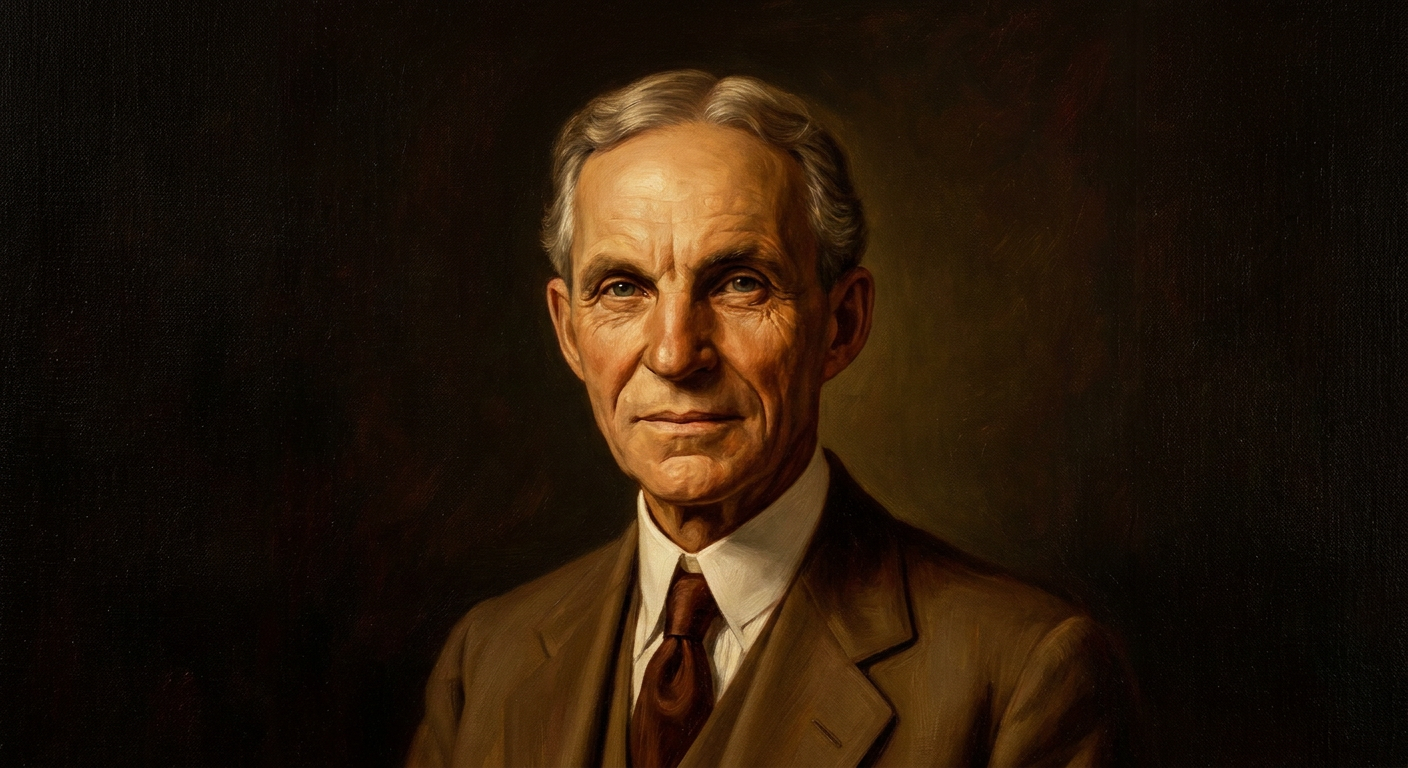
Henry Ford
1863 – 1947 · American · Industrialist, automobile manufacturer, and business innovator
Recommended Audiobooks
Listen next from Marcus Alden

Life Lessons from James Clerk Maxwell
Marcus Alden · 42 min

Life Lessons from Archimedes
Marcus Alden · 48 min
Henry Ford transformed the automobile from an expensive novelty into a practical product within reach of millions of ordinary Americans. Born on a Michigan farm in 1863, he became a skilled machinist, engineer, racing-car builder, and founder of the Ford Motor Company. His Model T, introduced in 1908, was durable, relatively affordable, and suited to poor roads. Ford's moving assembly line then accelerated production so dramatically that it became an international symbol of modern industry.
Yet Ford's importance extends beyond cars. His factories influenced manufacturing, wages, consumer culture, transportation, urban growth, agriculture, and the organization of work. The celebrated five-dollar workday helped Ford retain employees and drew worldwide attention, although it came with intrusive supervision and strict conditions. His company also fought unions, while Ford's newspaper spread antisemitic propaganda with lasting consequences.
Ford therefore remains both an industrial pioneer and a deeply controversial public figure. He demonstrated how engineering, standardization, and scale could lower prices, but his methods could also reduce workers' control and concentrate enormous power in one employer. Students still examine him because his life captures the promises and dangers of twentieth-century mass production: greater mobility and material abundance alongside social conflict, environmental change, prejudice, and corporate power.
Quick Facts
| Field | Details |
|---|---|
| Full Name | Henry Ford |
| Common Name(s) | Henry Ford |
| Born | July 30, 1863 |
| Died | April 7, 1947 |
| Age at Death | 83 |
| Birthplace | Springwells Township, Wayne County, Michigan, United States |
| Nationality | American |
| Occupation | Industrialist, engineer, automobile manufacturer |
| Historical Era | Second Industrial Revolution; Progressive Era; early twentieth century |
| Famous For | Founding Ford Motor Company, the Model T, and large-scale moving assembly-line production |
| Political Affiliation | Publicly independent; Democratic candidate for the U.S. Senate in 1918 |
| Religion | Raised Episcopalian; religious and moral language influenced his public outlook |
| Education | Local one-room schools; no university degree; practical training as a machinist |
| Parents | William Ford and Mary Litogot Ford |
| Spouse(s) | Clara Jane Bryant Ford, married 1888 |
| Children | Edsel Bryant Ford |
| Major Works | My Life and Work; Today and Tomorrow; Moving Forward; Greenfield Village and the Henry Ford Museum |
| Major Achievements | Model T, moving assembly line, five-dollar day, mass automobile production, Fordson tractor |
Early Life
Henry Ford was the eldest surviving child of William Ford, an Irish-born farmer, and Mary Litogot Ford, whose family had Belgian roots. He grew up on a prosperous family farm near Dearborn, Michigan. The United States was undergoing rapid industrialization, but farm work still depended heavily on human effort, horses, and relatively simple equipment.
Ford showed an early fascination with machinery. Family recollections describe him dismantling watches and repairing them for neighbors. Such stories were later polished by Ford's publicity machine, but his mechanical aptitude is well established. He disliked repetitive farm labor and became convinced that machines could reduce physical drudgery.
His mother died in 1876, when Ford was thirteen. In 1879 he left the farm for Detroit, where he worked as an apprentice machinist at James F. Flower & Brothers and later at the Detroit Dry Dock Company. Wages were modest, so he repaired watches after hours. He also learned about steam engines while working for the Westinghouse company in Michigan.
Ford attended local schools but received no advanced formal education. His real classroom was the workshop. He learned by taking machines apart, observing skilled mechanics, testing ideas, and correcting failures—a working method that remained central throughout his career.
Rise to Prominence
Ford married Clara Bryant in 1888. Supported partly by his father, the couple initially lived on a farm, where Ford operated a sawmill rather than embracing conventional agriculture. Their only child, Edsel, was born in 1893.
That year Ford became chief engineer at the Edison Illuminating Company of Detroit. The position gave him financial security and enough free time to experiment with gasoline engines. In June 1896 he completed the Quadricycle, a light vehicle with four bicycle-style wheels. It was not America's first automobile, but it proved that Ford could design a working gasoline-powered car.
Ford met Thomas Edison at an industry meeting in 1896 and received encouragement to continue his experiments. Edison became a friend and symbolic mentor, although Ford's later publicity sometimes exaggerated the direct technical influence.
His first automobile venture, the Detroit Automobile Company, was established in 1899 but failed because its cars were costly and unsatisfactory. The Henry Ford Company followed in 1901, but disagreements with investors caused Ford to leave; that business became the Cadillac Motor Car Company under Henry Leland.
Racing restored Ford's reputation. In 1901 he defeated the prominent driver Alexander Winton in a race at Grosse Pointe. His powerful racing cars, including the 999, attracted investors and publicity. In 1903 Ford and a group led financially by coal dealer Alexander Malcomson founded the Ford Motor Company. James Couzens provided crucial administrative and financial discipline.
Early models sold well, but Ford's ambition was not merely to build luxury machines. He wanted a simple, dependable car produced in large quantities. That goal culminated in the Model T.
Major Achievements
The Model T
Introduced on October 1, 1908, the Model T combined a lightweight vanadium-steel frame, high ground clearance, simple controls, and an engine that could tolerate rough conditions. It was designed for a country where paved roads remained uncommon.
As production rose, Ford repeatedly lowered the price. More than 15 million Model Ts were built before production ended in 1927. It was not the first affordable automobile, but its extraordinary scale made personal motoring a central part of American life.
The Moving Assembly Line
Ford did not invent either the assembly line or interchangeable parts. Manufacturers, meatpacking plants, bicycle makers, firearms producers, and others had developed important precedents. Ford's achievement was to combine existing ideas into a highly coordinated system for automobile production.
At the Highland Park plant in 1913, workers and managers introduced moving assembly techniques in stages. The chassis moved past workers, each performing a limited task. Assembly time fell sharply—from more than twelve worker-hours for a chassis to roughly ninety minutes in its most efficient form.
The system lowered costs and became a global model. It also made many jobs monotonous, tightly paced, and physically demanding. This mixture of cheap goods and regimented labor became known as Fordism.
The Five-Dollar Day
In January 1914 Ford announced a five-dollar daily wage for qualifying workers, approximately double the prevailing rate for many industrial jobs. He also shortened the standard working day from nine hours to eight, enabling three shifts.
The policy reduced costly employee turnover and absenteeism while generating enormous publicity. It helped some workers become consumers of mass-produced goods, including cars. However, the full payment was initially tied to behavioral standards enforced by Ford's Sociological Department, which investigated workers' homes, finances, and personal habits. Women and some other employees did not receive equal access under the earliest rules.
Fordson Tractors and Global Expansion
Ford applied mass-production principles to agriculture through the Fordson tractor, introduced during the First World War. Its relatively low price encouraged farm mechanization, although tractors also contributed to economic and environmental changes in rural life.
Ford established factories and assembly operations across the world. The company became a multinational enterprise, and its production methods influenced industrial development from Europe to Latin America and the Soviet Union.
River Rouge
The vast River Rouge complex embodied Ford's pursuit of vertical integration. Raw materials—including iron ore, coal, rubber, and glass—could be transported, processed, and turned into finished automobiles within one industrial system. The Rouge demonstrated remarkable logistical control, but it also concentrated thousands of workers in a workplace marked by pollution, surveillance, and labor conflict.
Leadership or Work
Ford was most effective when pursuing a clear engineering objective. He valued simplicity, low cost, durability, experimentation, and continuous improvement. He often encouraged teams to test practical solutions instead of waiting for perfect theories.
He was less successful at building stable institutions independent of his personality. Ford distrusted bankers and outside investors, centralized authority, and could abruptly reverse decisions. Talented executives such as James Couzens eventually left after disagreements. Ford's relationship with his son Edsel was especially difficult: although Edsel became company president in 1919, his father repeatedly overruled or undermined him.
Ford's commitment to a single inexpensive product became a weakness. He resisted replacing the Model T even as General Motors offered greater variety, annual styling changes, and consumer credit. The delayed transition to the Model A forced Ford factories to halt production temporarily in 1927.
His leadership combined genuine manufacturing insight with paternalism. He believed management should provide high wages and useful products, yet he also expected obedience and treated independent unions as threats to his authority.
Personal Life
Ford and Clara remained married for nearly fifty-nine years. Clara generally avoided the political spotlight but supported cultural and preservation projects. Their son Edsel developed refined interests in design and art and played an important role in Ford products, including the Lincoln brand.
Ford preferred relatively plain food, country dancing, walking, bird-watching, and rural settings. He idealized an America of farms, small towns, handicrafts, and self-reliance even while his automobiles helped transform that world. This tension inspired Greenfield Village, where historic structures associated with Edison, the Wright brothers, and everyday American life were preserved or reconstructed.
His close friendship with Thomas Edison became publicly celebrated through camping trips with Harvey Firestone and naturalist John Burroughs. The group was known as the Vagabonds, although their heavily supported expeditions were far from rough wilderness travel.
Ford suffered strokes and declining health in his later years. Edsel died from cancer in 1943 at age forty-nine, a devastating family and corporate loss. Henry temporarily resumed the presidency before transferring control to his grandson Henry Ford II in 1945.
Philosophy or Beliefs
Ford believed industry should create useful products at prices ordinary people could afford. He argued that profits should follow service rather than be the sole purpose of business. His wage policies and price reductions reflected this philosophy, though they also served practical commercial goals.
He idealized independence, thrift, discipline, and productive work. His thinking was often contradictory: he celebrated rural life while accelerating urbanization; opposed war while profiting from wartime contracts; and promoted high wages while denying workers an independent voice.
Ford launched a highly publicized peace mission to Europe in 1915, chartering the so-called Peace Ship in an unsuccessful attempt to encourage negotiations ending the First World War. Critics mocked the effort as naïve. After the United States entered the war, Ford plants produced military equipment.
Politically, Ford resisted easy classification. President Woodrow Wilson encouraged his unsuccessful 1918 Senate campaign as a Democrat, but Ford was not a consistent party loyalist. He held deeply prejudiced views about Jews, disseminating conspiracy theories that historians identify as a grave part of his legacy.
Challenges and Controversies
Antisemitism
Ford purchased the Dearborn Independent in 1918. Beginning in 1920, it published articles blaming Jews for financial, cultural, and political problems. These writings were collected as The International Jew and circulated internationally. They drew on fabricated conspiratorial material, including The Protocols of the Elders of Zion.
Jewish organizations, journalists, religious leaders, and others condemned the campaign. After a libel lawsuit brought by attorney and farm organizer Aaron Sapiro, Ford closed the newspaper and issued an apology in 1927. Scholars debate how much he personally edited individual articles, but there is no serious dispute that he owned the paper, supported its campaign, and bore responsibility for its influence. The propaganda was later praised by Nazi figures, making this one of the darkest aspects of Ford's historical record.
Labor Conflict
Ford opposed unionization and empowered security chief Harry Bennett's Service Department to monitor and intimidate employees. At the 1932 Ford Hunger March, police and company guards fired on demonstrators; four marchers died soon afterward and another later died from injuries.
In 1937 company agents attacked United Automobile Workers organizers, including Walter Reuther, during the Battle of the Overpass. Photographs damaged Ford's public standing. Ford Motor Company finally signed a UAW contract in 1941 after a major strike and pressure from workers, the federal government, and—according to family accounts—Clara Ford.
Failed Projects and Rigidity
Fordlandia, a rubber plantation and planned community established in Brazil in 1928, failed commercially. Disease, unsuitable agricultural practices, labor conflict, and management's limited understanding of local conditions undermined the project.
Ford's stubborn attachment to the Model T also cost the company market leadership. His suspicion of experts and centralized control, once sources of speed, increasingly obstructed adaptation.
War and Historical Debate
Ford's German subsidiary operated during the Nazi period, while the company participated heavily in Allied production in the United States during the Second World War. Historians examine questions of corporate control, forced labor in wartime Germany, and Ford's attitudes toward Nazism. These issues require distinguishing Henry Ford's documented antisemitism from unsupported claims about every corporate decision. In the United States, the Willow Run plant became a major producer of B-24 bombers, though Edsel Ford and production specialist Charles Sorensen were central to that achievement.
Legacy
Henry Ford helped create the economic and physical landscape of modern America. Affordable cars expanded personal mobility, reshaped courtship and leisure, encouraged road construction, and supported suburbs, service stations, roadside businesses, and tourism. They also contributed to congestion, petroleum dependence, accidents, urban sprawl, and air pollution.
His production system influenced appliances, food, weapons, and countless consumer goods. Later manufacturers adapted or rejected elements of Fordism; Toyota's lean-production system, for example, pursued efficiency while reducing some forms of inventory and inflexibility associated with mass production.
The Henry Ford in Dearborn—comprising the Henry Ford Museum of American Innovation, Greenfield Village, and related collections—preserves industrial, technological, and social history. Ford's Fair Lane estate survives as a historic site, while the Rouge remains an emblem of American manufacturing.
Ford is remembered neither simply as a heroic inventor nor solely as an oppressive tycoon. His career demonstrates that technological achievement does not erase moral responsibility. His innovations broadened opportunity, while his prejudices and labor practices inflicted real harm. That complicated combination makes his legacy especially relevant in debates about automation, corporate leadership, wages, platform power, and responsible innovation.
Interesting Facts
- Ford was born during the American Civil War, only days after the Battle of Gettysburg.
- He repaired watches as a young man but never became a professional watchmaker.
- His 1896 Quadricycle initially could not pass through the workshop doorway until part of the wall was removed.
- Ford's first two automobile companies did not produce his lasting success.
- Automobile racing helped him attract investors despite his dislike of racing as an end in itself.
- The Model T's steering wheel was placed on the left, helping establish an American standard.
- Model Ts were produced in colors other than black, especially in their early and late years.
- Black dominated for much of the production run partly because standardization simplified manufacturing.
- The five-dollar day was both a wage innovation and a strategy for reducing turnover.
- Ford bought out minority shareholders in 1919, giving his family complete company control.
- Ford Motor Company purchased Lincoln in 1922.
- Ford ran unsuccessfully for the U.S. Senate in 1918.
- He once promoted products made from soybeans and other agricultural materials.
- Fordlandia's remains still stand in the Brazilian Amazon region.
- Ford collected historic buildings as well as machines, relocating some to Greenfield Village.
- He received Nazi Germany's Grand Cross of the German Eagle in 1938, an honor that remains controversial.
- Ford plants built civilian cars and enormous quantities of military equipment at different points in his career.
- Roughly 15 million Model Ts were manufactured worldwide.
Famous Quotes
- “Any customer can have a car painted any color that he wants so long as it is black.” In My Life and Work (1922), Ford used this line to explain Model T standardization. It applied to a major production period, not the car's entire history.
- “History is more or less bunk.” Ford made this notorious remark in a 1916 newspaper interview. In context, he attacked reverence for tradition, although his later creation of a history museum revealed a more complicated attitude.
- “Failure is simply the opportunity to begin again, this time more intelligently.” Published in My Life and Work, it summarizes Ford's presentation of repeated experimentation as productive learning.
- “There is no happiness except in the realization that we have accomplished something.” Also associated with My Life and Work, the statement reflects his emphasis on productive activity.
- “Money is naturally the result of service.” Ford used this formulation in My Life and Work to argue that businesses should concentrate on making useful products.
- “An idealist is a person who helps other people to be prosperous.” This documented line expresses Ford's claim that industrial success should spread material benefits, though his labor record complicates it.
- “Business is never so healthy as when, like a chicken, it must do a certain amount of scratching around for what it gets.” In My Life and Work, Ford argued that easy profit could weaken management.
- “Coming together is a beginning; keeping together is progress; working together is success.” Frequently credited to Ford, but researchers have not established a secure primary Ford source; the attribution should be treated as disputed.
- “Whether you think you can, or you think you can't—you're right.” Commonly attributed to Ford, but its exact origin remains uncertain. It should not be presented as securely documented.
- “Quality means doing it right when no one is looking.” Widely linked to Ford, yet a reliable original source is difficult to verify; attribution is disputed.
Timeline
- 1863 — Born near Dearborn, Michigan, on July 30.
- 1876 — His mother, Mary Ford, dies.
- 1879 — Leaves the family farm to train as a machinist in Detroit.
- 1888 — Marries Clara Bryant and operates a sawmill on farm property.
- 1893 — Son Edsel is born; Ford becomes chief engineer at Edison Illuminating.
- 1896 — Completes the Quadricycle and meets Thomas Edison.
- 1899 — Helps establish the Detroit Automobile Company.
- 1901 — Defeats Alexander Winton in a widely publicized automobile race.
- 1902 — Leaves the Henry Ford Company, which later becomes Cadillac.
- 1903 — Ford Motor Company is incorporated.
- 1908 — Model T is introduced.
- 1913 — Moving assembly-line methods are implemented at Highland Park.
- 1914 — Ford announces the five-dollar day.
- 1915 — Sponsors the unsuccessful Peace Ship mission.
- 1917 — Fordson tractor enters production.
- 1918 — Runs unsuccessfully for the U.S. Senate and purchases the Dearborn Independent.
- 1919 — Edsel becomes company president; the Ford family buys out other shareholders.
- 1920 — The Dearborn Independent begins its sustained antisemitic campaign.
- 1922 — Ford acquires Lincoln Motor Company.
- 1927 — Model T production ends; Ford apologizes for antisemitic publications and closes the newspaper.
- 1928 — Model A production expands; Fordlandia is established in Brazil.
- 1929 — Edison Institute, including Greenfield Village, is dedicated.
- 1932 — Ford Hunger March ends in deadly violence.
- 1937 — Ford agents assault union organizers in the Battle of the Overpass.
- 1941 — Ford Motor Company signs its first UAW contract; Willow Run begins wartime production.
- 1943 — Edsel Ford dies; Henry resumes the company presidency.
- 1945 — Henry Ford II becomes president.
- 1947 — Henry Ford dies at Fair Lane on April 7.
Frequently Asked Questions
1. Did Henry Ford invent the automobile?
No. Experimental automobiles existed before Ford built his first vehicle, and inventors in Europe and the United States had developed steam, electric, and gasoline-powered cars. Karl Benz patented an influential gasoline automobile in 1886. Ford's distinctive contribution was to improve the affordability, reliability, production, and distribution of cars. The Model T and Ford's manufacturing system brought motoring to a much larger public. Calling him the inventor of the automobile obscures the collaborative, international history of automotive technology.
2. Did Ford invent the assembly line?
Not by himself, and not from nothing. Interchangeable parts and sequential production had long histories, while meatpacking and other industries offered models of moving work. Ford employees—including engineers, managers, and shop-floor specialists—combined and refined these principles at Highland Park. Ford deserves credit for backing and scaling the system, but describing it as one man's sudden invention ignores the contributions of a large industrial team and earlier manufacturers.
3. Why was the Model T important?
The Model T was simple, durable, relatively easy to repair, and capable of traveling on rough roads. Mass production allowed Ford to reduce its price as output increased. Consequently, automobile ownership spread beyond the wealthy and became possible for many middle-income families and farmers. The car changed commuting, shopping, recreation, and rural isolation. Its success also accelerated road construction and petroleum use, producing environmental and urban consequences that became clearer over time.
4. Was every Model T black?
No. Early Model Ts were available in several colors, and colors returned near the end of the production run. Black was standard during much of the peak mass-production era, especially from 1914 through the mid-1920s. Restricting finishes simplified scheduling, purchasing, and assembly. The famous statement that customers could choose any color “so long as it is black” therefore captures Ford's philosophy of standardization but should not be interpreted as a rule covering every Model T ever built.
5. Why did Ford pay workers five dollars a day?
The announcement addressed severe labor turnover caused by fast, exhausting, repetitive factory work. Better pay helped attract and retain employees, reduce training costs, and maintain continuous production. It also created favorable publicity and supported Ford's belief that workers should participate in consumer prosperity. Nevertheless, not every employee immediately qualified. The profit-sharing portion initially depended on standards concerning behavior, family life, and finances, monitored through invasive home investigations.
6. Could Ford workers afford the cars they made?
Some could, especially as wages rose and Model T prices fell, but the popular claim needs qualification. Household expenses, employment stability, family size, and eligibility for Ford's full wage affected purchasing power. Workers did not all immediately buy automobiles. Still, Ford's combination of lower prices and comparatively high industrial wages helped expand the consumer market. The broader idea that mass-production workers could become customers became an important feature of twentieth-century industrial economies.
7. What was Fordism?
Fordism describes a system combining standardized products, specialized machinery, moving assembly lines, large production volumes, and comparatively high wages. In theory, efficient factories produced inexpensive goods while well-paid workers created mass demand. Critics emphasize its repetitive jobs, strict supervision, and limited worker autonomy. Scholars also use the term more broadly for the consumer society and corporate organization associated with mid-twentieth-century mass production, not merely for policies personally designed by Henry Ford.
8. Why did the Model T eventually fail in the market?
The Model T remained technically useful, but consumer expectations changed. General Motors offered multiple brands, more styling choices, regular model updates, and convenient installment purchasing. Ford resisted replacing his signature car, believing customers still valued low price and basic transportation above variety. By 1927 the company had to stop Model T production and retool for the Model A. The episode illustrates how a successful strategy can become a liability when leaders resist changing markets.
9. What was Henry Ford's relationship with Edsel Ford?
Edsel was Henry and Clara Ford's only child and became company president in 1919. He had strong interests in design, aviation, and modern management, and he supported projects including Lincoln automobiles and wartime production. Henry nevertheless retained ultimate authority and often humiliated or overruled him, particularly through the influence of security chief Harry Bennett. Historians generally regard their relationship as loving at a family level but professionally damaging and emotionally difficult.
10. Was Henry Ford antisemitic?
Yes. Ford owned and supported the Dearborn Independent when it published a sustained campaign of antisemitic conspiracy theories. The articles were distributed as The International Jew and reached readers abroad. Ford apologized in 1927, claiming he had not known the full contents, but historians find that explanation insufficient to remove responsibility. Debate continues over his involvement in composing particular articles, not over the prejudiced nature of the campaign or his role in enabling it.
11. Did Ford support Nazi Germany?
The answer requires care. Ford's antisemitic publications were admired by Nazi leaders, and Nazi Germany awarded him the Grand Cross of the German Eagle in 1938. Ford's German subsidiary continued operating under the Nazi regime, a subject of substantial historical investigation. At the same time, Ford Motor Company became a major producer for the Allied war effort after American entry into the Second World War. These facts coexist and should not be reduced to a simple slogan.
12. Why did Ford oppose labor unions?
Ford believed that management could directly provide workers with good wages and stable employment, making independent unions unnecessary. He also feared that unions would weaken managerial control and disrupt production. In practice, the company used surveillance, dismissals, intimidation, and violence against organizers. Workers increasingly rejected Ford's paternalistic model, especially during the Depression. After strikes and public pressure, Ford recognized the United Automobile Workers in 1941.
13. What happened at Fordlandia?
Fordlandia was a rubber plantation and planned industrial community established in the Brazilian Amazon to supply Ford with rubber. Managers attempted to impose American schedules, housing expectations, food, and social rules without adequately adapting to local culture or tropical agriculture. Plant disease, labor disputes, poor planning, and new synthetic materials undermined the venture. It became a costly failure and an enduring warning about exporting corporate systems without sufficient local knowledge.
14. Was Ford a pacifist?
Ford strongly opposed the First World War and financed the Peace Ship expedition of 1915, hoping neutral activists could encourage negotiations. The mission failed and was widely ridiculed. Once the United States entered the conflict, Ford factories accepted military contracts. During the Second World War, his company became essential to American aircraft and vehicle production. Ford's position is therefore best described as an unstable mixture of personal antiwar sentiment, nationalism, and industrial pragmatism rather than consistent pacifism.
15. How did Ford change everyday American life?
Affordable automobiles gave many people greater freedom to travel, work farther from home, visit relatives, and seek entertainment outside their neighborhoods. Cars stimulated highway building, motels, service stations, restaurants, suburban development, and new forms of tourism. They also weakened some rail and streetcar systems and contributed to accidents, congestion, segregation of land uses, and fossil-fuel dependence. Ford did not cause these changes alone, but his company's scale accelerated them dramatically.
16. How wealthy was Henry Ford?
Ford became one of the wealthiest industrialists of his era, though exact comparisons depend on methods for translating historical fortunes into modern money. His wealth came primarily from family ownership of Ford Motor Company rather than from a conventional salary. In 1919 the family acquired the shares of remaining minority investors. Ford used portions of his fortune for museums, historic preservation, education, agricultural experiments, and political causes, including harmful propaganda.
17. Where is Henry Ford buried?
Henry Ford is buried in the cemetery of St. Martha's Episcopal Church in Detroit, alongside Clara Ford. He died at Fair Lane, his Dearborn estate, on April 7, 1947, after suffering a cerebral hemorrhage. His funeral drew substantial public attention because he had become one of the most recognizable American industrialists. Many places associated with him remain accessible through museums and historic sites in the Detroit and Dearborn area.
Lessons We Can Learn
- Simplify around users' real needs. The Model T succeeded on rough roads because it emphasized durability and repairability. Modern innovators can likewise prioritize practical conditions over novelty.
- Improvement is often collaborative. Ford scaled the assembly line, but many workers and earlier industries supplied its foundations. Breakthroughs rarely belong to one person alone.
- Lower costs can broaden access. Ford linked standardization to falling prices. The modern interpretation is that efficiency matters most socially when its benefits reach customers.
- Working conditions affect productivity. The five-dollar day responded partly to extreme turnover. Better compensation can be both humane and economically rational.
- Benefits do not excuse intrusion. Ford's wage program included surveillance of private life. Employers should distinguish fair workplace standards from paternalistic control.
- Past success can obstruct adaptation. Ford's resistance to replacing the Model T allowed competitors to advance. Strong leaders need mechanisms that challenge their assumptions.
- Local knowledge is essential. Fordlandia failed partly because managers imposed outside practices. Global projects require cultural and environmental understanding.
- Technical brilliance does not ensure ethical judgment. Ford's industrial achievements coexisted with antisemitic propaganda. Competence in one field does not confer moral authority in another.
- Opposition cannot always be suppressed. Violent resistance to unions damaged Ford's reputation and delayed an eventual settlement. Durable institutions usually require negotiation.
- Legacy includes unintended consequences. Mass motoring increased freedom while contributing to pollution and sprawl. Modern assessments of innovation should consider long-term social costs.
Related Historical Figures
- Thomas Edison — Ford's friend and symbolic mentor, whose electrical enterprises employed Ford and encouraged his experiments.
- Clara Bryant Ford — Ford's wife, family partner, philanthropist, and an important influence during the 1941 labor crisis.
- Edsel Ford — His only son and company president, associated with design, Lincoln, and wartime expansion.
- Henry Ford II — His grandson, who took control in 1945 and modernized company management.
- James Couzens — An early Ford executive whose financial and administrative skill helped stabilize the company.
- Alexander Malcomson — The Detroit coal dealer who provided crucial backing for Ford Motor Company's founding.
- Henry Leland — Precision manufacturer who reorganized Ford's second abandoned venture into Cadillac and later founded Lincoln.
- Walter Reuther — UAW organizer assaulted by Ford agents who later became a major American labor leader.
- Alfred P. Sloan — General Motors executive whose product variety and decentralized management challenged Ford's strategy.
- Harvey Firestone — Tire manufacturer, business associate, and fellow participant in the Vagabonds camping trips.
Watch and Learn
The Roaring 20's: Crash Course US History #32 — CrashCourse — approximately 14 minutes.
This widely viewed educational video places Ford's mass-production system within the broader rise of consumer culture, advertising, automobiles, and economic change in the 1920s. It is recommended as a concise, reputable introduction to the society Ford helped shape, although it is contextual history rather than a complete biography of Ford.
Watch and Learn
The Roaring 20's: Crash Course US History #32 · CrashCourse
Related Historical Figures