Quick Facts
- Years
- 1491 – 1547
- Category
- World Leaders & Revolutionaries
- Nationality
- English
- Occupation
- King of England and Ireland
Henry VIII
1491 – 1547 · English · King of England and Ireland
Recommended Audiobooks
Listen next from Marcus Alden

Life Lessons from Simon Bolivar
Marcus Alden · 55 min

Life Lessons from George Washington
Marcus Alden · 54 min
Henry VIII was one of England’s most consequential—and most controversial—monarchs. King from 1509 until 1547, he is remembered for six marriages, the executions of prominent subjects and the dramatic separation of the English Church from papal authority. Yet the familiar image of a volatile, aging tyrant tells only part of his story.
As a young ruler, Henry appeared athletic, educated, musical and eager to embody Renaissance kingship. He pursued military glory in France, debated theology and surrounded himself with accomplished ministers and artists. His inability to secure a surviving legitimate son with Catherine of Aragon, however, produced a dynastic crisis. When the pope would not annul their marriage, Henry used Parliament and royal authority to establish the monarch as supreme head of the Church of England.
That revolution transformed English religion, government and property ownership. Monasteries were dissolved, opposition was harshly punished, and political life became increasingly dangerous. Henry remained doctrinally conservative even while destroying papal jurisdiction, leaving later rulers to determine what the English Reformation would mean.
People still study Henry because his reign joined intimate family concerns to vast constitutional change. His choices shaped the English monarchy, the British Isles and the religious history of the English-speaking world.
Quick Facts
| Field | Details |
|---|---|
| Full Name | Henry Tudor |
| Common Name(s) | Henry VIII |
| Born | 28 June 1491 |
| Died | 28 January 1547 |
| Age at Death | 55 |
| Birthplace | Palace of Placentia, Greenwich, England |
| Nationality | English |
| Occupation | King of England and Ireland |
| Historical Era | Tudor period; European Renaissance and Reformation |
| Famous For | Six marriages, royal supremacy and England’s break with Rome |
| Political Affiliation | Not applicable; Tudor monarchy |
| Religion | Raised Roman Catholic; later upheld an independent English Church under royal supremacy while retaining many Catholic doctrines |
| Education | Privately educated in languages, theology, music, history and courtly skills |
| Parents | Henry VII and Elizabeth of York |
| Spouse(s) | Catherine of Aragon, Anne Boleyn, Jane Seymour, Anne of Cleves, Catherine Howard and Catherine Parr |
| Children | Mary I, Elizabeth I and Edward VI; also acknowledged Henry FitzRoy, an illegitimate son |
| Major Works | Defence of the Seven Sacraments; songs and courtly compositions attributed to him |
| Major Achievements | Strengthened royal government, ended papal jurisdiction in England, expanded the navy and oversaw the union of England and Wales |
Early Life
Henry was the second surviving son of Henry VII, founder of the Tudor dynasty, and Elizabeth of York. Their marriage symbolically united the rival Lancastrian and Yorkist houses after the Wars of the Roses. Because Henry’s elder brother Arthur was heir to the throne, the younger prince initially received an education suitable for a senior royal rather than preparation focused solely on kingship.
Tutors taught him Latin, French, theology, history, literature and music. He became an accomplished horseman and enjoyed hunting, jousting, dancing and composing. His learning later enabled him to participate actively in religious controversy rather than merely approving other people’s arguments.
Arthur died in 1502, probably from an epidemic illness, making the ten-year-old Henry heir. Arthur’s widow, Catherine of Aragon, was the daughter of Ferdinand II of Aragon and Isabella I of Castile. Diplomatic negotiations eventually arranged her marriage to Henry. Because Catherine had married his brother, a papal dispensation addressed the potential religious impediment.
Henry VII died in April 1509. The seventeen-year-old Henry inherited a stable treasury and a monarchy restored after decades of civil conflict.
Rise to Prominence
Henry married Catherine of Aragon in June 1509 and was crowned with her at Westminster Abbey. His accession was widely welcomed. He distanced himself from some unpopular financial practices of his father’s final years, allowing the prosecution of ministers Richard Empson and Edmund Dudley.
The young king wanted military distinction. England joined campaigns against France, and Henry personally crossed the Channel in 1513. The Battle of the Spurs brought limited but useful victories, while English forces defeated the invading Scots at Flodden during his absence. Catherine, serving as regent, helped organize England’s response.
Cardinal Thomas Wolsey emerged as Henry’s leading minister. Wolsey managed diplomacy, justice and royal administration, helping arrange the spectacular 1520 meeting between Henry and Francis I of France known as the Field of Cloth of Gold.
Henry’s European reputation also rested on religion. His 1521 Defence of the Seven Sacraments attacked Martin Luther’s teachings. Pope Leo X rewarded him with the title “Defender of the Faith.” The irony is striking: within little more than a decade, Henry would reject papal authority in England.
Major Achievements
The Royal Supremacy
Henry’s most important act was ending the pope’s legal authority over the English Church. The 1534 Act of Supremacy recognized the king as its supreme head. This was not initially a full conversion to Protestant theology. It was a transfer of jurisdiction that allowed Henry to control appointments, doctrine and church wealth while obtaining recognition of his marriage to Anne Boleyn.
The settlement permanently altered the relationship between church and state. Although Mary I later restored papal authority briefly, Elizabeth I re-established an independent national church.
The Dissolution of the Monasteries
Between 1536 and 1540, the Crown closed monasteries, convents and religious houses. Officials alleged corruption and misuse, though reform, political control and financial gain were all important motives. Their lands and valuables passed to the Crown, and much property was subsequently sold or granted to nobles and gentry.
The dissolution removed institutions that had provided worship, education, charity and employment. It also created a landowning class with a material interest in preserving the Reformation settlement.
Government and Parliamentary Change
Henry’s ministers, especially Thomas Cromwell, used statutes to give religious changes legal force. Parliament’s role in defining succession, church authority and the Crown’s powers grew significantly. Historians debate whether this amounted to a deliberate “revolution in government,” but the reign undeniably produced more systematic administration and extensive legislation.
The Laws in Wales Acts of 1535 and 1542 integrated Wales more fully into the English legal and administrative system and provided Welsh representation at Westminster. Their centralizing effects were substantial, although they privileged English law and language.
Naval and Defensive Development
Henry invested in warships, dockyards, coastal fortifications and naval administration. The fleet expanded, and vessels such as the Mary Rose became symbols of Tudor military ambition. He did not create the navy from nothing, but his spending helped provide foundations for England’s later maritime power.
Leadership or Work
Henry believed that a monarch ruled by divine authority and should command obedience in both political and religious affairs. He could be charming, generous and intellectually engaged, but he increasingly treated disagreement as disloyalty.
He delegated heavily to gifted ministers—first Wolsey and later Cromwell—while reserving final authority. This system could work efficiently, yet ministers were vulnerable when policies failed or royal desires changed. Wolsey died while facing treason proceedings; Cromwell was executed in 1540.
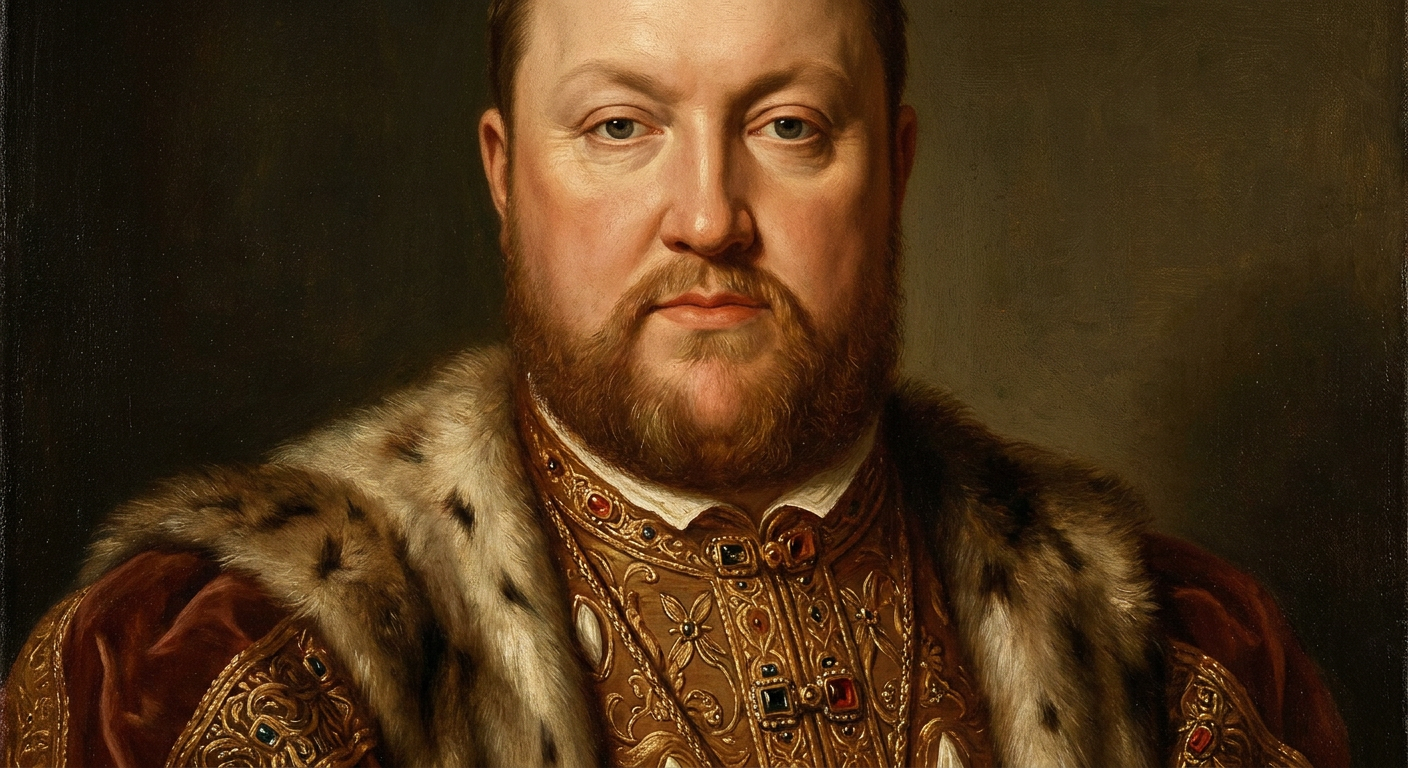
Henry understood ceremony and image. Portraits, palaces, clothing, tournaments and public ritual projected wealth, masculinity and command. Hans Holbein the Younger’s famous portraits present a broad, immovable king facing the viewer directly.
His strengths included confidence, education, political instinct and an ability to use talented administrators. His weaknesses included extravagance, impatience, vindictiveness and an unwillingness to accept responsibility for failures. Later in life, chronic pain and reduced mobility may have worsened his temper, but health cannot excuse calculated repression.
Personal Life
Henry’s marriages were both personal relationships and matters of state:
- Catherine of Aragon bore several children, but only Mary survived infancy. Henry sought an annulment after more than two decades of marriage.
- Anne Boleyn gave birth to Elizabeth. After miscarriages and political decline, she was convicted of adultery, incest and treason and executed in 1536. Most modern historians consider the charges unproven and probably engineered.
- Jane Seymour gave Henry his long-awaited son, Edward, but died shortly after childbirth in 1537.
- Anne of Cleves married Henry in 1540. Their marriage was annulled after six months, and Anne received property and an honored position as the king’s “sister.”
- Catherine Howard was executed in 1542 after evidence emerged of relationships before marriage and alleged adultery during it.
- Catherine Parr helped reconcile Henry with Mary and Elizabeth, encouraged learning and survived him.
Henry enjoyed music, architecture, hunting, gambling and elaborate food. A serious jousting accident in 1536 left him unconscious and may have aggravated an existing leg injury. Chronic ulcers, obesity and declining mobility marked his final years. Retrospective medical diagnoses remain speculative because no modern clinical examination is possible.
Philosophy or Beliefs
Henry’s worldview combined Renaissance education, Catholic theology, dynastic responsibility and an exalted concept of monarchy. He considered producing a male heir a sacred political duty because uncertain succession had recently brought England civil war.
His rejection of Rome did not make him a straightforward Protestant. He opposed papal jurisdiction and permitted an English Bible, yet defended doctrines such as transubstantiation and clerical celibacy. The 1539 Act of Six Articles reaffirmed conservative teachings and punished dissent.
Policy therefore moved in apparently contradictory directions. Evangelical reformers gained opportunities under royal supremacy, while Protestants could be burned for heresy and Catholics executed for denying the king’s ecclesiastical title. To Henry, the consistent principle was obedience to the religious order established by the Crown.
Challenges and Controversies
The annulment campaign dominated Henry’s middle reign. Catherine maintained that her marriage to Arthur had never been consummated and that her union with Henry was valid. Pope Clement VII faced theological, legal and political pressures, including the influence of Catherine’s nephew, Emperor Charles V. Henry interpreted delay as obstruction and turned to national legislation.
Those who rejected royal supremacy faced severe consequences. Sir Thomas More and Bishop John Fisher were executed in 1535 after refusing to accept the new settlement as required. Their supporters regard them as defenders of conscience; critics note that More, while in office, had himself supported persecution of religious heresy. Both realities belong in a balanced assessment.
The dissolution provoked the Pilgrimage of Grace in 1536, a large northern rebellion combining religious, economic and political grievances. Henry offered negotiations and pardons, but after renewed disorder the government executed many participants and leaders.
Anne Boleyn’s trial remains among the reign’s greatest scandals. The speed of proceedings, dubious allegations and political advantages of her removal have convinced most scholars that she was not proved guilty. The precise role Henry played in constructing the case remains debated, but he accepted and benefited from its outcome.
Foreign wars brought prestige but consumed enormous resources. Campaigns in France and Scotland, palace building and court expenditure contributed to financial strain. The government sold former monastic lands and debased the coinage, producing damaging inflation. By Henry’s death, the Crown was more powerful in some respects but heavily indebted.
Legacy
Henry left three legitimate children, each of whom became monarch: Edward VI, Mary I and Elizabeth I. Their contrasting religious policies demonstrate how unresolved his settlement remained. Edward’s government pushed Protestant reform, Mary restored Catholic communion with Rome, and Elizabeth established a durable Protestant monarchy with the sovereign as supreme governor of the Church of England.
His reign enlarged the state’s reach into religion and local society. It redistributed land, diminished monastic culture and helped make parliamentary statute central to constitutional transformation. It also normalized coercion on a severe scale: executions for treason and heresy made religious allegiance a matter of survival.
Henry remains visible at Hampton Court Palace, the Tower of London, Windsor Castle and numerous Tudor collections. The recovered Mary Rose and its museum in Portsmouth reveal the material world of his navy. His life continues to inspire scholarship, drama, novels, films and musical theatre, though popular retellings often simplify the experiences of his wives.
Interesting Facts
- Henry was not born to be king; he became heir after Arthur’s death.
- He was nearly six feet tall, unusually imposing for his era.
- He could read and write Latin and French and understood some Italian and Spanish.
- He played instruments and composed music.
- “Greensleeves” is often linked to Henry, but there is no reliable evidence that he wrote it.
- He married Catherine of Aragon shortly before his coronation.
- Catherine served as regent during Henry’s 1513 French campaign.
- Pope Leo X granted him the title “Defender of the Faith” in 1521.
- Parliament later preserved that title for English monarchs despite the break with Rome.
- Henry met Francis I at the lavish Field of Cloth of Gold in 1520.
- Anne Boleyn and Catherine Howard were first cousins.
- Jane Seymour was the only wife buried beside Henry.
- Anne of Cleves outlived Henry and all his other wives.
- Henry acknowledged Henry FitzRoy as his illegitimate son.
- His flagship Mary Rose sank in 1545 and was raised in 1982.
- His expanding waistline required increasingly elaborate armor.
- All three of his surviving legitimate children ruled England.
- Despite breaking with Rome, Henry never regarded himself as a Lutheran.
Famous Quotes
Quotations attributed to Tudor rulers often come through secretaries, ambassadors or later chronicles. The following have identifiable contexts, but spelling is modernized for readability.
- “Pastime with good company I love and shall until I die.” — Opening of a song in the Henry VIII Manuscript, widely attributed to the young king. It reflects courtly ideals rather than a complete statement of policy.
- “Mine own sweetheart.” — Henry’s recurring address to Anne Boleyn in surviving love letters from the late 1520s, revealing unusual personal urgency during their courtship.
- “Wishing myself, specially an evening, in my sweetheart’s arms.” — From a letter to Anne. It documents his desire, although it does not explain the later destruction of their marriage.
- “The king’s majesty justly and rightfully is and ought to be the supreme head of the Church of England.” — The substance of the 1534 Act of Supremacy. It was statutory language enacted in Henry’s name, not necessarily a verbatim spoken remark.
- “How presumptuous then are ye, the rude commons of one shire?” — From Henry’s written response to the Lincolnshire rebels in 1536, showing his contempt for resistance to royal policy.
- “I and all my realm have great cause to give thanks to Almighty God.” — Reported in connection with Prince Edward’s birth in 1537, expressing relief at obtaining a male heir.
- “We at no time stand so highly in our estate royal as in the time of Parliament.” — From Henry’s 1545 address to Parliament, transmitted by chroniclers. It acknowledged Parliament’s dignity while assuming cooperation with monarchy.
- “The knowledge of God’s word should not be disputed, rhymed, sung and jangled in every alehouse and tavern.” — From the same parliamentary speech, criticizing uncontrolled popular religious argument.
- “All is lost! Monks, monks, monks!” — Traditionally presented as a deathbed cry. It is poorly supported and should be treated as legend, not established fact.
Timeline
- 1491 — Born at Greenwich on 28 June.
- 1502 — Becomes heir after Prince Arthur’s death.
- 1509 — Becomes king; marries Catherine of Aragon and is crowned.
- 1513 — Campaigns in France; Scotland is defeated at Flodden.
- 1515 — Thomas Wolsey becomes lord chancellor.
- 1520 — Meets Francis I at the Field of Cloth of Gold.
- 1521 — Publishes Defence of the Seven Sacraments and receives the title “Defender of the Faith.”
- 1527 — Intensifies efforts to annul his marriage to Catherine.
- 1529 — Wolsey falls after failing to secure an annulment.
- 1533 — Marries Anne Boleyn; Archbishop Cranmer declares the first marriage invalid; Elizabeth is born.
- 1534 — Act of Supremacy establishes royal headship of the English Church.
- 1535 — Thomas More and John Fisher are executed.
- 1536 — Catherine dies; Anne Boleyn is executed; Henry marries Jane Seymour; dissolution begins; Pilgrimage of Grace erupts.
- 1537 — Edward is born; Jane Seymour dies.
- 1540 — Henry marries and divorces Anne of Cleves; marries Catherine Howard; Cromwell is executed.
- 1542 — Catherine Howard is executed; Henry assumes the title King of Ireland.
- 1543 — Marries Catherine Parr.
- 1544 — Invades France and captures Boulogne.
- 1545 — The Mary Rose sinks during conflict with France.
- 1547 — Dies at Whitehall Palace on 28 January; Edward VI succeeds him.
Frequently Asked Questions
1. Why did Henry VIII have six wives?
Henry married repeatedly because marriage served dynastic, diplomatic and personal purposes. Catherine of Aragon did not provide a surviving son, creating fear about Tudor succession. Henry’s relationship with Anne Boleyn then became bound to his effort to obtain an annulment. Jane Seymour produced Edward but died soon afterward. Anne of Cleves was chosen for diplomacy, Catherine Howard for attraction and Catherine Parr partly for companionship and household stability. The rhyme “divorced, beheaded, died” is memorable but legally imprecise: Henry’s first and fourth marriages were annulled.
2. Why did Henry break with the Roman Catholic Church?
The immediate cause was Pope Clement VII’s refusal to grant the annulment Henry wanted from Catherine of Aragon. Behind that dispute stood questions of succession, sovereignty, church wealth and papal jurisdiction. Reform-minded advisers argued that English rulers possessed authority over the national church. Henry used Parliament to end appeals to Rome and declare royal supremacy. He did not initially intend to create a fully Protestant church; his own theology remained conservative, even as the institutional break allowed Protestant ideas to spread.
3. Was Henry VIII a Protestant?
Not in the simple modern sense. Henry rejected the pope’s authority and supported an English Bible, both changes associated with Reformation politics. Nevertheless, he continued to believe in many traditional Catholic teachings, including transubstantiation, confession and clerical hierarchy. He opposed Martin Luther and authorized punishment of Protestants whose doctrines went beyond his settlement. Historians commonly describe his church as independent from Rome but doctrinally conservative. England’s clearer movement toward Protestant worship occurred under Edward VI after Henry’s death.
4. Did Henry VIII execute all his wives?
No. He authorized the executions of two wives, Anne Boleyn and Catherine Howard. Catherine of Aragon died after her marriage was annulled, Jane Seymour died following childbirth, Anne of Cleves survived an annulment, and Catherine Parr outlived Henry. Anne Boleyn’s conviction is widely viewed by modern historians as politically driven and unsupported by convincing evidence. Catherine Howard’s case involved stronger evidence of concealed premarital relationships and alleged misconduct after marriage, although the procedures gave her little meaningful protection.
5. Why was a male heir so important?
The Tudor dynasty was new, and memories of the Wars of the Roses remained powerful. No woman had yet ruled England successfully in her own right, and many contemporaries feared that a female succession could invite foreign influence, disputed claims or civil conflict. Henry therefore viewed a legitimate son as essential to political stability. That concern was understandable in its period, but it became an obsession with destructive consequences. Ironically, his daughters Mary and Elizabeth both inherited the throne, and Elizabeth became one of England’s longest-reigning Tudor monarchs.
6. What happened to Catherine of Aragon?
After years of legal conflict, Archbishop Thomas Cranmer declared Catherine’s marriage to Henry invalid in 1533. She lost the title of queen and was styled Dowager Princess of Wales, referring to her earlier marriage to Arthur. Catherine refused to accept that ruling and continued to consider herself Henry’s lawful wife and Mary the legitimate heir. Separated from her daughter, she lived under restricted conditions at several residences and died at Kimbolton Castle in January 1536. Modern examination of the evidence cannot establish her precise cause of death with certainty.
7. Was Anne Boleyn guilty of adultery and treason?
Most modern historians conclude that the prosecution did not prove its allegations and that several accusations were chronologically implausible. Anne was charged with sexual relationships involving multiple men, including her brother, and with imagining the king’s death. The proceedings unfolded rapidly after her political position collapsed. Scholars disagree about whether Thomas Cromwell independently engineered her fall or acted chiefly according to Henry’s wishes. Henry approved the process, married Jane Seymour soon afterward and benefited directly from Anne’s removal.
8. What was the Dissolution of the Monasteries?
It was the closure and confiscation of England and Wales’s monasteries, convents and friaries between 1536 and 1540. Government investigations criticized religious houses, but financial need, royal control and reforming ideology also drove policy. Buildings, land and valuables passed to the Crown; much of the land was sold to private owners. The process enriched some elites and reshaped local economies. It also eliminated centers of prayer, hospitality, education and poor relief, while manuscripts, art and architecture were dispersed or destroyed.
9. How many people did Henry VIII execute?
No complete, reliable total exists. Popular claims that he executed tens of thousands often rely on later estimates that cannot be verified from surviving records. Hundreds were certainly put to death for treason, rebellion, heresy and other offenses, including high-profile ministers, nobles, clergy and two queens. Executions following the Pilgrimage of Grace were particularly severe. The absence of a precise number should not minimize the repression: Henry’s government expanded treason law and used exemplary punishment to enforce political and religious obedience.
10. What role did Thomas Cromwell play?
Cromwell became Henry’s principal minister during the decisive 1530s. He helped devise statutes ending papal jurisdiction, strengthened administrative bodies and supervised the dissolution of the monasteries. His methods combined organizational skill, parliamentary management and aggressive enforcement. Cromwell promoted the alliance with Anne of Cleves, which displeased Henry after the marriage failed. Political enemies then moved against him, and he was executed for treason and heresy in 1540. Henry later reportedly regretted losing such an effective servant, though the evidence is indirect.
11. Did a jousting accident change Henry’s personality?
Henry suffered a serious accident at Greenwich in January 1536 when a horse fell on him, leaving him unconscious for a time. The incident may have worsened leg injuries and reduced his ability to exercise. Some modern accounts claim it caused brain damage and transformed his personality, but surviving evidence cannot prove that diagnosis. Henry had displayed ruthlessness before 1536, and political choices cannot be explained by one injury. Chronic pain probably affected his comfort and mood, but strong claims about neurological change remain speculative.
12. What illness did Henry VIII have?
Contemporary evidence supports obesity, recurring leg ulcers and severe mobility problems in later life. Proposed diagnoses include diabetes, endocrine disorders, infection, traumatic injury and rare genetic conditions, but none can be confirmed. Claims that he had syphilis are especially weak because records do not show the standard mercury treatment then used for that disease. Responsible historians distinguish symptoms recorded by contemporaries from modern retrospective diagnosis. His declining health was real; its exact medical causes remain uncertain.
13. What did Henry contribute to the Royal Navy?
Henry expanded the fleet, invested in dockyards and encouraged more permanent naval administration. He ordered powerful warships and built coastal defenses in response to threats from France and the Holy Roman Empire. The Mary Rose, launched during his reign, combined heavy guns with traditional close-combat capabilities. Earlier kings had possessed ships, so describing Henry as the navy’s sole founder exaggerates his role. Even so, his sustained investment was an important stage in the development of England’s later professional maritime power.
14. Who succeeded Henry VIII?
His nine-year-old son Edward VI succeeded him in 1547. Because Edward was a child, England was governed through regency councils dominated first by Edward Seymour and later John Dudley. Edward’s government introduced more explicitly Protestant doctrine and worship. After his death in 1553, an attempt to install Lady Jane Grey failed, and Mary I became queen. Elizabeth I followed Mary in 1558. Thus all three of Henry’s legitimate surviving children occupied the throne, though none produced an heir.
15. Where is Henry VIII buried?
Henry is buried in St George’s Chapel at Windsor Castle beside Jane Seymour. He planned a far grander monument, incorporating elements taken from Cardinal Wolsey’s unfinished tomb, but it was never completed. A simple floor slab now marks the vault. The modest memorial contrasts sharply with Henry’s monumental self-presentation during life. Other places closely associated with him include Hampton Court Palace, the Tower of London, Greenwich and Portsmouth’s Mary Rose Museum.
Lessons We Can Learn
- Private decisions can become public revolutions. Henry’s marital crisis changed national institutions; leaders must consider consequences beyond immediate goals.
- Succession planning matters. Tudor insecurity was genuine, even though Henry’s response became destructive.
- Talented advisers require protection as well as scrutiny. Wolsey and Cromwell achieved much but operated in a system where failure could be fatal.
- Law can legitimize both reform and repression. Parliament enabled structural change while expanding treason and religious penalties.
- Institutional destruction has social costs. Monastic wealth changed hands, but communities also lost charity and cultural resources.
- Image is not character. Magnificent portraits communicated authority without revealing illness, fear or policy failure.
- Financial ambition needs restraint. Warfare and display brought prestige but damaged Crown finances and currency.
- Religious uniformity imposed by force breeds conflict. The Pilgrimage of Grace showed the risks of rapid change without consent.
- Medical explanations should remain evidence-based. Claims about Henry’s personality and disease illustrate the danger of confident retrospective diagnosis.
- Historical judgment requires context, not excuses. Dynastic anxiety helps explain Henry’s choices but does not absolve executions or injustice; this is a modern ethical conclusion grounded in documented events.
Related Historical Figures
- Henry VII — Henry’s father, who founded the Tudor dynasty and restored royal stability.
- Elizabeth of York — His mother, whose marriage united competing dynastic traditions.
- Catherine of Aragon — His first wife and central figure in the annulment crisis.
- Anne Boleyn — His second wife, whose marriage accelerated the break with Rome.
- Jane Seymour — His third wife and mother of Edward VI.
- Thomas Wolsey — Cardinal and chief minister during Henry’s early reign.
- Thomas Cromwell — Architect and administrator of much of the 1530s religious settlement.
- Thomas More — Former lord chancellor executed for refusing royal supremacy.
- Charles V — Holy Roman Emperor, Catherine’s nephew and a major European rival.
- Elizabeth I — Henry and Anne Boleyn’s daughter, who consolidated England’s Protestant monarchy.
Watch and Learn
“Henry VIII - OverSimplified” — OverSimplified — approximately 12 minutes. This widely viewed animated overview introduces Henry’s marriages and break with Rome in an accessible, humorous format. It is useful as a starting point, though its compression and comedy should be supplemented with detailed historical sources, especially when studying disputed motives and legal proceedings.
Watch and Learn
Henry VIII - OverSimplified · OverSimplified
Related Historical Figures