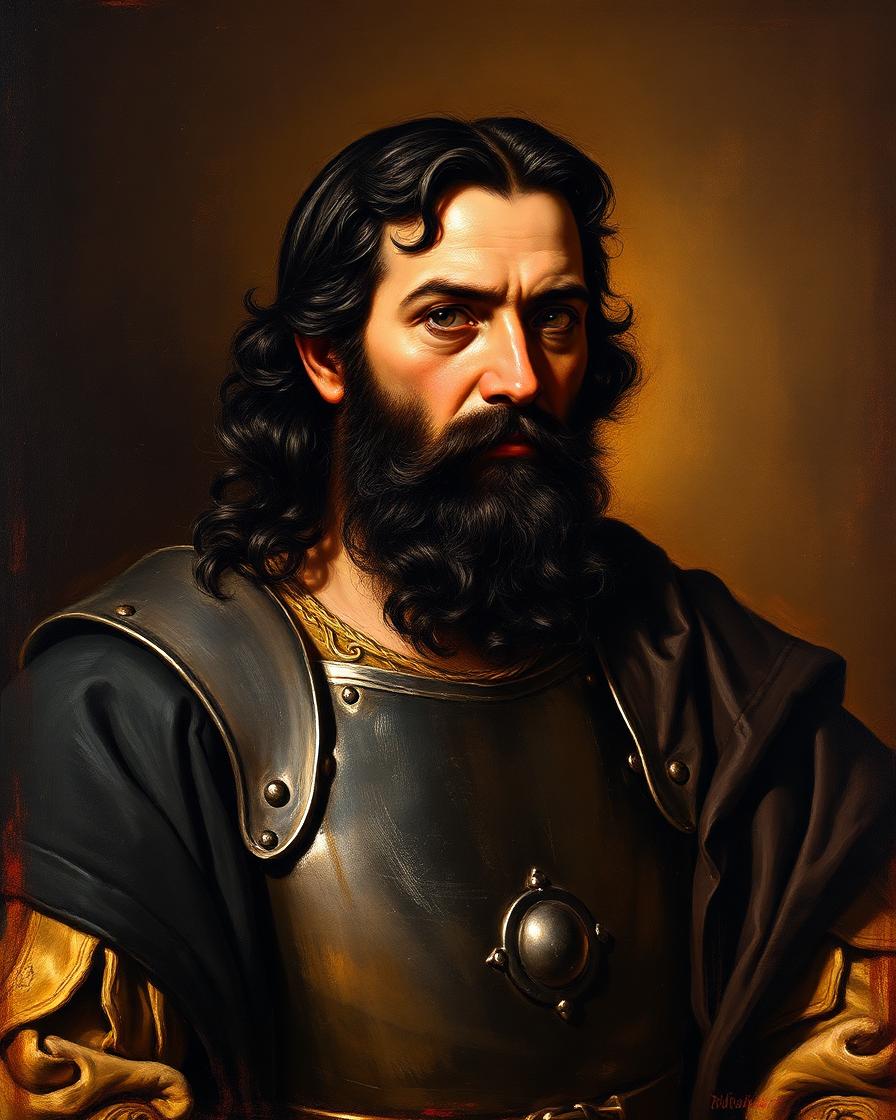
Quick Facts
- Years
- 1485 – 1547
- Category
- Explorers & Adventurers
- Nationality
- Spanish
- Occupation
- Conquistador & Explorer
Hernán Cortés
1485 – 1547 · Spanish · Conquistador & Explorer
Audiobook

Life Lessons from Hernan Cortes
Marcus Alden
Hernán Cortés was a Spanish conquistador whose expedition overthrew the Aztec Empire and brought central Mexico under Spanish rule. Born in Medellín, Castile, in 1485, he traveled to the Caribbean as a young man and rose through colonial society before leading an unauthorized expedition to Mexico in 1519. Working with Indigenous allies—especially Tlaxcalans—and interpreters including Malintzin, Cortés entered Tenochtitlan, seized Emperor Moctezuma II, survived a disastrous retreat, and captured the capital in 1521.
His campaign transformed world history. It accelerated Spanish colonization, Christianity's spread, and the integration of Mexico into an emerging Atlantic economy. It also brought warfare, coerced labor, political dispossession, and profound cultural disruption. Epidemics introduced from the Old World devastated Indigenous populations, although Cortés neither created nor fully controlled that biological catastrophe.
Cortés remains controversial because older heroic narratives often minimized the indispensable role of Indigenous peoples and the violence of conquest. Modern scholarship studies him not as a solitary conqueror but as one actor within a vast conflict involving rival Mesoamerican states, Spanish imperial ambitions, translators, enslaved people, settlers, and missionaries. His career illuminates military leadership and cross-cultural diplomacy while raising enduring questions about empire, historical memory, and responsibility.
Quick Facts
| Field | Details |
|---|---|
| Full Name | Hernando Cortés de Monroy y Pizarro Altamirano |
| Common Name(s) | Hernán Cortés; Hernando Cortés |
| Born | 1485; traditionally dated to December, exact day uncertain |
| Died | 2 December 1547 |
| Age at Death | About 62 |
| Birthplace | Medellín, Crown of Castile, now Extremadura, Spain |
| Nationality | Castilian/Spanish |
| Occupation | Conquistador, explorer, colonial governor, landholder |
| Historical Era | Age of Exploration; early Spanish colonial period |
| Famous For | Leading the campaign that defeated the Aztec Empire |
| Political Affiliation | Spanish Crown; briefly governor and captain general of New Spain |
| Religion | Roman Catholic |
| Education | Briefly studied at Salamanca; no degree recorded |
| Parents | Martín Cortés de Monroy and Catalina Pizarro Altamirano |
| Spouse(s) | Catalina Suárez Marcaida; Juana de Zúñiga |
| Children | Several legitimate and acknowledged natural children, including Martín Cortés (the mestizo), Catalina Pizarro, Luis Cortés, Martín Cortés y Zúñiga, and others |
| Major Works | Five surviving Cartas de relación addressed to Charles V; ordinances and official correspondence |
| Major Achievements | Founded Veracruz; built an Indigenous-Spanish coalition; captured Tenochtitlan; became Marquis of the Valley of Oaxaca; explored parts of Mexico and the Pacific coast |
Early Life
Cortés was born in Medellín, a small town in Extremadura, in 1485. His parents belonged to the lesser nobility, or hidalgo class, but were not wealthy magnates. Extremadura later produced several conquistadors, including Francisco Pizarro, although claims that close family relationships determined their careers are often overstated.
Contemporary and near-contemporary writers described Cortés as physically frail during childhood. Details about his early years are sparse, and later biographies sometimes converted uncertain anecdotes into signs of destiny. What can be established is that his family hoped education might offer advancement.
Around age fourteen, he was sent to Salamanca. He probably studied Latin and acquired some familiarity with law and administrative writing, but he did not graduate from the university. This limited schooling nevertheless proved useful: his later letters reveal skill in legal argument, political presentation, and the language of royal service.
Cortés came of age shortly after the conquest of Granada and Columbus's first Atlantic voyage in 1492. Castile was expanding overseas, and the Caribbean promised social mobility to men without large inheritances. In 1504, after abandoning plans for another career, Cortés sailed to Hispaniola.
Rise to Prominence
On Hispaniola, Cortés received land and Indigenous labor under colonial arrangements and worked as a notary. The position taught him how grants, municipal councils, petitions, and royal authority operated. He participated in the consolidation of Spanish rule and thus entered colonial life before becoming a famous commander.
In 1511, he joined Diego Velázquez de Cuéllar's conquest of Cuba. Cortés became a prominent settler, served as an official at Santiago, and gained property. His relationship with Velázquez mixed cooperation with rivalry. He married Catalina Suárez Marcaida, whose family had connections within Cuban society.
Reports from expeditions by Francisco Hernández de Córdoba and Juan de Grijalva revealed wealthy societies west of Cuba. Velázquez selected Cortés to lead a new expedition in 1518, then attempted to remove him, apparently fearing his independence. Cortés sailed from Cuba in February 1519 before the revocation could stop him.
On the mainland, Cortés defeated Tabascan forces at Centla and received twenty women from local leaders. One was Malintzin, also called Marina or Malinche, who spoke Maya and Nahuatl. Working initially through the Spanish-speaking Maya interpreter Jerónimo de Aguilar, she enabled Cortés to negotiate in central Mexico and soon became his principal interpreter and adviser.
Cortés founded the municipal settlement of Villa Rica de la Vera Cruz. Its council appointed him captain general and chief justice, allowing him to claim that he answered directly to Charles V rather than Velázquez. This was clever legal theater, not an uncontested authorization. He then dismantled or grounded his ships—not literally burning them—to prevent desertion and free sailors for the inland campaign.
Major Achievements
Building a Mesoamerican Coalition
Cortés's most important strategic success was political rather than purely military. The Mexica rulers of Tenochtitlan headed a tribute empire with numerous enemies and uneasy subjects. After fighting the fiercely independent Tlaxcalans, Cortés negotiated an alliance with them in September 1519.
Thousands of Tlaxcalan and other Indigenous warriors subsequently supplied the expedition, carried materials, fought battles, and provided regional knowledge. Without them, the few hundred Spaniards could not have defeated the empire. The coalition mattered because it converted a foreign incursion into a broader Mesoamerican war, even though allies did not foresee all the consequences of Spanish victory.
March to Tenochtitlan
At Cholula, Spanish and Tlaxcalan forces killed a large but uncertain number of inhabitants. Cortés claimed he had uncovered an ambush; some historians accept evidence of a threat, while others regard the massacre as a calculated act of terror. The episode intimidated communities along the route.
Cortés entered Tenochtitlan on 8 November 1519 and met Moctezuma II. Popular stories that Moctezuma believed Cortés was the god Quetzalcoatl are not securely supported by early evidence. The emperor likely treated the newcomers as dangerous political actors within Indigenous diplomatic conventions.
Cortés soon placed Moctezuma under guard. This extraordinary seizure gave the Spaniards temporary leverage but destabilized the capital and helped destroy the emperor's legitimacy.
Surviving the Crisis of 1520
Velázquez sent Pánfilo de Narváez to arrest Cortés. Leaving Pedro de Alvarado in Tenochtitlan, Cortés marched to the coast, defeated Narváez in May 1520, and persuaded most of his troops to join him.
While Cortés was absent, Alvarado's men massacred participants at the festival of Toxcatl, provoking rebellion. Moctezuma died during the crisis; Spanish accounts blamed stones thrown by his subjects, whereas Indigenous traditions and later accounts accused Spaniards of killing him. The evidence does not settle the question.
During the retreat of 30 June–1 July, known traditionally as La Noche Triste and increasingly as the Victorious Night from a Mexica perspective, the invaders suffered severe losses. Cortés preserved a remnant of his army, reached Tlaxcala, rebuilt his coalition, and prepared a second campaign.
Capture of Tenochtitlan
Smallpox reached central Mexico in 1520, probably through someone associated with Narváez's expedition. The epidemic killed many people, including the ruler Cuitláhuac, and gravely weakened resistance. It was a decisive factor alongside alliances, siege tactics, weapons, and political fragmentation.
Cortés constructed thirteen brigantines for Lake Texcoco, cut causeways and aqueducts, and coordinated assaults with a much larger Indigenous army. After a brutal siege marked by starvation and destruction, Cuauhtémoc was captured on 13 August 1521.
The fall of Tenochtitlan ended effective imperial resistance but did not instantly conquer all of Mexico. Campaigns continued for years. The victory nevertheless enabled Spain to establish New Spain and rebuild the capital as Mexico City.
Government, Exploration, and Writing
Charles V appointed Cortés governor and captain general of New Spain in 1522. He organized expeditions, distributed encomiendas, promoted agriculture, and supported missionary activity. His administration also faced accusations of factionalism, illegal coercion, and misuse of royal resources.
From 1524 to 1526, Cortés led a difficult expedition to Honduras. During it, he ordered the execution of Cuauhtémoc after alleging a conspiracy. The decision remains one of the darkest and most disputed acts of his career.
His Cartas de relación described Mexico and defended his actions to Charles V. They are major historical sources but also carefully constructed political arguments. Cortés portrayed himself as a loyal royal servant while minimizing insubordination and emphasizing wealth, conversion, and order.
Cortés later sponsored Pacific expeditions and personally explored Baja California in 1535–1536. These ventures expanded geographical knowledge but yielded disappointing financial returns. In 1529, the Crown named him Marquis of the Valley of Oaxaca, granting prestige and extensive estates while withholding restoration of broad political control.
Leadership and Work
Cortés was adaptive, audacious, and skilled at exploiting divisions among opponents. He gathered intelligence, used interpreters, negotiated alliances, and combined cavalry, artillery, steel weapons, lake vessels, and Indigenous armies. His capacity to recover after the 1520 retreat was a remarkable feat of organization.
He also understood institutions. By creating a town council at Veracruz and repeatedly writing to Charles V, he framed rebellion against Velázquez as direct service to the monarch. This legal-political skill was as important as battlefield command.
His weaknesses were inseparable from his strengths. Boldness became recklessness; ambition became insubordination; persuasion operated alongside intimidation. He tolerated or directed massacres, hostage-taking, torture, and forced labor. His followers repeatedly quarreled over gold, offices, and encomiendas.
Cortés depended heavily on others. Malintzin made high-level negotiation possible. Tlaxcalan commanders such as Xicotencatl the Elder and Indigenous rulers such as Ixtlilxochitl helped shape the war. Captains including Alvarado and Gonzalo de Sandoval led major operations. Treating Cortés as a lone genius obscures this collective—and deeply unequal—enterprise.
Personal Life
Cortés married Catalina Suárez in Cuba. She joined him in Mexico and died suddenly at Coyoacán in 1522. Rumors accused Cortés of strangling her after an argument. A later legal inquiry heard conflicting testimony, but no conclusive proof established murder. The case remains unresolved.
He later married Juana de Zúñiga, a noblewoman from a powerful Spanish family. Cortés had children both within and outside marriage. His son with Malintzin, Martín Cortés, was born around 1522 and was later legitimized by papal authority. Another son, Martín Cortés y Zúñiga, inherited the marquisate.
His relationships with Indigenous women occurred within colonial structures of conquest, enslavement, political exchange, and unequal power. Older biographies often romanticized them; modern historians examine both individual agency and coercive circumstances.
Cortés accumulated estates, sugar enterprises, livestock, mines, and urban residences. He enjoyed status and courtly recognition, yet spent years in litigation over offices, revenue, and debts. Later descriptions portray a persuasive, energetic man who could be generous to followers but was also calculating, severe, and intensely concerned with honor.
Philosophy and Beliefs
Cortés presented himself as a devout Catholic charged with suppressing idolatry and spreading Christianity. He installed crosses and images, requested missionaries, and praised conversion in his correspondence. His religious convictions were probably genuine, but they also legitimized conquest and strengthened his claims before the Crown.
Politically, he believed in monarchy, hierarchy, personal honor, and rewards for service. He did not regard Indigenous states as sovereign equals in the modern sense. He sought their submission to Charles V, while sometimes respecting their governmental sophistication and using existing tribute systems.
His ethical worldview reflected early-sixteenth-century imperial Christianity, not contemporary ideals of equality or religious liberty. Even by the standards of his own time, however, conquest methods were contested. Clerics and officials debated forced conversion, enslavement, warfare, and Indigenous rights. Cortés's stated concern for royal justice coexisted with actions that caused immense suffering and enriched himself and his associates.
Challenges and Controversies
Legality of the Expedition
Cortés departed Cuba after Velázquez tried to revoke his command. Supporters argued that Veracruz's council and later royal approval legitimized him. Critics regarded his campaign as mutiny wrapped in legal formalities. The Crown rewarded his results but remained wary of granting him independent power.
Violence and Indigenous Suffering
The massacres at Cholula and Toxcatl, the siege of Tenochtitlan, torture used to locate treasure, forced labor, and executions are central to his record. Alvarado ordered the Toxcatl massacre, but Cortés commanded the expedition and benefited from its coercive system. Indigenous allies also pursued their own wars and rivalries, yet Spanish colonization ultimately subordinated them.
Disease and Demographic Collapse
Smallpox was not a deliberate biological weapon used by Cortés; no reliable evidence supports that claim. Nevertheless, European expansion introduced pathogens that contributed to catastrophic population loss. Warfare, famine, displacement, labor demands, and later epidemics compounded the devastation.
Execution of Cuauhtémoc
Cortés ordered the former emperor hanged during the Honduras expedition in 1525, alleging a plot. Even some Spaniards questioned the evidence and wisdom of the act. Historians commonly view it as driven by fear, political calculation, or both.
The Torture of Cuauhtémoc
After Tenochtitlan fell, royal treasurer Julián de Alderete pressed for information about missing gold. Cuauhtémoc and another noble were tortured by having their feet burned. Cortés attempted to distance himself from responsibility, but as commander he permitted the torture.
Rival Interpretations
Traditional Spanish narratives celebrated Cortés as a heroic founder. Mexican nationalist histories often cast him as an emblem of invasion and oppression. Recent scholarship moves beyond both solitary-hero and simple two-sided models, emphasizing Indigenous agency, multilingual diplomacy, internal Mesoamerican conflict, ecology, and the gradual nature of colonial domination.
Legacy
Cortés helped initiate the political order that became the Viceroyalty of New Spain. Mexico City rose over and around Tenochtitlan, while Spanish institutions interacted with surviving Indigenous communities, languages, and traditions. The resulting society was neither simply European nor a continuation of the preconquest world.
His letters influenced European knowledge of Mesoamerica and remain essential, if partisan, sources. Historians read them alongside accounts by Bernal Díaz del Castillo, Francisco López de Gómara, Indigenous-language annals, pictorial manuscripts, archaeology, and testimony assembled by Bernardino de Sahagún.
Cortés's remains were moved several times and now rest discreetly in the Hospital de Jesús Nazareno in Mexico City, an institution he founded. Monuments to him are comparatively limited in Mexico. A statue group in Coyoacán depicting Cortés, Malintzin, and their son has generated debate, while his birthplace of Medellín, Spain, maintains memorial associations.
Today, Cortés is studied as a military entrepreneur, imperial agent, colonial administrator, and author. His memory remains politically charged because the conquest helped create modern Mexico while inflicting destruction and dispossession. Responsible commemoration therefore includes the Mexica defenders, Indigenous allies, interpreters, enslaved people, and epidemic victims whose histories older accounts marginalized.
Interesting Facts
- Cortés used both Hernán and Hernando as forms of his given name.
- He briefly studied at Salamanca but did not earn a university degree.
- His early work as a notary helped him master colonial legal procedures.
- He participated in the conquest of Cuba before sailing to Mexico.
- Malintzin translated Nahuatl and Maya and became a crucial political intermediary.
- Cortés did not burn his ships; they were disabled, dismantled, or grounded.
- The Veracruz council provided his claim to independent command.
- His army entered Tenochtitlan on 8 November 1519.
- The claim that Moctezuma mistook him for Quetzalcoatl is widely questioned.
- Thousands of Indigenous allies fought beside the Spaniards.
- Smallpox greatly weakened central Mexico during the campaign.
- Thirteen brigantines supported the final lake siege.
- Tenochtitlan fell on 13 August 1521.
- Charles V appointed him governor in 1522 but later restricted his authority.
- He received the title Marquis of the Valley of Oaxaca in 1529.
- He explored part of Baja California in the 1530s.
- The Gulf of California was once called the Sea of Cortés.
- Cortés joined the unsuccessful Algiers expedition of 1541.
- He died near Seville rather than in Mexico.
- His remains are interred at the Hospital de Jesús Nazareno in Mexico City.
Famous Quotes
Translations vary, and Cortés's letters were crafted to persuade the emperor rather than record spontaneous speech.
- “I have wished that Your Highness should know the affairs of this land.” — From the Second Letter to Charles V, introducing his report and claim of loyal service.
- “This great city of Temixtitan is founded in a salt lake.” — From the Second Letter, beginning a detailed description of Tenochtitlan's geography.
- “It is as large as Seville or Córdoba.” — Cortés comparing Tenochtitlan's scale with cities familiar to his European audience.
- “There are, in all districts of this great city, many temples or houses for their idols.” — From his description of Mexica religion, revealing both observation and Christian hostility.
- “The manner of living among the people is very similar to that in Spain.” — A translated summary of his comparison of markets, order, and social organization; wording differs by edition.
- “Considering that the people of this city were rebels...” — From Cortés's justification for war and siege; it shows his use of royal legal categories.
- “There was so much grief and suffering that it was beyond our power to describe.” — Common translation from his account of Tenochtitlan's final agony; exact wording varies.
- “They have a square twice as large as that of Salamanca.” — From the description of Tlatelolco's marketplace, emphasizing its enormous scale.
- “We Spaniards know a sickness of the heart that only gold can cure.” — Frequently attributed to Cortés through a later account by Francisco López de Gómara; not documented as a verbatim statement in Cortés's own writings.
- “I and my companions suffer from a disease of the heart which can be cured only with gold.” — Variant of the same disputed attribution, illustrating why famous quotations require source caution.
Timeline
- 1485 — Born in Medellín, Castile.
- About 1499 — Sent to Salamanca for education.
- 1504 — Sails to Hispaniola.
- 1511 — Joins the Spanish conquest of Cuba.
- 1518 — Chosen by Diego Velázquez to command a Mexican expedition.
- February 1519 — Leaves Cuba despite Velázquez's attempt to remove him.
- March 1519 — Fights at Centla; Malintzin joins the expedition.
- July 1519 — Establishes Veracruz and claims direct royal authority.
- September 1519 — Forms an alliance with Tlaxcala.
- October 1519 — Massacre at Cholula.
- 8 November 1519 — Enters Tenochtitlan and meets Moctezuma II.
- May 1520 — Defeats Pánfilo de Narváez.
- May 1520 — Alvarado's Toxcatl massacre triggers open revolt.
- 30 June–1 July 1520 — Spanish-led force retreats during the Noche Triste.
- Late 1520 — Smallpox devastates central Mexico.
- May–August 1521 — Siege of Tenochtitlan.
- 13 August 1521 — Cuauhtémoc captured; Tenochtitlan falls.
- 1522 — Cortés appointed governor and captain general of New Spain; Catalina Suárez dies.
- 1524–1526 — Leads expedition to Honduras.
- 1525 — Orders Cuauhtémoc's execution.
- 1528 — Travels to Spain to defend his record.
- 1529 — Named Marquis of the Valley of Oaxaca; marries Juana de Zúñiga around this period.
- 1530 — Returns to New Spain without full political authority.
- 1535–1536 — Leads expedition to Baja California.
- 1540 — Returns permanently to Spain.
- 1541 — Participates in Charles V's failed Algiers expedition.
- 2 December 1547 — Dies at Castilleja de la Cuesta near Seville.
Frequently Asked Questions
Who was Hernán Cortés?
Hernán Cortés was a Castilian conquistador, colonial official, and writer. He led the expedition that entered central Mexico in 1519 and, with very large Indigenous allied forces, captured Tenochtitlan in 1521. The victory opened the way for Spanish rule in central Mexico. He later governed New Spain, received a noble title, and sponsored further exploration. He is historically important but deeply controversial because his achievements were tied to invasion, mass violence, forced labor, dispossession, and colonial rule.
When and where was Cortés born?
Cortés was born in 1485 in Medellín, a town in Extremadura within the Crown of Castile, now part of Spain. His precise birthday is uncertain, despite later traditions assigning dates in December. He came from a family of modest hidalgo status: socially privileged compared with common laborers but lacking the wealth of high nobility. This background helps explain his search for opportunity overseas, where conquest and settlement offered land, office, labor grants, and social advancement.
Did Cortés conquer the Aztec Empire alone?
No. Cortés began with only several hundred Spaniards and could not have conquered a populous empire unaided. Tlaxcalans, Texcocans, Totonacs, and other Indigenous groups supplied thousands of fighters, provisions, intelligence, and transport. Malintzin and other interpreters enabled diplomacy. Epidemic disease, particularly smallpox, also weakened the Mexica. Cortés coordinated important elements of the campaign, but the conquest was a multinational coalition war followed by Spanish domination, not the achievement of one man or a tiny European force acting alone.
Why did Indigenous peoples ally with Cortés?
Their motives differed. Some communities resented tribute demands or military pressure from the Mexica-led empire. Tlaxcala had remained independent but suffered from conflict and economic isolation, while factions in Texcoco pursued dynastic goals. Local leaders treated the Spaniards as potential allies within existing rivalries and sought security, territory, revenge, or political advantage. They could not fully predict that victory would produce a durable Spanish colonial regime that eventually restricted their autonomy and transformed their societies.
Who was Malintzin?
Malintzin—also called Marina and, later, La Malinche—was a Nahua woman given to the Spaniards in Tabasco in 1519. Because she spoke Nahuatl and Maya, she initially translated through Jerónimo de Aguilar and soon learned Spanish. She interpreted negotiations, explained political conditions, and advised Cortés. She also bore his son Martín. Her historical role cannot be reduced to the label “traitor”: she had been displaced and enslaved, the modern Mexican nation did not yet exist, and she operated under profound constraints while exercising significant skill.
Did Cortés burn his ships?
No reliable contemporary evidence says that he dramatically burned the fleet. He ordered the vessels disabled, grounded, or dismantled, citing their condition and the need for sailors and materials. The action prevented opponents from returning easily to Cuba and committed the expedition to the inland campaign. The popular image of flames became a powerful metaphor for irreversible commitment, but “scuttling the ships” is historically more accurate than “burning the ships.”
Did Moctezuma think Cortés was a god?
The familiar claim that Moctezuma believed Cortés was the returning god Quetzalcoatl is doubtful. It rests heavily on later colonial interpretations of speeches recorded after the conquest. Moctezuma's gifts and ceremonial reception can be understood as diplomacy, intelligence gathering, or attempts to manage a dangerous foreign force. Scholars debate Indigenous expectations, but most reject the simplistic picture of an emperor surrendering because he mistook a Spaniard for a deity.
How did Cortés defeat Tenochtitlan?
He combined diplomacy, Indigenous alliances, siege warfare, lake vessels, cavalry, firearms, steel weapons, and blockades. After his 1520 defeat, he regrouped in Tlaxcala and built thirteen brigantines for Lake Texcoco. Coalition forces severed causeways and water supplies and repeatedly attacked the city. Smallpox had already killed many residents and leaders. Starvation and disease became devastating during the siege. Tenochtitlan finally fell on 13 August 1521 after fierce resistance under Cuauhtémoc.
What happened on the Noche Triste?
During the night of 30 June to 1 July 1520, Spaniards and their allies attempted to escape rebellious Tenochtitlan. Mexica forces attacked them on the causeways, killing many people and capturing weapons and treasure. Cortés's army lost much of what it had gained, although surviving estimates vary. Spanish tradition called the event the “Sad Night.” Because it was a major Indigenous victory, many now prefer “Victorious Night” or use both terms to acknowledge contrasting perspectives.
Was Cortés responsible for smallpox?
Smallpox arrived with the wider Spanish invasion, probably through an infected person connected to Narváez's force in 1520. There is no evidence that Cortés intentionally spread it, and sixteenth-century Europeans did not understand viral transmission. Nevertheless, the epidemic operated within the circumstances created by transatlantic expansion. It killed enormous numbers of people, disrupted leadership and food production, and materially aided the invaders. Later diseases, exploitation, famine, and social disruption deepened the demographic collapse.
What happened to Moctezuma II?
After Cortés entered Tenochtitlan, the Spaniards detained Moctezuma and ruled through him for several months. During the uprising of 1520, Moctezuma appeared before the crowd and was injured. Spanish accounts say his own people struck him with stones and arrows, after which he died. Other traditions suggest the Spaniards killed him when he was no longer useful. The surviving sources are partisan and contradictory, so historians cannot state the precise cause of death with certainty.
Why did Cortés execute Cuauhtémoc?
During the exhausting Honduras expedition in 1525, Cortés received reports that Cuauhtémoc and other Indigenous nobles were plotting against him. He ordered Cuauhtémoc hanged without a transparent judicial process. The alleged conspiracy is difficult to verify, and contemporaries questioned the execution. Cortés may have feared rebellion while isolated in difficult terrain, but political convenience also mattered: Cuauhtémoc remained a potent symbol of legitimate Mexica authority. The execution seriously damaged Cortés's reputation.
Was Cortés officially authorized by Spain?
His status changed over time. Diego Velázquez initially commissioned the expedition from Cuba but tried to revoke Cortés's command before departure. Cortés then used the newly created Veracruz council to claim authority independent of Velázquez and appealed directly to Charles V. After the conquest, the monarch appointed him governor and captain general, retrospectively rewarding success. The Crown later curtailed his political authority and subjected his conduct to investigation, demonstrating that royal approval was never unlimited.
What did Cortés write?
Five surviving Cartas de relación, or letters of account, are attributed to Cortés and addressed to Charles V. They describe campaigns, landscapes, cities, political institutions, and natural resources while defending his legality and requesting recognition. The first letter is lost, although a letter from the Veracruz council covers related events. These works are indispensable sources, but they are advocacy documents. Historians compare them with Spanish and Indigenous testimony rather than accepting their claims uncritically.
What title did Cortés receive?
In 1529, Charles V granted Cortés the hereditary title Marquis of the Valley of Oaxaca. The grant included extensive estates and jurisdictional privileges across scattered parts of New Spain. It made him one of the colony's greatest landholders and recognized his services without restoring unrestricted gubernatorial power. His descendants inherited the title, while Cortés continued litigating over revenues, boundaries, labor obligations, and the exact scope of his rights.
Where did Cortés die and where is he buried?
Cortés died on 2 December 1547 at Castilleja de la Cuesta near Seville, Spain, while preparing to return to New Spain. His remains were relocated several times according to changing instructions and political circumstances. They eventually came to rest in the Hospital de Jesús Nazareno in Mexico City, an institution associated with him. Their location was kept inconspicuous for a period because his memory could provoke political hostility.
How should Cortés be remembered today?
Cortés should be studied neither as a flawless hero nor as the sole cause of every colonial outcome. He was an unusually capable commander and political operator who depended on Indigenous allies, interpreters, disease, and imperial resources. He also employed coercion and helped establish a colonial system built on unequal power. Remembering him responsibly means integrating Spanish and Indigenous evidence, recognizing human agency on all sides, and confronting the conquest's creativity, violence, contingency, and enduring consequences together.
Lessons We Can Learn
- Coalitions can outweigh numerical weakness. Cortés survived because he built alliances with Tlaxcala and others. Today, durable partnerships often matter more than individual brilliance.
- Language expertise is strategic power. Malintzin's interpretation shaped negotiations. Modern leaders should invest in linguistic knowledge and culturally informed advisers.
- Never erase local agency. Indigenous allies pursued their own goals. Historical and contemporary analysis fails when it treats communities as passive background.
- Success does not prove legality. Veracruz's council helped Cortés justify insubordination, but clever procedure did not eliminate legal doubts. Outcomes should not substitute for lawful authority.
- Technology works within social systems. Spanish weapons mattered, but alliances, supplies, disease, and intelligence were equally crucial. Innovation alone rarely explains victory.
- Short-term alliances can have unforeseen costs. Anti-Mexica partners gained an immediate victory but faced expanding colonial power. Agreements should be assessed for long-term consequences.
- Propaganda must be read critically. Cortés's letters mixed detailed observation with self-defense. Modern readers should ask who produced a source and what the author wanted.
- Resilience can serve destructive ends. Rebuilding after the Noche Triste displayed extraordinary persistence, yet enabled a devastating siege. Determination is not automatically moral.
- Public health can redirect history. Smallpox altered military and political conditions. Epidemics reveal how biology, mobility, inequality, and government interact.
- Memory requires multiple perspectives. “Sad Night” and “Victorious Night” describe the same event differently. Inclusive history tests inherited labels against the experiences of all participants.
Related Historical Figures
- Moctezuma II — Mexica emperor who received Cortés in Tenochtitlan and was later held captive.
- Malintzin (La Malinche) — Interpreter, diplomat, adviser, and mother of Cortés's son Martín.
- Cuauhtémoc — Final Mexica ruler, captured in 1521 and executed on Cortés's order in 1525.
- Diego Velázquez de Cuéllar — Governor of Cuba who commissioned and then tried to stop Cortés.
- Pedro de Alvarado — Cortés's captain whose Toxcatl massacre precipitated the 1520 uprising.
- Xicotencatl the Elder — Senior Tlaxcalan statesman associated with the alliance against the Mexica.
- Cuitláhuac — Moctezuma's successor, leader during the Spanish retreat, and victim of smallpox.
- Charles V — Spanish king and Holy Roman emperor to whom Cortés addressed his letters and appeals.
- Bernal Díaz del Castillo — Soldier whose later chronicle provides a detailed, debated account of the conquest.
- Bartolomé de las Casas — Dominican critic of Spanish abuses whose writings frame wider debates over conquest and Indigenous rights.
Related Historical Figures