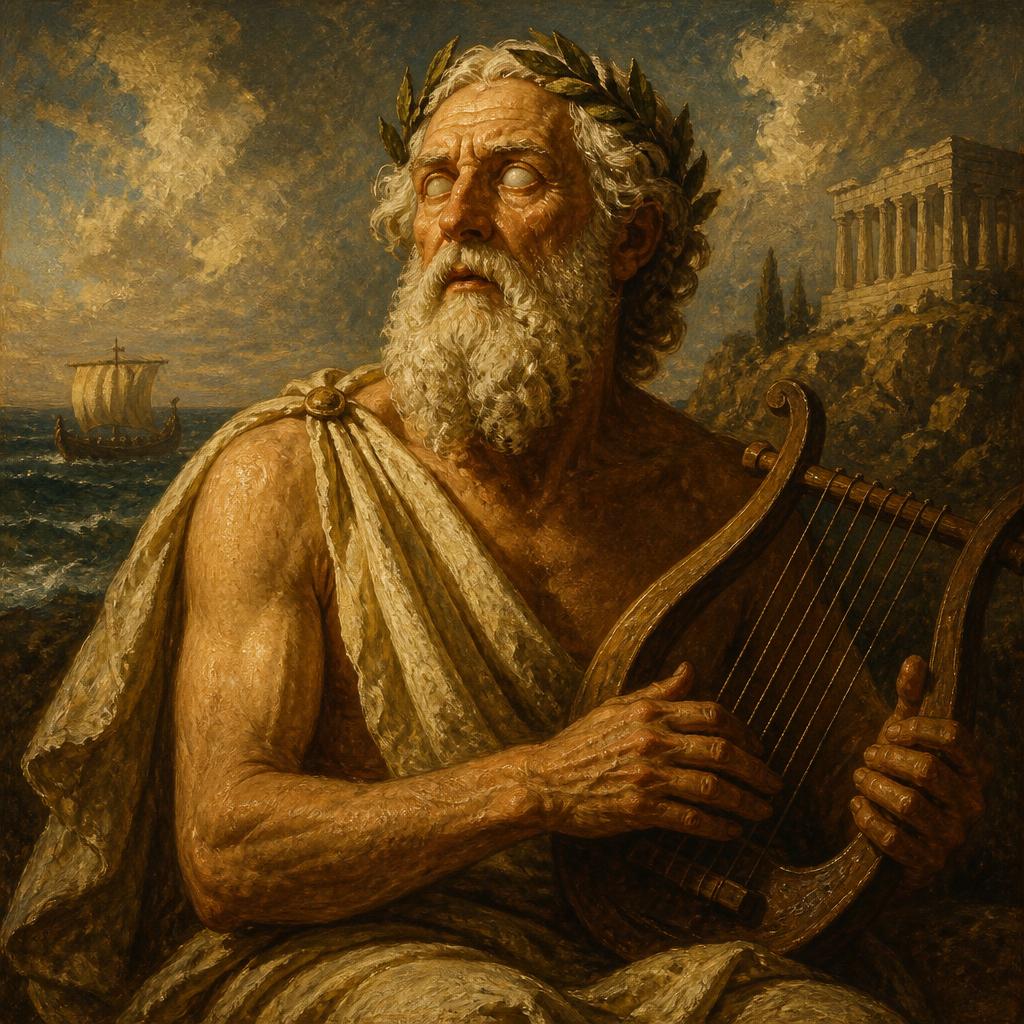
Quick Facts
- Years
- 750 BC – 650 BC
- Category
- Writers & Poets
- Subcategory
- Poets
- Nationality
- Greek
- Occupation
- Epic Poet
Homer
750 BC – 650 BC · Greek · Epic Poet
Audiobook

Life Lessons from Homer
Marcus Alden · 48 min
Homer is the name traditionally given to the ancient Greek poet associated with the Iliad and the Odyssey, two epics that stand near the beginning of surviving Greek literature. Probably composed during the late eighth or early seventh century BCE, the poems transformed older traditions about the Trojan War and heroic homecomings into works of remarkable scale, unity, and emotional force. They shaped Greek education, religion, ethics, language, and ideas about heroism for centuries.
Almost nothing reliable is known about Homer as an individual. Ancient biographies described him as a blind wandering singer and assigned him several possible birthplaces, but these accounts were written long after the period in which he probably lived. Scholars continue to debate whether one poet created both epics, whether “Homer” represents a succession of oral performers, and how oral compositions became written texts. This complex set of questions is known as the Homeric Question.
Whatever the author’s identity, the poems’ influence is beyond dispute. Achilles’ anger, Hector’s defense of Troy, Odysseus’ long return, and Penelope’s endurance became enduring elements of world culture. Homer influenced Greek historians and dramatists, Roman poets such as Virgil, and countless later writers, artists, translators, and filmmakers. He remains central to the study of oral poetry, war, leadership, mortality, storytelling, and the foundations of classical civilization.
Quick Facts
| Field | Details |
|---|---|
| Full Name | Unknown; traditionally called Homer |
| Common Name(s) | Homer; Greek: Homēros |
| Born | Unknown; conventionally placed around the eighth century BCE |
| Died | Unknown; sometimes broadly dated to the late eighth or seventh century BCE |
| Age at Death | Unknown |
| Birthplace | Disputed; ancient claims included Chios, Smyrna, and other Greek cities |
| Nationality | Ancient Greek, in cultural and linguistic terms |
| Occupation | Epic poet or singer; exact historical role uncertain |
| Historical Era | Archaic Greece, probably late eighth or early seventh century BCE |
| Famous For | The Iliad and the Odyssey |
| Political Affiliation | Not applicable or not recorded |
| Religion | Traditional ancient Greek polytheistic culture, as reflected in the epics; personal beliefs unknown |
| Education | Not recorded; likely connected with oral poetic tradition if a historical individual |
| Parents | Unknown; ancient legendary genealogies are unreliable |
| Spouse(s) | Unknown; later traditions are not historically verifiable |
| Children | Unknown |
| Major Works | Iliad; Odyssey; other works were attributed to Homer in antiquity but are disputed or rejected |
| Major Achievements | Monumental shaping of Greek epic; foundational influence on classical education and Western literature |
Early Life
No contemporary record describes Homer’s birth, parents, childhood, or education. Even his dates are inferred rather than documented. Many scholars place the decisive composition of the Iliad and Odyssey between approximately 750 and 650 BCE, although narrower and sometimes later chronologies have been proposed.
Ancient communities competed for the honor of being Homer’s birthplace. Smyrna and Chios, both linked to the eastern Aegean and the Ionian Greek world, became especially prominent claimants. The poems’ language supports a broad eastern Greek context: it is an artificial poetic mixture dominated by Ionic forms but containing Aeolic and older linguistic elements. It does not reveal a simple local biography.
If Homer was one principal poet, he probably learned within an oral culture. Singers known as aoidoi performed narrative verse using a stock of metrical phrases, recurring scenes, genealogies, and traditional story patterns. The Odyssey itself portrays singers such as Demodocus and Phemius, offering valuable—though literary rather than documentary—images of epic performance.
The historical setting was one of profound change. Greek communities were emerging from the centuries following the collapse of the Late Bronze Age palace systems. Trade and colonization expanded, sanctuaries grew in importance, and the Greeks adapted the Phoenician alphabet. The epics remember a distant heroic age but combine Bronze Age echoes with institutions and material details from later periods. They are therefore poetic constructions, not straightforward records of Mycenaean society.
No mentors can be identified. Homer’s deepest “teachers,” in a historical sense, were probably generations of anonymous singers who preserved and reshaped traditions concerning Troy, Achilles, Odysseus, and other heroes.
Rise to Prominence
There is no recoverable account of Homer’s early career. The most plausible reconstruction begins not with private writing but with performance. Epic singers could improvise or recompose traditional stories in meter before audiences at courts, festivals, or communal gatherings. A gifted poet may have expanded inherited material into unusually long and architecturally sophisticated narratives.
The Iliad does not recount the whole Trojan War. It concentrates on a brief period in its final year, beginning with Achilles’ anger and ending with Hector’s funeral. The Odyssey likewise organizes many adventures around Odysseus’ delayed return to Ithaca. This disciplined selection from a much larger tradition helped distinguish the poems.
How they reached stable written form is debated. One theory proposes that a poet used the relatively new Greek alphabet to compose or dictate them. Another suggests that oral performances were written down later and edited over time. The poems show both oral-formulaic characteristics and large-scale design, and scholars disagree about precisely how those features arose together.
By the sixth century BCE, Homeric poetry held exceptional authority throughout the Greek world. A later tradition associated the Athenian ruler Peisistratus or his sons with arranging Homeric recitations at the Panathenaic festival. Claims that they produced a definitive edition are uncertain, but regulated public performance probably helped stabilize the text and increase its prestige.
Major Achievements
Shaping the Iliad
The Iliad made Achilles’ wrath the organizing theme of a vast heroic world. When Agamemnon dishonors Achilles, the greatest Greek fighter withdraws from battle. His decision contributes to disaster, including the death of Patroclus. Achilles returns to kill Hector, but the poem’s climax is moral rather than military: the aged Priam enters his enemy’s shelter and begs for his son’s body.
The epic mattered because it joined battlefield grandeur to a searching examination of rage, status, grief, pity, and mortality. Its warriors seek kleos—enduring fame—yet the poem repeatedly displays the human cost of that ambition. Later tragedy, historiography, political rhetoric, and war literature drew upon its conflicts.
Shaping the Odyssey
The Odyssey developed a different model of heroism. Odysseus survives not only by strength but also through intelligence, disguise, patience, persuasive speech, and control of information. Its nonlinear structure moves among Ithaca, Telemachus’ search for news, and Odysseus’ retrospective account of his wanderings.
The poem established enduring narrative patterns: the difficult homecoming, the journey through marvelous lands, the faithful spouse, the son seeking a father, and the stranger whose identity is gradually revealed. Its influence extends from Virgil and Dante to James Joyce, modern novels, cinema, and the everyday use of “odyssey” for a long, transformative journey.
Perfecting Monumental Oral-Derived Epic
Both poems use dactylic hexameter, repeated epithets, type-scenes, catalogues, similes, and formulaic expressions. Twentieth-century scholarship associated especially with Milman Parry and Albert Lord demonstrated that such features are not merely signs of unimaginative repetition. They are tools of oral composition and performance.
The epics’ achievement lies in turning traditional language into extended works with thematic depth. Their methods transformed scholarly understanding of oral cultures worldwide, influencing research on South Slavic singers and many other traditions.
Establishing a Shared Greek Cultural Reference
The epics gave geographically divided Greek communities a common heroic past. Their gods, heroes, ethical vocabulary, and geographical imagination became shared points of reference. Greeks quoted Homer in education, law courts, philosophy, literary criticism, and public debate.
This authority was never uncontested. Philosophers criticized Homer’s portrayals of divine deception and violence. Yet even criticism confirmed his centrality: to dispute Greek values often meant arguing with Homer.
Creating Enduring Human Characters
Achilles is both terrifying and vulnerable; Hector is a defender, husband, father, and doomed warrior; Penelope combines fidelity with strategic intelligence; Odysseus is ingenious but often deceptive; Helen recognizes her compromised position; and Priam crosses enemy lines in grief.
Their complexity encouraged continual reinterpretation. Different eras have praised or condemned the same characters, allowing the poems to support discussions about honor, trauma, gender, authority, home, slavery, and war.
Leadership and Work
Homer held no documented political or military leadership position. Any description of his “leadership style” must therefore concern poetic authority rather than public office.
The epics display extraordinary control over inherited material. They delay information, shift viewpoints, embed stories within stories, and use repeated scenes with meaningful variation. The narrator can sympathize with opposing sides: the Trojans are not reduced to faceless enemies, and Hector receives some of the Iliad’s most humane treatment.
The poet’s apparent strengths include structural planning, characterization, vivid similes, memory, and command of formulaic language. A further strength is ethical openness. The narrative presents tensions—between glory and life, justice and revenge, identity and disguise—without always resolving them into simple lessons.
Possible “weaknesses” depend on modern expectations. Repetitions, inconsistencies, and shifts in tone have led some scholars to propose multiple authors or layers of revision. Other scholars see these features as natural products of oral-derived poetry or as purposeful variations. Because no manuscripts survive from the presumed time of composition, the process cannot be reconstructed with certainty.
Personal Life
Nothing dependable is known about Homer’s marriage, children, friendships, habits, health, or personality. Ancient biographical writings supplied picturesque details, but these generally belong to legend rather than verifiable history.
The most famous tradition portrays Homer as blind. Blindness may have been inferred from a hymn in which a singer calls himself “the blind man who dwells in rocky Chios,” although the attribution of that hymn to Homer is not secure. Blind singers also carried symbolic prestige in ancient storytelling: Demodocus in the Odyssey is blind but favored by the Muse.
The “Lives of Homer,” composed centuries later, describe travels, poetic contests, relatives, and death on the island of Ios. These narratives reveal how antiquity imagined the ideal poet; they do not provide firm biographical evidence.
It is equally risky to infer Homer’s personality directly from his characters. The narrator’s compassion, humor, and attention to domestic life reveal qualities of the poetry, not necessarily the private character of a single author.
Philosophy and Beliefs
Homer left no philosophical treatise, and the poems should not be reduced to a systematic creed. They portray a polytheistic universe in which Zeus, Athena, Apollo, Hera, Poseidon, and other gods intervene in human affairs. The gods are powerful but morally inconsistent, and humans remain responsible within limits imposed by fate, circumstance, and mortality.
Honor is central. Heroes care intensely about public status, prizes, reputation, and fame after death. Yet the epics also test heroic values. Achilles’ pursuit of honor isolates him, while Priam’s appeal awakens recognition of shared suffering. Odysseus’ longing for home places family, identity, and belonging beside martial glory.
Hospitality, or xenia, is another major ethical principle. Good hosts feed and protect strangers before demanding their identities; violators invite disorder and punishment. The suitors in the Odyssey abuse Odysseus’ household, while exemplary hosts provide safety and gifts.
Politically, the poems depict kings, councils, assemblies, and disputes among elites, but they do not advocate a modern program. Agamemnon’s failures show that rank alone does not guarantee good judgment. Effective authority requires persuasion, restraint, reciprocity, and respect for communal expectations.
Challenges and Controversies
The Homeric Question
The central controversy asks who composed the epics and how. “Unitarians” have emphasized each poem’s overall artistic coherence and often favor a dominant author. “Analysts” historically separated the texts into layers or independent lays. Oral-traditional scholarship shifted the debate by showing how a singer could create substantial poetry through inherited formulas.
Current positions vary. Some scholars accept one exceptional poet for each epic, possibly the same person; others favor successive composition, performance, and editorial development. “Homer” may designate a historical poet, a traditional name, or a convenient label for a complex process.
Date and Place
Linguistic evidence, material references, and historical context generally support an Archaic date, but estimates differ. The eastern Aegean is a common hypothesis because of the dialect and later associations with Chios and Ionia. No claimed birthplace can be proved.
Authorship of Other Works
Ancient Greeks attributed many poems to Homer, including hymns, comic works, and parts of the Epic Cycle. Modern scholarship generally limits the core Homeric corpus to the Iliad and Odyssey, while recognizing that even their common authorship is uncertain. The Homeric Hymns are a collection by different poets and dates.
Historical Accuracy
Heinrich Schliemann’s excavations at Hisarlık helped establish that a major Bronze Age settlement existed at the site widely identified with Troy. They did not prove that the Trojan War occurred exactly as Homer tells it. Archaeology suggests conflict and destruction in the region, but the epics combine distant memories, later customs, fantasy, and poetic invention.
Ethical Criticism
Plato objected to stories in which gods behave badly and questioned poetry’s role in educating citizens. Modern readers also confront enslavement, patriarchal structures, slaughter, and revenge. Some interpret the epics as endorsing heroic violence; others emphasize their exposure of violence’s grief and instability. Both poems sustain rather than eliminate this tension.
Legacy
Homer became the foundation of Greek literary education. Students learned language, mythology, rhetoric, and ethics through the epics. Alexandrian scholars, including Zenodotus and Aristarchus, compared manuscripts, marked doubtful lines, and helped establish textual criticism.
Roman literature absorbed Homer deeply. Virgil’s Aeneid combines a wandering first half reminiscent of the Odyssey with a martial second half shaped by the Iliad. Later writers from Dante and Shakespeare to Goethe, Derek Walcott, and Margaret Atwood reworked Homeric themes.
The poems remain central to debates about oral tradition, translation, reception, and the representation of war. Modern translators continually reinterpret their speed, formality, repetition, violence, and humor. Archaeologists and historians use Homer cautiously, comparing the epics with material evidence rather than treating them as chronicles.
Memorials reflect both history and legend. Chios preserves traditions connecting the island with Homer, including the site called Daskalopetra or “Homer’s Stone.” Ios has a legendary “Tomb of Homer.” Statues and busts of an idealized blind poet appear in museums and libraries worldwide, though none is a contemporary portrait. Institutions bearing his name range from schools to research projects, while manuscripts and papyri are held by major museums and libraries.
Homer’s greatest memorial is linguistic and imaginative. “Achilles’ heel,” “Trojan horse,” “siren song,” “between Scylla and Charybdis,” and “odyssey” remain widely understood expressions, even though some derive from the wider mythic tradition rather than specific wording in the epics.
Interesting Facts
- No contemporary portrait, inscription, or biographical record of Homer survives.
- The Iliad contains more than 15,000 lines in its standard form.
- The Odyssey contains more than 12,000 lines.
- Both poems are composed in dactylic hexameter.
- The Iliad covers only a short span near the end of the Trojan War.
- The Trojan horse does not appear as a full episode in the Iliad.
- The Odyssey briefly refers to the wooden horse.
- The Iliad ends with Hector’s funeral, not Troy’s fall.
- “Sing, goddess” and “Tell me, Muse” announce dependence on divine inspiration.
- Homeric Greek is a specialized poetic language rather than ordinary speech from one place and date.
- Ancient tradition named seven or more cities as Homer’s birthplace.
- The blind-poet image is traditional but unproven.
- Formulaic epithets such as “swift-footed Achilles” helped fit names and ideas into the meter.
- The poems preserve traces of different historical periods.
- Papyri show that Homer was among the most frequently copied authors in antiquity.
- Alexandrian editors divided or standardized the epics into 24 books each.
- The Greek alphabet has 24 letters, although the familiar book divisions developed after composition.
- The Batrachomyomachia, or “Battle of Frogs and Mice,” was once attributed to Homer but is not accepted as his work.
- Milman Parry’s research transformed understanding of Homeric formulaic composition.
- The word “odyssey” entered many languages as a term for a long, eventful journey.
Famous Quotes
Translations vary, so wording below follows common English renderings rather than claiming a single definitive phrasing.
- “Sing, goddess, the anger of Peleus’ son Achilles.” — Iliad, Book 1. The opening identifies wrath as the epic’s subject and invokes divine assistance.
- “There is nothing alive more agonized than man.” — Iliad, Book 17. Zeus reflects on mortal suffering; translations differ substantially.
- “No man is going to hurl me to Hades before my time.” — Iliad, Book 6. Hector expresses courage within a world governed by fate.
- “Let me not die without a struggle, inglorious.” — Iliad, Book 22. Hector chooses a final stand after recognizing that death is near.
- “I have endured what no one on earth has ever done before—I put to my lips the hands of the man who killed my son.” — Iliad, Book 24. Priam’s plea to Achilles turns shared grief into compassion.
- “Tell me, Muse, of the man of many ways.” — Odyssey, Book 1. The opening defines Odysseus through versatility; “many ways” is also translated as “complicated” or “of twists and turns.”
- “There is nothing sweeter than a man’s own country and parents.” — Odyssey, Book 9. Odysseus explains why comfort abroad cannot replace home.
- “Nobody is my name.” — Odyssey, Book 9. Odysseus’ pun deceives the Cyclops Polyphemus and illustrates survival through language.
- “Of all creatures that breathe and move upon the earth, nothing is bred that is weaker than man.” — Odyssey, Book 18. Odysseus, disguised, warns against confidence in good fortune.
- “The blade itself incites to deeds of violence.” — traditionally attributed to Homer. This wording circulates widely but lacks a secure, straightforward Homeric source in this form and should be treated as a disputed attribution.
Timeline
- c. 1200 BCE — Approximate era of the destruction of several Late Bronze Age centers; later Greek tradition placed the Trojan War in this distant past.
- c. 1050–800 BCE — Generations of oral singers likely transmitted and reshaped heroic traditions.
- c. 750–650 BCE — Broad conventional period for the composition or monumental shaping of the Iliad and Odyssey.
- Eighth century BCE — Greeks adapt and develop alphabetic writing, creating conditions for recording long poems.
- Sixth century BCE — Homeric recitations become associated with the Panathenaic festival at Athens; traditions connect regulation of the text with the Peisistratid period.
- Fifth–fourth centuries BCE — Historians, dramatists, and philosophers quote, adapt, and criticize Homer.
- Third–second centuries BCE — Alexandrian scholars edit and comment on Homeric texts.
- First century BCE — Virgil begins the Aeneid, a Roman epic profoundly indebted to Homer.
- Fifteenth century CE — Printed editions help circulate Homer in Renaissance Europe.
- 1795 CE — Friedrich August Wolf’s Prolegomena ad Homerum renews systematic debate over authorship and textual formation.
- 1870s CE — Heinrich Schliemann excavates at Hisarlık, identified with ancient Troy.
- 1920s–1930s CE — Milman Parry develops the oral-formulaic theory of Homeric composition.
- Twentieth–twenty-first centuries — New translations, archaeological research, papyrus discoveries, and reception studies continue to reshape Homeric scholarship.
Frequently Asked Questions
Was Homer a real person?
Possibly, but the evidence cannot prove it. Ancient Greeks generally treated Homer as an individual poet, while later biographies supplied detailed legends. No contemporary document confirms his existence. Some scholars think an exceptional singer was chiefly responsible for one or both epics. Others understand “Homer” as the name attached to poems produced through generations of oral performance and later textual stabilization. The safest conclusion is that the traditional name represents the authoritative source of the poems, while the precise historical identity behind it remains unknown.
When was Homer born?
No reliable birth date survives. Dates such as 750 BCE are modern conventions, not recorded facts. Most scholars place the monumental formation of the epics in the late eighth or early seventh century BCE, though arguments extend beyond that range. A poet responsible for them would have lived around their period of composition, but the poems may also preserve material developed over centuries. For that reason, biographical dates should always be labeled approximate or unknown.
Where was Homer born?
Ancient traditions named numerous locations, particularly Smyrna and Chios. Both lie in or near the eastern Aegean cultural region associated with Ionic Greek. The poetic language contains strong Ionic features as well as Aeolic and archaic elements, supporting a broad regional connection but not identifying a city. Claims by individual communities reflected cultural prestige as much as historical memory. No birthplace can be verified.
Was Homer blind?
The familiar image of Homer as a blind singer is ancient but unconfirmed. It may be linked to a passage in the Hymn to Apollo mentioning a blind singer from Chios, although neither the hymn’s authorship nor its autobiographical character is certain. The blind bard Demodocus in the Odyssey may also have encouraged the association. Ancient portraits showing sightless eyes are idealized works created long after Homer’s presumed lifetime.
Did Homer write both the Iliad and the Odyssey?
Tradition says yes, but scholars disagree. The poems share meter, language, formulas, and a common mythic world, yet they differ in tone, structure, social emphasis, and perhaps date. Some scholars attribute both to one poet at different stages of life; others propose separate principal poets working within the same tradition. There is no external evidence that settles the question. “Homeric” therefore often describes the poems and their tradition without requiring certainty about common authorship.
Were the epics written or orally composed?
They are deeply rooted in oral tradition. Repeated formulas, type-scenes, and metrical patterns resemble techniques used by oral singers who compose during performance. The surviving poems, however, possess monumental scale and careful organization. Scholars debate whether they were dictated by a singer, composed with writing, recorded from performances, or stabilized through repeated transmission and editing. Oral and written processes need not be mutually exclusive; the texts may stand at a transition between them.
Is the Iliad a history of the Trojan War?
No. It is an epic poem centered on Achilles’ anger during a short part of the war’s final year. Archaeology confirms that a substantial settlement existed at Hisarlık and suffered destructions, but it cannot verify Homer’s plot, heroes, gods, or chronology. The poem contains possible Bronze Age memories alongside later institutions and imaginative elements. Historians use it cautiously as evidence for Greek cultural memory and poetic values, not as an eyewitness chronicle.
Does the Iliad tell the story of the Trojan horse?
No. The Iliad ends with Hector’s burial before Troy falls. The wooden horse belongs to other parts of the Trojan tradition. It receives brief references in the Odyssey, especially in songs about the capture of Troy, and was narrated in lost poems of the Epic Cycle. Virgil later provided the most famous extended account in Book 2 of the Aeneid.
What is the Iliad mainly about?
Its announced subject is the anger of Achilles and the suffering that follows. The dispute between Achilles and Agamemnon raises questions about honor, authority, and recognition. Patroclus’ death turns anger into grief and vengeance. Priam’s appeal at the end reveals a shared humanity between enemies. Although war dominates the setting, the poem is also about mortality, bereavement, leadership, family, and the terrible cost of heroic fame.
What is the Odyssey mainly about?
The Odyssey concerns return, identity, and the restoration of a disrupted household. Odysseus struggles to reach Ithaca after Troy while Penelope and Telemachus face predatory suitors. The hero’s intelligence and adaptability help him survive, but his pride and secrecy also create danger. Hospitality provides an ethical test throughout the poem. Its conclusion restores Odysseus’ household through recognition and violence, then requires divine intervention to halt further revenge.
What language did Homer use?
The epics use Homeric Greek, an artificial literary language shaped for dactylic hexameter. Ionic forms predominate, but Aeolic features, archaic words, and expressions from different periods also appear. It was probably never the everyday dialect of one community. Its layered character reflects long poetic transmission and allowed singers to choose among alternative forms according to metrical need.
What is dactylic hexameter?
Dactylic hexameter is the traditional meter of Greek and Latin epic. Each line contains six metrical units, with patterns based on long and short syllables rather than English-style stress. Formulaic phrases fit recurring positions within this structure, helping singers organize language rapidly and aiding audience recognition. Virgil, Ovid, and other Roman poets later adapted the meter to Latin, making it one of antiquity’s most influential verse forms.
Why do Homeric epithets repeat?
Expressions such as “swift-footed Achilles,” “grey-eyed Athena,” and “rosy-fingered Dawn” fit particular metrical contexts and identify characters or scenes efficiently. Oral-formulaic research showed that repetition is integral to composition, not simply careless redundancy. Epithets can also create continuity, evoke tradition, and generate irony—for example, a standard description may appear when a character is not displaying the named quality. Translators differ over how fully to preserve them.
What is the Homeric Question?
The Homeric Question is the cluster of debates concerning authorship, composition, date, unity, and transmission of the epics. It asks whether one poet made both works, whether shorter songs were combined, how oral tradition operated, and when writing entered the process. Friedrich August Wolf gave the debate major modern impetus in 1795, while Milman Parry’s twentieth-century work transformed it by demonstrating the systematic nature of formulaic oral poetry.
How did Homer influence education?
For centuries, Greek students learned reading, recitation, vocabulary, mythology, and moral examples through Homer. Teachers and philosophers treated the epics as cultural authorities, even when criticizing them. Romans studied Homer as a model for poetry and interpreted him allegorically. Modern schools and universities continue to teach the poems in courses on classics, literature, history, war, mythology, translation, and oral tradition.
Are the Homeric Hymns by Homer?
Probably not. The collection called the Homeric Hymns consists of poems in epic language and meter addressed to Greek gods. They come from different dates and authors, though some may be early. The label “Homeric” reflects their style and traditional association, not secure authorship. The same caution applies to the Batrachomyomachia and much of the lost Epic Cycle, which antiquity sometimes connected with Homer.
Why is Homer still relevant?
The epics examine experiences that remain recognizable: anger, war, bereavement, displacement, family separation, political failure, the desire for fame, and longing for home. They also force readers to confront ethically difficult societies rather than offering easy models. Their storytelling techniques influence modern fiction and film, while debates over authorship illuminate how communities create and preserve cultural memory.
Lessons We Can Learn
- Unchecked anger harms communities. Achilles’ quarrel causes losses far beyond the original insult. Modern leadership likewise requires separating personal grievance from collective responsibility.
- Authority needs legitimacy. Agamemnon possesses rank but repeatedly makes poor decisions. Position alone cannot replace judgment, persuasion, and respect.
- Empathy can cross enemy lines. Priam and Achilles recognize shared grief. Humanizing opponents can interrupt cycles of vengeance.
- Adaptability is a form of strength. Odysseus survives by changing tactics. Flexible thinking matters when familiar solutions fail.
- Pride can undo intelligence. Odysseus reveals his name to Polyphemus and invites Poseidon’s anger. Success should not eliminate caution.
- Home requires active stewardship. Penelope and Telemachus preserve a threatened household through endurance and growth. Institutions survive when members accept responsibility.
- Hospitality builds trust. Good hosts in the Odyssey respect vulnerable strangers. Humane treatment of outsiders remains a measure of social character.
- Stories preserve collective memory. Oral singers transmitted traditions across generations. Cultural knowledge survives through disciplined teaching and adaptation.
- Great work can emerge from collaboration with tradition. The epics depend on inherited formulas and plots. Originality often means reshaping, not rejecting, what came before.
- Victory does not erase suffering. Neither epic presents war as cost-free. Ethical reflection should include those who endure the consequences of heroic decisions.
Related Historical Figures
- Hesiod — An early Greek poet near Homer’s traditional period; his Theogony and Works and Days offer a contrasting poetic voice.
- Sappho — An Archaic Greek lyric poet who inherited and transformed epic vocabulary and myth.
- Herodotus — The historian discussed Homer’s date and used epic traditions while developing prose inquiry.
- Aeschylus — A tragedian whose treatments of heroic myth grew from the cultural world shaped by epic.
- Sophocles — His tragedies reinterpret heroes and ethical conflicts familiar from Homeric tradition.
- Euripides — He often exposed the suffering, especially of women and captives, behind heroic warfare.
- Plato — A philosopher who admired Homer’s power but criticized his theology and educational influence.
- Aristotle — In the Poetics, he praised Homer’s narrative skill and selection of unified action.
- Virgil — The Roman author of the Aeneid, the most influential classical reworking of Homeric epic.
- Milman Parry — A twentieth-century scholar whose oral-formulaic research revolutionized the study of Homeric composition.
Related Historical Figures