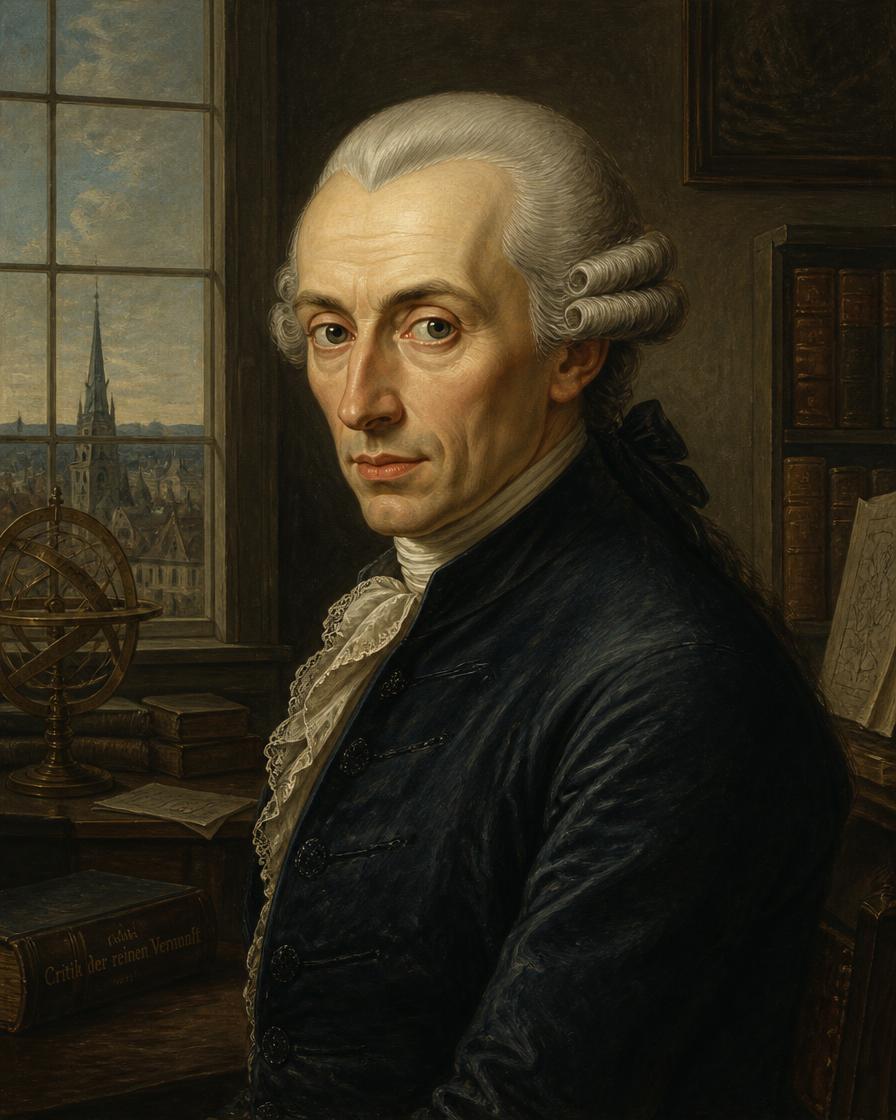
Quick Facts
- Years
- 1724 – 1804
- Category
- Philosophers & Thinkers
- Subcategory
- Enlightenment
- Nationality
- German
- Occupation
- Philosopher
Immanuel Kant
1724 – 1804 · German · Philosopher
Audiobook

Life Lessons from Immanuel Kant
Marcus Alden · 51 min
Immanuel Kant (1724–1804) was a Prussian philosopher whose work transformed metaphysics, epistemology, ethics, aesthetics, and political thought. Living almost his entire life in Königsberg, East Prussia, he developed what he called a “critical” philosophy: an inquiry into the powers and limits of human reason. Rather than simply choosing between rationalism and empiricism, Kant argued that knowledge arises through the interaction of sensory experience with structures supplied by the mind.
His greatest achievement was the critical system presented in the Critique of Pure Reason, Critique of Practical Reason, and Critique of the Power of Judgment. In ethics, he formulated the categorical imperative, according to which rational agents must act only on principles they could will as universal laws and must treat humanity as an end, never merely as a means. His essays on enlightenment, freedom, law, and peace also helped shape modern political philosophy.
Kant remains central because he changed the questions philosophers ask. He attempted to explain how objective knowledge is possible, how freedom can coexist with natural causation, and why morality binds rational beings. Although later thinkers criticized his system, they rarely escaped its influence. Contemporary debates about autonomy, human dignity, scientific knowledge, international order, and aesthetic judgment still draw upon—or argue against—Kantian ideas.
Quick Facts
| Field | Information |
|---|---|
| Full Name | Immanuel Kant |
| Common Name(s) | Immanuel Kant; baptized Emanuel Kant |
| Born | 22 April 1724 |
| Died | 12 February 1804 |
| Age at Death | 79 |
| Birthplace | Königsberg, Kingdom of Prussia, now Kaliningrad, Russia |
| Nationality | Prussian |
| Occupation | Philosopher, university professor, tutor, librarian |
| Historical Era | Enlightenment; early modern philosophy |
| Famous For | Critical philosophy, transcendental idealism, categorical imperative, theory of autonomy |
| Political Affiliation | None recorded; broadly associated with Enlightenment republican and liberal ideals, though not a modern party member |
| Religion | Raised in a Pietist Lutheran household; developed a rational, morally centered interpretation of religion |
| Education | Collegium Fridericianum; University of Königsberg (Albertina) |
| Parents | Johann Georg Kant and Anna Regina Reuter Kant |
| Spouse(s) | Never married |
| Children | None recorded |
| Major Works | Critique of Pure Reason; Groundwork of the Metaphysics of Morals; Critique of Practical Reason; Critique of the Power of Judgment; Religion within the Boundaries of Mere Reason; Toward Perpetual Peace |
| Major Achievements | Founded critical philosophy; reshaped epistemology and metaphysics; developed deontological ethics; influenced aesthetics, political philosophy, and theories of human dignity |
Early Life
Kant was born on 22 April 1724 in Königsberg, an important Baltic port and administrative center of East Prussia. His father, Johann Georg Kant, was a harness maker. His mother, Anna Regina Reuter Kant, was remembered by Kant as intelligent and morally serious. The family was respectable but of modest means, and several of its children died young, as was common in eighteenth-century Europe.
His parents belonged to the Pietist movement within Lutheranism. Pietism emphasized sincere faith, personal discipline, Bible reading, and moral conduct rather than elaborate theological controversy. Kant later rejected aspects of the strict religious education associated with his youth, yet its focus on conscience and duty probably contributed to his mature moral outlook.
At about eight, Kant entered the Collegium Fridericianum, a Pietist school directed by Franz Albert Schultz. The curriculum concentrated heavily on Latin classics and religious instruction. Kant became highly proficient in Latin, although later accounts suggest that he found the school’s austere regime oppressive.
In 1740, he enrolled at the University of Königsberg, commonly called the Albertina. He studied philosophy, mathematics, theology, and the natural sciences. A major intellectual influence was Martin Knutzen, who introduced students to the rationalist philosophy of Gottfried Wilhelm Leibniz and Christian Wolff while also encouraging engagement with Isaac Newton’s physics.
Kant’s father died in 1746, leaving him without adequate financial support. He departed the university without immediately completing the qualifications required for an academic post and worked for several years as a private tutor in East Prussian households. This period broadened his social experience beyond his artisan upbringing and university environment.
His formative world was shaped by the Enlightenment, the scientific revolution, Prussia’s expanding state, and conflicts among rationalism, empiricism, and traditional theology. These tensions became the background to his lifelong effort to reconcile science, morality, freedom, and religious hope without allowing any one of them unlimited authority.
Rise to Prominence
Kant’s first book, Thoughts on the True Estimation of Living Forces, appeared in 1749. It addressed a dispute in natural philosophy but attracted little attention. After his years as a tutor, he returned to Königsberg and completed the academic work necessary to teach at the university.
In 1755 he received a doctoral degree and qualified as a Privatdozent, an unsalaried lecturer paid largely through student fees. His Latin dissertation, A New Elucidation of the First Principles of Metaphysical Cognition, helped establish his academic credentials. That same year he published Universal Natural History and Theory of the Heavens, proposing that the solar system had developed from a rotating cloud of matter. The hypothesis anticipated elements of what later became known as the Kant–Laplace nebular theory.
Kant lectured on an unusually broad range of subjects, including logic, metaphysics, ethics, mathematics, physics, geography, anthropology, natural law, and pedagogy. He became a popular teacher known for lively presentations rather than merely reading from a fixed text.
Academic advancement was slow. Kant unsuccessfully sought professorships and briefly served as assistant librarian at the royal castle library. In 1770, at the age of 46, he was appointed professor of logic and metaphysics at the University of Königsberg. His inaugural dissertation distinguished the sensible from the intelligible world and marked a transition toward his mature philosophy.
Kant then published little for roughly a decade. This so-called silent decade was not inactivity: he was constructing a new theory of knowledge. The decisive stimulus, by his own account, came from David Hume, whose skepticism interrupted his “dogmatic slumber.”
The Critique of Pure Reason appeared in 1781. Its difficulty and unconventional argument initially produced confusion. Kant responded with the more accessible Prolegomena in 1783 and substantially revised the Critique in 1787. During the 1780s, his ethical and historical essays made him one of Europe’s leading philosophers.
Major Achievements
The Critical Revolution in Philosophy
In the Critique of Pure Reason, Kant asked how synthetic a priori knowledge—knowledge that is informative yet necessary and not derived simply from experience—is possible. He argued that the mind does not passively copy reality. It organizes sensory material through forms of intuition, especially space and time, and through conceptual categories such as causality and substance.
Kant compared this reversal to the Copernican revolution: objects as experienced must conform to the conditions under which human beings can know them. This explained, he believed, how mathematics and fundamental principles of natural science possess necessity.
The long-term impact was enormous. Philosophy could no longer discuss knowledge without examining the knowing subject’s contribution. German idealism, phenomenology, analytic philosophy, and cognitive theory all developed partly through engagement with this argument.
Establishing the Limits of Speculative Reason
Kant distinguished appearances—phenomena—from things as they are independently of our mode of cognition, often called noumena or things in themselves. Human beings can know the world of possible experience, but speculative reason cannot establish theoretical knowledge of the soul’s immortality, the universe as a totality, or God.
This was not straightforward skepticism. Kant sought to secure empirical science while restraining metaphysical claims that exceeded possible experience. His analysis of reason’s “antinomies” showed how apparently valid arguments could generate contradictions when applied beyond experience.
This achievement altered metaphysics from a supposed science of supersensible objects into a critique of reason’s own boundaries. Debate continues over whether Kant successfully limited knowledge without making unknowable things in themselves philosophically problematic.
Formulating the Categorical Imperative
In the Groundwork of the Metaphysics of Morals and Critique of Practical Reason, Kant argued that morality rests on reason and autonomy rather than desire, social convention, or predicted consequences. A categorical imperative commands unconditionally.
Its universal-law formulation directs a person to act only on a maxim that could consistently be willed as a universal law. Its humanity formulation requires treating humanity, in oneself and others, always as an end and never merely as a means.
This framework became a foundation of deontological ethics. It continues to influence discussions of rights, consent, professional duties, medical ethics, and human dignity. Critics nevertheless question its rigor, its treatment of consequences, and the difficulty of specifying maxims impartially.
Developing a Theory of Autonomy and Dignity
For Kant, a morally free person does not merely follow impulses or external commands. Freedom consists in rational self-legislation: giving oneself principles that any rational being could accept. Because persons can act under moral laws, they possess dignity rather than a market price.
This idea helped redirect moral and political thought toward autonomy, equal respect, and the inviolable status of persons. Modern human-rights language is not simply derived from Kant, but Kantian concepts remain deeply embedded in legal and bioethical debates.
Unifying Nature, Freedom, and Judgment
The Critique of the Power of Judgment examined aesthetic judgment and the apparent purposiveness of organisms. Kant described judgments of beauty as disinterested and subjectively grounded, yet carrying a claim to universal agreement. His account of the sublime explored experiences in which overwhelming magnitude or power reveals the superiority of rational vocation over sensible limitation.
The book also treated organisms as if their parts existed for and through the whole, while warning against turning purposiveness into demonstrable knowledge of divine design. This work shaped modern aesthetics, Romanticism, philosophy of biology, and theories of interpretation.
Contributions to Enlightenment and Political Philosophy
In “An Answer to the Question: What Is Enlightenment?” Kant defined enlightenment as humanity’s emergence from self-incurred immaturity and urged people to dare to use their own understanding. He distinguished the public use of reason by scholars from role-specific obligations within institutions.
In Toward Perpetual Peace, he advocated republican civil constitutions, a federation of free states, and cosmopolitan rights governing hospitality. Although not a blueprint for any later institution, the essay became an important reference point in theories of international law, democratic peace, and global justice.
Early Contributions to Natural Science and Geography
Before his critical philosophy, Kant wrote on cosmology, earthquakes, winds, physical geography, and natural history. His nebular hypothesis proposed a natural developmental account of the solar system rather than treating its arrangement as static.
Some scientific claims became obsolete, but the work demonstrated his commitment to explaining nature through lawful processes. His geography lectures also helped institutionalize academic geography, although portions reflected the inadequate evidence and racial hierarchies common in European scholarship of his era.
Leadership and Work
Kant was not a political ruler or institutional founder. His leadership was intellectual and pedagogical. As a professor, he trained students to reason rather than merely memorize doctrine. Accounts from former students describe lectures enriched with examples and humor, though recollections written long afterward require some caution.
His working method combined extensive reading, precise distinctions, repeated revision, and systematic architecture. He sought principles capable of connecting many fields. This produced extraordinary coherence, but it also led to dense terminology and arguments that readers often found difficult.
Kant valued independence of judgment, intellectual honesty, consistency, and disciplined inquiry. He did not simply follow dominant authorities: his mature philosophy challenged Leibnizian rationalism, Humean skepticism, traditional metaphysics, and some forms of religious dogmatism.
He maintained relationships with students, colleagues, publishers, and correspondents across the German-speaking world. Important interlocutors included Marcus Herz, Johann Georg Hamann, Johann Gottfried Herder, Christian Garve, and Karl Leonhard Reinhold. Some became critics as well as admirers.
His strengths included patience, conceptual originality, and the ability to integrate science, morality, and aesthetics. Weaknesses included obscurity of expression, limited engagement with lives outside his social setting, and reliance in anthropology on generalizations now recognized as prejudiced. His determination to create a unified system sometimes made his conclusions seem more rigid than the underlying problems allowed.
Personal Life
Kant never married and had no recorded children. He considered marriage at least occasionally, according to early biographers, but no proposal or sustained courtship is securely documented. He formed enduring friendships and enjoyed company, conversation, and carefully arranged meals.
The popular image of Kant as a humorless recluse is misleading. He spent most of his life in and around Königsberg, yet he was sociable and well informed about international affairs through books, newspapers, letters, and visitors. At dinners he preferred varied conversation and discouraged excessively technical philosophical debate.
Kant became famous for regular habits, especially his daily walk. The story that neighbors set their clocks by him captures his reputation for punctuality, but its literal precision should not be assumed. He organized his later life carefully to protect time for teaching and writing.
He had broad interests in science, geography, travel accounts, politics, and literature. Though he never traveled far, his geographical imagination was expansive. His knowledge of distant peoples, however, came from uneven European reports rather than firsthand observation.
In old age Kant’s memory, strength, and ability to work declined markedly. He described his final unfinished project as an effort to bridge metaphysics and physics. Friends and attendants assisted him as his health deteriorated. He died in Königsberg on 12 February 1804 and was buried near the cathedral.
Philosophy and Beliefs
Kant’s philosophy begins from a distinction between what human beings can know and what reason naturally seeks. Knowledge requires both intuitions and concepts: sensory material without conceptual organization is blind, while concepts without experiential content are empty. Space and time are forms of human sensibility, and the categories structure possible experience.
His “transcendental idealism” does not claim that ordinary objects are imaginary. Rather, objects are empirically real as appearances while known under conditions supplied by human cognition. What things may be independently of those conditions cannot be theoretically known.
Ethically, Kant held that a good will is good not because of its results but because it acts from duty. Moral worth depends on respect for law freely recognized by rational agency. Happiness remains a legitimate human aim, but it cannot serve as morality’s supreme principle.
Kant defended freedom as practically necessary for moral responsibility. God and immortality were not objects of theoretical proof; in his moral philosophy they became “postulates” of practical reason connected with the highest good. His religious outlook emphasized moral faith and criticized ritual, ecclesiastical authority, and claims to supernatural knowledge when detached from ethical conduct.
Politically, he supported legal freedom, civic equality, representative republican government, and the rule of public law. He welcomed the French Revolution’s republican aspirations from a distance but rejected a legal right to violent revolution. He also opposed direct democracy as he defined it, believing it could permit majority despotism.
His cosmopolitanism coexisted with serious limitations. Kant defended universal moral principles and criticized colonial injustice in later writings, yet some of his earlier anthropology and geography lectures classified races hierarchically and included racist claims. Scholars debate the extent of his change over time, but the objectionable passages are genuine and cannot be reconciled easily with equal human dignity.
Challenges and Controversies
The first Critique was criticized as obscure and idealistic. Some readers thought Kant had reduced the external world to mental representation. He insisted that empirical objects were real and added or revised arguments in the 1787 edition, but disputes over the coherence of transcendental idealism have never ended.
His distinction between appearances and things in themselves presents a famous difficulty: if things in themselves cannot be known, how can philosophers legitimately say that they exist or affect us? Defenders interpret the distinction as one between two standpoints on the same objects; others treat it as a division between different kinds of entities. No consensus has prevailed.
Kant’s ethics has been accused of formalism, rigidity, and insufficient concern for consequences or emotion. His essay on an alleged right to lie is frequently criticized because he denied that benevolent motives create a right to make a false statement. Kantian interpreters differ over how his principles apply to coercive or deceptive circumstances.
His religious writing caused conflict with Prussian authorities. After publication of Religion within the Boundaries of Mere Reason, King Frederick William II’s government accused him of misusing philosophy to disparage Christianity. In 1794 Kant promised the king that he would refrain from public discussion of religion. After the king’s death, Kant explained that he regarded the promise as tied to that monarch’s lifetime.
Modern scholarship has scrutinized Kant’s writings on race, sex, and culture. He made hierarchical racial classifications and repeated stereotypes about women and non-European peoples. Some scholars emphasize later texts opposing slavery and colonial conquest; others argue that his universalism remained compromised by exclusions. Responsible interpretation must acknowledge both the emancipatory potential and historical limitations of his thought.
Kant’s political theory also withheld active citizenship from certain economically dependent people and opposed a right of revolution. These positions complicate portrayals of him as a straightforward modern liberal democrat.
Legacy
Kant’s immediate successors—Johann Gottlieb Fichte, Friedrich Schelling, and Georg Wilhelm Friedrich Hegel—treated his philosophy as the starting point for German idealism. Arthur Schopenhauer praised Kant’s achievement while radically revising it. Neo-Kantian movements later renewed his influence in science, culture, and ethics.
In the twentieth and twenty-first centuries, philosophers as different as Edmund Husserl, Martin Heidegger, John Rawls, Jürgen Habermas, Christine Korsgaard, Onora O’Neill, and John McDowell have developed arguments through engagement with Kant. His theories remain prominent in moral philosophy, epistemology, aesthetics, legal thought, and international relations.
Kant is commemorated at Königsberg Cathedral in present-day Kaliningrad, where his tomb and a portico memorial survive. The Immanuel Kant Baltic Federal University bears his name. Statues and plaques commemorate him in Kaliningrad and elsewhere, though regional conflict has periodically made his symbolic status contentious.
His legacy is therefore both foundational and contested. Concepts of autonomy, dignity, public reason, and cosmopolitan law remain powerful, while his racial and gendered assumptions demand criticism. Kant is still studied not because every conclusion is accepted, but because his questions continue to organize philosophical inquiry.
Interesting Facts
- Kant was baptized “Emanuel” but later used the spelling “Immanuel.”
- He spent nearly his entire life in or near Königsberg.
- His father made harnesses and related leather equipment.
- Kant worked as a private tutor before becoming a university lecturer.
- He lectured for approximately fifteen years before gaining a professorship.
- His courses included geography and anthropology as well as philosophy.
- He proposed a nebular account of the solar system in 1755.
- David Hume’s skepticism helped redirect his mature philosophy.
- The first edition of the Critique of Pure Reason appeared when Kant was 57.
- He substantially revised the work for its second edition in 1787.
- Kant never married and had no recorded children.
- He enjoyed sociable midday meals with invited guests.
- His famous punctuality became the subject of stories during and after his lifetime.
- He owned many books but relied heavily on libraries, correspondence, and reviews.
- Prussian authorities censured his writings on religion.
- His essay on perpetual peace influenced later international political theory.
- His tomb stands beside Königsberg Cathedral in modern Kaliningrad.
- His final years were marked by severe cognitive and physical decline.
Famous Quotes
-
“Thoughts without content are empty, intuitions without concepts are blind.” — Critique of Pure Reason. Kant summarizes his view that knowledge requires both sensory presentation and conceptual understanding.
-
“Sapere aude! Have courage to use your own understanding!” — “An Answer to the Question: What Is Enlightenment?” Kant adopted Horace’s phrase as the Enlightenment’s motto, calling for intellectual independence.
-
“Nothing can possibly be conceived in the world, or even out of it, which can be called good without qualification, except a good will.” — Groundwork of the Metaphysics of Morals. The statement introduces his claim that moral worth is not reducible to talent, success, or happiness.
-
“Act only in accordance with that maxim through which you can at the same time will that it become a universal law.” — Groundwork. This is the universal-law formulation of the categorical imperative.
-
“So act that you use humanity, whether in your own person or in the person of any other, always at the same time as an end, never merely as a means.” — Groundwork. It expresses the duty to respect persons as rational agents.
-
“Out of the crooked timber of humanity, no straight thing was ever made.” — “Idea for a Universal History with a Cosmopolitan Aim.” Kant emphasizes the difficulty of creating perfectly just institutions from imperfect human beings.
-
“Enlightenment is the human being’s emergence from his self-incurred immaturity.” — “What Is Enlightenment?” Immaturity means dependence on another’s direction when one could reason independently.
-
“The starry heavens above me and the moral law within me…” — Critique of Practical Reason. In the concluding passage, Kant identifies two sources of continually renewed wonder and reverence.
-
“Perpetual peace is no empty idea, but a task…” — Toward Perpetual Peace. Kant presents international peace as a practical goal requiring gradual legal progress.
-
“Experience without theory is blind, but theory without experience is mere intellectual play.” — Frequently attributed to Kant, but this exact wording is not securely documented in his published works; it should be treated as disputed.
Timeline
- 1724 — Born in Königsberg on 22 April.
- 1732 — Entered the Collegium Fridericianum.
- 1740 — Enrolled at the University of Königsberg.
- 1746 — Left the university after his father’s death and began tutoring.
- 1749 — Published Thoughts on the True Estimation of Living Forces.
- 1754 — Published essays on Earth’s rotation and aging.
- 1755 — Published Universal Natural History; earned his doctorate and qualified as a lecturer.
- 1756 — Sought an academic chair unsuccessfully.
- 1763 — Published The Only Possible Argument in Support of a Demonstration of the Existence of God.
- 1764 — Published Observations on the Feeling of the Beautiful and Sublime.
- 1766 — Published Dreams of a Spirit-Seer; became assistant librarian.
- 1770 — Appointed professor of logic and metaphysics; delivered his inaugural dissertation.
- 1781 — Published the first edition of Critique of Pure Reason.
- 1783 — Published Prolegomena to Any Future Metaphysics.
- 1784 — Published essays on universal history and enlightenment.
- 1785 — Published Groundwork of the Metaphysics of Morals.
- 1786 — Published Metaphysical Foundations of Natural Science.
- 1787 — Issued the second edition of Critique of Pure Reason.
- 1788 — Published Critique of Practical Reason.
- 1790 — Published Critique of the Power of Judgment.
- 1793 — Published Religion within the Boundaries of Mere Reason.
- 1794 — Reprimanded by the Prussian government over his religious writings.
- 1795 — Published Toward Perpetual Peace.
- 1797 — Published The Metaphysics of Morals.
- 1798 — Published The Conflict of the Faculties and Anthropology from a Pragmatic Point of View.
- 1804 — Died in Königsberg on 12 February.
Frequently Asked Questions
Who was Immanuel Kant?
Immanuel Kant was an eighteenth-century Prussian philosopher and professor at the University of Königsberg. He created a “critical philosophy” that investigated the conditions and limits of knowledge, morality, and judgment. His central works addressed how experience becomes intelligible, why metaphysics produces unresolved conflicts, and how rational beings can be morally autonomous. Kant’s ideas influenced German idealism, modern ethics, aesthetics, political philosophy, and theories of science. He is usually ranked among the most important philosophers in the Western tradition.
What is Kant most famous for?
Kant is most famous for the Critique of Pure Reason and the categorical imperative. The Critique argues that experience is organized through forms and concepts contributed by the human mind. The categorical imperative expresses morality as an unconditional requirement of reason, including the duties to universalize one’s principles and to treat persons as ends rather than merely as means. He is also known for his concepts of autonomy, dignity, enlightenment, aesthetic disinterestedness, and perpetual peace.
What did Kant mean by a “Copernican revolution” in philosophy?
Kant compared his method to Copernicus’s change in astronomy. Earlier philosophers often assumed that knowledge had to conform to independently structured objects. Kant proposed instead that objects of possible experience conform to the mind’s forms of intuition and categories. He did not mean that individuals invent reality at will. Rather, universally shared cognitive conditions make coherent experience and objective empirical knowledge possible. This reversal aimed to explain the necessity of mathematics and basic natural science while limiting claims about realities beyond experience.
What is transcendental idealism?
Transcendental idealism is Kant’s view that human beings know objects only as they appear under the conditions of human sensibility and understanding. Space and time are forms through which we receive appearances, while categories such as causality organize them conceptually. Kant combined this with “empirical realism”: ordinary objects are genuinely real within experience. The interpretation remains disputed. Some readers understand appearances and things in themselves as two aspects of the same objects; others interpret them as distinct ontological domains.
What is the categorical imperative?
The categorical imperative is Kant’s supreme principle of morality. Unlike a hypothetical command—such as studying if one wants to pass an examination—it applies regardless of personal goals. One formulation says to act only on maxims one could will as universal laws. Another commands respect for humanity as an end in itself. Kant believed these formulations expressed one underlying principle of rational autonomy. Practical application requires careful description of an action’s maxim and attention to duties toward oneself and others.
What did Kant mean by treating people as ends?
To treat someone as an end is to respect that person as a rational agent capable of choosing purposes. People must not be manipulated, coerced, deceived, or exploited merely as tools for another’s plans. Kant did not prohibit every use of another person’s services: ordinary cooperation involves means. The crucial word is “merely.” Ethical relationships require consent, respect, and room for agency. This idea strongly influences contemporary discussions of human dignity, medical consent, labor, privacy, and political rights.
Did Kant believe in God?
Kant believed in God, but he denied that speculative reason could prove God’s existence as theoretical knowledge. He criticized traditional arguments when they claimed to establish a supersensible being beyond possible experience. In his moral philosophy, belief in God and immortality appears as a postulate of practical reason connected with hope for the highest good, in which virtue and happiness are ultimately harmonized. His religion was therefore strongly moral and rational, a position that generated conflict with Prussian religious authorities.
How did David Hume influence Kant?
Hume’s skepticism about causation challenged the rationalist assumption that reason could know necessary connections in reality directly. Kant later wrote that Hume interrupted his “dogmatic slumber.” Kant agreed that necessity cannot simply be extracted from repeated observations. His response was that causality is a category through which the understanding organizes experience. This preserved causal necessity for possible experience while denying its unrestricted use beyond experience. Hume was a catalyst, although Kant’s mature system also drew on Leibniz, Wolff, Newton, Rousseau, and others.
Did Kant ever leave Königsberg?
Kant traveled within the surrounding East Prussian region, particularly while working as a private tutor, but he never made the extensive journeys sometimes expected of a scholar with his geographical interests. He spent virtually his entire life in or near Königsberg. His knowledge of the wider world came from books, newspapers, maps, correspondence, travelers, and conversation. This allowed broad intellectual engagement, but it also meant that his claims about distant peoples depended on secondhand and often unreliable European sources.
Was Kant really punctual enough to set clocks by?
Kant was known for an exceptionally regular daily routine, and later biographical tradition claimed that neighbors could set their clocks by his afternoon walk. The story conveys a genuine reputation for punctuality, but its precise details are difficult to verify and may have been embellished. He did not always live according to the same schedule; his regimented habits became especially associated with his mature years. The anecdote should therefore be treated as a memorable illustration rather than literal proof of perfect regularity.
Why did Kant never marry?
No definitive explanation survives. Kant never married and had no recorded children. Early biographers reported that he considered marriage but deliberated too long or lacked sufficient income when the opportunity arose. Such stories may contain truth, but documentation is limited. His delayed academic security, demanding work, and preference for an ordered independent household may all have contributed. It would be speculative to claim that he rejected intimacy or social life: evidence portrays him as a sociable host with friendships and regular dinner companions.
What was Kant’s view of freedom?
Kant distinguished freedom from simply doing whatever one desires. Moral freedom is autonomy: rationally giving oneself a universal law rather than being governed only by appetite, pressure, or accidental inclination. Theoretical reason cannot observe freedom as an event outside natural causation, because experienced events fall under causal laws. Practical reason nevertheless requires agents to regard themselves as free when deliberating about duty. This relationship between natural necessity and moral freedom is one of the central tensions of his system.
What did Kant write about peace?
In Toward Perpetual Peace (1795), Kant proposed conditions for moving away from war. He favored republican constitutions, a voluntary federation of free states, and a limited cosmopolitan right of hospitality. He condemned conquest, certain forms of interference, and practices that make future trust impossible. Kant did not propose a single global state. His essay later influenced debates about international law, federalism, democratic peace, and institutions designed to regulate conflict among states.
Was Kant a racist?
Kant published and taught racial classifications that included hierarchical and prejudiced claims about non-European peoples. By present standards, these views are racist, and they also conflict with his universal language of dignity. Some scholars argue that his later political and moral writings moved toward stronger universalism and opposition to colonial injustice. Others maintain that no complete retraction occurred and that exclusionary assumptions remained. The responsible conclusion is neither to hide the evidence nor to reduce his entire philosophy to it, but to examine the contradiction critically.
Why is the Critique of Pure Reason difficult?
The book addresses technical disputes in metaphysics, logic, mathematics, science, theology, and psychology while introducing a specialized vocabulary. Kant also revised the work’s structure and arguments, leaving interpretive tensions between the 1781 and 1787 editions. Its long sentences and architectonic organization can obscure the main questions. Readers often begin with the Prolegomena or a scholarly guide. The core project is more approachable when understood as an attempt to explain both the possibility and the limits of human knowledge.
How did Kant influence modern human rights?
Kant’s account of persons as autonomous ends possessing dignity provides a major philosophical vocabulary for equal respect and rights. It has influenced legal philosophy, medical ethics, theories of justice, and international thought. However, modern human rights emerged from many religious, political, revolutionary, and legal traditions, so they should not be attributed to Kant alone. His exclusions concerning race, sex, property, and citizenship also show that universal principles do not automatically guarantee universally inclusive application.
Lessons We Can Learn
-
Examine the limits of certainty. Kant challenged both dogmatic metaphysics and sweeping skepticism. Today, intellectual confidence should be matched by clarity about what evidence can establish.
-
Think independently. His Enlightenment motto, “Dare to know,” encouraged public reasoning rather than passive deference. Modern citizenship likewise requires informed judgment.
-
Test principles for consistency. The universal-law test asks whether a rule could be accepted for everyone. It remains useful when evaluating excuses, policies, and professional conduct.
-
Respect people as agents. Kant’s humanity formula condemns manipulation and exploitation. Consent and dignity remain central in workplaces, medicine, technology, and government.
-
Distinguish motives from outcomes. His ethics reminds us that success alone does not make conduct good. Intentions and principles matter, even though consequences also deserve attention.
-
Persist through delayed recognition. Kant lectured for years before receiving a professorship and published his masterpiece late in life. Significant work need not follow a rapid career timetable.
-
Revise when misunderstood. He wrote the Prolegomena and revised the first Critique after difficult reception. Clearer explanation and revision can strengthen ambitious ideas.
-
Build peace through institutions. Kant treated peace not as a wish but as a legal and political task. Durable cooperation requires rules, accountability, and sustained design.
-
Confront contradictions in admired thinkers. Kant’s racism conflicts with his universal ethics. Studying that failure shows why principles must be tested against actual inclusion.
-
Balance discipline with sociability. His ordered work habits coexisted with conversational meals and friendship. Productive routines need not require total isolation.
Related Historical Figures
- David Hume — Scottish empiricist whose skepticism about causation and metaphysics helped provoke Kant’s critical project.
- Jean-Jacques Rousseau — Thinker whose emphasis on freedom and human moral worth deeply affected Kant’s ethics and political philosophy.
- Gottfried Wilhelm Leibniz — Rationalist predecessor whose metaphysics formed part of the tradition Kant inherited and transformed.
- Christian Wolff — Systematic German philosopher whose school dominated the academic environment in which Kant was educated.
- Isaac Newton — His mathematical physics shaped Kant’s conception of natural science and early cosmology.
- Martin Knutzen — Kant’s university teacher, who introduced him to rationalism and Newtonian science.
- Johann Georg Hamann — Königsberg contemporary and critic who challenged Enlightenment rationalism and interacted with Kant’s intellectual circle.
- Johann Gottfried Herder — Former student who became a major philosopher of history and a critic of Kant’s universalism.
- Johann Gottlieb Fichte — Early successor who developed Kantian freedom and idealism into a new philosophical system.
- Georg Wilhelm Friedrich Hegel — German idealist who treated Kant as indispensable but criticized the limits and dualisms of critical philosophy.
Watch and Learn
PHILOSOPHY: Immanuel Kant · The School of Life
Related Historical Figures