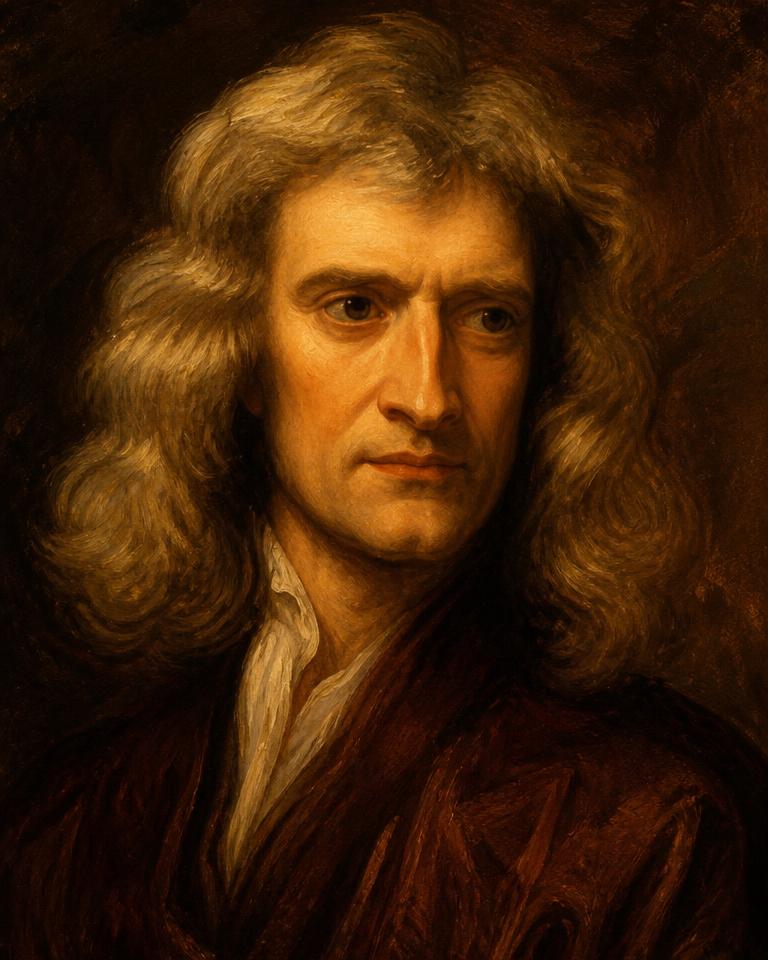
Quick Facts
- Years
- 1643 – 1727
- Category
- Scientists & Inventors
- Subcategory
- Classical Physics
- Nationality
- English
- Occupation
- Physicist & Mathematician
Isaac Newton
1643 – 1727 · English · Physicist & Mathematician
Audiobook

Life Lessons from Isaac Newton
Marcus Alden · 54 min
Isaac Newton was an English mathematician, physicist, astronomer, natural philosopher, theologian, and public official whose work transformed the study of nature. Born in rural Lincolnshire in 1643, he developed the mathematical theory of motion and universal gravitation, made foundational contributions to calculus, and demonstrated through experiment that white light contains a spectrum of colors.
His masterpiece, Philosophiæ Naturalis Principia Mathematica (1687), united terrestrial and celestial motion under common mathematical laws. It explained phenomena ranging from falling bodies to planetary orbits and became a cornerstone of classical physics. Newton also built an effective reflecting telescope and helped make experiment, measurement, and mathematical proof central to scientific inquiry.
His career extended far beyond theoretical science. He served as Lucasian Professor at Cambridge, president of the Royal Society, master of the Royal Mint, and a member of Parliament. At the Mint, he pursued counterfeiters and assisted England’s major coinage reform.
Newton could be secretive, combative, and relentless in disputes over priority, especially with Robert Hooke and Gottfried Wilhelm Leibniz. He also devoted enormous effort to alchemy, biblical chronology, and unorthodox Christian theology. These interests complicate the modern image of Newton as a purely rational scientist. He remains essential to understanding physics, mathematics, astronomy, the Scientific Revolution, and the changing relationship between science and religion.
Quick Facts
| Field | Details |
|---|---|
| Full Name | Isaac Newton |
| Common Name(s) | Isaac Newton; Sir Isaac Newton |
| Born | 25 December 1642 Old Style / 4 January 1643 New Style |
| Died | 20 March 1726 Old Style / 31 March 1727 New Style |
| Age at Death | 84 by modern calendar reckoning |
| Birthplace | Woolsthorpe-by-Colsterworth, Lincolnshire, England |
| Nationality | English |
| Occupation | Mathematician, physicist, astronomer, natural philosopher, theologian, alchemist, university professor, Mint official |
| Historical Era | Scientific Revolution; early Enlightenment |
| Famous For | Laws of motion, universal gravitation, calculus, optics, reflecting telescope |
| Political Affiliation if applicable | Whig-aligned in later public life; member of Parliament for Cambridge University |
| Religion if significant | Christian with privately held anti-Trinitarian beliefs |
| Education | The King’s School, Grantham; Trinity College, Cambridge |
| Parents | Isaac Newton Sr. and Hannah Ayscough Newton |
| Spouse(s) | Never married |
| Children | None recorded |
| Major Works | De analysi; Philosophiæ Naturalis Principia Mathematica; Opticks; Arithmetica Universalis; The Chronology of Ancient Kingdoms Amended |
| Major Achievements | Mathematical physics of motion and gravity; co-creation of calculus; experimental theory of color; practical reflecting telescope; reform and enforcement work at the Royal Mint |
Early Life
Newton was born at Woolsthorpe Manor shortly after the death of his father, a prosperous but non-literate farmer also named Isaac Newton. He was premature and reportedly very small at birth. England was then in civil war, although rural family circumstances shaped his childhood more immediately than national politics.
When Newton was about three, his mother, Hannah Ayscough, married the clergyman Barnabas Smith and moved away, leaving her son with his maternal grandmother. The prolonged separation may have contributed to the insecurity and defensiveness that some biographers detect in his adult relationships, although psychological conclusions drawn retrospectively remain uncertain.
After Smith died, Hannah returned with Newton’s three younger half-siblings. She initially removed Isaac from the King’s School in Grantham to prepare him for farming. He proved poorly suited to agricultural management, and relatives and teachers supported his return to school.
In Grantham, Newton lodged for a time with the apothecary William Clarke. This environment may have encouraged his interest in chemicals and practical experimentation. Accounts of model machines and mechanical devices from his youth come mainly from later recollections and should be treated cautiously.
Newton entered Trinity College, Cambridge, in 1661 as a subsizar, a student whose reduced expenses could involve service duties. Cambridge’s formal curriculum still emphasized Aristotle, but Newton independently read René Descartes, Pierre Gassendi, Johannes Kepler, Galileo Galilei, and contemporary mathematicians. The mathematician Isaac Barrow became an especially important academic influence.
Newton earned his bachelor’s degree in 1665. Soon afterward, plague forced Cambridge to close. He returned to Woolsthorpe for much of 1665–1666, a period later celebrated as his anni mirabiles, or “wonder years.” He developed methods that became calculus, investigated light, and began thinking systematically about gravity. The familiar apple story has a basis in Newton’s later recollections, but the fruit did not strike his head in any reliable account.
Rise to Prominence
Newton returned to Cambridge, became a fellow of Trinity in 1667, and received his master’s degree in 1668. In 1669 Isaac Barrow resigned the Lucasian Professorship of Mathematics, and Newton succeeded him while still in his twenties.
His earliest mathematical discoveries circulated privately rather than in print. In De analysi per aequationes numero terminorum infinitas, written in 1669, he demonstrated powerful methods using infinite series. His reluctance to publish limited immediate recognition and later complicated priority disputes.
Optics first brought him broad notice. He constructed a reflecting telescope that used a curved mirror rather than a large objective lens, reducing the colored fringes that troubled refracting telescopes. After demonstrating the instrument, Newton was elected a fellow of the Royal Society in 1672.
That year he published his theory that white light is composed of rays differing in refrangibility. Robert Hooke and others challenged aspects of the theory and Newton’s interpretation of experiments. Newton reacted intensely to criticism and largely withdrew from public optical debate.
His decisive turning point came in 1684, when astronomer Edmond Halley visited Cambridge and asked what orbit would result from an inverse-square attraction toward the Sun. Newton answered that it would be an ellipse and later supplied a demonstration. Encouraged and financially supported by Halley, Newton expanded the argument into the Principia, published in 1687.
The book established Newton as Europe’s leading mathematical natural philosopher. Its demanding geometry and technical language restricted its readership, but experts recognized its extraordinary power. Newton had provided a unified framework for motion on Earth and in the heavens.
Major Achievements
The Three Laws of Motion
In the Principia, Newton formulated three general laws governing bodies under applied forces. In modernized language, they describe inertia, change of motion under force, and equal-and-opposite interactions.
Their importance lay in replacing separate qualitative explanations with a coherent mathematical system. Together with definitions of mass, momentum, and force, they made problems of projectiles, machines, collisions, tides, and planetary motion quantitatively tractable.
The laws remain accurate for ordinary speeds and macroscopic scales. Relativity and quantum mechanics later revealed their limits, but engineering, navigation, construction, and much of astronomy still rely on Newtonian mechanics.
Universal Gravitation
Newton proposed that every body attracts every other body with a force proportional to their masses and inversely proportional to the square of their separation. This connected a falling object with the Moon’s orbit and extended the same principle across the solar system.
Using this framework, Newton explained Kepler’s planetary laws, cometary trajectories, tidal effects, and features of Earth’s shape. He did not claim to identify gravity’s physical mechanism. His famous refusal to “feign hypotheses” addressed that unresolved question.
Universal gravitation offered an unprecedented synthesis. Later observations, including the return of Halley’s Comet and predictions of planetary behavior, strengthened Newtonian astronomy. Einstein’s general relativity eventually supplied a deeper account of gravitation, yet Newton’s equations remain indispensable approximations.
Calculus and Infinite Series
During the 1660s Newton developed his “method of fluxions,” treating changing quantities as generated by continuous motion. He recognized the inverse relationship between differentiation and integration and applied infinite series to difficult calculations.
Gottfried Wilhelm Leibniz independently developed calculus and published his method first, using notation that proved more adaptable and became standard. Historians credit both men with independent foundational work rather than assigning sole invention to either.
Calculus enabled precise study of change, accumulation, curves, motion, fluids, and growth. It became essential to physics, engineering, economics, statistics, and computing. Newton’s unpublished manuscripts show that his achievement preceded the public controversy by decades.
Experimental Optics and the Theory of Color
Newton passed sunlight through a prism and obtained an elongated spectrum. By isolating individual colors and passing them through a second prism, he argued that the prism separates colors already present in white light rather than creating them.
This challenged established theories that treated color as a modification of pure white light. Newton also used a lens-and-glass arrangement to study interference patterns now called Newton’s rings, though the later wave explanation differed from his preferred corpuscular account.
Published comprehensively in Opticks in 1704, this research influenced experimental physics through carefully arranged trials, measurement, and questions for future investigation. Modern optics revised parts of Newton’s theory while preserving his central analysis of white light and spectral composition.
The Reflecting Telescope
Newton built a small practical reflecting telescope around 1668 and displayed an improved instrument to the Royal Society in 1671. Mirrors avoided the chromatic aberration inherent in simple refracting lenses.
He did not originate every idea behind reflection-based telescopes, but his was the first known successful practical example. The Newtonian telescope design remains widely used by amateur and professional astronomers.
Its construction demonstrated Newton’s ability to connect theory with skilled craftsmanship. It also opened the institutional path to his Royal Society membership and early fame.
The Principia and Mathematical Natural Philosophy
The Principia did more than announce isolated laws. It presented definitions, axioms, mathematical propositions, observational comparisons, and increasingly complex applications in a unified structure modeled partly on classical geometry.
The book helped establish a standard according to which successful natural philosophy should derive testable consequences mathematically. Its influence spread through later editions, commentaries, textbooks, and the work of continental mathematicians who translated Newtonian mechanics into calculus-based forms.
The resulting Newtonian worldview profoundly shaped the Enlightenment. Nature increasingly appeared understandable through general laws, although Newton himself believed divine governance remained necessary.
Service at the Royal Mint
Newton became warden of the Royal Mint in 1696 and master in 1699. These were not merely honorary appointments for him. During the Great Recoinage, the government replaced badly clipped and counterfeited silver currency.
Newton organized records, supervised production, questioned informers, and personally assembled cases against counterfeiters. His pursuit of William Chaloner ended in Chaloner’s conviction and execution in 1699 under the severe criminal law of the period.
As master, Newton improved administrative efficiency and advised government on monetary matters. His 1717 report helped set the gold guinea at 21 shillings. Britain’s movement toward a de facto gold standard had several causes, so it should not be attributed to Newton alone.
Leadership and Work
Newton led through expertise, control of detail, and institutional authority rather than warmth or broad consultation. At Cambridge he worked largely alone. At the Mint, however, he coordinated employees, suppliers, investigators, and officials with notable administrative discipline.
His methods combined intense concentration, mathematical deduction, experiments, manuscript revision, and close reading. He kept extensive notes, revisited problems for years, and often delayed publication until he believed his position defensible.
As president of the Royal Society from 1703 until his death, Newton strengthened his intellectual and institutional dominance. Admirers regarded him as rigorous and commanding. Critics saw him as authoritarian, especially when Society procedures intersected with his personal disputes.
His strengths included extraordinary persistence, technical range, precision, and the ability to unify apparently separate phenomena. His weaknesses included secrecy, mistrust, sensitivity to criticism, and a willingness to use status in priority conflicts. Relationships with Hooke, Leibniz, John Flamsteed, and others deteriorated when questions of evidence, credit, or control arose.
Personal Life
Newton never married and had no recorded children. Evidence for romantic relationships is sparse. A youthful friendship with Catherine Storer, the apothecary’s stepdaughter at Grantham, was remembered later, but claims of an engagement are unproven.
His closest relationships were often intellectual or familial. He supported relatives and formed an important bond with his niece Catherine Barton, who managed his London household and moved in influential social circles. Edmond Halley was crucial to the Principia, while the Swiss mathematician Nicolas Fatio de Duillier became a close friend before an unexplained rupture.
Newton’s surviving notebooks reveal disciplined but sometimes obsessive habits. He copied recipes, performed chemical experiments, analyzed scripture, and tracked personal faults. Reports that he routinely forgot to eat or slept very little are difficult to verify in detail, though sustained periods of extreme work are well documented.
In 1693 he experienced a serious episode involving insomnia, agitation, suspicion, and fractured correspondence. Scholars have proposed exhaustion, chemical exposure, depression, or another illness, but no retrospective diagnosis can be established securely. He recovered sufficiently to assume major public responsibilities.
Newton accumulated substantial wealth through salary and investments. He lost money in the South Sea Bubble of 1720, although the exact scale is uncertain. In later life he suffered from gout and urinary or kidney problems. He died in London in 1727.
Philosophy and Beliefs
Newton believed nature displayed order established and sustained by God. Scientific investigation, in his view, revealed divine craftsmanship rather than replacing theology. The Principia’s later editions included a “General Scholium” discussing God, space, and natural order.
Privately, Newton rejected the orthodox doctrine of the Trinity and regarded its development as a corruption of early Christianity. Because denial of the Trinity could destroy an academic or public career, he concealed these views. A royal dispensation in 1675 allowed him to retain his Cambridge fellowship without entering Anglican holy orders.
He produced extensive writings on biblical prophecy, church history, and ancient chronology. These were not casual hobbies: by manuscript volume, they occupied a major part of his intellectual life. Newton sought original, uncorrupted truths in scripture much as he searched for fundamental principles in nature.
He also pursued alchemy, studying transmutation, matter, active principles, and symbolic texts. Scholars debate how directly alchemical concepts affected his physics, but the research unquestionably shaped his understanding of matter and natural forces.
Politically, Newton defended Cambridge against James II’s attempt to impose a Catholic officeholder and later sat in the Convention Parliament following the Glorious Revolution. He aligned broadly with Protestant and Whig interests, although he was not a major political theorist.
Challenges and Controversies
The Hooke Dispute
Robert Hooke criticized Newton’s optical claims and later asserted that he had supplied key ideas about planetary attraction. Hooke had indeed discussed orbital motion as a combination of tangential inertia and attraction and had considered an inverse-square relation. Newton, however, developed the mathematical demonstrations and universal system found in the Principia.
Their conflict concerned both priority and recognition. Newton initially acknowledged Hooke’s correspondence but resisted claims that minimized his own achievement. After Hooke’s death, Newton’s influence over the Royal Society grew. The story that Newton deliberately destroyed Hooke’s portrait is unsupported; no authenticated contemporary portrait is known to survive.
The Calculus Priority Dispute
Newton devised fluxional methods before Leibniz’s first publications, but Leibniz published calculus in 1684 and 1686. His notation spread rapidly in Europe. Accusations of plagiarism later emerged from Newton’s supporters and escalated into a bitter international dispute.
In 1712 a Royal Society committee issued a report favoring Newton. Newton, then Society president, covertly directed much of the process and wrote substantial portions of the report. Modern scholarship concludes that Leibniz developed calculus independently. Newton had priority in private discovery; Leibniz had priority in publication and superior influential notation.
Flamsteed and Astronomical Data
Astronomer Royal John Flamsteed supplied observations useful to Newton but resisted premature publication of his incomplete catalog. Newton and allies used institutional pressure to publish an edition in 1712 without Flamsteed’s full consent.
Flamsteed later obtained copies and burned many of them. Newton believed timely access to accurate observations served important scientific work; Flamsteed defended authorship, accuracy, and control over unfinished material. The episode exposes Newton’s readiness to place his objectives above a collaborator’s wishes.
Alchemy, Theology, and Secrecy
Later admirers often minimized Newton’s alchemy and anti-Trinitarian theology because these interests conflicted with an image of modern scientific rationality. Current historians treat them as central to his intellectual world without assuming that they invalidate his scientific achievements.
Alchemy was not then sharply separated from chemistry, but it included secrecy, allegory, and claims now rejected by science. Newton’s concealed theology also illustrates the legal and social restrictions on religious dissent in seventeenth-century England.
Limitations of Newtonian Science
Newton’s account did not provide a mechanical cause for gravity. Critics viewed action across empty space as obscure or even occult. Later Newtonians often interpreted the theory more mechanically than Newton himself did.
Classical mechanics also proved incomplete. Einstein revised concepts of gravity, space, and time; quantum physics transformed the understanding of matter and light. These developments limit rather than erase Newton’s achievement: his theories remain powerful within their appropriate domains.
Legacy
Newton’s greatest legacy is the mathematical unification of physical science. For more than two centuries, Newtonian mechanics supplied the dominant framework for astronomy and terrestrial physics. It enabled increasingly accurate predictions, from planetary positions to artillery trajectories and engineering loads.
His influence reached philosophy and culture. Enlightenment writers treated the success of universal laws as evidence that reason could uncover order in other fields. Sometimes they simplified Newton’s own religious and alchemical commitments to fashion him into a symbol of secular rationality.
Scientific institutions continue to honor him. The SI unit of force is the newton. The Isaac Newton Institute for Mathematical Sciences in Cambridge bears his name, as do schools, telescopes, spacecraft projects, streets, medals, and research programs.
Newton was buried in Westminster Abbey, an exceptional honor for a scientist. His monument there presents him amid mathematical and astronomical symbols. A famous statue by Louis-François Roubiliac stands at Trinity College, Cambridge, while Eduardo Paolozzi’s sculpture inspired by William Blake’s image of Newton stands outside the British Library.
Woolsthorpe Manor is preserved by the National Trust. Trinity College holds important Newton materials, and the Cambridge Digital Library provides online access to many manuscripts. His reflecting telescope is preserved by the Royal Society.
Modern scholarship emphasizes a complete Newton: mathematician and experimenter, but also theologian, alchemist, administrator, investor, and controversial institutional leader. That fuller portrait makes his achievement more historically intelligible and more human.
Interesting Facts
- Newton was born under the Julian calendar on Christmas Day 1642, corresponding to 4 January 1643 in the modern Gregorian calendar.
- His father died before he was born.
- He was removed from school to become a farmer but proved unsuited to the work.
- Plague closures sent him home from Cambridge during his most celebrated early period of discovery.
- Newton himself later connected a falling apple with his reflections on gravity.
- No reliable source says that an apple struck his head.
- His reflecting telescope was only about six inches long in its early form.
- He became Lucasian Professor at approximately 26 years old.
- Edmond Halley paid for the publication of the Principia.
- Newton served twice as a member of Parliament for Cambridge University.
- The frequently repeated claim that his only parliamentary speech concerned closing a window is not securely documented.
- He was knighted by Queen Anne in 1705.
- He was the second scientist knighted in England, after Francis Bacon, though Newton’s honor was closely connected to politics and office.
- He devoted extensive research to alchemy under considerable secrecy.
- His private theology rejected the Trinity.
- He worked actively as an investigator of counterfeit currency.
- His dog “Diamond,” allegedly responsible for burning manuscripts, is probably part of an unsupported legend.
- Leibniz’s calculus notation, rather than Newton’s fluxional notation, became internationally standard.
- Newton owned shares and lost money during the South Sea Bubble.
- He was buried in Westminster Abbey.
Famous Quotes
- “If I have seen further it is by standing on the shoulders of Giants.” — Letter to Robert Hooke, 1676. Newton acknowledged intellectual predecessors, although historians debate whether the wording also carried a personal edge toward Hooke.
- “Hypotheses non fingo” (“I frame no hypotheses”). — Principia, General Scholium, 1713. Newton declined to invent an unsupported physical mechanism for gravity.
- “To the same natural effects we must, as far as possible, assign the same causes.” — Principia, Rule II. The statement summarizes his search for economical, general explanations.
- “Nature is pleased with simplicity, and affects not the pomp of superfluous causes.” — Principia, Rule I in an older translation. It expresses Newton’s preference for explanatory economy.
- “This most beautiful system of the sun, planets, and comets, could only proceed from the counsel and dominion of an intelligent and powerful Being.” — Principia, General Scholium. It shows how he linked cosmic order with divine governance.
- “For the rays, to speak properly, are not coloured.” — Opticks. Newton distinguished physical rays from the sensations produced in observers.
- “Are not gross Bodies and Light convertible into one another?” — Opticks, Query 30. This was a speculative research question, not a completed theory of mass–energy equivalence.
- “Truth is ever to be found in simplicity, and not in the multiplicity and confusion of things.” — From Newton’s theological manuscript writings. It reflects a principle he applied in both religion and natural philosophy.
- “I keep the subject constantly before me, and wait till the first dawnings open slowly, by little and little, into a full and clear light.” — Recollection reported by William Stukeley. It captures Newton’s sustained concentration, though it is preserved through a later witness.
- “I do not know what I may appear to the world, but to myself I seem to have been only like a boy playing on the sea-shore...” — Reported after Newton’s death and commonly attributed to him, but its documentation is indirect; treat it as disputed or weakly sourced.
Timeline
- 1642/1643 — Born at Woolsthorpe, Lincolnshire.
- 1646 — His mother remarries; Newton remains with his grandmother.
- 1653 — His mother returns after Barnabas Smith’s death.
- About 1655 — Attends the King’s School, Grantham.
- 1661 — Enters Trinity College, Cambridge.
- 1665 — Receives bachelor’s degree; plague closes Cambridge.
- 1665–1666 — Develops early calculus, optical experiments, and gravitational ideas at Woolsthorpe.
- 1667 — Elected fellow of Trinity College.
- 1668 — Receives master’s degree; constructs an early reflecting telescope.
- 1669 — Becomes Lucasian Professor of Mathematics.
- 1671 — Reflecting telescope is demonstrated to the Royal Society.
- 1672 — Elected fellow of the Royal Society; publishes optical theory.
- 1675 — Receives dispensation from ordination requirements at Cambridge.
- 1679–1680 — Corresponds with Hooke about orbital motion.
- 1684 — Halley visits Newton about the inverse-square orbit problem.
- 1687 — Publishes the first edition of the Principia.
- 1689–1690 — Serves in Parliament for Cambridge University.
- 1693 — Suffers a period of serious emotional and physical disturbance.
- 1696 — Appointed warden of the Royal Mint.
- 1699 — Becomes master of the Mint; William Chaloner is executed.
- 1701–1702 — Serves a second term in Parliament and resigns Cambridge posts.
- 1703 — Elected president of the Royal Society.
- 1704 — Publishes Opticks.
- 1705 — Knighted by Queen Anne.
- 1707 — Arithmetica Universalis is published.
- 1712 — Royal Society report intensifies the calculus dispute.
- 1713 — Second edition of the Principia appears.
- 1717 — Advises on the guinea’s value relative to silver.
- 1720 — Suffers losses in the South Sea Bubble.
- 1726 — Third edition of the Principia appears.
- 1727 — Dies in London and is buried in Westminster Abbey.
Frequently Asked Questions
What is Isaac Newton best known for?
Newton is best known for formulating the laws of motion and universal gravitation in the Principia. These principles showed that the motion of falling objects, projectiles, moons, planets, and comets could be analyzed within one mathematical framework. He also made foundational contributions to calculus, proved that white light contains a spectrum of colors, and constructed the first known practical reflecting telescope. His achievement was not the discovery of a single isolated fact, but the creation of a systematic mathematical physics with enormous predictive power.
When was Isaac Newton born?
Newton was born at Woolsthorpe in Lincolnshire on 25 December 1642 according to the Julian calendar then used in England. That date corresponds to 4 January 1643 under the Gregorian calendar used today. Both dates therefore appear in reputable sources. The apparent disagreement is calendrical, not historical. England did not adopt the Gregorian calendar until 1752, decades after Newton’s death.
Did an apple really inspire Newton’s theory of gravity?
A falling apple probably did contribute to Newton’s reflections. Several later accounts trace the story to Newton himself, including recollections by William Stukeley and John Conduitt. The observation may have encouraged him to ask whether Earth’s attraction extended as far as the Moon. However, no reliable early account says the apple hit his head. Universal gravitation emerged through years of mathematics, astronomical evidence, and engagement with work by Galileo, Kepler, Hooke, Halley, and others.
Did Newton discover gravity?
People understood that objects fall long before Newton, and earlier thinkers studied weight, acceleration, and planetary attraction. Newton’s breakthrough was to formulate a quantitatively precise theory of universal gravitation and integrate it with laws of motion. He showed mathematically how an inverse-square attraction could account for planetary orbits and terrestrial phenomena. Saying he “discovered gravity” is convenient shorthand, but saying that he developed the first successful universal mathematical theory of gravitation is more accurate.
Did Newton invent calculus?
Newton and Gottfried Wilhelm Leibniz independently created foundational forms of calculus. Newton developed his fluxional approach during the 1660s but delayed full publication. Leibniz developed his own method and published first in the 1680s. A bitter priority dispute later accused Leibniz of borrowing from Newton, but modern historians reject that conclusion. Newton had earlier private results; Leibniz had earlier publication, independent achievement, and notation that became standard. Calculus also built on work by Fermat, Barrow, Cavalieri, and others.
What are Newton’s three laws of motion?
The first law states that a body remains at rest or in uniform straight-line motion unless acted upon by a force. The second relates force to change in momentum; for constant mass it is often written as F = ma. The third states that interacting bodies exert equal and opposite forces on one another. These modern formulations simplify Newton’s original Latin definitions. Together, the laws form the foundation of classical mechanics for ordinary macroscopic conditions.
What did Newton discover about light?
Newton demonstrated that white light is a mixture of rays associated with different colors and degrees of refraction. His prism experiments showed that a second prism could not turn an isolated spectral color into another color and that separated colors could be recombined into white light. He therefore argued that prisms separate rather than manufacture color. His corpuscular interpretation of light was later superseded in important respects, but his experimental conclusions about spectra and white light remained fundamental.
Why did Newton build a reflecting telescope?
Refracting telescopes produced colored fringes because lenses bend different colors by different amounts. Newton believed this chromatic aberration could not be removed effectively with the available lens designs, so he used a curved mirror to gather and focus light. His compact instrument performed well and attracted the Royal Society’s attention. Reflecting telescopes later became central to astronomy because large mirrors can collect substantial light without the same chromatic problem.
What was the Principia?
Published in Latin in 1687, Philosophiæ Naturalis Principia Mathematica—usually shortened to the Principia—was Newton’s major work on mechanics and gravitation. It presented definitions and laws of motion, developed the mathematics of orbital behavior, and applied universal gravitation to planets, moons, comets, tides, and Earth’s shape. Edmond Halley encouraged Newton and financed publication. Its arguments were difficult, but the book fundamentally altered physics and astronomy.
Was Newton religious?
Yes. Newton was deeply religious and wrote extensively on scripture, prophecy, church history, and chronology. He believed the orderly universe testified to an intelligent and powerful God. However, his Christianity was unorthodox: he privately rejected the Trinity and believed established churches had corrupted early doctrine. He concealed these views because anti-Trinitarianism carried serious legal and professional risks. His faith and science were interconnected parts of his search for divine order.
Was Newton an alchemist?
Yes. Newton copied alchemical texts, conducted laboratory experiments, studied metals and chemical transformations, and sought hidden principles governing matter. In the seventeenth century, alchemy overlapped with emerging chemistry, medicine, metallurgy, and natural philosophy, although many of its theories are now rejected. Scholars debate how strongly alchemy influenced Newton’s physics. The surviving manuscripts nonetheless prove it was a major and sustained part of his intellectual life, not a minor eccentricity.
What did Newton do at the Royal Mint?
As warden and later master, Newton helped administer the Great Recoinage, improve coin production, and enforce laws against counterfeiting. He interviewed witnesses, cultivated informants, and prepared detailed prosecutions. His case against the counterfeiter William Chaloner was especially notable. Newton also advised the government on the relationship between gold and silver currency. His Mint career demonstrates administrative and investigative skills quite different from the solitary image associated with his scientific work.
Why did Newton and Leibniz quarrel?
They disputed who deserved credit for calculus. Newton’s methods existed earlier in unpublished manuscripts, while Leibniz published first and introduced influential notation. National rivalry and aggressive supporters worsened the conflict. A Royal Society investigation officially favored Newton, but Newton secretly shaped the report while serving as the Society’s president. Historians now recognize independent discovery by both. The quarrel damaged cooperation between British and continental mathematicians and shows how secrecy and priority anxiety can obstruct science.
Did Newton have a mental breakdown?
In 1693 Newton suffered insomnia, severe agitation, suspicion, and disruptions in correspondence. Some biographers describe this as a breakdown. Proposed explanations include overwork, depression, mercury exposure from alchemical experiments, poisoning, or another illness. The evidence is insufficient for a confident modern diagnosis. He subsequently recovered and managed demanding responsibilities at the Mint and Royal Society, so the episode did not end his public career.
Was Newton knighted for science?
Queen Anne knighted Newton at Trinity College in 1705. His scientific fame certainly made him an illustrious recipient, but the knighthood occurred in a political context involving an election and the influence of Charles Montagu, Newton’s patron and former chancellor of the Exchequer. It is therefore misleading to treat the honor simply as a scientific prize. Newton thereafter became widely known as Sir Isaac Newton.
How did Isaac Newton die?
Newton died in Kensington, London, in March 1727. Contemporary accounts and later medical interpretations point to painful urinary or kidney problems, often described as bladder stones or a related condition, but a precise modern diagnosis is impossible. He received a ceremonial burial in Westminster Abbey on 28 March Old Style. His burial among national figures reflected the exceptional prestige natural philosophy had acquired through his career.
How is Newton’s physics used today?
Newtonian mechanics remains central whenever objects move much slower than light and quantum effects are negligible. Engineers use it to analyze structures, vehicles, machines, and spacecraft. Astronomers use Newtonian approximations for many orbital calculations, while students learn it as the foundation for advanced physics. Relativity is required for extreme gravity or high speeds, and quantum mechanics for atomic scales. These limitations define Newtonian theory’s domain rather than making it obsolete.
Lessons We Can Learn
- Unify problems instead of isolating them. Newton connected falling bodies and planetary orbits. Today, searching for common principles can reveal solutions across disciplines.
- Combine theory with evidence. His optics joined geometrical reasoning to controlled prism experiments. Strong conclusions require both conceptual clarity and reproducible observation.
- Build useful tools. The reflecting telescope turned an optical insight into an instrument. Practical prototypes can test and extend abstract ideas.
- Study predecessors deeply. Newton learned from Galileo, Kepler, Descartes, Barrow, and others. Innovation often begins with mastering inherited knowledge.
- Persist with difficult questions. His work matured over decades. Important problems may require sustained attention rather than immediate answers.
- Publish clearly and promptly. Newton’s secrecy helped fuel the calculus dispute. Documenting and communicating work reduces confusion over priority and enables collaboration.
- Accept that criticism can improve work. Newton often responded defensively, yet objections forced clarification. Modern researchers benefit by separating critique of an argument from personal attack.
- Use authority responsibly. His conduct toward Leibniz and Flamsteed shows how institutional power can compromise fairness. Transparent review procedures matter.
- Recognize the limits of successful models. Newton did not establish gravity’s mechanism, and later physics revised his framework. Useful theories need not be final theories.
- Avoid simplifying complex people. Newton was simultaneously scientist, theologian, alchemist, and official. Understanding historical figures requires attention to the full context rather than modern stereotypes.
Related Historical Figures
- Galileo Galilei — Established major principles of motion and telescopic astronomy on which Newtonian mechanics built.
- Johannes Kepler — Formulated empirical laws of planetary motion that Newton explained through gravitation.
- René Descartes — Influenced Newton’s early studies; Newton later rejected Cartesian vortex cosmology.
- Isaac Barrow — Cambridge mathematician, mentor, and predecessor to Newton as Lucasian Professor.
- Robert Hooke — Experimentalist who debated Newton over optics and claimed priority in ideas concerning orbital attraction.
- Edmond Halley — Prompted Newton’s orbital analysis, financed the Principia, and championed Newtonian astronomy.
- Gottfried Wilhelm Leibniz — Independent co-creator of calculus and Newton’s principal rival in the priority dispute.
- Christiaan Huygens — Major mathematician and physicist whose work on motion, light, and timekeeping intersected with Newton’s.
- John Flamsteed — Astronomer Royal whose observations aided Newton but whose control of data became a source of conflict.
- Albert Einstein — Replaced Newton’s gravitational framework at relativistic extremes while preserving it as an excellent limiting approximation.
Watch and Learn
Newton's Laws: Crash Course Physics #5 · CrashCourse
Related Historical Figures