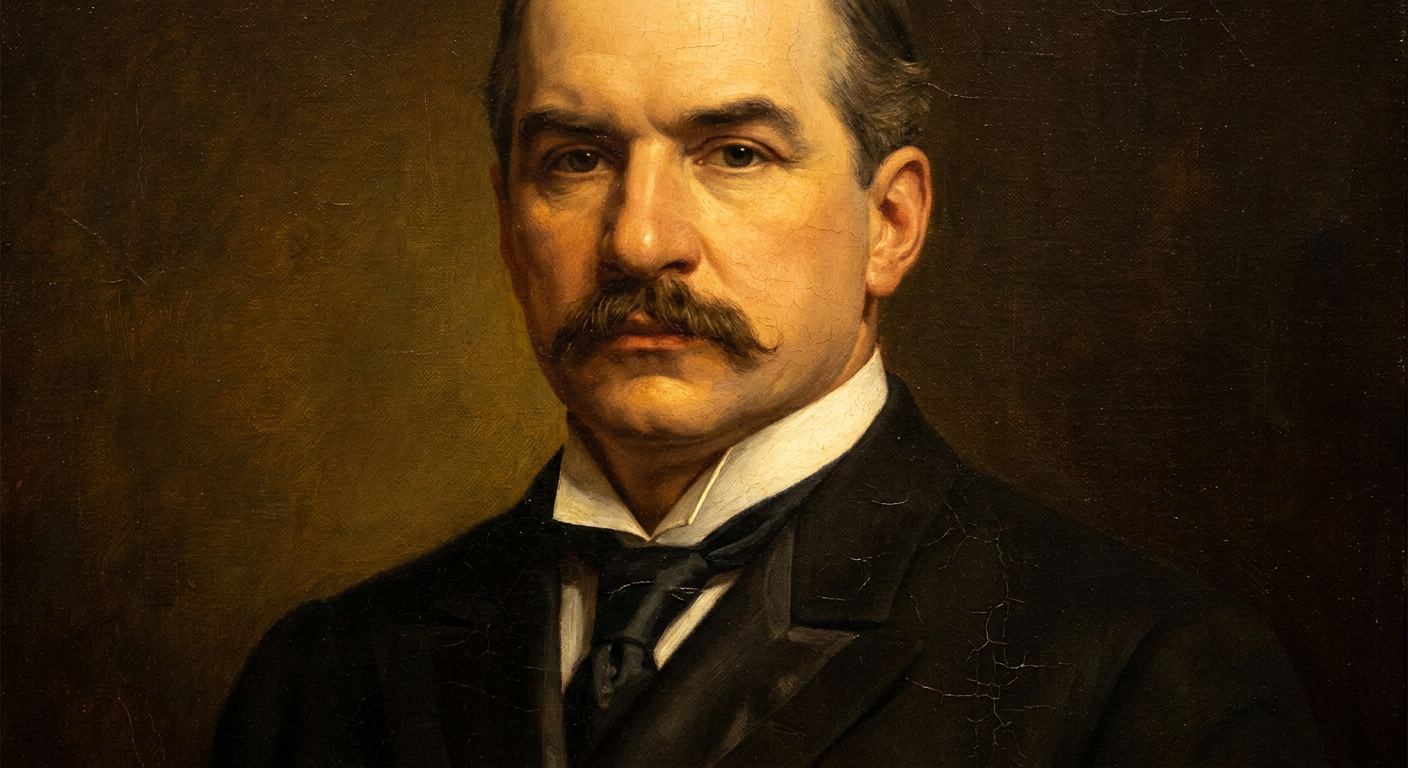
Quick Facts
- Years
- 1837 – 1913
- Category
- World Leaders & Revolutionaries
- Nationality
- American
- Occupation
- Financier, banker, corporate reorganizer, and art collector
J. P. Morgan
1837 – 1913 · American · Financier, banker, corporate reorganizer, and art collector
Recommended Audiobooks
Listen next from Marcus Alden

Life Lessons from Simon Bolivar
Marcus Alden · 55 min

Life Lessons from George Washington
Marcus Alden · 54 min
John Pierpont Morgan was the most influential American financier of the Gilded Age. With imposing confidence, international connections, and an extraordinary ability to mobilize capital, he reorganized failing railroads, helped create General Electric and United States Steel, and twice participated in efforts to stabilize the nation’s financial system.
Morgan was neither an inventor nor an industrial manager in the usual sense. His specialty was organization. He brought investors, bankers, executives, and competing companies together—sometimes constructively, sometimes coercively—to replace destructive competition with large, centrally directed corporations. Admirers considered him a guardian of financial order. Critics saw him as the personification of the “money trust”: a private banker whose influence over credit, transportation, and industry appeared incompatible with democratic government.
His most dramatic public role came during the Panic of 1907. With no modern central bank available, Morgan coordinated bankers and corporate leaders to prevent financial collapse. The episode demonstrated his leadership, but it also exposed the danger of depending on one unelected financier. That contradiction helps explain why his career remains important. Morgan contributed to the rise of modern corporate America while also encouraging demands for antitrust enforcement, banking regulation, and the Federal Reserve. He was additionally one of his era’s great art collectors and a major benefactor of the Metropolitan Museum of Art and the library now known as the Morgan Library & Museum.
Quick Facts
| Field | Details |
|---|---|
| Full Name | John Pierpont Morgan |
| Common Name(s) | J. P. Morgan; Pierpont Morgan |
| Born | April 17, 1837 |
| Died | March 31, 1913 |
| Age at Death | 75 |
| Birthplace | Hartford, Connecticut, United States |
| Nationality | American |
| Occupation | Financier, banker, corporate reorganizer, art collector |
| Historical Era | Gilded Age and Progressive Era |
| Famous For | Railroad reorganizations, General Electric, U.S. Steel, and leadership during the Panic of 1907 |
| Political Affiliation | Republican-leaning, though never an elected official |
| Religion | Episcopalian |
| Education | Schools in Hartford and Boston; Bellerive school in Switzerland; University of Göttingen |
| Parents | Junius Spencer Morgan and Juliet Pierpont Morgan |
| Spouse(s) | Amelia Sturges; Frances Louisa Tracy |
| Children | Louisa, John Pierpont Jr., Juliet, and Anne Morgan |
| Major Works | J. P. Morgan & Co.; railroad reorganizations; formation of General Electric and U.S. Steel; major art and manuscript collections |
| Major Achievements | Helped restore federal gold reserves in 1895; organized U.S. Steel; led private financial rescue efforts in 1907; strengthened major cultural institutions |
Early Life
Morgan was born into a prosperous New England family. His father, Junius Spencer Morgan, became a prominent international banker and taught his son the importance of reputation, discipline, and transatlantic finance. His mother, Juliet Pierpont Morgan, came from a family of ministers, poets, and educators.
His childhood coincided with rapid railroad expansion and the growing integration of American and European markets. Poor health interrupted his schooling. After suffering rheumatic fever, he spent time in the Azores recovering. He later attended Boston’s English High School, studied French at Bellerive near Vevey, Switzerland, and studied at the University of Göttingen in Germany. Although he did not earn a degree, the experience gave him useful language skills and familiarity with European business culture.
Junius was Morgan’s most important mentor. Through him, the young financier entered a commercial world in which personal character and family reputation could determine access to credit. Morgan’s education was therefore practical as well as academic: he learned how bills of exchange, government bonds, and international investment connected New York, London, and continental Europe.
Rise to Prominence
Morgan began working in New York in 1857 at Duncan, Sherman & Company, the American representative of George Peabody’s London banking house. During the Civil War he avoided military service by paying for a substitute, as federal law permitted. This legal but controversial choice later reinforced criticism that wealthy Americans could escape dangers borne by poorer men.
Morgan was also involved in financing a wartime transaction involving obsolete Hall carbines purchased from a federal arsenal and resold to the government at a substantial markup. He did not manufacture the weapons and was not found guilty of fraud, but the episode remains an early example of the ethically questionable speculation surrounding wartime procurement.
After partnerships in Dabney, Morgan & Company and Drexel, Morgan & Company, Morgan emerged as a leading intermediary between European capital and American enterprise. The death of his father in 1890 further strengthened his international position. In 1895 his firm became J. P. Morgan & Company.
Railroads made his reputation. Many lines had been built with excessive debt, duplicate routes, and unreliable management. Morgan refinanced troubled companies, replaced executives, placed trusted representatives on boards, and pressured competitors to cooperate. This process became known as “Morganization.” It could rescue valuable enterprises, but it also concentrated control in the hands of bankers.
Major Achievements
Reorganizing the Railroads
Morgan participated in the restructuring of major systems including the Erie, Northern Pacific, Philadelphia and Reading, and Southern Railway. In 1885 he brought leaders of the New York Central and Pennsylvania railroads aboard his yacht, Corsair, to negotiate an end to damaging competition.
The reorganizations improved coordination and reassured investors. Yet they also reduced competition and expanded Wall Street’s authority over transportation, making Morgan both a symbol of efficiency and a target of antimonopoly criticism.
Helping Create General Electric
In 1892 Morgan helped arrange the merger of Edison General Electric with Thomson-Houston Electric Company. The resulting General Electric combined important patents, engineering talent, factories, and access to investment capital.
Thomas Edison’s name disappeared from the company title, illustrating Morgan’s priorities: the financier valued a durable corporate structure more than loyalty to an individual inventor. GE became one of the most important industrial corporations in American history.
Restoring the Federal Gold Reserve
During the economic depression of the 1890s, investors exchanged paper currency for gold, draining the Treasury’s reserves and threatening confidence in the gold standard. In 1895 Morgan and August Belmont organized a syndicate that supplied the government with approximately $65 million in gold in exchange for federal bonds.
The arrangement stabilized the reserve, but critics objected that private bankers received favorable terms and profited from a public emergency. President Grover Cleveland defended the deal as necessary. The episode illustrated both Morgan’s usefulness and the government’s dependence on Wall Street.
Forming United States Steel
In 1901 Morgan combined Andrew Carnegie’s steel interests with Federal Steel and other companies to form United States Steel. Capitalized at about $1.4 billion, it was the world’s first billion-dollar corporation.
The merger integrated mines, transportation, mills, and distribution on an unprecedented scale. It signaled that the American economy had entered an age of enormous corporations. Supporters expected stability and efficiency; critics feared monopoly power and financial manipulation.
Managing the Panic of 1907
A failed attempt to corner the stock of United Copper helped trigger runs on trust companies in October 1907. Because the United States had no central bank, Morgan gathered bankers in his Manhattan library, examined institutions’ accounts, arranged loans, and pressed wealthy financiers to contribute to rescue funds.
He also supported U.S. Steel’s purchase of Tennessee Coal, Iron and Railroad Company after receiving assurance from President Theodore Roosevelt that the government would not immediately challenge the deal. Morgan’s actions helped restore confidence, although the acquisition later attracted criticism.
The panic made him appear indispensable. It also convinced many reformers that a modern nation should not rely on a private individual during crises. The subsequent debate contributed to the creation of the Federal Reserve System in 1913.
Leadership or Work
Morgan worked through small networks of partners rather than a sprawling modern bureaucracy. He relied heavily on personal meetings, private information, and judgments about character. Once convinced, he could decide quickly and expect others to follow.
His principal strengths were:
- An international network capable of moving large amounts of capital.
- A talent for evaluating managers and forcing negotiations.
- Willingness to act during panics when others hesitated.
- An emphasis on long-term solvency rather than short-term price wars.
His weaknesses were closely related. He was secretive, impatient with public scrutiny, and overly confident that responsible insiders should guide the economy. Morgan valued cooperation among powerful firms, whereas Progressive reformers believed competition and transparent regulation better protected the public.
Personal Life
Morgan married Amelia Sturges in 1861. She was already seriously ill with tuberculosis and died in 1862, only months after their wedding. Her death deeply affected him. In 1865 he married Frances Louisa Tracy. They had four children: Louisa, John Pierpont Jr., Juliet, and Anne.
He divided his time among residences in New York, his estate at Cragston on the Hudson River, and frequent European travel. He enjoyed sailing and owned several yachts named Corsair. His forceful gaze, large physique, and skin condition—often identified as severe rosacea with rhinophyma—made him visually distinctive. He disliked close photography and could be sensitive about his appearance.
Morgan collected rare books, manuscripts, paintings, decorative arts, gemstones, and antiquities. Collecting was both a private passion and a form of cultural patronage. His daughter Anne became an important philanthropist and advocate for working women, while his son, J. P. Morgan Jr., inherited leadership of the firm.
Philosophy or Beliefs
Morgan was a committed Episcopalian who supported churches and served in church-related roles. His faith existed alongside an elite, paternalistic worldview: he believed people of established character and experience had a duty—and a right—to impose order on unstable institutions.
Economically, he defended sound credit, the gold standard, corporate consolidation, and contractual obligations. He distrusted uncontrolled competition because he had repeatedly seen price wars produce bankruptcies and investor losses. His preferred answer was coordination under reputable leadership.
That outlook differed from both laissez-faire individualism and Progressive regulation. Morgan accepted private restraint imposed by bankers, but resisted extensive public interference. Historians disagree over whether this philosophy primarily protected the economy or protected the influence and profits of his circle. Evidence supports elements of both interpretations.
Challenges and Controversies
The “Robber Baron” Debate
Morgan was accused of creating monopolies, charging excessive fees, and placing partners on interconnected corporate boards. Reformers argued that this “money trust” gave a small financial group influence over credit and industry.
Defenders responded that his reorganizations rescued insolvent companies, protected investors, and created enterprises capable of competing globally. Modern historians generally avoid treating him as either a pure public servant or a simple predator. His work produced genuine efficiencies while concentrating private power.
Northern Securities
Morgan and railroad magnates James J. Hill and E. H. Harriman became involved in a struggle for control of the Northern Pacific Railway. The resulting Northern Securities Company held major railroad interests in the Northwest. President Theodore Roosevelt’s administration sued under the Sherman Antitrust Act, and the Supreme Court ordered the company dissolved in 1904.
The case demonstrated that even Morgan’s combinations could face federal limits. It also strained his relationship with Roosevelt, though they later cooperated during the 1907 panic.
The Pujo Investigation
In 1912 a congressional committee led by Representative Arsène Pujo investigated whether a “money trust” controlled American finance. Testimony showed extensive links among banks, insurance companies, railroads, and industrial corporations. Morgan denied possessing the sweeping power attributed to him and emphasized personal character as the foundation of credit.
The committee did not prove that Morgan commanded a single centralized conspiracy. It did reveal, however, how a relatively small network of financiers occupied overlapping positions throughout the economy. The hearings strengthened support for banking reform.
Legacy
Morgan helped establish the organizational foundations of twentieth-century corporate capitalism. General Electric survived for more than a century in changing forms, U.S. Steel remains active, and the firm that carried his name became part of JPMorgan Chase.
His crisis leadership influenced the movement for a central bank. The Federal Reserve Act was signed in December 1913, months after his death. Morgan did not design the Federal Reserve, but the inadequacy exposed in 1907 made reform politically urgent.
His cultural legacy is equally visible. He served as president of the Metropolitan Museum of Art and gave or bequeathed major objects to public collections. His private library, designed by Charles Follen McKim, became the Morgan Library & Museum in New York. Its holdings include rare manuscripts, early printed books, drawings, and musical scores.
Morgan remains relevant to debates about “too big to fail,” private financial rescues, corporate consolidation, and the political influence of major banks. His career poses a lasting question: what happens when public stability depends on private power?
Interesting Facts
- Morgan normally used “Pierpont” rather than John in personal life.
- He studied in Switzerland and Germany and spoke French and German.
- Ill health sent him to the Azores during his youth.
- He paid $300 for a Civil War substitute, a legal practice at the time.
- He helped settle a railroad dispute aboard his yacht in 1885.
- Several of his yachts were named Corsair.
- He financed important electrical consolidation but did not invent electrical technology.
- U.S. Steel was the first corporation capitalized above $1 billion.
- He cancelled a planned voyage on the Titanic, whose operating company belonged to a Morgan-controlled shipping combination.
- He owned important medieval manuscripts and Renaissance artworks.
- The mineral morganite was named in his honor by gemologist George F. Kunz.
- Morgan served as president of the Metropolitan Museum of Art from 1904 until his death.
- He gave funds and collections to institutions rather than founding a university bearing his name.
- His library was designed by architect Charles Follen McKim.
- He testified before Congress only months before his death.
- His son led the family firm through World War I.
- His daughter Anne supported working women and relief work in France.
- Morgan died in Rome while traveling in Europe.
Famous Quotes
Morgan’s remarks are frequently paraphrased, so documentary status matters.
- “The first thing is character.” In his 1912 Pujo Committee testimony, Morgan said credit rested primarily on character, not property. It summarized his relationship-based banking philosophy.
- “Money cannot buy it.” From the same exchange, referring to character. He meant that collateral could not compensate for a borrower he considered untrustworthy.
- “A man I do not trust could not get money from me on all the bonds in Christendom.” Pujo testimony; an emphatic statement about personal confidence in lending.
- “All the money and all the banks in Christendom cannot control credit.” Pujo testimony; Morgan argued that credit ultimately depended on public confidence.
- “I do not feel that I have vast power.” Pujo testimony. Critics considered this unconvincing, but it reveals how he distinguished influence from formal authority.
- “I like a little competition, but I like combination more.” Widely attributed to Morgan and consistent with his methods, although its precise original setting is not securely documented.
- “A man always has two reasons for doing anything: a good reason and the real reason.” Commonly attributed to Morgan, but firm primary-source documentation is lacking.
- “If you have to ask how much it costs, you can’t afford it.” Often associated with Morgan and his yachts; the attribution is disputed and should not be treated as certain.
- “No price is too great for a work of unquestioned beauty and known authenticity.” Traditionally attributed to Morgan in connection with collecting; wording varies across later accounts.
- “I don’t want a lawyer to tell me what I cannot do. I hire him to tell me how to do what I want to do.” Reported by lawyer John W. Sterling and often repeated in slightly different forms; it illustrates Morgan’s results-oriented temperament but is not a stenographic record.
Timeline
- 1837 — Born in Hartford, Connecticut.
- 1850s — Studies in Boston, Switzerland, and Göttingen.
- 1857 — Begins banking work in New York.
- 1861 — Marries Amelia Sturges; the Civil War begins.
- 1862 — Amelia dies from tuberculosis.
- 1865 — Marries Frances Louisa Tracy.
- 1871 — Forms Drexel, Morgan & Company with Anthony J. Drexel.
- 1877 — Helps arrange financing connected with William H. Vanderbilt’s railroad holdings.
- 1885 — Mediates between major competing railroads aboard Corsair.
- 1890 — His father, Junius Morgan, dies.
- 1892 — Helps form General Electric.
- 1895 — Organizes a syndicate to replenish the federal gold reserve; firm becomes J. P. Morgan & Company.
- 1901 — Organizes United States Steel and participates in creating Northern Securities.
- 1902 — Forms International Mercantile Marine Company.
- 1904 — Supreme Court dissolves Northern Securities; Morgan becomes president of the Metropolitan Museum of Art.
- 1907 — Coordinates private rescue efforts during the financial panic.
- 1912 — Testifies before the Pujo Committee; cancels his planned Titanic voyage.
- 1913 — Dies in Rome on March 31; Federal Reserve Act becomes law in December.
- 1924 — His son opens the Morgan library to the public as an institution.
Frequently Asked Questions
1. What was J. P. Morgan famous for?
Morgan was famous for reorganizing railroads, financing industrial mergers, and coordinating emergency financial rescues. He helped form General Electric and U.S. Steel, supported the federal gold reserve in 1895, and led bankers during the Panic of 1907. His influence made him a symbol of both corporate modernization and excessive financial concentration.
2. Was J. P. Morgan the founder of JPMorgan Chase?
Not directly in its present form. Morgan led J. P. Morgan & Company, one of several historic institutions that eventually became part of JPMorgan Chase through a long series of mergers. The modern bank therefore carries his name and institutional heritage, but it is much larger and structurally different from his private partnership.
3. How did Morgan make his money?
He earned money through banking commissions, securities sales, partnership profits, investments, and corporate reorganizations. His firm connected American borrowers with wealthy investors in the United States and Europe. Contrary to a common impression, he did not personally own every company associated with him; his power often came from financing, board representation, and investor confidence.
4. Was Morgan richer than Rockefeller?
No. John D. Rockefeller’s personal fortune was substantially larger. Morgan exercised exceptional influence because he directed capital belonging to clients, partners, institutions, and syndicates. His authority over financial networks could therefore exceed what his personal wealth alone suggests. Comparisons are difficult because historical valuations and the worth of art collections vary.
5. What was “Morganization”?
“Morganization” was the name given to Morgan’s method of reorganizing troubled companies, especially railroads. Debt would be restructured, inefficient managers replaced, operations coordinated, and trusted bankers placed on boards. The method often restored profitability, but it could reduce competition and shift control from local managers and shareholders to Wall Street financiers.
6. Did Morgan save the United States economy?
That description is exaggerated, but he played important stabilizing roles. His 1895 syndicate restored Treasury gold, and in 1907 he coordinated loans that helped prevent additional financial failures. Many bankers, government officials, and institutions also contributed. The rescues reduced immediate danger without solving the structural weaknesses that later encouraged creation of the Federal Reserve.
7. What happened during the Panic of 1907?
Runs began after a failed stock speculation damaged confidence in financial institutions. Depositors withdrew money, trust companies faced collapse, and credit froze. Morgan organized teams to inspect financial statements and assembled rescue funds from banks and wealthy individuals. The crisis subsided, but it demonstrated that the country needed a dependable lender of last resort.
8. Why was U.S. Steel important?
U.S. Steel brought numerous steel operations under one corporate structure and became the first billion-dollar corporation. Its size represented a new stage in American industrial development. The company could coordinate production and investment on a vast scale, but its formation also intensified concerns about monopolies, worker bargaining power, and financial control over industry.
9. Was Morgan a robber baron?
The answer depends partly on definition. Critics point to anticompetitive combinations, high financial fees, boardroom influence, and privileged government dealings. Defenders emphasize that he rescued companies, imposed accounting discipline, and mobilized capital for industrial growth. Most historians recognize both the productive and power-concentrating consequences of his work rather than assigning a simple label.
10. Did Morgan own the Titanic?
Not personally. White Star Line, the company operating the Titanic, belonged to International Mercantile Marine, a shipping combination organized under Morgan’s financial influence. Morgan had reportedly planned to sail on the ship but cancelled. Claims that his cancellation proves advance knowledge of the disaster are unsupported conspiracy theories.
11. Why did the government sue Northern Securities?
Northern Securities brought major northwestern railroad interests into a holding company associated with Morgan and James J. Hill. Theodore Roosevelt’s administration considered it an unlawful restraint of interstate commerce. The Supreme Court agreed in 1904 and ordered dissolution, making the case an important assertion of federal antitrust authority against powerful financial combinations.
12. What did Morgan say about character and credit?
Before the Pujo Committee, Morgan argued that character came before money or property in determining creditworthiness. He said a person he did not trust could not borrow from him even with enormous collateral. The statement reflected private banking culture, where reputation mattered greatly, but it also showed how much authority depended on financiers’ personal judgments.
13. What was Morgan’s relationship with Theodore Roosevelt?
Their relationship mixed conflict and cooperation. Roosevelt’s administration successfully attacked Northern Securities, challenging Morgan’s assumptions about private consolidation. During the 1907 panic, however, the president worked pragmatically with Morgan and permitted U.S. Steel’s emergency acquisition of Tennessee Coal and Iron to proceed. Their interactions reveal the uneasy relationship between government and finance.
14. Was Morgan an art collector?
Yes. He assembled exceptional collections of manuscripts, printed books, drawings, paintings, antiquities, jewelry, and decorative arts. Some collecting practices of his era raise modern questions about provenance and cultural ownership, but Morgan also transferred major works to public institutions. The Morgan Library & Museum and Metropolitan Museum preserve much of his cultural legacy.
15. How did J. P. Morgan die?
Morgan died at the Grand Hotel in Rome on March 31, 1913, while traveling in Europe. He had experienced declining health and was 75. His body was returned to the United States, and he was buried at Cedar Hill Cemetery in Hartford. His death marked the end of an era dominated by private banking partnerships.
16. Did Morgan create the Federal Reserve?
No. The Federal Reserve resulted from years of legislative debate involving politicians, bankers, economists, and reformers. Morgan’s handling of the 1907 panic influenced that process indirectly by demonstrating both the value and danger of private crisis management. The Federal Reserve Act became law in December 1913, nine months after his death.
Lessons We Can Learn
- Trust can be an economic asset. Morgan’s lending emphasized reputation; modern interpretation should add transparent standards so trust does not become favoritism.
- Preparation matters in a crisis. His networks and access to financial information allowed rapid action in 1907.
- Private solutions have public consequences. Morgan’s rescues stabilized markets but lacked democratic accountability.
- Consolidation can improve efficiency. Railroad coordination reduced duplication, though efficiency must be weighed against monopoly risk.
- Institutions should not depend on one person. The 1907 rescue helped inspire a permanent central banking system.
- International knowledge creates opportunity. Morgan’s European education and contacts connected American industry with foreign capital.
- Legal conduct is not always ethical conduct. His substitute service and carbine financing were lawful or unpunished, yet remain open to moral criticism.
- Strong leadership benefits from scrutiny. Morgan’s secrecy increased public suspicion even when his actions were stabilizing.
- Culture can be a form of public service. His collections became lasting educational resources when transferred to museums.
- Order and competition require balance. Morgan favored order; modern regulatory experience suggests stable markets also need competition and oversight.
Related Historical Figures
- Junius Spencer Morgan — His father, mentor, and link to international banking.
- Anthony J. Drexel — Morgan’s senior partner in Drexel, Morgan & Company.
- John D. Rockefeller — Fellow Gilded Age titan whose oil wealth exceeded Morgan’s personal fortune.
- Andrew Carnegie — Sold his steel interests in the transaction that created U.S. Steel.
- Thomas Edison — Inventor whose company became part of General Electric.
- Theodore Roosevelt — President who challenged Northern Securities but cooperated with Morgan in 1907.
- Grover Cleveland — President whose administration accepted Morgan’s 1895 gold syndicate.
- James J. Hill — Railroad executive allied with Morgan in Northern Securities.
- E. H. Harriman — Railroad financier who competed with Morgan’s interests.
- J. P. Morgan Jr. — Son and successor who led the bank through World War I.
Watch and Learn
“The Industrial Economy: Crash Course US History #23” — CrashCourse — approximately 13 minutes
This widely viewed educational overview explains the industrial expansion, corporate consolidation, labor conflict, and immense fortunes of the Gilded Age. It is recommended because it places Morgan’s banking and mergers within the broader economic system that produced both rapid growth and demands for reform.
Watch and Learn
The Industrial Economy: Crash Course US History #23 · CrashCourse
Related Historical Figures