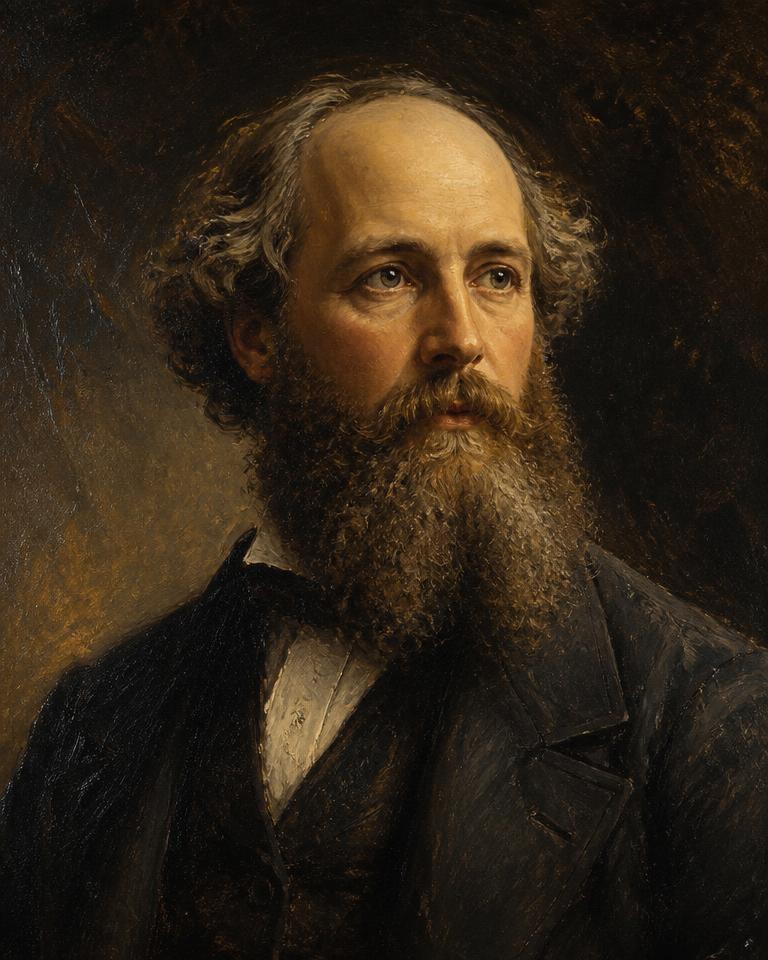
Quick Facts
- Years
- 1831 – 1879
- Category
- Scientists & Inventors
- Subcategory
- Electromagnetism
- Nationality
- Scottish
- Occupation
- Physicist & Mathematician
James Clerk Maxwell
1831 – 1879 · Scottish · Physicist & Mathematician
Audiobook

Life Lessons from James Clerk Maxwell
Marcus Alden · 42 min
James Clerk Maxwell (1831–1879) was a Scottish physicist and mathematician whose work transformed the study of electricity, magnetism, light, heat, gases, and color. His greatest achievement was the mathematical theory of electromagnetism. The equations now bearing his name showed that electric and magnetic fields are interconnected and predicted electromagnetic waves traveling at the measured speed of light. Maxwell therefore concluded that light itself is an electromagnetic phenomenon—a unification often compared in scientific importance with Isaac Newton’s synthesis of terrestrial and celestial mechanics.
Maxwell also helped establish statistical physics. His analysis of gas molecules produced the Maxwell distribution of molecular speeds and prepared the way for Ludwig Boltzmann’s broader kinetic theory. In optics, he investigated color perception and directed the demonstration commonly described as the first durable color photograph. As the first Cavendish Professor of Experimental Physics at Cambridge, he designed the Cavendish Laboratory and established standards of precise physical measurement.
Albert Einstein, Max Planck, and other architects of modern physics regarded Maxwell’s field theory as foundational. Radio, radar, telecommunications, electrical engineering, and relativity all developed within the scientific world his equations helped create. Maxwell remains studied not merely for individual discoveries but for demonstrating how mathematical reasoning, experimental evidence, and physical imagination can reveal unity beneath apparently separate natural forces.
Quick Facts
| Field | Details |
|---|---|
| Full Name | James Clerk Maxwell |
| Common Name(s) | James Clerk Maxwell; James Maxwell |
| Born | 13 June 1831 |
| Died | 5 November 1879 |
| Age at Death | 48 |
| Birthplace | 14 India Street, Edinburgh, Scotland |
| Nationality | Scottish; British |
| Occupation | Physicist, mathematician, professor |
| Historical Era | Victorian era; nineteenth-century classical physics |
| Famous For | Maxwell’s equations, electromagnetic theory of light, kinetic theory of gases, color research, Saturn’s rings |
| Political Affiliation if applicable | No formal party affiliation recorded |
| Religion if significant | Devout Christian; raised in the Church of Scotland and later associated with the Church of England |
| Education | Edinburgh Academy; University of Edinburgh; Peterhouse and Trinity College, Cambridge |
| Parents | John Clerk Maxwell and Frances Cay Maxwell |
| Spouse(s) | Katherine Mary Dewar, married 1858 |
| Children | None |
| Major Works | On Faraday’s Lines of Force; On Physical Lines of Force; A Dynamical Theory of the Electromagnetic Field; Theory of Heat; A Treatise on Electricity and Magnetism; Matter and Motion |
| Major Achievements | Unified electricity, magnetism, and optics; predicted electromagnetic waves; developed a molecular-speed distribution; explained the stability of Saturn’s rings; advanced quantitative color science; founded the Cavendish Laboratory’s research program |
Early Life
Maxwell was born in Edinburgh to John Clerk Maxwell, an advocate and landowner, and Frances Cay Maxwell. He was their only surviving child. The family belonged to the Scottish landed professional class and maintained an estate at Glenlair in Kirkcudbrightshire. His father had adopted the additional surname Maxwell after inheriting that property.
Much of Maxwell’s childhood unfolded at Glenlair. From an early age he displayed intense curiosity about mechanisms, shapes, light, and the reasons objects behaved as they did. His often-repeated question—essentially asking how something worked—was remembered by relatives as characteristic rather than merely anecdotal. His mother supervised his early education but died of abdominal cancer in 1839, when he was eight. The loss deeply affected the household; his father thereafter played a central role in his upbringing.
After an unsuccessful period with a private tutor, Maxwell entered Edinburgh Academy in 1841. His country clothing, accent, and social reserve initially made him a target of teasing. He nevertheless formed enduring friendships with Lewis Campbell, later his biographer, and Peter Guthrie Tait, later a major mathematical physicist.
Maxwell’s unusual geometrical ability appeared early. At fourteen he wrote on curves generated using pins and thread. The Royal Society of Edinburgh received his paper, “On the Description of Oval Curves,” in 1846; because of his youth, Professor James Forbes presented it for him.
He entered the University of Edinburgh in 1847. There he studied natural philosophy under Forbes, mathematics under Philip Kelland, and logic and metaphysics under Sir William Hamilton. He also experimented independently at Glenlair, converting improvised spaces into a laboratory and investigating polarized light, elasticity, and color.
In 1850 Maxwell moved to Cambridge, first joining Peterhouse and then transferring to Trinity College. William Hopkins, a renowned private mathematical tutor, coached him for the demanding Mathematical Tripos. Maxwell graduated in 1854 as Second Wrangler, behind Edward Routh, but shared the Smith’s Prize with him. Cambridge sharpened Maxwell’s command of mathematical physics while bringing him into a culture that valued both abstract analysis and experimental verification.
Rise to Prominence
After graduating, Maxwell became a fellow of Trinity College and began publishing important research. His 1855–1856 paper “On Faraday’s Lines of Force” translated Michael Faraday’s qualitative conception of fields into mathematical form. Rather than treating electrical effects solely as forces acting instantaneously across empty space, Maxwell investigated stresses and motions distributed through the surrounding field.
In 1856 he accepted the chair of natural philosophy at Marischal College, Aberdeen. He was only twenty-five. Aberdeen gave him teaching duties, laboratory responsibilities, and the independence to pursue difficult problems.
His first major public triumph concerned Saturn’s rings. The University of Cambridge’s Adams Prize competition asked for an analysis of their stability. Maxwell demonstrated that a solid ring would be unstable and that a fluid ring was also inadequate; the observed system had to consist of numerous separate particles. His essay won the 1857 Adams Prize and was published in 1859. Later astronomical observation broadly confirmed the particulate model.
Maxwell married Katherine Mary Dewar, daughter of Marischal College’s principal, in 1858. When Marischal and King’s colleges were merged to form the University of Aberdeen in 1860, his chair was abolished. He unsuccessfully sought a post at Edinburgh, but soon became professor of natural philosophy at King’s College London.
The London years, 1860–1865, were exceptionally productive. Maxwell worked near Faraday, conducted color experiments, developed kinetic theory, and completed his mature electromagnetic field paper. Election to the Royal Society in 1861 and the award of its Rumford Medal in 1860 confirmed his standing. By the mid-1860s he had become one of Britain’s foremost theoretical physicists.
Major Achievements
Explaining Saturn’s Rings
Maxwell’s Adams Prize essay analyzed whether Saturn’s rings could remain stable if they were solid, fluid, or particulate. Through mathematical arguments, he showed that neither a single rigid ring nor a continuous fluid ring satisfactorily matched stable motion. A swarm of independently orbiting particles was the viable explanation.
This mattered because telescopes could not then resolve the individual ring particles. Maxwell used dynamics to infer an unseen physical structure from observed behavior. Spacecraft observations later revealed rings composed largely of countless pieces of ice and rock, making his analysis a celebrated example of mathematical prediction in astronomy.
Establishing the Maxwell Distribution
In 1860 Maxwell proposed a statistical distribution for the speeds of molecules in a gas. Instead of trying to track every molecule, he calculated how molecular velocities should be distributed among many particles in thermal equilibrium.
The approach was revolutionary because it connected probability with physical law. Ludwig Boltzmann extended the theory, producing what is now called the Maxwell–Boltzmann distribution. This work helped found statistical mechanics and clarified how pressure, temperature, viscosity, diffusion, and heat conduction emerge from molecular motion.
Unifying Electricity and Magnetism
Across papers published from 1855 to 1865, Maxwell converted the experimental findings of Faraday, André-Marie Ampère, and others into a unified field theory. A decisive innovation was the displacement current term, which made his account of changing electric fields consistent and connected electric and magnetic processes.
Maxwell calculated that disturbances in the electromagnetic field should propagate at a finite speed close to the known speed of light. In “A Dynamical Theory of the Electromagnetic Field,” presented in 1864 and published in 1865, he concluded that light consists of transverse electromagnetic undulations.
The long-term impact is immense. Heinrich Hertz experimentally produced and detected radio waves in the late 1880s. Maxwell’s framework became the basis of classical electrodynamics and electrical engineering, while its incompatibility with traditional Newtonian ideas of space and motion helped stimulate Einstein’s special theory of relativity.
Advancing Color Science and Color Photography
Building on Thomas Young’s theory of three-color vision and Hermann von Helmholtz’s research, Maxwell studied how combinations of red, green, and blue light produce perceived colors. He devised a color top and a color box to quantify color mixtures, distinguishing additive mixtures of light from the behavior of pigments.
At a Royal Institution lecture in 1861, photographer Thomas Sutton projected three images of a tartan ribbon made through red, green, and blue filters. Their superposition generated a color image. The experiment is often called the first color photograph, although the photographic plates were unexpectedly sensitive to ultraviolet and some blue light, so the demonstration did not work exactly according to the intended spectral mechanism.
Maxwell’s quantitative approach helped lay foundations for colorimetry, color display technology, digital imaging, and three-channel photographic reproduction.
Building the Cavendish Laboratory
In 1871 Maxwell became the first Cavendish Professor of Experimental Physics at Cambridge. He supervised the planning and equipment of the Cavendish Laboratory, funded by William Cavendish, seventh Duke of Devonshire. The laboratory opened in 1874.
Maxwell emphasized precise measurement, instrument calibration, careful recordkeeping, and the productive union of theory with experiment. Under later directors, the Cavendish became one of the world’s most important research institutions, associated with discoveries including the electron, atomic nucleus, neutron, and DNA’s double-helical structure.
Editing Henry Cavendish’s Electrical Research
Maxwell spent years reconstructing and editing the unpublished electrical experiments of Henry Cavendish. Published in 1879, the resulting volume showed that Cavendish had anticipated several later electrical measurements and concepts.
The project was both historical and experimental: Maxwell and colleagues repeated measurements to understand Cavendish’s methods. It preserved valuable science while demonstrating Maxwell’s respect for evidence, accurate attribution, and the cumulative nature of discovery.
Leadership and Work
Maxwell led chiefly through intellectual example rather than administrative force. Students and colleagues remembered his humor, patience, originality, and willingness to discuss problems informally. He avoided presenting science as a collection of settled facts; he wanted students to understand how measurements were made and where assumptions entered an argument.
His working method combined several modes of thought:
- physical analogies and mechanical models;
- rigorous mathematical development;
- direct experiment and instrument design;
- dimensional and numerical checking;
- critical reading of earlier investigators.
Maxwell’s analogies—such as imagined vortices or mechanical stresses in a medium—were reasoning tools, not necessarily claims that nature literally contained those mechanisms. He was prepared to abandon a model once its mathematical relations had revealed a deeper structure.
At the Cavendish Laboratory, he helped choose apparatus, organize practical instruction, and establish measurement standards. His approach encouraged collaboration without erasing individual responsibility. He treated technicians and experimental skill with respect unusual in institutions that sometimes privileged pure mathematics.
His strengths included synthesis, geometric imagination, mathematical versatility, and the ability to move between theory and experiment. His limitations were partly communicative. The Treatise on Electricity and Magnetism was dense, used a large and evolving notation, and did not present the compact four-equation vector form familiar today. Many contemporaries found his theory difficult. Later physicists—including Oliver Heaviside, Heinrich Hertz, and Josiah Willard Gibbs—recast parts of it in clearer modern notation.
Personal Life
Maxwell married Katherine Mary Dewar in Aberdeen on 2 June 1858. No children were born to the marriage. Katherine assisted with experiments, particularly work related to gas viscosity, and Maxwell cared for her during periods of illness. Surviving correspondence indicates an affectionate partnership, although the documentary record about Katherine’s independent life is limited.
Maxwell maintained close relationships with his father, his aunt Jane Cay, Lewis Campbell, Peter Guthrie Tait, William Thomson, and other scientific contemporaries. His letters often mixed technical discussion, playful verse, puns, and family concerns. He enjoyed poetry and composed comic scientific poems, including “Rigid Body Sings,” written in imitation of Robert Burns.
At Glenlair he took part in estate management, riding, walking, reading, and practical construction. He had a strong interest in mechanical devices and sometimes built apparatus himself. Accounts portray him as unpretentious and absent-minded in some everyday matters, but these recollections should not be exaggerated into the stereotype of a socially incapable genius.
His health deteriorated seriously in 1879. He was diagnosed with abdominal cancer, probably the same broad type of illness that had killed his mother at nearly the same age. He returned to Cambridge for his final weeks and died there on 5 November 1879. He was buried near his parents at Parton in Kirkcudbrightshire.
Philosophy and Beliefs
Maxwell was a committed Christian throughout adulthood. His religious thought drew on the Church of Scotland, Cambridge Anglican life, biblical study, and wider Christian theology. He did not regard scientific explanation as a substitute for theology, nor did he use scripture as a shortcut around physical investigation.
He distinguished the changing models of science from permanent religious truth. Because scientific theories develop, he warned against tying theological claims too tightly to any particular mechanism of nature. This caution shaped his preference for intellectual humility.
His scientific philosophy emphasized lawful relations, measurement, and the limits of models. Mechanical analogies could help the mind, but they should not be confused with reality itself. He valued the intelligibility and order of nature while recognizing that human representations remained partial.
Maxwell left no substantial record of party-political activism. He lived within Victorian Britain’s social hierarchy and managed a landed estate, but describing him through a modern partisan label would be misleading. Ethically, his letters and actions suggest strong commitments to duty, honesty, service, family loyalty, and charitable treatment of others.
Challenges and Controversies
Maxwell’s electromagnetic theory was not immediately accepted or understood. Its mathematical complexity, unfamiliar field concepts, and dependence on mechanical imagery made it difficult for many physicists. Some continental researchers preferred action-at-a-distance theories. Later experimental confirmation by Hertz strengthened the field interpretation.
The exact historical meaning of “Maxwell’s equations” also requires care. Maxwell did not print the four compact vector equations taught today. His mature theory appeared as a larger system expressed through components, potentials, and quaternions or related notation. Heaviside and Gibbs helped formulate the modern vector presentation. Crediting Maxwell remains justified because the essential electromagnetic synthesis and displacement-current concept were his, but the textbook form reflects later development.
The 1861 color demonstration is sometimes overstated as a fully successful modern color photograph. Sutton made the exposures and Maxwell designed the three-color method. Because available photographic emulsions had little red sensitivity, the tartan image resulted partly from unintended ultraviolet reflectance. It was nonetheless a landmark demonstration of three-channel color reproduction.
Maxwell’s kinetic theory initially faced criticism because atoms and molecules were not universally accepted as physically real. His statistical treatment also challenged expectations that fundamental mechanics should predict individual motions exactly. Subsequent work in thermodynamics and statistical mechanics vindicated the broad approach, though Maxwell himself identified puzzles—most famously “Maxwell’s demon”—that exposed deep questions about entropy and information.
Institutionally, Maxwell experienced setbacks. He lost his Aberdeen chair through university reorganization and failed to secure the Edinburgh professorship. His lectures were reportedly difficult for some students, and attendance could be small. These reverses reveal that lasting intellectual importance does not always produce immediate professional success.
Legacy
Maxwell’s central legacy is the electromagnetic field. His equations describe how electric charges and currents generate fields and how changing electric and magnetic fields propagate. They underlie electric motors, generators, antennas, radio, television, radar, microwave systems, wireless networks, optical technologies, and much of modern electrical engineering.
His prediction of electromagnetic waves connected nineteenth-century physics to the communications revolution. Einstein later acknowledged that special relativity owed its origins to problems raised by Maxwellian electrodynamics. Quantum electrodynamics changed the theoretical framework at microscopic scales, but Maxwell’s equations remain the classical limit and an indispensable engineering tool.
In statistical mechanics, the Maxwell–Boltzmann distribution continues to describe dilute classical gases. “Maxwell’s demon,” introduced in a letter to Tait, remains influential in discussions of entropy, computation, and information theory.
Institutions and memorials preserve his name. The James Clerk Maxwell Telescope operates on Mauna Kea in Hawaii. The Institute of Physics awards the James Clerk Maxwell Medal and Prize. A statue of Maxwell stands on George Street in Edinburgh, and memorials exist at Westminster Abbey, Cambridge, Glenlair, and Parton. His Edinburgh birthplace is maintained by the James Clerk Maxwell Foundation. The Cavendish Laboratory continues as a major center of physics.
Maxwell is often ranked with Newton and Einstein because he unified domains previously treated as separate. More importantly, his work changed what physicists understood an explanation to be: fields could possess dynamics, probability could yield macroscopic law, and mathematically predicted entities could later become experimentally observable.
Interesting Facts
- Maxwell published his first scientific paper at age fourteen.
- He was nicknamed “Dafty” by some schoolmates at Edinburgh Academy.
- He graduated as Cambridge’s Second Wrangler in 1854.
- He shared the Smith’s Prize with the Senior Wrangler, Edward Routh.
- His analysis predicted that Saturn’s rings consist of separate particles.
- He was elected a Fellow of the Royal Society in 1861.
- He received the Royal Society’s Rumford Medal for color research.
- Thomas Sutton, not Maxwell, operated the camera for the 1861 color demonstration.
- Maxwell’s three-primary principle underlies RGB displays.
- He introduced a statistical law for molecular velocities.
- He coined the term “displacement current” for a crucial electromagnetic concept.
- He inferred that light is an electromagnetic wave.
- He created the thought experiment later called “Maxwell’s demon.”
- He wrote humorous poetry about scientific subjects.
- Maxwell and Katherine had no children.
- He became the first Cavendish Professor at Cambridge.
- He personally helped plan the Cavendish Laboratory.
- He edited Henry Cavendish’s electrical papers shortly before his death.
- He died at the same age—forty-eight—at which his mother had died.
- The maxwell, a former cgs unit of magnetic flux, was named in his honor.
Famous Quotes
-
“We have strong reason to conclude that light itself … is an electromagnetic disturbance in the form of waves propagated through the electromagnetic field according to electromagnetic laws.” — From “A Dynamical Theory of the Electromagnetic Field” (1865). It expresses Maxwell’s unification of optics and electromagnetism.
-
“The special theory of relativity owes its origins to Maxwell’s equations of the electromagnetic field.” — Not Maxwell, but Albert Einstein, in an essay on Maxwell’s influence. It documents Maxwell’s importance to twentieth-century physics.
-
“Thoroughly conscious ignorance is the prelude to every real advance in science.” — From Maxwell’s 1870 address to the Mathematical and Physical Section of the British Association. It advocates recognizing uncertainty rather than concealing it.
-
“The true logic of this world is in the calculus of probabilities.” — From a letter to Lewis Campbell (1850). The remark anticipates Maxwell’s later statistical approach to gases.
-
“The only laws of matter are those which our minds must fabricate, and the only laws of mind are fabricated for it by matter.” — From Maxwell’s Cambridge-era reflections. The deliberately paradoxical phrasing concerns the relation between mental models and physical law.
-
“I have also a great respect for the elder of those celebrated acrobats, Virial and Ergal.” — From “A Paradoxical Philosophy” (1878), humorously personifying technical terms associated with energy and mechanics.
-
“Aye, I suppose I could stay up that late.” — Commonly attributed to Maxwell after being told that compulsory chapel was at 6 a.m. The anecdote appears in biographical tradition, but its exact wording is not securely documented; treat it as disputed.
-
“What is done by what is called myself is, I feel, done by something greater than myself in me.” — From a letter written during his final illness. It reflects his religious humility and sense of vocation.
-
“The dimmed outlines of phenomenal things all merge into one another unless we put on the focusing-glass of theory.” — From an 1871 introductory lecture at Cambridge. Maxwell argued that theory enables observers to organize experience.
-
“The mind of man has perplexed itself with many hard questions. Is space infinite, and in what sense?” — From Matter and Motion (1877). It introduces the conceptual problems beneath elementary mechanics.
Timeline
- 1831 — Born in Edinburgh on 13 June.
- 1839 — His mother, Frances, dies.
- 1841 — Enters Edinburgh Academy.
- 1846 — His first paper, on oval curves, is presented to the Royal Society of Edinburgh.
- 1847 — Begins studies at the University of Edinburgh.
- 1850 — Moves to Cambridge, entering Peterhouse and then Trinity College.
- 1854 — Graduates as Second Wrangler and shares the Smith’s Prize.
- 1855 — Becomes a fellow of Trinity; presents early work on Faraday’s lines of force.
- 1856 — Appointed professor of natural philosophy at Marischal College, Aberdeen; his father dies.
- 1857 — Wins the Adams Prize for his study of Saturn’s rings.
- 1858 — Marries Katherine Mary Dewar.
- 1859 — Publishes the completed essay on Saturn’s rings.
- 1860 — Marischal chair is abolished; joins King’s College London; publishes kinetic theory work; receives the Rumford Medal.
- 1861 — Elected Fellow of the Royal Society; directs the three-color photographic demonstration.
- 1864 — Presents “A Dynamical Theory of the Electromagnetic Field.”
- 1865 — The paper is published; Maxwell leaves King’s College and returns to Glenlair.
- 1867 — Introduces the “demon” thought experiment in correspondence with Tait.
- 1871 — Becomes the first Cavendish Professor; publishes Theory of Heat.
- 1873 — Publishes A Treatise on Electricity and Magnetism.
- 1874 — The Cavendish Laboratory opens.
- 1877 — Publishes Matter and Motion.
- 1879 — Publishes his edition of Henry Cavendish’s electrical research; dies in Cambridge on 5 November.
Frequently Asked Questions
Who was James Clerk Maxwell?
James Clerk Maxwell was a nineteenth-century Scottish physicist and mathematician. He made fundamental contributions to electromagnetism, optics, thermodynamics, astronomy, and statistical mechanics. His electromagnetic theory showed that electricity, magnetism, and light are aspects of one physical system. He also developed a probability distribution for molecular speeds, explained the particulate structure of Saturn’s rings, and advanced three-color imaging. From 1871 until his death, he served as Cambridge’s first Cavendish Professor of Experimental Physics.
What is James Clerk Maxwell most famous for?
Maxwell is most famous for the theory summarized by Maxwell’s equations. These relations describe how electric and magnetic fields arise from charges and currents and how changing fields influence one another. Maxwell found that electromagnetic disturbances should travel at the speed of light and concluded that light is an electromagnetic wave. The theory became the foundation of classical electrodynamics and eventually enabled technologies ranging from radio broadcasting to wireless communication.
What are Maxwell’s equations?
In modern notation, Maxwell’s equations are four coupled equations governing electric and magnetic fields. They express that electric charge is the source of electric flux, that isolated magnetic monopoles have not been observed, that changing magnetic fields produce electric fields, and that electric currents and changing electric fields produce magnetic fields. Maxwell’s own presentation was more extensive than today’s four-vector-equation form. Oliver Heaviside and others later reorganized the theory into the compact notation now taught.
Did Maxwell discover radio waves?
Maxwell predicted electromagnetic waves mathematically, but he did not produce or detect radio waves experimentally. Heinrich Hertz accomplished that in the late 1880s, after Maxwell’s death. Hertz’s experiments generated and detected waves whose reflection, refraction, polarization, and speed agreed with Maxwellian theory. Maxwell therefore deserves credit for predicting the broader electromagnetic spectrum, while Hertz deserves credit for its first decisive laboratory demonstration beyond visible light.
How did Maxwell prove that light is electromagnetic?
Maxwell derived a wave speed from the measured electrical and magnetic constants of his theory. The result was strikingly close to the known speed of light. He inferred that this agreement was not accidental: visible light must be a transverse disturbance of the same electromagnetic field. This was a theoretical inference supported by existing measurements rather than a single experiment performed by Maxwell. Later work, especially Hertz’s experiments, confirmed that electromagnetic waves share optical properties.
What did Maxwell contribute to the kinetic theory of gases?
Maxwell introduced a probability distribution describing molecular velocities in a gas at equilibrium. The distribution explains why molecules do not all move at one speed and relates their collective behavior to temperature. He also studied viscosity, diffusion, and thermal conduction. Boltzmann later generalized the statistical framework. Together, their work established a bridge between microscopic molecular mechanics and macroscopic thermodynamics, creating a foundation of statistical physics.
What is Maxwell’s demon?
Maxwell’s demon is a thought experiment devised to probe the statistical meaning of the second law of thermodynamics. An imagined intelligent being sorts fast and slow gas molecules between two chambers without apparently expending work, creating a temperature difference and reducing entropy. The scenario was not a claim that thermodynamics could easily be violated. It exposed the importance of information, measurement, and fluctuations. Modern analyses connect the demon’s operation to the thermodynamic cost of processing or erasing information.
What did Maxwell discover about Saturn’s rings?
Maxwell demonstrated mathematically that Saturn’s rings could not remain stable as a single rigid solid and were unlikely to behave as one continuous fluid structure. He concluded that they consist of a vast number of small, independently orbiting bodies. Modern observations show that the rings are indeed composed of countless particles, mostly water ice with rocky material and dust. His analysis was a major early success in inferring astronomical structure through dynamics.
Did Maxwell invent color photography?
Maxwell established and demonstrated the principle of reproducing color through three primary channels. In 1861 Thomas Sutton photographed a tartan ribbon through red, green, and blue filters under Maxwell’s direction, then projected the images together. Sutton operated the photographic equipment, so calling Maxwell the sole inventor is inaccurate. Moreover, the red-filter exposure succeeded partly because of ultraviolet sensitivity. Even with these qualifications, the demonstration was a foundational event in color photography and RGB imaging.
Where did Maxwell study?
Maxwell attended Edinburgh Academy before entering the University of Edinburgh in 1847. He moved to Cambridge in 1850, briefly enrolling at Peterhouse and then transferring to Trinity College. At Cambridge he trained intensively in mathematics under William Hopkins. He graduated in 1854 as Second Wrangler and shared the Smith’s Prize with Edward Routh. His education combined Scottish natural philosophy and experimentation with Cambridge mathematical analysis.
Where did Maxwell teach?
Maxwell held three principal academic posts. He was professor of natural philosophy at Marischal College, Aberdeen, from 1856 until institutional merger abolished his chair in 1860. He then taught at King’s College London from 1860 to 1865. In 1871 he returned to Cambridge as the first Cavendish Professor of Experimental Physics, directing the creation and early work of the Cavendish Laboratory until his death.
Was Maxwell religious?
Yes. Maxwell was a serious Christian whose letters, prayers, and reflections show sustained engagement with scripture and theology. His denominational setting changed with his circumstances, but Christian belief remained important throughout his life. He saw scientific inquiry and faith as compatible while warning against identifying religious doctrine with temporary scientific models. Historians differ in emphasis when interpreting his theology, but there is no serious doubt that his faith was personally significant.
Did Maxwell have children?
No. Maxwell and Katherine Mary Dewar married in 1858 and had no children. Katherine participated in aspects of his experimental work and accompanied him through his appointments and years at Glenlair. Much less documentation survives about her perspective than about Maxwell’s, so historical accounts should avoid unsupported claims about either the cause of their childlessness or the exact character of every aspect of their marriage.
How did Maxwell die?
Maxwell died in Cambridge on 5 November 1879 at age forty-eight after suffering from abdominal cancer. Contemporary accounts commonly describe the disease as the same type that had killed his mother at approximately the same age, although nineteenth-century diagnostic terminology was less precise than modern pathology. He endured his final illness with composure, cared for by Katherine and friends. His body was buried at Parton, near the family estate of Glenlair.
How did Maxwell influence Einstein?
Maxwell’s equations imply that light travels at a fixed speed determined by electromagnetic laws. Reconciling this result with Newtonian mechanics and contemporary ideas about motion became a central problem in late nineteenth-century physics. Einstein’s 1905 special theory of relativity resolved the conflict by reformulating space, time, and simultaneity. Einstein repeatedly acknowledged that Maxwell’s electromagnetic theory was a decisive starting point for relativity.
Why are Maxwell’s equations still important?
They remain the governing classical equations for electric and magnetic phenomena. Engineers use them to design circuits, motors, generators, antennas, waveguides, optical devices, radar, and communication systems. Physicists use them to analyze electromagnetic radiation from radio frequencies to visible light and beyond. Quantum theory is required at microscopic scales, but it does not make Maxwell’s equations obsolete; rather, classical electromagnetism emerges as an extraordinarily accurate large-scale limit.
Was Maxwell recognized during his lifetime?
Yes, although not all of his deepest ideas were immediately understood. He won the Adams Prize, received the Rumford Medal, became a Fellow of the Royal Society, held prestigious professorships, and was respected by leading physicists. Yet his electromagnetic theory remained difficult for many readers, and its experimental triumph came after his death through Hertz. His reputation therefore grew substantially in the late nineteenth and twentieth centuries.
Lessons We Can Learn
- Seek unity beneath separate problems. Maxwell connected electricity, magnetism, and light. Today, looking for shared principles can simplify complex systems.
- Use models without worshiping them. His mechanical analogies generated equations, but he treated them as aids rather than final reality. Models should remain revisable.
- Combine theory with measurement. From color experiments to electrical standards, Maxwell checked abstractions against evidence. Modern innovation likewise needs both analysis and testing.
- Let probability explain complexity. His gas theory extracted reliable laws from countless unpredictable particles. Statistical thinking remains essential in science, economics, and public policy.
- Accept professional setbacks. Losing the Aberdeen chair did not halt his research. A disrupted career can still contain productive new directions.
- Study predecessors carefully. Maxwell built on Faraday and reconstructed Cavendish’s experiments. Progress requires both originality and accurate engagement with earlier work.
- Acknowledge collaborators. Sutton made the photographs used in the color demonstration, while Katherine assisted experimentally. Historical achievement is often collective.
- Recognize ignorance openly. Maxwell called conscious ignorance a prelude to advance. Clearly defining what is unknown makes investigation more effective.
- Build institutions, not only ideas. His work on the Cavendish Laboratory created conditions for discoveries by later generations. Durable infrastructure multiplies individual impact.
- Communicate difficult ideas more clearly. Maxwell’s dense notation delayed understanding. Even brilliant work gains influence when its structure and assumptions are accessible.
Related Historical Figures
- Michael Faraday (1791–1867) — His experiments and field-line concepts supplied the physical foundation Maxwell translated into mathematics.
- Isaac Newton (1642–1727) — Maxwell’s electromagnetic synthesis is often compared with Newton’s unification of celestial and terrestrial mechanics.
- William Thomson, Lord Kelvin (1824–1907) — A friend and fellow Scottish physicist who exchanged ideas with Maxwell on thermodynamics and electricity.
- Peter Guthrie Tait (1831–1901) — Maxwell’s school friend and scientific correspondent; Maxwell introduced his demon in correspondence with Tait.
- Ludwig Boltzmann (1844–1906) — Extended Maxwell’s molecular statistics and helped establish statistical mechanics.
- Heinrich Hertz (1857–1894) — Experimentally generated and detected the electromagnetic waves predicted by Maxwell.
- Oliver Heaviside (1850–1925) — Reformulated Maxwell’s theory into a compact vector form and developed its engineering applications.
- Thomas Young (1773–1829) — His trichromatic theory of vision helped inspire Maxwell’s quantitative color research.
- Henry Cavendish (1731–1810) — Maxwell edited and experimentally examined Cavendish’s previously unpublished electrical investigations.
- Albert Einstein (1879–1955) — Built special relativity in response to problems arising from Maxwellian electrodynamics and praised Maxwell’s transformative influence.
Watch and Learn
Great Minds: James Clerk Maxwell, Electromagnetic Hero · SciShow
Related Historical Figures